
You pick up a pair of little ceramic pigs at an estate sale for two dollars. They look like every other novelty set from grandma’s cabinet. Most vintage salt and pepper shakers sell for pocket change today, but certain sets and pairs bring serious cash to collectors.
So, I’ll explain how to spot what you have, what actually drives the value, and which shakers are the most sought-after today.
How to Identify Vintage and Antique Salt and Pepper Shakers?
Before you begin to evaluate your shaker set’s value, you have to figure out what you have. Age, maker, and material all leave clues, and most of them show up on the bottom of the shaker. Here’s what you should check:
Check for the Maker’s & Country Stamps
The bottom of a shaker is basically its birth certificate. You’ll find ink stamps, embossed marks, and foil labels that tell you who made it, where, and often when. So before you even think about value, flip that piece and check the base.
Country-of-origin marks give you a reliable dating window because of U.S. import law. Here’s a quick timeline that actually works in the field:
- “Nippon” – Japanese exports from 1891 to 1921.
- “Japan” or “Made in Japan” – 1921 onward, and again after 1952.
- “Made in Occupied Japan” or “Occupied Japan” – Only used during the American postwar occupation, which ran from late 1945 through April 1952. That narrow window makes marked pieces very datable.
- “Made in USA” – Common on American-made pieces from the late 1930s onward.
- “Western Germany” – Post-1949 through 1990. Marks reading just “Germany” is usually pre-war.
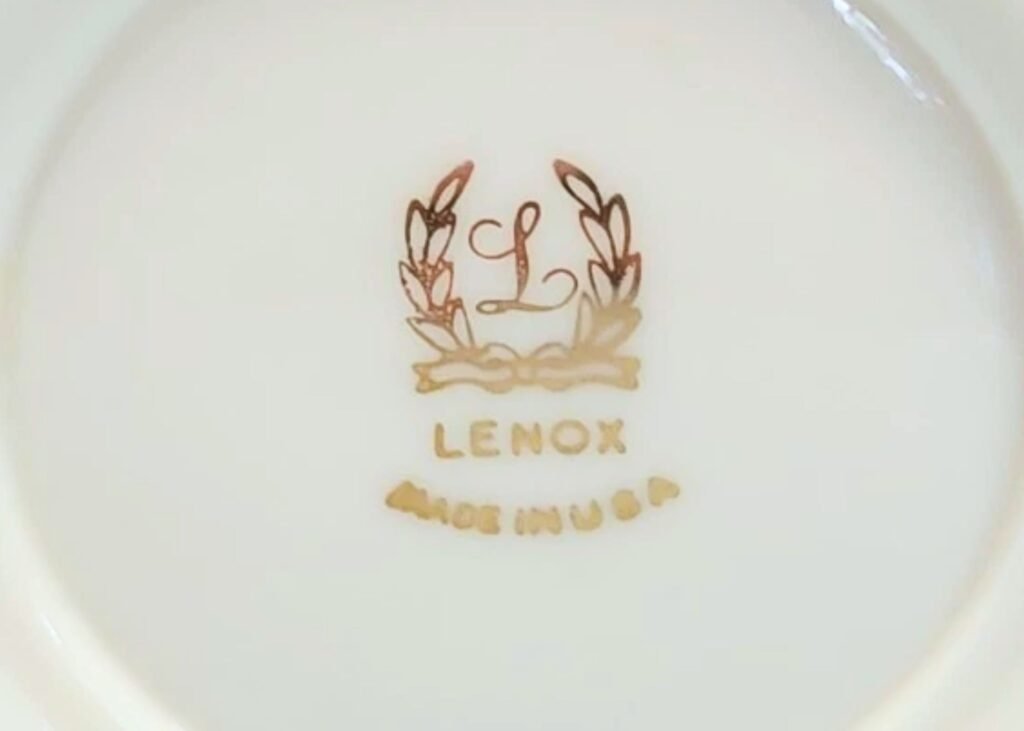
For American makers, look for company names or logos. Shawnee Pottery often reads “USA” with a mold number. Lenox has its wreath-and-palette mark. Fenton pieces often carry a foil sticker instead of an impressed mark, so a missing sticker doesn’t mean it’s fake.
Pro Tip: Foil labels fall off. A shaker with no mark at all can still be a genuine vintage piece. Don’t dismiss unmarked shakers, especially glass, since many Depression-era producers never stamped their smaller items.
Materials Tell You the Era
Different materials point to different decades. You can easily date most shaker pairs within a 10 to 20-year window just by handling them.
- Glass was common from the 1920s to the 1940s. Depression glass shakers came in pink, green, amber, cobalt, and delphite blue. Milk glass shakers, especially the hobnail style from Fenton, were popular from the late 1940s to the 1970s.
- Ceramic and porcelain pairs peaked between the 1930s and 1960s. This is the era of figural novelty shakers, cartoon animals, kitschy characters, and hand-painted pairs. American potters like Shawnee, Ceramic Arts Studio, and Regal China led the ceramic boom.
- Silver and silver plate show up in older pieces, mostly Late Victorian through the 1930s. Victorian and Edwardian pieces tend to have chased floral work, beaded rims, and sometimes little novelty shapes like owls or ducks. Real sterling will have a hallmark, usually “STERLING” or “925” on U.S. pieces.
- Plastic shakers arrived in the 1940s and exploded in the 1950s. Early hard plastic pieces from Pyro Plastics, Federal, and Tupperware are all considered vintage and collectible now.
Dating by Style and Design
Style is often the fastest way to date a shaker at a glance. So even before you check the bottom, the shape and decoration can point you to the right decade.
- 1920s to 1930s – Depression glass in pastel colors, Art Deco stepped forms, lusterware finishes.
- 1930s to 1940s – Range shakers with ribbed or embossed glass bodies, aluminum lids, and kitchen colors like jadeite and delphite. Figural ceramic shakers are starting to become popular here.
- 1940s to 1950s – The golden age of figural and novelty ceramics. Pigs, cats, cartoon characters, huggers, and nodders. Occupied Japan imports flood the U.S. market.
- 1950s to 1960s – Peak kitsch. Holt-Howard, anthropomorphic everything, pastel palettes, and holiday themes. Milk glass hobnail is at its high point.
- 1970s to 1980s – Plastic starts to dominate everyday shakers. Tupperware Hourglass, souvenir sets, and mass-produced figurals.
Real vs. Reproduction: Five Red Flags
Reproductions are pretty common in this category. Depression glass and Pixieware have both been faked heavily, but there are certain clues you can easily tell.
- The glaze feels too smooth – Old ceramics have tiny surface variations from hand-finishing. Modern repros feel uniform and slick.
- The paint sits on top instead of soaking in – On old pieces, hand-painted details wear at the high points. Repros have crisp, factory-perfect paint.
- Weight feels wrong – Original Depression glass is heavier than modern copies. Original figural ceramics have more heft than lightweight import repros.
- The mark looks printed, not stamped – Old ink stamps have slight bleeds and uneven pressure. Modern repros use clean digital-looking prints.
- The colors are too bright – Some of the most-copied Depression glass patterns, like Cherry Blossom, Mayfair, and Cameo, now show up in cobalt or iridescent shades that the original companies never produced. If the color feels off, trust that feeling.
Collectible Antique & Vintage Salt and Pepper Shakers to Spot
From figural ceramics to elegant Depression glass, below are 12 highly collectible old salt and pepper shakers with specific patterns that serious collectors chase.
1. Enesco Anthropomorphic “Banana Hula” Shakers
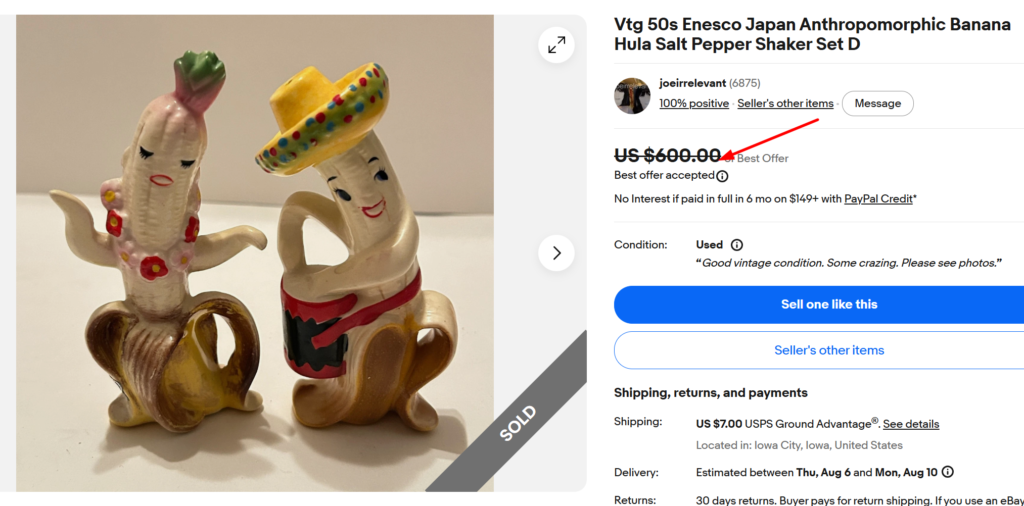
Sold for $600
Enesco anthropomorphic fruits and veggies from this era are hot with mid-century kitsch collectors. The Banana Hula pair is one of the most sought-after anthropomorphic sets from Enesco’s 1950s Japan-made line.
The pair has two cartoon bananas peeled at the base, one dressed as a hula girl with a pink flower lei, the other as her partner in a big polka-dot sombrero and drum.
Crazing is common on these older ceramics, but crisp paint and the original pair together are what collectors want.
- Estimated Value: $200 to $600 per pair
- Production Years: 1950s
- What to Check: Paint condition, crazing severity
2. Chevron “Gasoline Supreme Pump” Shakers
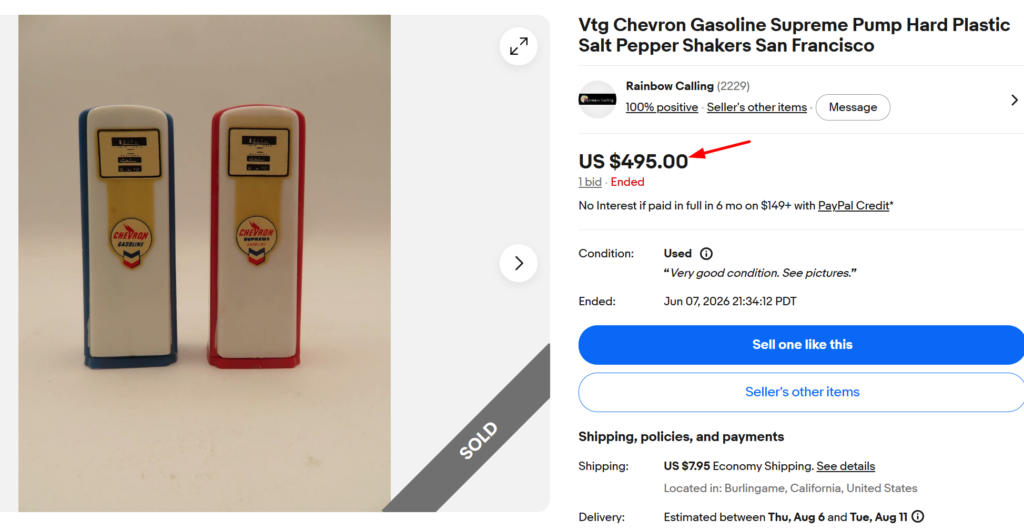
Sold for $495
The Chevron Supreme Pump pair is a classic advertising collectible from mid-century American gas station culture.
Made in hard plastic, the shakers are shaped like miniature gasoline pumps, one red and one blue, each with the classic Chevron Supreme decal and the little price and gallon window up top.
Complete pairs in clean condition are much harder to find than singles.
- Estimated Value: $150 to $500 per pair
- Production Years: 1950s to early 1960s
- What to Check: Decal condition, price window intact
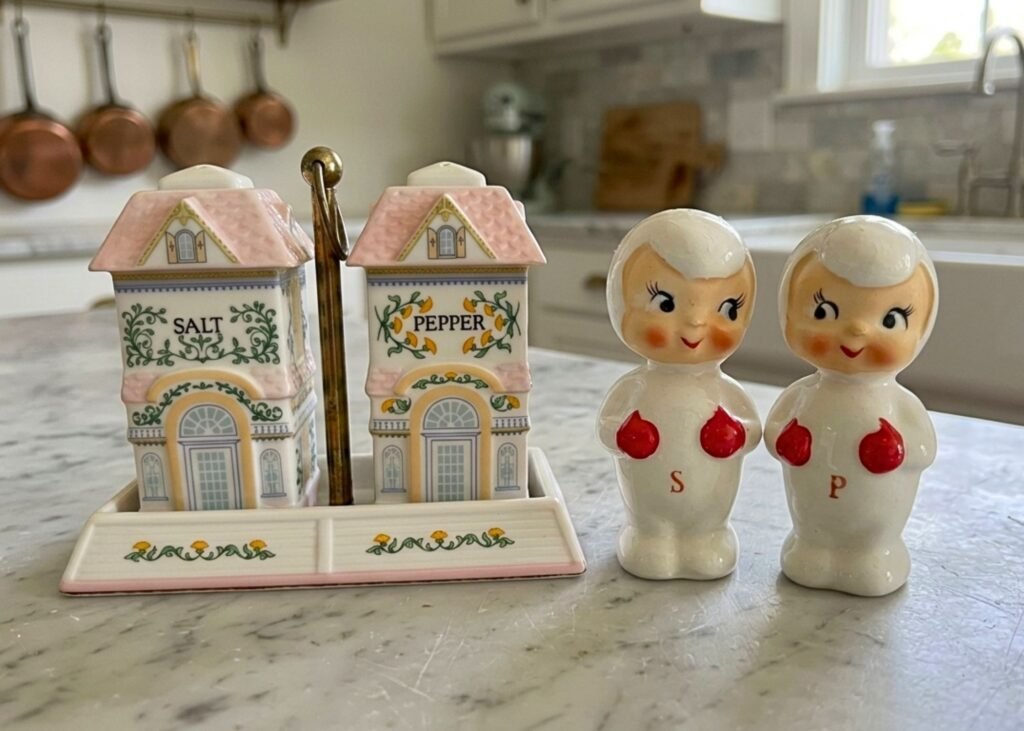
4. Lenox “Spice Village” Salt and Pepper Shakers
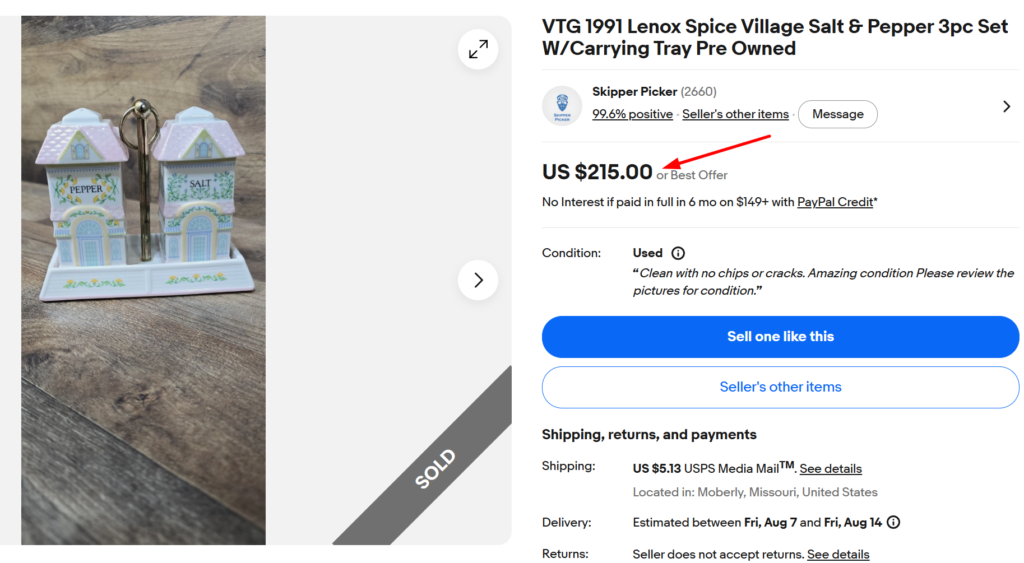
Sold for $215 (packed)
The Spice Village line is one of Lenox’s most collected 1990s releases. The shakers are shaped like little Victorian-style houses in pastel pink and lavender, with a matching gold-handled tray between them.
These shakers were issued in 1991 as part of the broader Spice Village collection, but they weren’t part of the original 24-jar spice set.
Complete sets with the tray and the box are the most valuable pieces.
- Estimated Value: $60 to $180 per set
- Production Years: Issued 1991
- What to Check: Complete tray, Lenox wreath mark
4. Regal China “Van Tellingen Huggers”
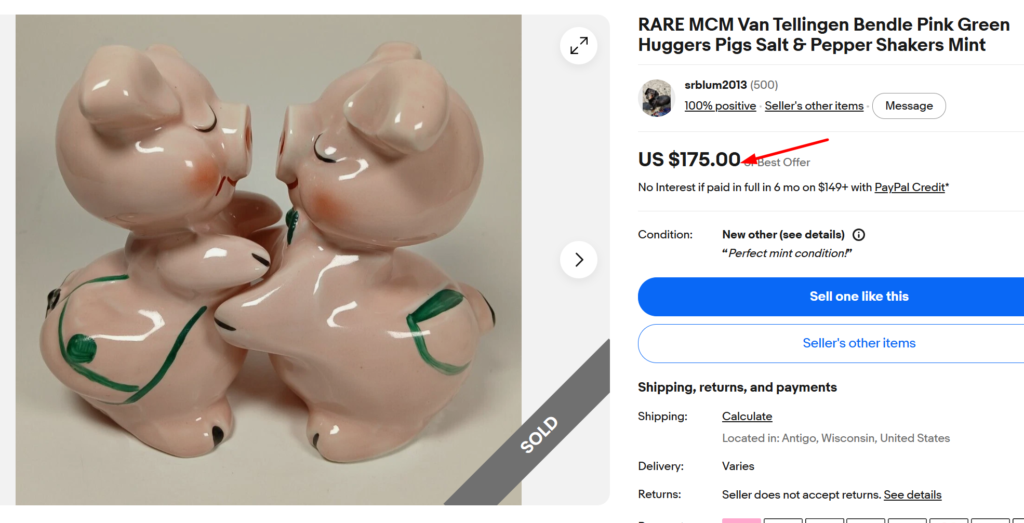
Sold for $175
Van Tellingen Huggers are probably the most recognizable figural shakers ever made. Designed by children’s book illustrator Ruth Van Tellingen Bendel in the late 1940s, they were manufactured by Regal China Company. Each pair fits together in a hug, and you can pick up both shakers with one hand.
Bunnies, bears, hugging pigs, Dutch boy and girl, boy hugging dog, and the rare mermaid and sailor are the main variations. Look for “Van Tellingen” or “Bendel” stamped on the bottom.
- Estimated Value: $40 to $250+ per pair
- Production Years: 1947 to the late 1950s
- What to Check: Bottom stamp, original cork stoppers
- Quick Notes: The Mermaid and sailor set is the rarest.
5. Holt-Howard “Cozy Kittens” Shakers
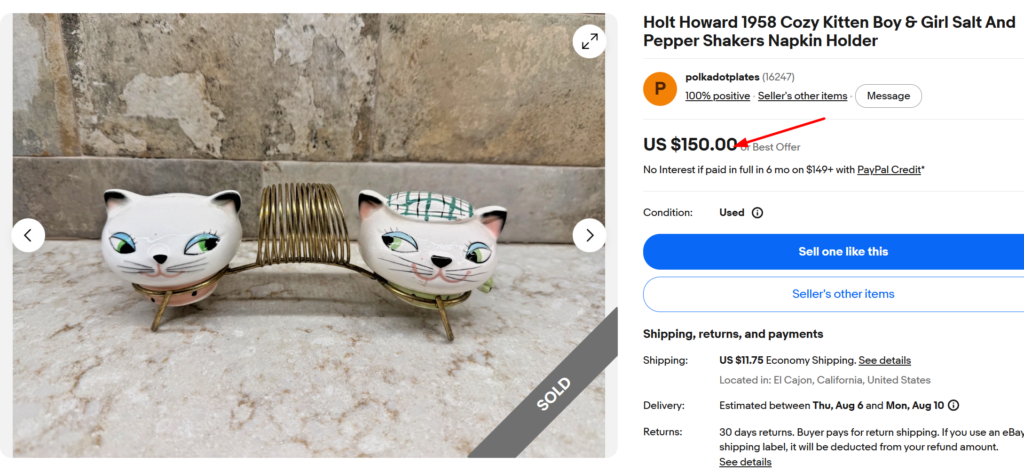
Sold for $150
The Cozy Kittens shakers are one of the most beloved mid-century cat collectibles. Introduced by Holt-Howard in 1958 and made in Japan, they show two white kittens with Siamese-style green eyes, pastel scarves around their necks, and hand-painted flower details around the base.
Some pairs came with built-in squeakers that probably won’t work after so many years, but still add to the collector’s story. Look for the 1958 Holt-Howard copyright stamp on the bottom.
- Estimated Value: $80 to $250 per pair
- Production Years: Starting 1958
- What to Check: 1958 copyright stamp, ear condition
6. Tupperware “Hourglass” Salt and Pepper Shakers
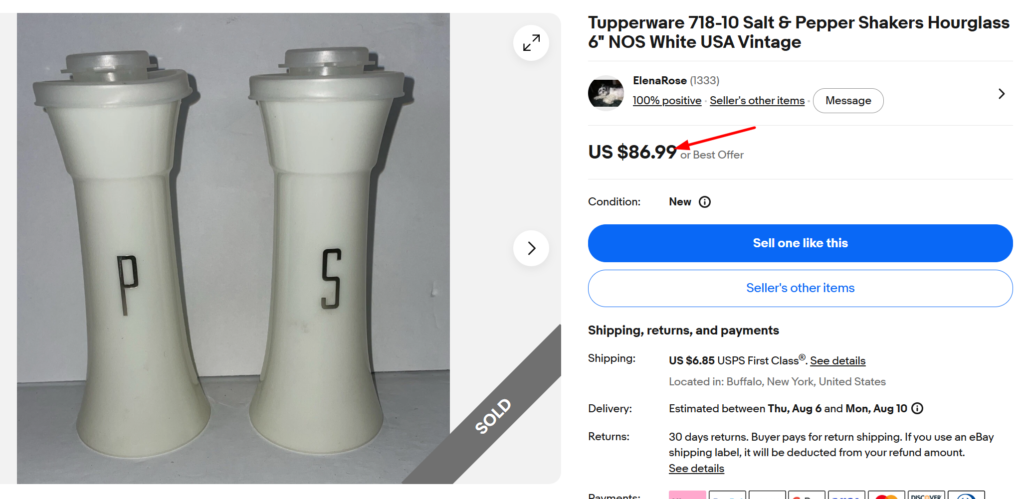
Sold for $85
The Model #718 Hourglass pair is the most collectible Tupperware shaker shape. The pinched-waist design with snap-top lids was popular throughout the 1970s and 1980s in white, sheer blue, sheer green, and a few other colors.
The sheer blue-and-green pair from the late 1980s fetches higher prices than the plain white version. Original lids matter for the value, since they don’t interchange cleanly with other models.
- Estimated Value: $15 to $50 per pair
- Production Years: 1970s to 1980s
- What to Check: Neck cracks, matching lids
7. Cambridge Glass “Rose Point” Shakers
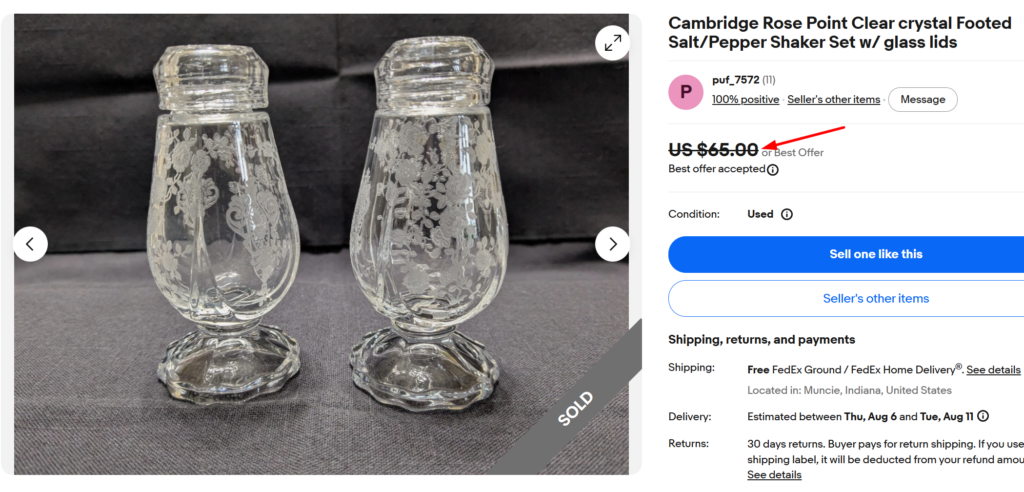
Sold for $65
Rose Point is Cambridge’s most famous etched crystal pattern. The salt and pepper shakers are among the most attractive small pieces in the whole Rose Point line.
The design features the delicate rose and scroll etching, which first showed up in the mid-1930s and stayed in the catalog until Cambridge closed in the early 1950s.
The pattern also appears on the Caprice shape shakers, which some collectors chase specifically. Etching condition and original metal lids in good shape matter the most for value.
- Estimated Value: $70 to $220 per pair
- Production Years: Mid-1930s to early 1950s
- What to Check: Etch crispness, original lids
8. Fenton Cranberry Opalescent “Hobnail” Shakers
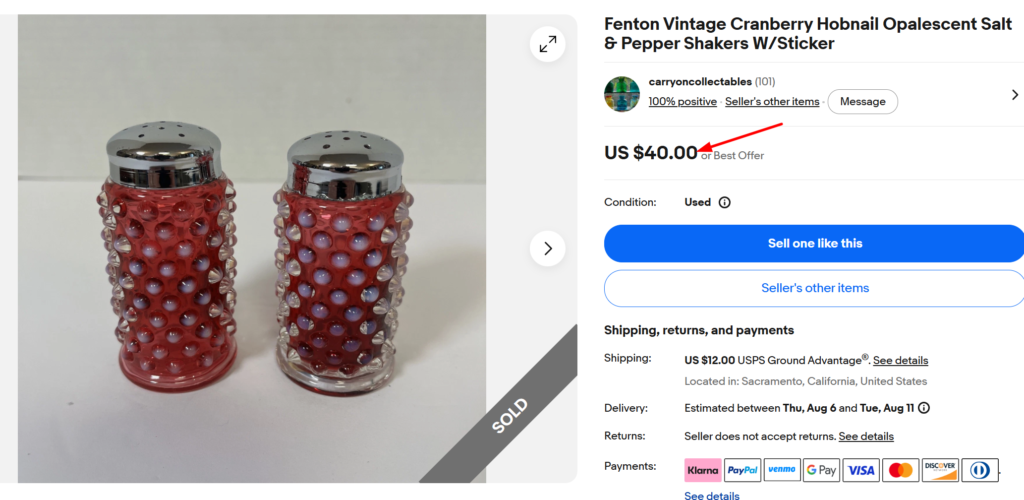
Sold for $40
The Cranberry Opalescent Hobnail pair is one of Fenton’s most collected forms. You can easily spot them by the deep pink-red cranberry glass with the milky white opalescent edges.
These examples are much harder to find than the standard milk glass hobnail version. Original chrome tops are also important, since corrosion hurts the value.
Look for the Fenton foil sticker on the base if it survived.
- Estimated Value: $75 to $250 per pair
- Production Years: Early 1940s onward
- What to Check: Chrome top condition, Fenton foil sticker
- Quick Notes: Cranberry rarer than plain milk glass
9. Gemco “Pyrex Butterfly Gold” Shakers
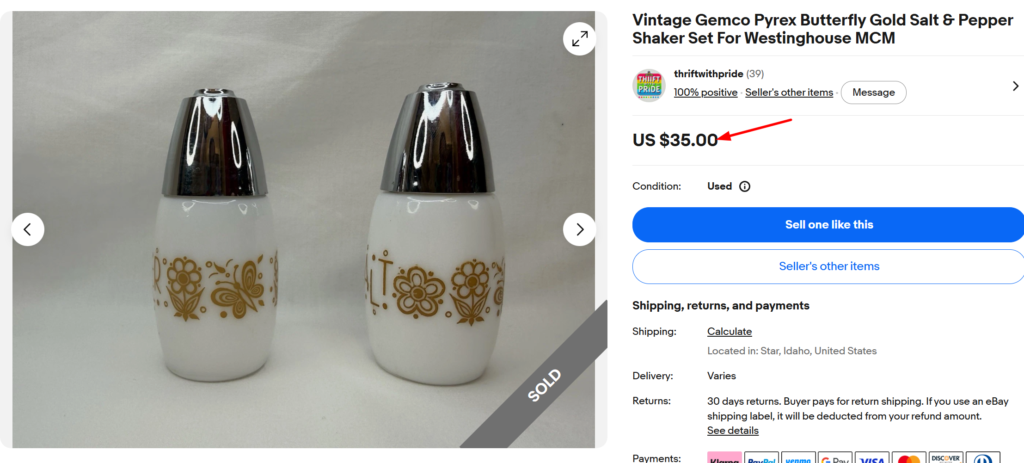
Sold for $35
The Butterfly Gold range shakers were made by Gemco with a design that matches the beloved Pyrex pattern. That signature pattern with butterflies and flowers, in gold on white, is easily recognizable.
Watch the paint carefully. Faded or scratched Butterfly Gold pattern kills the value fast, since the pattern is what people pay for.
- Estimated Value: $40 to $130 per pair
- Production Years: Late 1950s to 1960s
- What to Check: Pattern paint condition, matching lids
10. Shawnee Pottery “Winnie and Smiley Pigs”
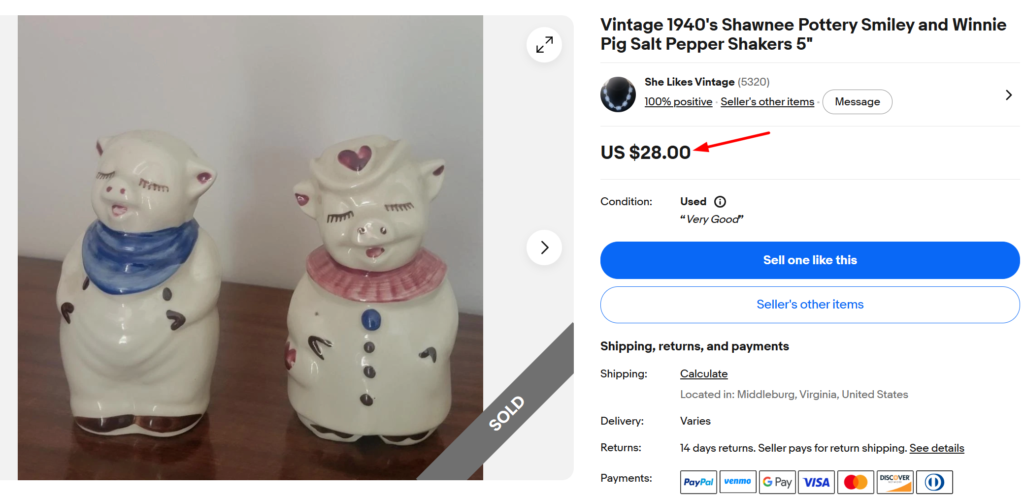
Sold for $30
Winnie and Smiley are the twin pig icons of American figural pottery. Made by Shawnee Pottery in Zanesville, Ohio, starting in the 1940s, they came in plain cold-painted versions, blue and red scarf variations, and rare gold-trimmed decal versions.
The gold-trimmed versions with clover, shamrock, or floral decals are the ones collectors go after.
ID Note: Terrace Ceramics bought molds in 1961, so those pieces may have different stamps.
- Estimated Value: $40 to $300+ per pair
- Production Years: 1940s to 1961
- What to Check: Gold trim, decal patterns
11. Ceramic Arts Studio “Wee Piggy Boy and Girl” Shakers
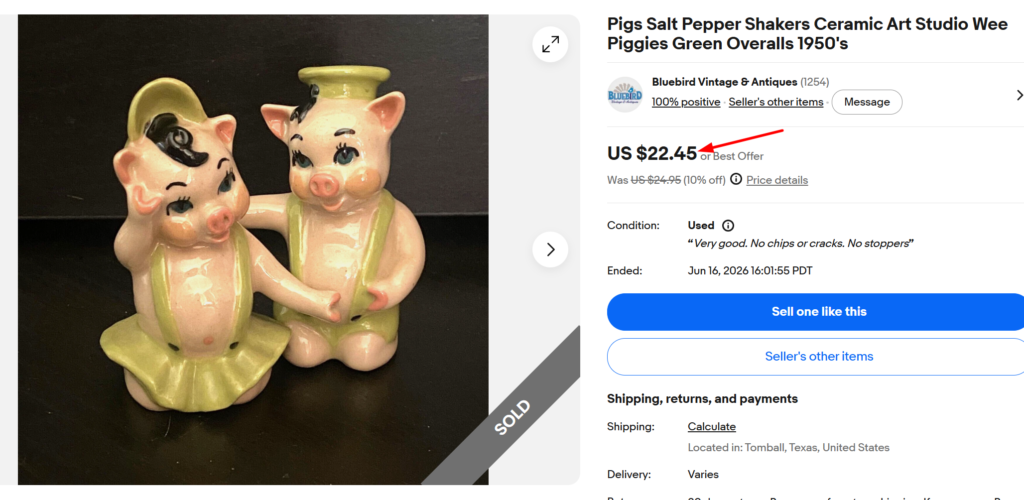
Sold for $22
The Wee Piggies are one of the sweeter Ceramic Arts Studio pairs, showing two little pigs dressed in overalls, one boy and one girl. They came out of the Madison, Wisconsin, studio in the 1940s and 1950s, featuring hand-painted details.
Green overalls are the most commonly seen variation; color variants also pop up and are rarer. Bottom marks read “Ceramic Arts Studio Madison, Wis.”
- Estimated Value: $45 to $150 per pair
- Production Years: 1940s to 1956
- What to Check: Madison Wis., bottom mark
12. Planters “Mr. Peanut” Pyro Plastic Shakers
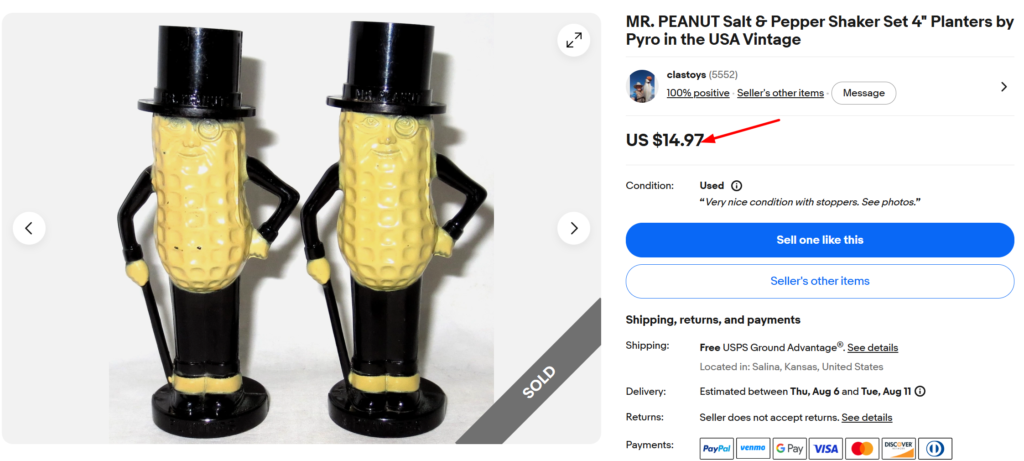
Sold for $15
Mr. Peanut shakers are advertising pieces. Planters ran a mail-in promotion around 1950, offering the shakers for a small fee plus a couple of empty peanut wrappers, which is why so many households ended up with a set.
They were made by Pyro Plastics in tan, red, yellow, pink, and blue variations. The tan/yellow and black version is the most common, but red, blue, and the harder-to-find pink and yellow versions bring stronger prices.
ID Note: Authentic pieces would have the “MR. PEANUT” molded into the hat rim and “PLANTERS” on the base.
- Estimated Value: $15 to $75 per pair
- Production Years: 1940s to 1950s
- What to Check: Color, PLANTERS base stamp
What Makes a Vintage Salt and Pepper Shaker Valuable?
Two nearly identical shakers can sell for wildly different prices. So what separates the $20 pair from the $200 pair? It usually comes down to the following factors working together:
Rarity of the pattern or figure
Condition matters more than age.
A pair with chips, cracks, crazing, or missing stoppers drops in value fast. Original cork stoppers are a big deal for collectors, since most old shakers lost theirs decades ago.
Complete pairs beat singles.
A single shaker is often worth only 20 to 30 percent of a matched pair. Huggers and condiment sets fall apart in value even faster when they’re split up.
Maker prestige
A signed Lenox, Shawnee, or Ceramic Arts Studio piece carries a name-brand premium. Anonymous pieces from the same era usually sell for a fraction of the price of a branded piece.
Original packaging and paperwork
Boxed sets with tags or original stickers sell for two to three times more than loose pairs. The Fenton foil sticker on the bottom is a small thing, but it can double the value.
Gold trim and special decoration
On makers like Shawnee, gold-trimmed and decal-decorated versions are the ones that bring the real money. A plain Smiley pig pair is worth a nice chunk, but the same pig with gold accents and a floral decal can jump into a whole different tier.
Most of the old salt-and-pepper shakers you’ll find at estate sales are worth $10-$20 today. But the pairs with the right name, pattern, and condition can bring hundreds or more. So, check the marks, materials, and patterns to see what you have.