
If you see a few old cookie jars in your mother’s or grandma’s kitchen, there is a good chance one of them is from the ’50s. You may overlook these jars, thinking they’re just old kitchenware, but some could be worth more than you’d expect.
List of High-Value Vintage Cookie Jars from the 1950s
Let’s discover some of the rarest and most valuable 1950s cookie jars below: what makes them special, how to spot them easily, and what they’re actually worth now.
1. Lefton “Bluebird” Jar
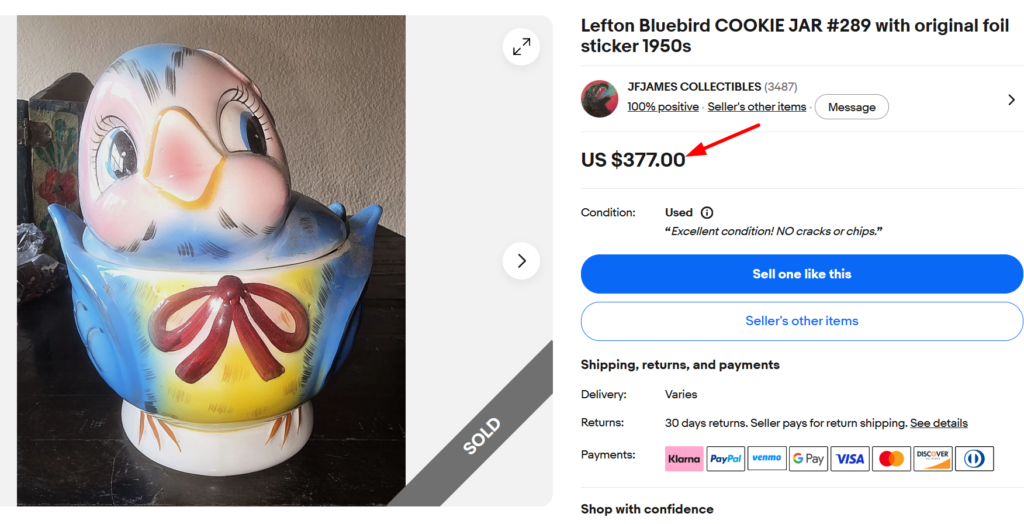
Sold for $377
This cute hand-painted Lefton porcelain bluebird jar came from Japan during the 1950s. It shows a nesting bird with blue wings, a yellow body, pink cheeks, and a red bow on the front; its head and wings form the lid.
Pattern #289 is the standard cookie jar size.
The wing tips are the most common spot for chips, so always check those first. Jars in excellent condition and with intact original Lefton foil stickers are worth the most.
- Estimated Value: $150 to $400
- Production Years: 1950s
- What to Check: Wing tip chips, foil sticker, lid fit
- Quick Notes: Made in Japan, marked “Geo. Z. Lefton”
2. Napco “Miss Cutie Pie”
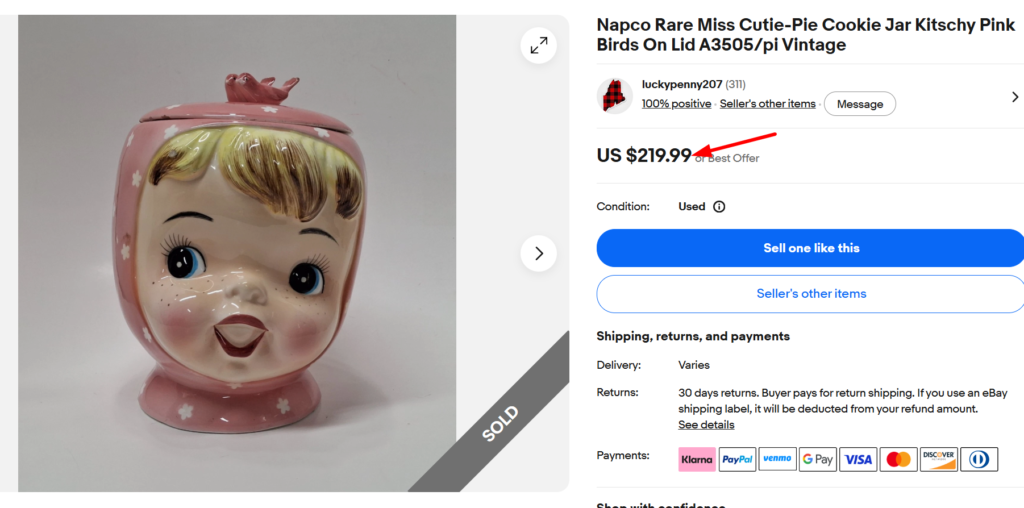
Sold for $220
Napco imported this cookie jar from Japan in the 1950s. The Miss Cutie Pie cookie porcelain jar is shaped like a girl’s head, with a scarf. The pink variant is considered the most popular.
These jars have not survived as well as American stoneware due to being made of porcelain, which is lighter. So, well-preserved pieces are valuable and rare.
- Estimated Value: $100 to $300
- Production Years: 1950s
- What to Check: Napco sticker or stamp, porcelain chips
- Quick Facts: Made in Japan; the pink version is most valuable.
3. Red Wing “King of Tarts” Collector Jar
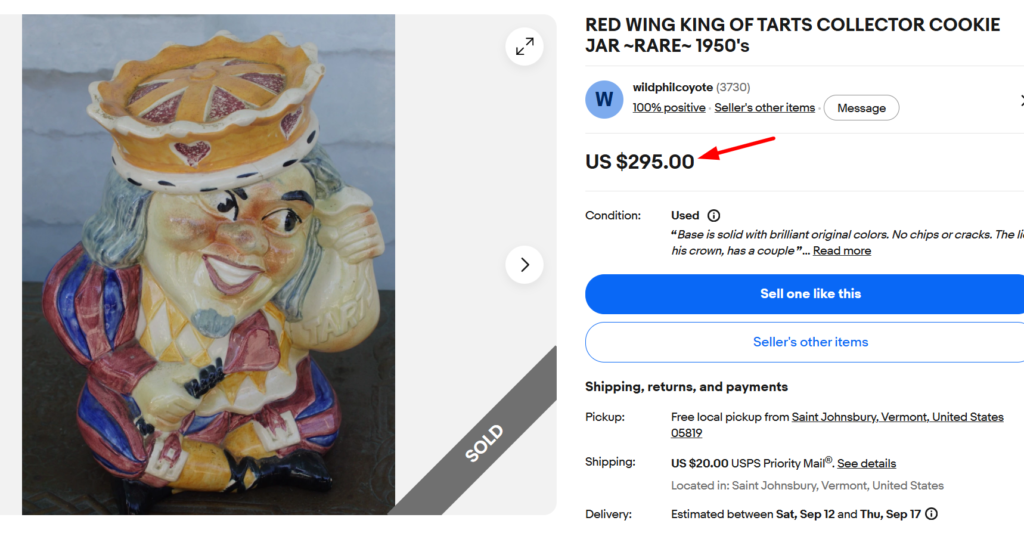
Sold for $295
The figural jar from Red Wing Pottery of Minnesota ran from the late 1940s to the mid-1950s. It is an image of a merry crowned king seated cross-legged, carrying a bag labeled “Tarts,” where the crown acts as a lid.
It’s available in solid colors like pink, blue, yellow, lime green, and sometimes black. The multi-colored example, with painted designs, is the most expensive.
Good to Know: “Fleck” glazed jars were created in the mid-1950s and fetch lower prices than the painted ones, but they appeal to collectors too.
- Estimated Value: $200 to $600+
- Production Years: Late 1940s to mid-1950s
- What to Check: Impressed “Red Wing USA” mark, crown lid
4. American Bisque “Cheerleaders” Corner Jar
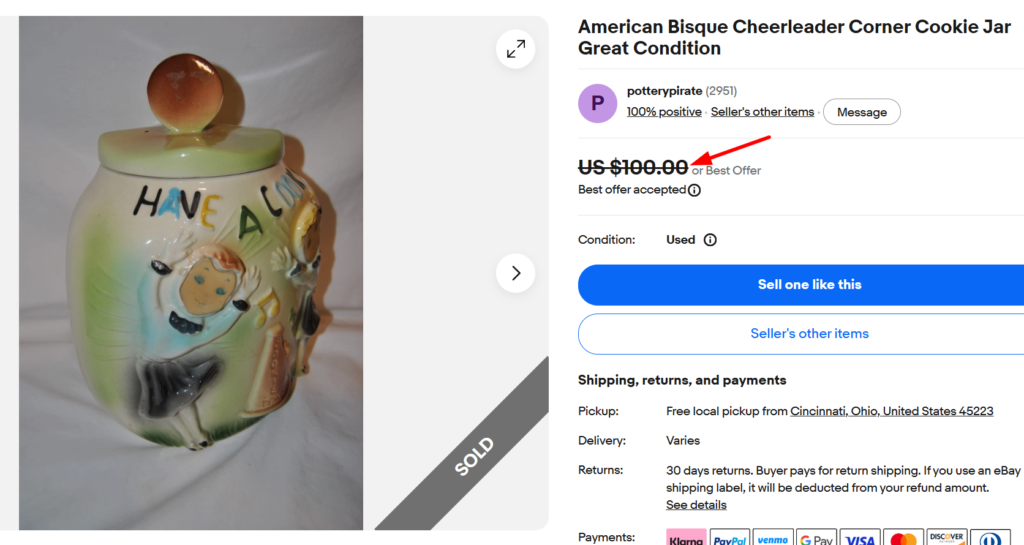
Sold for $100
This three-sided jar from American Bisque sits well in a corner on the kitchen counter. It consists of two cheerleaders holding megaphones, along with a top that also holds a megaphone as a finial.
Its distinguishing characteristic is the use of “flasher” lenticular faces that seem to open and close their eyes with a change in angle.
- Estimated Value: $65 to $250
- Production Years: Mid-1950s
- What to Check: Flasher faces intact, crazing, lid
- ID Notes: Check for “Model 802 USA” on the base.
5. McCoy “Clown in a Barrel”
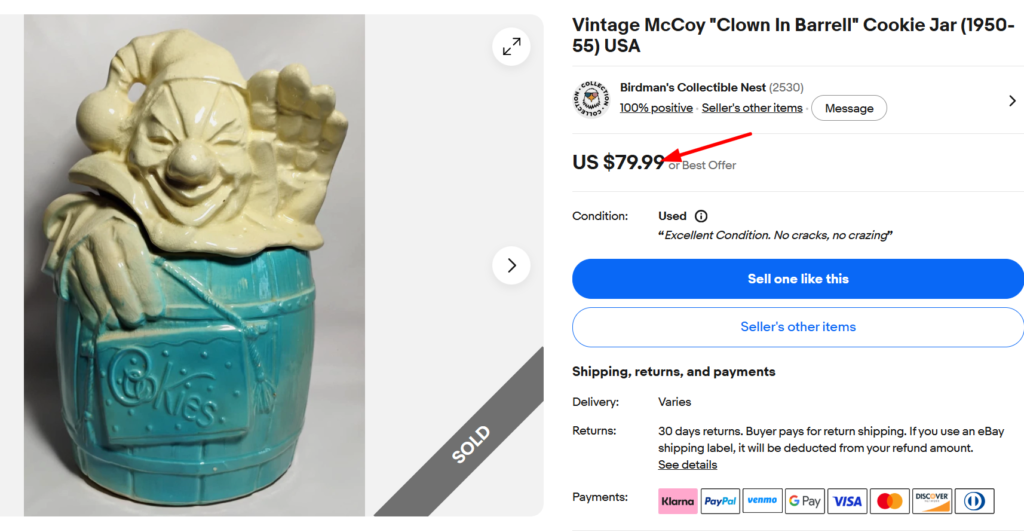
Sold for $80
This is one of the most iconic jars produced by McCoy during the middle of the century. The jar features the image of a clown with a smile emerging from a barrel.
This McCoy jar was available in several colors such as aqua, pink, and white. Because of cold-painting, losing the paint is common, thus decreasing its value very quickly.
- Estimated Value: $50 to $250
- Production Years: 1953 to 1956
- What to Check: Cold-paint condition, barrel color
Value Notes: Pink barrel commands the highest prices.
6. American Bisque “Bear in Overalls”
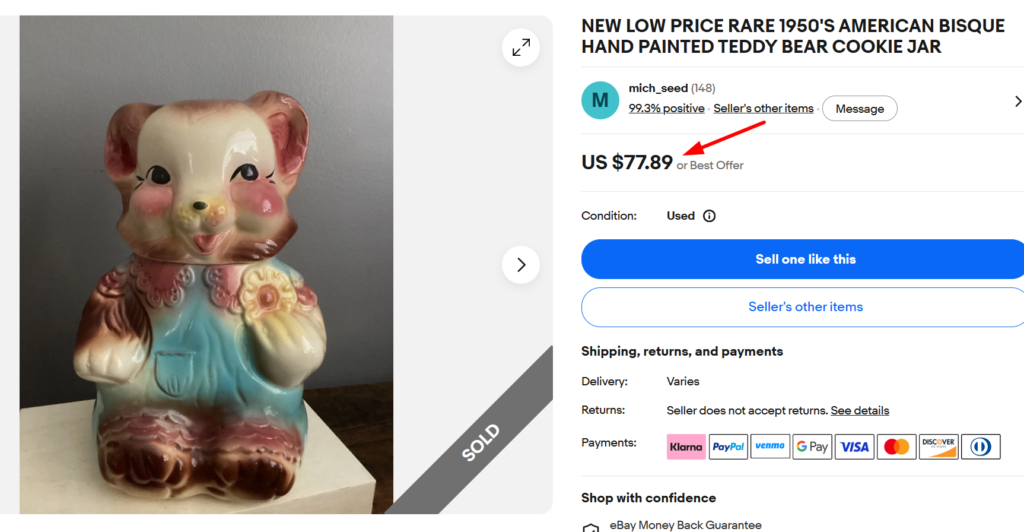
Sold for $78
This jar from the 1950s shows a sitting bear wearing overalls, and sometimes a baseball cap. It is a heavy ceramic piece with the distinctive American Bisque wedge-foot bottom.
These jars came in various outfit colors, but green overalls were the most common. Also, it’s 11-12 inches tall and relatively heavy to distinguish it from reproductions.
- Estimated Value: $40 to $150
- Production Years: 1950s
- What to Check: Wedge-shaped base, overalls color, heavy weight
7. Shawnee “Smiley Pig”
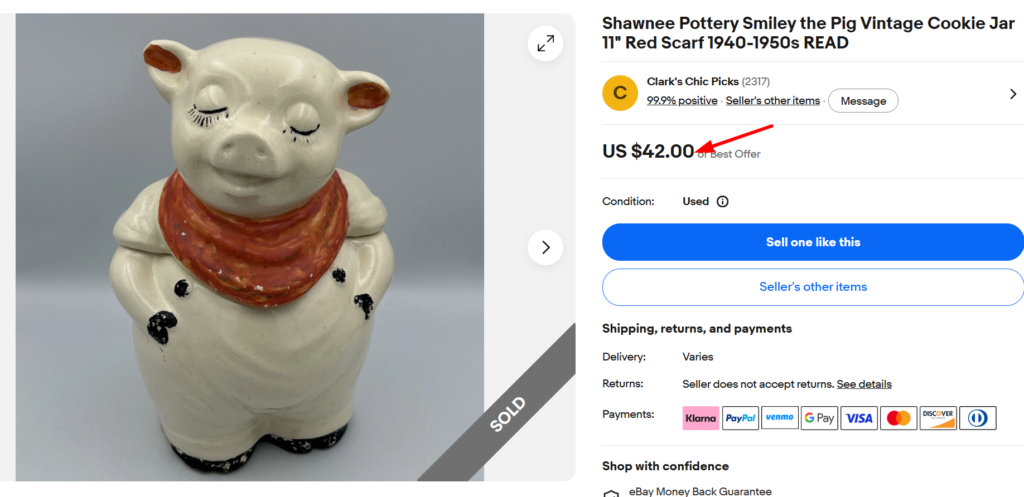
Sold for $42
Smiley is the most collected cookie jar produced by Shawnee. It’s an upright pig figure with hands on its hips/waist. It was created by Rudy Ganz in the early 1940s and was still being manufactured until the 1950s.
Originally, Smiley had either a blue or red scarf. There are also variations that have a shamrock, chrysanthemum, or tulip decal.
- Estimated Value: $50 to $750
- Production Years: 1942 to 1961
- What to Check: Gold trim, decal pattern, scarf color
- ID Notes: Marked “USA” with a number on the base.
8. Brush Pottery “Davy Crockett”
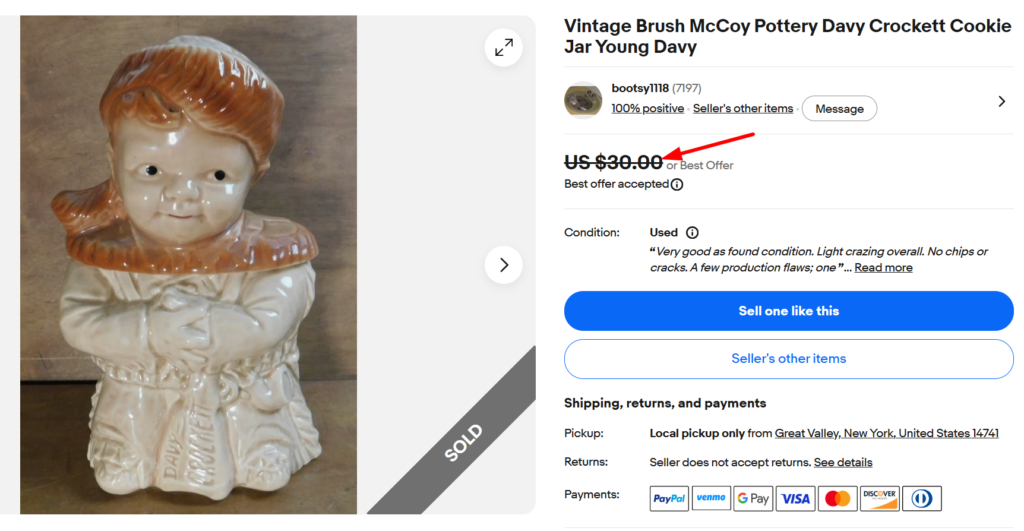
Sold for $30
Brush issued this jar in 1956 as part of the Davy Crockett trend, fueled by the Disney television miniseries. It has a sculpted figure of young Davy Crockett wearing his coonskin cap, the cap being the lid of the jar.
The letters “Davy Crockett” appear on the front of the jar. The base marking on most jars reads “USA” without the prefix “W,” unlike other Brush jars. Adult Davy Crockett jars are rarer than the young ones.
- Estimated Value: $25 to $80 (young); $100 to $300+ (adult)
- Production Years: 1956
- What to Check: Relief lettering, “USA” base mark
9. Shawnee “Corn King” Jar
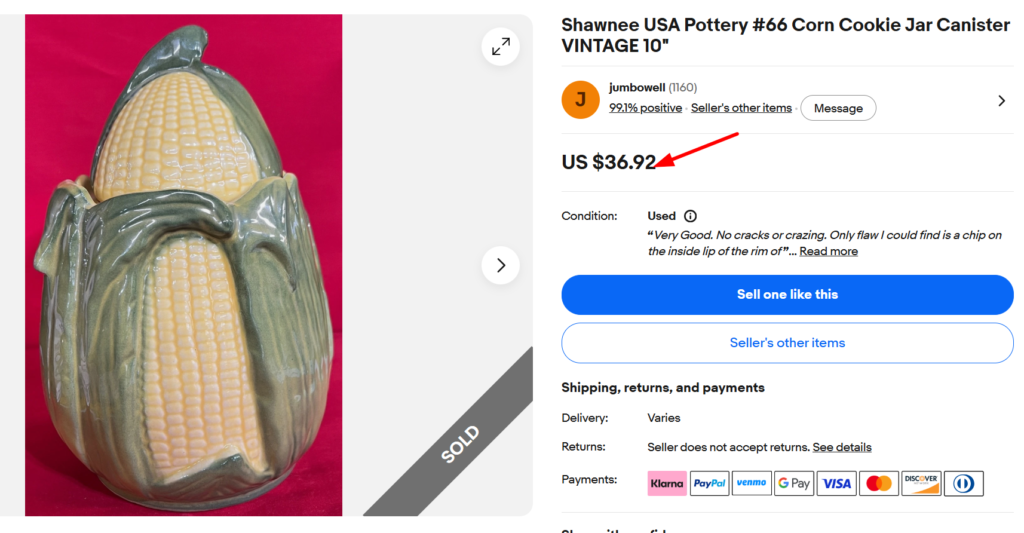
Sold for $37
Corn King is the most popular dinnerware pattern in the Shawnee line. The centerpiece of the pattern is the cookie jar, which features an ear of corn with yellow kernels and green shucks in a raised mold design.
The Corn Queen variation from 1954-1961 featured lighter colored kernels and darker shucks; these are less valuable. Golden rim designs are priced much higher than regular versions.
- Estimated Value: $75 to $250+
- Production Years: 1946 to 1954
- What to Check: Kernel color, gold trim, lid fit
10. RRP Co. “Hey Diddle Diddle”
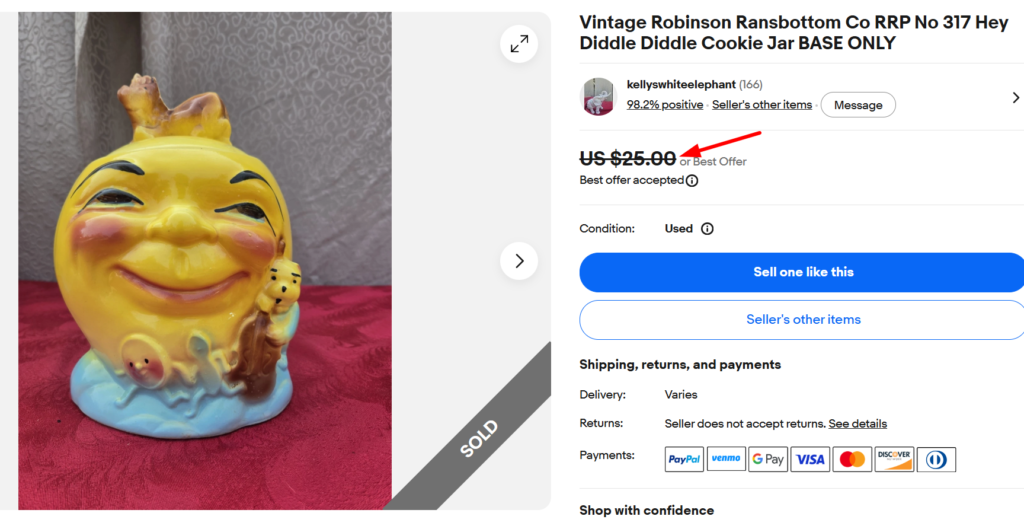
Sold for $25
This nursery rhyme-themed jar was made by Robinson Ransbottom Pottery at Roseville, Ohio. The body has an image of the smiling moon, a cat playing the fiddle, and a dish with a spoon.
The lid depicts a jumping cow over the moon, and complete jars with original lids are getting harder to find.
This 1950s jar is common, but quite popular among American pottery collectors.
- Estimated Value: $20 to $300
- Production Years: 1950s
- What to Check: Lid completeness, moon, and cow-shaped lid handle
11. McCoy “Cookie Barrel” Jar
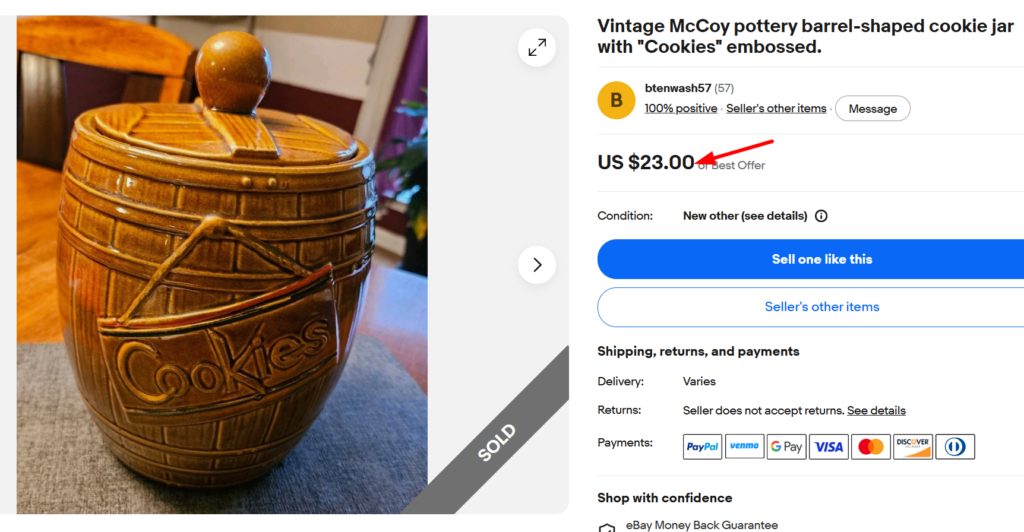
Sold for $23
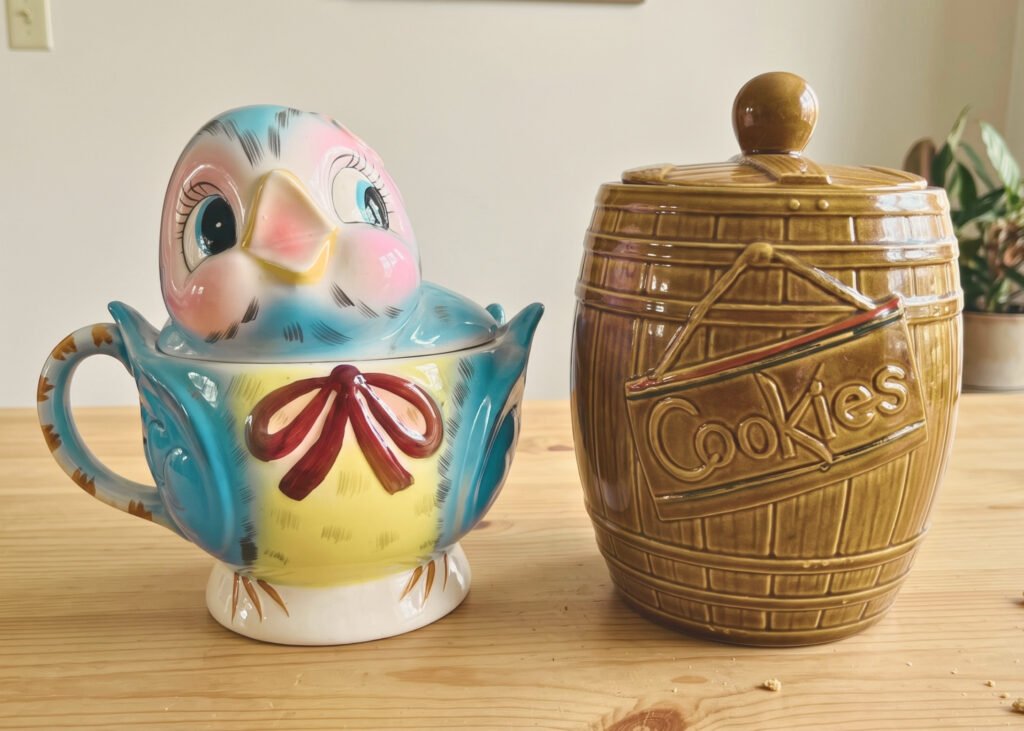
The barrel-shaped cookie jar from McCoy that has “Cookies” imprinted on its front surface was a kitchen staple during the 1950s. The most commonly found design is the brown colored one with a wooden finish, but some rarer two-tone versions in colors such as green and yellow also exist.
- Estimated Value: $20 to $225
- Production Years: 1950s
- What to Check: “McCoy USA” mark, glaze condition
12. American Bisque “Cookie Truck”
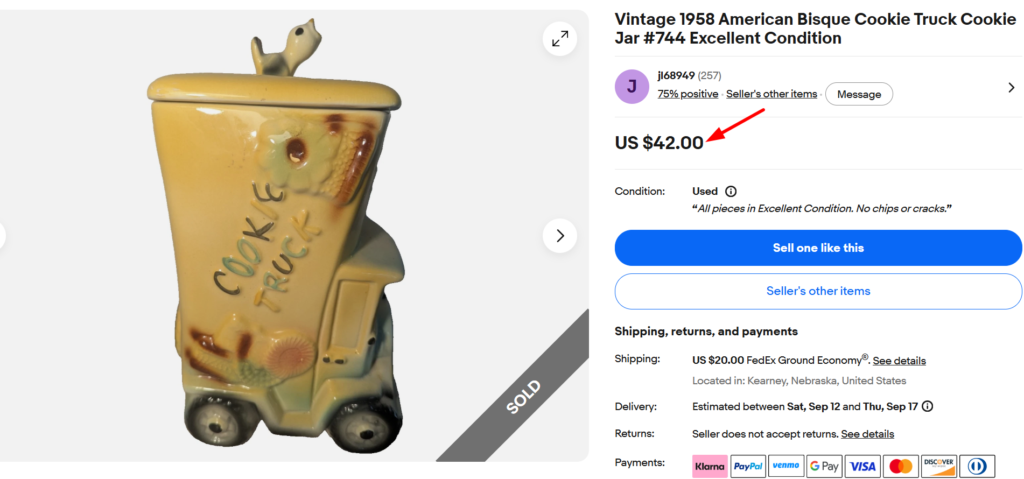
Sold for $42
The unique cookie jar resembles a delivery truck having either “Cookies” or “Cookie Truck” molded onto its body. Another key feature is a small bird perched on the lid as its knob.
The most common color of this jar is yellow, and it has the traditional American Bisque-shaped bottom marked “USA.”
Examples in mint condition with cold paint are worth more than worn ones with paint loss.
- Estimated Value: $30 to $175
- Production Years: 1950s
- What to Check: Wedge foot, embossed text, bird on the lid
Identifying a Genuine Cookie Jar from the 1950s
The first step to identification is checking the jar’s base. Turn the cookie jar over and look for any stamps, marks, or mold numbers on the bottom.
- McCoy cookie jars of this age tend to be marked as “McCoy” or “McCoy USA.”
- Cookie jars by Shawnee will usually bear “USA” along with a number.
- As for American Bisque jars, one of the fastest ways to spot them is their unique wedge-shaped foot.
Next, verify that the pattern, line, or specific color of that jar actually belongs to the manufacturer. For example, if you see a Smiley Pig jar with a “McCoy” base stamp, it’s a fake, because McCoy never made it.
Be wary of fakes. Reproductions are always made using the mold of original cookie jars. So, repros are almost always smaller and lighter due to the contraction of the mold while baking.
What Makes 1950s Cookie Jars Valuable?
There are three factors that tell whether an old cookie jar is worth $30 or $300.
- First, the manufacturer. There are three most desirable brands: McCoy, Shawnee, and American Bisque. Most collectible pieces come from these.
- Second, the jar’s condition. When we talk about cold-painted cookie jars, it usually refers to the condition of the painting. Ceramic damage comes after the loss of paint.
- Third, the rarity. Gold-trimmed versions, rare colors, and short production runs are always worth more than common designs.