
Most people find an old rolling pin in their grandmother’s drawer, give it a quick look, and toss it in the donation pile. That’s a mistake more often than you’d think.
That’s why you must know what you’re looking at. This guide walks you through how to date and identify antique rolling pins, what actually drives their value, and collectible examples that are popular today.
When Were Rolling Pins Invented?
Rolling pins date back to the Etruscans around 800 BC, when they were just simple wooden cylinders. American colonial kitchens used one-piece wooden pins, and the modern handled version with a rotating rod was patented in the late 1800s by inventor J.W. Reed. Glass rolling pins had their heyday from the late 1700s through the Victorian era, mostly in England.
How to Identify an Antique or Vintage Rolling Pin?
Before you can value an old rolling pin, you need to figure out roughly when it was made and what it’s made of. So here’s how you can identify an antique rolling pin.
Construction & Handle Style
The most reliable age clue is how the handles work. One-piece pins with no separate handles, or pins where the handles turn with the barrel, are usually pre-1880. Pins where the handles stay still while the barrel spins on an inner rod came after J.W. Reed’s patent in the late 1800s, and this became the standard by the early 1900s.
Also check for pegged wooden construction, small tool marks from a foot-powered lathe, and slight asymmetry. These are all signs of hand-turned pieces from before mass production took over.
Materials to Look For
Wood is the most common material for rolling pins, but the wood type matters. Antique American pins were usually maple or beech, both hardwoods with tight grain. Tiger maple, with its wavy “chatoyant” stripes, is worth extra.
Pine was used earlier but got scarce by the mid-1800s, so pine pins tend to be older.
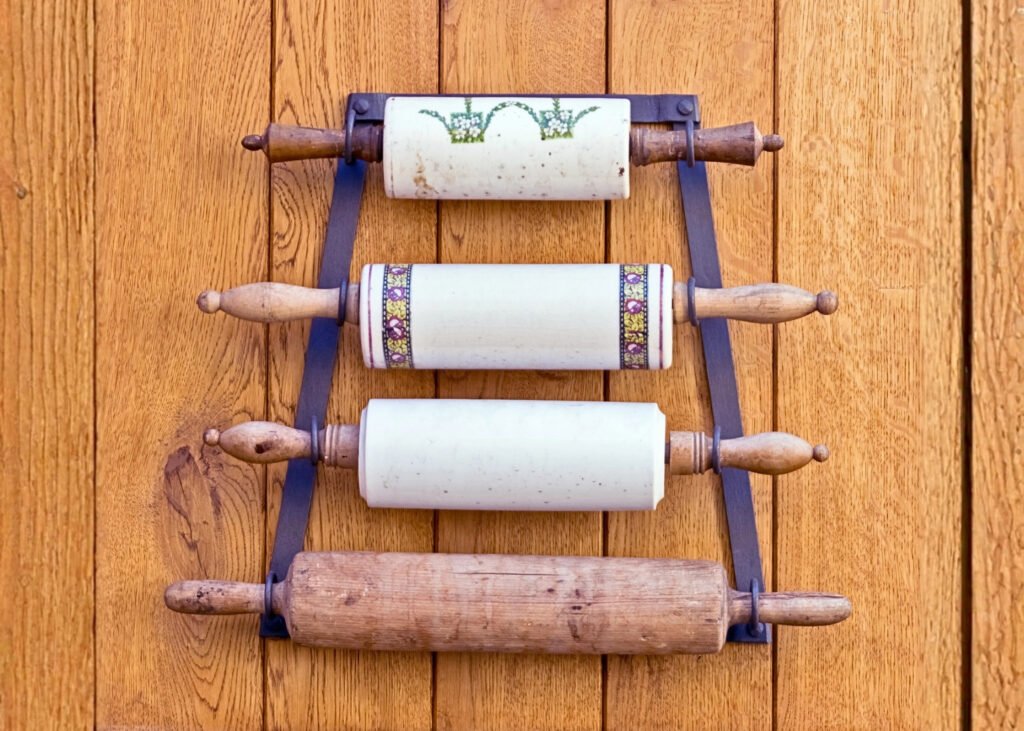
Beyond wood, you’ll find glass (both clear and colored), yellow ware pottery, stoneware, ironstone, marble, and even brass or copper. Any material other than plain wood usually points to something more collectible.
Handle Colors and Paint
Painted handles are a great dating shortcut for 20th-century pins. Red-painted handles were most popular from the 1930s to the 1950s. Green handles peaked in the 1940s. Blue handles are less common and usually earlier.
Natural, unpainted wood typically means the pin is either pre-1930 or a very plain later piece.
Look for honest wear on the paint. Original paint shows uneven fading where hands gripped it, not smooth, even coverage.
Maker’s Marks and Stamps
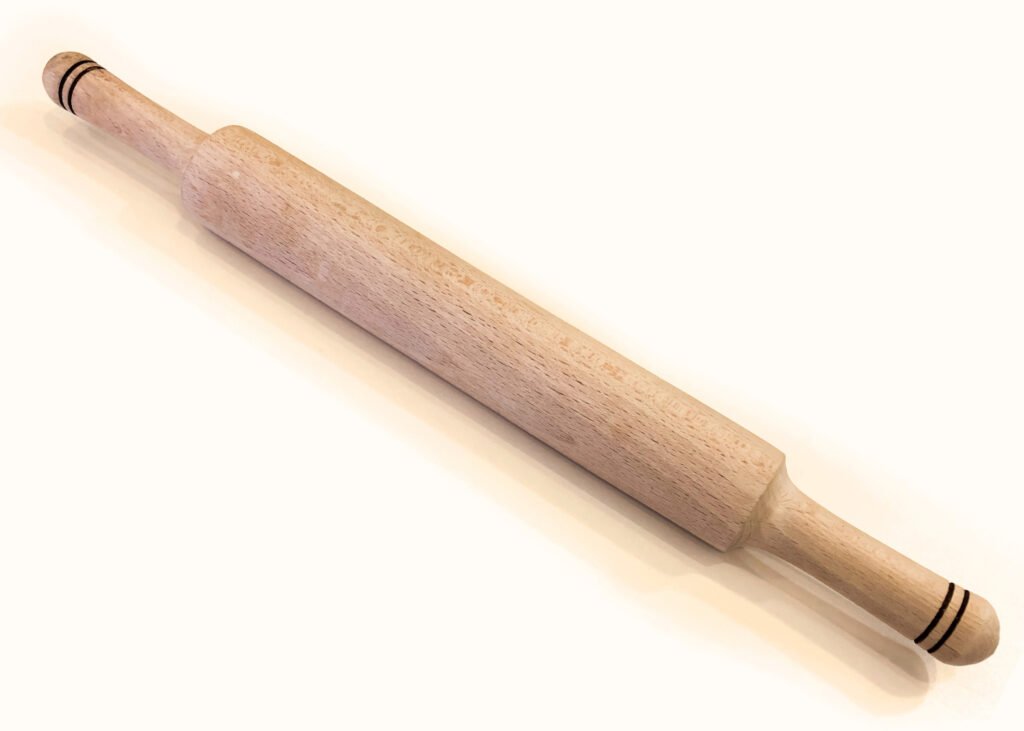
Most 19th-century wooden pins are unmarked, so don’t panic if yours has no stamp. But American brands like Munising, Foley, and Thorpe started signing their pins in the early to mid 20th century, usually with a small stamp on one end cap.
Glass pins from Imperial Manufacturing of Cambridge, Ohio, carry a raised patent mark reading “Imperial Mfg. Co. Cambridge, Ohio Pat. July 26, 1921”. English advertising ironstone pins have transfer-printed brand names right on the barrel.
Collecting Tip: Never sand or clean off a mark thinking it’s dirt. Faded stamps still count toward value, and buyers check them for valuation.
Valuable Antique & Vintage Rolling Pins Worth Collecting
Let’s take a look at some antique and vintage rolling pins that are highly collectible today and how much they can sell for today.
1. Cobalt Blue Blown Glass Rolling Pin (Bristol)
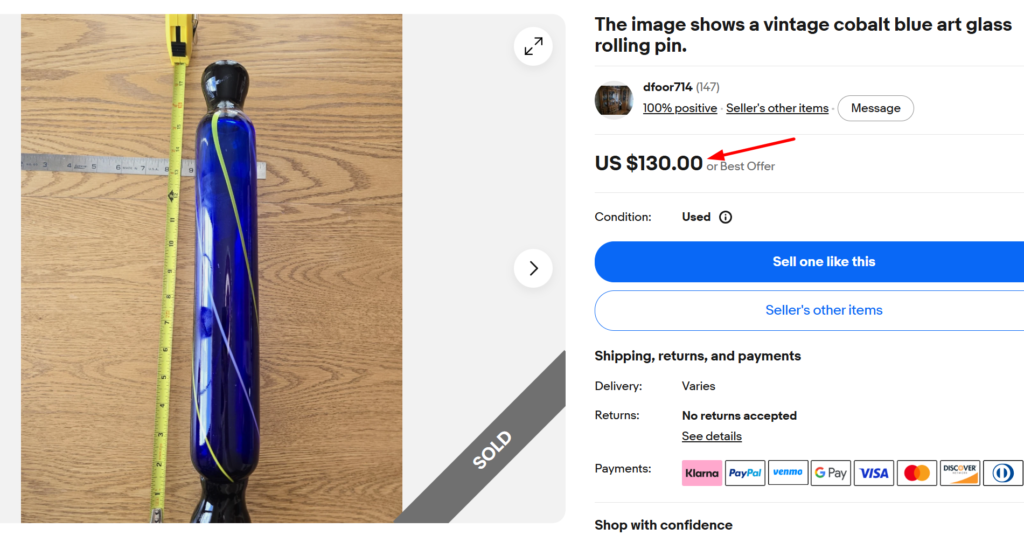
Sold for $130
Bristol blue pins are among the most recognizable English glass rolling pins. They were hand-blown in the famous cobalt shade, hollow, and had a small opening at one end so they could be filled with cold water to keep pastry cool while rolling.
Most sold examples have some pattern loss, since the hand-painted or gilt decoration wore off with age. That’s normal and doesn’t ruin the value.
- Estimated Value: $150 to $250
- Production Years: c.1830 to 1880
- What to Check: Deep cobalt color, pontil mark, hollow body
- Quick Notes: English origin, filled with cold water for pastry
2. Nailsea Combed Glass Rolling Pin (c.1880)
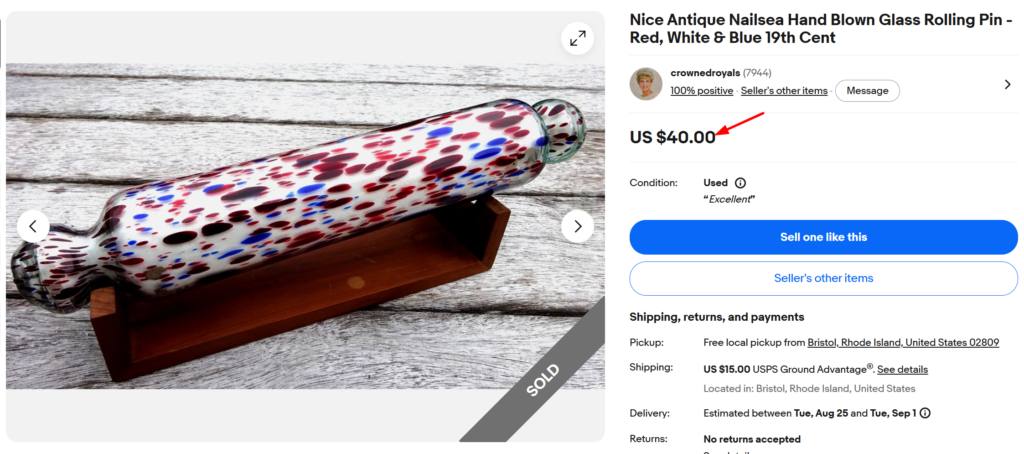
Sold for $40
Nailsea pins came from the famous Somerset glassworks, but the “Nailsea style” was also made in Bristol, Sunderland, and Scotland. So you’ll see pink, blue, and white candy-striped patterns rolled into clear or colored glass.
A Nailsea Wrockwardine Wood and rarer combed examples are highly collectible.
- Estimated Value: $100 to $250
- Production Years: 1788 to 1873 (Nailsea Glassworks era)
- What to Check: White or colored combed enamel swirls
- Quick Facts: Often sold as sailor gifts, hung on walls
3. Sailor’s Love Token Glass Pin with Verse
Estimated Value: $200 to $700+
These are the top tier of English glass rolling pins. Sailors bought them at ports as parting gifts, and they carried painted phrases like “Be True to Me” or transferred images of frigates.
A 19th-century amethyst example with a three-masted ship and the verse “Love and Be Happy” is the most collectible. Cleaner cobalt examples with intact decoration and ship transfers are also desirable.
- Production Years: Early to mid 1800s
- What to Check: Hand-painted or transferred romantic verse
- Quick Notes: Ship imagery adds premium.
4. Imperial Milk Glass Rolling Pin (Patented 1921)
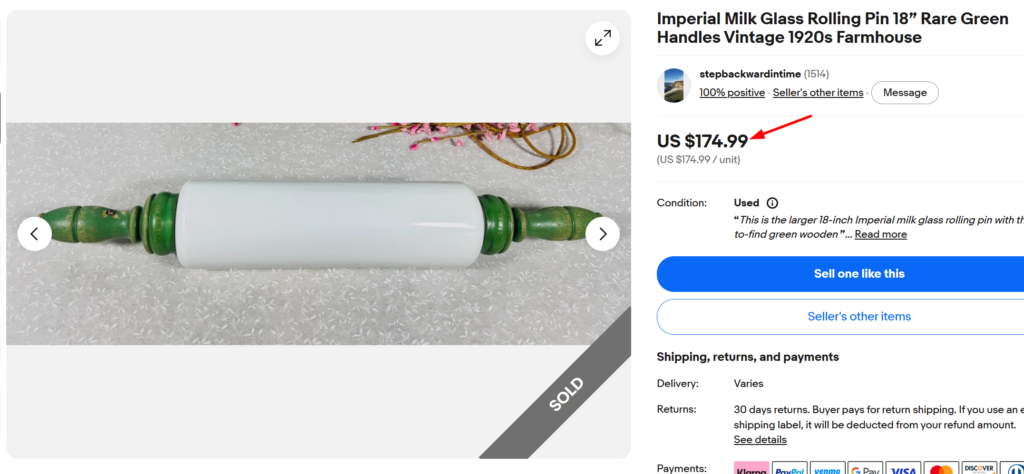
Sold for $175
Imperial Manufacturing of Cambridge, Ohio patented this design in July 1921. The pin has an opaque white milk glass barrel with a wooden dowel and short painted handles at each end. The raised patent inscription is the ID marker and confirms authenticity right away.
Original painted handles in red or green add value. Repainted or replaced handles cut it in half.
- Estimated Value: $100 to $180
- Production Years: 1921 through the 1930s
- What to Check: Milk glass barrel, raised patent mark on side, wooden handles
5. English Advertising Ironstone Rolling Pin
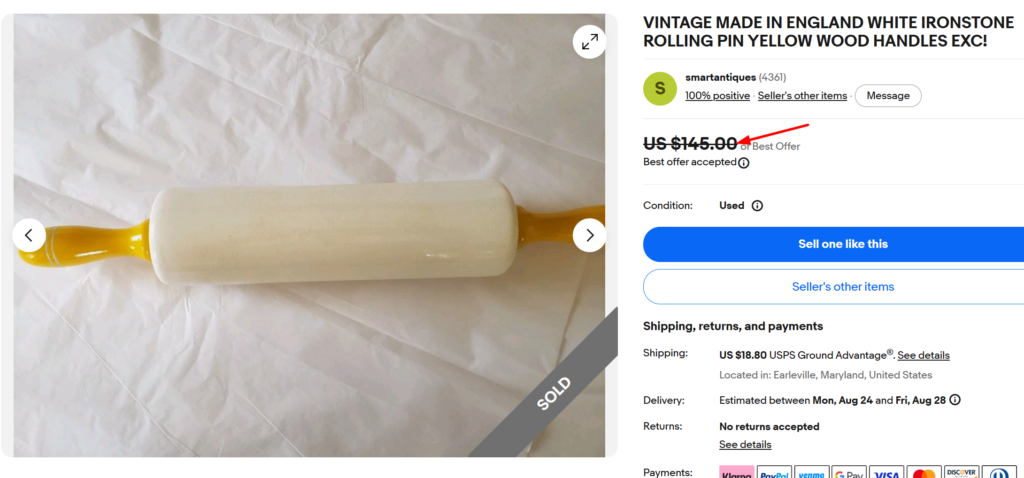
Sold for $145
These pins were promotional items given out by grocers, mills, and flour companies. The white ironstone barrel carries a transfer-printed advertisement, often for something like Allinson’s Wholewheat Flour, Kilverts’ Pure Lard, or a local shop.
Rarer brands, complete text, and matching original wooden handles push these into the higher end. Standard ironstone examples are worth less.
- Estimated Value: $150 to $400
- Production Years: c.1890 to 1930
- What to Check: Black or brown transfer-printed brand text
6. Yellow Ware Rolling Pin with Original Handles
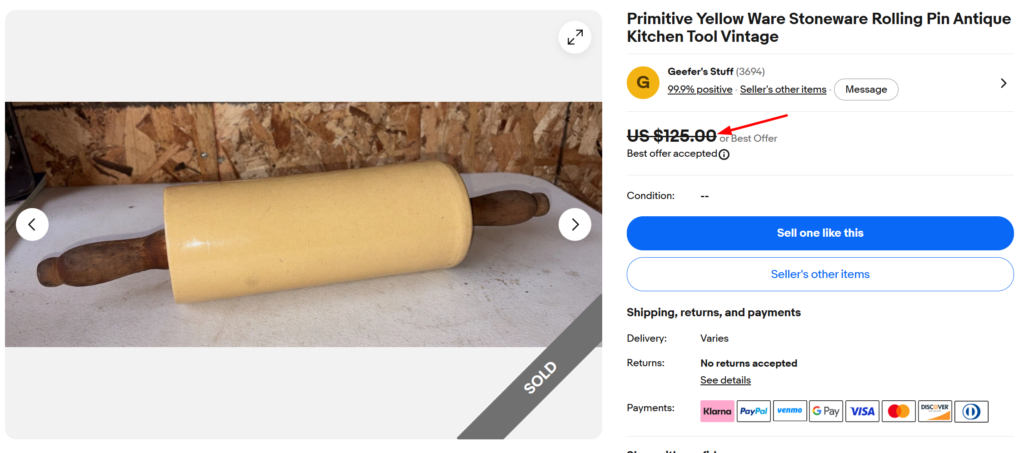
Sold for $125
Yellow ware was a durable American pottery favored for kitchen tools because it kept dough cool. These pins are heavy, with a smooth glazed pottery barrel and turned wooden handles that thread through a central dowel.
Absence of hairline cracks and “spidering” in the glaze is critical. Replacement handles knock the price down significantly. Examples with blue or white slip are most collectible.
- Estimated Value: $250 to $350
- Production Years: 1880 to 1920
- What to Check: Cream-yellow pottery body, no hairline cracks
7. Blue and White Stoneware Advertising Pin
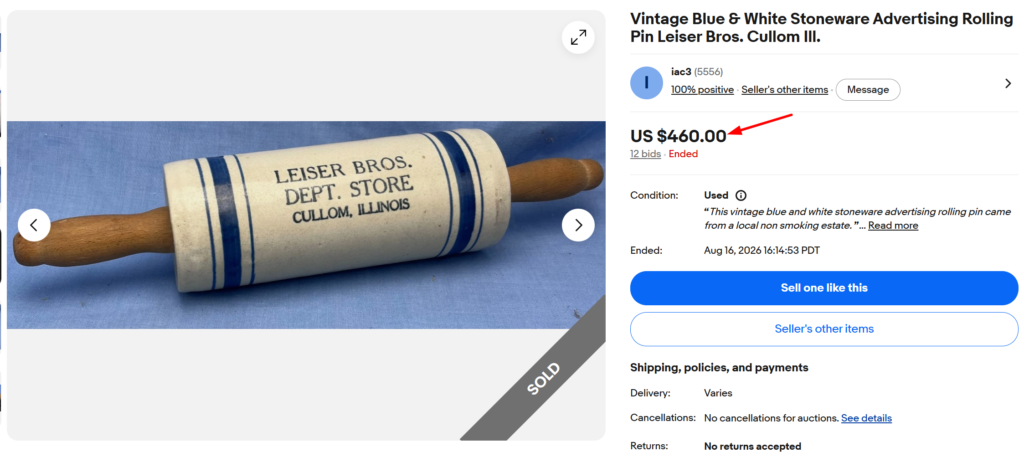
Sold for $460
American stoneware advertising pins from small Midwestern towns are among the hottest collectibles in the category. Merchants ordered them as customer giveaways, so most have short production runs.
Text like “Compliments of J.S. Weir, Ottumwa Iowa” or “Prairie City Grocery” gives collectors both provenance and rarity. Blue-banded versions with clear cobalt stenciling in solid condition are the most valuable.
- Estimated Value: $300 to $500
- Production Years: c.1900 to 1925
- What to Check: Cobalt-stenciled town name and merchant
- Quick Notes: Rare small-town names bring high premiums.
8. Hand-Carved German Springerle Rolling Pin (c.1900)
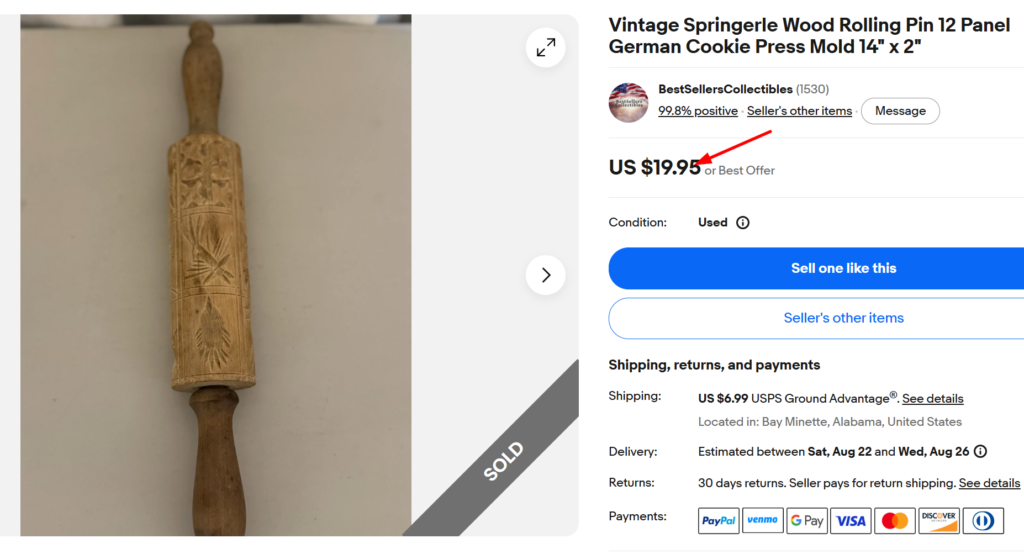
Sold for $20
Springerle pins were used to press anise-flavored German Christmas cookies. Each barrel has multiple carved panels, usually 8 to 16, with folk motifs like birds, flowers, houses, and holiday scenes.
The wood is typically beech or maple, dense enough to hold fine detail over decades. Sharper carvings, more panels, and older folk-art versions from Bavaria or Alsace push the value higher.
- Estimated Value: $65 to $150
- Production Years: Late 1800s to early 1900s
- What to Check: Deep, crisp carved cookie panels
9. Munising Maple Rolling Pin with Green Handles
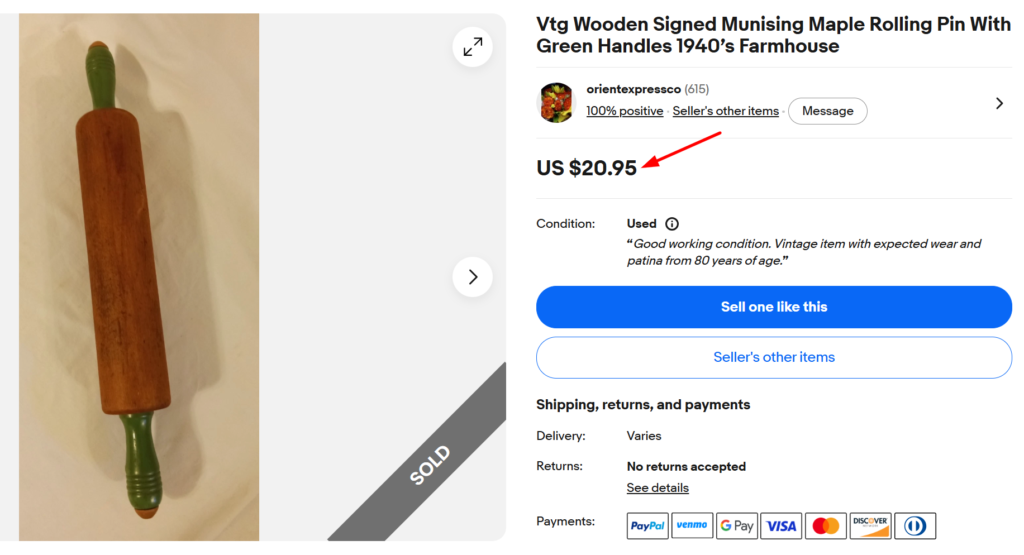
Sold for $20
The Munising Wood Products Company of Michigan made classic American maple rolling pins in the mid-20th century. So they’re common but consistently collected, especially with original painted handles in green or red.
Cleaner pieces with strong Munising stamps and bright original paint reach the top of the range, and they show up regularly at garage sales.
- Estimated Value: $15 to $75
- Production Years: c.1935 to 1955
- What to Check: “Munising” script stamp on end cap
- Value Notes: Original painted handles must be intact
What Makes an Old Rolling Pin Valuable? 7 Checks
Most vintage rolling pins are common and sell for $20 to $40. But a small percentage are collectible, and it comes down to the following specific factors:
- Material rarity – Blown glass, yellow ware pottery, and hand-carved springerle pins outrank plain wood.
- Maker’s marks or advertising – A stamped advertising rolling pin from a defunct grocery or flour company can be worth 10 times a plain version.
- Sailor’s love token glass – 19th-century English blown-glass pins with painted verses or transferred ship images are the top tier.
- Original paint on handles – Untouched, original color adds real money. Repainted handles kill it.
- Complete original hardware – Cork stoppers, screw caps, wooden stands, and hooks all count.
- Condition – Cracks in glass, chips in pottery, and handle wobble drop value fast. Crazing on glaze is usually acceptable and expected.
- Provenance – Documented history or a known collection adds a premium.
Apart from these factors, always make sure to check the prices of sold listings on eBay to know what a specific piece is actually worth rather than what is expected of it.
Next time you spot an old rolling pin, check the handles, the material, and the end caps before you walk past. These quick checks are what separates a $15 wooden pin from a $400 find.