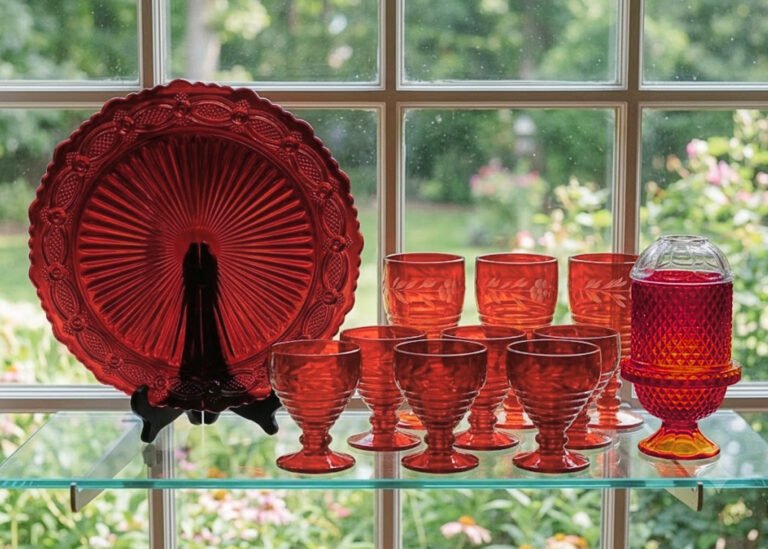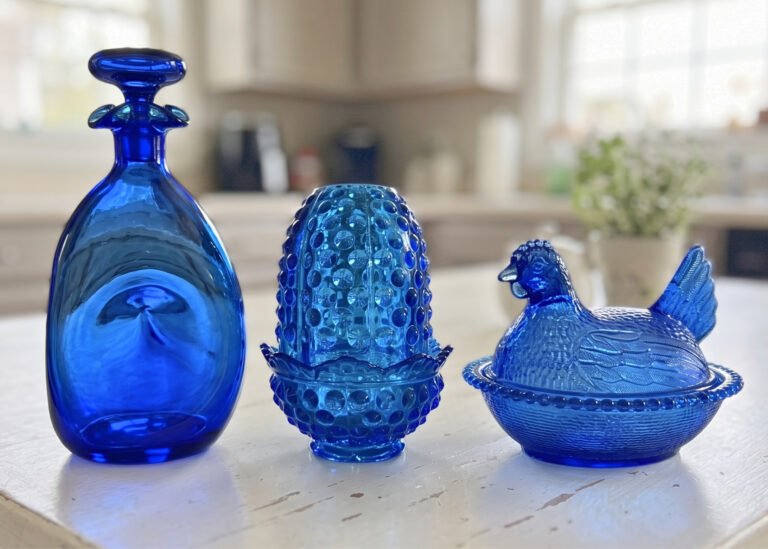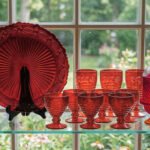

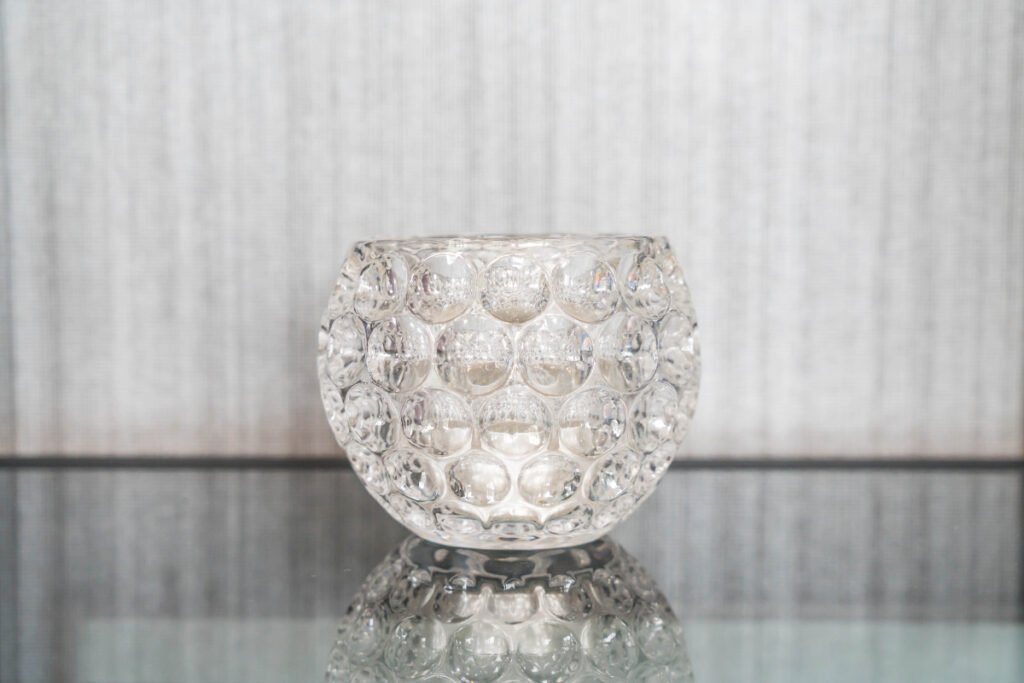
Hobnail glass is called so because it has “hobs” which resemble old metal studs hammered into the soles of work boots in Victorian times. The pattern was patented in 1886 by Hobbs, Brockunier & Co. of Wheeling, West Virginia. Their original name for it was “Dewdrop,” and it was officially their pattern No. 323.
Other makers from Fenton Art Glass to Anchor Hocking copied the design, and collectors started calling it hobnail. Today, vintage Hobnail glass is collectible. This guide reveals notable makers, colors, and pieces that are actively collected today.
How to Identify Genuine Antique & Vintage Hobnail Glass
Most hobnail glass is unmarked. Stickers fell off decades ago, and a lot of makers never molded their logos in at all. So you have to identify it by looking at the piece itself. But that’s not too tricky if you know what to look for.
1. Examine the Hobnails (Bumps) Themselves
The hobs on an antique hobnail glass piece are your first clue. The shape, sharpness, and spacing are different from one company to the next.
For example, Fenton’s hobs are sharp and pointed, but Anchor Hocking’s hobs are softer, rounded, and dome-shaped. L.E. Smith hobs are spaced further apart, while Westmoreland’s English Hobnail is like a diamond-grid layout.
So, before you even look for a mark, run your fingertip across the hobs. They can actually tell you the maker.
2. Check for a Maker’s Mark
A mark is the best clue, but most hobnail glass doesn’t have one. Still, check the base every time for a molded logo, an acid-etched signature, a paper or foil sticker, or sometimes a hand-written number.
The marks and logos of companies changed over the years, which makes them a reliable dating tool. So, familiarize yourself with makers’ marks using catalogs. But when it comes to paper labels, dating becomes difficult as these are almost always lost today.
3. Check the Base (Pontil Marks & Mold Seams)
The base will tell you almost as much as the bumps on top. There are three things to look for: a pontil, seams, and the finish.
The pontil is either the rough or smoothed area where the glass was snapped off from the metal rod it hung from during production. Hand-blown Hobbs, Brockunier glass items usually have a polished pontil, while machine-made Anchor Hocking Moonstone does not.
Mold seams matter too. Older, handmade pieces have very faint seams or none at all because the marks were smoothed by hand while the glass was hot. Newer, mass-produced reproductions show sharp seams running up the body.
So, if you can feel a seam slicing through a bump, you’re probably holding a modern piece.
4. Color & Opalescence Clues
Colors are one of the most important things to look at when trying to date or value hobnail glasses. Every company had its own color scheme, with some only made for a brief period of time. We’ll check that below.
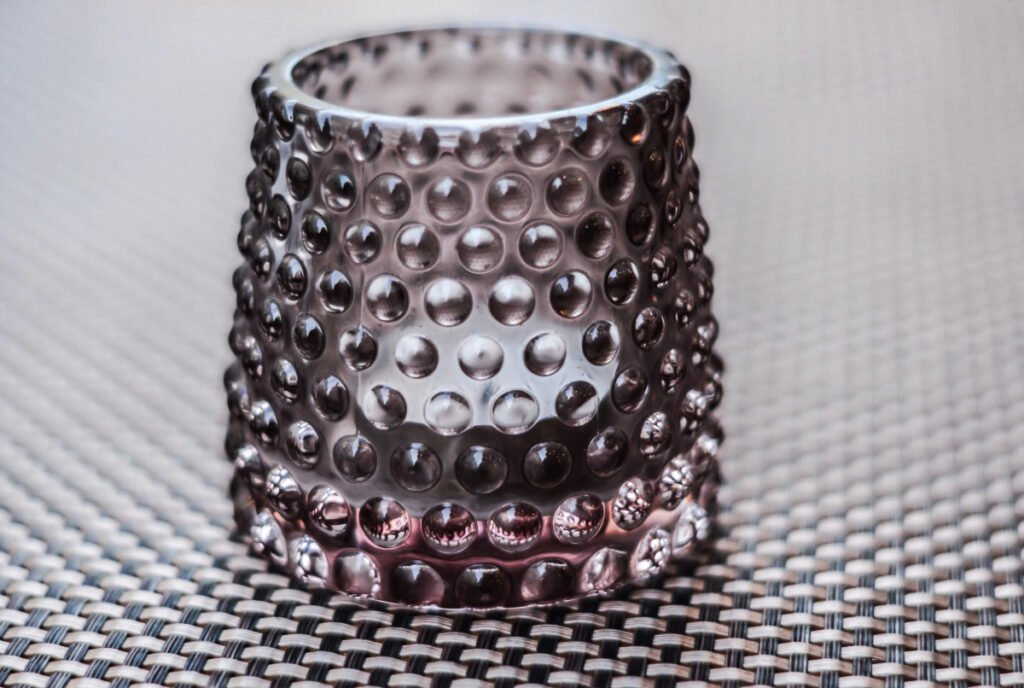
The opalescent quality is that milky white appearance on the outside edges and top surfaces of the hobs, while the glass remains clear or colored.
Fenton produced their opalescent hobnail glass from 1939 in such varieties as French opalescent (colorless body with white ends), blue opalescent, cranberry opalescent, and topaz opalescent.
The Anchor Hocking Moonstone piece is opalescent as well, but the base glass is colorless rather than colored. If you own a piece of opalescent glass in cranberry, plum, or topaz colors, it’s virtually certain to be a hobnail opalescent glass from the Fenton factory.
5. Weight, Ring & Feel
Feel the weight of your piece. Genuine vintage hobnail glass usually feels heavier than you expect, especially the pre-1960s handmade pieces. Modern repros are typically thinner and lighter, since they’re machine-pressed with less glass.
Next, tap it lightly using your fingernail. The older, lead glass will have a softer sound or tone to it, while the new lime glass replicas will produce a dull or sharp sound. This is not the most accurate way to check authenticity, but it can be useful when used together with the above characteristics.
Lastly, feel the rim. Hand-finished hobnail glass antique pieces often have a slightly uneven rim because the ruffles were crimped while the glass was still hot. Machine pieces are uniform all the way around.
6 Major Hobnail Glass Makers & Their Designs
As I said above, knowing the maker is half the process of figuring out what your hobnail piece is worth. The exact same form in white milk glass may cost $10 if it is by L.E. Smith but $40 if it is Fenton.
Below are the important brands that you should recognize:
1. Fenton Art Glass (1939–2011)
Fenton is the king of hobnail in the 20th century, and milk glass hobnail made up most of their production as early as 1952. The hobs have sharp points, almost cone-shaped in appearance.
As for markings, there were none prior to 1970. Since then, an oval mark with “Fenton” appears on the base. Underneath the letter “n”, a number appears from 1980 onwards, where “8” denotes the 80s, “9” denotes the 90s, and “0” denotes the 2000s.
The color range includes cranberry, blue opalescent, topaz, plum, ruby, milk glass, and colonial amber.
2. Hobbs, Brockunier & Co. (1880s)
Hobbs hobnail is the rarest. The company created hobnail in 1886 as “pattern No. 323” and named it “Dewdrop”. It was made for just about the same time period, the last part of the 1880s to the very early 1890s.
No molded marks exist on any Hobbs piece. You can identify it by the polished pontil on the base (hand-blown sign), pointed hobs that match the original patent, and color treatments like Frances Ware (frosted body with amber-stained top).
3. Westmoreland Glass – English Hobnail (1928–1984)
Westmoreland’s English Hobnail pattern uses flat-topped square hobs in diamond grids, completely different from the round bumps of Fenton or Anchor Hocking. That diamond grid is the giveaway.
From around 1910 to the mid-1940s, a “W” inside keystone mark was used, while from 1946 onwards, there has been an interlocking “WG”.
This line included over 175 items in various colors, including pink, green, and turquoise. Green and pink hobnail glass pieces from 1928–1931 are classic English hobnail depression glass.
4. Anchor Hocking – Moonstone (1942–1946)
Anchor Hocking’s Moonstone was made for just four years during WWII and is the most affordable opalescent hobnail you’ll run into. The body is clear glass with milky opalescent hobs and rims that sometimes show a faint blue tint.
Hocking pieces are almost never marked. They only used paper labels, which are usually gone. So, identify by the rounded, softer hobs and the clear body. Common forms like bowls, plates, sherbets, and goblets sell for $10–$40 each.
5. Duncan & Miller (1930–1955)
Duncan & Miller produced hobnail glass until they closed their business in 1955. Their quality is comparable to that of Fenton glass, but they cost less because their name is less well-known.
Their pieces are also usually unmarked. The distinct stepped profile on pedestal stems is a good identification clue. Colors include clear, ruby, milk glass, plus the rarer pink opalescent, blue opalescent, and Caribbean blue.
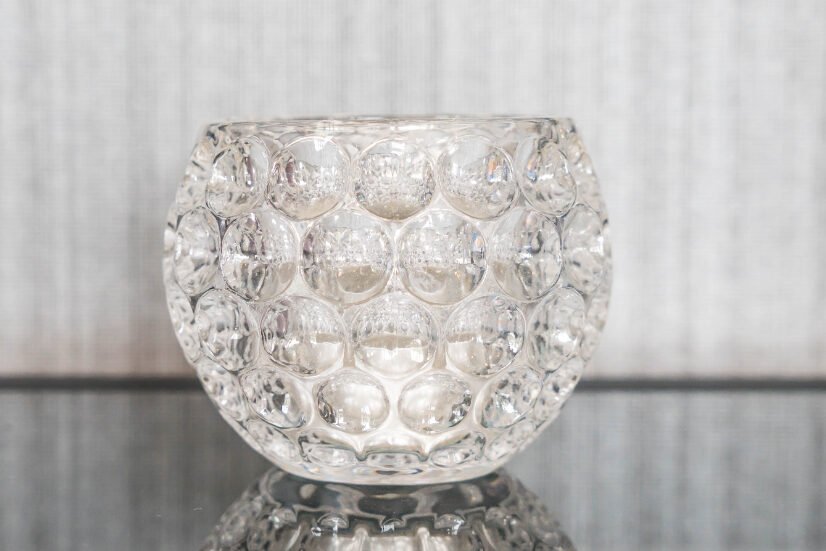
6. L.E. Smith (1907–2004)
L.E. Smith made colored hobnail starting in the 1940s, then their Hobnail Milk pattern from 1960 into the 1980s.
Most Smith pieces are unmarked, though 1970s revival pieces sometimes show an “S” with tiny “G” and “C” letters tucked in the curves. The hobs are well-defined but spaced further apart than Fenton’s, giving a chunkier look.
Three-peg or three-toe feet are a Smith signature. Notable colors include jadeite, bittersweet orange, and amberina.
Hobnail Glass Colors and Which Are Most Valuable
After the maker, color is the single biggest driver of hobnail glass value once you’ve confirmed the maker. The exact same form in white milk glass and cranberry opalescent might sell for $20 versus $400.
I’ve prepared a list of major hobnail glass colors, sorted by rarity and price.
| Glass Colors | Notes | Average Value |
| Cranberry opalescent | Gold-formula glass, white opalescent edges | $300 – $1,000+ |
| Plum opalescent | Deep amethyst-purple, Fenton – 1959–1962 only | $150 – $500 |
| Red / Ruby | Gold-based red, hard to produce | $80 – $250 |
| Vaseline / Uranium | Yellow-green glows under UV | $75 – $300 |
| Cobalt blue | Deep saturated blue, rare in early makers | $50 – $200 |
| Amber / Amberina | Amberina shading rarer than plain amber | $20 – $80 |
| Topaz / Yellow opalescent | Uranium glass with opalescent rims | $50 – $250+ |
| Pink | Westmoreland depression, Fenton (rose) | $20 – $70 |
| Blue opalescent | Soft blue with white hobs, heavily reproduced | $40 – $250 |
| Green | Many makers, Fenton lime green, common | $20 – $60 |
| White milk glass | Made by every major maker, common | $5 – $30 |
12. Rare & Valuable Hobnail Glass Finds
The pieces below are real hobnail glassware collectibles that regularly show up on eBay and other online platforms, and are some of the most sought-after pieces today.
1. Fenton Hobnail Milk Glass Octagon Punch Set
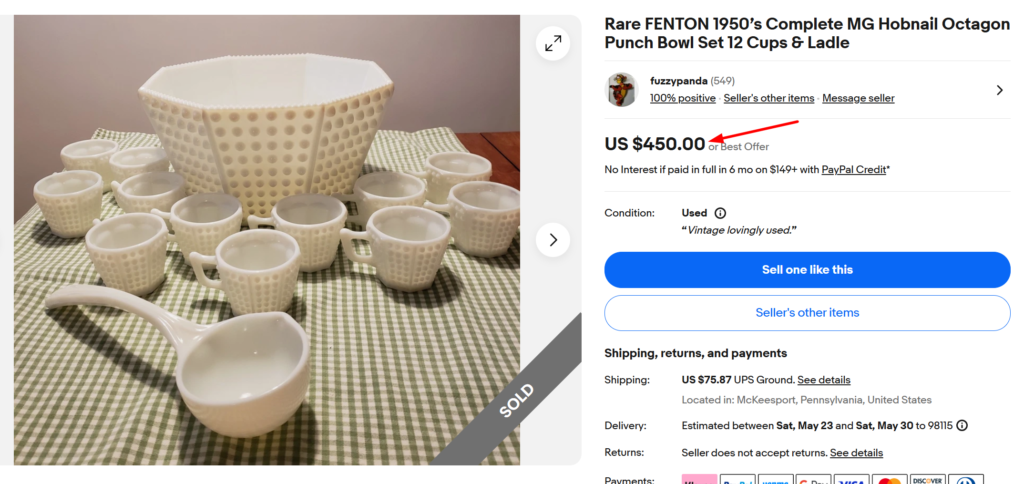
Sold for $450
The Fenton octagon hobnail punch bowl set is the upgraded version of the standard round milk glass set. The octagonal eight-sided wall is harder to mold and was produced in smaller numbers, making complete sets more valuable. Sets include the bowl, 12 cups with handles, and a milk glass ladle.
Standard round Fenton hobnail punch bowl sets in milk glass sell for $150–$250. The octagonal version pulls $300–$500 in complete condition.
- Estimated Value: $250 – $500 (full sets)
- Production Year: 1950s
- Characteristics: White milk glass body, Eight-sided octagonal bowl shape, pie-crust crimped top
- Quick Notes: Glass ladle is crucial for top value; adds $30–$50
2. Fenton Cranberry Opalescent Epergne
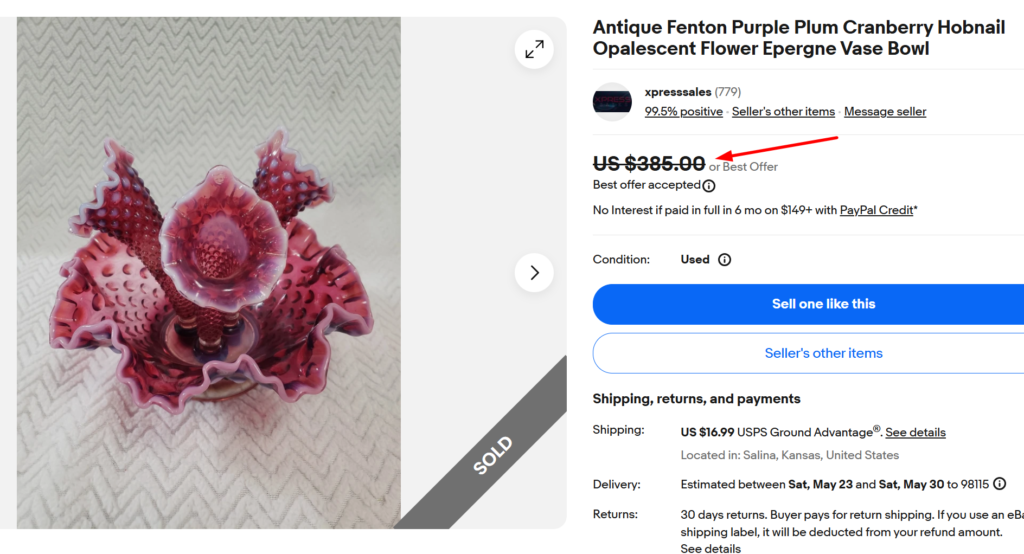
Sold for $385
The cranberry Fenton hobnail opalescent glass epergne is the centerpiece in any glass collection. It’s a ruffled-edge bowl with tall, trumpet-shaped inserts called “horns” that fit in the center.
The cranberry color comes from real gold in the glass formula, and the white opalescence runs along every ruffled rim and hob tip. This is one of the most sought-after colors.
Complete examples are rare, as the horns may be missing from the set after years of use. Also, watch the joint where each horn meets the bowl for chips.
- Estimated Value: $250 – $500+
- Production Year: 1940s–1980s
- Characteristics: Cranberry-to-plum color, horns set into a ruffled center bowl, opalescent hobs
- Quick Notes: All horns must match (not replaced) for the top value.
3. L.E. Smith Jadeite Hobnail Cake Stand
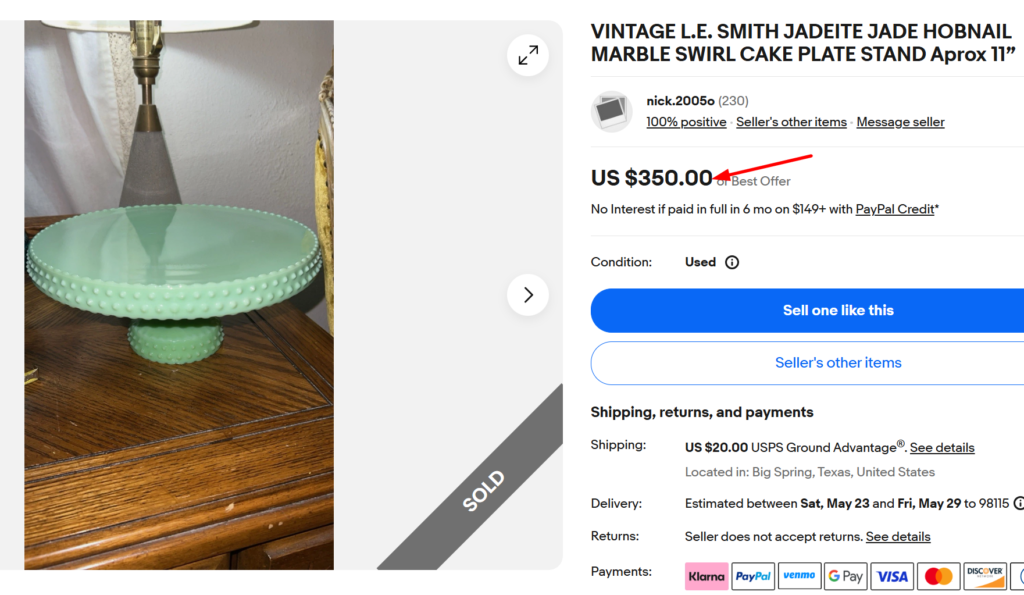
Sold for $350
The L.E. Smith Hobnail cake stand in Jadeite is a relatively rare color variation on the collector’s market. Jadeite colors are generally seen in Fire-King and Jeannette Glass pieces rather than in Smith’s Hobnail pattern. The 11-inch pedestal stand is the most desirable form.
Three-peg or pedestal feet are an L.E. Smith signature. Also, true vintage jadeite has slight color variation and may show a subtle marble swirl when held to light. Modern reproductions are uniformly green and lighter in weight.
- Estimated Value: $150 – $400
- Production Year: Mid-20th century
- Characteristics: Soft jade-green opaque body, pedestal foot, hobnail border
- Quick Notes: Genuine jadeite has a slight marble swirl visible against light.
4. Fenton Amber Hobnail Fairy Lamp
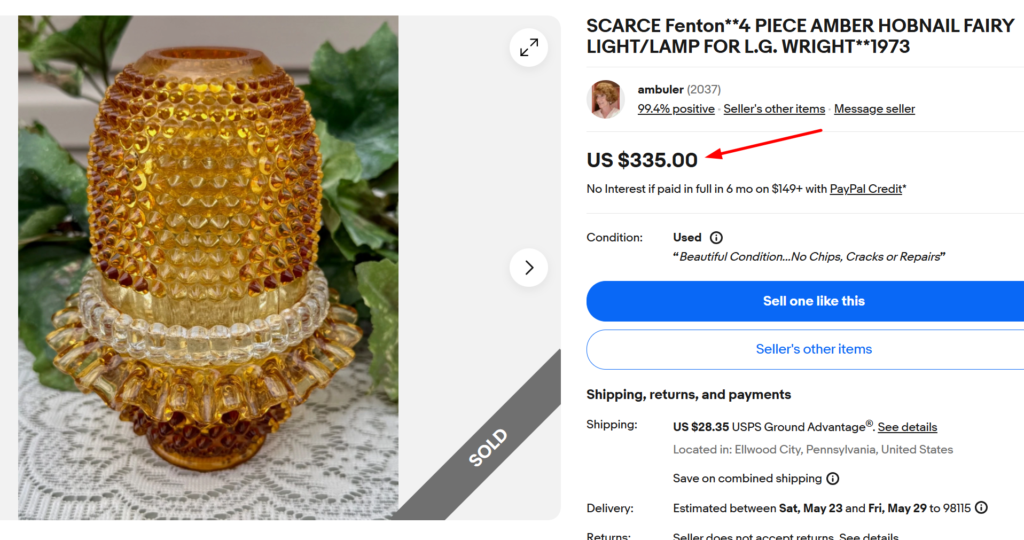
Sold for $335
This is an amber hobnail fairy lamp from Fenton made in contract for L.G. Wright in 1973. L.G. The four pieces stack as base, ruffled crest, candle insert, and dome. Color is a warm amber that’s lighter than Fenton’s Colonial Amber, with the ruffled clear crest at the base separating it from standard Fenton fairy lamps.
Wright distributed glass products, making items like this through companies such as Fenton and Westmoreland, and selling them under their own brand. Pieces like this are rare due to small production runs.
- Estimated Value: $150 – $400
- Production Year: 1973 (L.G. Wright collaboration run)
- Characteristics: Amber body with applied clear ruffled crest, four-piece set
- Quick Notes: Documented piece. Check catalogs for verification.
5. L.E. Smith Bittersweet Orange Hobnail Swung Vase
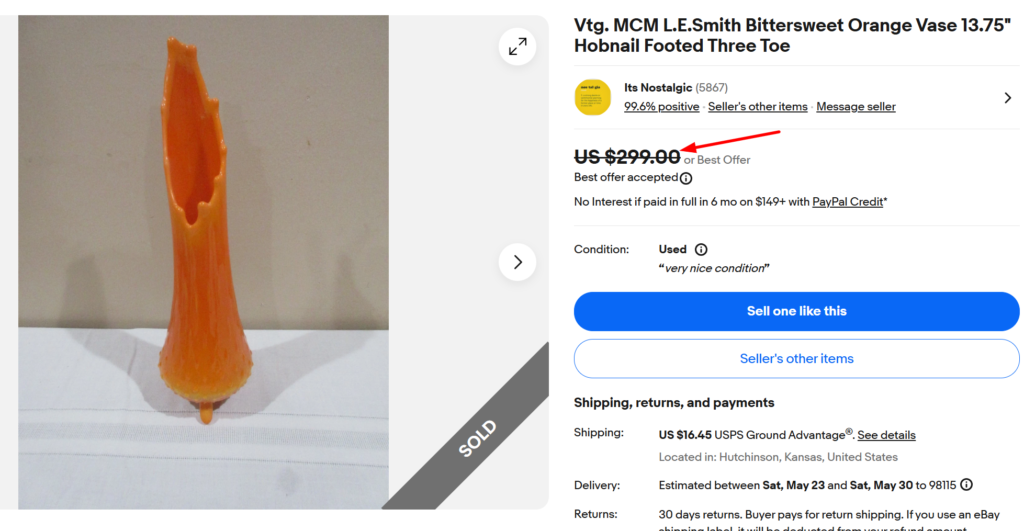
Sold for $300
The L.E. Smith bittersweet orange hobnail swung vase is a mid-century modern classic. Swung refers to the stretching of the glass while still molten, giving each piece a distinctive, irregular height and asymmetrical top.
Each of the pieces will be unique; this one is a 13.75-inch high vase. The height partially drives the value.
The bitter orange or the deep amber red color became quite popular in the late sixties and early seventies. The three-toe base foot indicates attribution to L.E. Smith.
- Estimated Value: $100 – $300
- Production Year: Mid-Century Modern (1960s–1970s)
- Characteristics: Tall swung-glass form, distinctive bittersweet orange color, three-toe footed base, irregular ruffled top
- Quick Notes: Three-toe-footed bases are an L.E. Smith signature.
6. Imperial Vaseline Hobnail Decanter
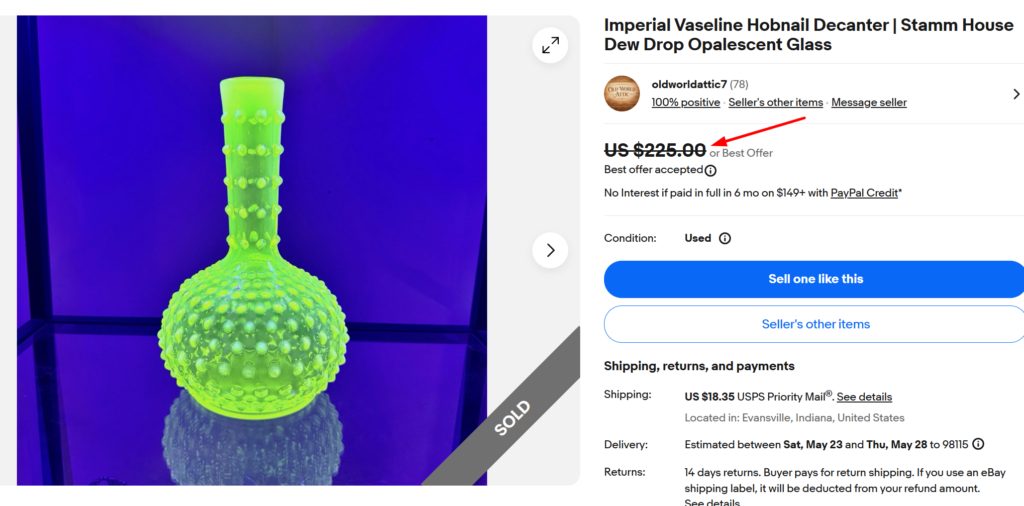
Sold for $225
The Imperial Stamm House Dew Drop decanter (catalog #1886/642) is one of the best uranium hobnail finds. Imperial reissued classic hobnail patterns in canary opalescent vaseline glass starting in 1966.
These pieces glow bright fluorescent green under black light because of the uranium content. The tall, slender neck is the distinguishing feature, since most hobnail decanters are squatter. The hobs run from the rounded base all the way up the neck.
Look for Imperial’s interlocked “IG” mark on the base, which started appearing in the 1950s and confirms attribution.
- Estimated Value: $150 – $300
- Production Year: 1966 onward (Stamm House Dew Drop #1886/642)
- Characteristics: Tall canary-yellow body, white opalescent hobs, UV glow,
- Quick Notes: Original matching stoppers can add 30% to the value.
7. Duncan Miller Thousand Eye Ruby Red Fairy Lamp
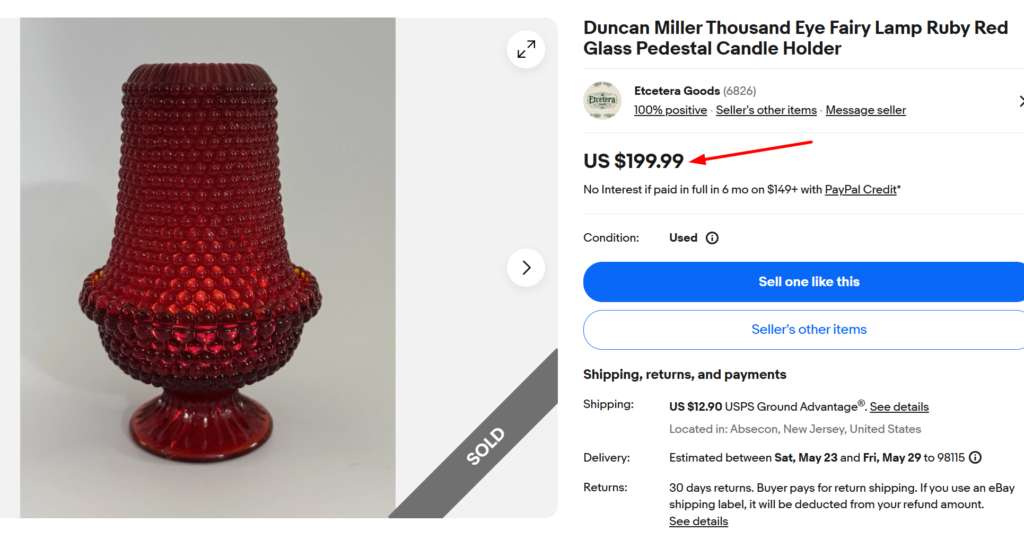
Sold for $200
The Duncan & Miller Thousand Eye pattern is a hobnail variant with smaller, more tightly packed beaded hobs. The pedestal fairy lamp pairs a footed candle base with a domed top, both covered in the same dense beaded pattern.
The ruby red color is one of the rarer Thousand Eye colors and one of the harder Duncan & Miller pieces to find.
Also, Duncan & Miller closed in 1955, so all true Duncan pieces predate that date. Pieces produced after 1955 under the US Glass Duncan Division through 1980 are also collected but carry slightly less weight.
Check the foot carefully. Duncan’s pedestals have a distinct stepped profile not seen in Westmoreland’s American Hobnail.
- Estimated Value: $150 – $250
- Production Year: 1940s–1950s (Duncan & Miller); some later via US Glass Duncan Division
- Characteristics: Ruby red color, beaded “thousand eye” hobs, footed pedestal base, dome top, “Thousand Eye” pattern.
- Quick Notes: Verify Duncan attribution by hob shape and foot style.
8. Hobbs Brockunier Cranberry Ribbon-Edge Bowl
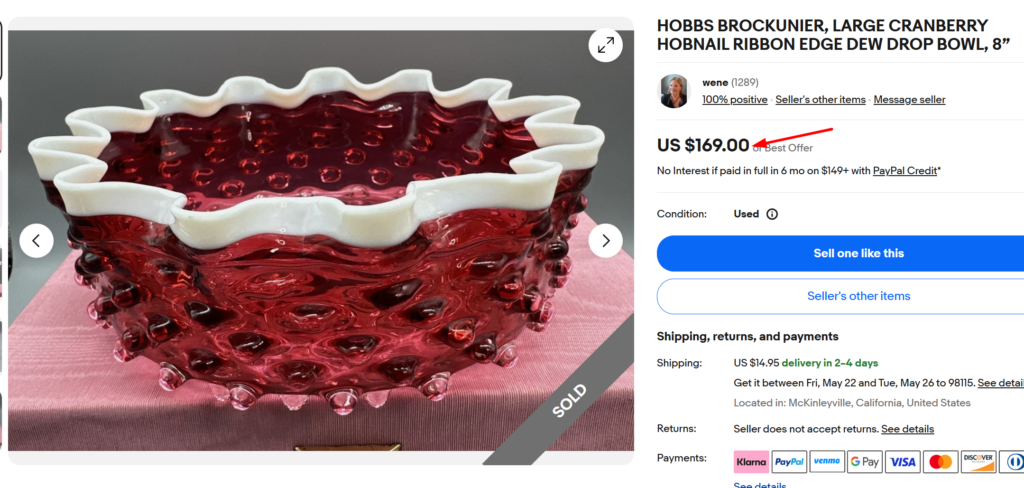
Sold for $170
This is a documented Hobbs Brockunier cranberry hobnail bowl from the original 1886–1891 production. The pointed hobs (rather than rounded) indicate the early Hobbs production, matching the original 1886 patent description of “projecting nodules.”
The defining feature of this piece is the applied opaque white “ribbon” wrap around the rim. It’s made by trailing molten white glass around the bowl edge while it’s still hot. This technique was a Hobbs specialty.
Pieces with documented Hobbs attribution and intact ribbon wraps command premium prices over generic Victorian cranberry hobnail.
- Estimated Value: $120 – $250
- Production Year: 1886–1891
- Value Factor: Documented Hobbs Brockunier attribution, Deep cranberry body with sharp pointed hobs, applied white ribbon edge.
- Quick Notes: Hand-applied ribbon edge is the key identifier.
9. Anchor Hocking Moonstone Set
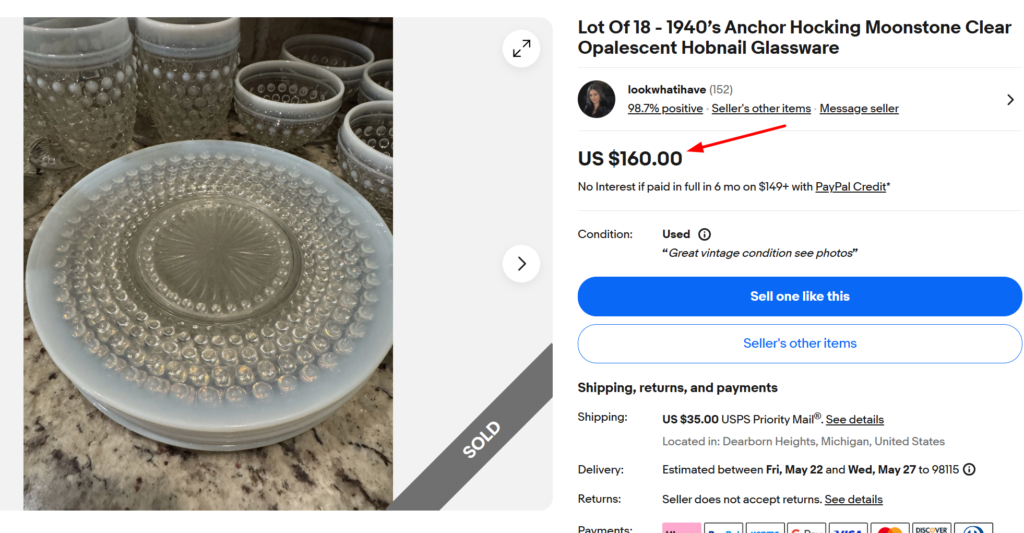
Sold for $160
Anchor Hocking Moonstone was made for just four years during World War II, then never again. The pattern uses a clear glass body with milky-white opalescent hobs and ruffled edges, giving it a softer look than Fenton’s milk glass.
Some pieces show a faint blue tint at the rim, caused by the way the opalescence shifts in light.
Individual Moonstone bowls and plates run $10–$30 each. The real value shows up in larger lots like this example. The candy dish, divided relish, and goblets are the more collectible single forms.
- Estimated Value: $80 – $200 (lots); $10-$50 (singles)
- Production Year: 1942–1946
- Characteristics: Clear body, opalescent white hobs and rims, rounded hobs
- Quick Notes: Pieces are unmarked; identify by rounded hobs and clear body.
10. Fenton Plum Opalescent Ruffled Compote
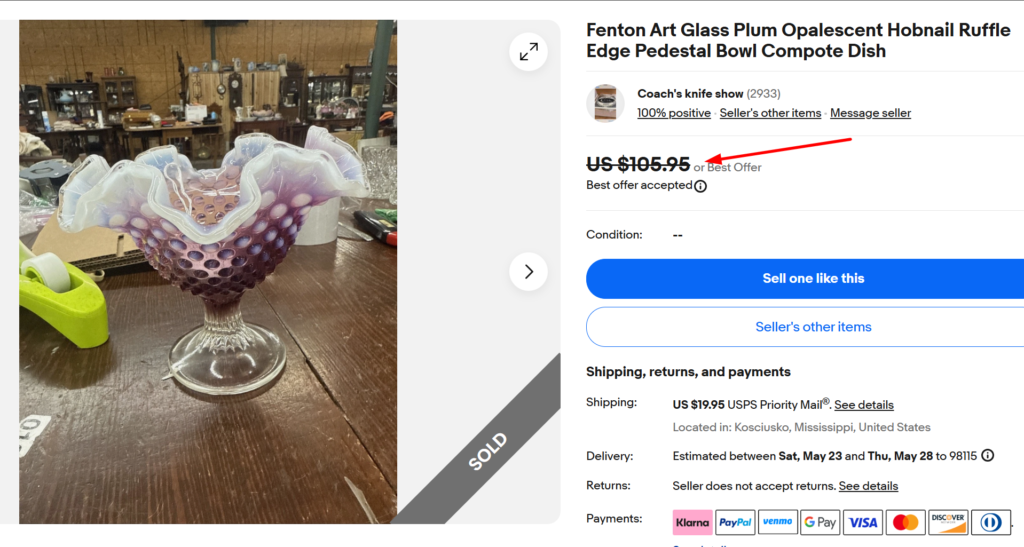
Sold for $105
Fenton’s plum opalescent was produced only between 1959 and 1962, making it among the rarest colors of Fenton’s hobnail glass. The deep, almost black-purple body at the deepest point is the key signal of an authentic piece, not the lighter lavender of reproductions.
The ruffled-edge pedestal compote consists of a clear stem and an amethyst-purple colored body, with white opalescent covering its entire ruffled edge and hobnails.
Smaller compotes and bowls sit in the lower end of the range. Larger 8-inch ruffled compotes, and the plum epergne can clear $300–$500.
- Estimated Value: $80 – $250
- Production Year: 1959–1962
- Characteristics: Purple body, white opalescent hobs, ruffled rim, clear pedestal foot
- Quick Notes: True plum is deep amethyst, not light lavender.
11. Westmoreland English Hobnail Uranium Glass Vanity Set
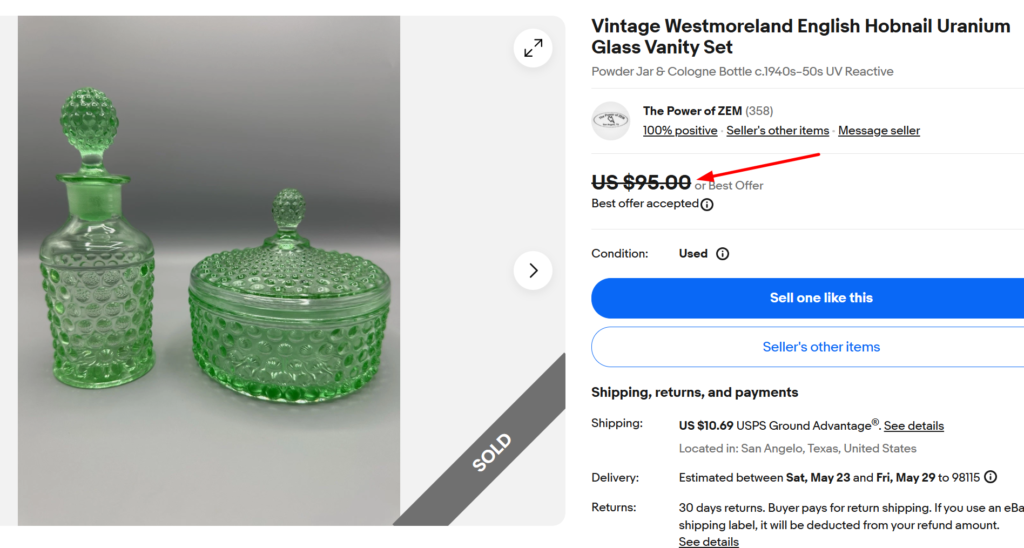
Sold for $95
A Westmoreland English Hobnail uranium vanity set usually has a cologne or perfume bottle with a hobnail-knobbed stopper plus a covered powder jar with a matching ball finial.
Both pieces glow bright green under UV light because of small amounts of uranium oxide in the green glass batch.
The square diamond-grid hobs are the giveaway for Westmoreland English Hobnail, very different from Fenton’s round bumps. Matched sets in original condition sell for the higher end of the range.
- Estimated Value: $80 – $150 (per set)
- Production Year: 1940s–1950s
- Characteristics: Green glass body, diamond-grid hobs, ball-finial stoppers
- Quick Notes: Confirm UV glow for authenticity.
12. Hobbs Brockunier original Dewdrop pitcher
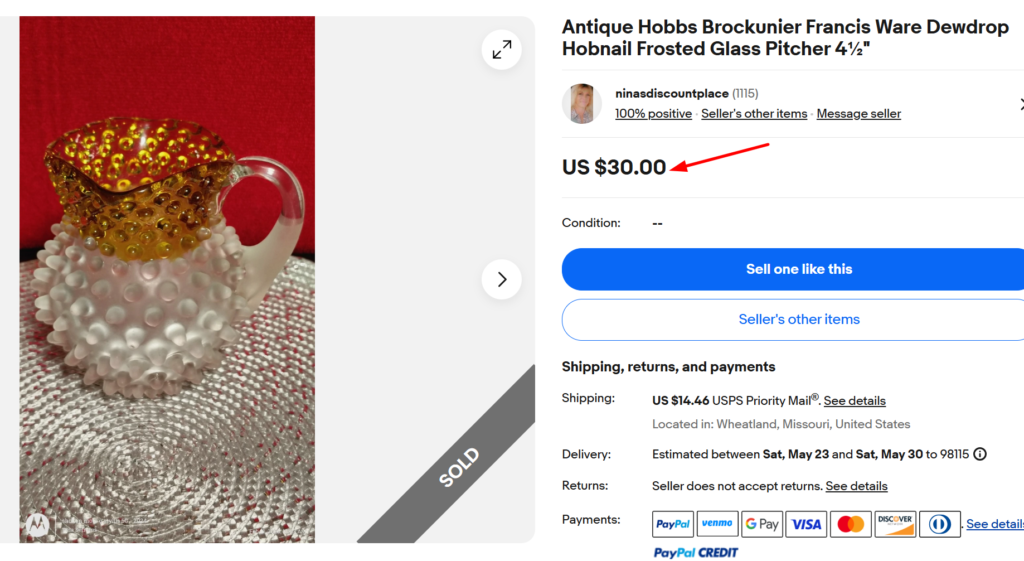
Sold for $30
The Hobbs Brockunier hobnail glass pitcher is the original, the actual antique that started the pattern. These were hand-blown into hobnail molds in Wheeling, West Virginia, between 1886 and 1891.
The handle was applied separately while the glass was still hot, and you can usually feel the pinch where the glassmaker pressed it into place. This example is a small “Francis Ware” creamer-sized pitcher (4–5 inches) with frosted bodies and amber-stained tops.
Larger water pitchers in cranberry, vaseline, and sapphire blue command much higher prices.
- Estimated Value: $30 – $100 (small); $100-$200+ (large, rare colors)
- Production Year: 1886–1891
- Characteristics: Polished pontil base, applied clear glass handle, often Frances Ware (amber-stained or frosted) treatment.
- Quick Notes: No molded marks; identify by form, pontil, and color treatment
How Much Is Vintage Hobnail Glass Worth?
Hobnail glass value covers a wide range, anywhere from $10-$15 to as much as $1,500+. But honestly, most pieces are in the lower value range; only a few pieces make it to the top-tier range.
So, what actually drives vintage hobnail glass value?
The maker matters most. The same form by Fenton can sell for double what L.E. Smith goes for in white milk glass, and a documented Hobbs, Brockunier piece carries a serious premium over any 20th-century version. Then comes the rarity of color and form.
Condition is the second big lever. A single chipped hob, even a tiny one, can drop a piece from collector-tier to bargain-bin. Cracks at handle attachment points, rim chips, and “fleabites” (tiny edge chips) all need close inspection.
Last but not least, completeness matters for sets. A punch bowl missing cups, an epergne missing horns, or a cruet missing its stopper all lose 30–50% of value.