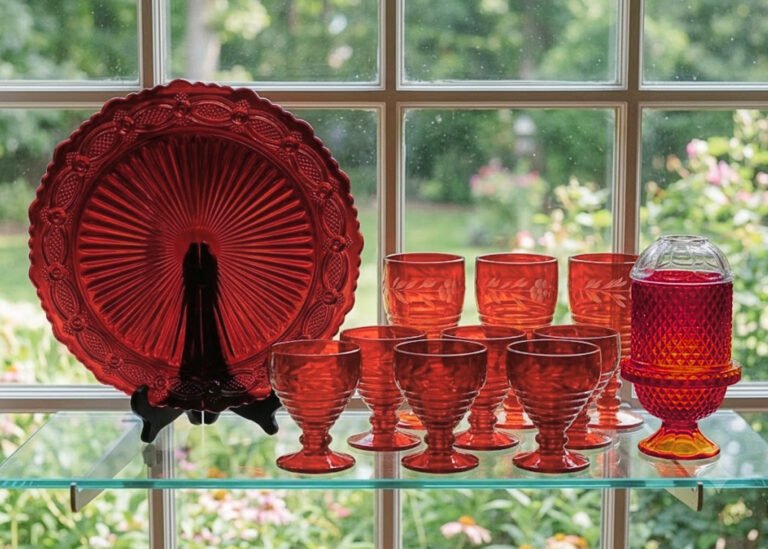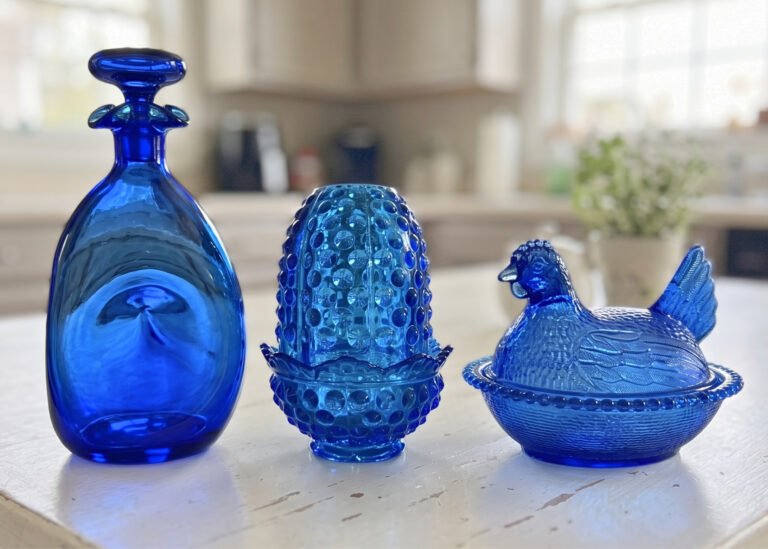

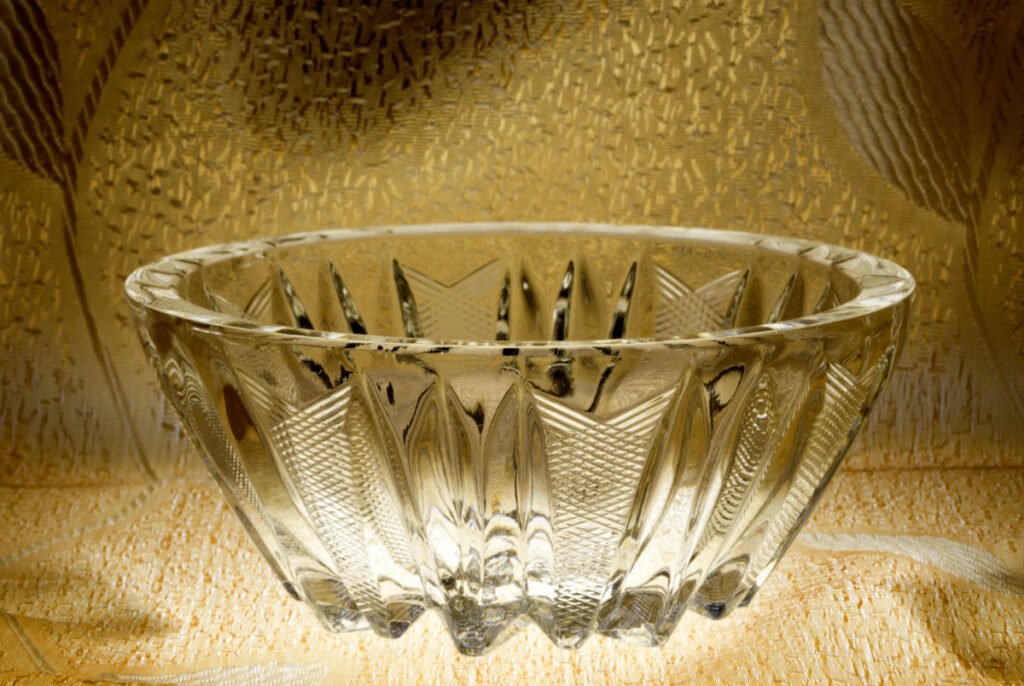
Depression glass is one of those things people walk right past at estate sales, or grab without realizing its actual worth. It’s true that most pieces today sell for $5 to $20, but some patterns and colors quietly fetch hundreds or thousands, as well.
This guide walks through 15 of the rarest finds worth chasing. You’ll learn about the most popular and rare Depression glass patterns, colors, and pieces that collectors are chasing today, and what value they hold.
What is Depression Glass?
Depression glass got its name from the era it was produced in. Between roughly 1929 and 1939, more than 20 American glass companies produced cheap, colorful, machine-pressed glassware to give people something pretty during hard times.
Most of it cost a few pennies per piece or was free. Companies tossed pieces into oatmeal boxes and flour sacks as promotional gifts. Movie theaters handed plates to customers on “Dish Night.” Gas stations gave glasses with a fill-up.
The factories sat mostly in the Ohio River Valley. Top makers included Anchor Hocking (known for moderntone depression glass and Royal Lace), Federal Glass, Hazel-Atlas, Jeannette, Macbeth-Evans, and Indiana Glass. Each had its signature patterns, colors, and quirks. That’s why pattern ID is the key to collecting Depression glass.
Most patterns lasted for just three to seven years before fading from catalogs. Some colors were tried and quickly discontinued. Those short-run colors, plus pieces that broke easily or were made in tiny numbers, are exactly what’s collectible now.
Key Authenticity Signs of Genuine Depression Glass
Before you spend serious money, do a quick check. Reproductions are everywhere, especially in the most valuable patterns. Here’s what to look for on an authentic piece:
- Mold seams running up the sides – Real Depression glass was machine-pressed, so you’ll see faint vertical seam lines. They should feel slightly raised but not sharp.
- Tiny air bubbles – Hold it to a light. Originals almost always have small bubbles and a few imperfections, which is a good sign, not a flaw.
- Straw marks on the base – These are little curved lines from the cast-iron molds. Repros are usually too clean.
- Soft, dusty color tone. All genuine depression glass colors are soft and muted. For example, pink is a soft rose, never bubblegum or orange-pink. Likewise, green has a subtle olive cast, not a bright lime.
- Lighter weight than reproductions – Unlike regular vintage glass, depression glass usually feels noticeably lighter in the hand.
- Sharp, crisp pattern detail – Original molds were detailed, so you’ll see sharp designs in original pieces. Repros and fakes tend to look soft, “mushy,” or blurred, especially around floral patterns.
- No greasy or oily feel – Many reproductions have a slick, almost slippery surface. Real Depression glass feels dry and clean.
There are some specific tests to identify certain patterns, too. For example, for the Cherry Blossom design, count the bumps on the cherries. Originals have 2 bumps per cherry, reproductions have 3.
Similarly, on a Mayfair cookie jar, old lid knobs have 8 sides, new ones have 6. Also, old bottoms have a raised mold ring; modern ones don’t.
Most Valuable Depression Glass Patterns & Colors to Know
The value of vintage Depression glass largely depends on four things: the pattern, the color, the condition, and the completeness.
Below, we will explore the 15 most popular patterns and color variations, covering everything from rare pink depression glass patterns to cobalt blue depression glass patterns and beyond.
1. Cobalt Blue “American Sweetheart” – Macbeth Evans
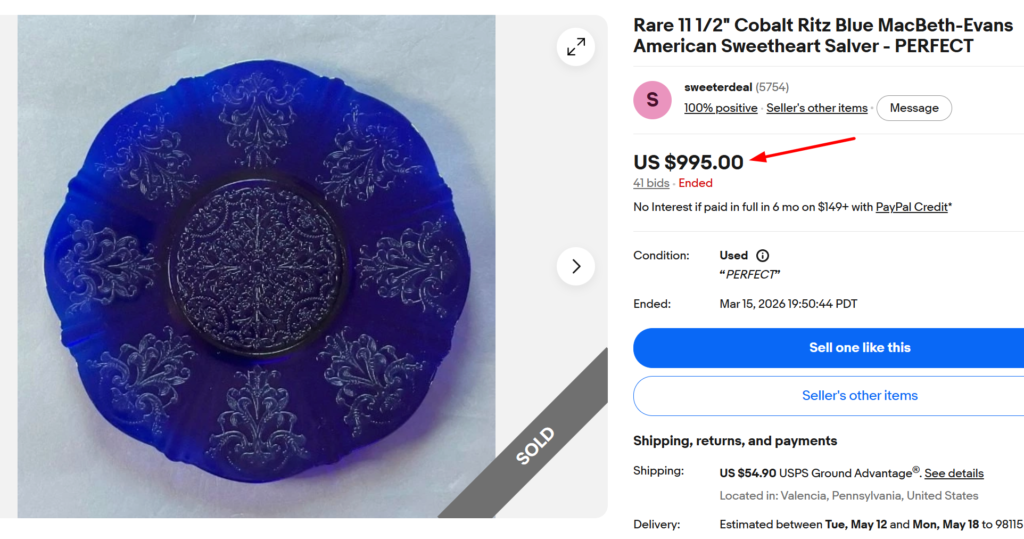
Sold for $995
American Sweetheart has one of the most delicate designs in Depression glass, with swirling scrolls and lacy curlicues. It was made from 1930 to 1936, mainly in pink and translucent white Monax; Ruby red and Ritz blue are the rarest versions, sold only as small dessert sets.
The colored versions were never produced as full dinnerware. Only plates, cups, saucers, sugar and creamer sets, console bowls, and tidbit sets came in red and cobalt. These are the most desirable pieces today.
- Estimated Value: $10-$60 (common, pink); $150-$1,000 (rare, red/cobalt)
- Brand: Macbeth-Evans Glass Company (Charleroi, PA)
- Production Year: 1930 to 1936
- Markings: Occasionally marked “MAC” or “M” in a circle
- Quick Notes: Ruby red is the rarest color, cobalt comes second.
2. Blue “Mayfair / Open Rose” – Anchor Hocking
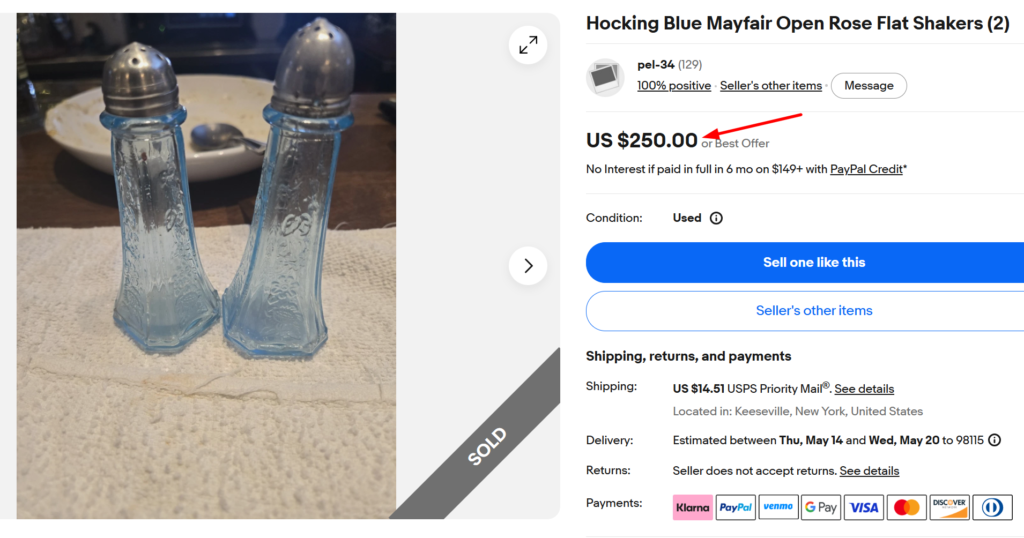
Sold for $250
Mayfair, also called Open Rose, is probably the most collected Depression glass pattern ever made. The design has big open roses with scrollwork, repeated four times around each piece. Hocking ran the pink (Flamingo) line from 1931 to 1937, making it one of the most common pink depression glass patterns today.
But certain pieces are rarer, including the footed pitcher, covered cookie jar, and sugar bowl lid. The design was also made in yellow, green, and ice blue; the last one tops the list of collectible light blue depression glass patterns.
Always check the design carefully. Old cookie jars have an eight-sided knob and a mold ring on the bottom. New ones have a six-sided knob and a smooth base. Also, if the green or pink color looks too pale or too bright, it’s a red flag.
- Estimated Value: $100-$300 (commons); $250-$1,000(rare pieces, pitchers)
- Brand: Hocking Glass Co. (Lancaster, Ohio)
- Production Year: 1931 to 1937
- Markings: Unmarked; identified by the four-rose pattern
- Quick Notes: Cookie jars and pitchers are heavily reproduced.
3. Green & Pink “Block Optic” – Hazel Atlas
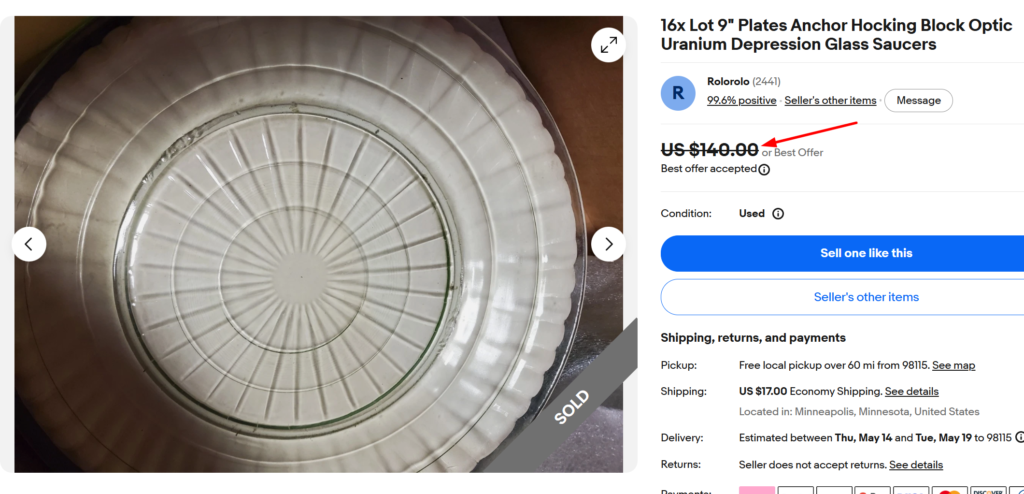
Sold for $140
Hocking produced block optic depression glass from 1929 to 1933 in green, pink, topaz/yellow, crystal, and a little amber. Green is by far the most common, since green was Hocking’s earliest mass color before they branched out. The pink is much harder to find and pricier.
Block Optic is a geometric “block” pattern molded around each piece. Hocking produced 56 distinct pieces in this pattern, featuring multiple styles of cups, creamers, sugars, and plate centers. Pink Block Optic includes a full dinner set.
The pink candy jars, pitchers, and console set pieces are the standouts to watch for. Pink runs noticeably higher than green across the line, and complete pink stemware sets are particularly hard to assemble.
- Estimated Value: $15-$40 (common, pink/green); $80-$200 (rare pieces)
- Brand: Hocking Glass Company
- Production Year: 1929 to 1933
- Markings: Unmarked
- Quick Notes: Pink is significantly rarer than green.
4. Cobalt Blue “Royal Lace” – Hazel Atlas
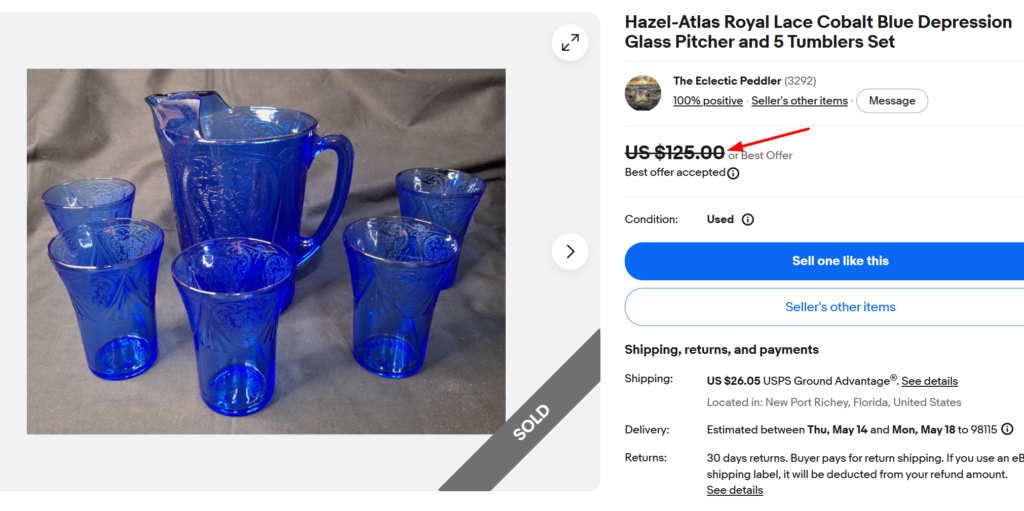
Sold for $125
Depression glass royal lace is one of the most loved patterns of the era, and the cobalt blue version (aka Ritz Blue) is the holy grail. Hazel-Atlas made it from 1934 to 1941, originally in green, pink, and crystal. Cobalt was made in 1936, almost by accident.
Hazel-Atlas had been making blue glass for a canceled Shirley Temple promotion and was stuck with vats of unused cobalt. They poured it into Royal Lace molds, and demand exploded. Today, the cobalt cookie jar, butter dish, pitcher sets, and toddy sets are the most collected pieces.
- Estimated Value: $100-$400+ (standout pieces); $400+ (sets)
- Brand: Hazel-Atlas Glass Company (Clarksburg, WV)
- Production Year: 1934 to 1941 (cobalt blue starting 1936)
- Markings: Some pieces have an “H” over an “A” mark on the base
- Quick Notes: Cookie jars and tumblers reproduced. Original Ritz Blue is brighter and less dark than the fakes.
5. Delphite Blue “Cherry Blossom” – Jeannette Glass
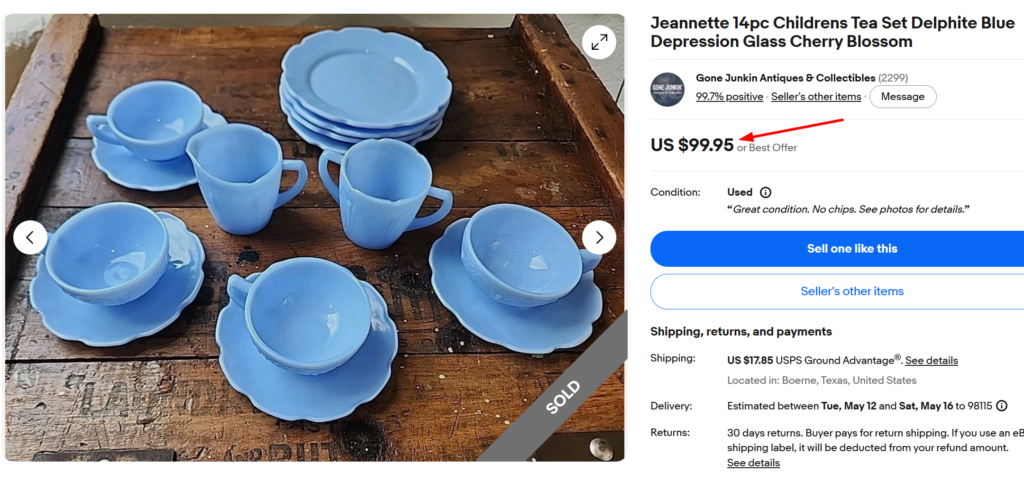
Sold for $100
Cherry Blossom is one of the top 10 most collected Depression patterns. It features delicate cherry branches with blossoms and leaves. Jeannette made it from 1930 to 1939, mostly in pink and green.
Delphite (an opaque pale blue) is the quirkiest color to find in Cherry Blossom design, and it’s one of the most striking light blue depression glass patterns overall. It showed up starting in 1932, including the famous children’s set never made in green. It’s unusual because the design only shows up when you flip the piece over (the pattern is on the outside of opaque pieces).
Note that Cherry Blossom is the most reproduced Depression pattern ever. Fakes have shown up in every color, including ones Jeannette never made (cobalt, iridescent). To check authenticity, check the cherry bump: originals have 2 bumps per cherry, reproductions have 3.
- Estimated Value: $30-$80 (commons); $150-$800+ (rare pieces)
- Brand: Jeannette Glass Company (Jeannette, PA)
- Production Year: 1930 to 1939 (Delphite from 1932)
- Markings: Unmarked, identified by pattern and color
- Quick Notes: Count cherry bumps for authenticity
6. Green “Cameo Ballerina” – Anchor Hocking
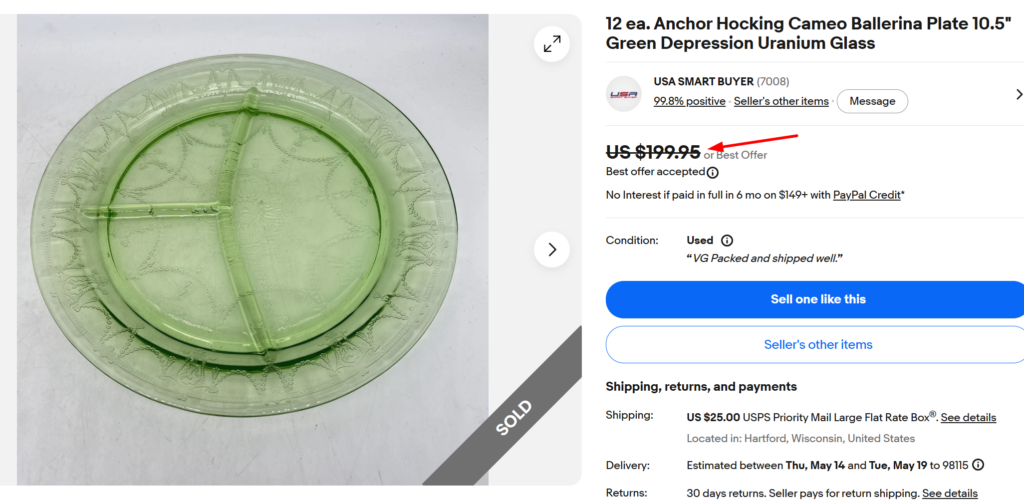
Sold for $200
Cameo gets its name from the tiny dancing-girl silhouette inside each cameo medallion. This was Hocking’s first mold-etched dinnerware, made from 1930 to 1934. Most pieces were green, with smaller runs in yellow (1932-1934), pink, and crystal, making it a key pattern for both green and yellow depression glass collectors.
Hocking sold the basics in boxed sets, so cups, saucers, and dinner plates are common and cheap. Large serving pieces and unique dishes are rarer and more valuable. For instance, the cone-shaped footed tumbler, butter dish, and grill plate can reach $200 or beyond.
The 3.5-ounce wine goblet and 15-ounce footed tumbler in green are among the priciest pieces in all of Depression glass.
- Estimated Value: $10-$40 *(common, yellow) $150-$800 (rare, green)
- Brand: Hocking Glass Co.
- Production Year: 1930 to 1934 (yellow 1932-1934)
- Markings: Unmarked, identified by the dancing-girl cameo
- Quick Notes: Watch for Mosser reproductions in shakers & child dishes.
7. Pink “Sharon/Cabbage Rose” – Federal Glass
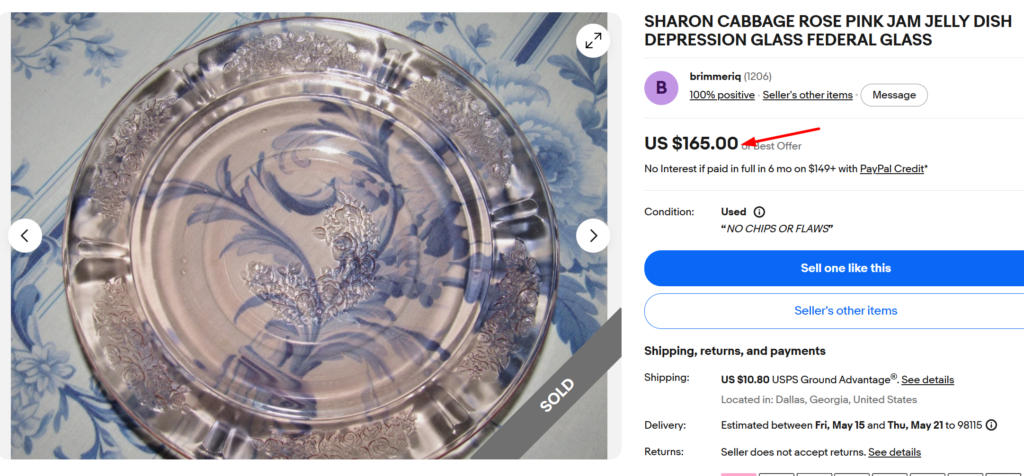
Sold for $165
Cabbage rose depression glass, officially called Sharon, has a chunky rose-and-leaf design pressed all over. Federal Glass made it from 1935 to 1939 in three main colors: amber (“Golden Glow”), pink (“Rose Glow”), and green (“Springtime Green”). Amber is common, pink is rarer, and green is the rarest.
For green Sharon, always confirm the shape is authentic since many shapes were never made in that color, like the flat soup bowl, footed tumbler, and the cheese dish. The footed pitcher and what’s available in green commands a premium.
Sharon is heavily reproduced, so be careful. Any Sharon in blue is automatically fake. Also, new amber Sharon will be too dark, new green and pink too light, and the mold work is mostly sloppy.
- Estimated Value: $20-$90 (common, green); $150-$400 (rare, pink/amber)
- Brand: Federal Glass Company (Columbus, Ohio)
- Production Year: 1935 to 1939
- Markings: Sometimes marked with a shield or “F” in a shield
- Quick Notes: Blue Sharon is fake.
8. Green “Princess” – Anchor Hocking
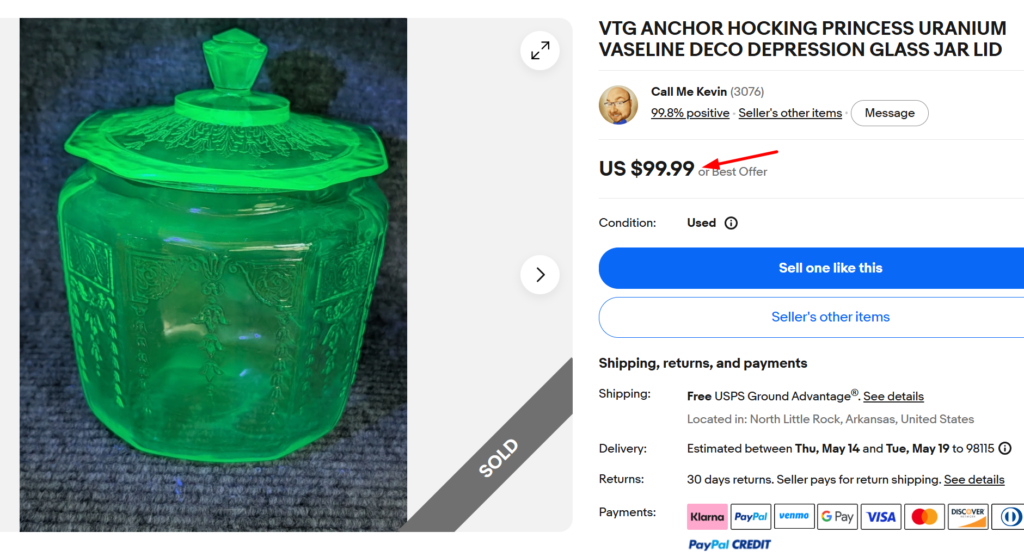
Sold for $100
The depression glass princess pattern has a pretty scrolled and squared design, and it ran from 1931 to 1935. It was Hocking’s second mold-etched pattern after Cameo. The most common colors are green, pink, topaz, and apricot. Some originals were made in light blue, but blue Princess is extremely rare.
Pink, green, and topaz are the most sought-after colors. The cookie jar in pink or uranium green usually sells for $100-$200+ when complete with its lid. Candy jars, tumblers, and grill plates are worth collecting, too. grabbing too.
The Princess candy jar has been reproduced. The easiest test to spot an original is the foot: originals have radiating panels on the underside, reproductions have a smooth, plain foot.
- Estimated Value: $80-$300 (common pink, green); $130-$250 (rare pieces)
- Brand: Anchor Hocking
- Production Year: 1931 to 1935
- Markings: Unmarked; some later pieces show “H” over an anchor
- Quick Notes: Check the foot for panels for authenticity
9. Iridescent “Iris & Herringbone” – Jeannette
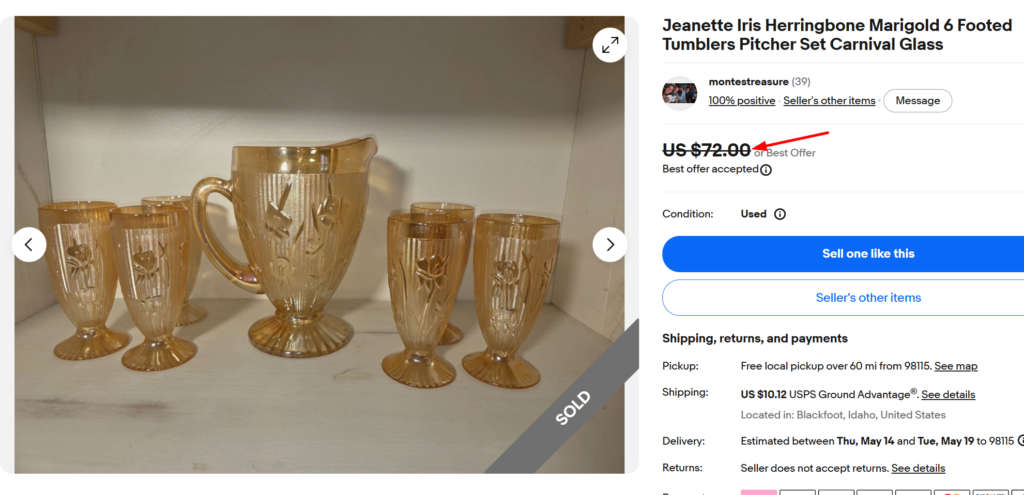
Sold for nearly $75
Iris and Herringbone is one of Jeannette’s most distinctive patterns, with raised iris flowers against a herringbone background. It was released in crystal from 1928 to 1932, and Jeannette brought it back in iridescent (marigold finish) from the late 1940s into the 1950s. Iridescent is the most common version today.
Common iridescent Iris pieces, like cups and plates, are affordable. Some pieces worth finding include the lamp shade, the covered candy dish, certain footed tumblers, the demitasse cup and saucer set, and the iris and herringbone pitcher, which is one of the most recognizable pieces in the pattern.
Iridescent pieces sometimes have uneven color or wear on the marigold finish, so check carefully. The crystal demitasse is even harder to find than the iridescent version.
- Estimated Value: $10-$100 (Common, iridescent); $100-$200+ (rare)
- Brand: Jeannette Glass Company
- Production Year: Crystal 1928-1932; Iridescent late 1940s-1950s
- Markings: Unmarked
- Quick Notes: Check the iridescent finish for wear.
10. Pink “Adam” – Jeannette
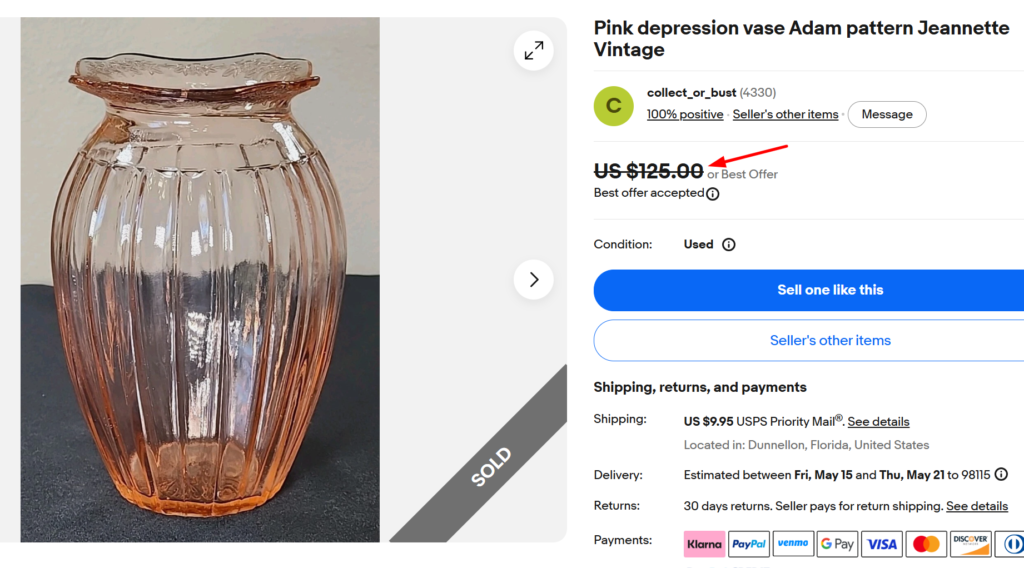
Sold for $125
Jeannette made the “Adam” pattern from 1932 to 1934. It has a striking stylized feather-and-floral design with squared shapes and wide flat rims. It was primarily released in pink and green, but a small number of pieces went out in yellow, Delphite (opaque blue), and crystal.
The pink and green sets are easier to find, with the pink vase and green butter dish being standout high-value pieces. The yellow round salad plates, cups, and saucers are available but rare. Delphite pieces also turn up occasionally. These experimental pieces command real premiums because so few were made.
- Estimated Value: $80-$200 (pink/green) $200-$400+ (rare, yellow/Delphite)
- Brand: Jeannette Glass Company
- Production Year: 1932 to 1934
- Markings: Unmarked
- Quick Notes: Nicks on the wide flat rims hurt value.
11. Green “Miss America” – Anchor Hocking
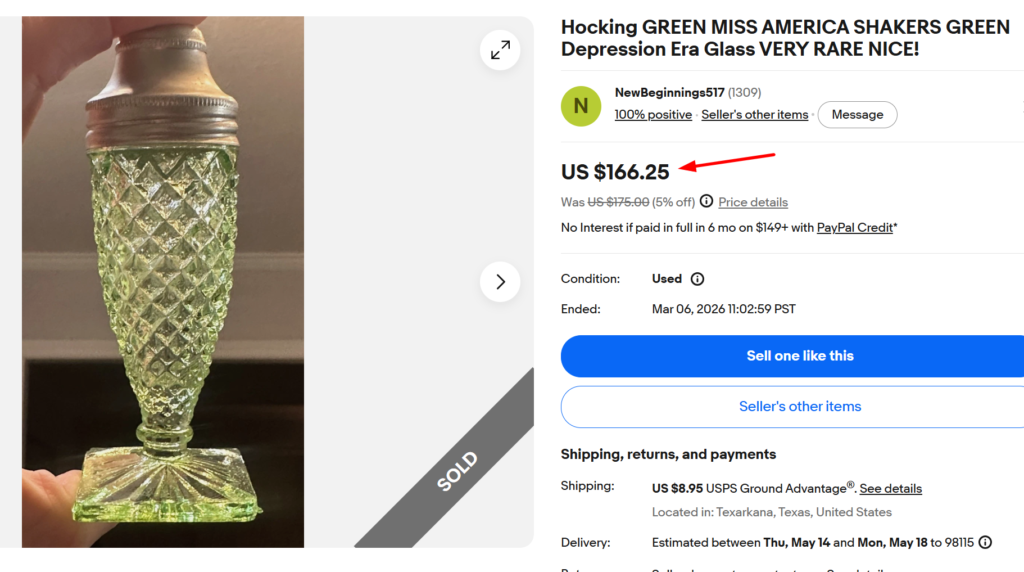
Sold for over $165
Miss America has a sharp diamond-and-hobnail design that catches the eye instantly. Hocking made it from 1935 to 1938, spanning the 1937 merger that created Anchor Hocking. Pink is the popular collector color, and crystal is the most common. Green, ice blue, jadeite, and royal ruby were also made, but barely.
Green Miss America is quite rare. Hocking only made a handful of pieces in a soft light green, including sherbet plates, regular plates, salad plates, berry bowls, 10 oz tumblers, shakers, and the cup. All are worth collecting today.
Royal ruby red pieces are even rarer than green but command similar premiums. A single ruby tumbler or sherbet brings $300+.
- Estimated Value: $10-$50 (common, pink); $80-$250 (ice blue, ruby red)
- Brand: Hocking Glass / Anchor Hocking
- Production Year: 1935 to 1938
- Markings: Unmarked
- Quick Notes: Royal ruby and Blue pieces are exceptionally rare
12. Pink “Dogwood/Apple Blossom” – Macbeth Evans
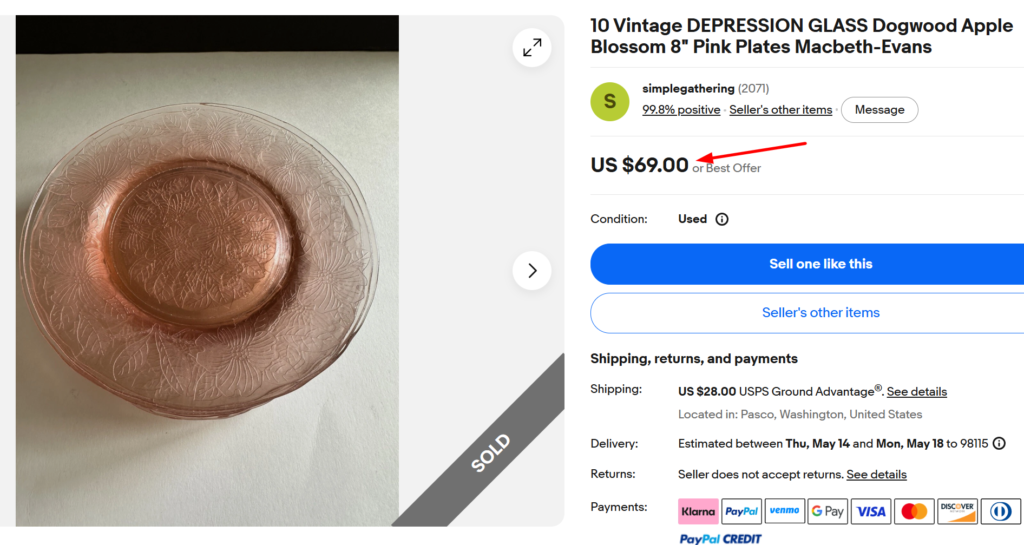
Sold for $70
Dogwood has a busy, all-over design of four-petaled flowers and leaves covering the entire piece. Macbeth-Evans made it from 1929 to 1932, mainly in pink with many pieces in soft apple green.
Crystal, yellow, Cremax (a creamy opaque), and Monax (translucent white) were also made in very small numbers. Pink Dogwood is the most collectible of all today. It comes as a full dinnerware set, which is where the value lies. The pink pitcher with ice lip, tumblers, and the rare pink coaster are among the hardest-to-find pieces.
Remember that the decoration on Dogwood tumblers was silk-screened onto the glass rather than molded into it, so the design can wear off. Pieces with crisp, unworn screening are worth significantly more than faded examples.
- Estimated Value: $15-$50 (Common, pink); $80-$400 (rare, cremax/yellow)
- Brand: Macbeth-Evans Glass Company
- Production Year: 1929 to 1932
- Markings: Occasionally marked “MAC” or “M” in a circle
- Quick Notes: Tumblers are silk-screened, and the design wears off.
13. Red “Manhattan” – Anchor Hocking
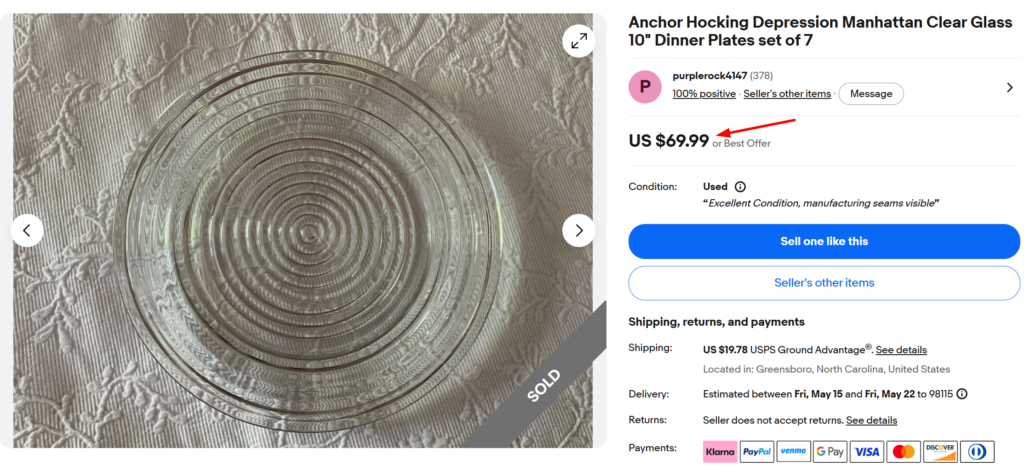
Sold for $70
Manhattan is one of the more striking Art Deco patterns of the era. It was made from 1938 to 1943, mostly in crystal, with smaller runs in pink and limited royal ruby red. The design is all about clean horizontal ribs, no flowers, just bold concentric rings.
Royal Ruby Manhattan is where collectors focus today. The five-piece relish tray set in royal ruby (five rounded triangular inserts nesting around a center plate) is the most recognized piece. Complete sets can run $80 to $200+. Clear crystal pieces, like larger bowls and pitchers, are also worth grabbing.
The royal ruby pieces from the Manhattan line are sometimes mixed up with later Anchor Hocking ruby pieces, like Bubble or generic ruby bowls. Pay attention to the ribbing; true Manhattan has those clearly defined horizontal ribs.
- Estimated Value: $80-$200+ (ruby red); $20-$40 (common, crystal)
- Brand: Anchor Hocking
- Production Year: 1938 to 1943
- Markings: Unmarked
- Quick Notes: Check for rib design to spot true Manhattan from later AH pieces.
14. Blue “Madrid” – Federal Glass
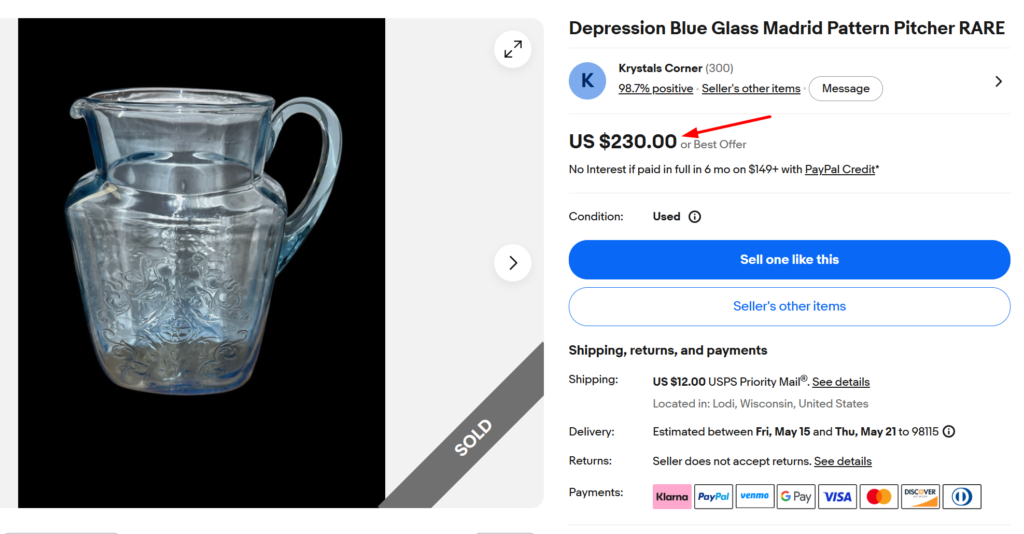
Sold for $230
Madrid pink depression glass is one of the most popular patterns that Federal Glass ever made. It came in amber, green, pink, crystal, and Madonna blue, with blue being the rarest by a wide margin.
The Madonna blue is a soft, almost grayish blue with no green or purple tone. Federal didn’t make many pieces in this color, so even cups and saucers can bring $30 to $50 each. Federal iridescent Madrid, while not as scarce, is also collectible today.
Watch for reproductions called “Recollection.” When Federal closed, Indiana Glass bought the molds and reissued Madrid in 1976 with the date “76” pressed in. Later, they removed the date mark.
- Estimated Value: $25-$80 (cups/pates, blue); $100-$300+ (rare, blue)
- Brand: Federal Glass Company
- Production Year: 1932 to 1939
- Markings: Sometimes shield-mark; repros may have “76” or “77” marks.
- Quick Notes: Any teal-colored Madrid is a repro; Original is soft & grayish.
15. Amber “Parrot Sylvan” – Federal Glass
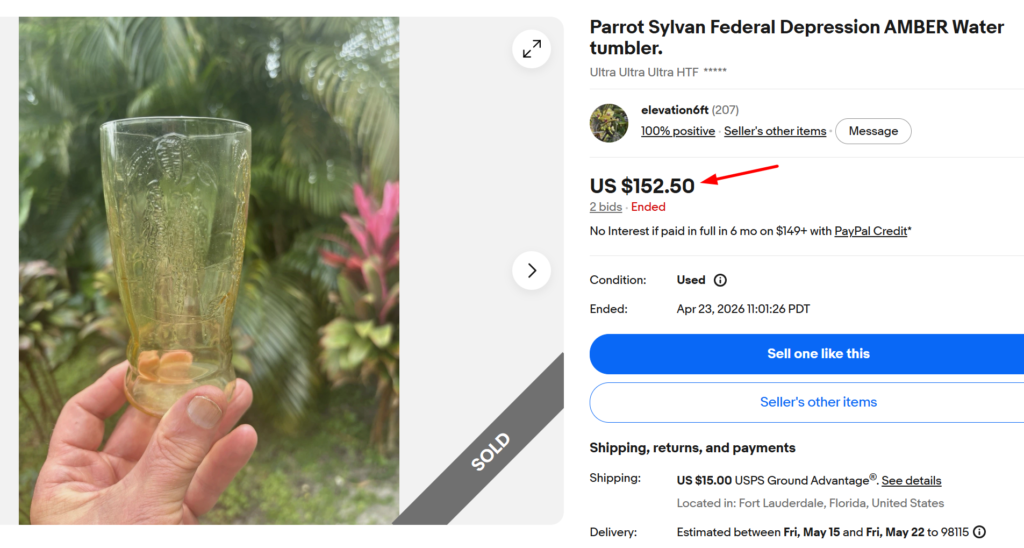
Sold for $150+
Sylvan, called “Parrot” by collectors, is one of the rarest and shortest-run Depression patterns ever made. Federal Glass produced it for just two years, 1931 to 1932. The design features two parrots perched on a branch with palm trees in the corners.
Primarily made in green and amber, it remains one of the most prized amber depression glass patterns today. Common pieces like sherbets and grill plates run $12 to $80. The pitcher, hot plate, and tumbler sets in either color have sold for several hundred to $3,500. Green is even rarer than amber.
Don’t confuse Sylvan with the “Indiana Parrot” pattern from Indiana Glass, which is unrelated and much less valuable. Genuine Federal Sylvan has eight panels, alternating between wide and narrow, around the body.
- Estimated Value: $12-$150 (singles, small sets); $300 to $3,500+ (rare pieces)
- Brand: Federal Glass Company
- Production Year: 1931 to 1932
- Markings: Unmarked; identify by the parrot-and-palm design
- Quick Notes: Don’t confuse with Indiana Parrot.
The patterns and colors shown above are among the most collectible in vintage Depression glassware. But before buying or selling, always check completed sales and auction results to get the best value for your pieces.