
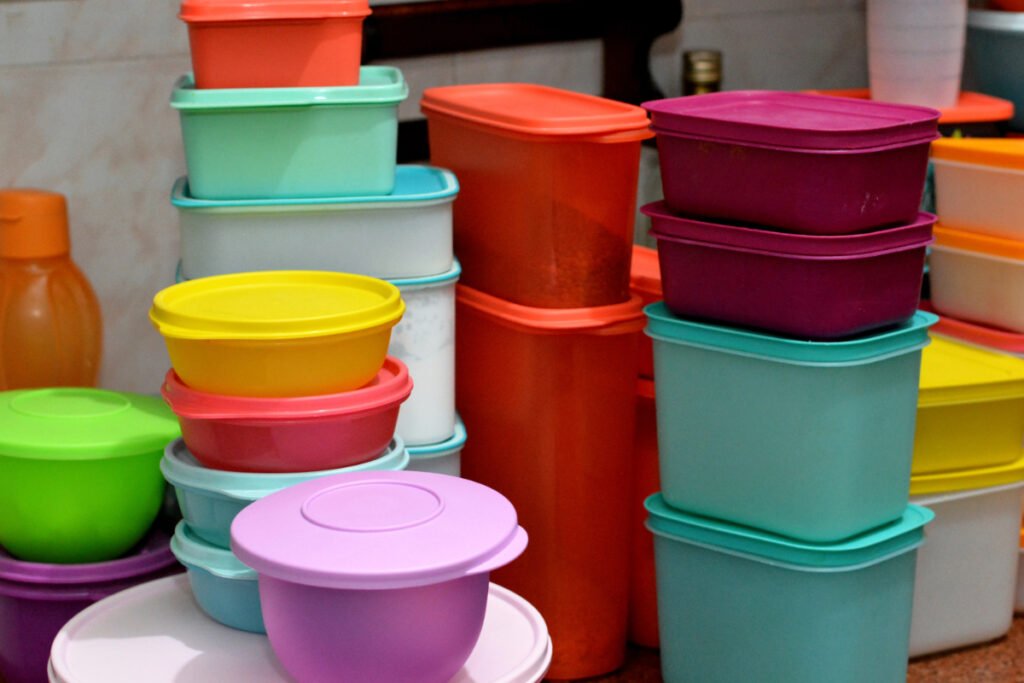
You opened your mother’s kitchen cabinet and saw a stack of orange canisters with weird sunburst lids. Maybe a frosty pastel bowl with a “burping” seal. Most people would toss it without knowing that certain old Tupperware pieces can sell for good money today.
The key is knowing what boosts the value. And this guide will help you with the same. Let’s learn how to identify vintage Tupperware, discover some of the rarest pieces, colors, and lines, and learn what makes it valuable.
What is Tupperware & Why Is It Collectible?
Tupperware was created by Earl Tupper, and his first food storage product, known as Wonder Bowl, went on sale in 1946. What made the product stand out compared to all other plastic kitchenware at the time was its unique design for an airtight “burping” lid.
It became a big hit during the 1950s due to the efforts of Brownie Wise, an independent saleswoman who invented the concept of Tupperware parties in homes across America.
In September of 2024, the company announced its Chapter 11 filing for bankruptcy, which has pushed vintage pieces into collector demand in 2026.
How Much Is Old Tupperware Worth Today?
Honestly, vintage Tupperware generally goes for between $10-$40 each. However, the good pieces, the ones that fetch $75, $150 and even more, often meet several criteria at once.
Here are the factors that actually move the price:
Line and Model
Some Tupperware lines have name recognition with collectors, and some don’t.
The Wonderlier bowls (1946), Bell Tumblers (1946), Millionaire Collection (late 40s–50s), and Servalier canisters (1970s) are the big four. Pieces from these lines move faster and pull higher prices than generic storage containers.
Also, the earlier the line, the more it tends to be worth. A 1950s Millionaire Line salt and pepper set with its original atomic stand can run $60 to $120. A 1990s storage container from the same brand may only fetch under $15.
Color
Color is probably the biggest single value driver in old Tupperware. Some shades indicate a specific decade, and collectors hunt them. Others fade badly, which makes the unfaded survivors rare.
Then, there were also some color combinations that were tried out temporarily but simply did not sell well. These are quite rare and valuable.
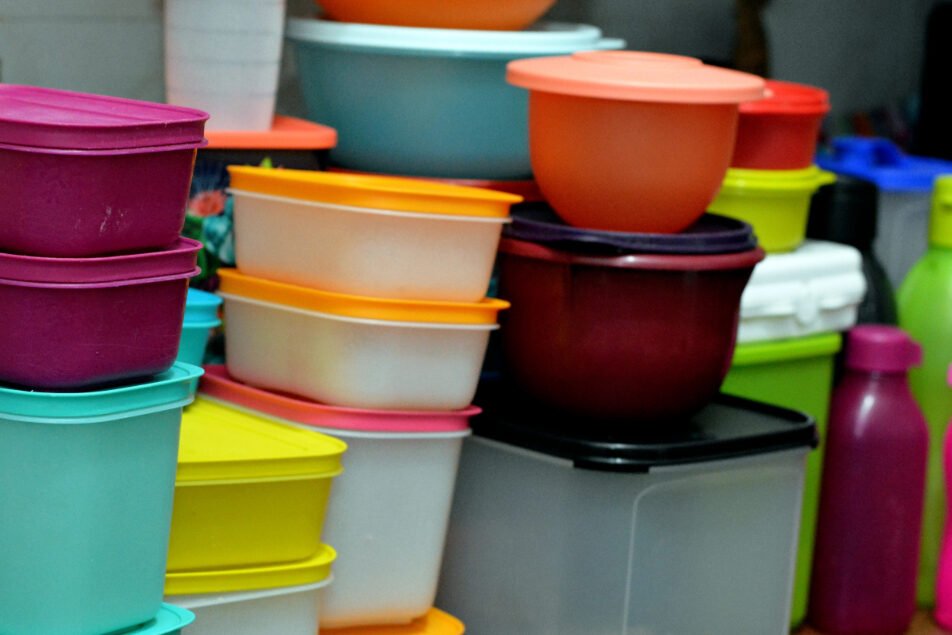
Check out a brief run-down on some vintage Tupperware colors sought after by collectors and their prices on eBay. Prices also reflect that complete sets in rare vintage colors or rare single pieces are worth more; individual pieces in common forms run lower.
Below are some key vintage Tupperware colors you must know.
| Color | Era | Why Collectors Want It | Average Value |
| Harvest Gold | 1970s | Very recognizable | $25–$60 (set) |
| Harvest Orange | 1970s | iconic Servalier color | $40–$90 (set of 3–4) |
| Avocado Green | 1970s | Part of nesting sets | $30–$70 (set) |
| Pastel Pink | 1950s–60s | Unfaded pieces are rare | $40–$100 (set) |
| Jadeite Green | 1960s–70s | Known for milk-glass jadeite look | $50–$150 (set) |
| Pastel Yellow | 1950s | Common in Wonderlier/Bell lines | $30–$60 (set) |
| Pastel Blue | 1950s–60s | Scarcer than yellow | $35–$70 (set) |
| Frosted/Sheer White | 1940s–50s | Earliest Tupperware | $20–$80 |
Pink is a desirable color. Most of it lost its color over decades of sun and washing. So when an unfaded pink set turns up, it can punch well above what you’d expect.
Condition
Since Tupperware is made of plastic, the rules for condition vary from other containers that are either glass or pottery.
The important factors collectors pay attention to are: that the seal works, the color is still vibrant, and no signs of melting exist from a dishwasher or stove-top.
A complete set of Servalier, which has a cracked lid, will be worth 30-50% less. Heavy staining from spices, turmeric, or tomato sauce knocks off another chunk. Crisp, unstained, color-true pieces are the ones pulling top dollar.
Completeness of the Set
Completeness matters more than people think. A single Wonderlier bowl with its original seal might pull $15 to $25. A complete nesting set of four or five Wonderlier bowls with every original seal can clear $100 to $175.
The same goes for canisters. A lone Servalier canister is a $10 to $20 item. The full graduated set of three or four in matching harvest colors can go for $75 to $90. So, original lids and seals are essential. And so is the original packaging in good condition.
13 Valuable Vintage Tupperware Finds to Look for
Here are 13 vintage Tupperware pieces, ranging from the iconic 70s canisters to short-run novelty items. These pieces are actively collected today and sell for reasonable prices.
1. Tupperware Modular Mates Set
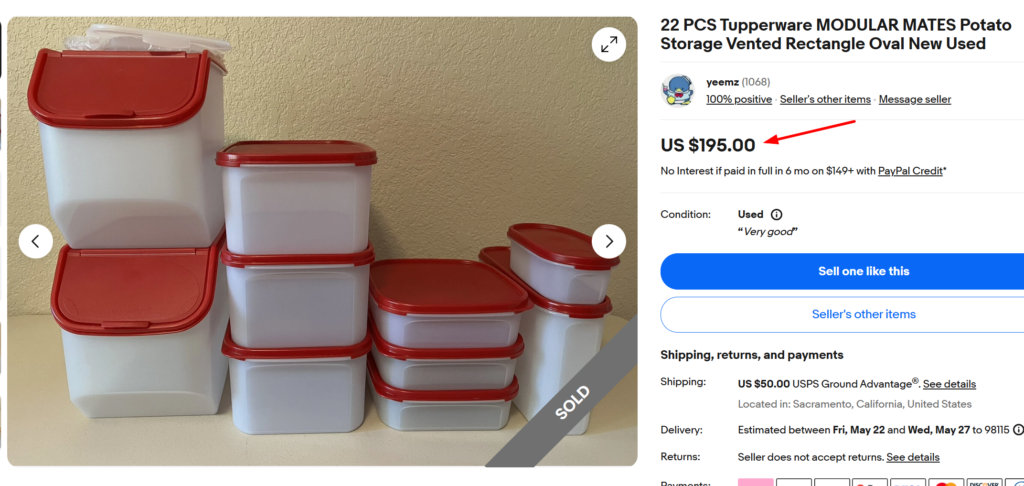
Sold for $195 (set)
Modular Mates launched in 1983 as Tupperware’s stacking square and rectangular canister system. The original 80s sets came with deep red, brown, or dark green push-button lids.
Because they’re stackable and still very usable, vintage Modular Mates sell more for function than nostalgia. A complete original 1980s set of 5 to 6 pieces with original lids in matching colors runs $40 to $80. Single pieces sell for $8 to $15.
The spaghetti container (model 1661, tall and narrow) is the one most collectors hunt to complete sets.
- Estimated Value: $40–$100 (full vintage set)
- Production Year: 1983 onward
- What to Check: Original 80s color lids (not modern black); all seals included.
- Quick Notes: Vintage Modern Modular Mates uses earthier tones.
2. Orange Tupperware Servalier Canister Set
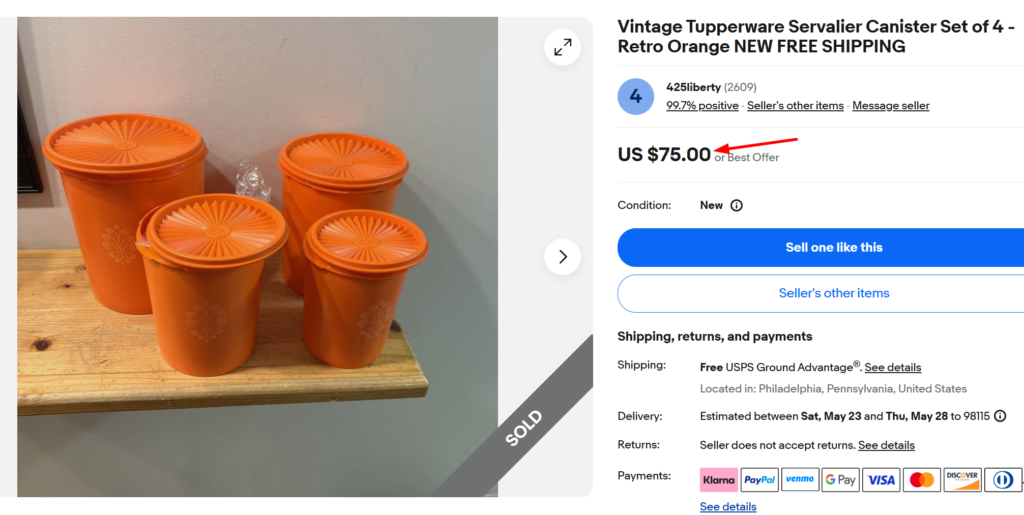
Sold for $75 (set)
The Servalier line was Tupperware’s answer to kitchen canisters in the 1970s. The name comes from “serve” and “seal.” Press the center of the push-button sunburst lid on top, and it instantly seals. Most sets came in graduated sizes of three or four.
Harvest orange is the most sought-after color among collectors. Complete sets in matching orange with all original sunburst lids are the holy grail.
- Estimated Value: $40–$90 (set of 3–4 with lids)
- Production Year: 1970s
- What to Check: All sunburst lids present and crack-free; matching color across pieces; the push-button still seals
- Quick Notes: Mold numbers like 811, 1204, 1297. Check the bottom of each piece.
3. Tupperware Wonderlier Bowls (with Original Seals)
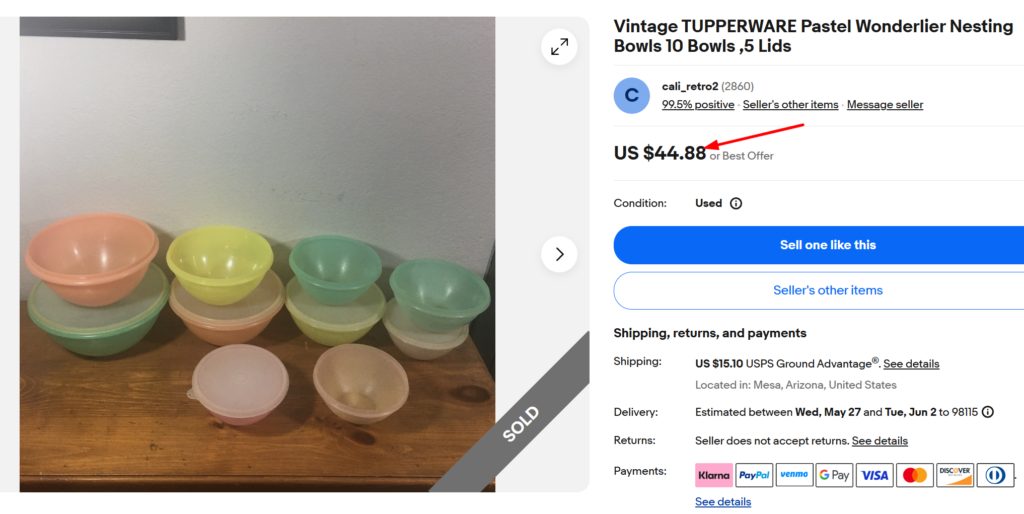
Sold for $45 (set)
This is the starting point. Earl Tupper introduced the Wonderlier bowls in 1946, making them the first plastic food storage containers ever to appear in America. The nesting bowl system and burping seal design made Tupperware what it became.
Older sets of Tupperware were available in pastel colors like pale pink, mint green, yellow, and light blue with matching or white lids.
The most important value factor is the lids. Many sets show up missing one or two original seals, which kills the value. A full nesting set of four or five with every original seal can clear $40 to $150 in good condition.
- Estimated Value: $40–$150 (complete set with all seals)
- Production Year: 1946 onward (vintage pastels mostly 1950s–60s)
- What to Check: All original seals included; bowls still flexible, no melt marks
- Quick Notes: Early Wonderliers with the “Tupper” mark are more valuable.
4. Jadeite Tupperware (Color)
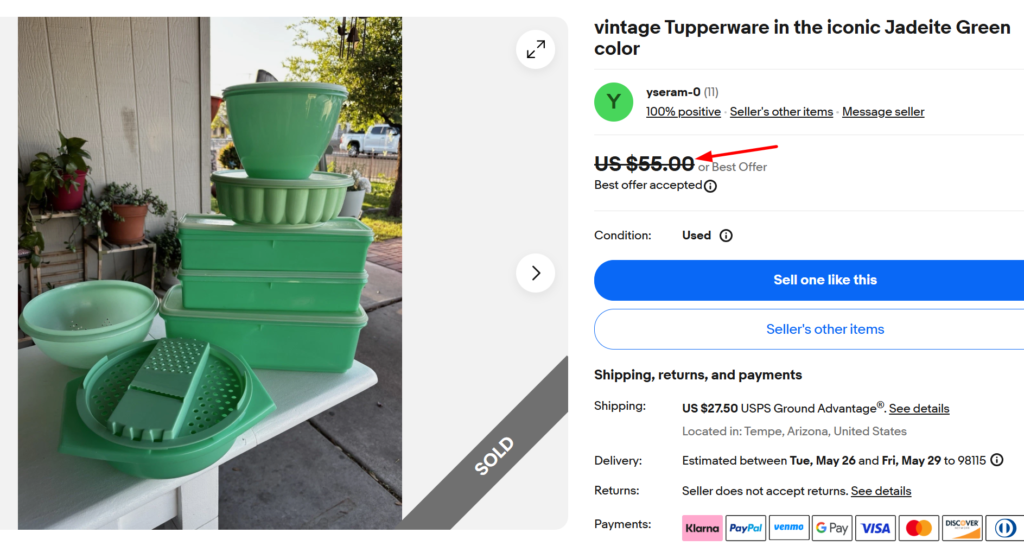
Sold for $55 (set)
Jadeite-colored Tupperware isn’t a separate line. It’s a color that mimics the milk-glass jadeite popular in mid-century kitchens. This shade ran across several lines, including graters, celery keepers, and small storage pieces, mostly through the 1960s and 70s.
It shows up less often than harvest orange or avocado green, which makes complete jadeite-colored lots and sets genuinely rare.
- Estimated Value: $50–$150 (multi-piece groupings)
- Production Year: 1960s–1970s
- What to Check: Color hasn’t faded or shifted; all original parts (graters, strainers, inserts) included
- Quick Notes: Top value comes with matching multi-piece lots.
5. Pastel Pink Canisters
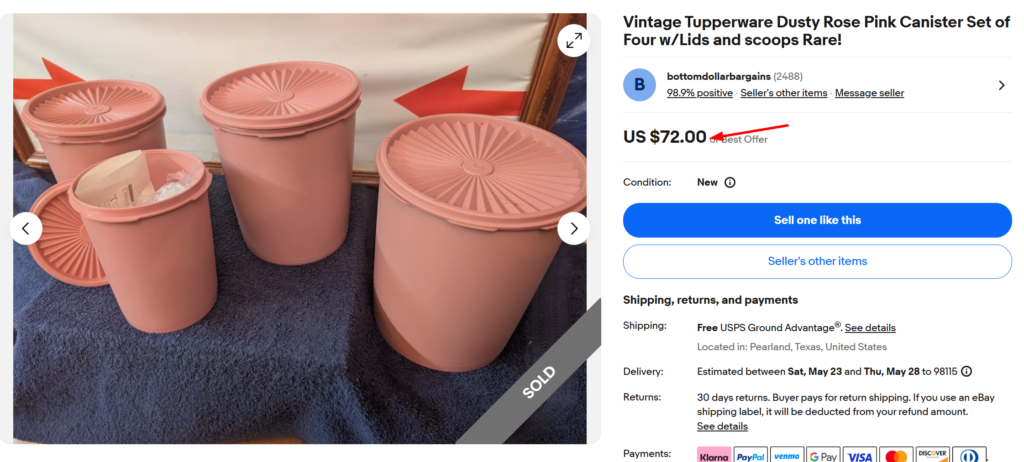
Sold for $72 (set)
The pink Tupperware pieces have to be among the most difficult to find in good condition, as the original pink color turns to a dingy brownish color from sun exposure and dishwashing. So the unfaded pieces are genuinely rare.
Pink showed up across Bell Tumblers, Wonderlier bowls, and the larger Servalier-style canister sets in dusty rose. Sets of four pink canisters with sunburst lids are usually more valuable than tumblers, as they are larger and rarer to come by.
- Estimated Value: $30–$80 (tumbler/bowl sets); $60–$100 (canister set)
- Production Year: 1950s–early 1970s (depending on form)
- What to Check: Pink is still vibrant (not faded to peach or tan); seals and scoops included.
- Quick Notes: Hold up to natural light; true vintage pink stays saturated.
6. Jel-N-Serve Jello Molds
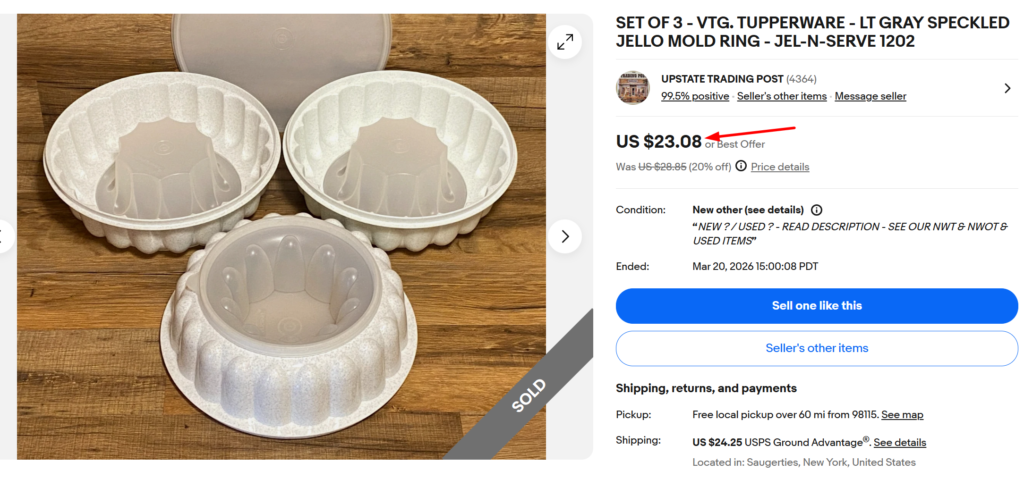
Sold for $23 (set)
Jel-N-Serve from Tupperware is part of the jello-mold fad of the 1960s and 1970s. The package consists of a round fluted dessert mold (normally one quart size), a lid to seal it, a serving tray, and various insert designs for decorating the jello.
Most molds show up in white or sheer, but a light gray speckled “granite” variant (mold 1202) appears occasionally and pulls a premium for its rarity. The value of any Jel-N-Serve lies in completeness; full kits are worth more than molds with lids.
- Estimated Value: $20–$35 (complete set); $8–$15 (mold + lid only)
- Production Year: Late 1960s–1970s
- What to Check: All 3–4 pattern inserts present; serving platter included
- Quick Notes: Heart-shaped variant mold #631 is rarer.
7. Harvest Gold Pitcher & Tumblers Set
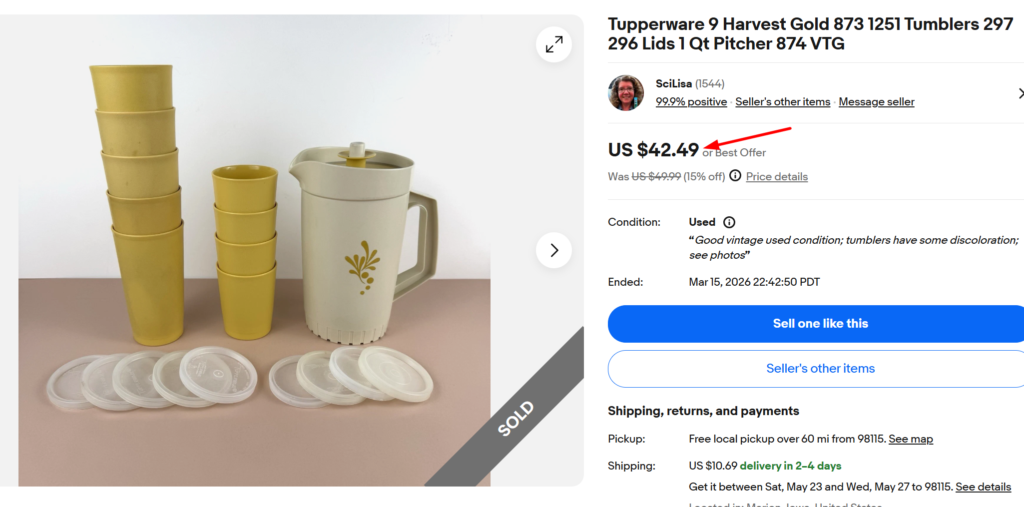
Sold for $42 (set)
The push-button harvest pitcher is among the most recognized 70s Tupperware shapes. It is a 1 to 2-quart pitcher with a sunburst design push-button lid, which is harvest gold or harvest orange.
You can see them being auctioned all the time on eBay, but at a lesser price than you’d expect. That’s because they were made in huge numbers. The pitcher alone runs $10 to $25 in good condition.
But pair it with a matching set of stacking tumblers (model 873 or 1251) and their original sheer lids, and the full beverage set can fetch $40-$50.
- Estimated Value: $10–$25 (pitcher); $40–$60 (matched drinkware set)
- Production Year: 1970s
- What to Check: Push-button seal still works; no cracks at the spout; color hasn’t yellowed.
- Quick Notes: Mold numbers include 587, 800, 874, and 1676 across different shapes and decades.
8. Tupperware Mini Party Set
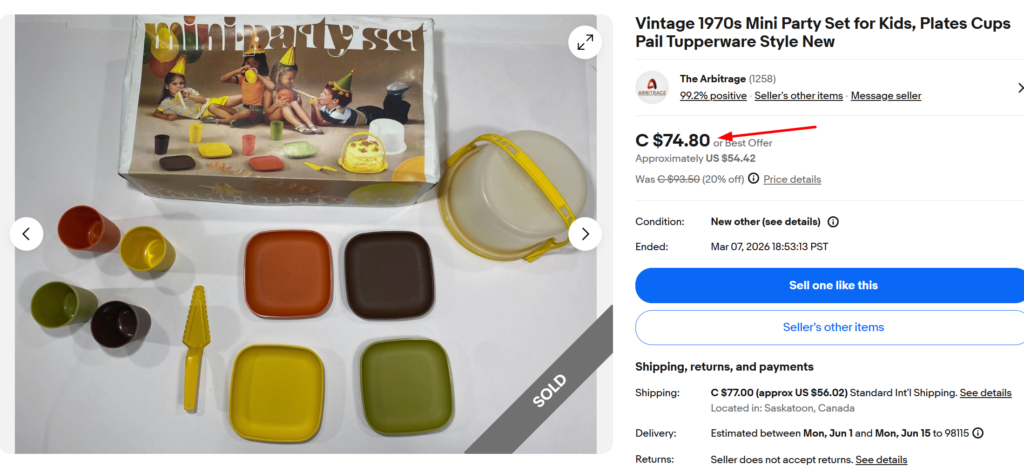
Sold for almost $75 (packed)
Tupperware sold a line of kids’ toys called Tupper Toys, and the Mini Party Set is one of the most collected. It’s a miniature version of a real Tupperware party setup with a tiny pitcher, mini bowls, small tumblers, plates, and sometimes a tiny cake carrier.
These hit kids in the 70s and 80s, and now those kids are buying them back as adults. Complete sets in the original box can pull $40 to $60, with boxed and unused examples fetching higher.
- Estimated Value: $25–$60 (loose); $50–$80 (complete in box)
- Production Year: 1970s–early 1980s
- What to Check: All pieces present (count against original box list); original colors not faded.
- Quick Notes: The Mini Mix-It and Mini Serve-It sets are related and worth checking for
9. Preludio Acrylic Tumblers
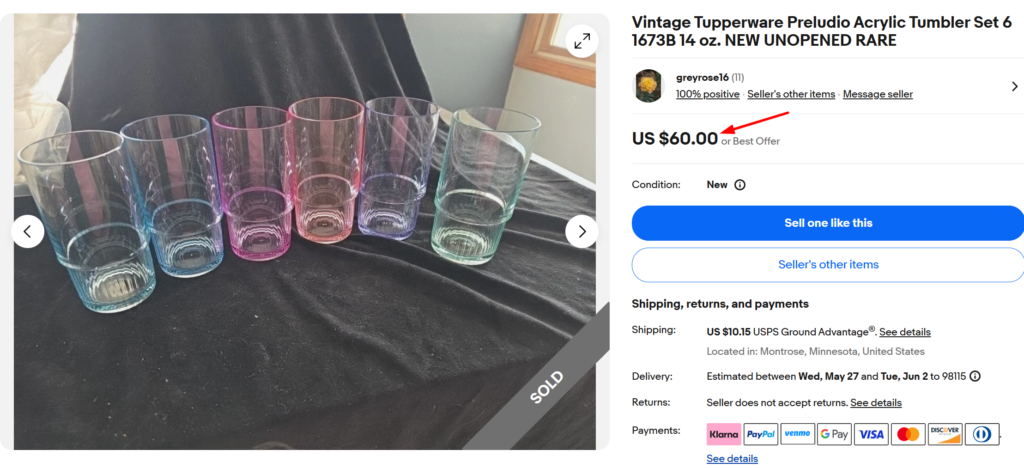
Sold for $60 (set of 6)
The Preludio line (mold 1673) consists of Tupperware stackable acrylic tumblers from the 80s and 90s. It comes in a 14-oz capacity, and each of the tumblers has a side texture to give a little grip.
The most appealing thing about these collectibles for people is their colorful appearance. Collectors usually look for a set with 6 different colors. Sets that are still in the package sell well since their acrylic remains crystal clear, while the used sets have an opacity due to dishwashing.
- Estimated Value: $30–$45 (used set of 6); $55–$70 (unopened set)
- Production Year: 1980s–1990s
- What to Check: All 6 colors present; acrylic still clear (not cloudy or hazed)
- Quick Notes: Larger tumblers are more valuable. Check the mold number.
10. Blockbuster Video Popcorn Bowl
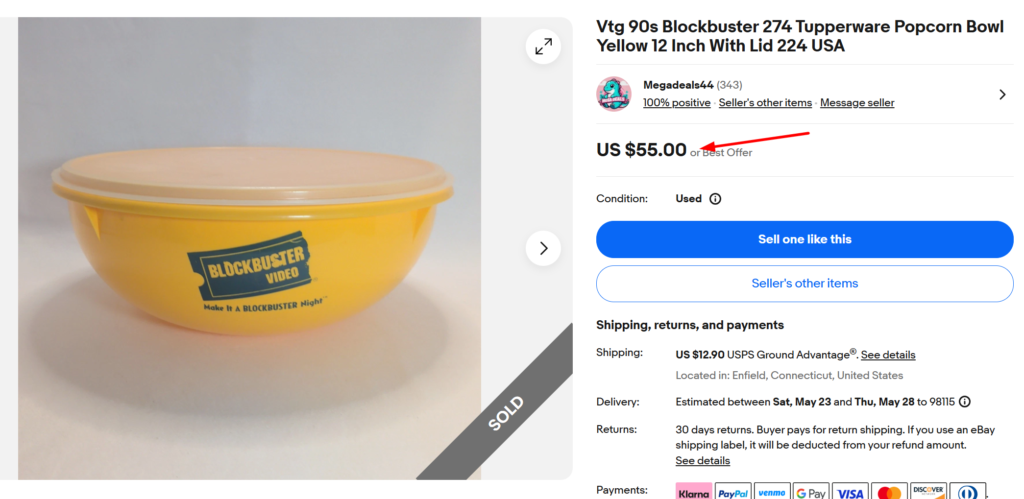
Sold for $55
This is not a real vintage collectible; it is a ’90s collectible, but still worth mentioning. Tupperware produced this 12-inch “Make It A Blockbuster Night” lidded popcorn dish to be used as part of the marketing scheme for Blockbuster Video.
The crossover of vintage Tupperware and the dead-and-buried Blockbuster brand makes it collectible. Clean examples with the original tabbed lid can sell for $30 to $60 today; missing lids drop value.
- Estimated Value: $30–$60 (with original lid)
- Production Year: 1990s
- What to Check: Blockbuster branding still readable; clear tabbed lid present
- Quick Notes: 90s Tupperware piece with collector demand
11. Harvest Gold Cake Carrier with Handle
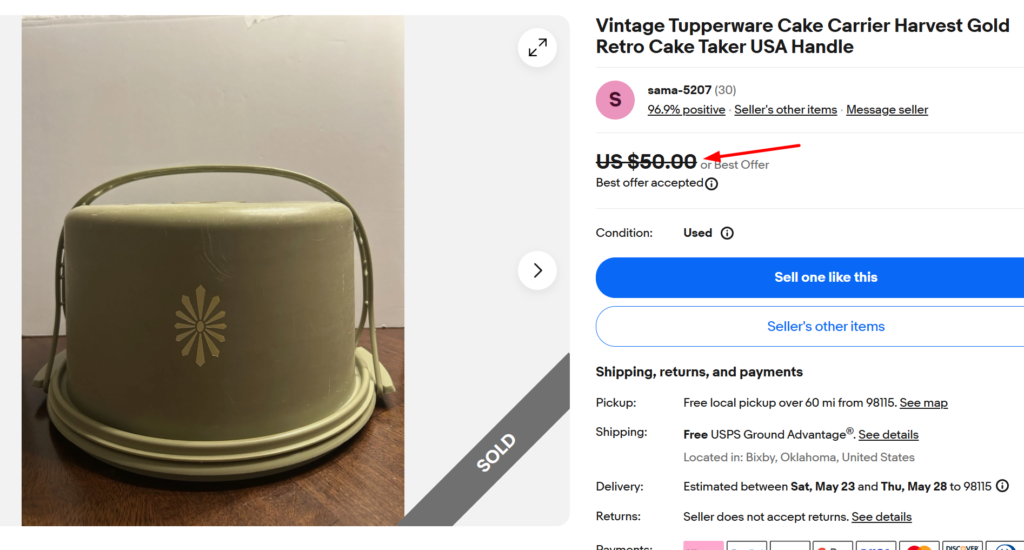
Sold for $50
The Tupperware pie taker (mold 719) and cake taker (mold 683) are round carriers with a domed lid and a center carrying handle. Harvest gold is the most common vintage color. They were a Tupperware party staple in the 60s and 70s for transporting dessert.
These are common, so prices stay modest. Yellow and white versions tend to sell slightly lower than harvest gold. Also, the original handle and a working latching seal are crucial for high value.
- Estimated Value: $15–$35
- Production Year: 1960s–1970s
- What to Check: Handle intact and screwed on tight; latching tabs not broken.
- Quick Notes: Rectangular cake takers are slightly rarer than round ones.
12. Millionaire Line Salt & Pepper with Atomic Stand
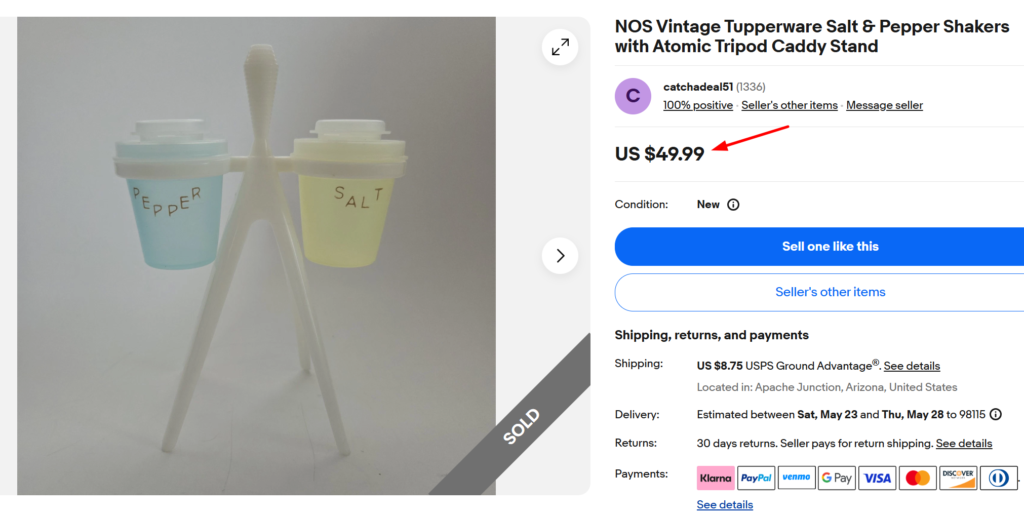
Sold for $50 (pair with stand)
This is one of the most recognizable 1950s Tupperware pieces. The Millionaire Line was launched in the late 1940s. The salt and pepper shakers came in mini sizes, mounted in a tripod stand with atomic-age legs, sometimes with a toothpick holder.
Pastel pink, blue, and yellow are the standard colors. The big value bump comes from the original printed “S” and “P” lettering still visible on the shakers, which fades easily with use.
This piece is valuable as a pair with a stand; the shakers alone usually sell for $10-$15.
- Estimated Value: $45–$120 (with stand and clear lettering)
- Production Year: Late 1940s–1950s
- What to Check: Original tripod stand; “S” and “P” letters still readable; all caps intact
13. Push-Button Servalier Bowl
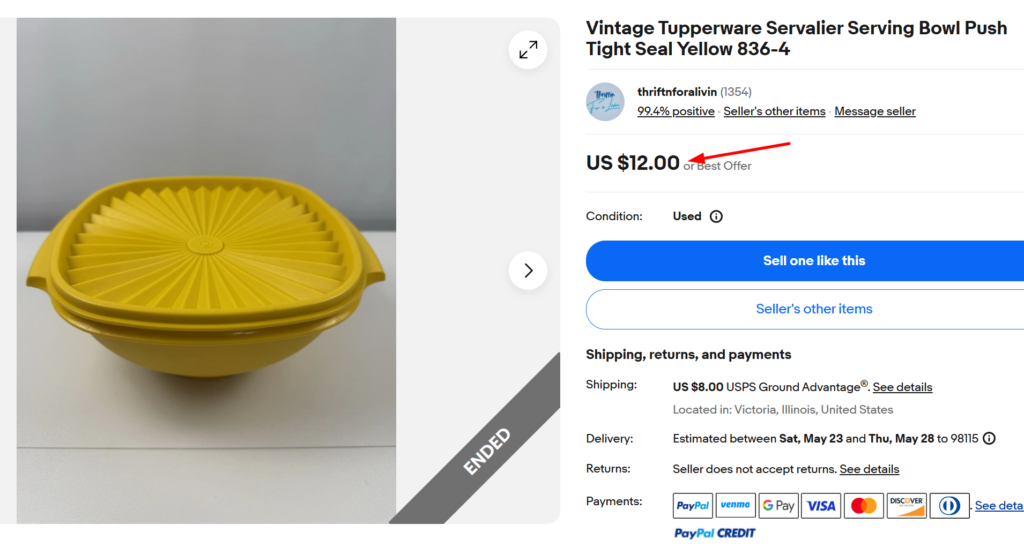
Sold for $12 (single)
Smaller cousin to the Servalier canister, the Servalier bowl has the same press-the-center sunburst lid but in a shallower nesting bowl shape. They came in nesting sets of three to six, and most were marketed for everyday food storage and serving.
These pull less than the canisters but are easier to find as complete sets. Harvest orange, avocado green, and the 1980s indigo blue are the most collectible colors.
- Estimated Value: $20–$60 (set of 4); $8-$15 (singles)
- Production Year: 1970s–1980s
- What to Check: Push-button seal still snaps tight; no warping in the lids, crisp sunburst pattern.
- Quick Notes: Genuine mold numbers include 858 and 1323.
How to Identify Vintage Tupperware?
If you’ve got an old plastic container in your hands and want to determine whether it’s indeed vintage Tupperware, here’s the handy checklist for you.
The Bottom Stamp
This is the most important clue. Authentic Tupperware will always have “Tupperware” embossed into the plastic itself and not just stamped on top or even on a label. If there is no such embossing, then chances are high that your piece is counterfeit.
Pieces that have only “Tupper” or “Tupper Plastics” (instead of Tupperware) on them were the first items manufactured in the late 1940s and up to around 1952. Some early pieces also carry “Pat. Pend.” or actual patent numbers. This will be the hardest-to-find stamping you will find.
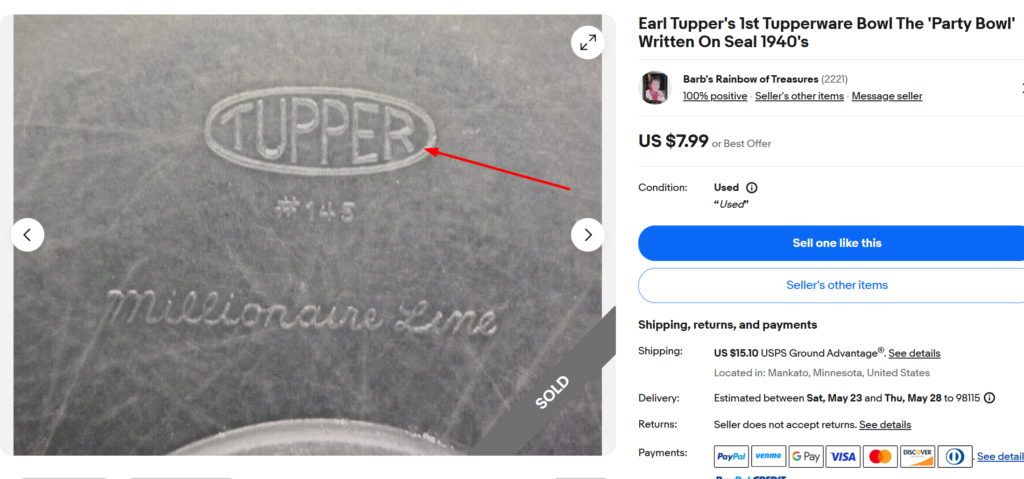
In post-1952 pieces, the “Tupperware” embossing appeared. You may also observe a number with two digits put next to the Tupperware logo. It may look like “234-5” or “1204-7”.
Here, the digit appearing before the dash is the mold number, and using the mold number, we can determine the type of the item, such as Wonderlier bowls or Servalier canisters.
The number after the dash is only the cavity number of the mold, identifying where in the mold used for manufacture your stamp was created. It has nothing to do with value, but it can be interesting to track.
Colors (for Dating)
Colors are not just value drivers; they can also help track the age of an old Tupperware find. The Brand adhered to the prevalent kitchen color trends of that time, so you can determine the approximate period just by the shade.
- Late 1940s and 1950s – Pastel shades like pink, mint green, light yellow, and baby blue date from this period, and usually came with white or see-through lids. Frosted or sheer white pieces are also typical of this earliest era.
- The 1960s – 60s brought slightly bolder colors but kept some pastels around. Sheer crystal, almond, and mid-tone yellows became common. Mid-decade is when Jadeite green appears in specialty pieces like graters and celery keepers.
- The 1970s – The 1970s colors are the easiest to identify. Earthy tones like harvest orange, harvest gold, avocado green, and brown colors reign.
- The 1980s – Jewel tones became popular during the 1980s, including cranberry, indigo, hunter green, and dark brown, with the introduction of Modular Mates in those colors.
- The 1990s – During the 1990s, the colors became brighter and bolder, such as teal and fuchsia.
Material Differences
The older Tupperware is very distinct from the newer plastics. You can learn the difference after handling only a few authentic pieces. The older pieces from the ’40s through the ’70s are made from a softer polyethylene, which will flex a little bit when you squeeze it on the side.
That flexibility was the whole point. The “burping” seal needed to give in the plastic to push out air and create the vacuum. So, if the item seems hard and brittle like modern plastic, then it definitely is not an original from the golden age.
But there are some signs to look out for: Some discoloration in white or transparent objects after years of use; a slightly waxy or chalky texture due to polyethylene deterioration, and some warping of the edges.
Tupperware switched to polypropylene plastic in the 1970s for some product lines, which feels slightly stiffer and shinier than the older polyethylene. By the 1990s, most newer pieces felt closer to modern plastic, which is a useful tell for dating mixed lots.
Original Tupperware vs. Reissues
The current “Heritage Collection” and “Vintage Series” sold by Tupperware itself are reissues. Although they look like the 1970s harvest items, they are not vintage at all. Pay attention to the following things to spot the difference:
- Original vintage pieces carry the molded mold number on the bottom (like “1204-7”). Modern Heritage reissues carry newer product codes and often have a printed dishwasher-safe symbol, microwave symbols, or “BPA Free” markings.
- Real vintage pieces also have softer plastic, more muted color (less candy-bright than reissues).
- Vintage pieces sometimes show the small “Made in U.S.A.” mark. Most reissues are made overseas now, including in Mexico, and that’s usually printed somewhere on the piece.
- Real 50-year-old plastic has personality. There will be small color shifts, faint scratches from years of dishwashers, and a slight waxy feel to the surface. If a “vintage” piece is too clean, vibrant, or too uniform, it’s probably a reissue.
Vintage Tupperware may not be worth a lot today, but the right pieces can make real money. So, before you sell or donate your old Tupperware pieces, check the color, pattern, completeness, and markings to know their real worth.