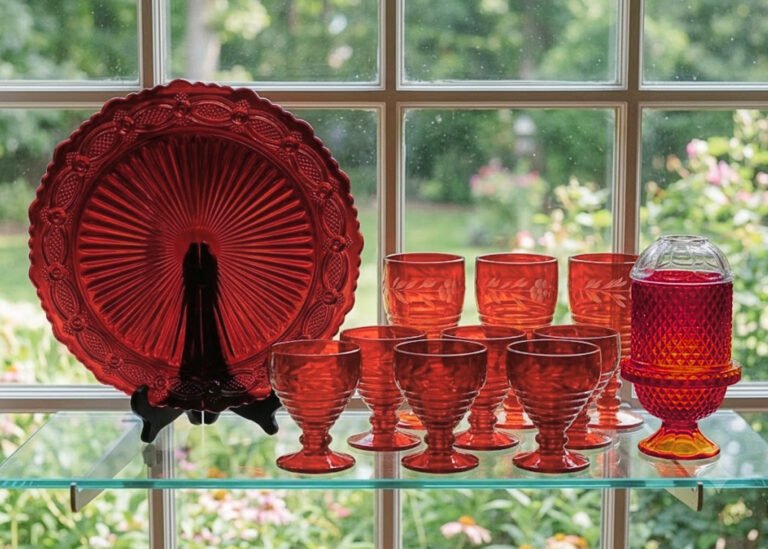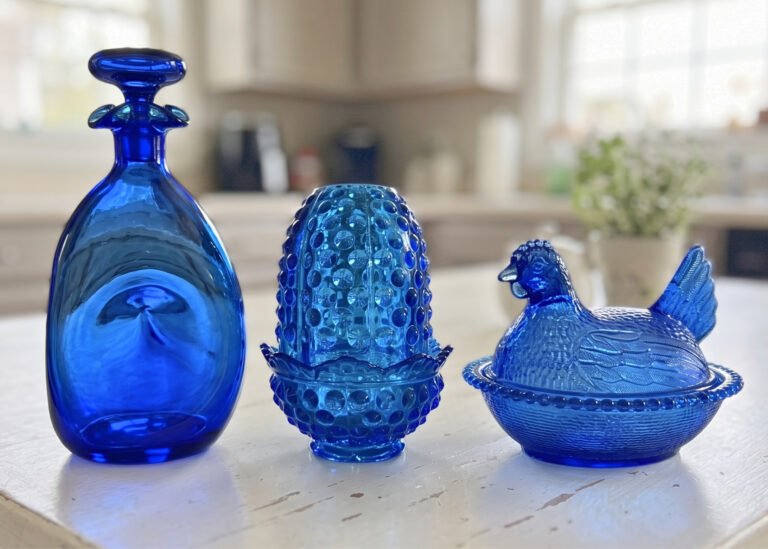

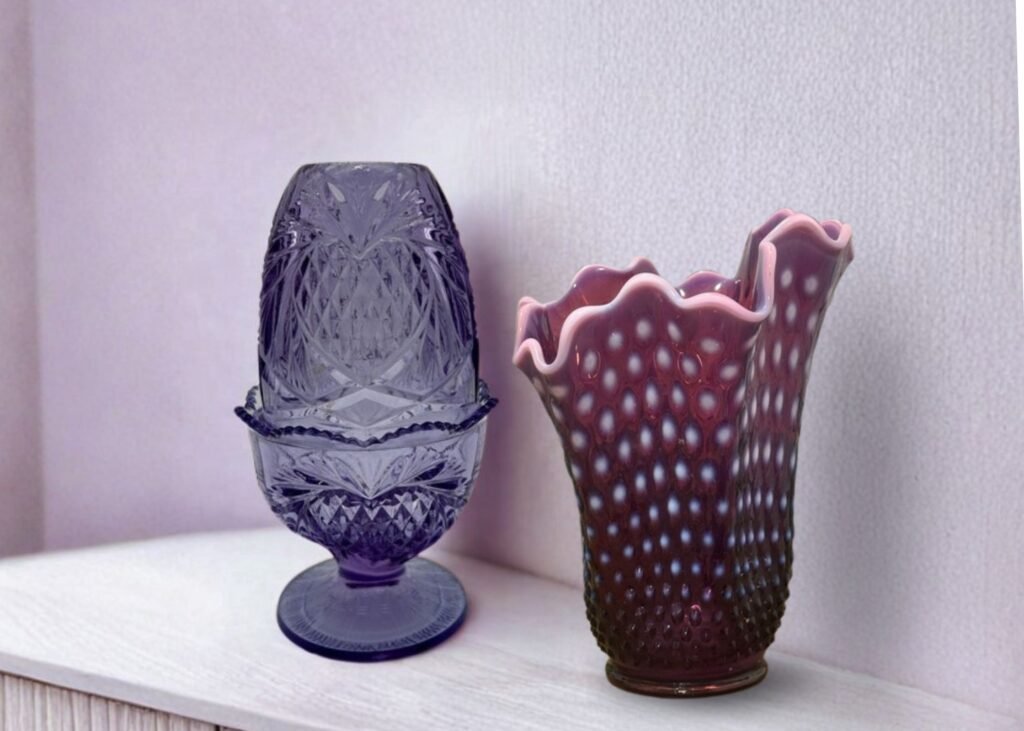
If you’ve ever picked up a ruffled milk glass bowl or long, thin vase with pointy hobs on it at a yard sale, there’s a good chance you were holding Fenton.
Fenton art glass was around for over a century, appearing in unique shapes, designs, and colors. Many pieces are worth a lot more today than when they were sold new.
This guide walks you through everything you need to spot a real Fenton piece, date it, and figure out what it’s actually worth. We’ll cover the marks, the patterns, the colors, and the rare finds that prove vintage Fenton glassware still has serious value.
History of Fenton Art Glass
Fenton Glass Company was founded way back in 1905 by two brothers, Frank L. and John W. Fenton, who established a decorating studio in Martins Ferry, Ohio, to decorate plain glassware created by other firms. This did not last long.
In 1906, the Fenton brothers established their glass-making factory in Williamstown, West Virginia. The very first item of Fenton glass produced in the factory was a crystal cream pitcher in a Water Lily and Cattails design, dated January 2, 1907. In the same year, the legendary iridescent “Carnival” glass appeared.
During a hundred years of existence, Fenton became the largest producer of hand-blown colored glassware in the country. The company endured all hardships: the Great Depression, both world wars, and fashion changes.
But ultimately, the production of traditional glass finally ceased in July 2011, which is one of the reasons for the ever-increasing prices of collectible Fenton glass.
Genuine Fenton Glass Identification (The 3-Signal Method)
Fenton produced countless shapes in hundreds of different colors over the course of more than a century, but not all pieces have been marked. So, the key to identifying Fenton glass is knowing additional specific details as well.
Fenton Art Glass Marks & Labels
This is easily the most reliable way of identification, but it’s tricky. Why? Because Fenton didn’t actually mold its logo into the glass until 1970, when the company began stamping an oval with “Fenton” written in script on its reissued Carnival pieces.
By 1972-1973, the oval logo was also appearing on items from the Hobnail line, among others. By 1974-1975, virtually all items produced by Fenton carried the logo. So, if an item has the embossed oval Fenton logo, it dates back to 1970 or later.
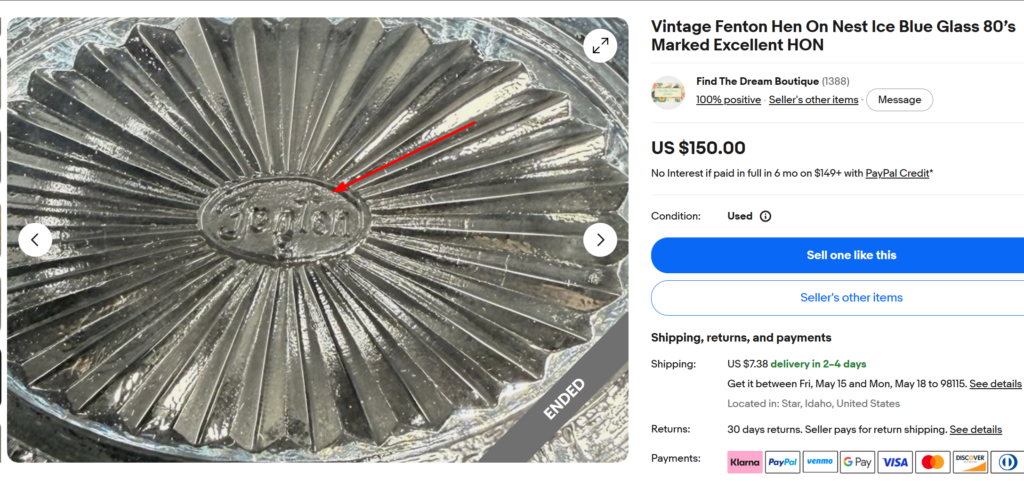
Then there’s the decade code. Starting in 1980, Fenton added a tiny number under the letter “n” in the logo. An “8” means it was made in the 1980s, “9” means the 1990s, “0” means 2000–2009, and “1” covers 2010 to 2011.
There are a few other marks worth knowing. A script “F” in an oval (no “Fenton” spelled out) shows up starting in 1983 on molds Fenton bought from other companies like Verlys or Paden City. A small star, flame, or block-letter “F” means the piece is a “preferred second” sold through the Fenton Gift Shop.
Pre-1970 Fenton Glass
As for pre-1970 Fenton glass, it was sold with paper foil stickers, which almost always peeled off long ago. So most vintage Fenton glass from the 1940s, 50s, and 60s has no permanent mark at all.
This is why the Fenton glassware markings can take you only halfway. For those pieces without any marks, you need to rely on other indicators, like designs, colors, and even the texture of the glass itself.
Recognizable Fenton Patterns
Some patterns are so closely tied to Fenton that spotting them is almost half the process. These patterns are:
- Hobnail – Those raised bumps (or “hobs”) covering the surface are Fenton’s signature look. Hobnail joined the general line in 1940 in opalescent colors, and by 1952, milk glass Hobnail became the company’s bestseller. Bill Fenton himself called it “our bread and butter.” Sharp, pointy hobs are key signs.
- Silver Crest – This is another giveaway. Released in 1942, it consists of a white milk glass body combined with a ruffled crystal edge in clear glass. This was not a technique adopted by any other company, meaning that whenever you find something similar to this, you’re looking at Fenton ware.
- Coin Dot – It first appeared in 1947 and ended in 1964. This pattern consists of circular dots on opalescent glass, with the cranberry opalescent variety being highly sought after.
- Thumbprint – This uses scooped-out oval shapes pressed into the glass, often seen in blue.
Other patterns worth knowing include Diamond Lace (1948), Spanish Lace, Daisy & Button, and Persian Medallion. And of course, there’s the Hen on Nest, a classic covered dish that Fenton made in tons of colors and is still a collector’s favorite.
Unique Fenton Glass Colors
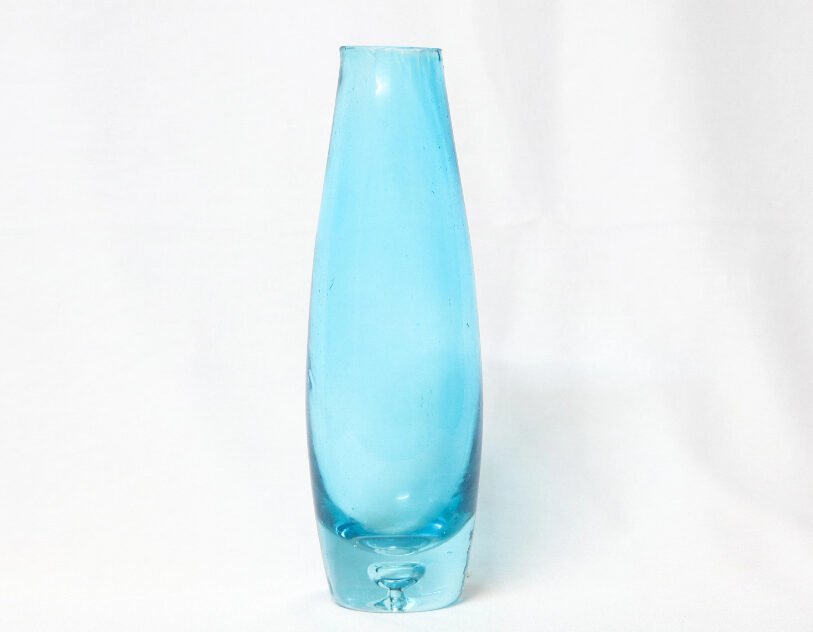
Colors help a ton in Fenton glass identification. Some hues are so distinctly Fenton that just spotting one tells you what you’ve got. These are:
- Milk glass is the bright, opaque white that defined Fenton’s mid-century run. The glass that comes before 1958 has an actual fire-like glow when held against the light, making it easy to identify.
- Cranberry glass has gold as an ingredient in it, which gives it that beautiful, deep red color.
- Burmese is opaque cream shading up to soft salmon-pink at the top. Fenton revived this old Mt. Washington formula in 1970, and it’s been a hit ever since.
- Carnival glass has a rainbow iridescence in it. Fenton made the first carnival glass pattern way back in 1907 and has created over 150 designs of carnival glass.
- Uranium glass (referred to as custard or topaz opalescent) will emit green fluorescence under UV light due to the presence of uranium in its composition.
Then there are the opalescent glass colors. Opalescent refers to milky-white, opaque, or bluish-white highlights on colored glass. The most collectible shades are:
- Blue opalescent
- Topaz opalescent
- Plum opalescent
- Cranberry opalescent
- Amberina
- Rosalene
- Wisteria (purple)
Other ID Clues
Even without a mark, there are physical clues that reveal genuine Fenton. The crimped or ruffled edges on bowls and vases were hand-shaped while the glass was hot, so you’ll see slight natural variation in the spacing. Machine-made copies look too perfect.
Fenton baskets have hand-applied handles, and where the handle joins the body, you can often spot a small stamped mark from the handler who attached it. These handle marks started in the 1950s. Each handler had a unique pattern.
The glass itself should feel solid and substantial in your hand. Thin, lightweight pieces that look like Fenton usually aren’t. And on blown opalescent pieces, look for that milky-white “fire” at the edges. Reproductions never replicate that glow.
12 Valuable Fenton Glass Finds with Real Prices
Here are some of the rare Fenton glass pieces that have been pulling in serious money on eBay and at auction.
1. Plum Opalescent Thumbprint Carnival Epergne
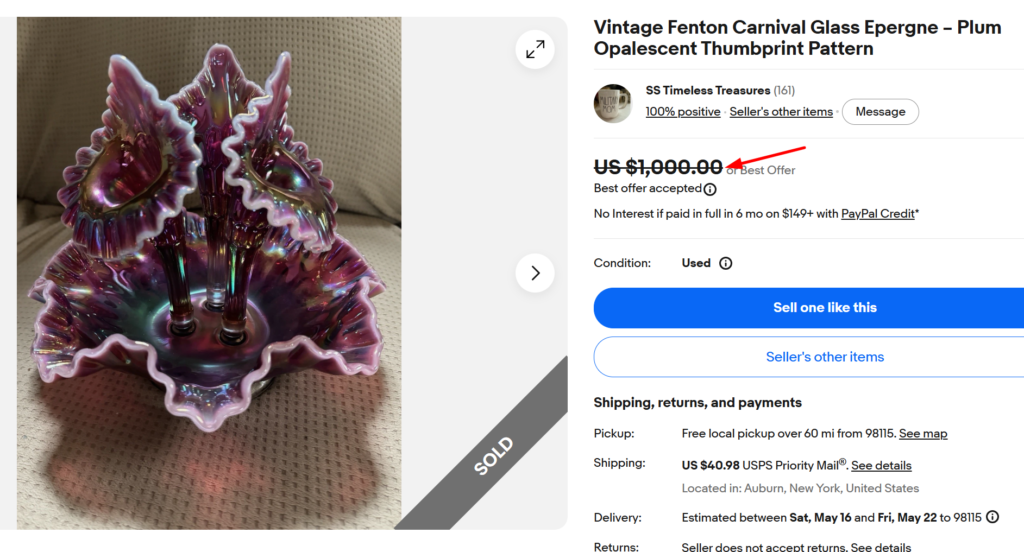
Sold for $1,000
An epergne is a centerpiece with a bowl base and tall, horn-shaped vases rising from it, usually three or four horns. This Fenton epergne in plum opalescent is a rare find.
Plum opalescent is one of Fenton collectors’ most favorite colors. It’s a soft, dusty purple with that signature milky glow at the edges, and it had a famously short production run.
This carnival-iridized version of the Thumbprint pattern epergne is one of the prettiest forms ever made in this color. A pristine Thumbprint Plum Opalescent Carnival epergne with all 4-horn intact can fetch $700-$1,200.
- Estimated Value: $700 – $1,200+ (4-horn mint examples)
- Production Year: Short production run; mid to late 20th century
- Characteristics: Plum-purple body with carnival iridescence, opalescent ruffled rim, Thumbprint pattern
- Markings: Most pieces unmarked
- Quick Notes: All horns must be original
2. Freehand Mosaic Threaded Vases
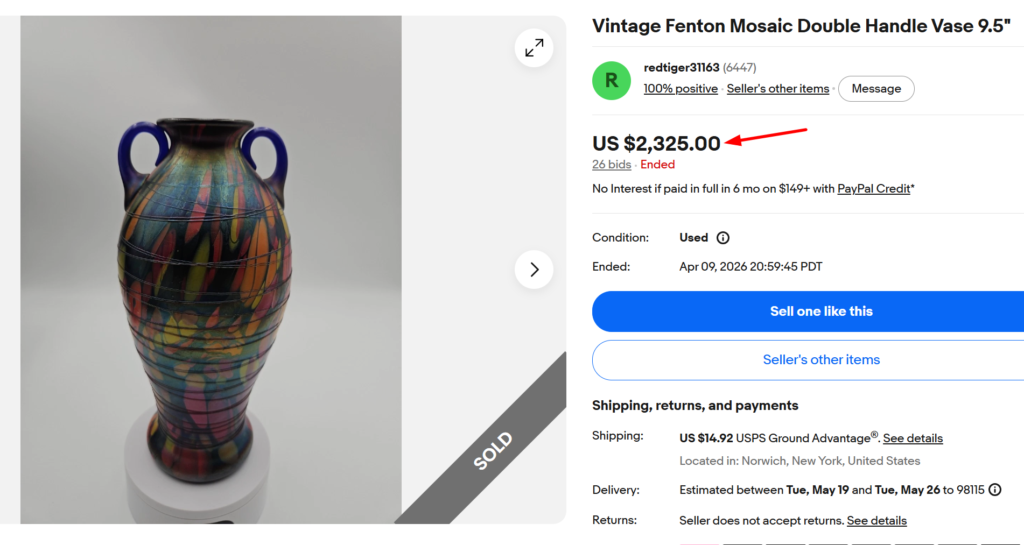
Sold for $2,325
The Mosaic vase style dates back to the Art Deco period in the 1920s at Fenton, where the artisans rolled hot glass into crushed colored glass called frit, creating a painted-splashed effect with colors unique to each piece.
Most pieces also show hand-applied threaded decoration, unique to Fenton, and come with double handles.
The combination of the freehand mosaic pattern, the impressive cobalt handles, and bold color play makes these pieces highly sought-after and, hence, valuable.
- Estimated Value: $1,500-$3,000+ (early pieces with applied handles) Production Year: Original Mosaic pieces from the 1920s
- Characteristics: Multi-colored frit pattern, applied colored handles, hand-blown form
- Markings: Early pieces unmarked; modern Fetty pieces signed and numbered
- Quick Notes: Early 1920s unmarked Mosaics are worth more.
3. Wisteria Glassware (Pineapple Fairy Lamp)
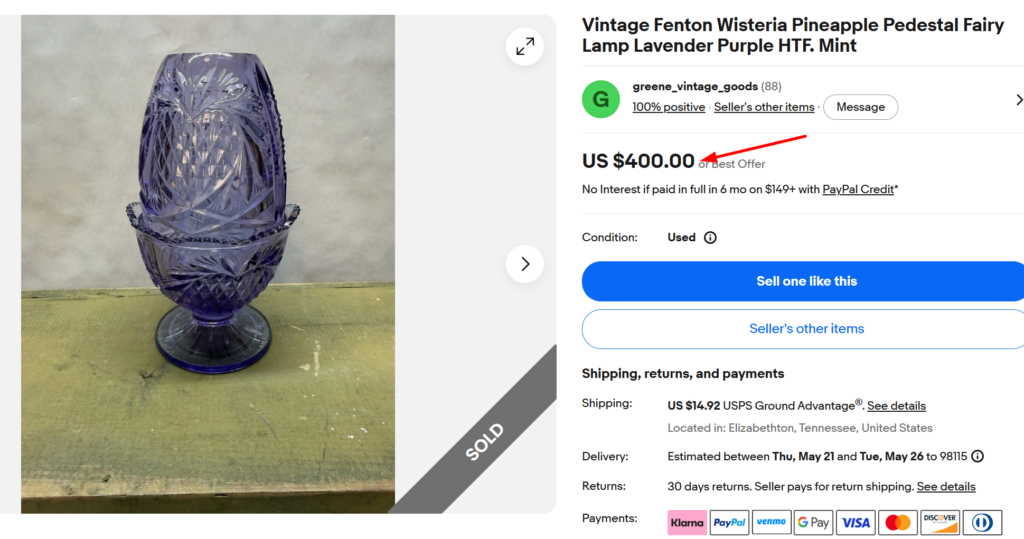
Sold for $400
Wisteria is one of Fenton’s most coveted colors. It’s a soft lavender-purple that the company only produced for a single year. The Pineapple pattern fairy lamp in this color is a “hard to find” piece. The lamp consists of two pieces: the pedestal bowl (base) and the tall pineapple-shaped shade that emits light when lit.
A mint condition Wisteria Pineapple fairy lamp can sell for up to $500, depending on condition.
- Estimated Value: $300 – $500 in mint condition
- Production Year: 1980 (Wisteria color one year only)
- Characteristics: Pale lavender-purple color, pineapple-cut pattern, two-piece fairy lamp design.
- Markings: Raised oval Fenton logo with small “8” beneath the “n.”
- Quick Notes: Completeness is a must for top value.
4. Cranberry Hobnail Epergne
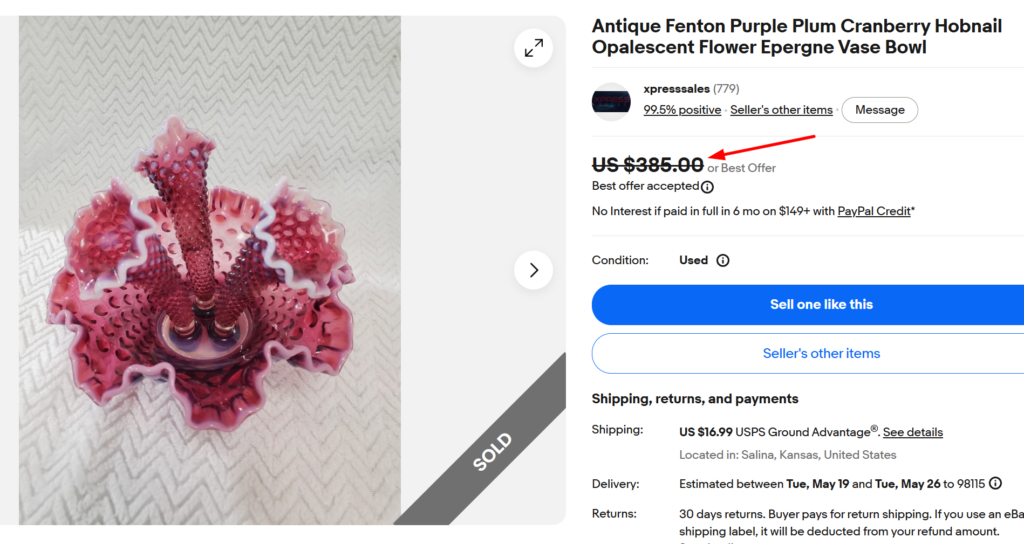
Sold for $385
One Fenton piece that tops every collector’s wishlist is the cranberry opalescent Hobnail epergne. The rare cranberry-pink body, combined with that milky opalescent edge and Fenton’s iconic hobnail pattern, makes this piece unique.
These were made in limited runs, and complete sets with all the horns intact are hard to find. Cracks and chips kill the value fast, so condition matters a lot here.
- Estimated Value: $300 – $700+ (complete, good condition)
- Production Year: 1940s (Cranberry)
- Characteristics: Hobnail pattern, cranberry pink with opalescent white edges, multi-horn centerpiece
- Quick Notes: All horns must be original to the piece
5. Burmese Hand-Painted Vases
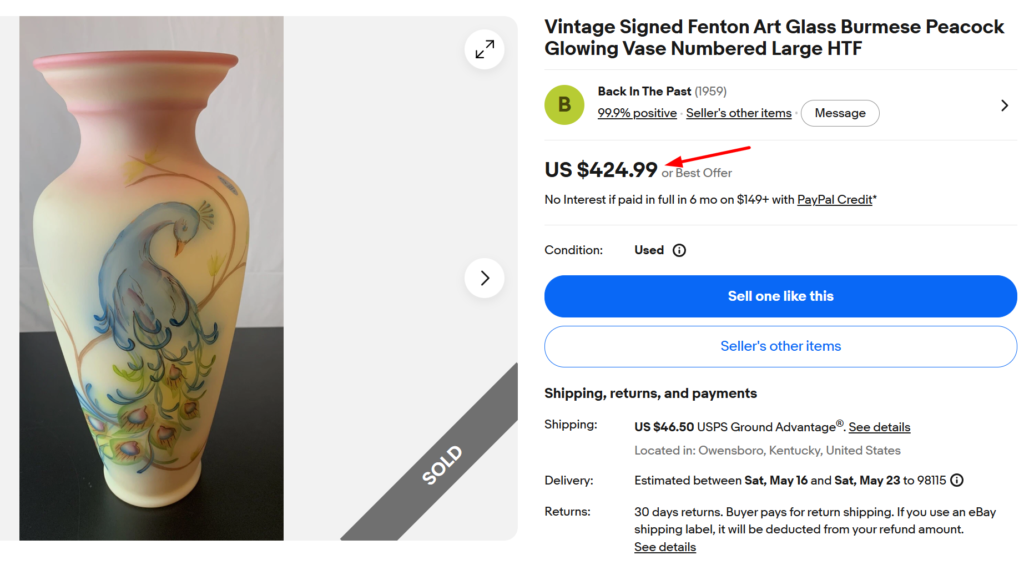
Sold for $425
Burmese is heat-sensitive glass containing both gold and uranium in its composition. The color ranges from yellowish cream at the base to light pink at the top.
The color, which was reintroduced by Fenton in 1970, is notoriously challenging to produce. Hand-painted Burmese paintings decorated with flowers or landscapes are highly collectible today.
The value lies in the artist’s signatures. Some names that can instantly boost value by 50% to 200% are Bill Fenton, Kim Barley, or Marilyn Wagner. Burmese art glass signed by artists is among the most consistently valuable Fenton art glass items.
- Estimated Value: $200-$1,500+ (hand-painted, signed)
- Production Year: 1970 onward (limited runs)
- Characteristics: Cream-to-pink shading; often glows under UV light from uranium content
- Markings: Raised oval Fenton logo + hand-signed artist name on base
- Quick Notes: Family member signatures carry the biggest premium
6. GWTW Opalescent Lamps
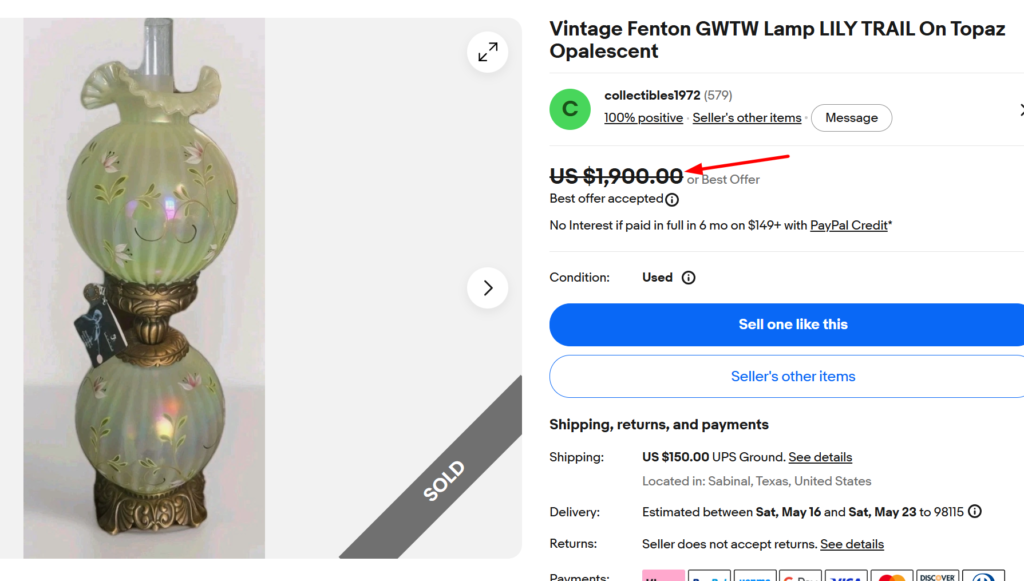
Sold for $1,900
Named for the iconic two-globe oil lamps seen in old Victorian parlors, these lamps have a matching round shade on top and bulb base below, joined by an ornate brass center.
The Lily Trail version on Topaz Opalescent glass is highly collectible. Topaz Opalescent has that warm yellow-green glow that comes from uranium in the formula. Plus, these have hand-painted lily vines crawling around both globes.
Perfect, complete Fenton GWTW examples in this glass color and design can fetch up to $2,000 or even more.
- Estimated Value: $1,500 – $2,500+ for hand-painted Lily Trail examples
- Production Year: 1970s–1990s (opalescent GWTW)
- Characteristics: Two-globe design, ornate brass center, hand-painted floral trail, UV-reactive Topaz glow
- Markings: Painted Fenton signs
- Quick Notes: Both globes must be original to the lamp.
7. Silver Crest Milk Glass Fairy Lamp
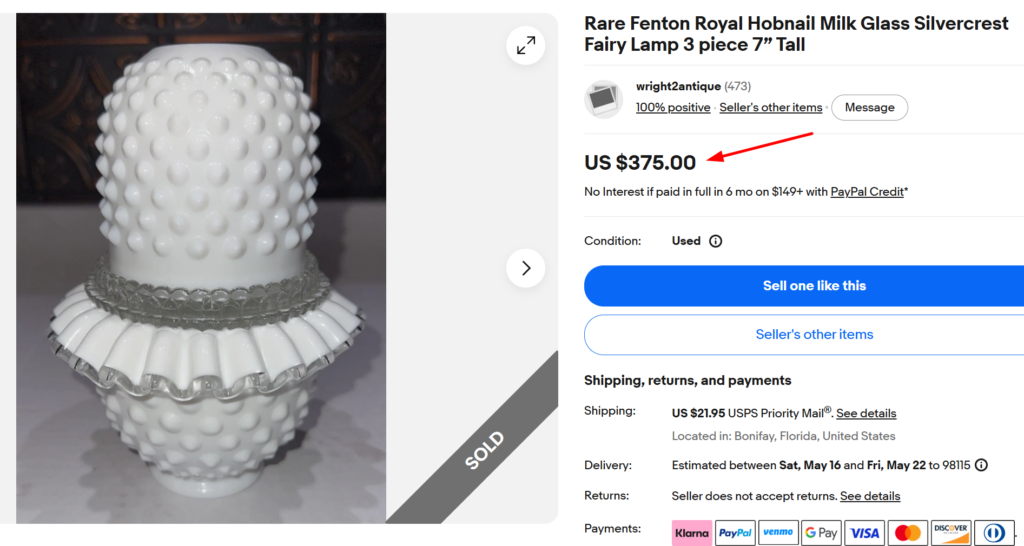
Sold for $375
This stunning Royal Hobnail Silver Crest fairy lamp features the bumpy Hobnail pattern on milk glass and a clear ruffled crystal edge on the base. It’s a three-piece construction: top shade, candle cup, and pedestal base.
Complete three-piece sets are the key here. Missing the candle cup or having any chips on the hobs drops the value sharply.
- Estimated Value: $170-$400 (complete, mint-condition)
- Production Year: 1970s onward (Silver Crest line ran 1942 – 1986)
- Characteristics: Hobnail pattern, ruffled clear crystal edge on base, three-piece design
- Markings: Raised oval Fenton logo on pieces from 1970+
- Quick Notes: All three pieces must be present for top value.
8. Hen on Nest Dishes (Gertrude Titanium Glass)
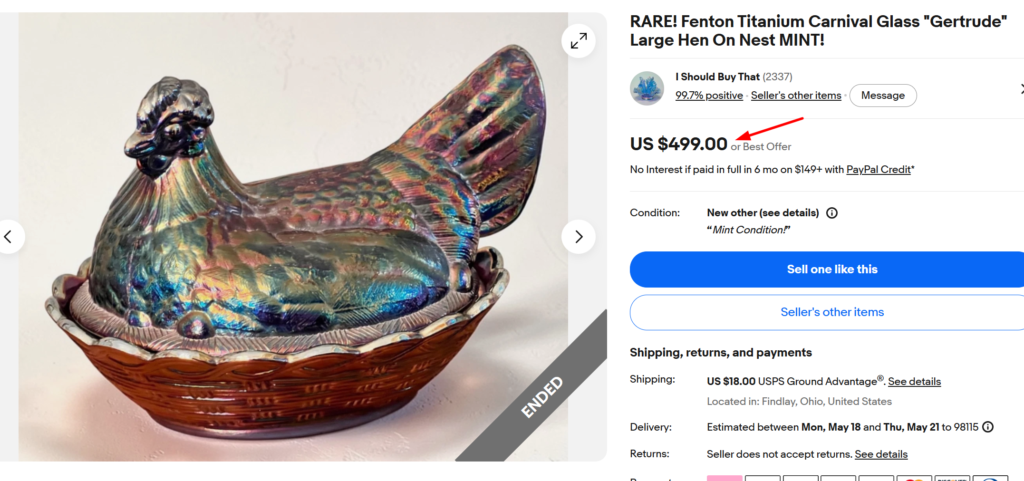
Sold for $500
The Hen on Nest is a classic Fenton form. It’s a hen-shaped lid sitting on a basketweave-woven dish. Common milk glass versions sell for $20 to $50. However, the “Gertrude” pattern in Titanium Carnival is an extremely rare find.
The colors in the pattern include deep iridescent purples, blues, and bronzes. The Titanic Carnival is a limited modern production, and the Gertrude pattern is very collectible since it is bigger than the normal hen.
A pristine example with a clear sheen can fetch a couple of hundred dollars easily for the size and the wild color play.
- Estimated Value: $400 – $600 (Titanium Carnival Gertrude examples)
- Production Year: Post-2000s (Limited production)
- Characteristics: Large hen-shaped lid, basketweave nest base, iridescent Titanium finish
- Markings: Raised oval Fenton logo with “Gertrude” on base.
- Quick Notes: “Gertrude” is larger than the standard Hen on Nest.
9. Swung Vases
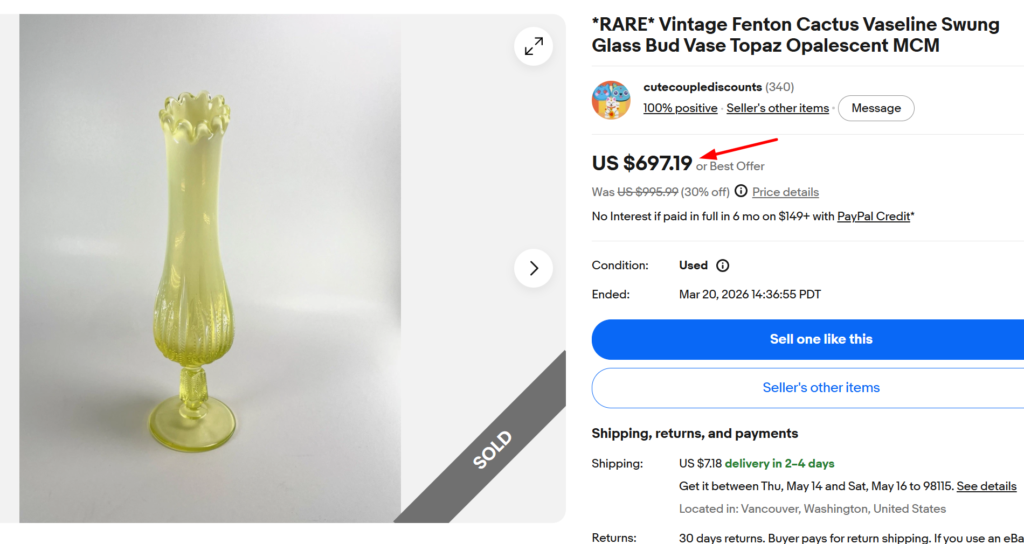
Sold for almost $700
The “swung” technique is one of Fenton’s most distinctive moves. A glass blower would heat the piece, then literally swing it on a punty rod, letting gravity pull the form into a tall, elegant shape with a flared, uneven rim. Since all are hand-made, no two swung vases come out identical.
This example features the Cactus pattern on a Topaz Opalescent glass. You should see pressed cactus motifs run up the body, and the swung top looks almost like a flame.
Swung vases are collectible in themselves, but they fetch even higher prices when found in rare colors like this.
- Estimated Value: $400 – $800 for rare topaz opalescent examples
- Production Year: Cactus pattern in Topaz Opalescent circa 1959–1960
- Characteristics: Hand-swung elongated form, pressed cactus design
- Markings: Pre-logo era; most examples are unmarked
- Quick Notes: Chips on the top edge hurt the value.
10. Milk Glass Fan Vases
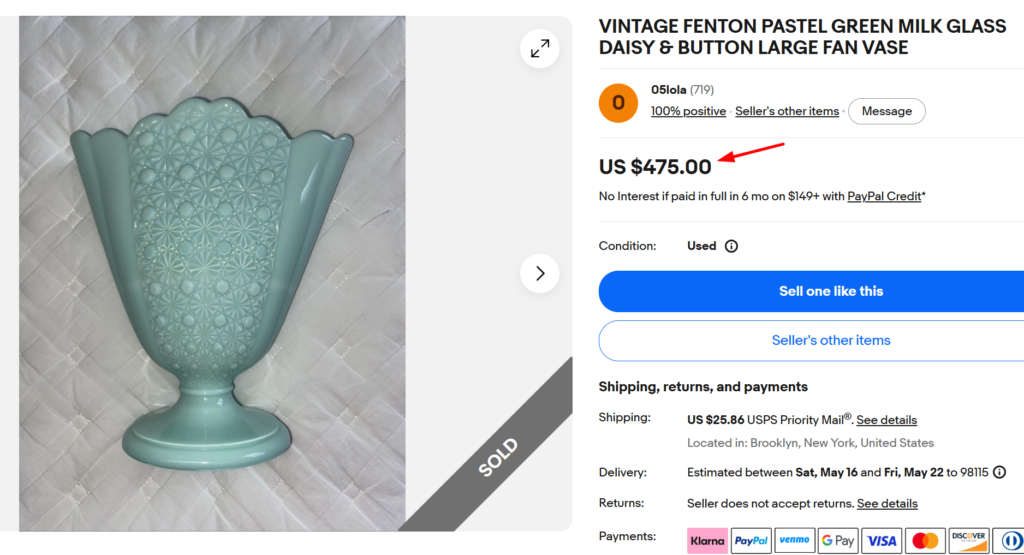
Sold for $475
Daisy & Button is among Fenton’s most popular pressed patterns, featuring an all-over design of tiny pressed star-and-button shapes. It was originally introduced in 1937 and then reissued in 1953.
This unique vase fans out at the top like an open hand fan. The design is also unique to Fenton. Most milk glass Fenton fan vases sell for $5–$30 range, but rare colors and pattern combinations like this Pastel Green Daisy & Button vase are worth more.
- Estimated Value: $200-$500 (rare colors & patterns)
- Production Year: 1950s–1990s (Green, Daisy & Button)
- Characteristics: Mint-green opaque body, all-over Daisy & Button pattern, fan-shaped top
- Markings: Pre-1970 examples unmarked; later versions show the oval logo
- Quick Notes: Rare colors increase the value.
Fenton Glass Value Guide: What Determines Price?
I’m sure by now you’re thinking, “Why does one Fenton vase sell for $5 while another goes for $500?” A few key factors decide what Fenton glass is worth. Let’s understand them below:
Rarity of Color
Rarity of Pattern
Artist Signatures, Marks, and Labels
Item Form and Type
Condition
Completeness
Whether you’re just starting to collect Fenton glassware or want to sell your own old pieces, the basics stay the same. Check the marks, learn the patterns, get familiar with the colors, and always inspect for condition for top value.