

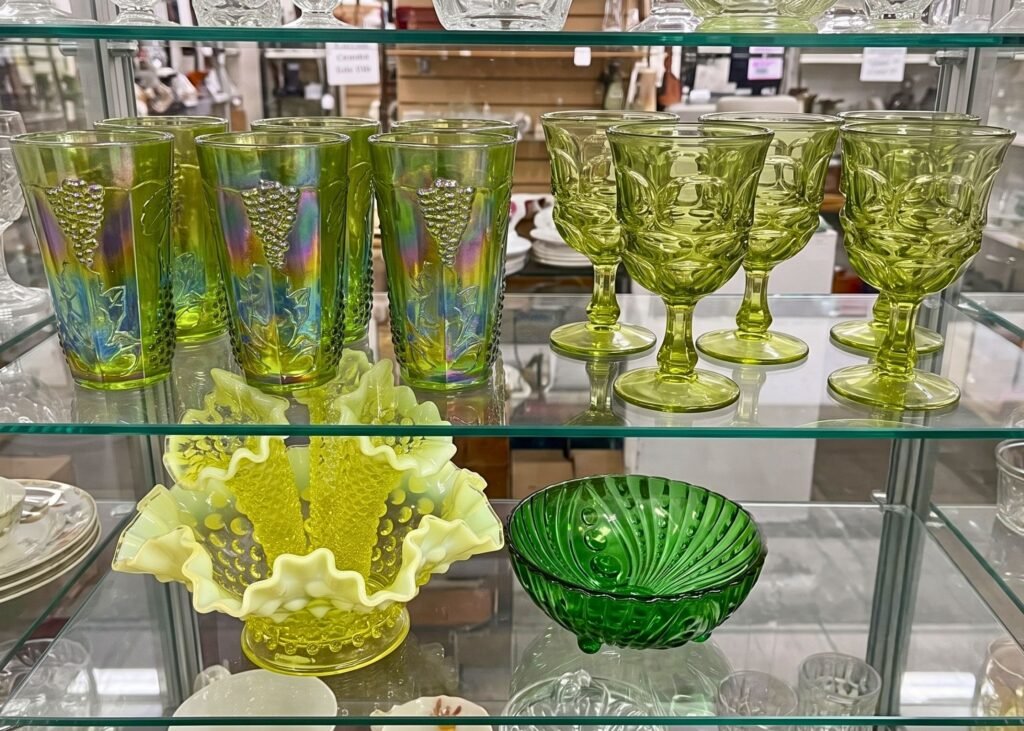
Vintage green glass is an umbrella term for green-colored American and European glass made from roughly the 1880s through the 1980s. It covers Victorian art glass, mass-produced Depression pieces, green milk glass, and thick MCM pieces from the disco era.
Each type has its own look, its own makers, and its own value. The color came from different formulas, too. Some greens got their tint from iron oxide; others used uranium oxide.
This guide covers the main types of vintage green glassware you’re likely to find, how to identify each, what drives their prices, and ten collectible pieces with their real eBay prices.
Is Vintage Green Glass Worth Anything?
Usually a modest amount. Most old green glassware pieces start from $5 for single small pieces in common patterns to over $500 for rare designs from top makers, like the Fenton Hobnail epergne in this list that went for $550.
The 6 Main Types of Vintage Green Glassware
Before we get into individual green glassware finds, it’s good to know which category your piece belongs to. Most vintage green glass falls into one of these six buckets, and identifying the type narrows down the maker, era, and value range quickly.
It’s also why there’s no single name for vintage green glass: depending on the type, collectors call it Depression glass, uranium or vaseline glass, jadeite, Forest Green, or avocado glass.
Green Depression Glass (1920s to 1940s)
Depression glass was machine-pressed, cheap, and often given away with flour, gas, or movie tickets. Green was one of the most popular colors, manufactured by Jeannette, Hocking, Hazel-Atlas, and Federal.
Embossed designs to look out for include Cameo, Princess, Cherry Blossom, Block Optic, and Florentine. Many green Depression pieces also glow yellow-green under UV because of trace uranium.
Uranium Glass and Vaseline Glass
These are the ones that glow. Uranium glass contains real uranium oxide (often around 2% by weight, according to the ORAU Museum of Radiation and Radioactivity) and glows a brilliant green under a black light.
Vaseline glass is a yellow-green type that resembles petroleum jelly during the day.
Jadeite (Jade-ite)
Jade-ite is opaque, milky pale green, and not transparent. McKee started it in the 1930s, but Anchor Hocking’s Fire-King line, which added Jade-ite in the mid-1940s and was popularized again by Martha Stewart in the 1990s, is what most people know of jadeite today.
Emerald and Forest Green (1950s to 1960s Anchor Hocking)
Anchor Hocking’s dark Forest Green was made from the 1950s through the mid-1960s across seventeen documented patterns. The green here is deep and saturated, not pale like Depression glass. Bubble, Sandwich, and Charm are the big names.
Avocado and Olive Green (1960s to 1970s Mid-Century)
The muddier, murkier greens belong to this era. Think Libbey, Indiana Glass, Tiara, and Fostoria’s Argus in olive. These pieces are heavier and thicker than earlier glass, and they’re finally collectible as MCM lovers chase them.
Art Glass and Studio Green (Fenton, Fostoria, Tiffin)
These are hand-blown or hand-finished pieces from Fenton (Hobnail, Silver Crest), Fostoria, and Tiffin (Vaseline stemware). Prices here run higher because craftsmanship, signatures, and limited production all stack up.
How to Identify Vintage Green Glass: 5 Key Signs
Identification is the most challenging part. Pattern books are dense, and Google image search can be misleading. So here’s the sequence a seasoned collector actually uses, in order.
- Start with the color – Pale, transparent green usually means Depression era. Opaque milky green points to jadeite. Deep dark green with no glow suggests Anchor Hocking Forest Green from the 50s and 60s. Muddy olive or avocado is late 60s to 70s.
- Do the blacklight test – A small UV flashlight is all you need. If the piece glows bright neon green, it has uranium. But uranium glass was made in large amounts before World War II, then production stopped for about 15 years and restarted in the late 1950s. So a glow suggests an older piece but doesn’t prove it: later Fenton and Tiara pieces glow too.
- Look at the pattern – Check the piece against a light source so the embossed design shows clearly. Then match it to a known pattern reference.
- Check the base for marks – Fire-King pieces say “OVEN Fire-King GLASS” or later “MADE IN USA.” Fenton started molding its oval logo into the glass around 1970. Fostoria Argus is marked “HFM” on the side for Henry Ford Museum. Unmarked doesn’t always mean fake, but marks make identification easy.
- Feel the weight – Many reproductions of Depression glass are heavier than originals, though it varies by pattern. Originals usually have thinner walls. So if it feels chunky and hefty for its size, be cautious.
Rare Vintage Green Glassware Finds Worth Collecting Today
Below are some of the most collectible and valuable green glassware patterns and pieces that collectors chase today, with tips to identify and real values.
1. Fenton Hobnail Vaseline Glass Epergne
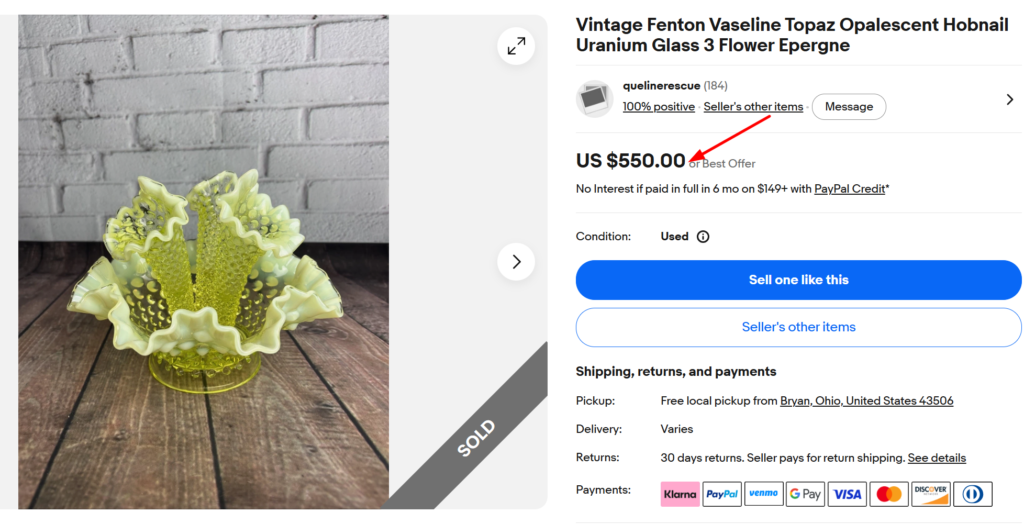
The Fenton company began the Hobnail line around 1939 using a Victorian style of dew-drop glass. The pattern covers the glass in evenly spaced raised round bumps, which look larger where the glass flares out.
Vaseline Hobnail glass made in the 1940s shows a bright yellow-green body because of uranium oxide in the formula. Epergne and bud vase designs, such as the #3855, are extremely collectible.
- Estimated Value: $50 to $250 for vases; $250 to $600+ (epergnes)
- Production Years: Hobnail from about 1939 onward
- What to Check: Raised hobs, opalescent edge, UV glow
- Quick Notes: Pre-early-1970s pieces are unmarked; marks add value
2. Tiara Chantilly Green Sandwich Fairy Lamp
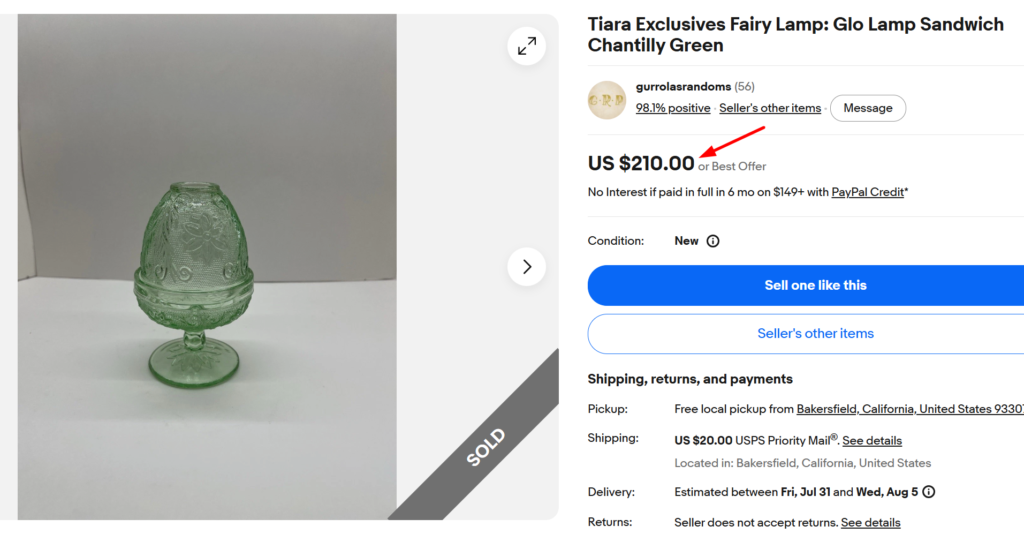
The Chantilly Green fairy lamp is Indiana Glass No. 364, made for Tiara Exclusives during the Sandwich pattern’s Chantilly run. It’s a two-piece lamp with a domed shade sitting on a candleholder base, both embossed with the classic Sandwich daisy pattern.
The light green body glows bright neon under UV thanks to trace uranium.
The piece stands about 6 inches tall and 3.5 inches across at the base. So the biggest value driver is completeness. Check both pieces glow together under a blacklight and are not mismatched replacements.
- Estimated Value: $30 to $200
- Production Years: Chantilly Green ran from 1982 to 1991
- What to Check: Two-piece fit, uranium glow, Sandwich pattern
3. Fostoria Olive Coin Pedestal Cake Stand
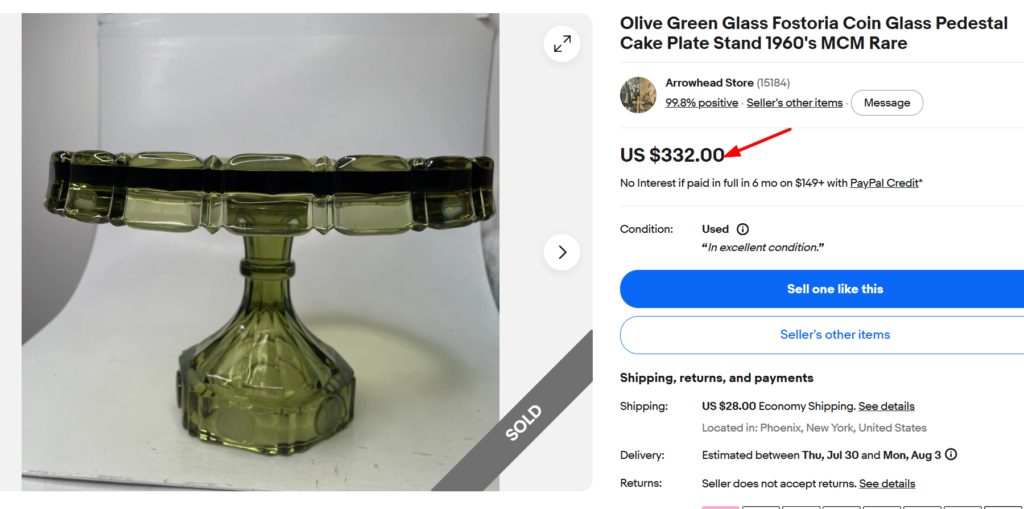
Fostoria’s Coin pattern uses embossed coin medallions, usually frosted, and features the date 1887 to mark Fostoria’s founding. Olive Green came in after the short 1965 Emerald run, so both colors carry a premium over amber or crystal.
Original Fostoria coins are frosted. Post-Lancaster Colony reissues left them unfrosted, though some were later sandblasted to look original.
- Estimated Value: $150 to $350
- Production Years: Olive Green from the late 1960s onward
- What to Check: Frosted coin medallions, hollow pedestal base
- Quick Notes: Emerald green ran only in 1965, rarer still
4. Tiffin Vaseline Glass Compote
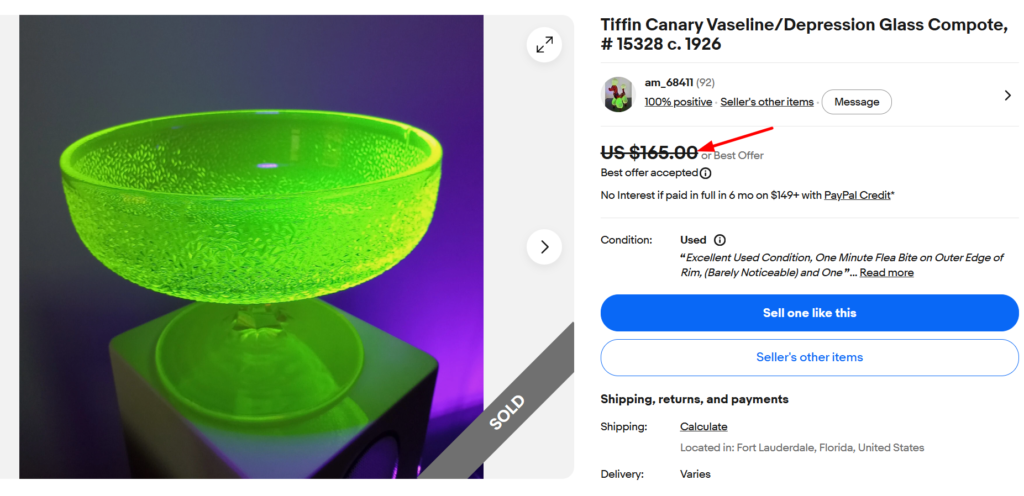
Tiffin, originally A.J. Beatty & Sons, joined US Glass in 1891 as factory R. Their vaseline glass compotes from the 1920s are highly collectible for their high uranium content, which makes them glow brilliantly even in weak UV light.
Most Tiffin pieces from this era are unmarked, so authentication comes down to comparing the shape to documented factory numbers like #315, #15315, or #15328.
- Estimated Value: $80 to $250
- Production Years: 1920s
- What to Check: Bright UV glow
- Quick Notes: US Glass factory R, usually unmarked
5. Jeannette Cherry Blossom Green Pitcher
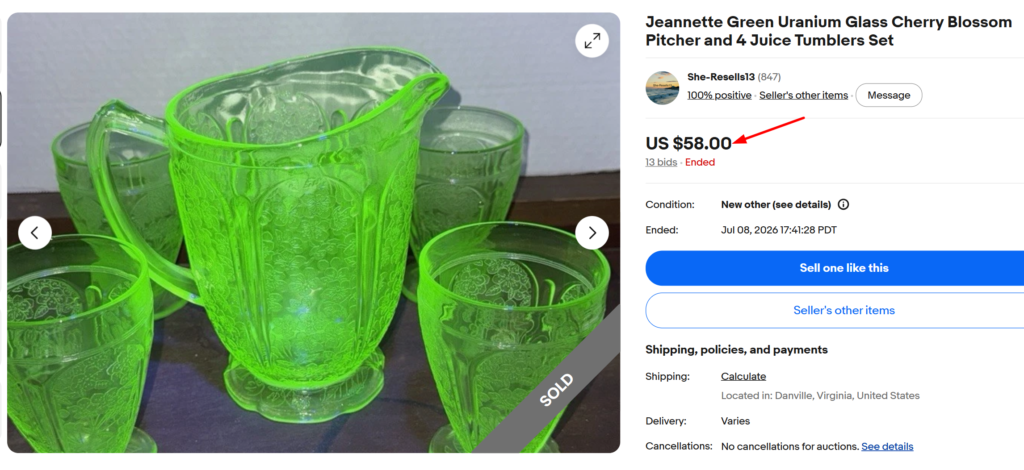
Cherry Blossom ran from 1930 to 1939, but green production was pulled after 1935. That short window makes green pieces rarer than pink Cherry Blossom. The pattern shows off-center cherry sprays with small leaves and twigs framed by graceful arcs and tiny dots.
Reproductions are common, so compare the cherries, leaves, and glass thickness with a pattern reference before you buy. On originals, the cherries are shaded; on many reproductions, they look like plain circles.
- Estimated Value: $75 to $400 (the $58 auction above, with 4 tumblers, came in under this)
- Production Years: Green made from 1930 to 1935
- What to Check: Leaf and cherry detail, arc borders
6. Bohemian Emerald Green Glass Decanter with Gold Trim
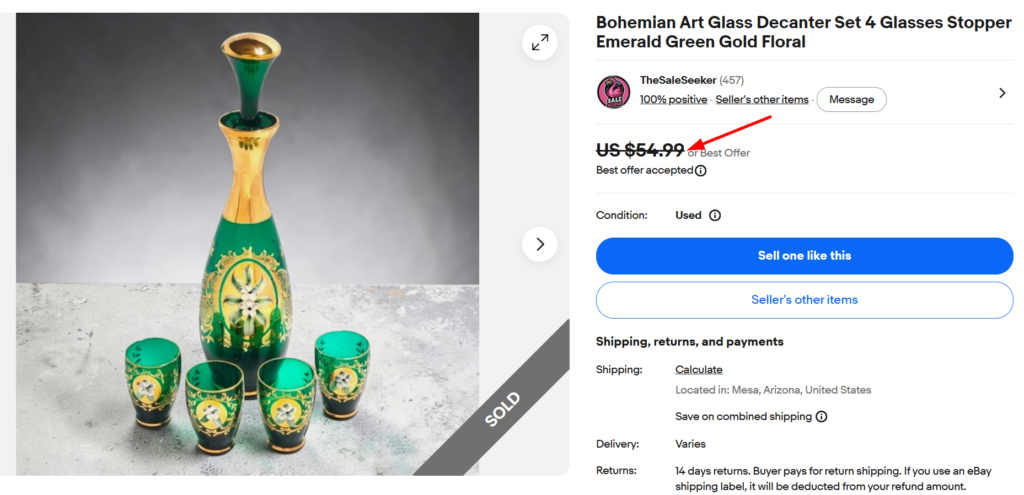
Czech Bohemian decanter sets in emerald green with gold trim were made throughout the mid-century, and they came into American homes as wedding gifts and department store buys.
The green is deep and rich, and the hand-painted gold banding, floral motifs, or raised flower work is the pattern signature. Complete sets, with the decanter, stopper, and matching cordial or highball glasses, sell for far more than singles.
- Estimated Value: $40 to $120 (with matching glasses)
- Production Years: 1950s to 1970s
- What to Check: Hand-painted gold banding, original stopper
- Quick Notes: Wear on the gold trim hurts the value.
7. Indiana Glass Harvest Grape Green Carnival Tumbler
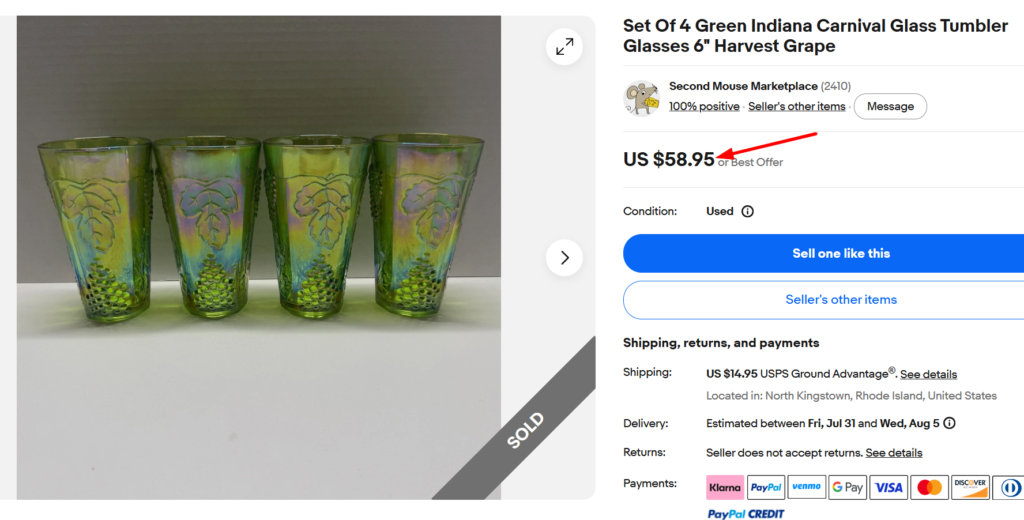
Indiana Glass made Harvest Grape in the 1970s to catch the Carnival revival wave. The lime green version is iridized, giving it a metallic shimmer with hints of purple and blue when the light hits it. The pattern is raised grape clusters and leaves.
Two sizes exist. The Cooler at 5.75 inches and 14 ounces is common, and the Juice at 4 inches is harder to find. Complete boxed sets bring a real premium.
- Estimated Value: $10 to $40 per tumbler
- Production Years: 1970s to mid 1980s
- What to Check: Raised grape clusters, iridescent lime finish
8. Fire-King Jade-ite Swirl Mixing Bowl Set
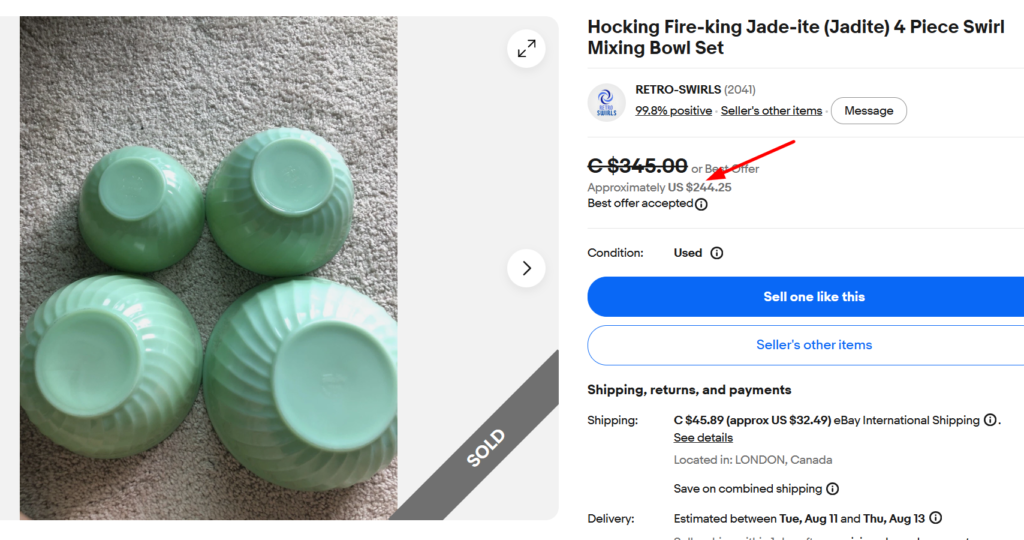
The Swirl mixing bowl set is one of the most recognizable Fire-King pieces Anchor Hocking made. Bowls nest in 6, 7, 8, and 9-inch sizes with a diagonal swirl pattern across the exterior.
Most carry the “OVEN Fire-King Ware Made in USA” mark, though the 7-inch is often unmarked. Watch for the year 2000 reproductions marked “2000.”
- Estimated Value: $100 to $350 (complete 4-piece set)
- Production Years: Swirl was produced from the 1950s
- What to Check: Diagonal swirl pattern, milky green tone
- Quick Notes: 4-piece set nests as 6, 7, 8, 9 inches
9. Fostoria Argus Olive Green Goblet Set
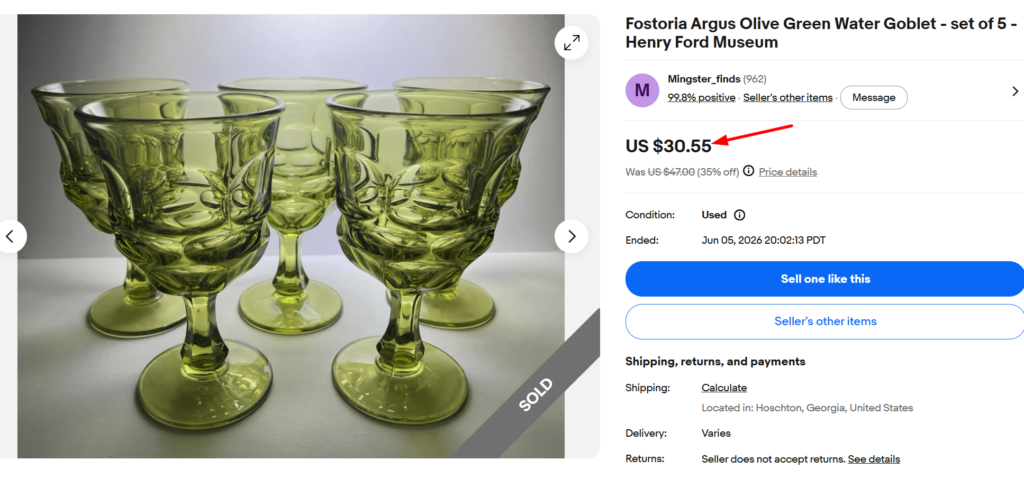
Fostoria produced Argus on an exclusive agreement with the Henry Ford Museum in Michigan, from 1963 into the early 1980s. The design of the pattern comes from 19th-century flint glass, and the heavy thumbprint bowl shape distinguishes it.
Colors used for Argus pieces include olive green, cobalt blue, ruby, gray, and clear. Olive green is the most popular color, and sets of six or eight goblets turn up often.
- Estimated Value: $40 to $150 (set of 6 to 8)
- Production Years: 1963 into the early 1980s
- What to Check: Thumbprint pattern, HFM mark on side
- Quick Notes: Made for the Henry Ford Museum
10. Anchor Hocking Forest Green Burple Footed Bowl (1950s)
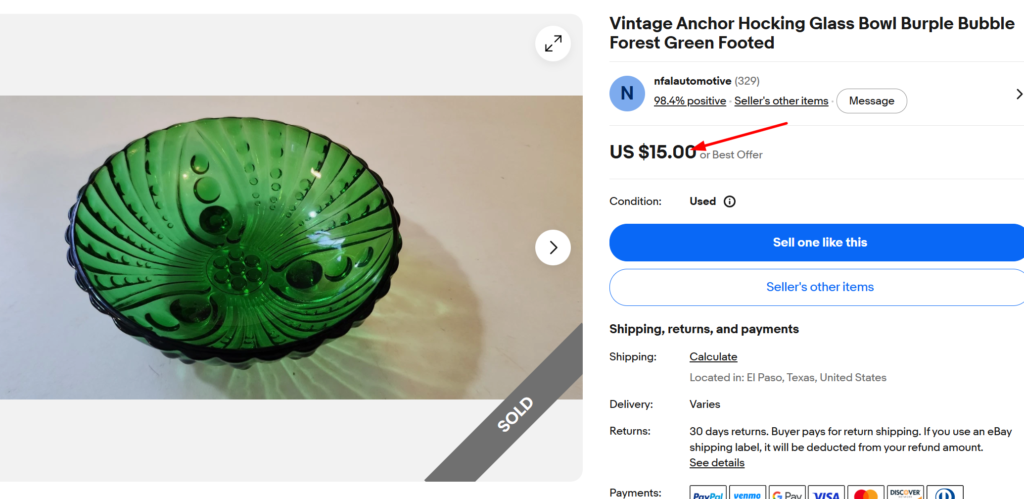
Burple is the collector name for Anchor Hocking footed pieces with swirled ribs and columns of raised bubbles, made in Forest Green in the 1950s.
The green here is deep and saturated, not the pale Depression tint. Burple turns up both as single bowls and as sets with larger footed serving bowls, and complete Forest Green sets bring more than single bowls, especially around Christmas.
Note that it is often confused with Bubble, Anchor Hocking’s plainer No. 1600 line, which was being advertised in Forest Green as “Anchorglass” by 1954 and has no swirled ribs.
- Estimated Value: $15 to $60
- Production Years: Forest Green Burple, 1950s
- What to Check: Swirled ribs, raised bubbles, footed base
- Quick Notes: Often listed as Bubble; Burple has swirled ribs and a footed base
What Makes Vintage Green Glassware Valuable?
Not all green glass is worth much. Some pieces sell for $5 at flea markets, while the top sales can reach over $500. The quickest way to tell if a green glass piece is valuable is to name its maker and pattern, check its condition, and compare it with sold (not asking) prices for the same piece.
- Pattern rarity is the biggest one. Common patterns like Sandwich (Tiara Chantilly) show up everywhere, so prices stay modest. Uncommon patterns like Cherry Blossom in green, or specific short-run pieces, command real money.
- Condition matters more than most people think. A chip on the rim, cloudiness inside a decanter, or a repaired lid can cut value by half or more. Serious collectors want mint or near-mint pieces.
- Uranium content can add a premium these days. Interest in UV-glowing glass has grown, and among glassware collectors, so a piece that glows can sell for more than a similar non-glowing one.
- Complete sets beat singles. A punch bowl with all twelve original cups, hooks, and the ladle can sell for more than what the pieces would fetch separately. The same goes for salt-and-pepper pairs, creamer-and-sugar sets, and matched stemware.
- Maker attribution with proof (a mark, a sticker, or documented provenance) pushes prices higher. An unmarked Fenton hobnail vase gets less than a marked one, even when they’re identical shapes.
If you have old green glassware at your home, first check the marks, patterns, color, and type of glass before you donate or sell anything. Do the same for the pieces you see at a thrift store, so you don’t miss a valuable find. Collecting glass by color? See our guides to cobalt blue glassware, collectible red glass, and amber glass.
Found this guide useful?
Save it for later
Share it with someone
Keep the old finds coming
New guides and finds worth looking for, delivered to your inbox.
Keep exploring
More guides in Vintage Glass
 13 finds13 Old Glass Bowls Worth Money: Top Makers, Patterns & ValueTop sale $797
 11 findsOld Libbey Glassware: How to Spot Rare Vintage PiecesTop sale $595
 9 finds9 Types of Vintage Tea Cups That Are Highly Collectible TodayTop sale $289
 10 findsRare Antique Carnival Glass Colors: From Ruby Red to Aqua OpalescentTop sale $400