
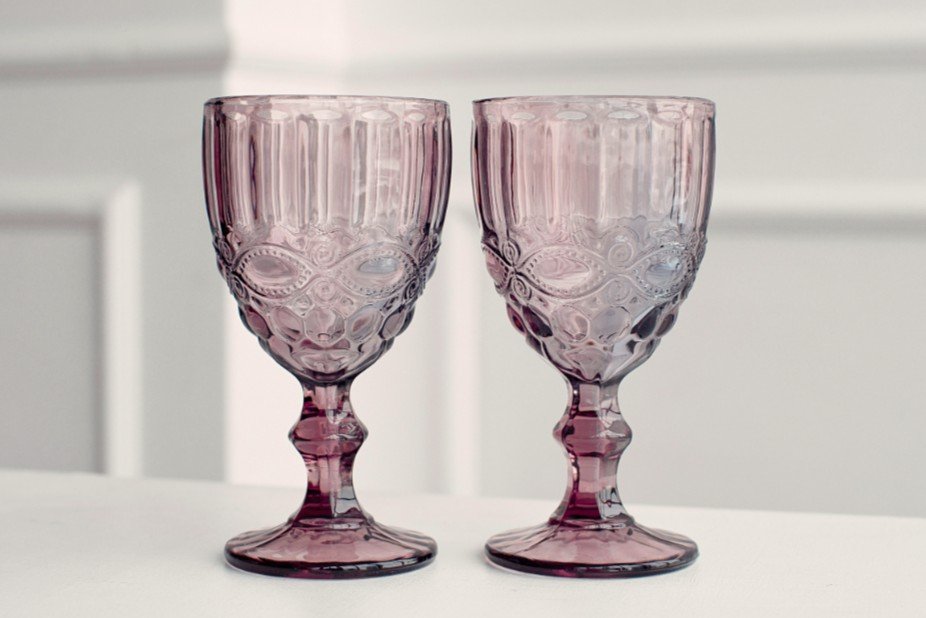
If you have ever turned a soft pink glass plate over at an estate sale, chances are you were looking at a Depression glass piece, asking yourself whether it is worth $5 or $500. The truth is that it all comes down to the pattern.
A common pink Sharon saucer might be worth a lunch today, while a pink Mayfair cookie jar can pay for a weekend getaway. This guide walks through the most valuable pink depression glass patterns, the specific pieces collectors pay real money for, and things that determine Pink depression glass value.
What is Pink Depression Glass?
Depression glass refers to glass that is mass-produced using a press and comes in different colors. Depression glass originated in the United States between 1929 and the early 1940s. Being cheap to make, it was usually given as a promotional item for flour, gasoline, and movie tickets. Pink was the most popular color of the era.
Manufacturers got that soft blush tone from selenium oxide added to the glass batch. That’s why most pink depression glass does NOT glow under a blacklight (uranium glass does).
Today, vintage pink depression glass is still very much collected. The most enthusiastic collectors are completing sets that they once saw in their grandmother’s china cabinet, and hard-to-find items in common patterns can sell for hundreds of dollars.
Is Pink Depression Glass Valuable in 2026?
Yes, but not most of it. Individual items of pink depression glass trade between $5 and $30. Everyday items like plates, cups, saucers, and bowls that have been made in millions can be found easily and thus are cheap.
However, value is held by those patterns and pieces that are rare and in good condition. There, prices regularly run from $200 into four figures. Four factors drive the value of any pink depression glass piece:
- Pattern Rarity – Patterns with short production runs (Adam, 1932–1934) or limited pink output (Madrid, Manhattan) command more than common patterns produced for a decade.
- Piece Type – Not every piece was made in equal numbers. Serving pieces (pitchers, butter dishes, cookie jars, candy jars with lids, footed tumblers, and specialty items like cheese dishes) are worth way more than plates and cups. A pink Sharon dinner plate sells for $20, while a cheese dish can hit $2,000+.
- Condition – Depression glass is fragile. Any chip, crack, or hairline reduces value by 50 to 80 percent. Even rim wear and cloudiness (called “sick glass” when caused by dishwasher etching) takes a meaningful bite out of price.
- Completeness – Lids matter enormously. A cookie jar without its lid is often worth a quarter of the complete set. Original boxes and matched sets command real premiums.
The most-searched patterns (Mayfair, Cherry Blossom, Miss America, American Sweetheart, Royal Lace, and Sharon) are also the ones that have been most heavily reproduced. Knowing how to authenticate is what differentiates between a $300 find and a $10 knockoff.
12 Most Valuable Pink Depression Glass Patterns & Finds
Below are the 12 patterns that show up more frequently on eBay and antique shops. Each pattern has certain features and specific pieces that are actively sought after by collectors.
1. Mayfair “Open Rose” by Hocking
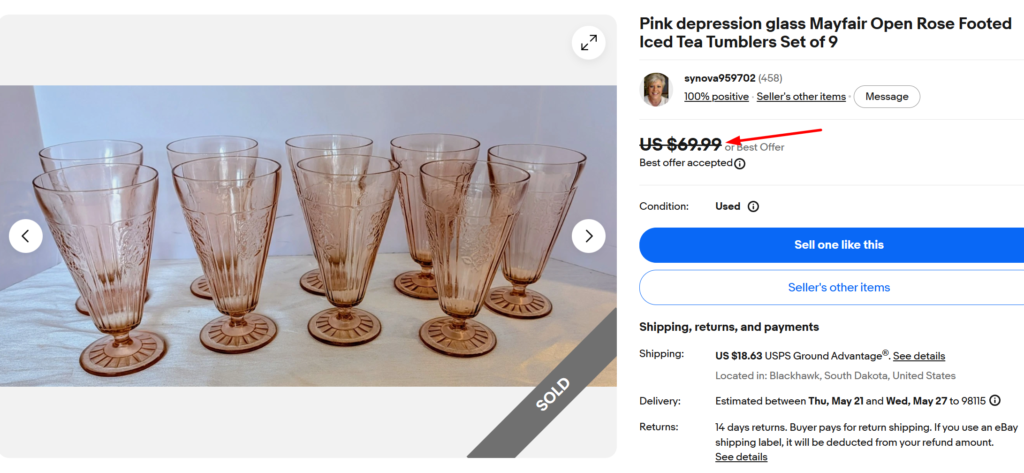
Sold for $70 (set of 9)
Mayfair is one of the most recognizable pink depression glass patterns. It features large open roses that circle the rim with a scalloped, scrolled edge. It was produced by Hocking between 1931 and 1937 in various colors, including pink, ice blue, yellow, and green.
While the pink color appears throughout the line, the covered cookie jar and footed pitchers are available in 32 oz., 60 oz., and 80 oz. capacities are the most desirable pieces.
- Estimated Value: $200-$300 (rare pieces); $40-$70 (common)
- Production Year: 1931 to 1937
- Line: Mayfair “Open Rose” by Anchor Hocking
- Characteristics: Large open-bloom roses with rim scrollwork; hook-shaped pitcher handles; deeply pressed scalloped lid edge
- Quick Notes: Heavily reproduced since the 1970s. Lid scalloping is the fastest authentication test.
2. Cherry Blossom by Jeannette
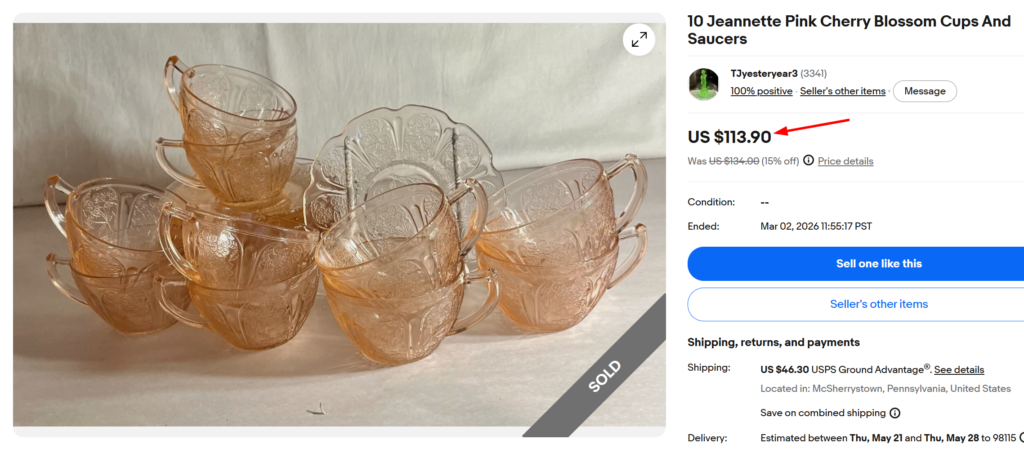
Sold for almost $115 (set of 10)
Cherry Blossom is one of the top five most-collected depression glass patterns. It’s also the most reproduced. Jeannette made it from 1930 to 1939 in pink, green, Delphite (an opaque medium blue), and very limited Jadeite and yellow.
The child’s set is the standout piece. Jeannette made a small set of child-sized dishes in pink and Delphite, and complete child’s sets pull strong money. Footed pitchers in pink are also highly collectible when verified as authentic.
The cherry count is a quick test for authenticity. Originals have 2 bumps per cherry. Reproductions have 3.
- Estimated Value: $250–$500+ (child’s set); $80–$180 (rare pieces)
- Production Year: 1930–1939
- Characteristics: Cherry tree branches, hanging fruit, scalloped edges, paneled sides on some pieces
- Quick Notes: Count bumps on the cherries for authentication.
3. Miss America by Hocking
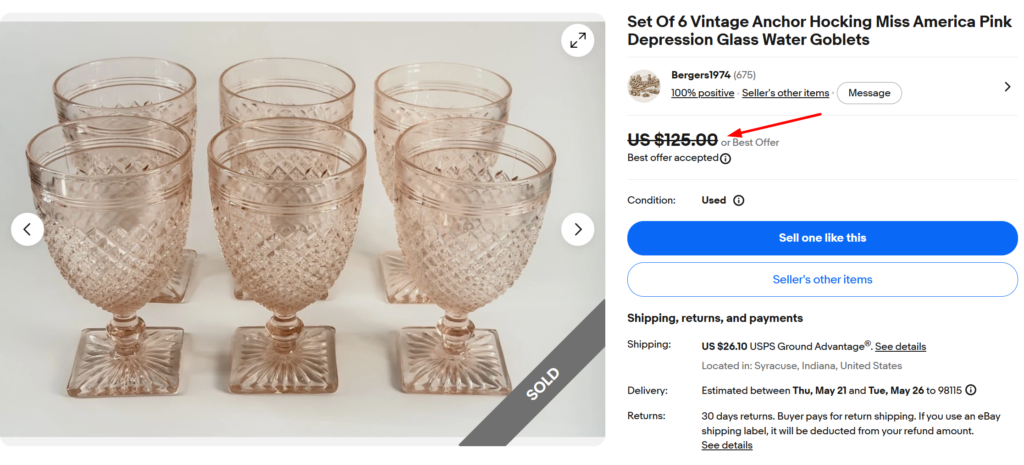
Sold for $125 (Set of 6)
Miss America has a faceted, diamond-cut look that some people confuse with English Hobnail. Hocking made it from 1935 to 1937 in pink, crystal, green, ice blue, and rare red. Pink is the most collected color today.
The pitcher and the salt and pepper shaker set are the high-value pieces. The pitcher without ice lip was made 1933–1936 and has a small “hump” on the top of the rim above the handle on originals. Reproductions are perfectly smooth there.
- Estimated Value: $75–$150 (pitchers); $80–$120 (tumblers)
- Production Year: 1935–1937
- Characteristics: Diamond-cut faceted pattern, uniform rays on base
- Quick Notes: Any cobalt or red Amberina Miss America is automatically a fake.
4. American Sweetheart by Macbeth-Evans
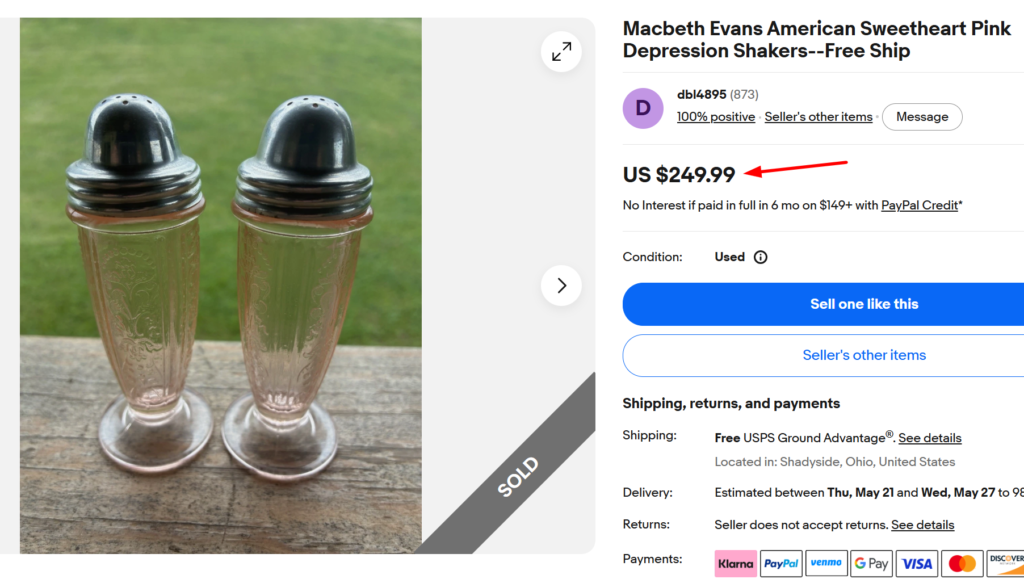
Sold for $250 (pair)
American Sweetheart has a delicate scroll-and-petal design with a ribbed, scalloped rim that sets it apart from chunkier patterns. Macbeth-Evans made it from 1930 to 1936 in pink, Monax (opaque white), red, blue, and limited Cremax.
The pink pitcher is one of the most desirable pieces in any depression glass pattern. The tumblers (only made in pink), footed salt and pepper shakers (in pairs) also sell for good money.
The pattern has never been reproduced. Nonetheless, the thin, delicate glass is its identifying feature.
- Estimated Value: $400-$900 (pink pitcher); $60-$150 (common pieces)
- Production Year: 1930 to 1936
- Line: American Sweetheart by Macbeth-Evans Glass
- Characteristics: Very thin, delicate glass; soft baby pink; ribbed and patterned scalloped rim
- Quick Notes: Inspect the scallop rim points for chips.
5. Royal Lace by Hazel Atlas
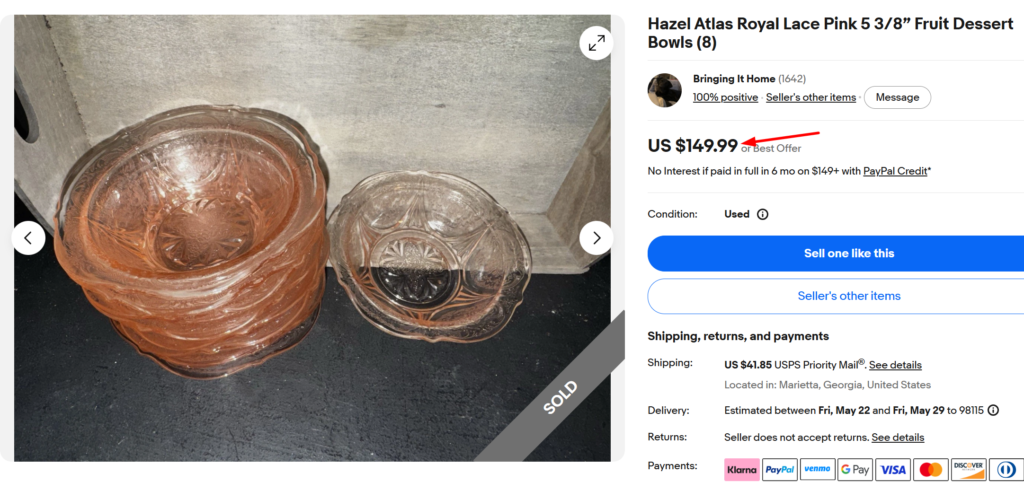
Sold for $150 (set of 8)
Royal Lace is the pattern most collectors fall in love with in cobalt blue, but pink Royal Lace is more affordable and still very collectible. Hazel-Atlas made it in pink, green, crystal, cobalt (Ritz Blue), and a rare amethyst called Burgundy.
The pink cookie jar with an intact lid is the most sought-after piece. Cookie jar bottoms were also sold as bases for cider sets and cottage cheese containers, so bottoms survive in much higher numbers than the lids.
Smaller pieces like fruit dessert bowls also sell well in matched sets, since the scalloped rims chip easily, and intact sets are harder to find.
- Estimated Value: $150-$250 (pink cookie); $70-$150 (bowls, plates)
- Production Year: 1934 to 1941
- Line: Royal Lace by Hazel-Atlas Glass
- Characteristics: Lacy scrolls and swags with rosettes; ribbed pull finial on cookie jar lid; three-legged console bowl
- Quick Notes: Cookie jars with lids are very rare.
6. Sharon “Cabbage Rose” by Federal
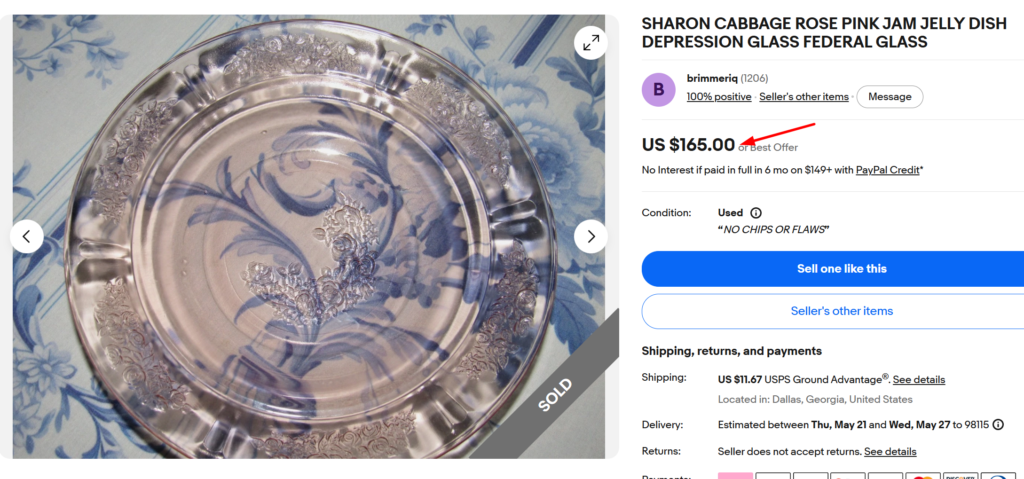
Sold for $165 (single)
The Sharon depression pattern is one of the most common patterns, having a general floral design consisting of roses and leaves. Federal produced this pattern between 1935 and 1939 in pink, amber, and, rarely, in green colors.
Most Sharon pieces are inexpensive, but the cheese dish and jam dish are big exceptions.
The cheese dish bottom is a 7½” salad plate with a raised glass ring to hold the lid. The butter dish bottom (same lid) is shallower with an inside indentation. The jam dish, often listed as a jelly dish, is the rarest of the three.
- Estimated Value: $100-$200 (pink jelly dish); $800-$1,200 (cheese dish)
- Production Year: 1935 to 1939
- Line: Sharon “Cabbage Rose” by Federal Glass
- Characteristics: All-over cabbage rose and leaf design; rosebud finial on lids; rays through the base center
- Quick Notes: Any blue Sharon is fake.
7. Princess by Hocking
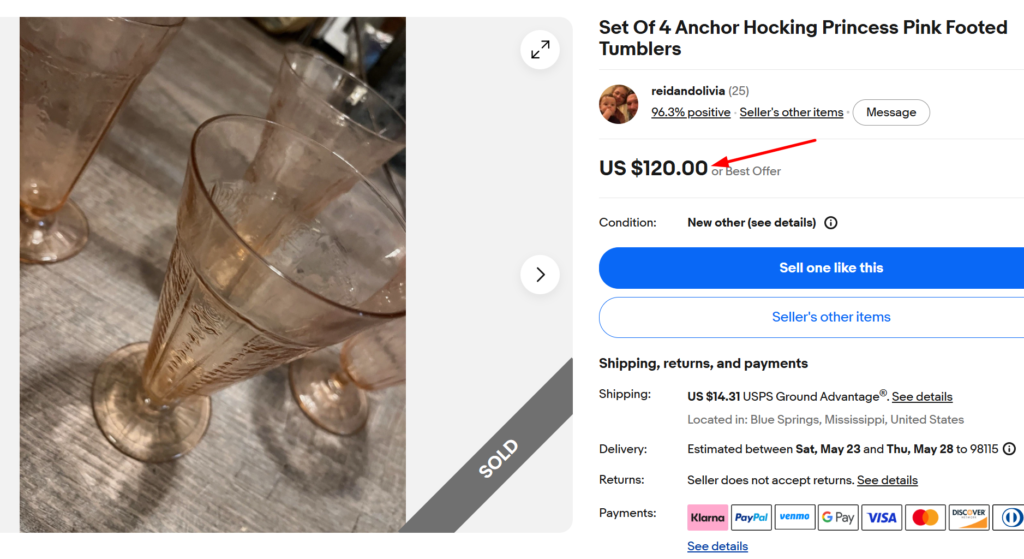
Sold for $120 (set of 4)
Princess is one of Hocking’s shorter-run patterns, made only from 1931 to 1934 in pink, green, topaz/apricot, and a very limited blue. The pattern features a central spoke design with lacy scrollwork and signature scalloped edges.
The hat-shaped bowl (flared rim) is the most distinctive piece, and the cookie jar is the most valuable everyday form. Footed tumblers in pink are another collector favorite, with their tall, flared shape and the all-over Princess pattern pressed into the body.
- Estimated Value: $50-$150 (tumblers); $35-$60 (hat-shaped bowl)
- Production Year: 1931 to 1934
- Line: Princess by Hocking Glass
- Characteristics: Central spoke design with lacy scrollwork; pebble-textured beading; deeply scalloped corners
- Quick Notes: Real beads in plates have a pebble texture; fake beads are smooth.
8. Dogwood “Apple Blossom” by Macbeth-Evans
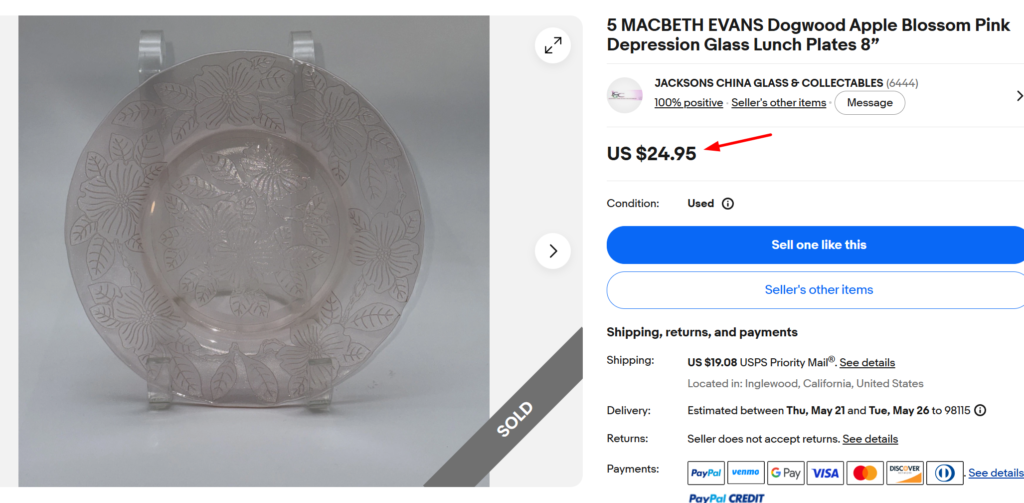
Sold for $25 (set of 5)
Dogwood (also called Apple Blossom or Wild Rose) is one of the prettier Macbeth-Evans patterns. Soft floral design, thin, clear glass body, sometimes with a frosted finish. Macbeth-Evans made it from 1929 to 1932 in pink and green, with very limited Monax.
Pink 8″ lunch plates are the most frequently seen form, often sold in sets of 4 to 6 at stores. The 80 oz pitcher is a rare piece that can sell for about $200. Grill plates (divided plates with separate sections) are common but yet collectible.
- Estimated Value: $150-$250 (pink 80 oz pitcher); $10-$25 (plates)
- Production Year: 1929 to 1932
- Line: Dogwood “Apple Blossom” by Macbeth-Evans Glass
- Characteristics: Soft blush pink; thin, delicate glass; all-over dogwood blossom and branch design; sometimes frosted
- Quick Notes: Check for crisp design for top value.
9. Old Colony “Lace Edge” by Hocking
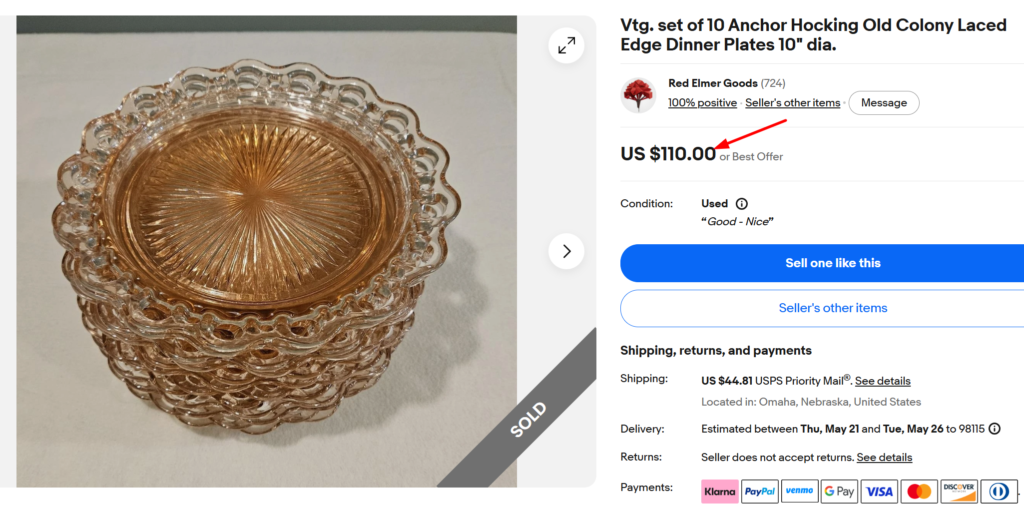
Sold for $110 (set of 10)
Old Colony (also called Lace Edge or Open Lace) has one of the most distinctive looks in depression glass. The open lattice border looks almost crocheted. Hocking made it only from 1935 to 1938, in pink and crystal, plus one rare green bowl.
The 10″ dinner plates with the full lacy rim are highly collectible, especially when found in matched sets of 8 or more. The footed comport and covered candy jar are the standout pieces.
Most plates and bowls have a rayed star impressed on the base. Pieces you don’t drink from have the open lace edge. Cups, sugars, and creamers have ribbed sides instead.
- Estimated Value: $25-$45 (footed comport); $50-$140 (lace edge plates)
- Production Year: 1935 to 1938
- Line: Old Colony “Lace Edge” by Hocking Glass
- Characteristics: Open lattice border with alternating ovals and round holes; rayed star on the base
- Quick Notes: Verify the exact lattice pattern to identify lookalikes.
10. Madrid by Federal
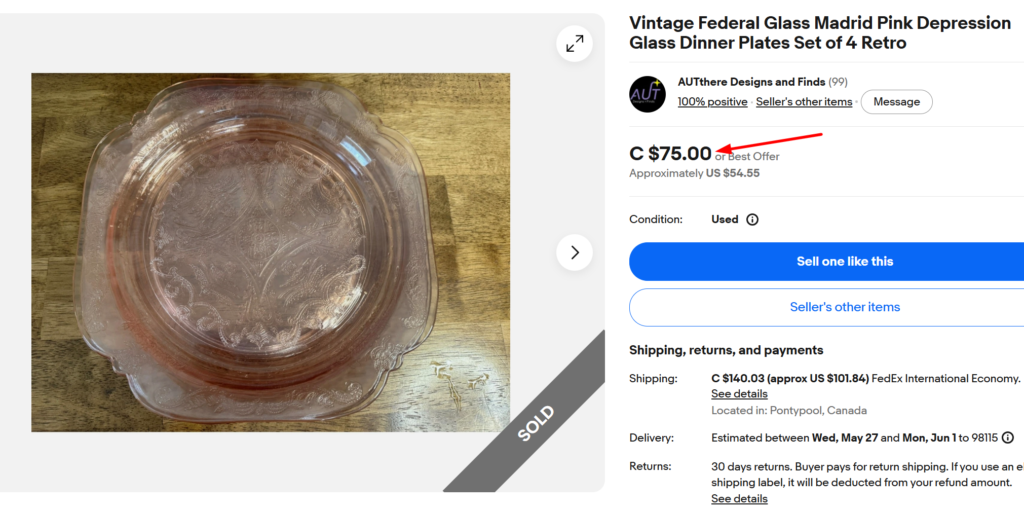
Sold for $75 (set of 4)
Madrid was one of Federal’s most popular depression patterns, with an Art Deco diamond-and-arch design. Federal made it from 1932 to 1939 in amber, green, blue, pink (called Rose-glo), and crystal. The pattern was reissued in 1976 as “Recollection.”
Federal made very few pieces in pink during the original run. No butter dish, creamer, sugar, dinner plate, or soup bowl in pink. Pink Madrid pieces that ARE original include the 80 oz ice-lip pitcher, sherbet, lunch plate, and specific bowl sizes.
Any pink Madrid square dinner plates you see for sale are reproductions from the 1976 reissue or later Indiana Glass production. Originals in pink simply weren’t made in that form.
- Estimated Value: $75-$150 (pink pitcher); $15-$25 (lunch plates)
- Production Year: 1932 to 1939 (originals); reissued from 1976
- Line: Madrid by Federal Glass
- Characteristics: Diamond and arch design with central rosette; Art Deco geometric framing
- Quick Notes: 1976 reissues carry a small “76” in the design. Teal Madrid is fake.
11. Manhattan by Hocking
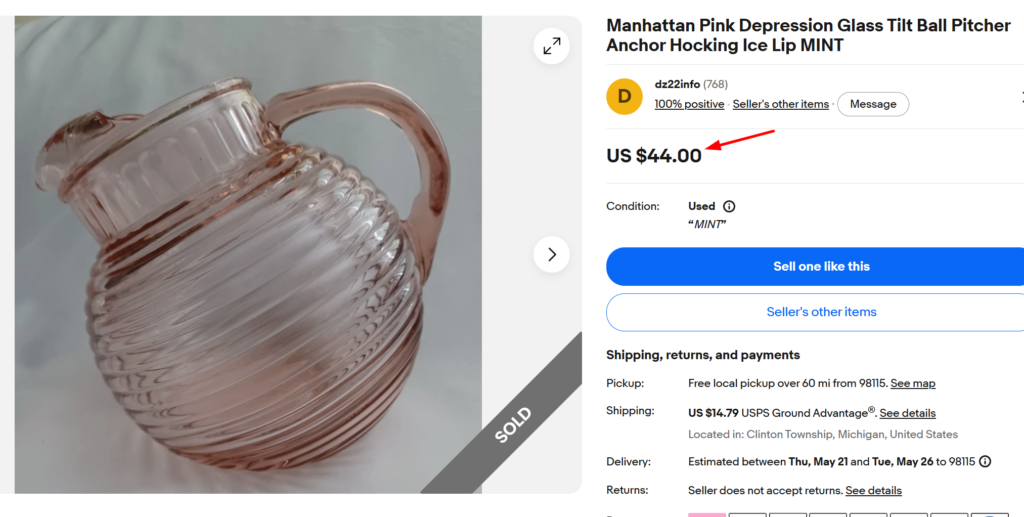
Sold for $45 (single)
Manhattan has one of the boldest Art Deco looks in depression glass. Strong horizontal ribs run around every piece. Anchor Hocking made it from 1938 to 1943 in crystal (most common), pink (less common), ruby, green, and iridescent.
The tilted ball pitcher is the standout. Round body, ice lip, ribbed handle, in juice and water sizes. Square candleholders about 3 inches tall hold one candle each and are favorites with Art Deco collectors. Pink Manhattan is genuinely harder to find than crystal.
The tilt ball pitcher in mint condition, with no chips along the ice lip, is the most actively chased Manhattan piece.
- Estimated Value: $100-$200 (pink tilted pitcher); $50-$80 (common pieces)
- Production Year: 1938 to 1943
- Line: Manhattan by Anchor Hocking
- Characteristics: Bold horizontal, rounded ribs; ribbed handles
- Quick Notes: Park Avenue (1970s) looks similar. Check the design for authenticity.
12. Adam by Jeannette
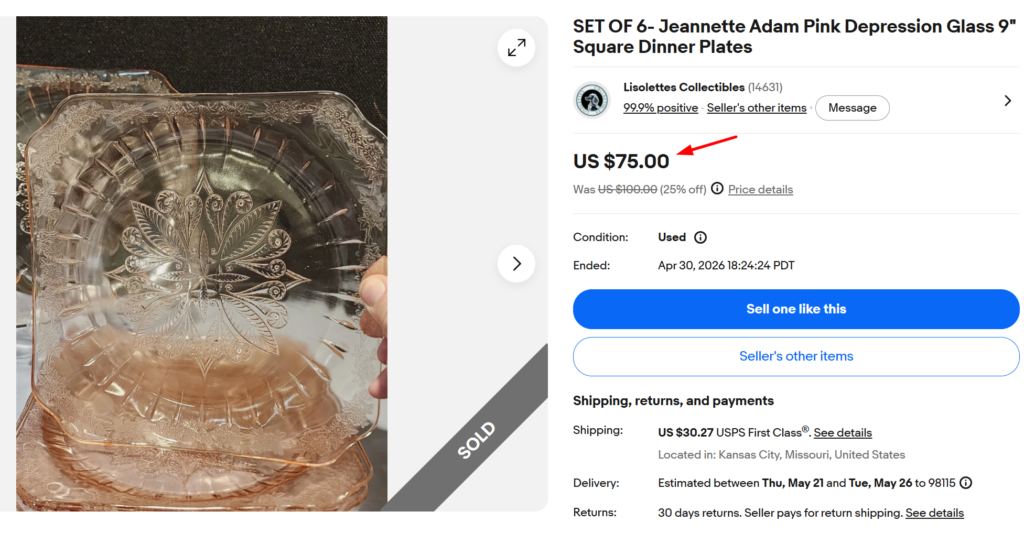
Sold for $75 (set of 6)
Adam stands out because of its square shapes and Art Deco feathered design. Jeannette made it from 1932 to 1934 in pink and green, with a few crystal pieces and very rare Delphite and yellow examples. The short two-year window makes complete sets hard to assemble.
Square 9″ dinner plates in pink, with the signature feathery center design, are some of the most recognizable Adam pieces and sell well in matched sets. The covered candy jar (which uses the same lid as the sugar bowl) and the square-bottomed footed pitcher are the must-know pieces.
- Estimated Value: $90-$150 (covered candy jar); $30-$80 (square plates)
- Production Year: 1932 to 1934
- Line: Adam by Jeannette Glass
- Characteristics: Square shapes throughout; feathery center design on bases; flower sprays on rims; paneled sides
- Quick Notes: Check the inside edge for inner rim roughness and chips.
How to Identify Genuine Pink Depression Glass?
From the color itself to the pattern details and shape, there are several clues that give it away as authentic pink Depression glass. Here are the key things to look for:
1. Identify the Pattern
Run your magnifier over the raised design. In almost all of the patterns used in depression glass, mold etching took place where the design was incised into the mold and then transferred onto the glass as raised designs rather than etched lines pressed into the glass. Trace the motif:
- Is it floral? – Mayfair has large open roses; Sharon has all-over cabbage roses; Cherry Blossom has cherry branches; Dogwood has scattered flower clusters.
- Is it geometric? – Manhattan has wide horizontal rounded ribs; Princess has scalloped octagonal rims; Adam has plumed feathers in square panels.
- Is it lacy? – Old Colony has an open lace-cut edge; Royal Lace has scrolled lace medallions.
- Is it diamond-cut? – (Miss America has uniform diamond points and a starburst center on plate bases)
Each pattern has its own fingerprints. The first are the specific base markings, like rayed stars on Old Colony or a feathery design on Adam. Reproductions often have smooth bottoms or wrong mold seam locations.
There are other pattern-specific clues. For example, the hook on a Mayfair handle, the hump on a Miss America pitcher rim, the star-shaped knob on a Miss America butter dish, the 4 wafers on Manhattan.
Get familiar with specific features of a pattern to identify original pieces.
2. Examine the Color
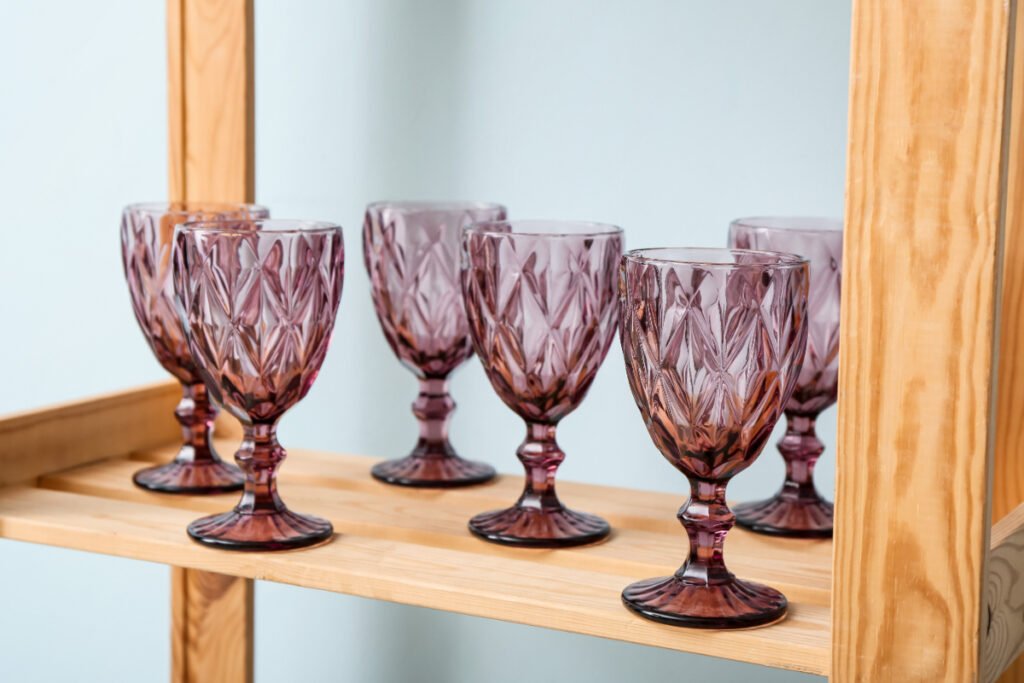
Real Depression-era pink is a soft, dusty rose color. It is not bubblegum pink, not orange pink, not even salmon. Compare your piece to a white sheet of paper under natural light.
Real pink glass should have the same look as the inside of a shell. Pink glass made in reproductions from the 1970s on can be either too pale or too bright.
A note on manganese tinting: very early pieces (pre-1915) sometimes contain manganese, which turns purple or amethyst when exposed to UV light or long sun exposure. True 1930s pink depression glass will never become purple, since manganese had already been substituted by selenium. If the “pink” glassware contains a slight tinge of lavender color, then it may be older than depression glass, or perhaps it may simply be a modern one.
Most of the pink depression glassware will not fluoresce under black light. If yours does fluoresce in green or yellowish green, then it is either vaseline glass or uranium glass.
Also, remember that each pattern was only produced in specific colors. If the color isn’t on the maker’s known list, it’s a fake or reproduction.
3. Check for Maker Marks & Mold Lines
Depression glass is almost never marked by the maker. No backstamps, no logos, no signatures. The pattern itself is the signature. Don’t be misled by the absence of any marking; that’s fine.
But then, what to look for? Mold seams are visible on the outside, going up vertically; small air bubbles are within the glass; and small ripples or what’s called “straw marks” are on the bottom. These are typical characteristics of mass-produced glass items.
Two exceptions to the no-marks rule are worth knowing. If there is a “76” on any part of the piece, it is the 1976 Bicentennial Madrid by Federal, not from the original 1930s manufacture. If it has a registered trademark or “MADE IN USA” in capital letters, it is a post-197.
Knowing the pattern, the production years, and the specific features can help you separate a $20 pink Depression piece at a flea market from walking past a $400 find.