
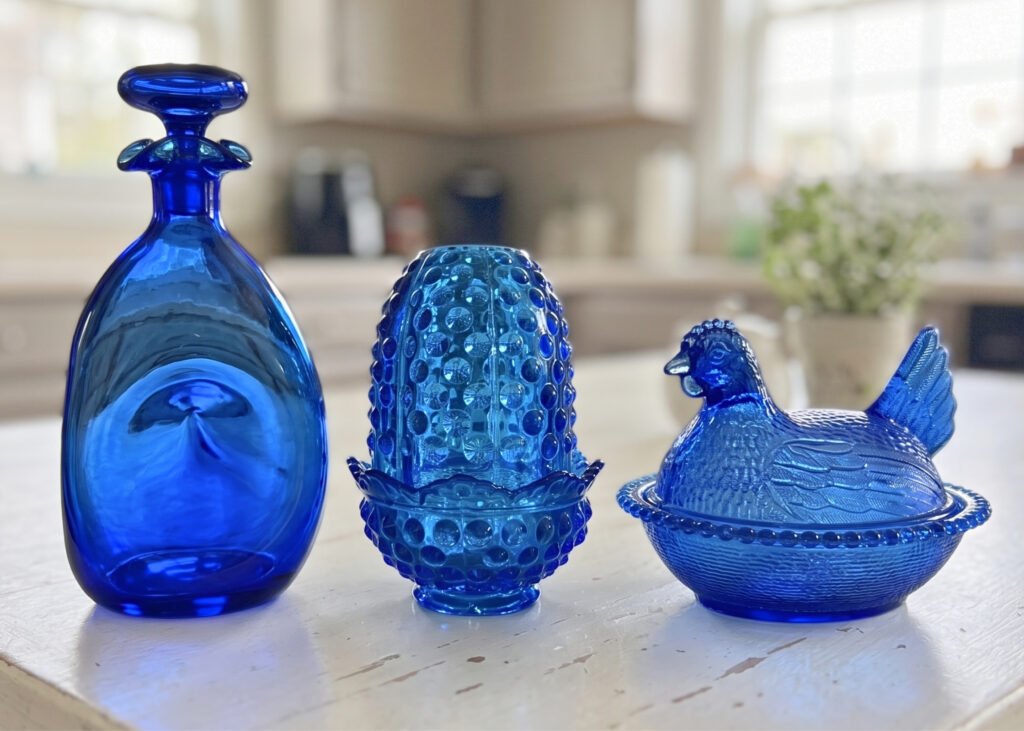
The deep, rich blue glass can’t be missed at estate and garage sales. Not all blue glass items are cobalt, and not all cobalt blue items have great value — some can be sold for $15, while others can cost more than $500.
In this guide, we’ll learn what sets the genuine, valuable cobalt blue items apart from inexpensive copies, what determines their value, and which cobalt items to collect now.
What Is Cobalt Blue Glass?
The color in cobalt blue glass comes from cobalt oxide, which is a mineral coloring agent used when manufacturing glass. The small quantity makes the blue appear so vibrant.
The color has been around for centuries. But cobalt glassware as we know it really took off in two waves. First, English makers like the Jacobs family in Bristol started producing it in the 1780s, and it spread across Europe and later into America.
The second wave was led by American glasshouses like Hazel Atlas, Cambridge, and Fenton during the 1930s and early 1940s. That’s where 90% of the pieces you’ll find at estate sales come from.
So when you’re looking at a cobalt piece, you’re usually looking at either a Georgian-era English antique, an American Depression-era piece, or a mid-century art glass piece. Each tier has its own value and identification clues.
How to Identify Antique & Vintage Cobalt Blue Glassware?
As I mentioned above, cobalt glassware comes from different eras, so identification can get tricky. People see blue glass, assume it’s old and valuable, and either overpay or sell for pennies.
But there are simple checks you can do at the table before you commit to buying or selling anything.
1. The Light Test: Real Cobalt vs Blue-Tinted Glass
Cobalt glass isn’t always what you think it is. While types of glass look quite the same, there is a huge distinction between them. So, pick the piece up first, and the weight and light will tell you the difference.
Hold it up to a bright window or a bare bulb. True cobalt shows a deep, uniform violet-blue all the way through, even where the glass is thick at the base. Cheaper “blue” glass often looks washed out at the edges, or reads more turquoise than blue. Some pieces are just clear glass with a blue coating sprayed on, and you can see the color get thinner at the rim.
Depression-era cobalt has a slightly darker, richer tone than modern reproductions. Newer pieces made in China or as gift-shop knockoffs tend to look flatter and brighter, almost neon in places. Once you’ve held a few real ones, the difference becomes obvious.
2. Weight, Ring & Feel
Older cobalt glass is dense. A Depression-era Hazel Atlas plate feels noticeably heavier than a modern replacement of the same size. Bristol Blue pieces from the 1800s are heavier still because of their lead content.
Give the rim a gentle tap with your fingernail. Genuine older glass gives a soft, clear ring that holds for a second. Modern pressed glass usually gives a dull thud or a very short ping.
Run your thumb around the base. Vintage pieces often have small imperfections, a slightly rough spot, tiny bubbles trapped in the glass, or subtle mold-seam ridges. Machine-perfect smoothness usually points to a newer piece.
3. Pontil Marks, Mold Seams & Base Wear
Flip the piece over and check the base for the following things to verify the authenticity of your cobalt glass piece:
Pontil Mark
A pontil mark, that rough or ground-down circle in the center of the base, means the piece was hand-blown. It’s the spot where the glass was broken off the blowpipe. You’ll see this on Bristol Blue, Bohemian cut glass, Blenko, and older Fenton art glass.
Mold Seams
Mold seams are the faint vertical lines you can feel running up the sides. On older pressed pieces from the 1920s and 1930s, these seams often stop short of the rim because the top was hand-finished.
On newer reproductions, the seams usually run all the way to the top and are sharper to the touch.
Base Wear
Always check the base for damage and wear. Real vintage pieces show fine scratches on the bottom from decades of being set down. If the base looks brand new and glossy, be suspicious. That’s the cleanest sign of a reproduction.
4. Maker’s Marks & Signatures
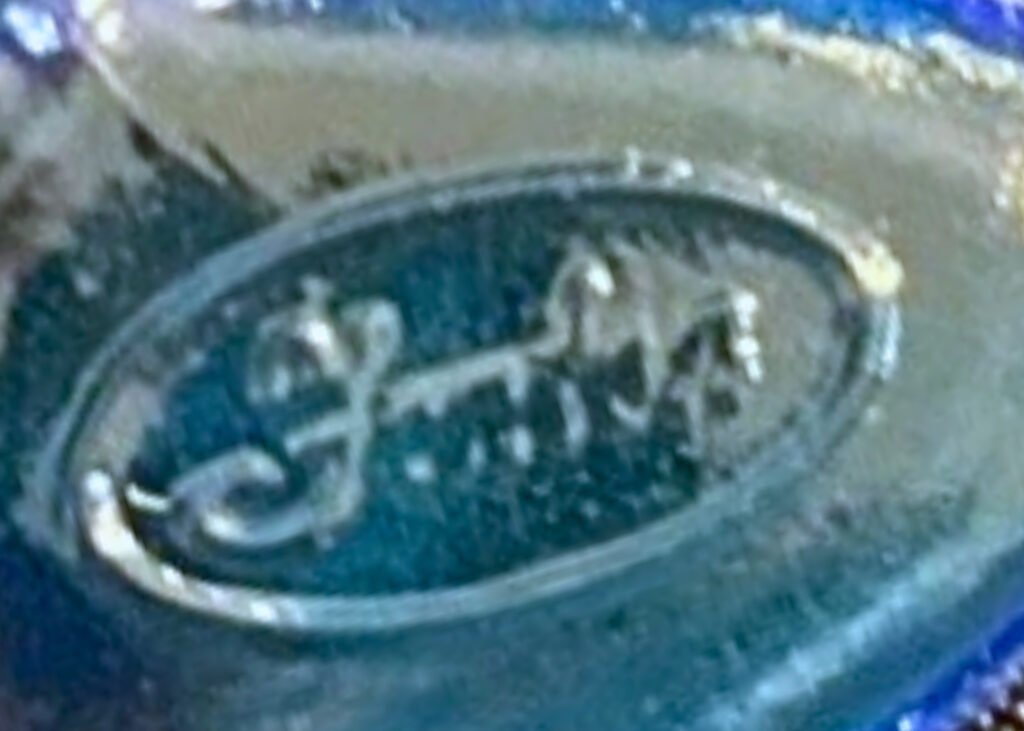
Hallmarks are where dating gets precise. Most Depression-era cobalt is unmarked, but when you do find a mark, it tells you exactly who made it and roughly when.
Here are the marks and makers worth memorizing for cobalt glass:
- Hazel-Atlas Glass Co. – Small “H over A” mark molded into the base, often faint. Made almost every major cobalt Depression pattern, including Royal Lace, Newport, Chevron, and the Shirley Temple pieces. Many pieces are unmarked, so pattern identification matters.
- Cambridge Glass Co. – Uses a “C in a triangle” mark on some pieces. Known for the Caprice pattern in Moonlight Blue and rarer true cobalt.
- Fenton Art Glass – From 1970 onward, an oval “Fenton” logo was molded into the glass. Pre-1970 pieces used only paper stickers, most of which are long gone. Handmade baskets often have a signed cane handle from later years.
- Anchor Hocking – Uses the well-known anchor logo with an “H” through it, mostly from the 1940s onward.
- Blenko Glass – Older pieces have foil labels that have usually fallen off. Modern pieces have an incised “Blenko” signature on the base.
- Bristol Blue – Almost always unmarked. The Jacobs family occasionally signed pieces in gilt on the base, but authentic Jacobs signatures are extremely rare and often faked.
- Bohemian (Czech) makers – Rarely marked. Look for hand-cut, deep facet-cutting through to clear glass underneath the cobalt layer.
- Murano (Italian) – Usually a paper or foil label. Signed pieces from named glasshouses like Barovier or Seguso command a real premium.
Easy Tip: If a “cobalt Depression glass” piece has an obvious, crisp maker’s mark, treat it as a reproduction until you can prove otherwise. Most authentic Depression cobalt is either unmarked or has a small, softly molded logo.
Reproduction Red Flags
Cobalt glass has been reproduced for the longest time. Some are even 40+ years old themselves, which makes spotting them tricky. But there are a few signs that will save you money.
Look for glass that is too bright, too clean, and too uniform in color. Genuine older cobalt has tiny variations in tone across the piece. Reproductions look flat and slightly plasticky under light.
Check for regular, evenly spaced bubbles in the glass. Real hand-blown pieces have random, uneven bubbles. Fake “hand-blown look” pieces often have suspiciously perfect bubbles because they were pressed into the mold.
Sticker-only branding is another warning sign. If the only proof of a maker is a shiny modern foil label, and there is no molded mark, no pontil, and no wear on the base, be careful. Real vintage pieces almost always show some kind of aging on the underside.
Most Collectible Cobalt Glass Patterns & Pieces Worth Saving
Below are some of the most collectible antique and vintage cobalt blue glassware patterns and items from top makers that collectors are hunting today. Learn how to spot them and what they’re worth.
1. Indiana Glass Cobalt Hen-on-Nest Dish
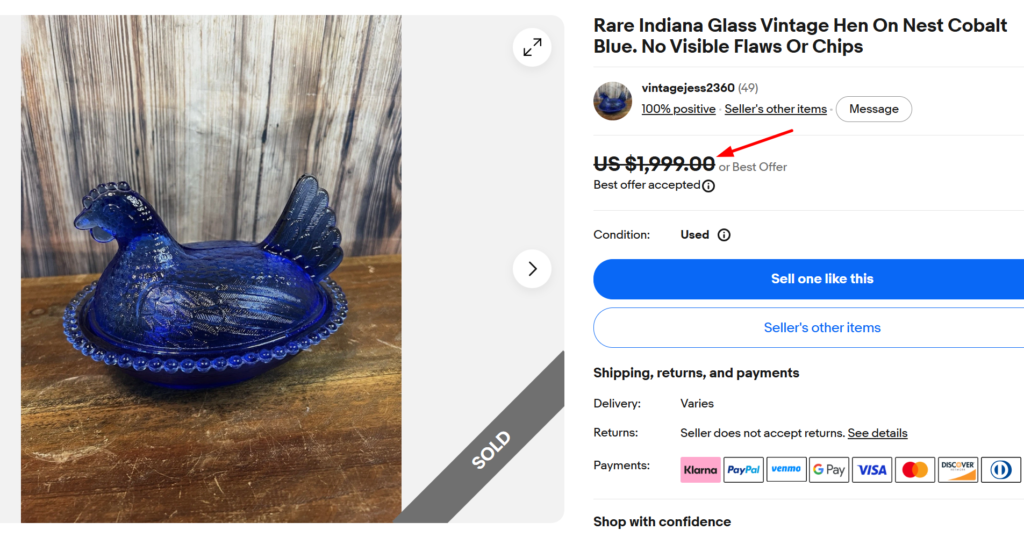
Sold for $2,000
Indiana Glass of Dunkirk produced its classic Hen on Nest covered dish for nearly a century in one 7-inch size. It features a feather-embossed body and a beaded rim base.
Cobalt is the legendary “Holy Grail” color, so rare that most blue hens on the market are actually reproductions or hand-tinted pieces.
- Estimated Value: $400 to $2,000+
- Production Years: Early 1900s through late 1900s
- What to Check: Beaded base rim, feather-embossed body
- ID Notes: Many “cobalt” hens are dyed reproductions; check carefully.
2. Hazel Atlas Royal Lace
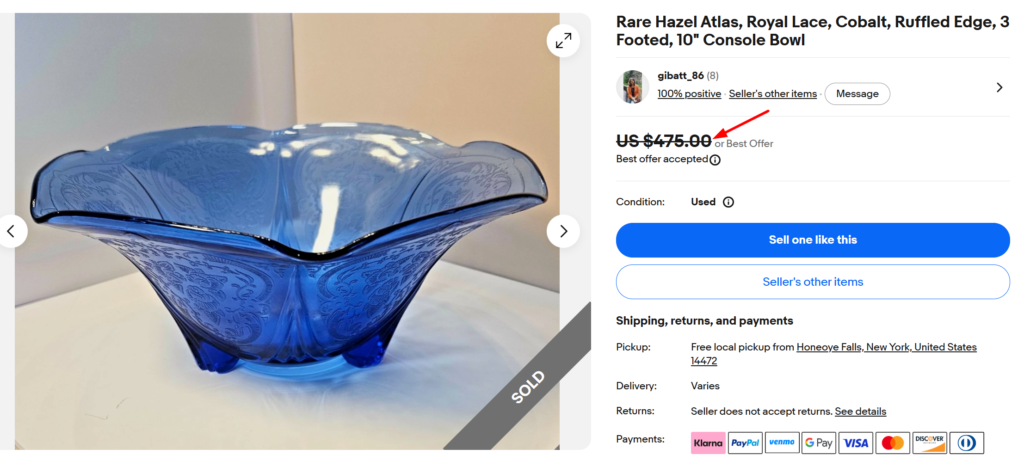
Sold for $475
Hazel Atlas made Royal Lace from 1934 to 1941 in pink, green, crystal, and their signature “Ritz Blue” cobalt. The pattern features three roses in a draped, lacy border that repeats around each piece.
Cobalt Royal Lace came about almost by accident, when General Mills canceled the Shirley Temple promotion and Hazel Atlas had vats of leftover blue glass. So they poured it into Royal Lace molds. Cookie jars, butter dishes, and console bowls are the top pieces.
- Estimated Value: $70 to $1,500+
- Production Years: 1934 to 1941
- What to Check: Rose-and-lace draped border pattern
3. Hazel Atlas Moderntone
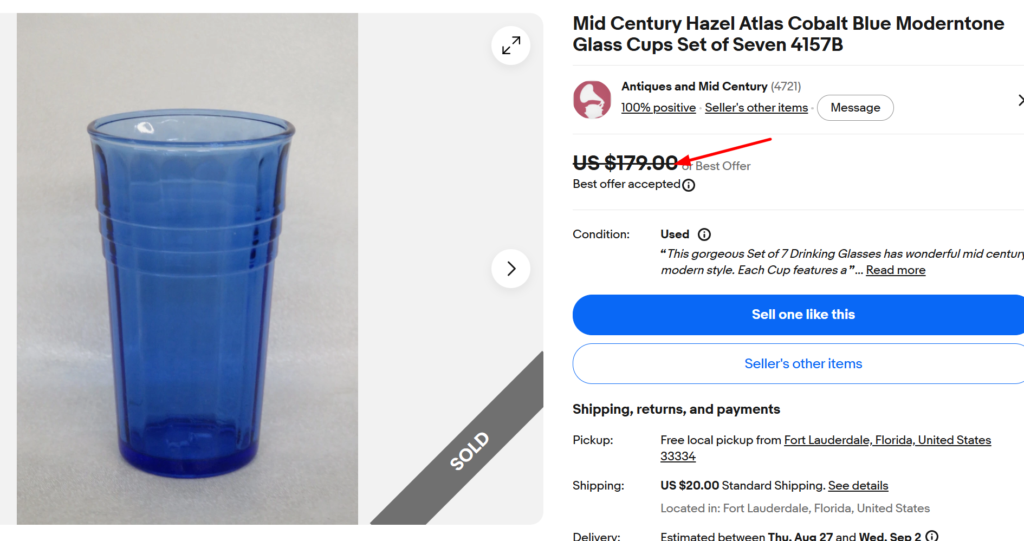
Sold for $180 (set of 7)
Moderntone is among the most popular cobalt Depression glass patterns. Hazel Atlas made it from 1934 to 1942 and briefly again in the late 1940s. The pattern is pure Art Deco, with simple raised concentric rings running around the body.
Cobalt is the most sought-after color, but Moderntone stays relatively affordable because a lot of it survived. Both partial sets and full sets of 25 to 40 pieces often turn up at estate sales.
- Estimated Value: $10 to $80 per piece
- Production Years: 1934 to 1942 (revived late 1940s)
- What to Check: Concentric raised ring bands
4. Fenton Hobnail Fairy Lamp
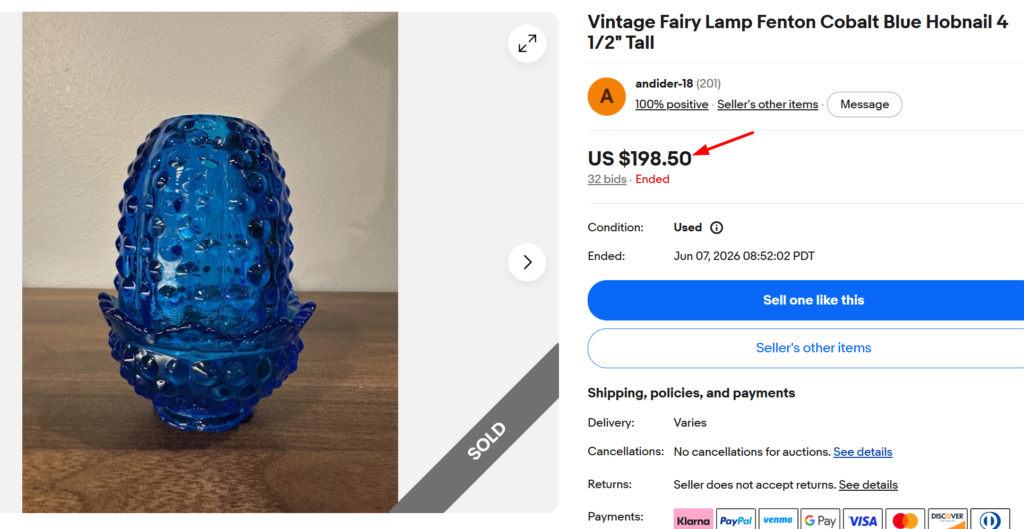
Sold for $200
Fenton launched its hobnail line in the 1940s, and it became one of the company’s signature looks. The pattern is instantly recognizable by the small, rounded “nubs” that cover the outside surface.
Cobalt hobnail is less common than milk glass hobnail, which is why it’s more collectible. Vases with a ruffled or crimped rim and fairy lamps tend to bring more than plain shapes.
ID Note: Look for the molded Fenton oval logo, which the company started using in 1970. Pre-1970 pieces rely on pattern and construction for identification.
- Estimated Value: $30 to $250 per piece
- Production Years: 1940s onward (cobalt runs varied)
- What to Check: Rounded nub texture, ruffled rim
5. Murano Sommerso Cobalt Blue Vase (Italian)
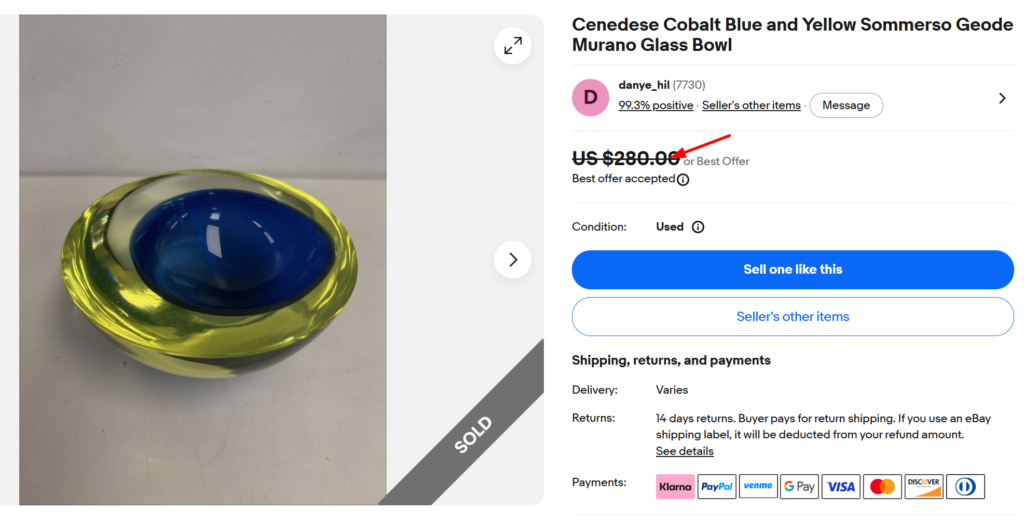
Sold for $280
Murano’s Sommerso technique was developed in the 1930s and perfected through the 1950s and 1960s. It involves submerging a core of colored glass inside layers of clear or contrasting glass.
Cobalt blue is one of the most sought-after colors, often paired with clear or teal encasing layers.
Value Tip: Signed pieces from famous Murano houses like Seguso, Cenedese, or designs by Flavio Poli are worth the most. Unsigned mid-century Sommerso pieces are still valuable, especially heavier examples with sharp facet cuts.
- Estimated Value: $150 to $1,850+ per vase
- Production Years: 1950s to 1970s (peak Sommerso era)
- What to Check: Layered blue-in-clear submerged effect
6. Hazel Atlas Aurora Berry Bowls
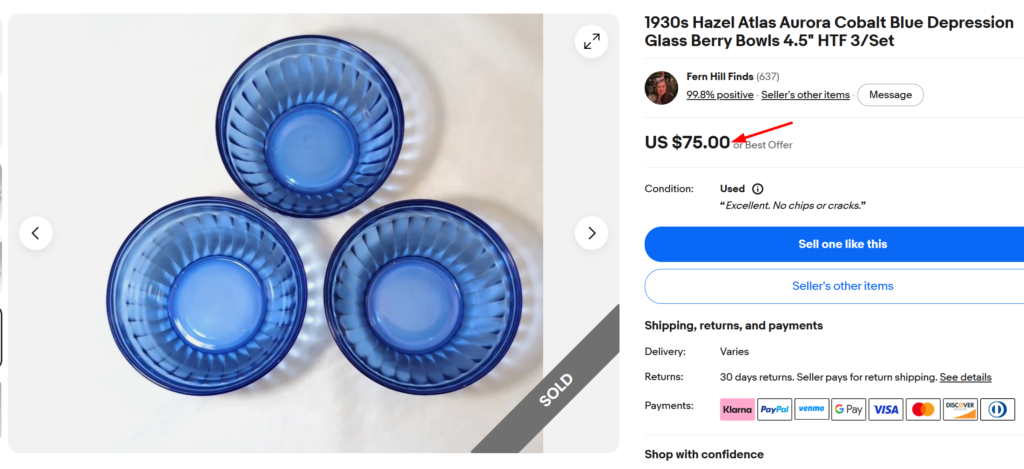
Sold for $75 (set of 3)
Aurora is a two-year wonder. Hazel Atlas made it only in 1937 and 1938 as a small breakfast or snack set, with just seven pieces in the entire line. No dinner plate. No sugar bowl.
It came in cobalt, pink, green, and crystal, but cobalt is by far the most collected.
Because the run was so short, complete cobalt Aurora sets are genuinely scarce. The 4¾-inch tumbler and the small creamer are the most valuable pieces.
- Estimated Value: $20 to $200 per piece
- Production Years: 1937 to 1938
- What to Check: Small snack set, no dinner plate
7. Hazel Atlas Shirley Temple Set
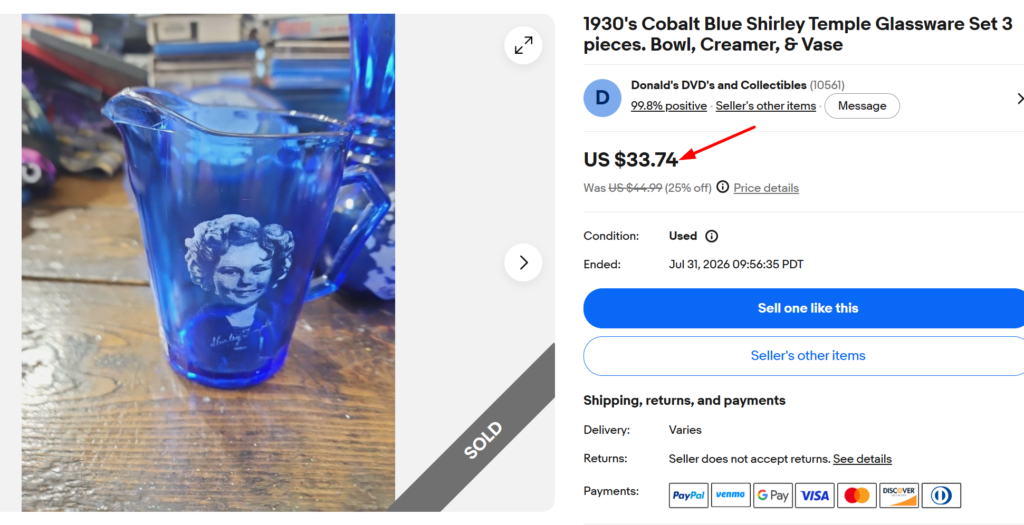
Sold for $33 (set of 3 pieces)
The Shirley Temple set is the most nostalgic cobalt piece ever made. Hazel Atlas produced it from 1934 to 1942 as a cereal premium for General Mills, using cobalt blue “honeycomb” panel glass with a white sandblasted portrait of Shirley Temple.
The three-piece set includes a small mug, a milk pitcher, and a cereal bowl. Millions were made, so individual pieces stay affordable. Also, reproductions from the 1980s and 1990s flood the market, so authentication matters.
- Estimated Value: $15 to $90 per piece
- Production Years: 1934 to 1942
- What to Check: Hexagonal honeycomb panels, sandblasted portrait
8. Cambridge Caprice in Cobalt Blue
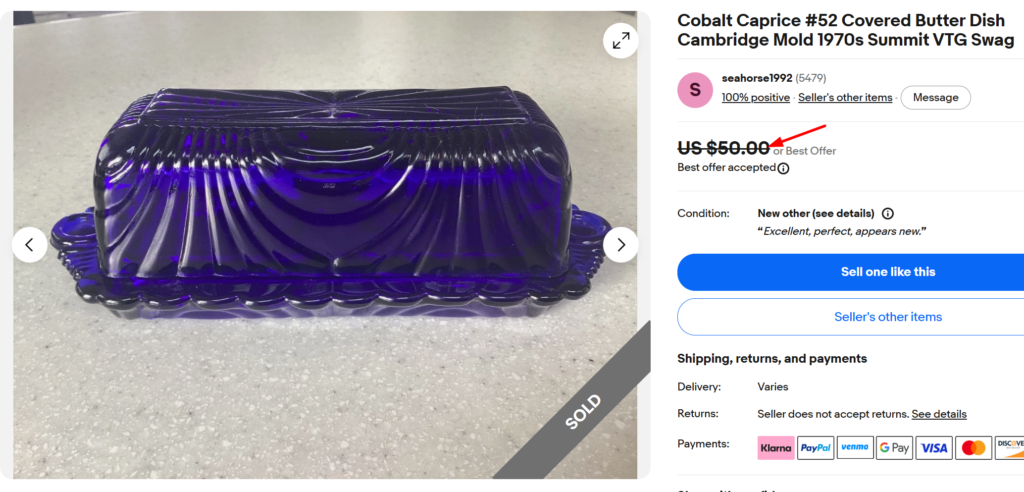
Sold for $50
Caprice is Cambridge Glass Company’s most famous pattern. Introduced in 1936 and produced until 1953, it features soft swirling lines that look a little like ocean waves rolling around the piece.
The majority of Caprices are colored in Moonlight Blue, a light shade compared to cobalt blue. Cobalt Caprices are very rare, and some of these pieces were actually manufactured post-1958 by Imperial Glass, which bought Cambridge molds.
Signed original Cambridge cobalt Caprice is the most collectible tier.
- Estimated Value: $40 to $500+ per piece
- Production Years: 1936 to 1953 (Cambridge)
- What to Check: Swirling wave lines, dot-motif feet
9. Antique Bristol Blue Glass Sugar Bowl
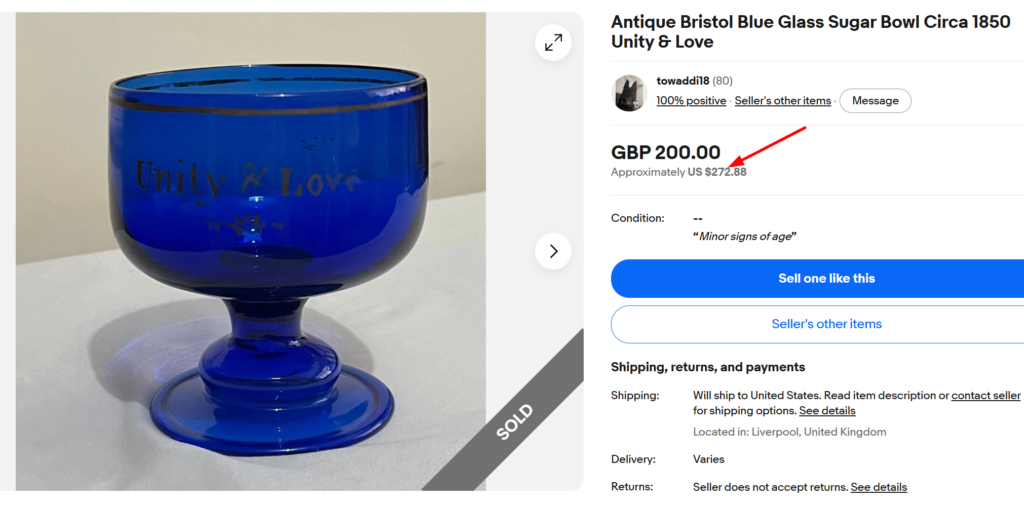
Sold for $272
Bristol Blue is the oldest and most collectible cobalt glass. English glassmakers in Bristol, led by the Jacobs family in the 1780s, developed the recipe by adding cobalt oxide from local ceramic suppliers to flint glass.
The result was a deep, jewel-like blue that Europe couldn’t get enough of.
Original pre-1920s Bristol Blue is almost always unmarked, so age has to be judged by weight, pontil marks, and gilding. Georgian and Victorian decanters, wine rinsers, and finger bowls are the pieces to know.
- Estimated Value: $80 to $2,000+ per piece
- Production Years: 1780s to early 1920s
- What to Check: Rough pontil, gilded lettering, heavy lead feel
- Quick Facts: Modern Bristol revival began in 1988.
10. Bohemian Cut-to-Clear Cobalt Blue Vase
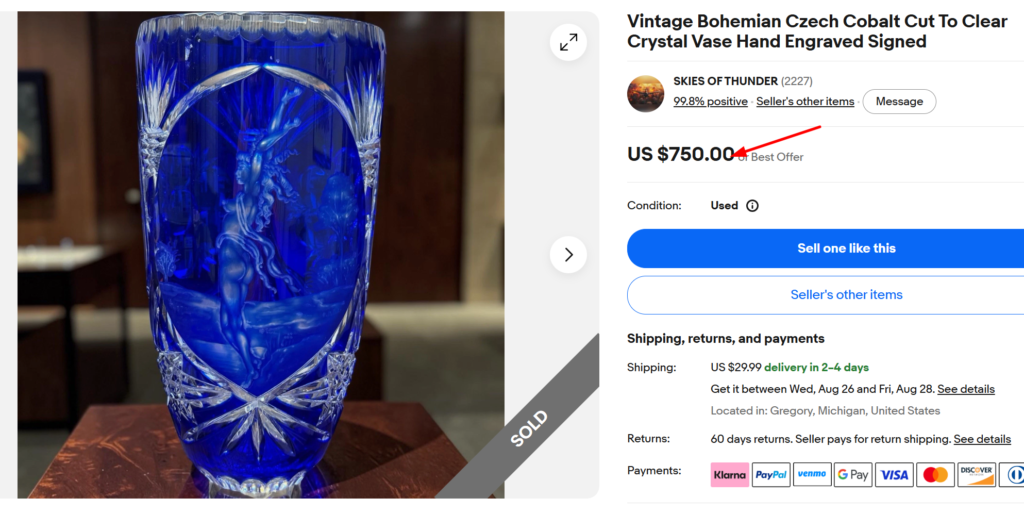
Sold for 750
Bohemian glass from what is now the Czech Republic is among the most expensive types. Cut-to-clear pieces are made by casing a layer of cobalt glass over a clear body, then hand-cutting through the blue layer to reveal the clear glass beneath in decorative patterns.
Antique 19th-century Bohemian pieces feature deep, sharp cutting and star or diamond motifs. Newer Czech reproductions from the 1950s onward are lighter and more shallow-cut. The depth and crispness of the cut work is the key value driver.
- Estimated Value: $60 to $1,500+ per piece
- Production Years: 1830s onward, peak 1850 to 1900
- What to Check: Deep cut motifs, cobalt over clear layers
11. Blenko Hand-Blown Cobalt Blue Decanter
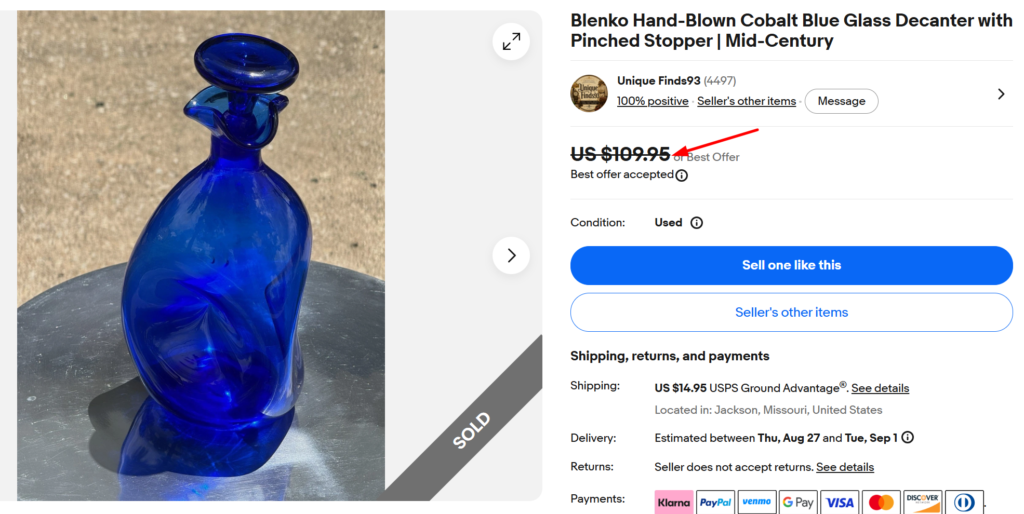
Sold for $110
Blenko Glass became one of America’s most respected mid-century art glass makers. Their cobalt decanters from the 1950s through the 1970s are most collected, especially the pinched-square shapes and pieces designed by named artists like Winslow Anderson and Joel Philip Myers.
Most vintage Blenko had only foil labels, and those are usually long gone. So identification comes down to shape, weight, and the tell-tale pontil mark on the base.
- Estimated Value: $75 to $400+ per decanter
- Production Years: 1950s to present (mid-century peak)
- What to Check: Rough pontil, hand-blown asymmetry
- Value Notes: Named-designer pieces climb sharply
Is Cobalt Glassware Valuable? What Actually Drives the Price
Most vintage cobalt blue glassware sells for $15 to $75 today. But there are also some top-tier pieces that can jump to $500 or $1,500. The difference between these two categories comes down to the following factors:
- Maker & Pattern – A common unmarked cobalt tumbler is worth about $10. That same tumbler in Royal Lace by Hazel Atlas is closer to $70. And a signed Cambridge Caprice piece in cobalt can push into the hundreds.
- Age – A generic 1970s cobalt vase might be worth less than a marked 1937 Aurora tumbler, even though it looks fancier. What collectors care about is a documented pattern from a known maker in a short production window.
- Rarity – Cookie jars, butter dishes, and pitchers in Royal Lace cobalt regularly sell for $400 to $1,500 because so few survived. Basic saucers in the same pattern sell for $20. Same maker, same pattern, wildly different values.
- Condition – A single chip on the rim can drop the value by 60% to 80%. Cloudy glass from dishwasher damage, called “sick glass,” is usually a dealbreaker for serious collectors. Small flea bites on the base hurt less.
- Completeness – Full sets, matching pairs of candlesticks, decanters with their original stoppers, and pitchers with all their tumblers sell for much more than the same pieces sold separately.
Is Vintage Cobalt Glassware Safe to Use?
Yes, for display and light use, but not recommended for daily food service. The cobalt oxide in the glass is chemically bound and does not leach in normal handling. However, some antique cobalt pieces, especially pre-1940 European ones, were made with lead-based glass for extra clarity and weight. Lead can leach slightly with acidic foods, wine, or hot liquids stored for long periods. Modern American Depression glass is generally safer. If you’re unsure, use vintage cobalt for display, dry goods, or short-term serving, not for storing acidic drinks or feeding children.
If you have a specific cobalt piece you’re trying to identify, start with the base. Then match the pattern, assess the condition, and check the completeness. That’s what tells you what you’ve got.