
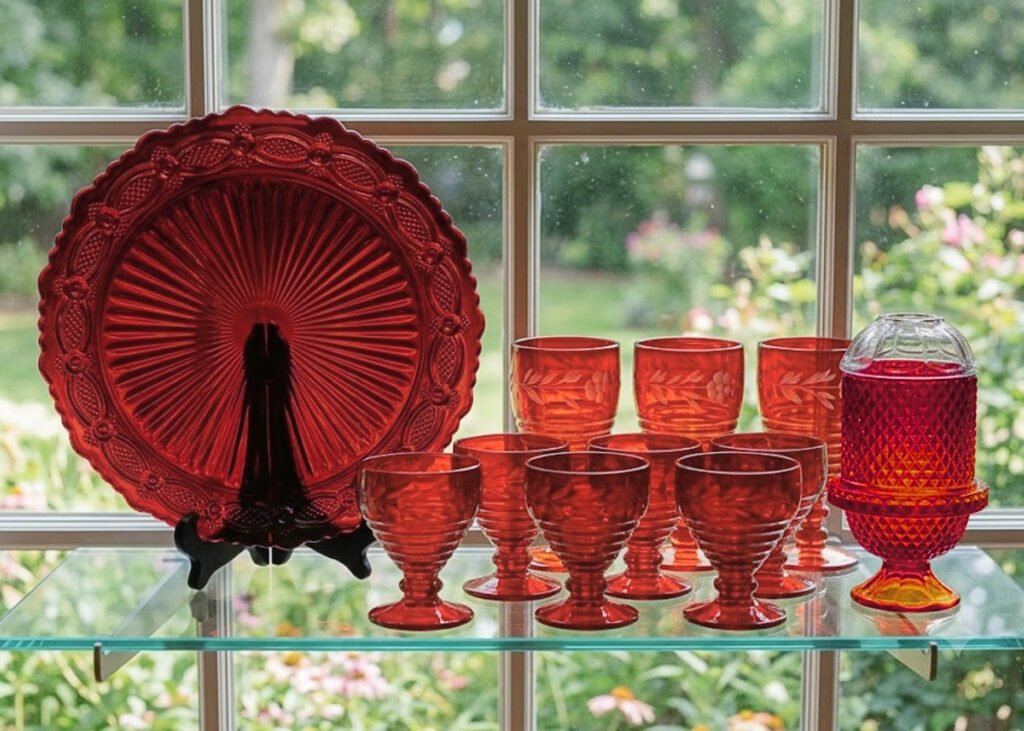
Red glass was a tricky color for traditional glassmakers to get right. For one thing, the batch needed gold chloride, copper, or selenium, and the red hue would appear only after a second heating in the furnace.
Timing was everything here; otherwise, they were left with clear or even brown glass.
That being said, it made the production process more expensive for manufacturers and, therefore, less likely to use it as an everyday color and more likely to use it for short production runs.
How to Identify Antique and Vintage Red Glass?
Before pricing anything, you first need to figure out what type of red glass you actually have. This is the list of things to look at.
True Ruby vs Flashed Red
This is the primary check and differentiates the $10 item from the $100 one. True ruby glass is red through and through; it has red color all the way across the glass piece.
Flashed red, on the other hand, is clear glass with the red coating applied to its surface. Often, it is cut to reveal clear glass below.
Use your fingernail to feel around the edge of the base for any chips. If you find a distinct layer there or notice the clear glass beneath the red coating where it got worn down, it is flashed. Flashing is not necessarily bad for collectability, but ruby is worth more money.
Weight and Feel
The older red glass usually feels heavier than the modern glass of the same size. The glassware made in the Depression and Elegant period of the 1930s and 1940s contained lead in it.
So when you hold a Cambridge Carmen goblet from those years and the modern-day replica in the same design, you will see how different they are in weight.
Base and Seam Lines
Turn the item upside down. Hand-made antiques typically have a pontil mark, which is where the glass was snapped from the blowpipe. Machine-made pieces, from the Depression era on, will have faint seam lines that run vertically.
Also, modern reproductions generally have sharper seam lines and a rounder, cleaner base than an antique would.
Color Depth Under Light
Hold the piece up to a window or bright light. Real ruby glass keeps its depth and looks slightly darker toward the thicker areas. Cheap modern reds look flat and uniform, almost plastic-like.
Maker’s Marks
Maker’s marks work well for dating, but it gets a bit tricky for red glass. Most classic makers, like Fenton prior to 1970, Anchor Hocking’s Royal Ruby line, and Cambridge, made items without any mark and only with paper labels, which mostly fade or get lost with time.
That means an unmarked item does not necessarily have to be a fake or more recent.
Some famous makers are Anchor Hocking, Fenton, Fostoria, Cambridge, Imperial, Westmoreland, Indiana Glass, Viking, Blenko, Whitefriars, Murano makers such as Seguso and Barovier, and Bohemian makers such as Egermann and Moser.
12 Valuable Antique and Vintage Red Glass Patterns and Pieces
Below are the red glassware patterns and pieces collectors pay real money for. Learn what makes them special and how much they can be worth today.
1. Anchor Hocking Royal Ruby
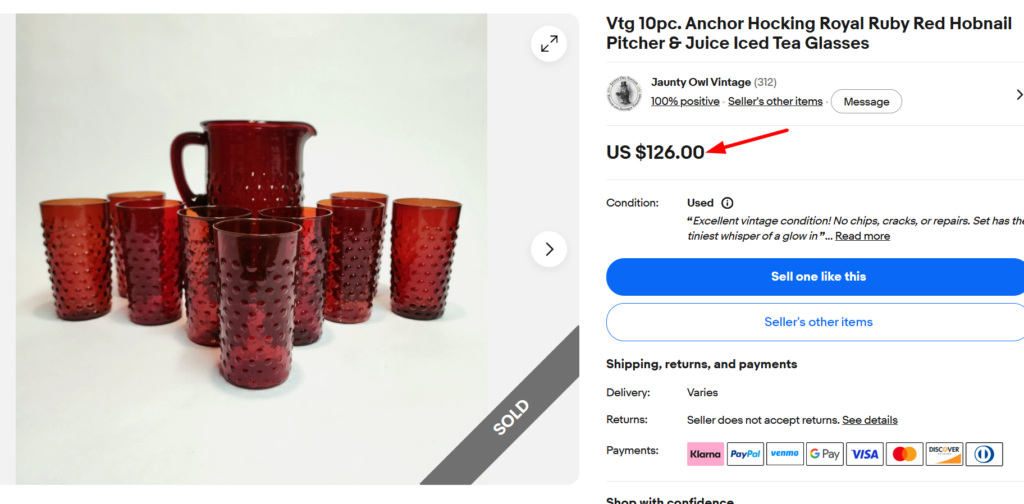
Sold for $125 (set of pitcher & tumblers)
Royal Ruby is the patented name for the dark red glass made by Anchor Hocking since 1938. Its color comes from the copper oxide and not gold, thus giving it a deeper shade compared to gold-red colors.
Hocking’s Royal Ruby items are usually not marked and were originally released with tiny paper labels. The line includes tumblers, pitchers, vases, plates, and even Schlitz beer bottles from 1949, 1950, and 1963.
- Estimated Value: $10 to $400+ per piece
- Production Years: 1938 to 1967, then 1973 to 1977
- What to Check: Deep even red, unmarked base
2. Fenton Hobnail Cranberry Opalescent
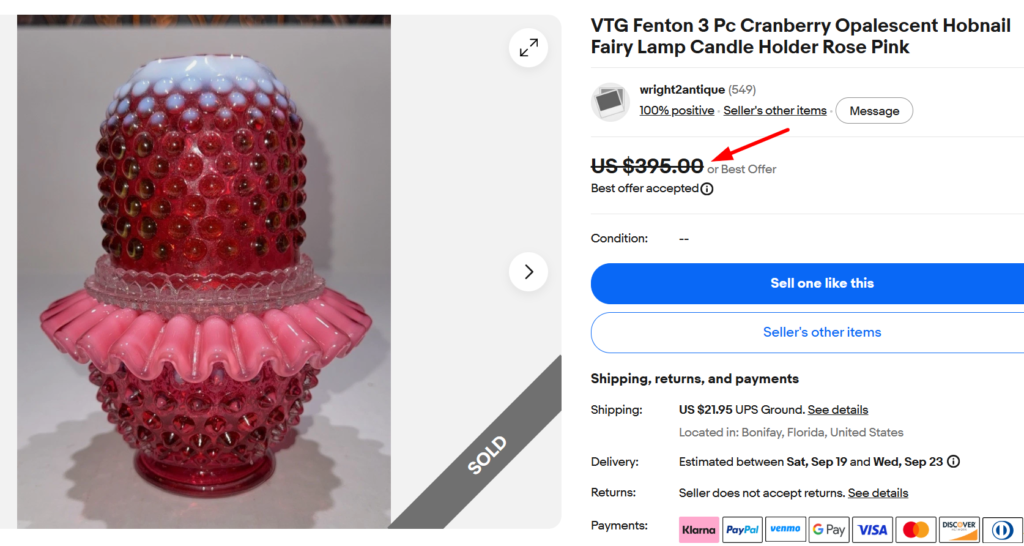
Sold for $395
Fenton began producing the hobnail glass in 1939. The cranberry was among the nine original colors. It is also the most sought-after. This design shows raised bumps in hexagonal groups.
The true cranberry opalescent glass always has a white, milky appearance at its thin edges. Pieces produced before 1970 have no permanent marking, so you need to identify them by their designs and opalescent appearance.
- Estimated Value: $30 to $700
- Production Years: 1939 onward
- What to Check: White glow at rim edges
- Value Notes: Baskets, lamps, and epergnes are most valuable.
3. Fostoria Coin Glass in Ruby
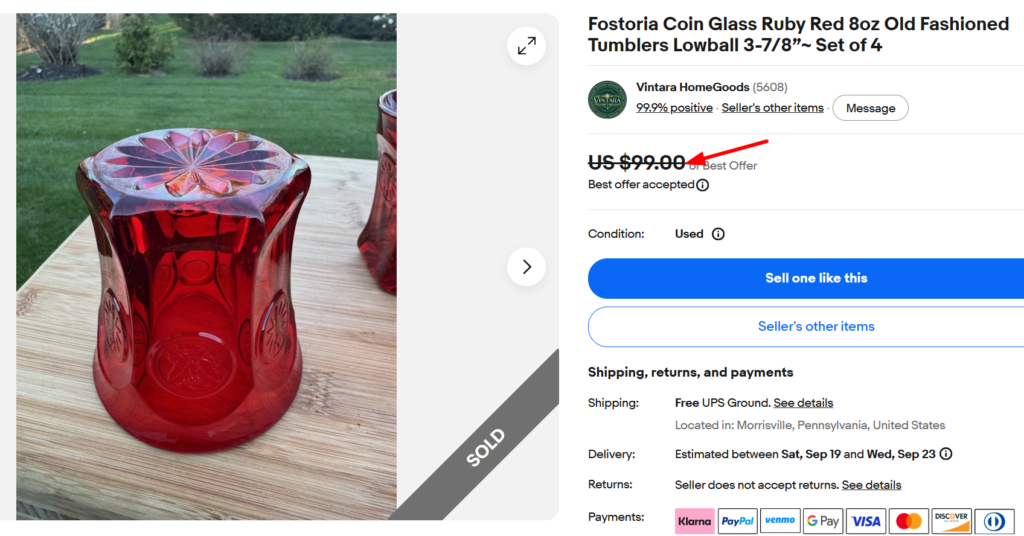
Sold for $100 (set of 4 tumblers)
The Fostoria Coin line dates back to 1958 and features oversized and highly embossed coin designs resembling American currency. You’ll see the eagle dated 1887 and the Liberty Torch.
This pattern was produced in crystal, amber, blue, olive green, and ruby colors, with the ruby typically selling for two to three times the price of the crystal version.
Lamps, covered candy boxes, and large bowls are the most valuable pieces here. Frosted coins are also much more popular than clear ones.
- Estimated Value: $30 to $250
- Production Years: 1958 to 1982
- What to Check: Frosted coins, ruby color depth
4. Cambridge Carmen
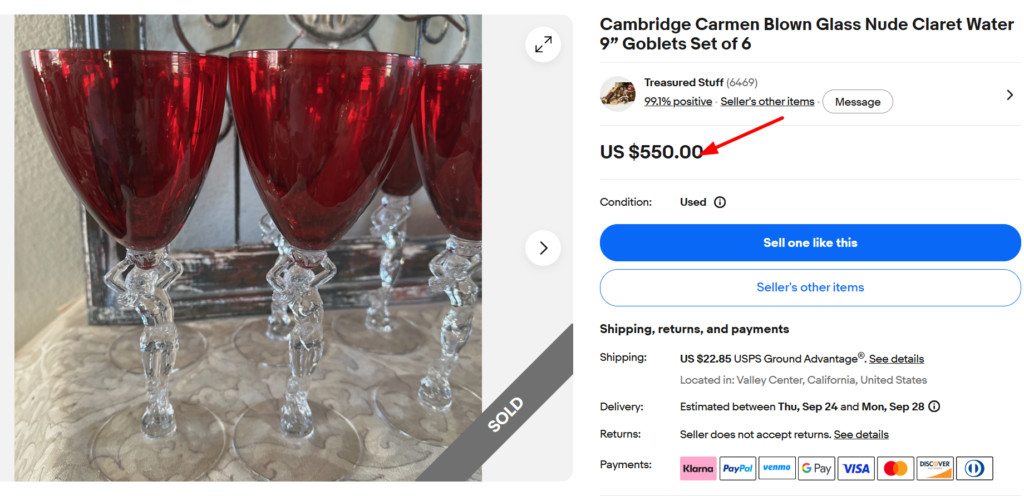
Sold for $550 (set of 6 Nude Stem goblets)
Carmen is the ruby red glassware made by the Cambridge Glass Company, using selenium and cadmium sulfide rather than gold. It is reportedly among the most desirable colors of Cambridge, specifically in the Nude Stem #3011 and Rose Point pattern.
Pieces from 1930 to 1958 bear a C in a triangle, though many are unmarked.
- Estimated Value: $40 to $600+
- Production Years: 1931 to 1958
- What to Check: Rich red, thinner spots lean yellow
- Value Notes: Nude Stem and Rose Point etched pieces are top-tier.
5. Imperial Candlewick in Ruby Red
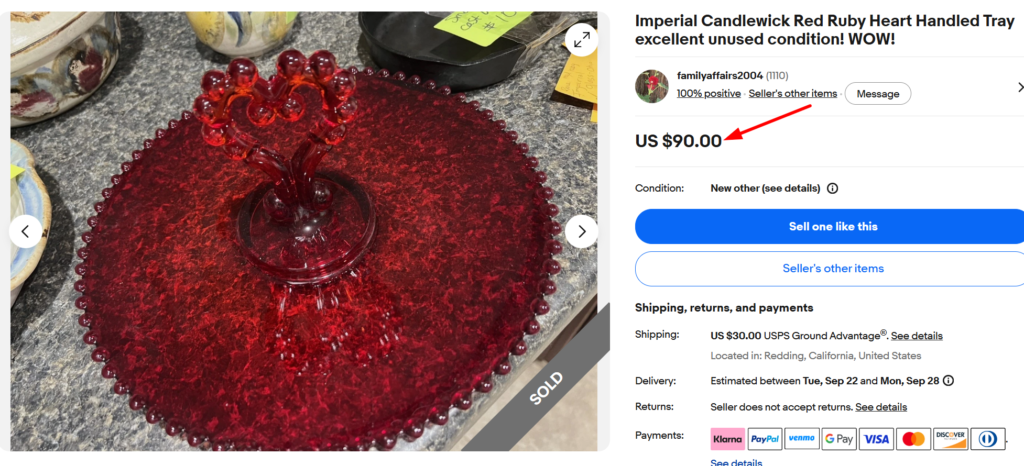
Sold for $90 (handled tray)
Candlewick is probably the most famous design by Imperial and easily recognizable due to the very small beading around the edges reminiscent of tufted Candlewick needlework.
Most Candlewick was produced in clear glass, which means any piece in ruby red is very rare. Popular among collectors are the ruby stems from #3400 and #3800.
- Estimated Value: $50 to $400+
- Production Years: 1936 to 1984; ruby was made in shorter runs
- What to Check: Beaded edges, intact beads
- Quick Notes: Ruby is rare, damaged beads drop value fast
6. Fenton Red Carnival Glass
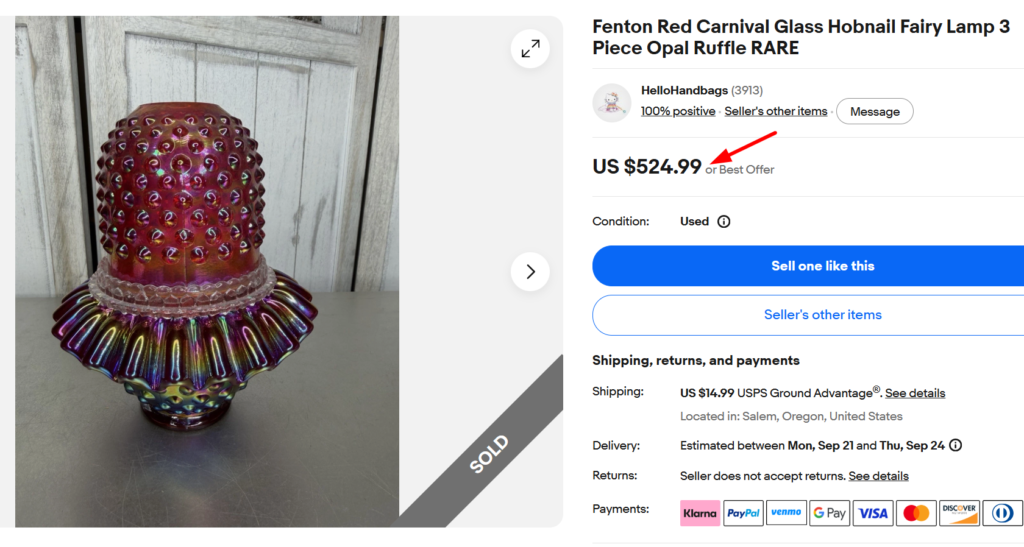
Sold for $525 (fairy lamp)
Fenton introduced iridescent glass in 1907, and it was also the first maker of red carnival glass. Red carnival glass is the holy grail in the world of carnival glass, as very few manufacturers made it.
Pay attention to this iridescent glaze, which changes color from red to gold as it reflects light. Glass items manufactured before 1970 lack any mark at all.
Northwood Red Carnival is even rarer.
- Estimated Value: $500 to $5,000+
- Production Years: 1907 to mid-1920s for early red
- What to Check: Iridescent shift, deep red base color
7. Victorian Cranberry Glass Pitcher
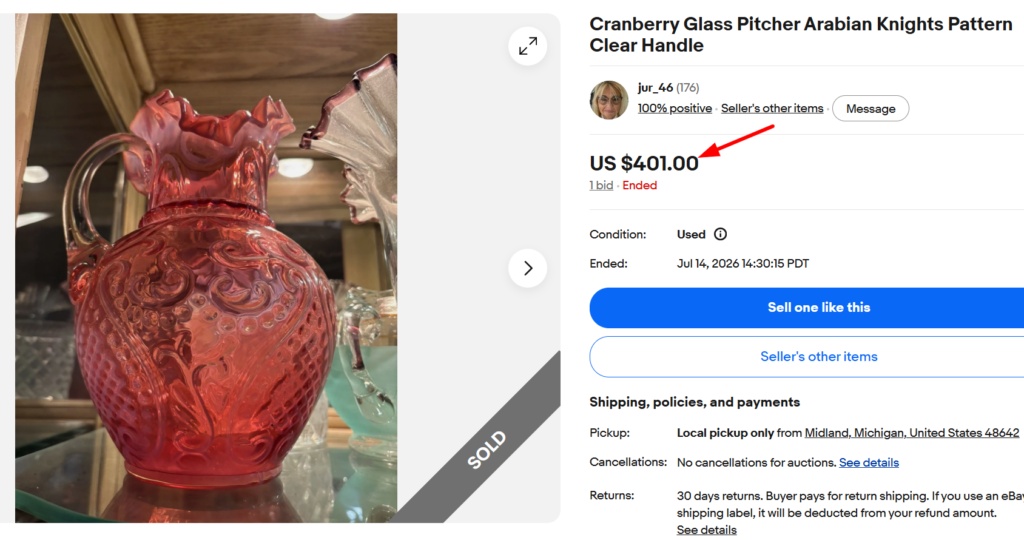
Sold for $400+
Cranberry glass is a glass in shades of red/pink, obtained by adding gold chloride to the glass formula. Cranberry glass from the Victorian period between 1860 and 1900 is the most sought-after among collectors today.
Features such as blown glass, application of a clear glass handle, pontil marks on the bottom, and opalescence in forms like coin dot and hobnail make it more valuable.
- Estimated Value: $150 to $600+
- Production Years: 1860 to 1900 for true Victorian
- What to Check: Applied handle, pontil mark, opalescent design
8. Bohemian Ruby Cut-to-Clear Glass
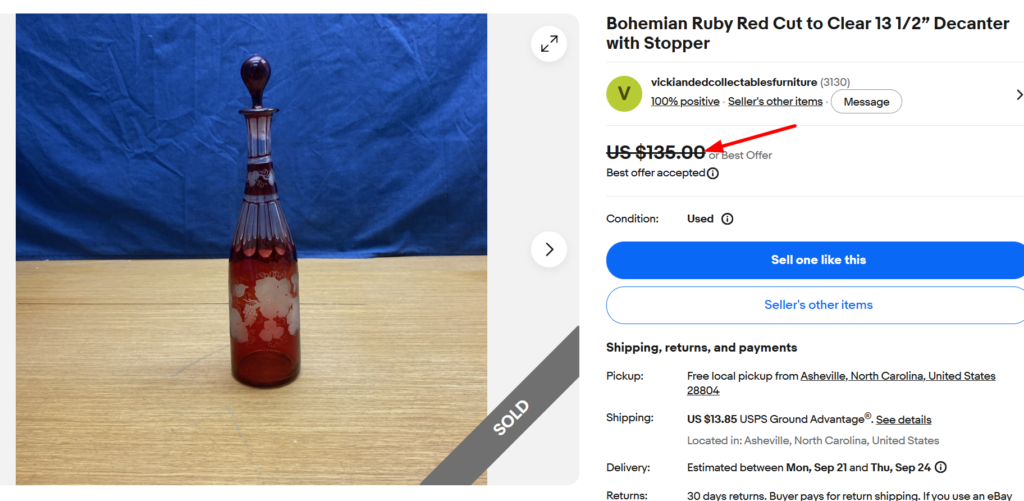
Sold for $135 (decanted with stopper)
The Czech pieces have ruby-colored glass covered by clear crystal, then cut on a wheel so the clear is visible in the form of deer, castles, grapes, or geometric shapes.
The most collectible examples are the decanters with genuine cased overlay from the latter half of the 19th century.
- Estimated Value: $125 to $550+ per decanter
- Production Years: 1850s onward, best pieces pre-1900
- What to Check: Cased overlay depth, cut quality
- Value Notes: Flashed versions are not worth a lot.
9. Murano Sommerso Ruby Red Vase
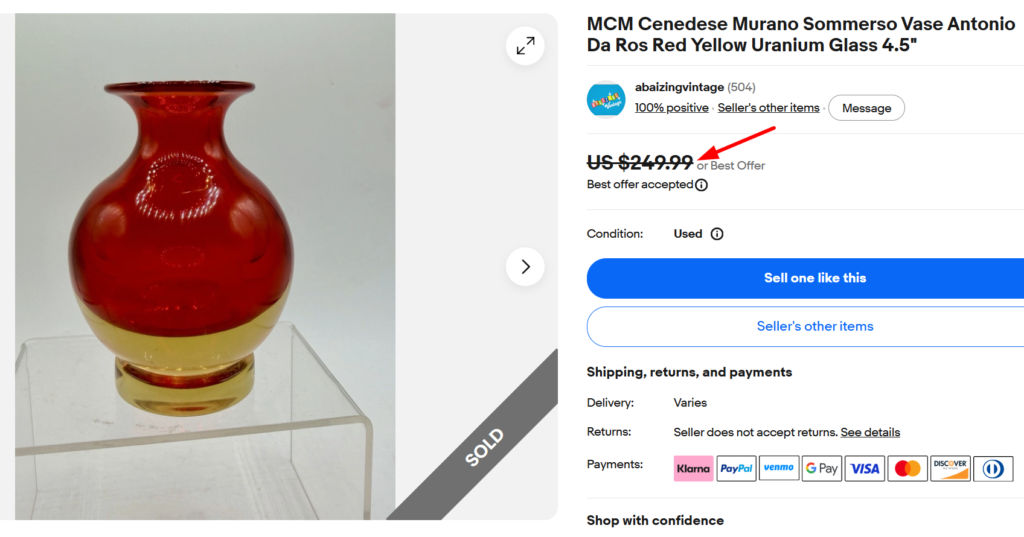
Sold for $250
The meaning of the ‘Sommerso’ in Italian is “submerged”. The concept is to layer colored glass within a very thick outer transparent shell.
The ruby red Sommerso vases made in the post-war period at Murano are great collectibles from the mid-century modern era, especially pieces attributed to named designers like Flavio Poli.
Most of these pieces did not have signatures and came with paper tags, which are rare to find intact and add value.
- Estimated Value: $200 to $1,500+
- Production Years: 1950s to 1970s
- What to Check: Thick clear casing, sculptural form
10. Viking Epic Ruby Swung Vase
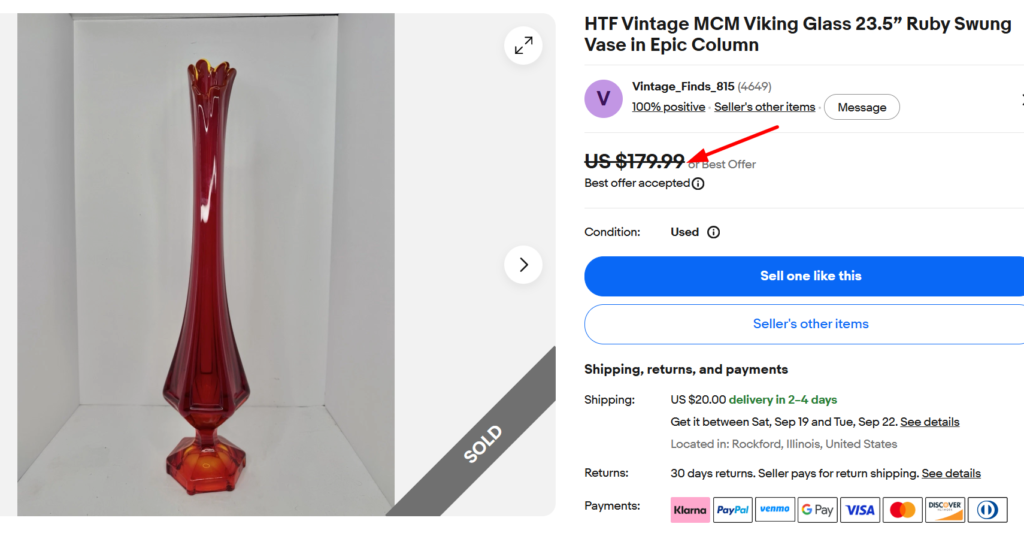
Sold for $180
Epic line was produced by Viking Glass of West Virginia from 1956 up until about 1975. The line perfectly reflected the mid-century modern look through its high and elongated swing vases.
The two main colors were ruby and amberina (glass that is red on one end, yellow on the other). The value depends on size; taller vases are worth more.
- Estimated Value: $60 to $265
- Production Years: 1956 to 1975
- What to Check: Tall swung form, deep ruby or amberina shift
11. Westmoreland Red Hen on Nest
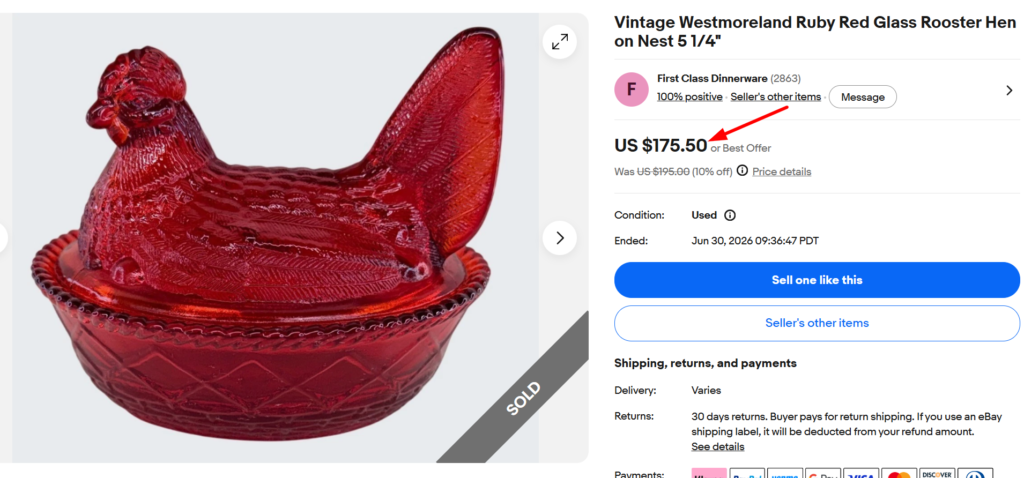
Sold for $175
The “Hen On Nest Covered Dish” was introduced by the Westmoreland company in the 1930s. Their red hens in milk glass and other colors are very popular amongst collectors.
The feather details are the key identifier; Westmoreland hens are far more detailed than competitors’. Indiana Glass, Fenton, and L. E. Smith also produced red hens, and ruby hens by Indiana are quite common.
- Estimated Value: $40 to $250+
- Production Years: 1930s onward
- What to Check: Detailed feathering, red comb and eyes
12. Avon Cape Cod Ruby Red Glass
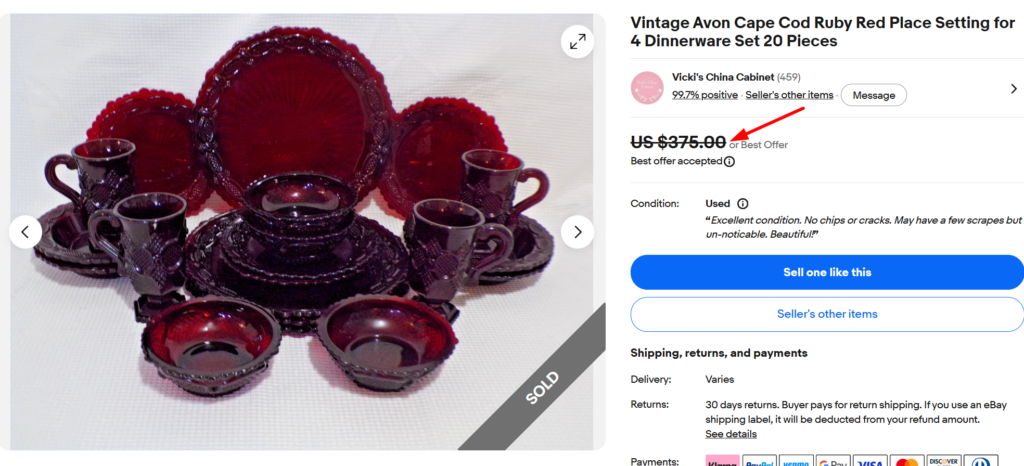
Sold for $375 (set of 20 pieces)
The 1876 Cape Cod collection of Avon ruby red pressed glassware is one of the most distinguished sets of its kind ever produced in America. The set was designed after the classic Boston Sandwich Glass patterns of Cape Cod, featuring designs with starbursts, diamond cuts, and lines.
The whole set comprises 37 pieces, which have been crafted by the Wheaton Glass Company of New Jersey.
- Estimated Value: $10 to $60 per piece
- Production Years: 1975 to 1993
- What to Check: Starburst pattern, deep even ruby
What Makes Old Red Glass Valuable?
There are five factors that work together to determine the value of old red glassware.
- The first one is manufacturer and pattern, since a piece of Fenton or Cambridge provenance is worth more than an unsigned one.
- Then comes age: items dated prior to 1940, in particular Depression and Elegant, are likely to be highly valued.
- Third is the scarcity of the shape: two pieces of the same color, namely a Royal Ruby tumbler and a Royal Ruby pitcher, may differ in price by $100.
- Glass quality is critical, too: even a small chip on the rim halves the value of the item.
- Completeness is important: a complete dinnerware service or a decanter with a matching stopper is worth much more than the sum of individual pieces.
Now you’ve got some proper vocabulary when it comes to antiques and vintage red glass pieces, ranging from Royal Ruby to Murano sommerso. The next time you come across a red bowl at a junk shop, you’ll know where to start your research.