
With a history spanning over a century, American glass manufacturer Anchor Hocking has made millions of pieces. Some of it is everyday glassware worth a few dollars, while others bring serious money. And, we’re talking thousands of dollars.
Let’s take a look at some of the most valuable vintage Anchor Hocking glass items, learn to identify genuine pieces, and understand what really determines the value.
History of Anchor Hocking Glass: Why Is It Collected?
Anchor Hocking was not always Anchor Hocking. Founded in 1905 as Hocking Glass Co., it was formed by Isaac J. Collins and several other investors. It took its name from the nearby Hocking River, which ran by their factory.
This company nearly went out of business twice. A fire destroyed the original factory in 1924, while the Wall Street Crash of 1929 should have ended the business for good. However, thanks to a machine capable of producing 90 items per minute, Hocking was able to survive through the Depression, selling tumblers at five cents for two.
On December 31, 1937, Hocking Glass Co. joined forces with Anchor Cap and Closure Corporation to form Anchor Hocking Glass Corporation. This new corporation released Royal Ruby in 1938 and Fire-King in 1942. These lines, together with the Depression patterns, make up all collectibles today.
How to Identify Anchor Hocking Glass: Marks, Logos & Dating
Identification of Anchor Hocking glass is the first step to differentiate a common piece from a rare find. The first clue is the marks, which changed several times. The patterns range around a hundred. And the company used a few proprietary colors that nobody else made.
Here’s how to use all that to identify a genuine piece.
Anchor Hocking Marks and Logos
The base marks on Anchor Hocking evolved over the decades. Knowing each version will help you date a piece within a fairly tight window.
But remember, a lot of pieces are unmarked, though. Don’t think of something invaluable just because you can’t find a logo at the bottom. For the ones with marks, use this markings guide:
- 1905-1937 – H.G. Co. mark. Some early pieces from Hocking Glass Company have an “H.G. Co.” mark within a shield. Most Depression glass pieces lack any markings whatsoever. Cameo, Princess, Mayfair, and Miss America glass were all produced using this former name.
- 1937-1976 – Anchor over H. The classic mark most people recognize. A capital H sits inside or over an anchor outline. You’ll find it on Royal Ruby, Forest Green, Fire-King pieces, and most post-merger output.
- 1948-1976 – Fire-King script logo. Used together with the anchor mark on the Fire-King line. Pieces from 1948-1950 read either “OVEN Fire-King GLASS” or “OVEN Fire-King WARE”.
- 1951-present – “MADE IN THE U.S.A.” mark added. Fire-King marks became more descriptive in 1951, often including mold numbers beside the trademark line.
- 1962-1976 – Anchor Hocking corporation logo added. Fire-King products between 1962 and 1976 typically have both logos on pieces: the Fire-King logo and the H-over-anchor.
- 1976-1999 – Anchor mark within a square. This version of the anchor mark logo is used during the Newell ownership period of the company. Pieces that have this mark are considered post-vintage.
- 2000 to date – “Fire-King 2000” mark. After the buyout by Anchor Hocking, there was a brief revival of the jadeite in 2000 with the pieces with the year mark.
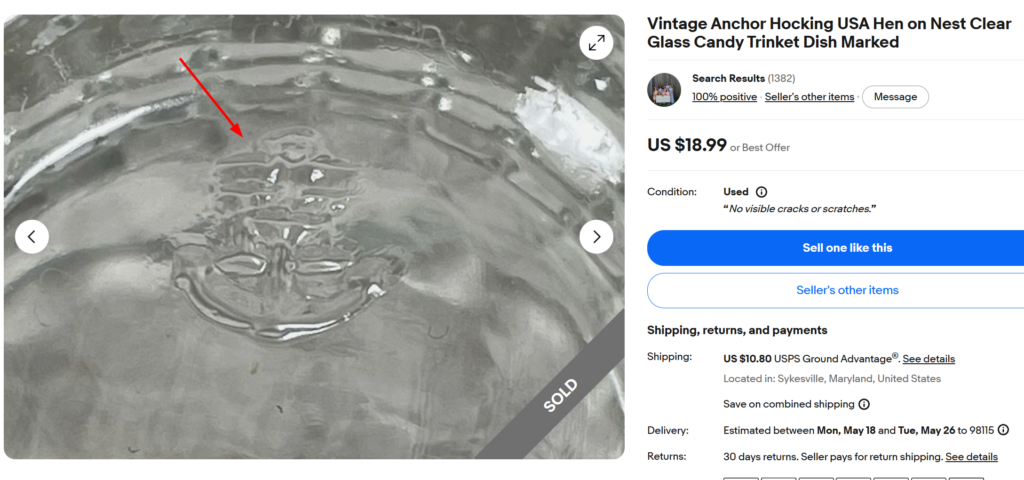
Easy Tip: “Fire-King” in all capital letters is from the ’40s. The combination of Fire-King script, “MADE IN U.S.A.,” mold number, and anchor logo dates from after 1962.
A note on unmarked pieces.
Royal Ruby Anchor Hocking glass was almost never marked. Moonstone usually had a foil sticker that’s long gone. Most Depression-era patterns like Miss America and Mayfair are unmarked entirely. For those, pattern identification matters more than the mark.
Anchor Hocking Patterns
The company released over a hundred patterns in total. However, only a few account for all the valuable pieces of glassware discovered. These are the patterns you should familiarize yourself with because they are often found in estate sales and even on the Internet.
- Mold-etched Depression glass patterns (1930-1937): Cameo (Ballerina), Princess, Mayfair (Open Rose), Miss America. This pattern has raised decorations that are molded into the glass and come in floral, geometric, and figural designs.
- Pressed glassware patterns: Sandwich, Wexford, Bubble, Boopie (Berwick), Early American Prescut, Star of David. This pattern is decorated with pressed designs but not the mold-etched ones.
- Fire-King patterns of solid color glassware (1940s-1970s): Jane Ray, Swirl, Shell, Alice, Restaurant Ware, Kimberly Diamond, Laurel Leaf. This heat-resistant glass was made in jadeite, peach luster, turquoise blue, and ivory, among others.
- Mid-century patterns: Soreno, Milano, Tartan, Wexford. Heavy pressed glass with textured surfaces, usually in avocado green, harvest gold, or aurora iridescent.
Anchor Hocking Colors
Color is also a huge part of identification. Anchor Hocking used several proprietary colors that almost nobody else made. Recognizing them can help you spot a genuine piece in just one look.
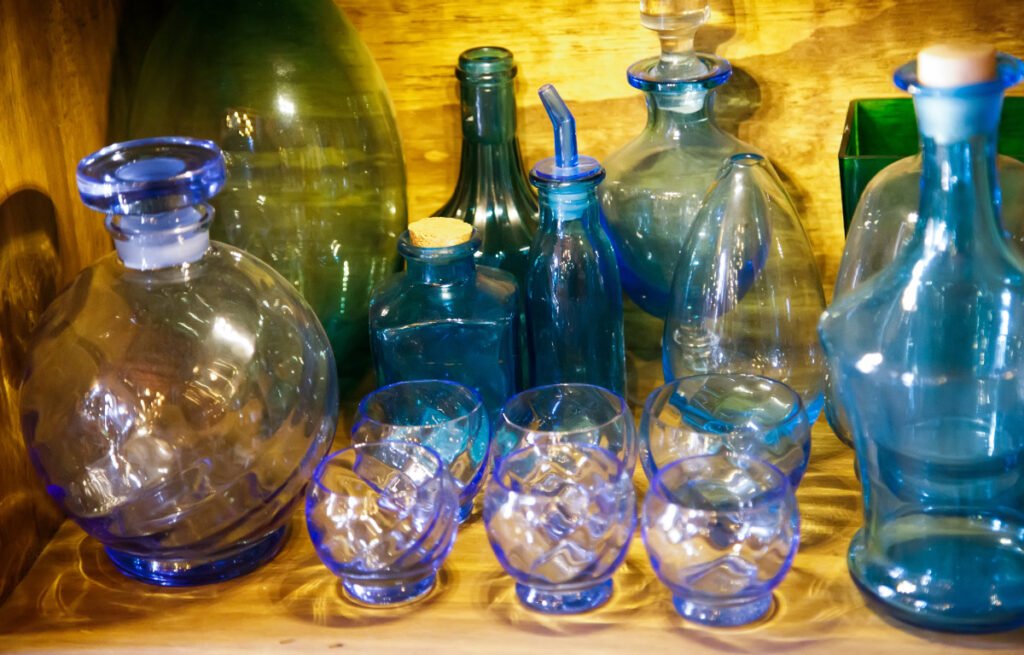
Besides, color drives value more than almost any other single factor, too. Some of the most notable colors are:
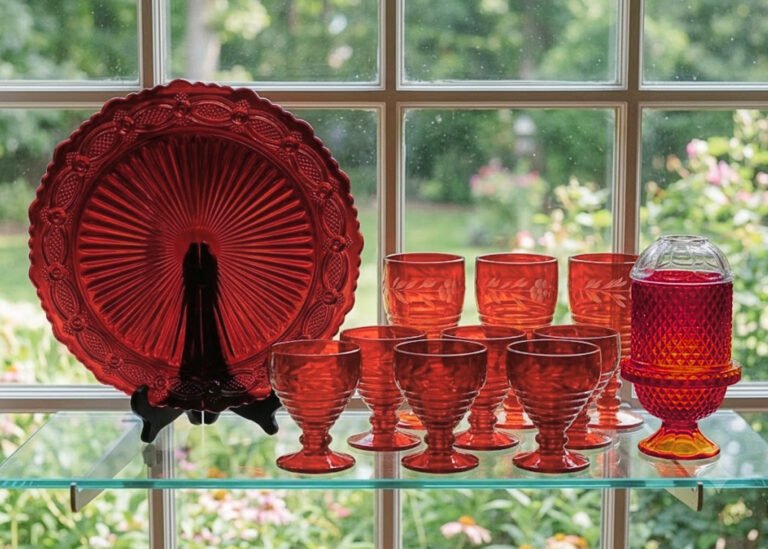
- Royal Ruby – a deep transparent red, patented by Anchor Hocking in 1938. The color comes from copper oxide, not gold chloride, like most other red glass. Production period was from 1938 until 1967, with a second production from 1973 until 1977. Pieces are usually unmarked.
- Forest Green – a deep, dark, transparent green that dates back to 1950 and lasted until 1965. One should not mix this color with the earlier pale green of the Depression era from the early 1930s, which has uranium and therefore is fluorescent under UV light.
- Vaseline/Uranium Green – an intense green-yellow from the 1930s in Cameo, Princess, and Mayfair. It fluoresces green under a black light because of its uranium content. Uranium was not used by Anchor Hocking after the early 1940s because of the war.
- Jadeite (Jade-ite) – Opaque blue-green milk glass used in Fire-King, mostly from 1945 to 1975. Does NOT glow under UV light, unlike the earlier Jadite from McKee and Jeannette. Heavier and more opaque than reproductions.
- Turquoise Blue – An opaque teal Fire-King color produced only from 1956 to 1958. Lighter and more green-blue than Jadite, and much rarer because of the short two-year production.
- Peach Luster – Iridescent amber-pink finish on Fire-King pieces from 1952 to 1963. A warm mirror-like sheen. Often confused with carnival glass, but the Fire-King mark on the base settles the question.
- Sapphire Blue – Transparent pale azure heat-resistant glass used in the Philbe line (1937-1938) and other early Fire-King pieces. One of the rarest and most valuable Anchor Hocking colors.
- Avocado green, harvest gold, honey gold – Mid-century colors used in Soreno, Milano, and other 1960s-70s patterns. Popular today but generally lower-value unless found in unusual forms.
- Pink (Flamingo) – Used in Miss America, Mayfair, Princess, and other Depression patterns. It’s less rare than blue or green Depression glass, but still very collectible.
Physical Identification Clues
Beyond marks, patterns, and colors, a few physical details help confirm authenticity. For instance, mold seam lines should run vertically up the sides of pressed pieces.
That’s the hallmark of machine pressing, which is what almost all Anchor Hocking glass used.
Second, hold a piece up to the light and look for tiny air bubbles in the glass. Those are normal in vintage machine-pressed pieces and often missing from modern reproductions, which are cleaner.
Weight is another good clue. The original Fire-King is noticeably heavier than the post-2000 reproductions.
15 Valuable Vintage Anchor Hocking Glass Finds
The following are some of the most valuable Anchor Hocking glassware pieces. Some are rare patterns, some are rare colors, and a couple are oddities to look for.
1. Jadeite “Teardrop” Nesting Bowls
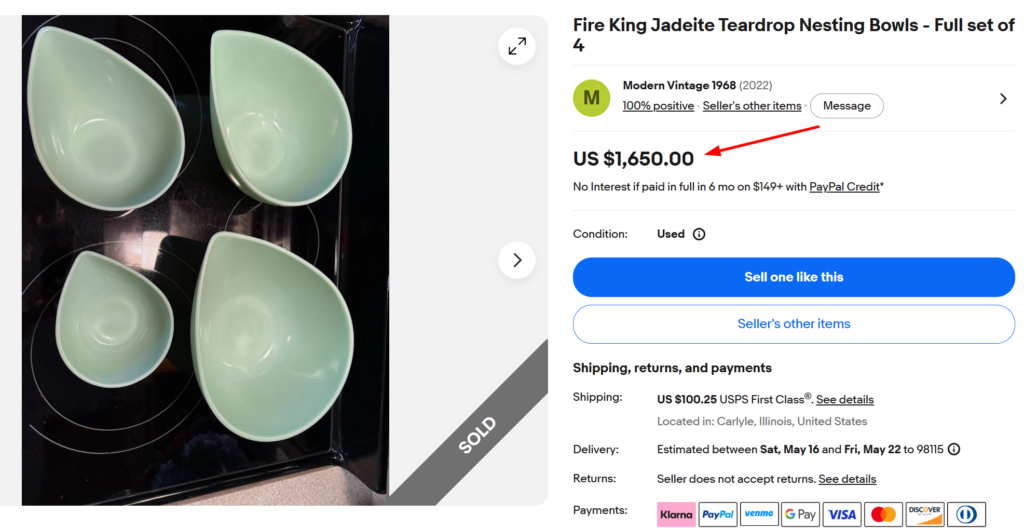
Sold for $1,650
The Fire-King Jadeite Swedish Modern bowls are among the rarest items in the Fire-King Jadeite collection. These bowls have an oval shape or egg shape, not round, and have a pouring spout at one end.
They were made in graduated sizes that nest together, sold as sets of 3 or 4. And the complete set is where the value lies. Individual bowls turn up regularly. But among all the singles bowls, the 6-inch bowl is reportedly the hardest to find.
- Estimated Value: $1,200-$1,800 (set of 4); $200-$400 (singles)
- Production Year: Late 1940s to 1950s
- Characteristics: Teardrop / egg-shaped bowls with a spout, size: 6.5″, 8″, 9.5″, and 11″
- Markings: “Fire-King Ovenware Made in USA” embossed on the base
- Quick Notes: Check the color across all pieces.
2. Ruby Red “Be Wise” Coin Bank
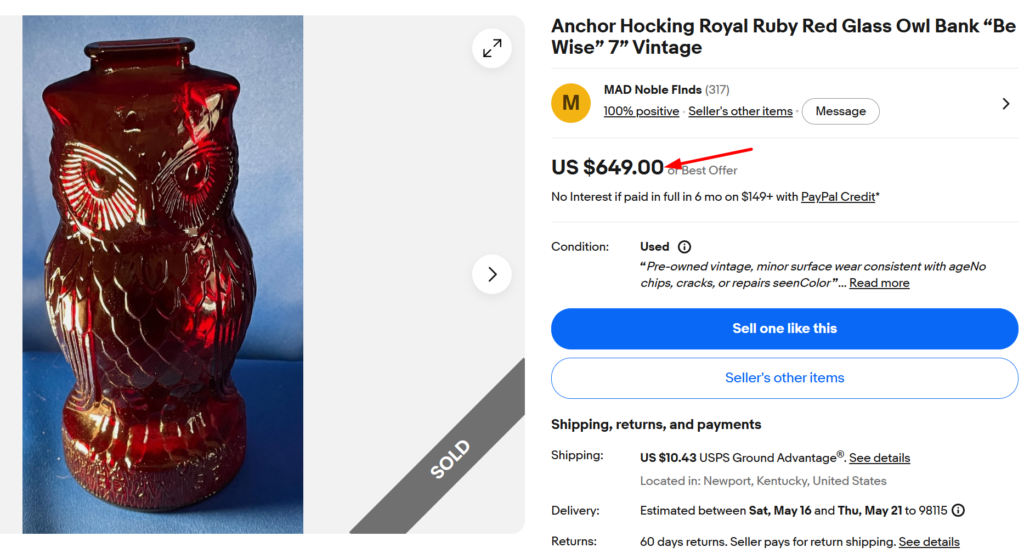
Sold for $650
The “Be Wise” owl bank is one of the more unusual Anchor Hocking Royal Ruby pieces. It’s a figural coin bank molded as an owl, with a slot cut into the head and “BE WISE” embossed on the body.
These weren’t part of regular dinnerware lines. They were novelty pieces and are very rare today. Royal Ruby was patented in 1938 and ran until 1967, with a brief revival from 1973 to 1977.
The red comes from copper oxide rather than gold chloride. Most Royal Ruby is unmarked, including this bank. Common Royal Ruby tumblers fetch $5-$15 each. The high value for these comes from the unique figural form.
- Estimated Value: $250-$700 (owl bank); $5-$15 (common pieces)
- Production Year: 1938 onward
- Characteristics: Figural owl shape, embossed “BE WISE” text, coin slot at top
- Markings: Unmarked (typical of Royal Ruby)
- Quick Notes: Figural Royal Ruby commands large premiums.
3. Light Amber “Kimberly” Mug
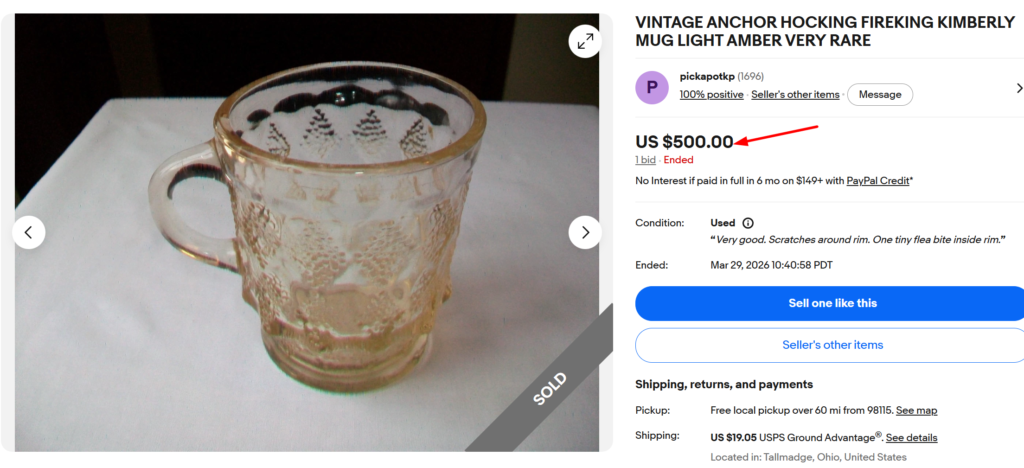
Sold for $500
“Kimberly” mugs are common. The defining feature is the diamond-textured pattern covering the entire body, and they were made in many colors, mostly milk-white and ombré fired-on finishes. Most Kimberly mugs sell for $5 to $20, but color drives the entire value range for this form.
This mug brought $500 because the transparent light amber color is genuinely rare. Kimberly mugs were mostly opaque (milk white) or clear.
- Estimated Value: $5-$20 (common); $50-$500+ (rare colors)
- Production Year: 1960s to 1970s
- Characteristics: Cylindrical shape with curved handle, diamond-textured surface, around 3.25 inches tall
- Markings: “Anchor Hocking Fire-King” & logo on base
- Quick Notes: Transparent amber, ombré reds, and unusual fired-on colors are rare.
4. “Swirl” Mixing Bowls
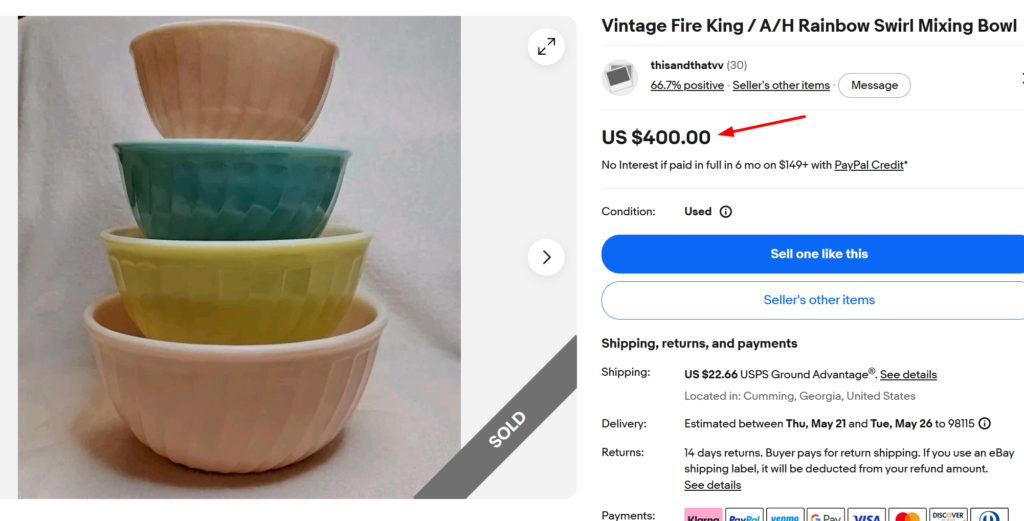
Sold for $400
This is a complete Rainbow set of Fire-King Swirl mixing bowls. The Swirl pattern ran from 1949 to 1962 in several solid colors, including Jadite, Azurite (blue), Ivory, Peach Luster, and Sunrise (pink-to-orange fade). Individual Swirl bowls in common colors sell for $20 to $50 each.
This set hit $400 because of the combination: four bowls, four colors, all matching the Rainbow scheme. Anchor Hocking sold them as a set, but they get separated over the decades. Putting together a complete Rainbow set takes years. Pink Swirl specifically gets chased.
- Estimated Value: $2500-$600 (full Rainbow set); $25-$80 (singles)
- Production Year: 1949 to 1962
- Characteristics: Spiral swirl pattern molded into the exterior, nesting sizes
- Markings: “FIRE-KING” or “Fire-King OVEN WARE” on the base
- Quick Notes: Pink Swirl (fired-on) and Roseite (solid pink) are different. Roseite has solid pink on the bottom; Pink Swirl has white.
5. Fire-King Turquoise Bowl
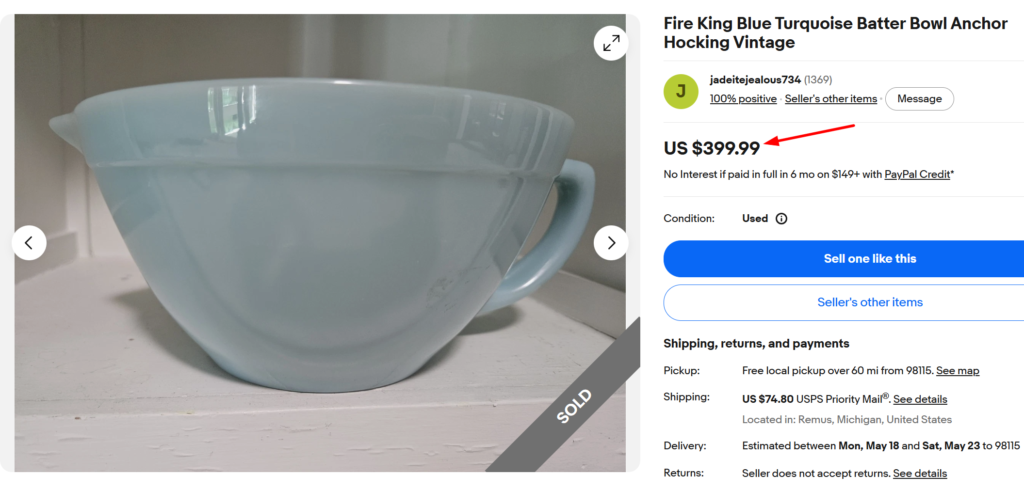
Sold for $400
Anchor Hocking made the Turquoise Blue Fire-King pieces only for two years, from 1956 to 1958. That short window is what makes it one of the hardest colors to find.
Most Turquoise Blue is dinnerware, including plates, cups, and saucers from the Swirl and Charm patterns. Kitchen pieces like this batter bowl are less common. It has a wide handle and an integrated pour spout, designed for whisking batter and pouring without dripping.
Common Jadite batter bowls sell for $40 to $80. The Turquoise Blue version pushes higher because of the short production.
- Estimated Value: $150-$450 (based on condition)
- Production Year: 1956 to 1958
- Characteristics: Spouted bowl with single handle, opaque teal color
- Markings: “Fire-King OVEN WARE Made in USA” embossed on base
- Quick Notes: True Turquoise Blue is more green-blue than the lighter Azurite.
6. Blue “Mayfair Rose” Flat Shakers
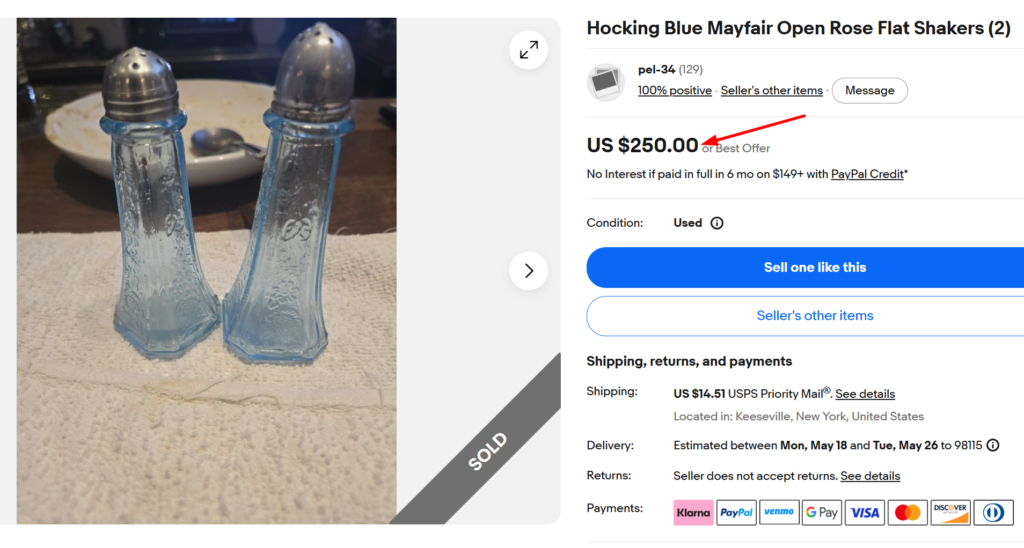
Sold for $250
“Mayfair,” also called “Open Rose” by early collectors, was Hocking’s longest-running mold-etched Depression pattern, running from 1931 to 1937. The most popular color is pink (aka Flamingo), although it’s blue Mayfair that gets real collectors’ attention.
Salt and pepper shakers in blue Mayfair are tough finds. The pattern has both a flat and a footed shaker, and the footed version is rarer. A set of two blue Mayfair shakers can fetch up to $300 in good condition.
- Estimated Value: $200-$400 (shakers); $1,500+ (cookie jars, shakers)
- Production Year: 1931 to 1937
- Characteristics: Mold-etched open rose design with vertical paneled flanks, octagonal shape on most pieces
- Markings: Unmarked
- Quick Notes: Blue Mayfair commands the highest prices.
7. Green “Cameo/Ballerina” Divided Plate
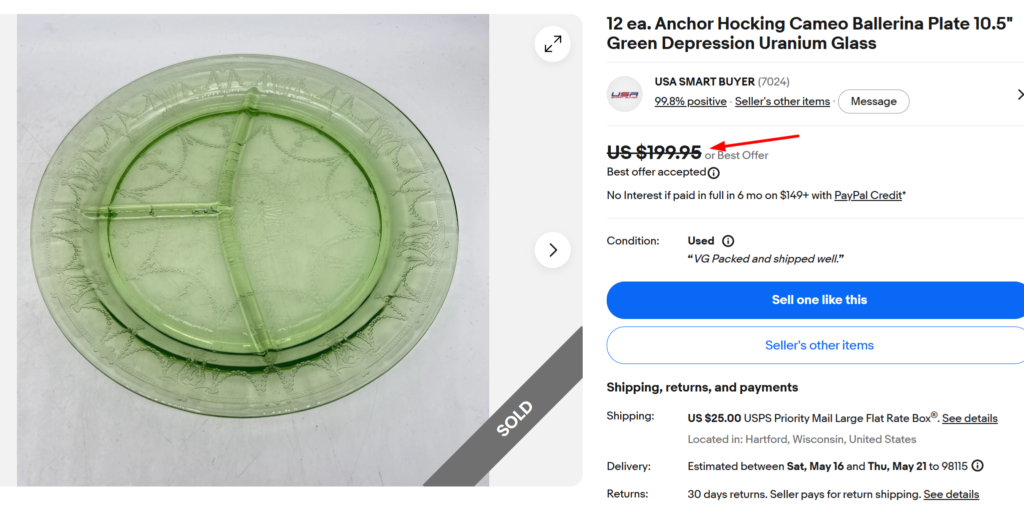
Sold for $200
Cameo was Hocking’s first mold-etched dinnerware line, produced from 1930 to 1934. The pattern earned its “Ballerina” nickname because of the small dancing figure inside the cameo medallion around the rim.
Green was by far the most widely produced color and is the one collectors chase. It contains uranium and glows bright green under a black light. Pink Cameo is genuinely rare.
- Estimated Value: $20-$40 (green pieces); $180-$500+ (rare pieces, sets)
- Production Year: 1930 to 1934
- Characteristics: Mold-etched medallion with a central female figure, flower chains, and tassels around the rim
- Markings: Unmarked
- Quick Notes: Bright green glow under UV light confirms authenticity.
8. Green “Bubble” Foot Glasses
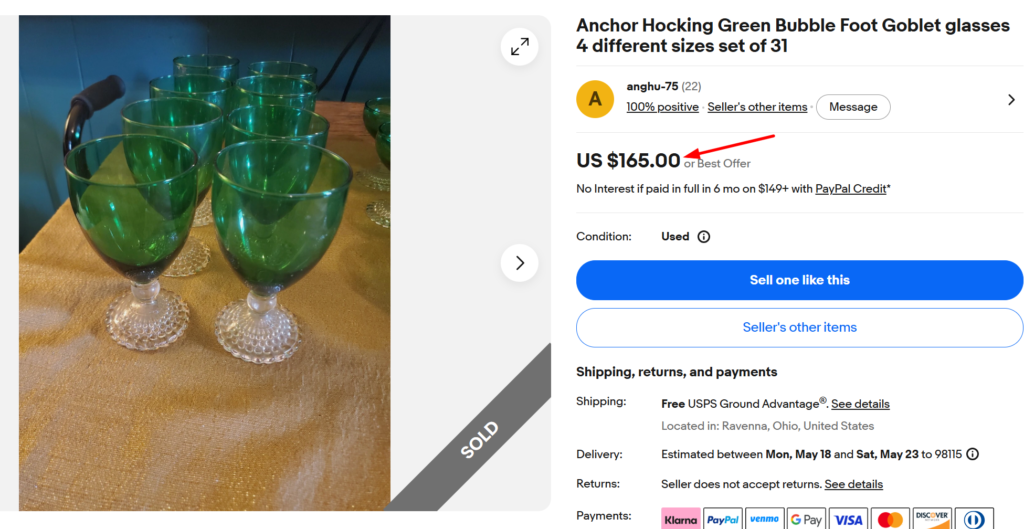
Sold for $165
“Berwick” was produced by Anchor Hocking between about 1950 and the early 1960s. It is commonly referred to as “Boopie,” a term created by glass historian Hazel Marie Weatherman during the 1970s.
The defining feature is the clear ball-bumped foot, which gets these confused with Imperial’s Candlewick.
The green version with the clear foot is the harder colorway. Most Boopie you find is plain crystal. This set of 31 green Boopie glasses mixed sold for over $160; individually, these goblets run $6 to $15 each.
- Estimated Value: $6-$15 (singles); $80-$200 (large sets)
- Production Year: 1940s to early 1960s
- Characteristics: Footed stemware with clear bubble-textured base
- Markings: Usually unmarked
- Quick Notes: Boopie’s bubbles are on the foot only, unlike Candlewick.
9. Peach Luster “Laurel Leaf” Glassware
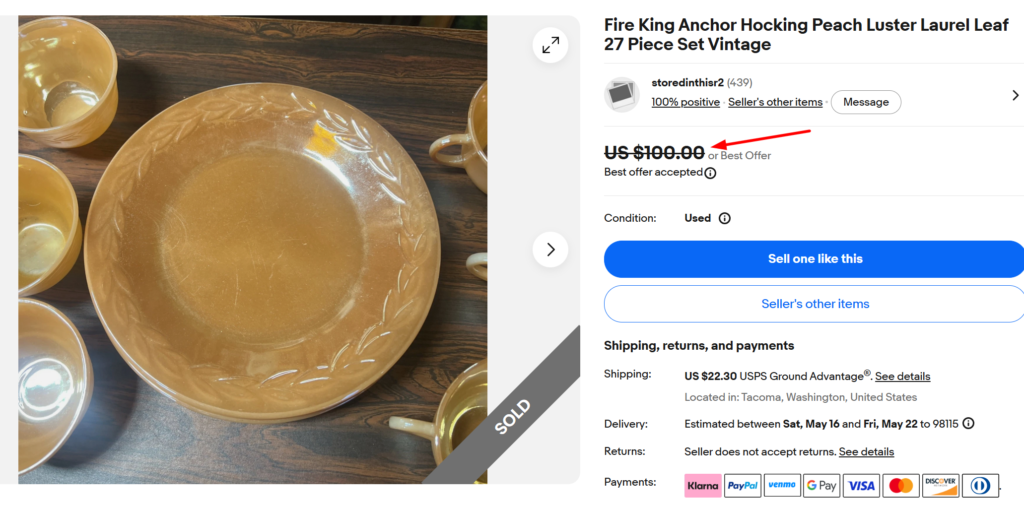
Sold for $100
Peach Luster is the most common iridescent Fire-King color, made from 1952 to 1963. The finish is a warm amber-pink sheen applied over the base glass. It was used on several patterns, including Swirl, Shell, and Laurel Leaf. The Laurel Leaf has a raised border around plate rims and bowl exteriors.
The value of peach luster glassware lies in completeness. Individual pieces are only worth $5 to $20; a large 25+-piece dinnerware set can reach up to $100. Remember, the Peach Luster finish is delicate, and a dishwasher can ruin old pieces.
- Estimated Value: $80-$150 (25 to 30-piece set); $4 to $20 (singles)
- Production Year: 1952 to 1963
- Characteristics: Iridescent amber-pink finish, raised laurel leaf border
- Markings: “Fire-King OVEN WARE” with anchor logo on base
- Quick Notes: Peach Luster fades and dulls when dishwashed.
10. Pink “Miss America” Tumblers
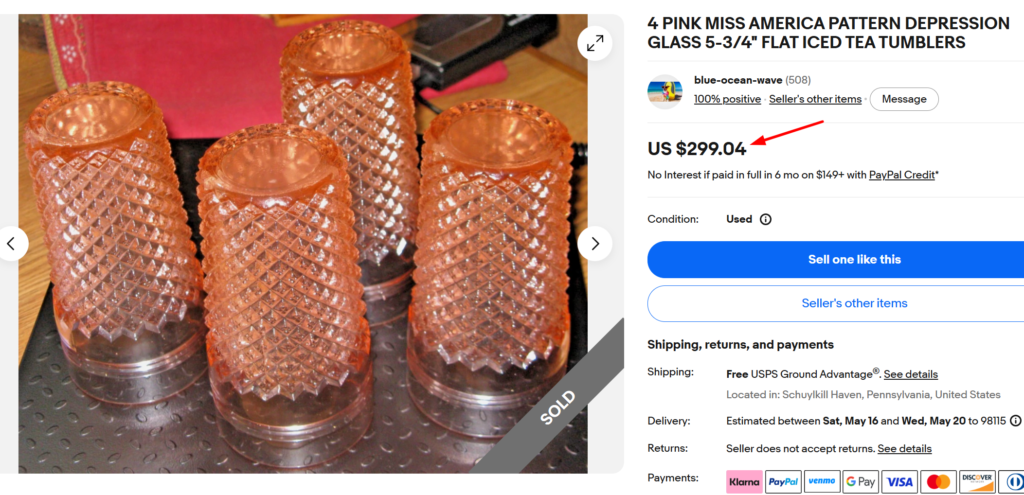
Sold for $300
Hocking created Miss America between 1935 and 1938. It’s one of the most popular Depression patterns ever produced. It can be recognized by its unique sawtooth edge, center starburst pattern on flat glassware, and diamond-pressed body. It is usually found in pink and crystal colors.
The 10 oz flat iced tea tumbler is a harder form than the standard 8 oz tumbler. A complete matched set of four is worth substantially more than individual pieces, which run $25 to $45 each.
- Estimated Value: $20-$50 (singles); $200-$400 (sets); $200+ (ice blue, each)
- Production Year: 1935 to 1938
- Characteristics: Sawtooth rim, starburst-pressed base, diamond-pattern body, square foot on stemware
- Markings: Unmarked
- Quick Notes: Original 1930s pieces have softer-feeling diamond points after 90 years.
11. Green “Princess” Pitcher
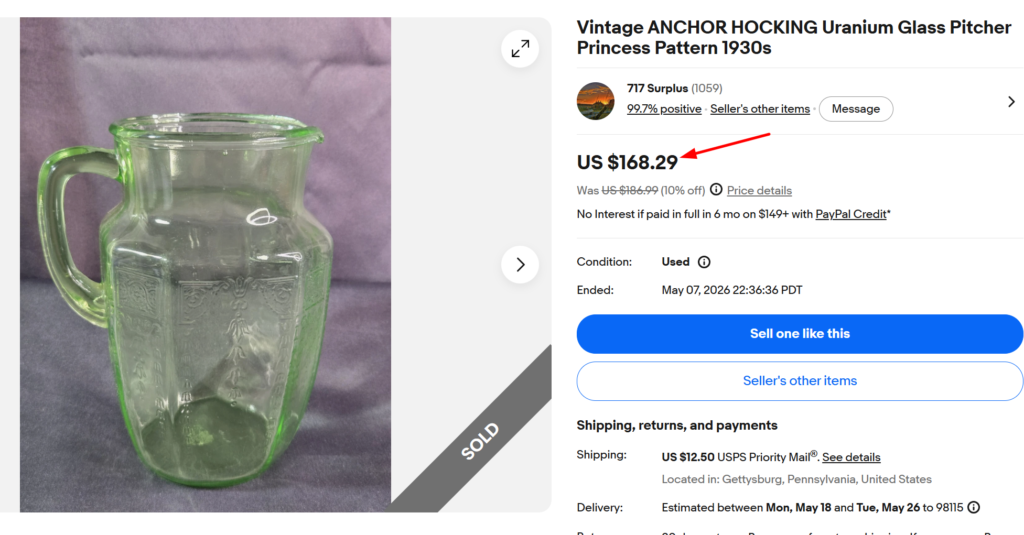
Sold for $170
Princess was one of Hocking’s first mold-etched Depression patterns, produced from 1931 to 1935. The pattern features ornate scrolls around the rim and floral swags around the body, all raised on the exterior. Green Princess contains uranium and glows brilliant green under a black light.
The pitcher is one of the more desirable Princess forms because it survived in lower numbers than plates and cups. Pink and green Princess command higher prices than topaz and apricot.
A green pitcher in good condition usually fetches $100 to $200. The covered butter dish and other large serving pieces run far higher.
- Estimated Value: $100-$200 (green pitchers); $50-$100 (pink)
- Production Year: 1931 to 1935
- Characteristics: Mold-etched scrolls & floral swags, square shapes on lidded pieces with pointed finials
- Markings: Mostly unmarked
- Quick Notes: Green Princess glows under UV light.
12. Forest Green “Sandwich” Pitcher
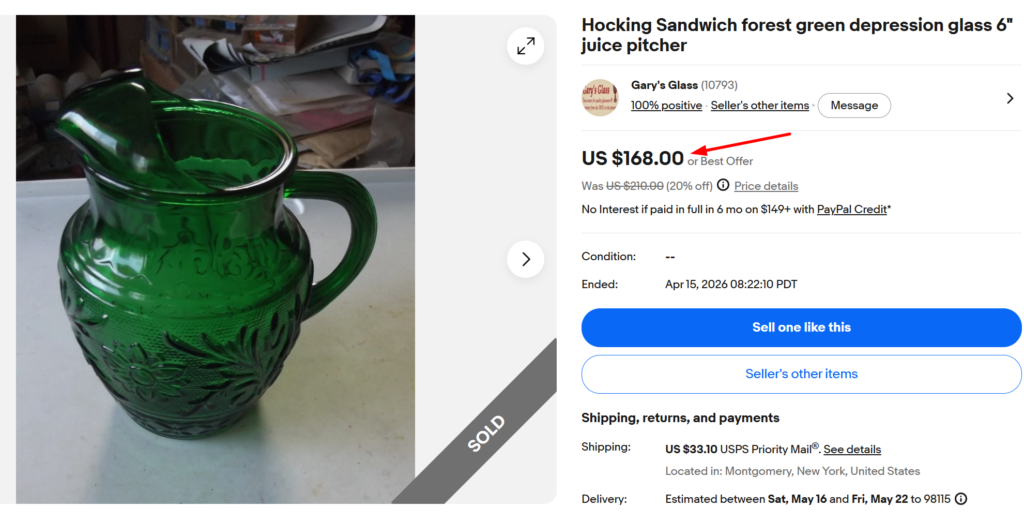
Sold for almost $170
The Anchor Hocking Sandwich Glass pattern is one of the company’s oldest designs, which runs from 1939 through 1964. This design is made up of flowers with double-lined petals and wing-like scrolls on a stippled ground.
Several other companies (Duncan & Miller, Indiana, Westmoreland) made Sandwich patterns too. Anchor Hocking’s version is the one with the double-line flower petals. That’s the key identification detail.
Forest Green Sandwich started around 1957. Five small pieces were promotional giveaways in Crystal Wedding oats boxes, so they’re abundant. Pitchers were not oat-box items, so they’re less common.
- Estimated Value: $120-$200 (pitchers); $5-$15 (common pieces)
- Production Year: 1939 to 1964 (Forest Green specifically from 1957)
- Characteristics: Stippled background with double-outlined floral motifs and scroll designs
- Markings: Unmarked
- Quick Notes: Spot double lines around each flower petal.
13. Moonstone Opalescent Glassware
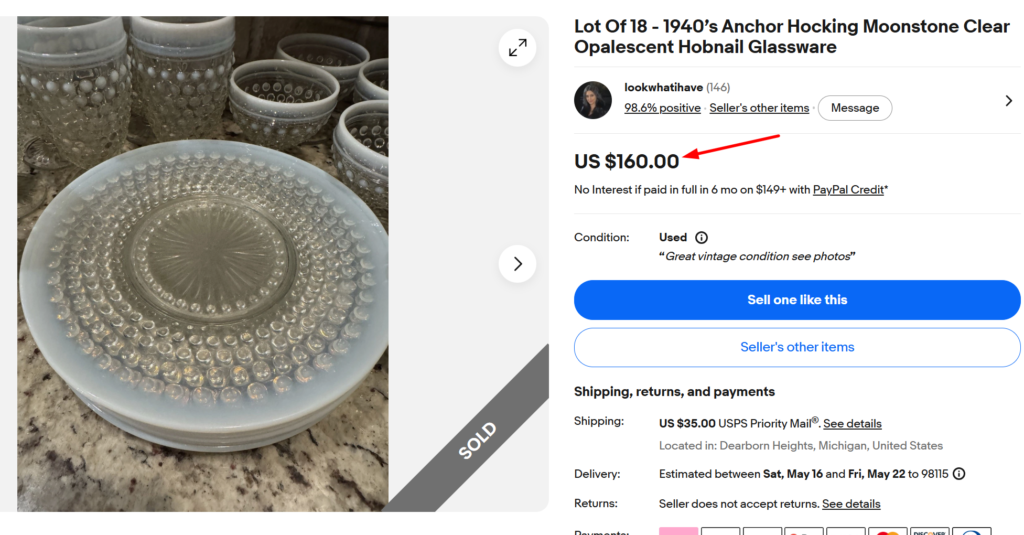
Sold for $160
Moonstone is one of the most iconic Anchor Hocking patterns, produced only for about five years between 1941 and 1946. The basic color of the glassware is transparent, with the mold having white opalescent, milky hobnails (raised bumps).
Some Moonstone pieces have a bluish cast, too.
Anchor Hocking Moonstone glassware is common. So, most individual pieces, like dessert bowls and luncheon plates, sell for $8 to $25 each. Partial or complete sets can reach up to $250 or more.
- Estimated Value: $8-$40 (singles); $120-$250 (large mixed lots)
- Production Year: 1941 to 1946
- Characteristics: Clear hobnail glass with white opalescent tips and rims
- Markings: Originally had foil “Anchor Hocking Moonstone” stickers; almost always missing now
- Quick Notes: Anchor Hocking Moonstone has clear bodies, unlike Fenton’s opaque white.
14. Green “Tartan Plaid” Tumbler Set
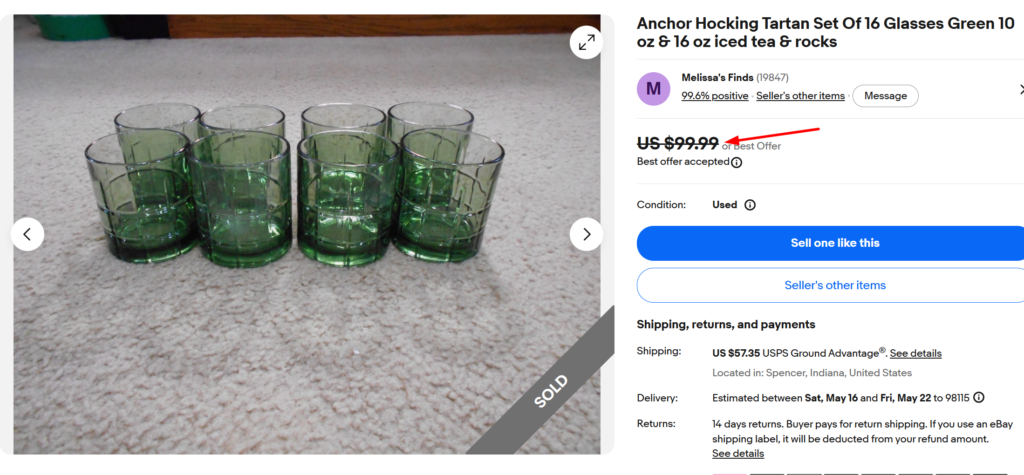
Sold for $100
Tartan is a relatively modern Anchor Hocking pattern. The plaid is pressed into thick, weighted-bottom glass. The company made it from 2001 to 2011, then renamed it “Manchester” and kept producing the clear version.
The green and blue Tartan glasses are the harder-to-find variant since these were made in smaller numbers. Individual green or blue Tartan tumblers sell for $4 to $8 each, while a full set of matched glasses brings closer to $100.
- Estimated Value: $80-$150 (sets of 12-16); $4-$10 (singles)
- Production Year: 2001 to 2011
- Characteristics: Pressed plaid pattern, weighted bottom, 8 to 16 oz capacities
- Markings: Impressed Anchor Hocking mark on base
- Quick Notes: Green is harder to find than clear. Manchester (clear) is still being made; green Tartan is discontinued.
15. “Soreno Avocado” Pitcher Set
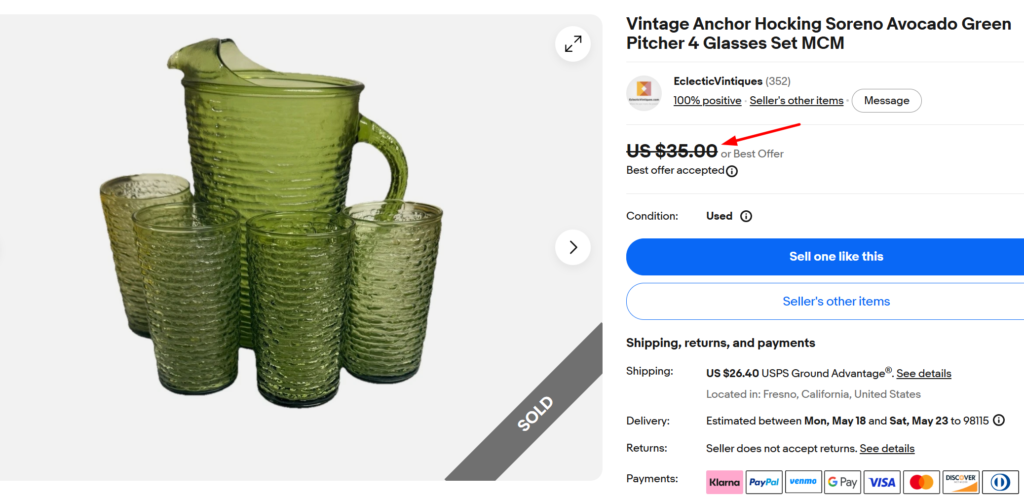
Sold for $35
The Anchor Hocking Soreno pattern is quite easy to recognize because of its bark-textured surface. The horizontal rippled ribs were designed to evoke tree bark.
Produced from 1966 to 1970, the pattern came in all the late-1960s colors: avocado green, harvest gold, honey gold, aurora iridescent, and clear. The pitcher-and-glasses set is the most common Soreno find. A complete set in avocado green can easily fetch $25 to $60.
- Estimated Value: $25-$60 (sets); $5-$15 (singles)
- Production Year: 1966 to 1970
- Characteristics: Horizontal bark-textured ribs, mid-century colors
- Markings: Foil stickers originally; pieces otherwise unmarked
- Quick Notes: Aquamarine blue and aurora iridescent are rarer.
How to Tell if Your Anchor Hocking Is Valuable?
After the mark, pattern, and color have been determined, the last factors are condition and completeness. This is what distinguishes a piece worth $50 from one that could sell for $500 within the same pattern family. Go down this list while holding your piece in your hand:
- Check the mark – Marks can tell you the estimated age of the piece. So, always trace the mark on the base. But, also keep in mind that unmarked pieces could be the most valuable (Depression-era) or the least, so don’t judge by the mark alone.
- Match the pattern to verified references – Make sure to cross-check the pattern on your piece using documented photo references. You can find them at Replacements.com and the Anchor Hocking Glass Museum website. Misidentifying a pattern is the most common pricing mistake.
- Confirm the color tier – The most valuable colors are: blue Mayfair, ice blue Miss America, Sapphire Blue Philbe, Turquoise Blue Fire-King, figural Royal Ruby. Mid-tier colors include Jadite, pink Depression, Peach Luster, Azurite, while Lower-tier colors include clear, ivory, avocado green, and harvest gold.
- Inspect condition in pattern-specific ways. Miss America diamond points chip easily. Cameo and Princess pitcher handles develop hairline cracks. Peach Luster dulls from dishwasher use (40 to 60% value loss). Moonstone hobnails chip without being obvious. Run a fingernail across rims and edges. Calculate damage discounts honestly.
- Look for complete sets – A matched set of 4 to 12 pieces sells for more than the sum of individual pieces. Original boxes, foil labels, and promo inserts (like Crystal Wedding oats boxes with Forest Green Sandwich) add 30 to 100% to value.
- Verify that “sets” actually match – Mismatched color batches, different pattern variants, or pieces from different eras are common in lots assembled by sellers. A true original set has consistent color and identical mark style across all pieces.