
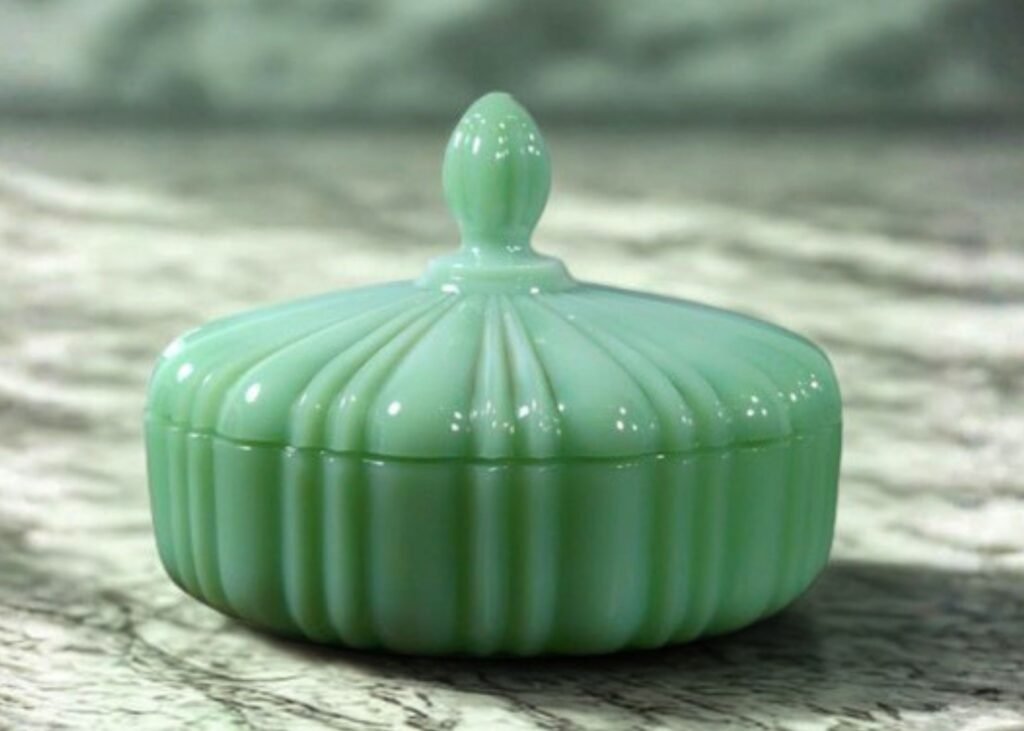
That milky green glass your grandmother used for everyday meals? Some of those pieces are now selling for hundreds, sometimes thousands of dollars. But not every green dish is worth real money.
A common Jane Ray saucer might bring $8. A Sheaves of Wheat snack tray may be $500+. The difference comes down to jadeite patterns, makers, production run, and condition.
This guide breaks down 12 valuable jadeite dinnerware and specialty pieces collectors actively hunt for, with real eBay sold prices. Plus, the identification tricks you need to tell real Fire-King jadeite from the flood of reproductions.
What Is Jadeite Dishware? (Quick History)
Jadeite is a type of opaque milky green glass that appeared in American kitchens in the 1930s. The McKee Glass Company started the trend in 1930 with their “Skokie” green line.
Jeannette Glass jumped in two years later with their version, which they spelled “Jadite.” Both companies added uranium oxide to get that signature green color. Anchor Hocking launched their “Jade-ite” line in the mid-1940s under the Fire-King brand.
Fire-King jadeite was made between 1945 and 1976 and became the best-selling product that Anchor Hocking ever made. The company stopped making Jadeite items using uranium in wartime, so they are not fluorescent under black light.
It was not until the late 1990s that the second wave of jadeite fever hit, with Martha Stewart featuring her collection on television. The prices that were merely a few pennies per piece back in the 1950s reached hundreds, and today, they can only become more valuable.
How Much is Jadeite Worth? Things That Impact Value
The difference between a $10 Jadeite piece and a $500 piece comes down to certain factors. Knowing these factors will help you identify valuable Jadeite ware easily:
- Rarity – Designs that have been produced for only one or two years, such as “Sheaves of Wheat” (1957-1959) and “Swirl” jadeite (1949-1951), are valued much higher than those designs that have been produced for a long period, such as Jane Ray (1945-1963).
- Maker – Fire-King is known for Jadeite, but McKee and Jeannette pieces from the 1930s usually beat Fire-King prices because they’re older and rarer. Likewise, within Fire-King alone, early “block letter” marks (1945–1948) are worth more than the later busier marks from the 1960s and 70s.
- Original Marks, Labels, and Matching Sets – A piece with its original foil sticker still attached can bring 2–3x the price of an unlabeled version. The same goes for complete sets in original boxes. A full Jane Ray starter set in the original decorated box can run $400–$500.
- Condition – Chips, cracks, scratches from utensils, and faded color due to dishwasher use will depreciate its worth. A chip on the edge could bring the price down from $100 to $20. But defects in manufacture, such as mold lines or tiny bubbles, do not apply to jadeite, as these are normal.
- Color Uniformity – The vintage jadeite is supposed to show variation in color since the quality control back then was poor. It’s much better to buy a piece where all items match in a group and have the appropriate minty color.
- Date of Production – Any jadeite produced prior to 1942 would definitely contain uranium. These earlier pieces (mostly McKee and Jeannette) command premium prices since uranium was pulled from glass formulas during the war.
- Restaurant Ware Popularity – Fire-King Restaurant Ware is the most collected jadeite line, period. The heavy diner-style pieces, especially mugs and grill plates, have a huge fan base. The white version is actually rarer and worth more since fewer were produced.
12 Valuable Jadeite Dishware Finds to Know
The following are the vintage Jadeite pieces that show up regularly in eBay searches and sell for real money. Some are common patterns with hard-to-find variations. Others are rare maker pieces you must know.
1. Fire-King Jadeite Ball Pitcher
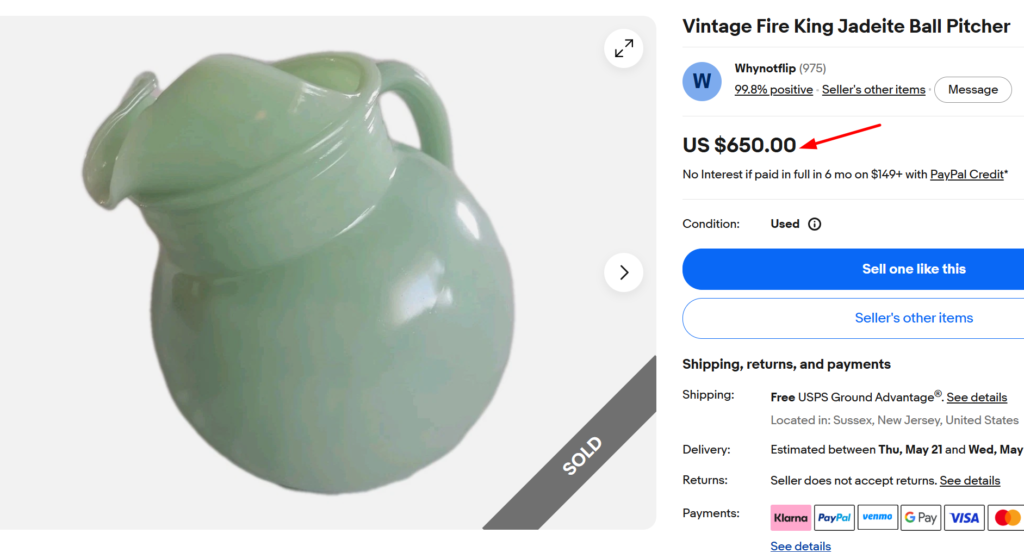
Sold for $650
The Fire-King jadeite ball pitcher is the unicorn of jadeite dishware. It’s a tilted pitcher with a round body. Anchor Hocking only made a few of these, and authentic examples are extremely rare.
Vintage Jadeite ball pitchers are part of the Restaurant Ware line, but are noticeably thinner than other Restaurant Ware pieces. Gibson made a reproduction “90 oz tilted pitcher” in China that comes with a barcode sticker on the bottom but is otherwise unmarked, just like the original.
Even the Gibson repro sells for around $200 because so many buyers want a jadeite ball pitcher. But vintage examples in good shape sell for $500 to $1,000, depending on the condition. Cracks on the handle and spout hurt the value.
- Estimated Value: $500-$1,000+ (vintage); $50-$200 (repros)
- Production Year: Mostly 1940s to 1960s
- Line: Restaurant Ware (ball jug pitcher specifically)
- Characteristics: Round bulbous body, distinctive curved handle, tilted spout
- Quick Notes: Heavily reproduced by Gibson, Mosser, and others.
2. Jeannette Dark Jadeite Shakers
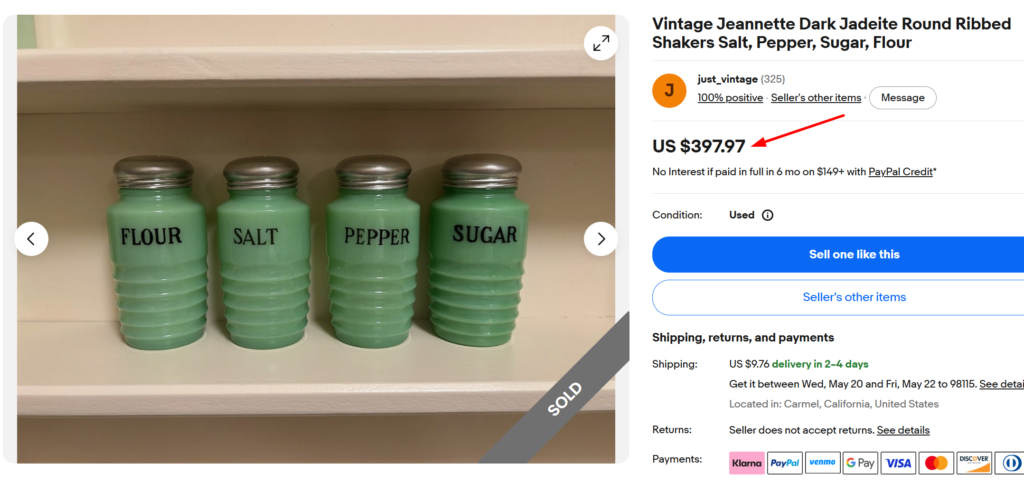
Sold for almost $400
Jeannette ribbed shakers are some of the most actively collected jadeite kitchenware pieces today. The “Dark Jadite” version is a deeper, more saturated green than the lighter Fire-King jadeite from a decade later.
Jeannette used very little quality control when making her items, so you may find different greens on items that are from the same line. The items have uranium oxide in them and will emit bright green colors when placed under a black light.
The painted black labels can wear off over time, so shakers with crisp, legible lettering bring premium prices.
- Estimated Value: $300-$500 (4-piece set); $60-$120 (singles)
- Production Year: 1930s to early 1940s
- Line: Jeannette Glass Kitchenware (Dark Jadite)
- Characteristics: Dark green, round-ribbed body, metal screw-on lids, black painted labels
- Quick Notes: Contains uranium and will glow under blacklight.
3. Fire-King Jadeite Swirl Nesting Bowls
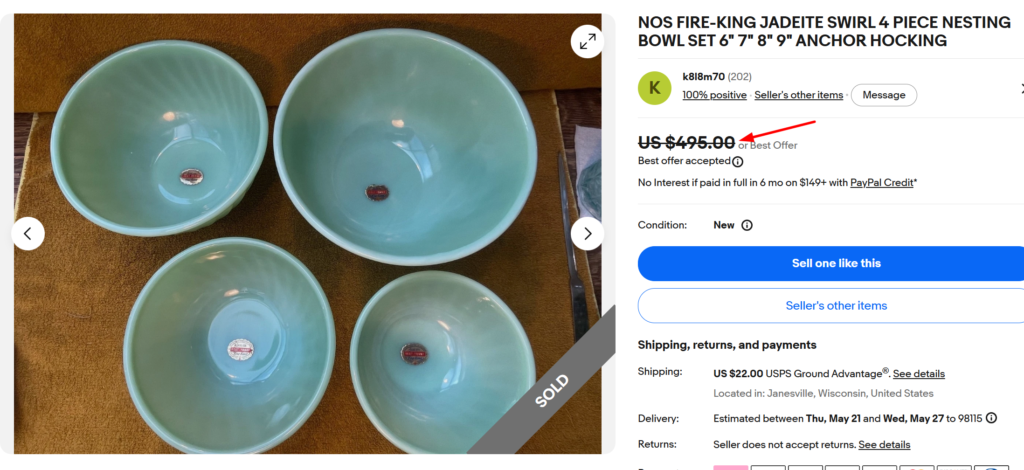
Sold for almost $500
The Fire-King Swirl mixing bowl set has been a collector’s favorite for decades. It comes with 4 nesting bowls, each bearing the swirl pattern on the outside. Also, look for the original foil stickers and the early block-letter markings to spot fake Fire King Jadeite bowls.
Complete 4-bowl sets in their original boxes in good condition usually run $300–$600; a complete 5-bowl set can fetch even higher. There’s also an experimental Swirl jadeite platter that was never released; it can fetch over $1,000 today.
- Estimated Value: $300-$600 (packed set); $600+ (5-bowl set)
- Production Year: 1949 to 1951
- Line: Fire-King Kitchenware
- Characteristics: Swirled ribbed pattern, nesting bowls in 6″, 7″, 8″, 9″ sizes
- Quick Notes: The 5″ bowl is the rarest.
4. Jeannette Jadite Canister
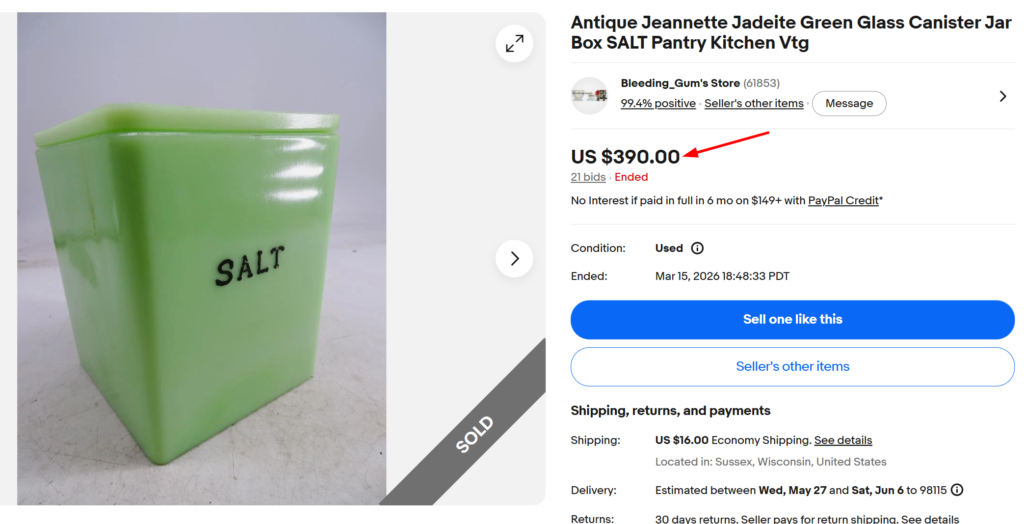
Sold for $390
The Jeannette Jadite canister box is a highly coveted piece. It’s a large container with a matching lid and a black label. Jeannette also made smaller spice canisters with metal or glass lids, which run $80–$200 each; the salt box is among the most valuable pieces in the Jeannette Jadite line.
There are usually no marks on Jeannette wares, although sometimes you will see a small “J” mark in a triangular shape on the bottom. These pieces are made using uranium, so they glow under a UV light.
- Estimated Value: $200-$400+ (large box); $80-$200 (smaller canisters)
- Production Year: 1930s to early 1940s
- Line: Jeannette Glass Kitchenware
- Characteristics: deeper green color, Rectangular box with a matching lid, labeled in black on the front
- Quick Notes: Marked with a “J” inside a triangle (some pieces); glow green
5. Fire-King Jadeite Refrigerator Dishes
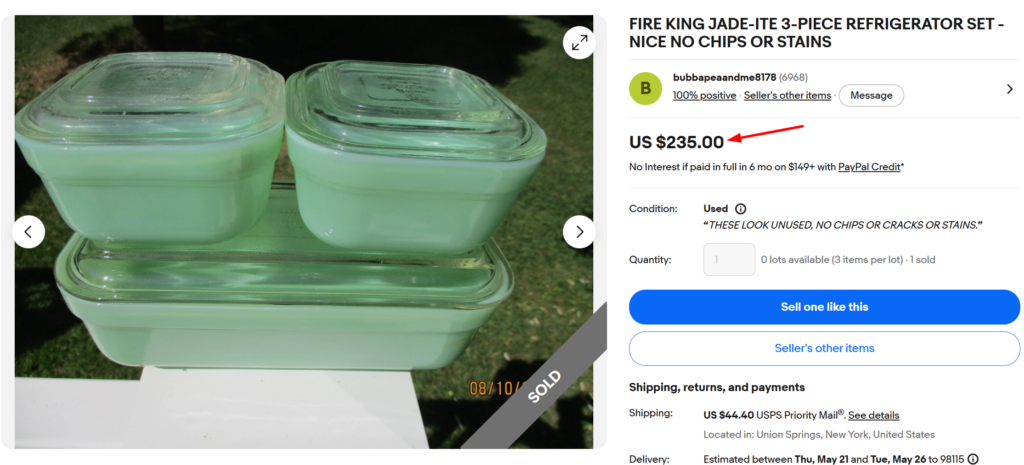
Sold for $235
These were the original meal prep containers, used to store leftovers in pre-Tupperware America. These came as sets. A complete refrigerator dish set (3/4 pieces with all original lids) can sell for up to $400+ on eBay.
Plain Colonial-style refrigerator dishes sell for $30–$60, and the missing lid is the biggest value killer for these dishes.
The Philbe pattern dishes are especially valuable because they predate the official Fire-King script logo. Philbe pieces from the late 1930s and early 40s often have no maker’s mark at all. Look for the distinctive scroll and fan embossing on the corners to identify them.
- Estimated Value: $30-$80 (per dish); $80-$200+ (single Philbe dishes)
- Production Year: 1940s to 1960s
- Line: Various, including Philbe and Colonial
- Characteristics: Rectangular stackable dishes with matching lids, sizes ranging from about 4×4 to 4×8 inches
- Quick Notes: Original lids are essential for top value.
6. Fire-King Jadeite Restaurant Ware mug
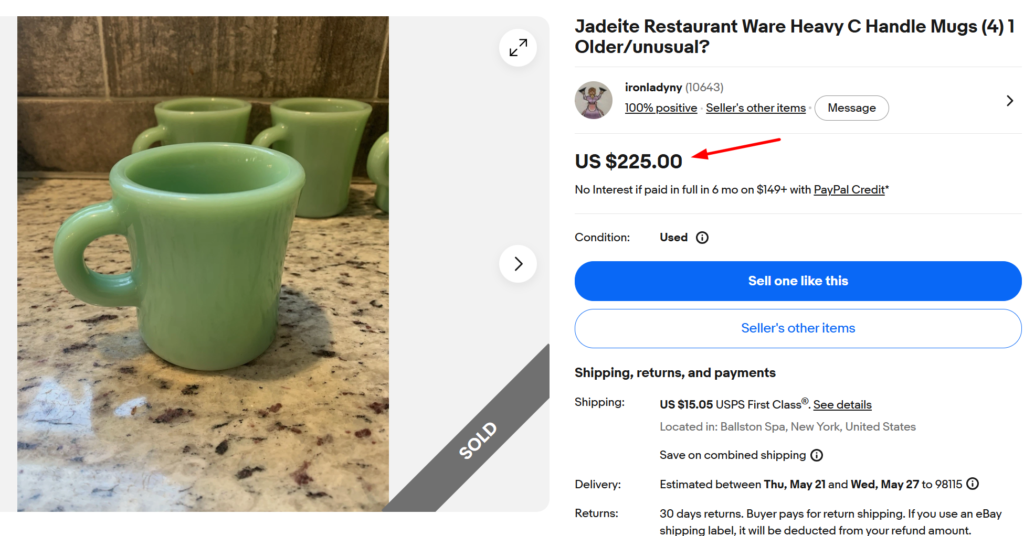
Sold for $225
Restaurant Ware was the line made for restaurant use by Fire-King. The C-handle mug is rarer than its D-handle cousin, thus making it more collectible. This is the longest-running Fire-King line and therefore features all variations of Fire-King stamps on the mugs.
The C-handle itself comes in three main variants: Extra Heavy, Small Restaurant, and Slim Chocolate. The Extra Heavy C-handle is a top-tier collector piece, with white versions selling into the high hundreds.
The seldom-seen 6 oz Slim Chocolate (aka “Cheater”) mug brings even more. Earlier mugs with simple “OVEN Fire-King WARE” block-letter marks (1948–1950) command the highest prices across all variants.
- Estimated Value: $40-$80 (singles); $80 to $200+ (Extra Heavy, Slim Chocolate variants)
- Production Year: 1948 to 1976
- Line: Restaurant Ware
- Characteristics: Cylindrical body with a curved C-shaped handle, thick-walled
- Quick Notes: C-handle mugs are rarer than D-handle mugs.
7. Fire-King Jadeite Alice pattern plate
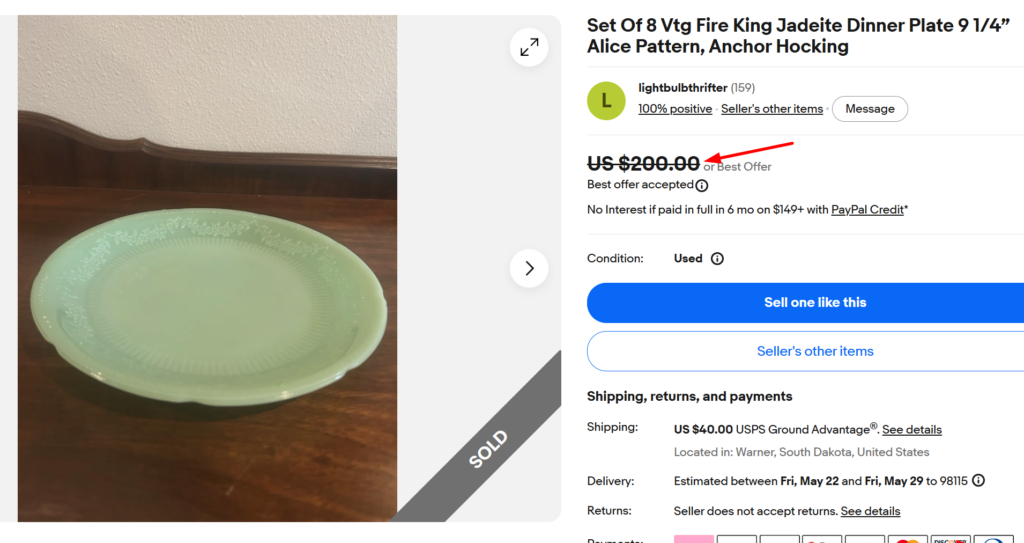
Sold for $200
Alice was one of the first Fire-King Jadeite patterns produced in 1945. The cups and saucers were distributed in the form of giveaways with Quaker Oats and Crystal Wedding Oats in 1945.
This explains their availability today. Dinner plates are not as common, since they had to be purchased separately to complete a set, and fewer were made and survived. Alice dinner plates in clean condition regularly sell for $35–$80 each, with sets reaching $250.
- Estimated Value: $15-$30 (single plates); $80-200 (sets)
- Production Year: 1945 to 1949
- Line: Fire-King Alice (the first jadeite pattern Fire-King ever produced)
- Characteristics: Floral pattern around the outer border, small notches on the plate edge
- Quick Notes: Dinner plates are rarer than cups and saucers.
8. Fenton Martha by Mail Jadeite Hen on Nest
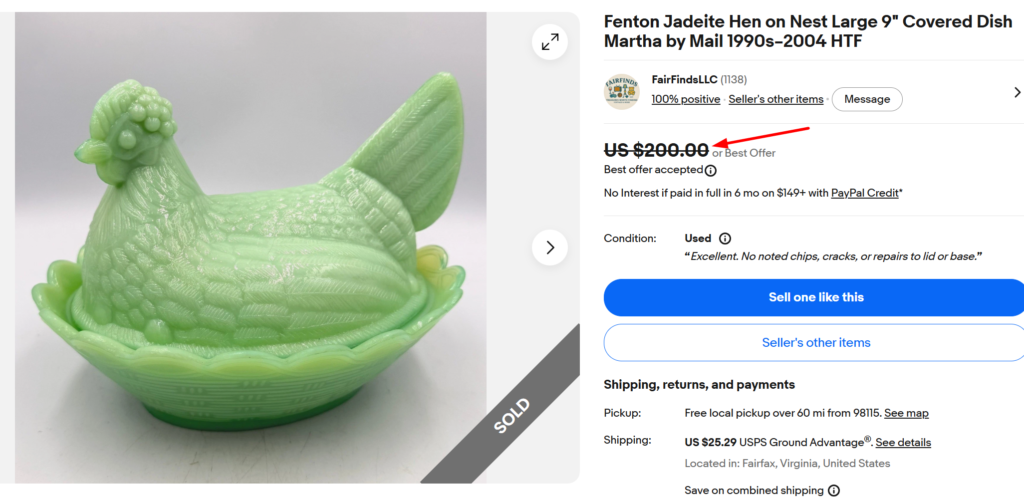
Sold for $200
Martha commissioned Fenton Glass Company to produce her jadeite line in the same old-world manufacturing style Fenton had used throughout the 20th century. The Fenton Jadeite Hen on Nest is the best-known piece from this collaboration.
It’s a traditional American glass-covered dish form, but the jadeite version was new to the 1990s revival. These are clearly marked Martha by Mail (MBM) or Fenton, so they won’t be confused with vintage 1930s–60s jadeite.
But the late-1990s pieces have become collectible on their own, especially since production ended around 2004.
- Estimated Value: $150-$250 (complete with lid)
- Production Year: 1990s to 2004
- Line: Martha by Mail (made by Fenton Glass Company)
- Characteristics: 9″ covered hen dish with basket-style nest base
- Quick Notes: Marked as Martha by Mail / Fenton.
9. Fire-King Jadeite Jane Ray Cup & Saucer
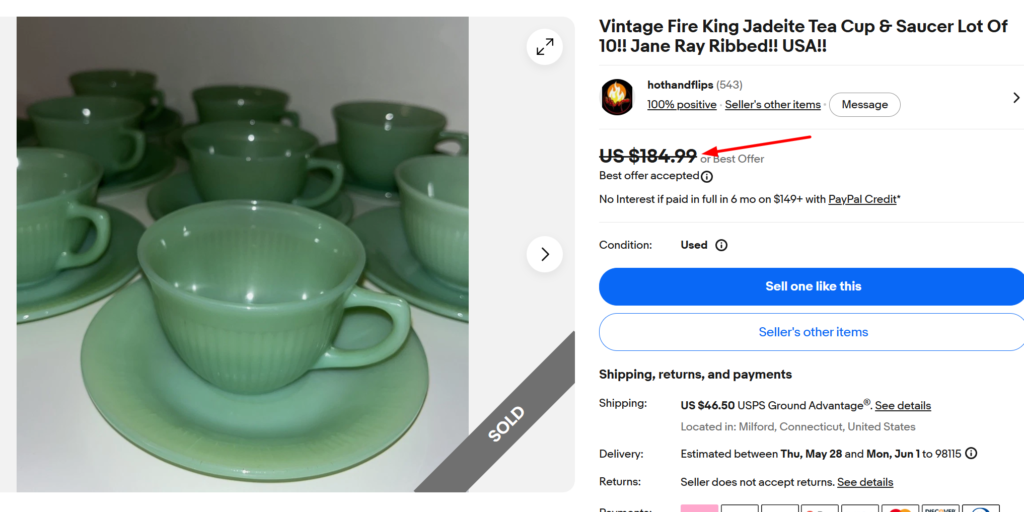
Sold for $185
Jane Ray is the most common jadeite pattern you’ll encounter because it was produced for 18 years. The standard cup and saucer sets are extremely common, which keeps prices moderate.
The value for these pieces lies in completeness and packaging. Complete cups and saucer sets in original 1940s–50s boxes can hit $400–$500. The 3½” demitasse cup is the hard-to-find piece, especially with an original foil label still attached.
Also, check the base for early markings; sets with mid-1940s “OVEN Fire-King GLASS” block-letter marks are worth more than the later “OVEN Fire-King WARE” marks from 1951–1960.
- Estimated Value: $100-$200 (set of 8-10); $40-$80 (demitasse cups)
- Production Year: 1945 to 1963/65
- Line: Fire-King Jane Ray
- Characteristics: Rayed border on both cup and saucer, plain center, thinner glass than Restaurant Ware
- Quick Notes: Demitasse cups and pieces with foil labels are valuable.
10. Fire-King Clear Butter Dish with Jadeite Lid
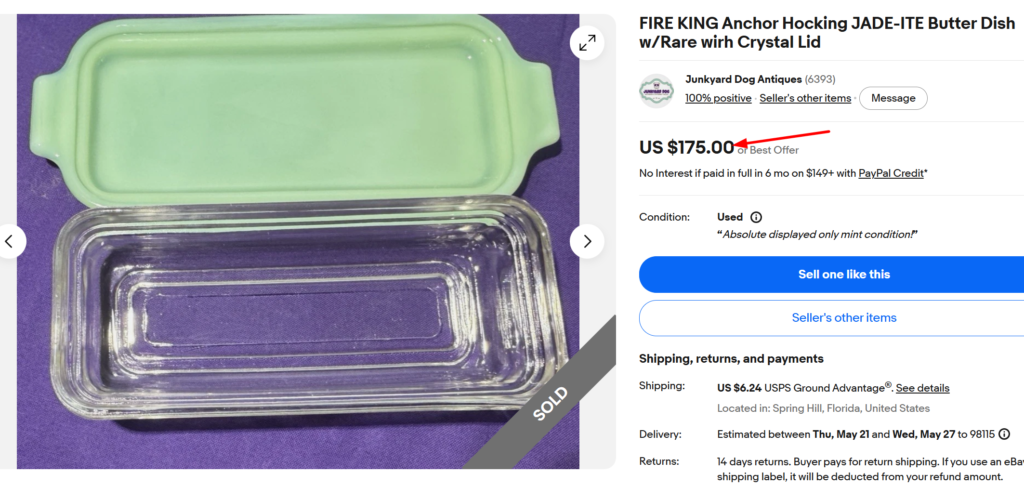
Sold for $175
The Fire-King jadeite butter dish with its original crystal lid is one of the harder complete pieces to find. The pairing of jadeite green with a clear crystal lid was an unusual design choice for Fire-King, since most of their covered pieces used matching jadeite lids.
The clear lid was also more fragile, which makes it a big value driver for these dishes; bases without lids are common and cheap.
Check for the “OVEN Fire-King WARE MADE IN U.S.A.” logo at the bottom of the base. The clear lid usually lacks a manufacturer’s logo. The clear lid is typically unmarked.
- Estimated Value: $100-$200 (complete with lid); $25-$50 (base alone)
- Production Year: 1950s to early 1960s
- Line: Fire-King Kitchenware
- Characteristics: Rectangular jadeite base with tab handles, a clear (crystal) glass lid
- Quick Notes: The clear crystal lid is crucial for top value.
11. McKee Jadite “Laurel” Cheese Dome
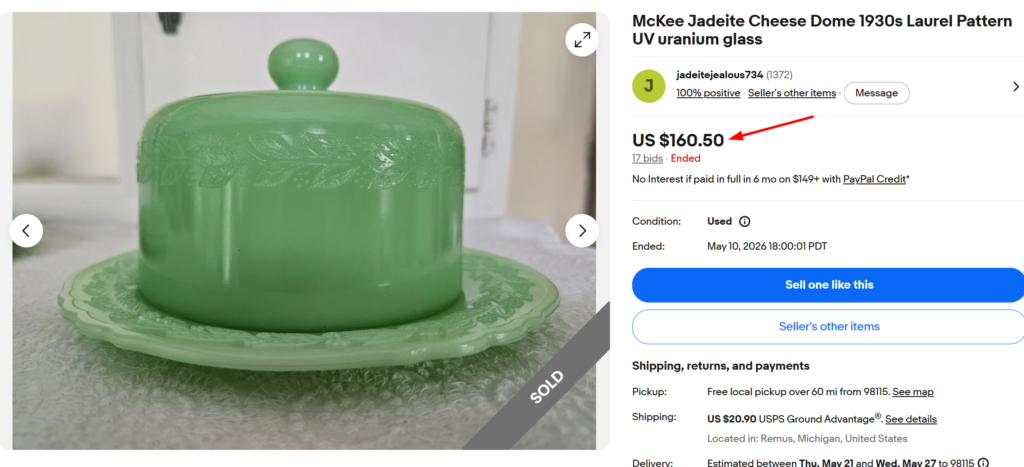
Sold for $160
McKee Laurel is the rarest of the three major jadeite makers because McKee only made one complete dinnerware line in jadeite. These pieces are about a decade older than most Fire-King jadeite, which puts them in the pre-uranium-ban era.
This McKee Laurel cheese dome is one of the most distinctive serving pieces. The laurel leaf border embossing is the key identification for this pattern. Most McKee products will have “McK” embossed on the bottom, though many do not have any marking at all. Also, the yellow-green color used by McKee is a little bit different than the blue-green shade of Fire-King.
A complete dome with an underplate can sell for $100 to $200 or more in pristine condition.
- Estimated Value: $120-$250 (complete set)
- Production Year: 1930s, primarily 1935 to 1941
- Line: McKee Laurel (the only complete jadeite dinnerware line McKee made)
- Characteristics: Domed cheese keeper with knob handle, embossed laurel leaf border around the dome, matching underplate
- Quick Notes: Glows green under blacklight (uranium content).
12. Fire-King Batter Bowl with spout
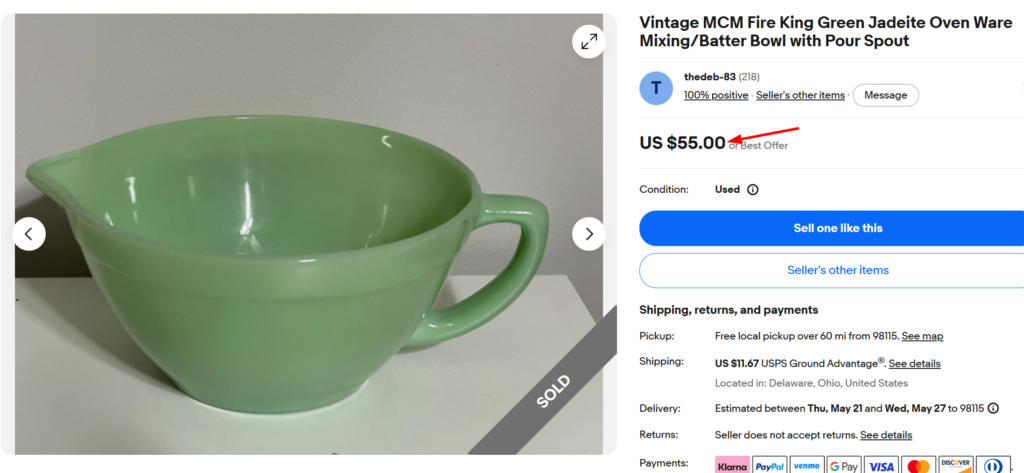
Sold for $55
The Fire-King batter bowl is one of the most searched jadeite pieces. It was advertised in newspapers as early as 1954 as a baking essential, and was perfect for directly pouring pancake or cake batter from the pitcher into the pans.
Older models would be stamped with the Fire-King name along the bottom, along with mold numbers and “MADE IN U.S.A.” after 1951. The reproduction batter bowls from 2000 are clearly marked with “2000” in the backstamp and were sold with a paper insert advertising.
Authentic vintage versions in clean condition typically sell in the $80–$120 range, with mint examples and ones with original foil labels pushing higher.
- Estimated Value: $60-$150 (vintage); $30-$50 (2000 reproduction)
- Production Year: Original 1950s–1960s; (2000 reproductions)
- Line: Fire-King Kitchenware
- Characteristics: Round bowl with a C-shaped handle, pouring spout, 7.5 inches across the rim, 4 inches tall
- Quick Notes: The 2000 reproductions are marked “2000.”
How to Identify Genuine Jadeite Dishware?
Jadeite reproductions are extremely common. Mosser, Pioneer Woman, Cracker Barrel, Tablecraft, Martha Stewart, Farmhouse Market, and even some Brazilian and Chinese manufacturers all make jadeite-style glass today.
That’s why it’s important to know the things that set vintage Jadeite apart from modern repros. Walk through these steps in order to spot a genuine piece.
Check the Maker’s Mark
The base of the piece gives the most reliable signs. The mark, or lack of one, narrows down the maker and era immediately. Here are some marks you need to know:
Fire-King Jadeite Markings by Era:
- 1942–1948: “FIRE-KING OVEN GLASS” or “FIRE-KING OVEN WARE” in block letters, no script logo. These early block letters are the most valuable Fire-King marks.
- 1948–1950: Fire-King script logo introduced along with “OVEN Fire-King GLASS” or “OVEN Fire-King WARE.”
- 1951–1960: Markings become more elaborate with “MADE IN THE U.S.A.” and mold numbers.
- 1962–1976: Anchor Hocking “H over anchor” logo added alongside the Fire-King script. Busier marks indicate later pieces.
- 2000 only: Reproduction line marked clearly with “2000” in the backstamp. Made in Brazil. These are reproductions, not vintage.
Other Maker Marks:
- McKee: “McK” stamped on the base. Some pieces are unmarked.
- Jeannette: A “J” inside a triangle. Many pieces are also unmarked.
- Federal Glass: Bold “F” inside a shield — often confused with Fire-King, but Federal never made jadeite. Skip these.
- Martha by Mail / Fenton / L.E. Smith / Mosser / Pioneer Woman: All clearly marked and dishwasher-safe stickered.
Remember that some vintage pieces, like Charm and Alice, are intentionally unmarked. Don’t assume unmarked equals fake. The shape, pattern details, and base finish matter just as much as the stamp.
Examine the Color
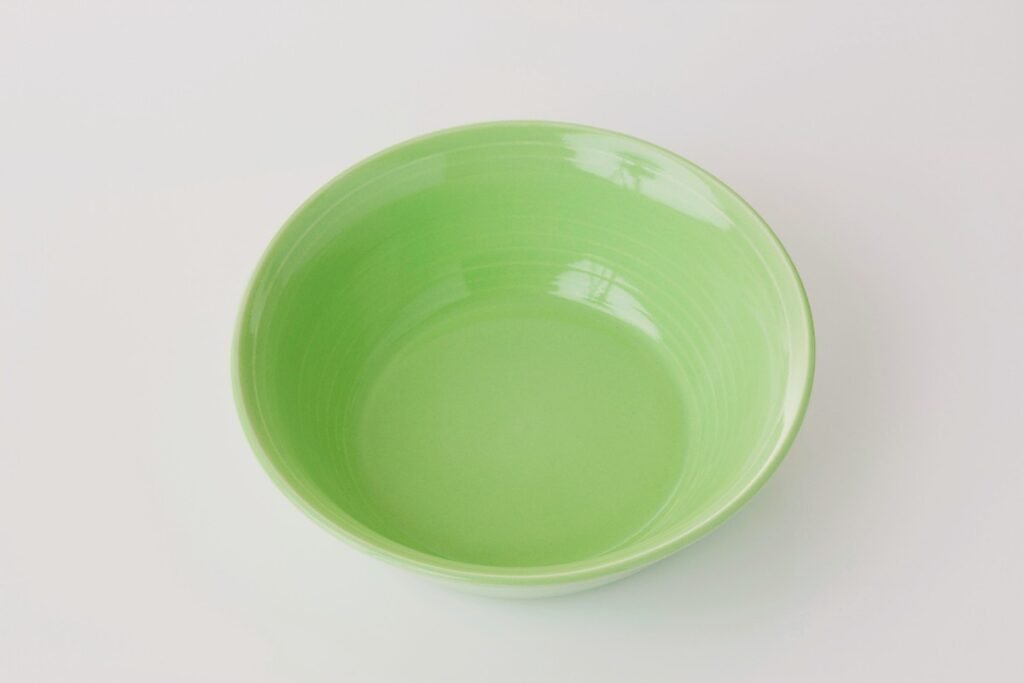
Real vintage jadeite has subtle color variations from piece to piece because quality control was loose during the 1930s–60s. Tiny air bubbles, swirl marks, and minor color variations are not uncommon and do not affect value.
“Skokie green” is a more common name for McKee jadeite that is greenish-yellow in color. Fire-King’s color is a slightly bluer-green. Chinese copies are usually characterized by uniform coloring, reminiscent of paint applied on the surface.
Compare a few pieces side by side under natural sunlight. If they have too even coloring, then you need to be suspicious.
Black-Light Test
A handheld UV blacklight is the cheapest jadeite tool you can buy and the fastest authenticity check. The McKee and Jeannette pieces made in the 1930s and 1940s have uranium oxide. So, they must emit bright green when exposed to UV lights.
Fire-King pieces from Anchor Hocking didn’t have uranium and will NOT glow. So if you have a piece marked Fire-King that glows, something’s wrong; either the mark is fake, or it’s not Fire-King.
Reproduction pieces from Mosser, Martha Stewart, Pioneer Woman, and other modern makers don’t glow either. The blacklight test mostly distinguishes pre-1942 McKee and Jeannette from everything else.
Feel the Weight & Mold Lines
Vintage jadeite is heavier than most reproductions. Older pieces feel more compact and dense in your hand. Restaurant Ware, in particular, is about twice as thick as Jane Ray.
When picking up a “Restaurant Ware” mug that is light in weight, it is probably a reproduction. Run your fingernail along the mold seam lines of the piece.
Vintage jadeite mold lines are often slightly rough and uneven because the molds were used heavily and the glass was hand-finished. Repro pieces tend to have crisp, clean mold lines because the molds are new. Tablecraft and Pioneer Woman repros are noticeably lighter than the originals, with smoother edges and less heft.
The most valuable Jadeite pieces aren’t always the prettiest. They’re usually the ones with short production runs, original labels, and rare forms. Check the pieces beyond that green color before selling or buying.