
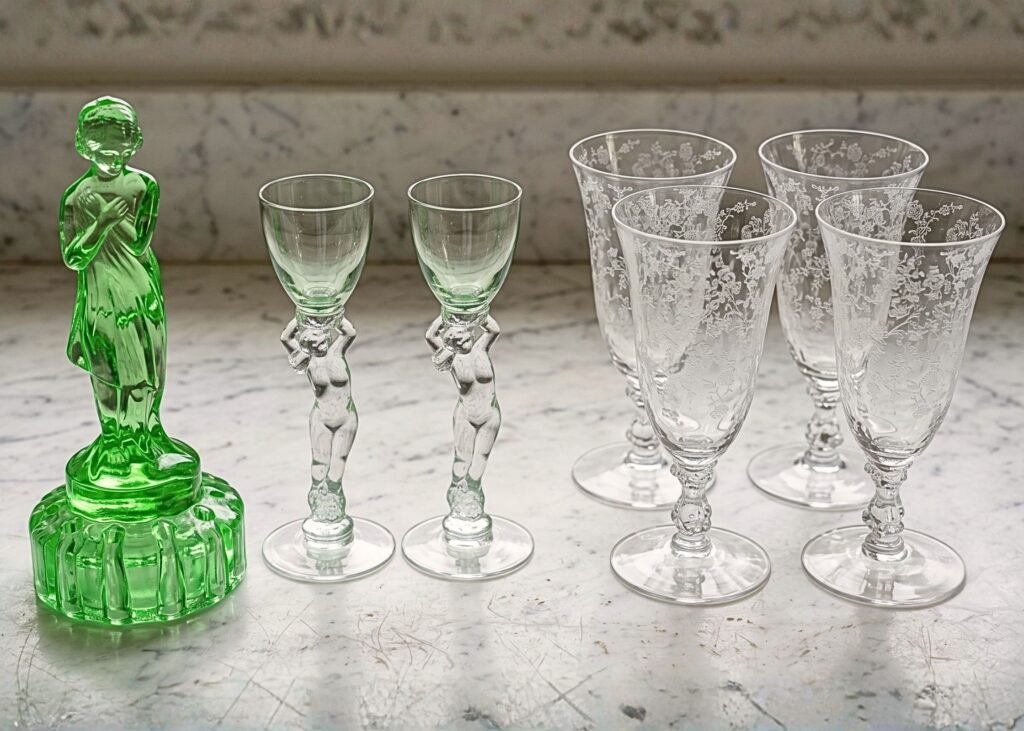
If you come across an old glassware piece marked with a tiny C inside a triangle, you’re likely looking at vintage Cambridge glass. And a piece of it might quietly be worth $200, while another looks nearly identical but sells for $15.
That’s what this guide is about. You’ll learn how to identify real Cambridge glass, spot the patterns, colors, and forms that collectors actually chase, and how much they can be worth today.
What Is Cambridge Glass?
Chartered in 1873 in Cambridge, the Cambridge Glass Company didn’t start production until 1902 under glassmaker Arthur J. Bennett. For over 50 years, Cambridge made handmade pressed and blown glassware, etched stemware, colored art glass, and figurals.
The 1930s were the golden years for Cambridge. That’s when Rose Point, Caprice, the Nude Stems, and standout colors like Carmen and Crown Tuscan came out.
Financial trouble hit after WWII. Cambridge closed in 1954, briefly reopened, then shut for good in 1958. Imperial Glass bought many of the molds in 1960, which is why spotting the reproductions is crucial.
How to Identify Vintage Cambridge Glass (The 4-Signal Method)
Identifying genuine Cambridge glass comes down to four things you can check by holding the piece right in your hand. Start at the base, then work through the pattern, color, and how it feels.
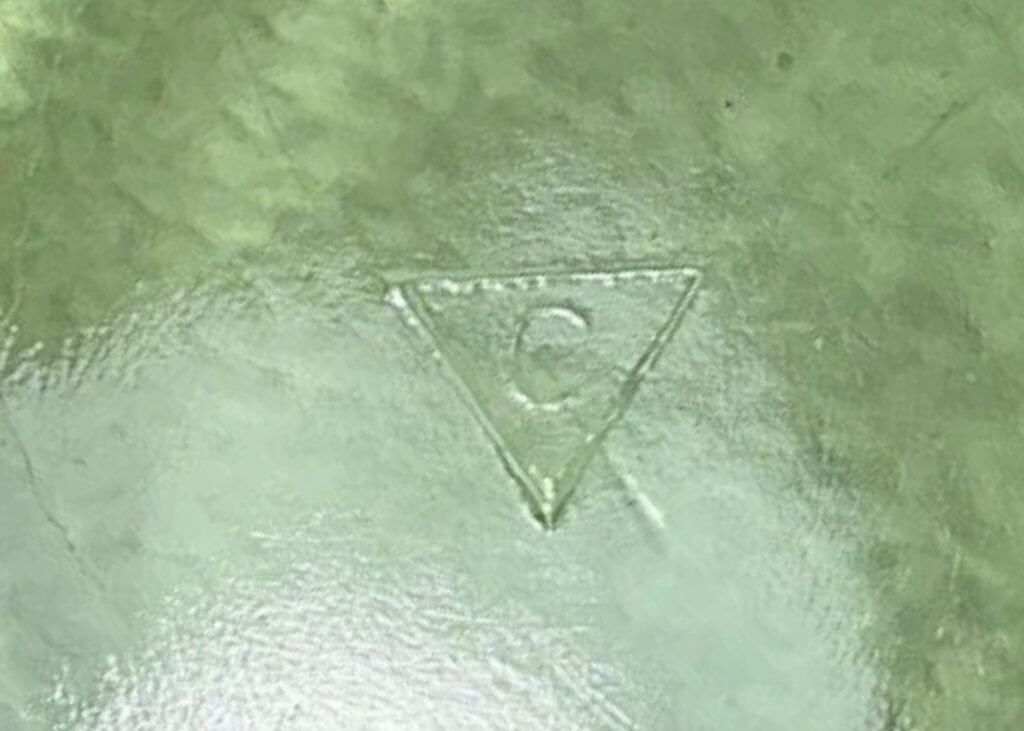
1. The Cambridge Mark (C in a Triangle)
Turn the piece over and check the mark at the base. The classic Cambridge mark is a capital C inside a triangle, pressed lightly into the glass on the base or the foot. It was introduced in 1922 and used through about 1954, but only on some items.
Cambridge never marked every piece, especially the earlier ones.
Before 1920, Cambridge marked their pressed glass with the word “NEAR CUT” molded right into the pattern. That mark ran roughly from 1904 to 1922. So a Near Cut piece is likely Cambridge from their earliest years.
From 1935 to 1954, Cambridge also used paper labels. Most of these have fallen off over the decades, so don’t rule out a piece just because it’s unmarked. Plenty of genuine Cambridge glass carries no factory mark at all. Pattern and color usually seal the ID.
ID Note: A fake etched “C in triangle” mark shows up on some reproduced flower frogs. The only authentic etched Cambridge mark was on laboratory glassware. On regular pieces, the triangle-C should be pressed into the mold, not scratched or acid-etched onto the surface.
2. Pattern Identification
Cambridge produced over 5,000 different molds by the 1930s, but a handful of etched and pressed patterns show up again and again. Learning to spot these first will identify most pieces you’ll ever find.
The five patterns to memorize:
- Rose Point – The most famous Cambridge etching. Elaborate wild roses with vines and delicate lace-like traceries. Produced from 1934 to 1958, mostly on crystal. Look for a small rose medallion inside a raised corner design.
- Caprice – A molded (not etched) swirl pattern with fan-shaped feet and rippling optic ribs. Introduced in 1936 and made until closing. Feels heavier than typical Cambridge stemware.
- Chantilly – Delicate etched scrolls that run horizontally to the rim, with small flowers. Produced from 1938 to 1958.
- Elaine – Big scrolls that run diagonally across the piece, never parallel to the rim. Etched from 1933 to 1954. This one is often confused with Chantilly, but the scroll direction is your quick tell.
- Wildflower – Naturalistic stems, leaves, and flowers scattered across the piece. Introduced in the early 1930s, produced into the mid-1950s. Often found with a gold rim.
Other important ones include Portia (an urn of flowers), Apple Blossom (large open blossoms with a formal center motif), Diane, Gloria, and Blossom Time. Most Cambridge etchings are found on crystal, but Apple Blossom and Gloria show up in emerald and Heatherbloom.
3. Glass Color as a Clue
Cambridge color is where value gets interesting. Crystal (clear) is by far the most common, but the company made dozens of colored glass formulas between 1923 and 1958. Some are common. A few are genuinely rare and push prices sharply higher.
Here are the colors that matter most for value:
- Crown Tuscan – A distinctive pink opaque milk glass introduced in 1932. Often found with hand-painted “Charleton” floral decorations added by Abels, Wasserman & Co. of New York.
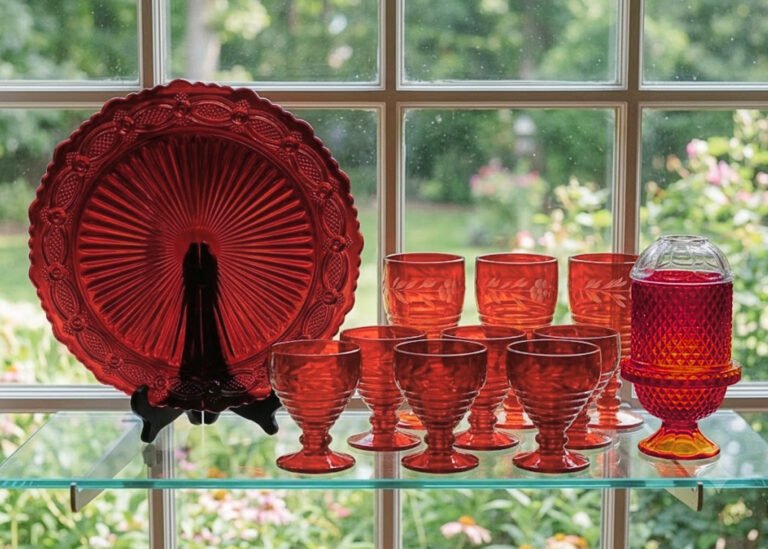
- Carmen – A deep ruby red, first made in 1931. At the time of production, Carmen items were priced 50 to 100 percent higher than other colors.
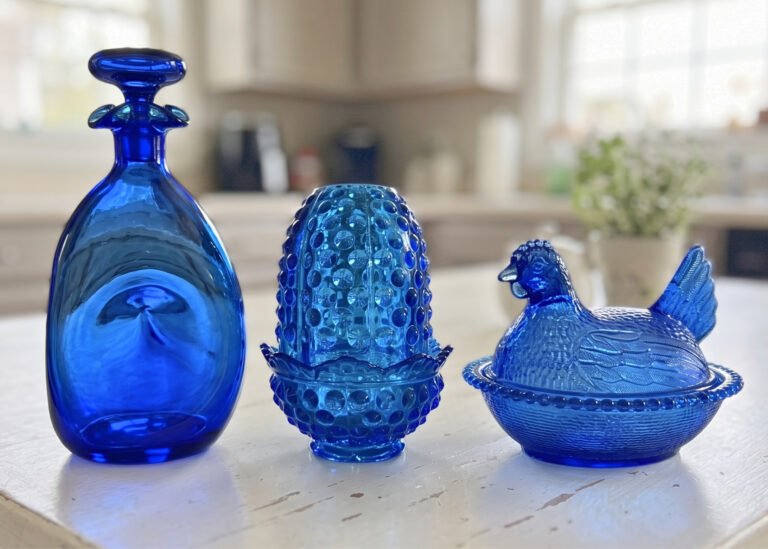
- Royal Blue – A rich cobalt introduced in 1931. Along with Carmen, it commands the highest prices among transparent colors.
- Heatherbloom – A neodymium glass from 1931 that shifts from lavender-blue to pink under different light. Genuinely rare and easy to authenticate because the color change effect is hard to fake.
- Moonlight Blue – A light transparent blue used mostly on Caprice from 1936 to 1953. Widely reproduced later by Summit Art Glass, so authentication matters.
- Peach-Blo, Emerald, Ebony, and Amber – Common production colors, but they are still more valuable than plain crystal.
4. Check the Cambridge Catalog
If you narrow the piece down to a pattern and a color, one more step confirms it. Cambridge made specific shapes in specific patterns and colors. If you can’t find your piece listed in a catalog reference for that pattern, something is off.
Either the ID is wrong, or the piece is a later reproduction.
You can cross-check sources like reprinted Cambridge catalogs sold through National Cambridge Collectors, Inc. (NCC), the pattern galleries on Replacements Ltd., and the extensive Virtual Museum on cambridgeglass.org.
Collectible Vintage Cambridge Glassware Patterns & Pieces
Below are the Cambridge patterns, colors, and forms that show up in serious collections and estate auctions. You’ll know what they’re worth and what to look for.
1. Rose Point Etched Crystal Stemware (#3121)
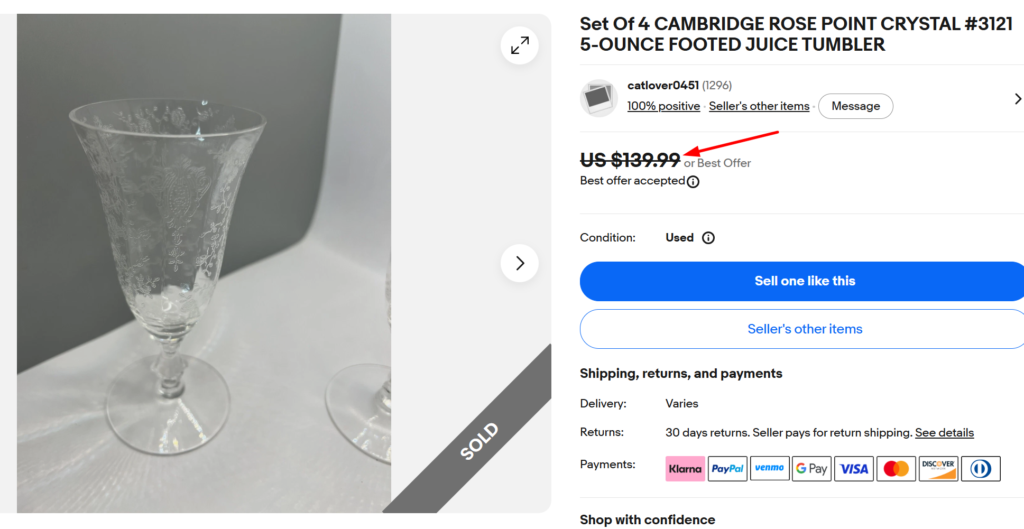
Sold for $140 (set of 4)
Rose Point is the pattern that defines Cambridge. It was introduced in 1934 and stayed in production until the factory closed in 1958. The design features delicate wild roses inside raised medallions with vine work wrapping around the piece.
Cambridge used it on hundreds of shapes, mostly on crystal. But Rose Point on colored glass, gold-encrusted pieces, or the rare Nude Stem are the most desirable.
- Estimated Value: $30 to $500+ per piece
- Production Years: 1934 to 1958
- What to Check: Small rose medallion, raised corner
- Quick Notes: Gold-encrusted and colored versions are much rarer.
2. Caprice Moonlight Blue Dinner Set
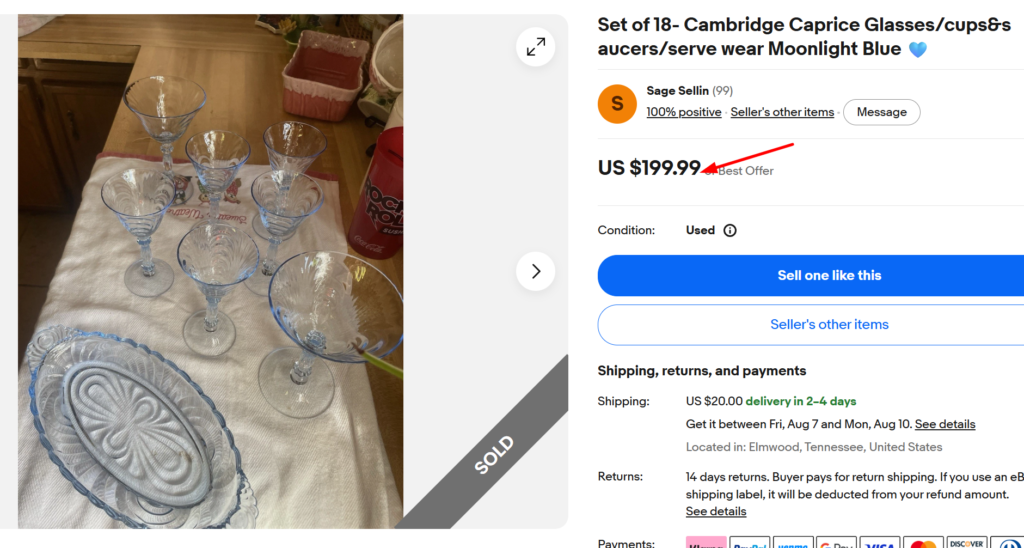
Sold for $200 (set of 18 pieces)
Caprice is Cambridge’s most collected pressed pattern, first introduced in 1936 with a rippling swirl motif the company called “the enchantment of Rippling Water.” Moonlight Blue was made alongside crystal from 1936 to 1953.
Look for the fan-shaped feet and the wave-like optic ribs. Summit Art Glass later reproduced it in a very close shade, so watch out.
- Estimated Value: $25 to $300 per piece
- Production Years: 1936 to 1953 (main run)
- What to Check: Fan-shaped feet, wave optic ribs
- Quick Notes: Summit reproductions match closely, beware
3. Swan Figural
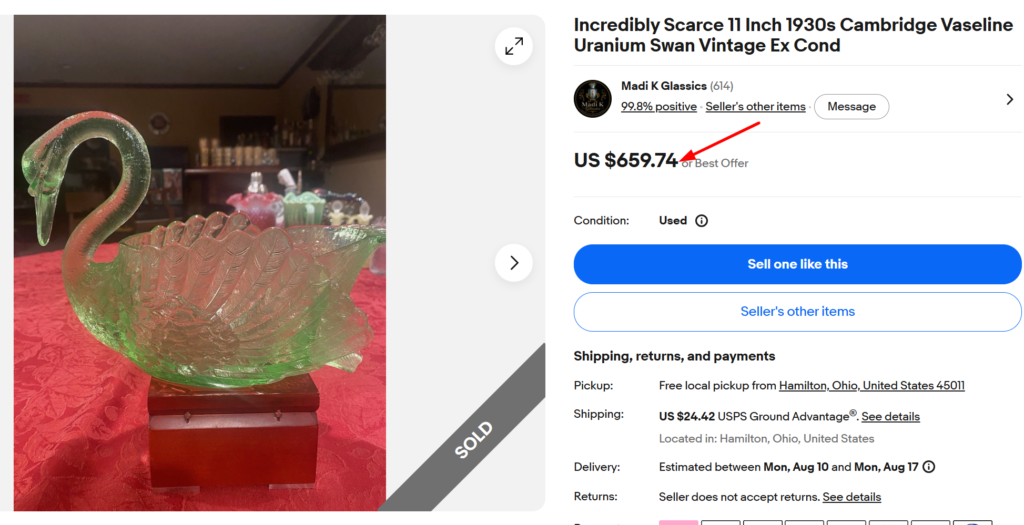
Sold for $660
The Cambridge Swan came in December 1928 and was produced through the closing years. It came in seven sizes, from a tiny 3-inch nut dish to a massive 10 and 13-inch center bowl. The largest ones are the most collectible and rarest.
Three different body styles exist: the early one with full feather detail and short bobbed wings, a second with wings raised and half the detail, and a plain third style used from 1940 forward.
Mosser and Boyd reissued smaller swans in colors Cambridge never used. That’s your reproduction clue.
- Estimated Value: $75 to $2,000+ (varies by size)
- Production Years: 1928 to 1958
- What to Check: Feather detail, wing shape, size
- Quick Notes: Later Boyd swans marked with B-in-diamond
4. Portia Amber Ball Pitcher & Tumbler Set
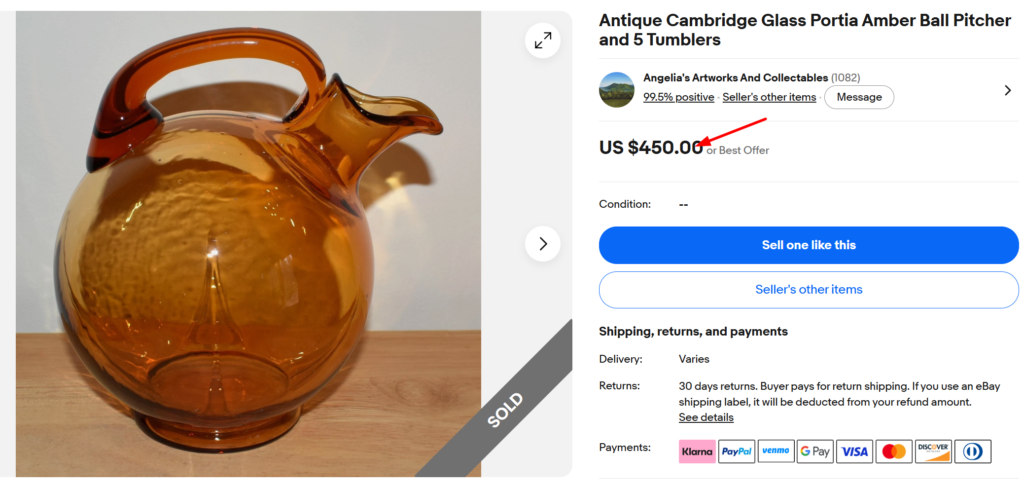
Sold for $450 (set of 6)
Portia was introduced in late 1931 or early 1932 and features a flat-topped urn overflowing with flowers. It stayed in the line for roughly 20 years. Cambridge used it mostly on crystal, but the etch also appears on Carmen, Royal Blue, and amber.
The #3400/38 ball-shaped jug was made in nine colors and seven etchings. An amber ball pitcher with matching Portia tumblers is a rare collectible combination.
- Estimated Value: $250 to $600+ (pitcher and tumbler set)
- Production Years: 1932 to early 1950s
- What to Check: Flat-topped urn with flowers etched
5. Tally-Ho Ruby Stemware with Gold Silk Screen (#1402)
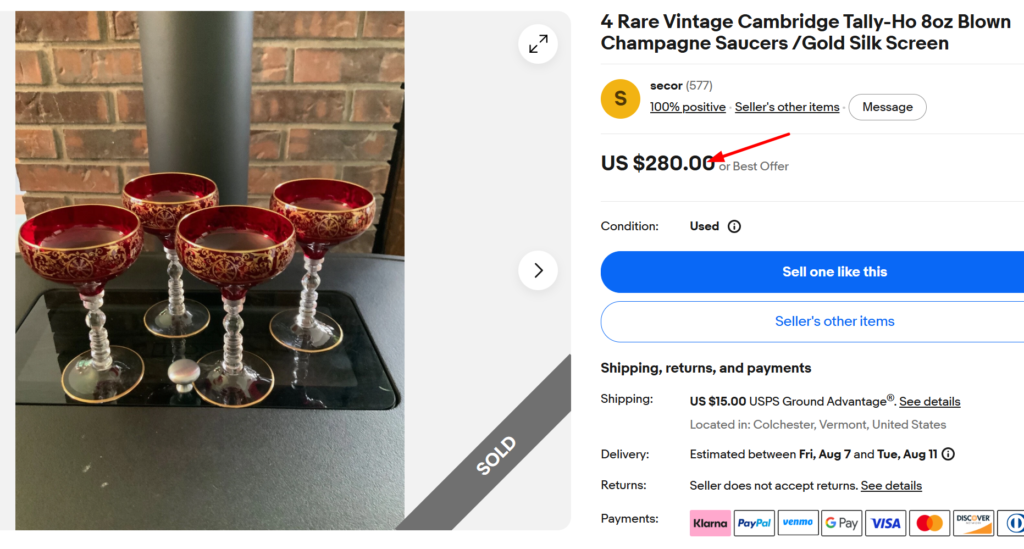
Sold for $280 (set of 4)
Tally-Ho was introduced in 1932 as line #1402 and included both pressed and blown stemware. The blown line features a stacked-ball crystal stem paired with a colored bowl. Cambridge made Tally-Ho in ruby (Carmen), cobalt Royal Blue, green, amber, amethyst, and crystal.
Ruby bowls with clear stacked stems and hand-applied gold silk-screen decoration are the most desirable Tally-Ho combination.
- Estimated Value: $60 to $80 per stem
- Production Years: 1932 to mid-1940s
- What to Check: Stacked-ball stem, ruby bowl, gold work
- Quick Notes: Gold silk-screen decoration adds a premium.
6. Statuesque Nude Stemware (#3011)
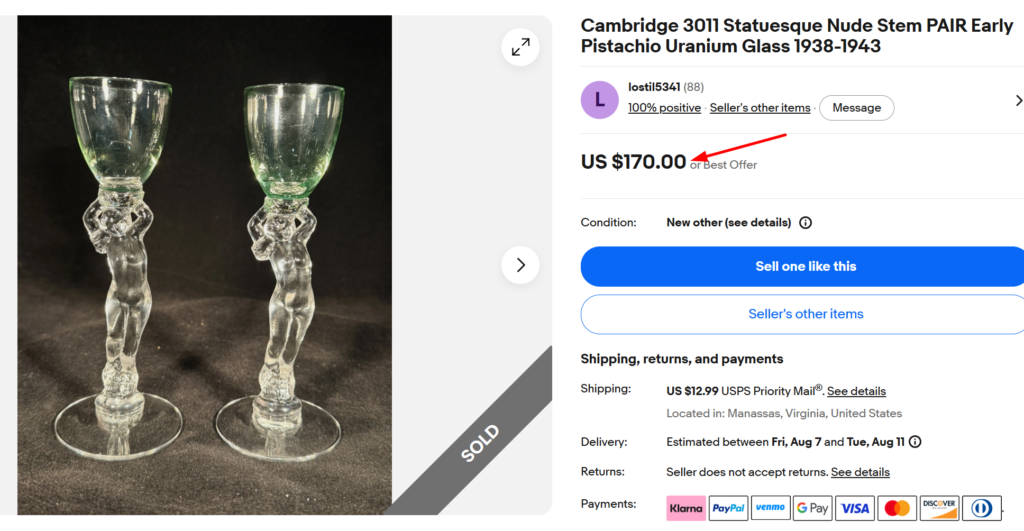
Sold for $170 (pair of 2)
The Nude Stems were introduced in 1931 as line #3011, and each stem features a hand-formed nude female figure supporting the bowl. Cambridge made nine sizes, from cordial to banquet goblet.
Nude Stems are most common with crystal figures and colored bowls. Royal Blue, Carmen, and Amethyst bowls with Crown Tuscan pink stems are the most desirable.
- Estimated Value: $150 to $400+ per stem
- Production Years: 1931 to 1958
- What to Check: Detailed nude figure at stem
- Quick Notes: Colored bowls with Tuscan stems are most collectible.
7. Crown Tuscan Seashell Bowl with Charleton Decoration
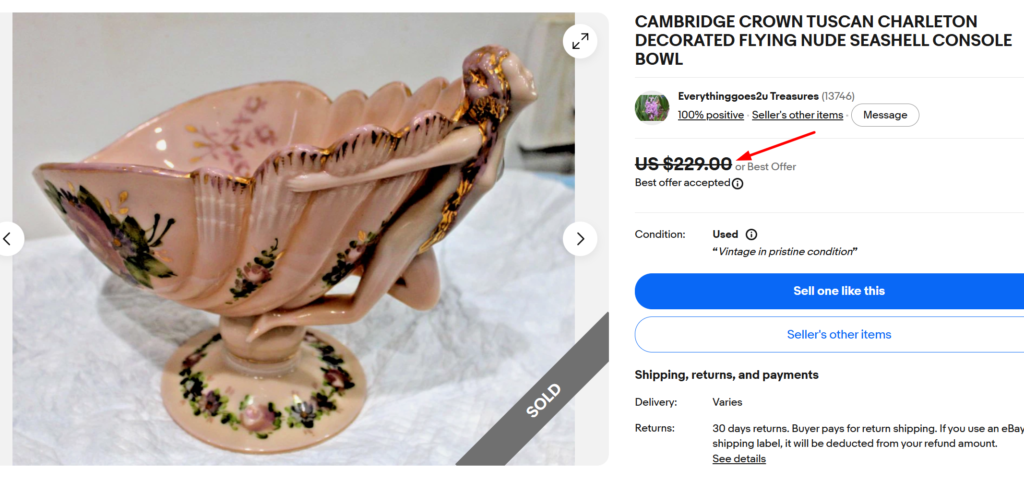
Sold for $230
Crown Tuscan is a pink opaque milk glass introduced in September 1932, and the Seashell line was launched in 1935 with 46 different shapes at its peak. Add hand-painted Charleton decorations from Abels, Wasserman & Co., and you get some of the most decorated Cambridge glass ever made.
Charleton pieces show flowers, sailing scenes, or picturesque motifs painted over the pink Crown Tuscan base, then trimmed with gold. Crisp brushwork and intact gilding are important for value.
- Estimated Value: $60 to $350 per piece
- Production Years: 1935 to 1954
- What to Check: Painted florals, gold gilt edges
- Quick Notes: Charleton decoration added by the NY firm
8. Heatherbloom Gloria or Apple Blossom
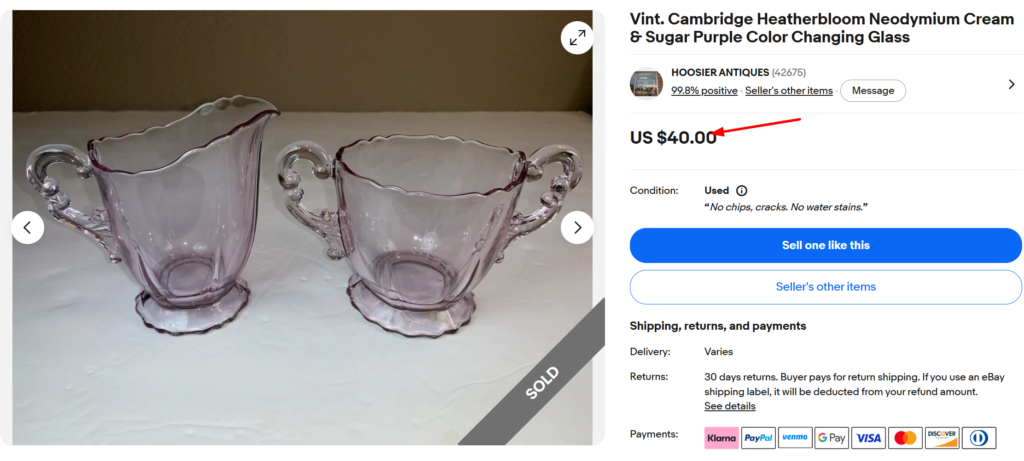
Sold for $40 (set of 2)
Heatherbloom is one of Cambridge’s rarest transparent colors. Introduced in 1931, it contained neodymium, an expensive coloring agent, that causes the color shift from lavender-blue in daylight to a pinkish tone under incandescent light.
That color change is the fastest way to authenticate it.
Heatherbloom was made in short quantities and mostly on the #3400 line, often with Apple Blossom or Gloria etchings. Cambridge only produced Heatherbloom for a few years in the early 1930s, making it rare.
- Estimated Value: $80 to $500+ per piece
- Production Years: 1931 to mid-1930s
- What to Check: Color shift under different light.
9. Everglade Moonlight Blue Glass
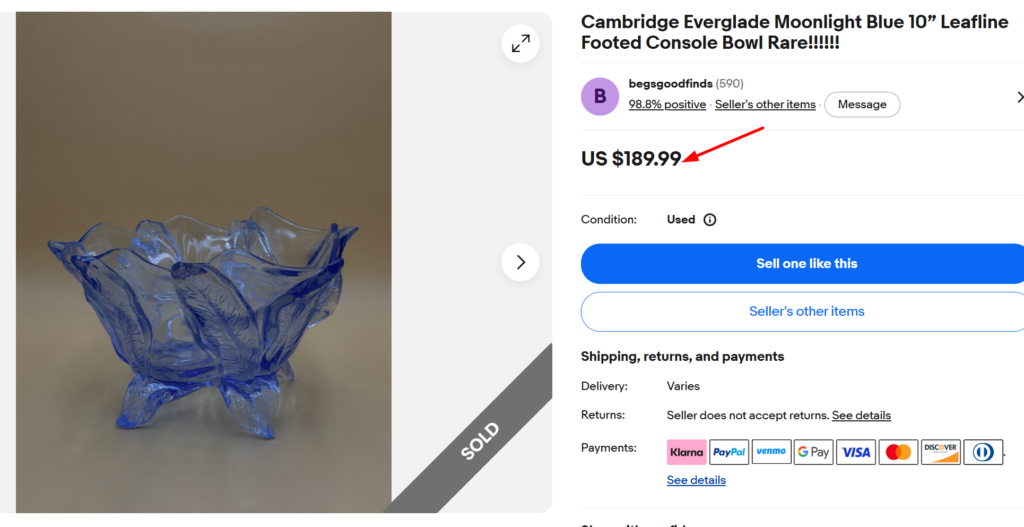
Sold for $190
The Everglade line is one of Cambridge’s most unusual designs. Produced from 1929 to 1958, it features naturalistic marsh motifs pressed into the mold, like long leaves, tulip forms, and ferns. Moonlight Blue was one of the earliest Everglade colors.
Because many Everglade pieces had leaves extending beyond the rim, they broke easily and are hard to find complete today. Candlesticks, console bowls, and mug sets, especially Frosted “Pearl Mist” versions, are most collected.
- Estimated Value: $80 to $350 per piece
- Production Years: 1929 to 1958 (Willow Blue 1929–1936)
- What to Check: Molded marsh scenes, delicate rim leaves
- Quick Notes: Extended leaves are often chipped or broken.
10. Draped Lady Figural Flower Frog
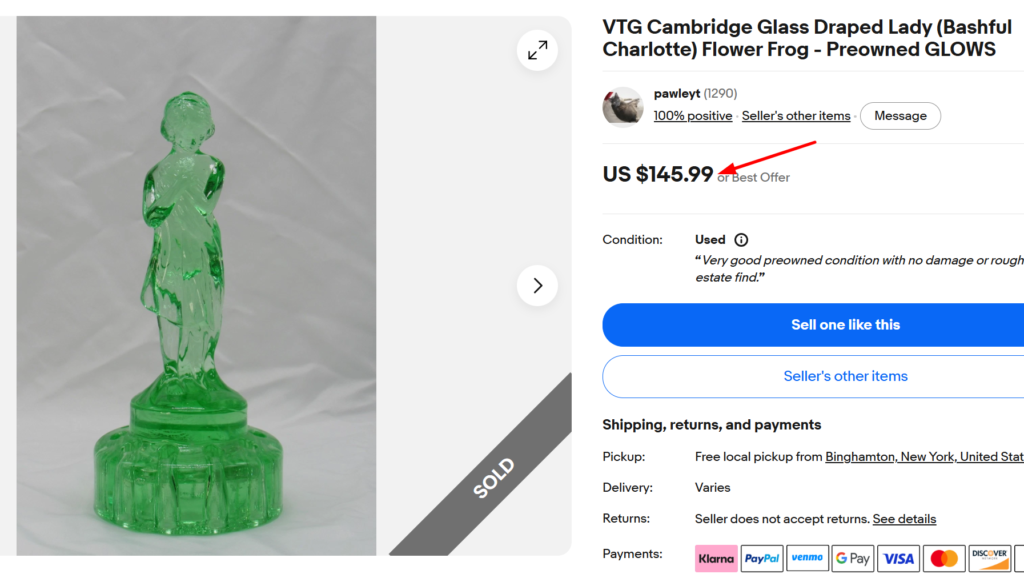
Sold for $145
The Draped Lady was Cambridge’s most popular figural flower frog. She came in three sizes (8.5, 12.5, and 13.25 inches) on scalloped, round, or oval bases. Look for the flowing draped robe and the holes in the base for arranging flowers.
Peach-Blo, green, and amber versions are more valuable than crystal. The 8.5-inch mold later went to Imperial.
- Estimated Value: $75 to $400+ per figure
- Production Years: 1927 to 1958
- What to Check: Draped robe, holes in base, size
- Quick Notes: Larger sizes and colored versions are worth more.
Is Cambridge Glass Worth Money? Here’s What Drives Value
Most vintage Cambridge glass sells for $15 to $80 on eBay, like a crystal Rose Point sherbet, a Caprice ashtray, a Chantilly candlestick, that kind of thing. But specific combinations of pattern, color, and form can fetch up to $200 to $1,000+.
Below are the five factors that decide how much a piece can be worth:
- Pattern rarity – Rose Point, on rare shapes, beats common ones. Short-run etches like Blossom Time, or Roselyn, cost more than long-running Chantilly.
- Color – Heatherbloom, Carmen, and Royal Blue routinely command 3 to 10 times the crystal prices for the same shape.
- Form – Serving pieces and figurals are worth more than tumblers. A 10-inch Cambridge swan blows past a wine goblet every time.
- Condition – Chips, cloudiness, and dishwasher damage cut the value hard. Etched patterns are especially fragile because a worn etch can’t be restored.
- Complete sets – A matched set of 6 or 8 goblets in the same pattern sells for 2 to 5 times what individual pieces bring.
A vintage Cambridge glass item can easily resell for a few hundred dollars today. All you need to do is learn patterns, colors, and marks. And cross-check your piece with genuine sold examples to know what it could be worth.