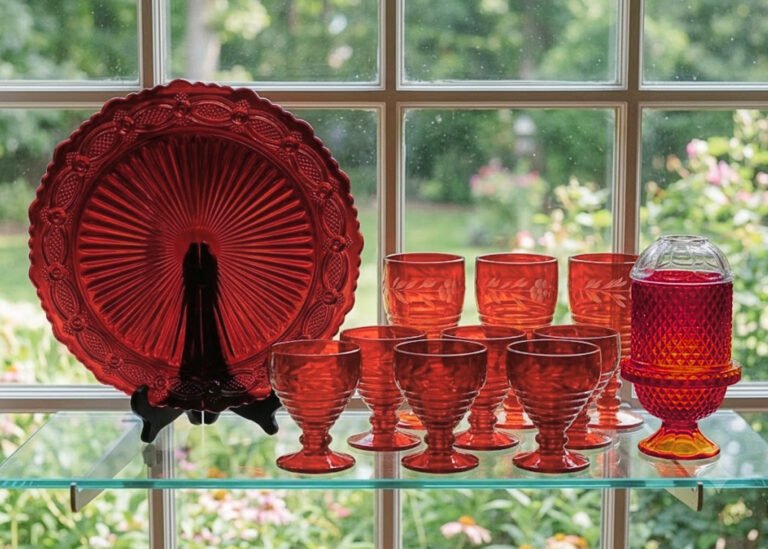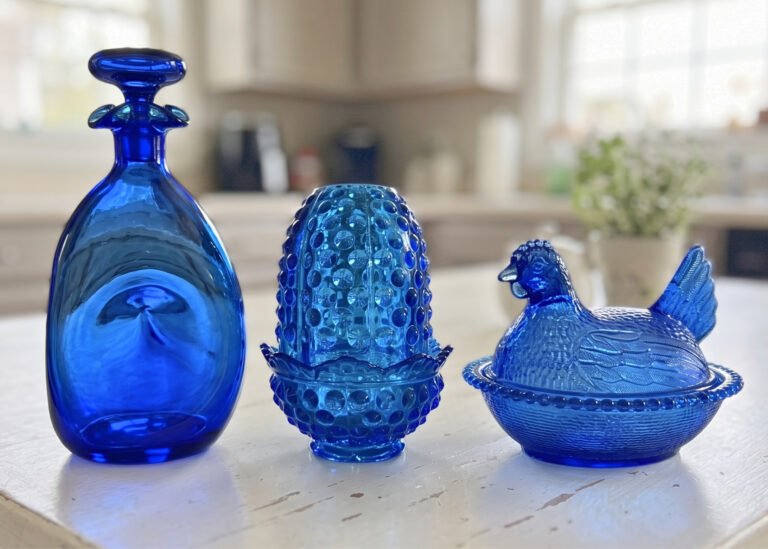

What is Pressed Glass?
Press glass is what its name implies. It’s molten glass that’s pressed using a steel plunger into a mold. This simple concept was improved in the United States in the 1820s, and made decorative glass mass-produced and affordable.
American makers like Bakewell, Pears & Co. of Pittsburgh, and the Boston & Sandwich Glass Company led the way. Collectors call the wave that followed Early American Pressed Glass, or EAPG, running roughly from 1850 to 1910.
Victorian pressed glass overlaps with that era and leans into bold patterns and color. English pressed glass came from firms like Sowerby and Davidson, who shipped opalescent and slag glass around the world.
People still collect all of it today. Some buy for nostalgia, some for the hunt, and some chase the rare patterns that quietly sell for serious money.
Pressed Glass vs Cut Glass vs Crystal: The Key Difference
When it comes to antique glassware, people often confuse these three types. They can look nearly identical from a distance, but the manufacturing method changes the details and value dramatically. Here’s how to tell them apart.
Pressed Glass vs Cut Glass
The fastest test is to run your fingertip lightly across the pattern. Pressed glass feels smooth and rounded because the design was formed by a mold, not carved. Cut glass feels sharp and crisp because each facet was ground into the surface with a rotating wheel.
The next test is the base and the seams. Pressed glass almost always shows mold seams (faint vertical lines) where the mold halves meet. Cut glass has no seams at all. Its blank was hand-blown or finished smooth before cutting began.
How to Tell Pressed Glass from Cut Crystal
Cut crystal is just cut glass made with lead added to the formula. The lead gives it extra weight and that signature ringing tone. So, cut crystal feels noticeably heavier than pressed glass of the same size.
Next, tap the rim gently with a fingernail. Real crystal will ring like a small bell. Pressed glass produces a dull thud. Crystal also throws prismatic rainbows from its facets, while pressed glass reflects softer, more diffuse light.
Here is a quick table to differentiate the three vintage glassware easily:
| Feature | Pressed Glass | Cut Glass | Cut Crystal |
| Made by | Mold + plunger | Hand-cut wheel | Hand-cut, lead glass |
| Mold seams | Usually visible | None | None |
| Pattern feel | Smooth, rounded | Sharp, crisp | Sharp, crisp |
| Weight | Lighter | Heavier | Heaviest |
| Tap sound | Dull thud | Clear ring | Bell-like ring |
| Light reflection | Soft, diffuse | Strong sparkle | Brilliant prisms |
| Base finish | Often mold mark | Polished smooth | Polished pontil |
| Typical price | $10 – $200+ | $50 – $500+ | $200 – $5,000+ |
How to Identify Antique Pressed Glass?
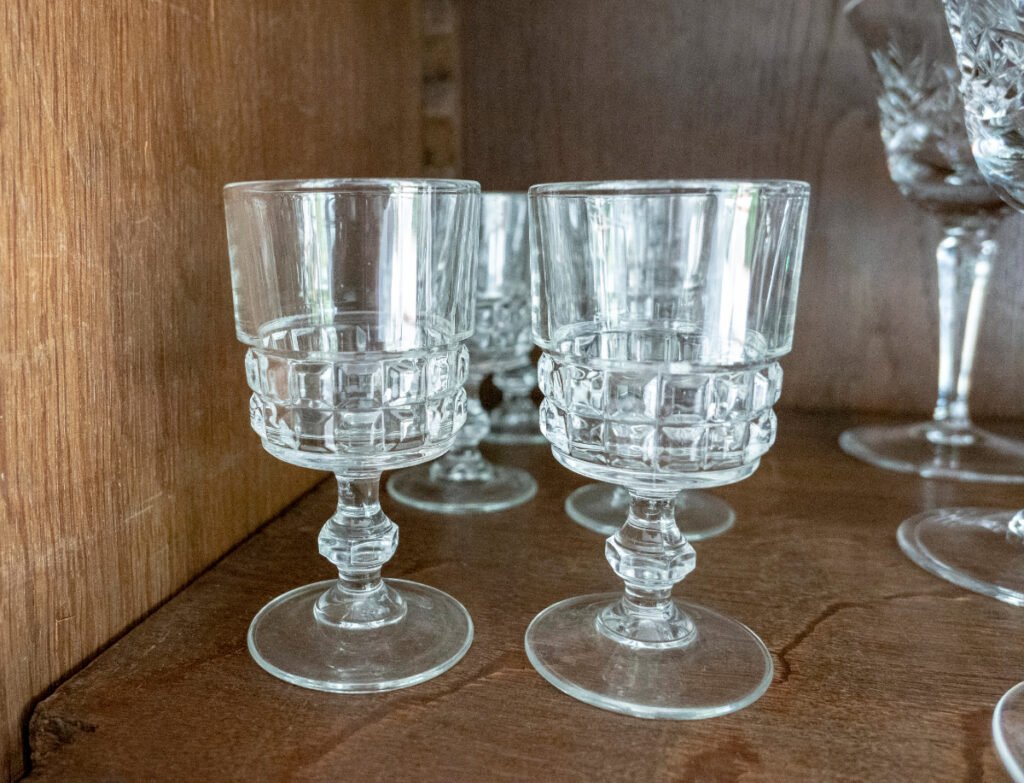
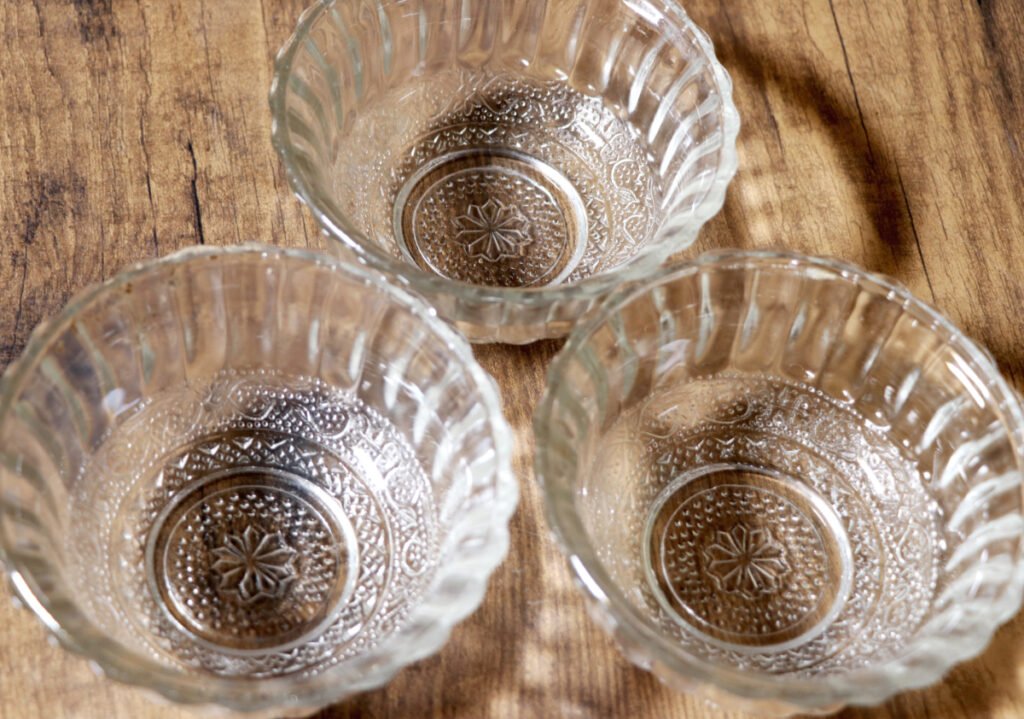
Identification of antique pressed glass comes down to four things. What is it made of (pressing)? What pattern is it? When was it made? And who made it? Let’s understand each step in vintage pressed glass patterns identification below.
Physical Signs of Pressed Glass
Before you worry about pattern or maker, confirm you’re actually looking at pressed glass. These are the key features:
- Repeating Perfection – The pattern repeats with mechanical precision. Compare two motifs on opposite sides; pressed glass matches exactly. Hand-cut pieces show small variations between repeats.
- Mold Seams – Look for faint vertical lines running up the body, through handles, or across the foot. They’re easiest to see under raking light at an angle. Most pressed pieces have two or three seams.
- Sharp-Then-Soft Details – Pressed designs are crisp where the mold cut deep, but edges and corners stay slightly rounded. They never feel knife-sharp.
- Stippled “Orange peel” Texture – Look in the recessed areas between the pattern elements. Early lacy glass especially shows a pebbly background of tiny dots that hide surface flaws.
- No Pontil Mark – Pressed glass doesn’t have a rough scar on the base like hand-blown glass. The base is flat, often with mold rings or a mold number.
- Uniform Thickness. Pressed glass walls are pretty consistent in thickness throughout the piece. Hand-blown pieces vary, sometimes a lot.
Pressed Glass Pattern Identification
Thousands of pattern names exist, and many have more than one name, the most common being the name of the original designer and a nickname given to it by collectors many years later.
Take several photographs of your piece from various angles, starting at the base. Then match the design’s main element against a reference. Look for whether the central motif is geometric (diamonds, bars, blocks), floral (daisies, grapes), figural (faces, animals), or thumbprint-style.
You can use free resources like the Early American Pattern Glass Society, the Brunnier Art Museum’s online collection at Iowa State, and the Replacements site.
How to Date Pressed Glass?
The manufacturing period of pressed glass can generally be narrowed by looking at three things:
- The glass composition
- The pattern type
- The manufacturing process
Here’s how these help in dating:
- Flint glass (lead glass), used roughly 1820–1865, rings when tapped and feels notably heavy. Early Boston & Sandwich, Bakewell, and McKee pieces are flint.
- Non-flint soda-lime glass took over around 1865 when lead got expensive. It thuds when tapped and feels lighter. Most EAPG from 1865–1914 is non-flint.
- Stippled “lacy” backgrounds are from the 1830s–1850s.
- Frosted/acid-finished sections on Victorian patterns belong to the 1870s–1890s. The Centennial era loved this look (Westward Ho, Frosted Lion, Three Face).
- Bold opalescent and vaseline glass that glows green under UV = 1880s–1900s English and American.
- Depression-era patterns are from the 1920s to the 1940s. These are machine-made, often thin and translucent in pinks, greens, and ambers.
- Heavy “cut crystal look” pressed glass in patterns like Wexford comes from the 1960s onward.
Wear patterns also help. Genuine 19th-century pieces show fine random scratches on the base from a century of use. Reproductions often have suspiciously clean bases or wear that looks deliberately added in a uniform pattern.
Identifying Maker’s Marks & Signatures
Most antique pressed glass is completely unmarked, so attribution usually comes from the pattern, not a signature. Don’t expect a tidy logo on the base.
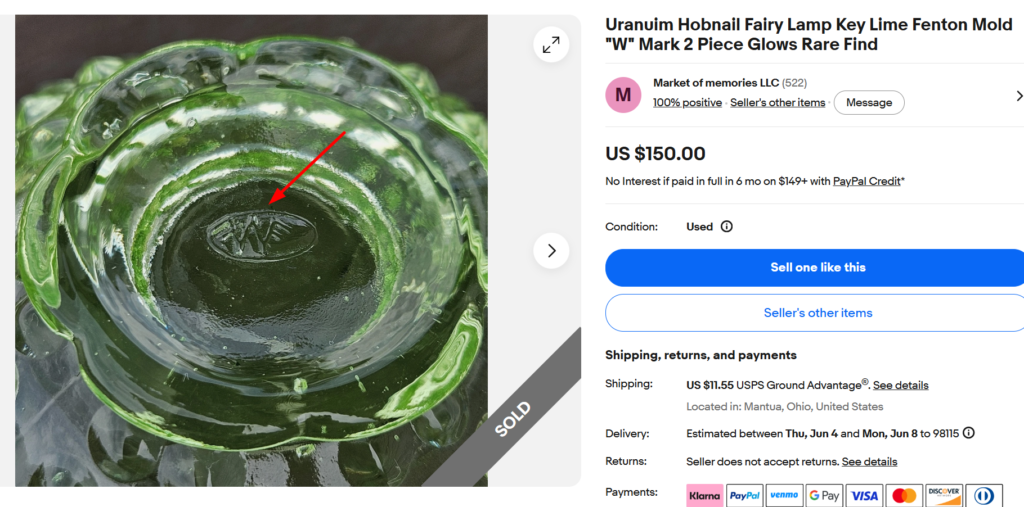
But when marks do exist, they help a lot. Westmoreland used a stacked WG from 1949, Imperial an IG, Fenton an oval logo from 1970, and Anchor Hocking an anchor.
English makers are friendlier. Sowerby stamped a tiny peacock-head trademark, and Davidson pieces carry British registration numbers that pin down the date. Foil and paper labels fall off easily, so don’t rely on them.
Good to Know: Reproductions sometimes copy old marks, and heavily faked patterns like Three Face need a blacklight test, not just a quick look at the base.
Pressed Glass Colors and What They’re Worth
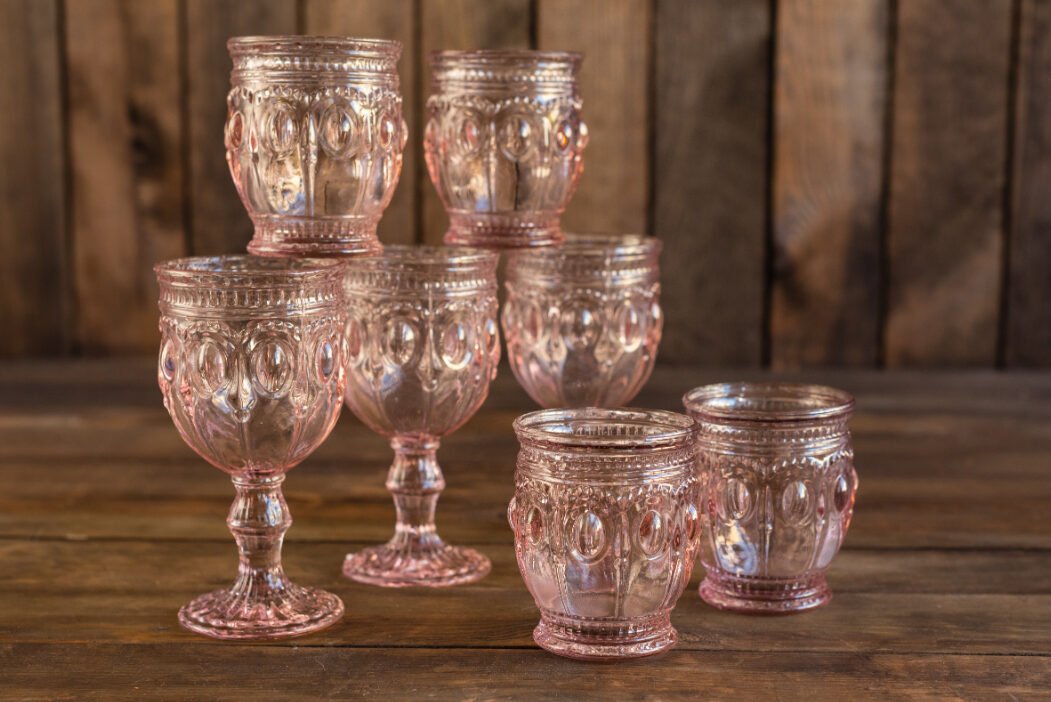
Color is one of the fastest value signals in pressed glass. Here’s roughly how the main colors stack up.
- Milk glass, opalescent, and slag – Opalescent and marbled slag glass usually beats plain white milk glass.
- Clear / crystal – By far the most common, so it sits at the bottom for value unless the pattern itself is rare.
- Amber – Easy to find and affordable, though crisp examples in scarce forms still sell steadily.
- Blue and cobalt blue – Always popular. Cobalt blue pressed glass brings strong money, especially in bowls and serving pieces.
- Green and apple green – Collectors love it. A good green pressed glass bowl will outsell the same form in clear glass.
- Canary/vaseline – Uranium-tinted yellow that glows green under UV. That glow makes it an instant buy for many collectors.
- Amethyst/purple – Genuinely scarce in old pressed glass and priced accordingly. Don’t confuse it with cheap sun-purpled clear glass.
- Ruby red – A premium color across most patterns, often two to three times a common shade.
- Chocolate/caramel slag – An Indiana Tumbler & Goblet (Greentown) and McKee specialty. Genuine pieces sell for $150–$700+, with St. Clair and Imperial reproductions much lower.
14 Valuable Antique Vintage Pressed Glass Pieces (Makers & Patterns)
Let’s take a look at some of the most notable antique and vintage pressed glass patterns and shapes from renowned makers that routinely show up at estate sales and fetch reasonable prices.
1. Fenton Hobnail – Epergne (1939 onward)
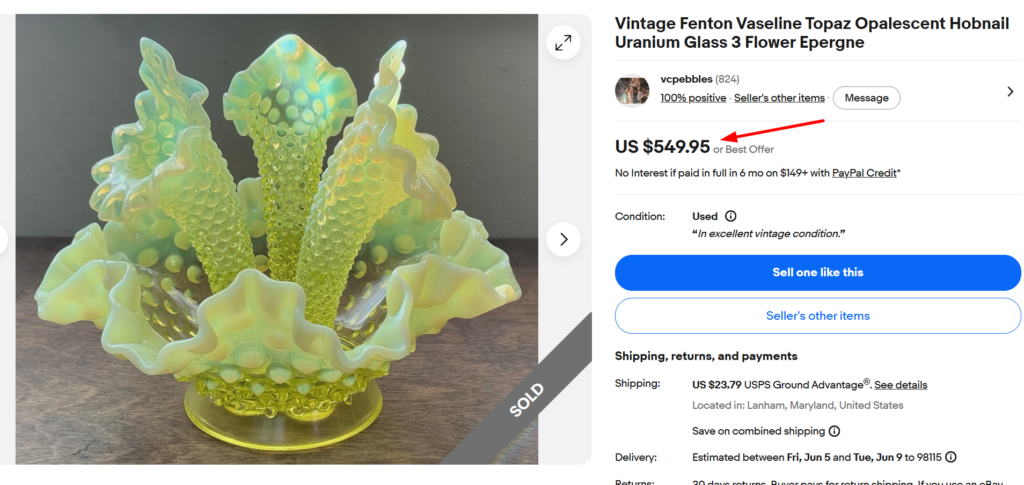
Sold for $550
Hobnail is Fenton’s signature pattern and the company’s biggest commercial hit. It is pressed glass covered in raised, uniform domed bumps in a precise hexagonal grid.
Fenton introduced it in opalescent colors in 1939, expanded into milk glass in 1952, and produced it until closing in 2007. Cranberry, topaz, and plum opalescent are the highest-selling variants.
Note that pieces with the Fenton oval logo date to 1970 or later; earlier production was unmarked.
- Estimated Value: $25 – $600+
- Production Years: c. 1939–2007
- What to Check: Fenton oval mark, rare colors
- Quick Notes: Cranberry, Topaz, plum opalescent command top dollar.
2. Hobbs, Brockunier & Co. Daisy and Button – Dish (1880s)
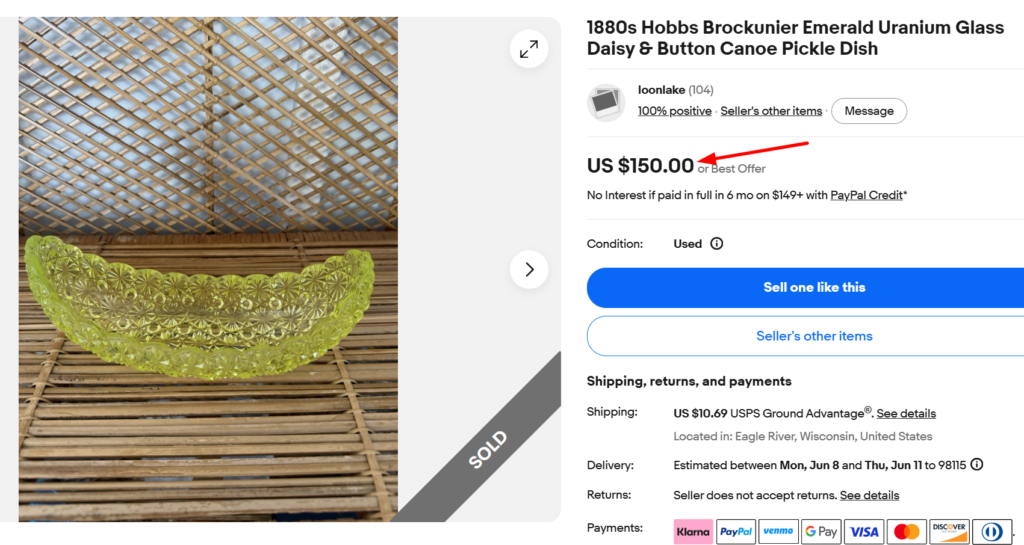
Sold for $150
Hobbs, Brockunier & Co. called this “Pattern No. 101” and made it in clear, amber, blue, canary vaseline, amberina, and rare green. Cobalt blue and amber examples are the rarest and the most valuable.
The easiest age check is the bottom scallop size. Original examples have small scallops just over 1/8″ deep, while L.G. Wright and other reproductions have scallops more than twice that size. Amberina is the most-faked variant.
- Estimated Value: $40 – $400
- Production Years: c. 1884–1891
- What to Check: Bottom scallop size
- Quick Notes: Amberina and cobalt sell for the most.
3. Anchor Hocking Wexford – Dinner Set (1967–98)
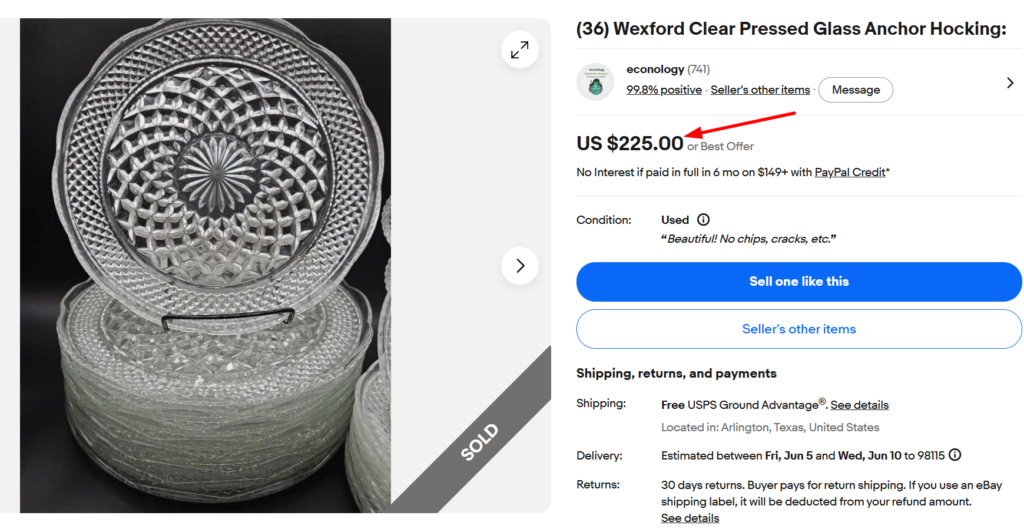
Sold for $225 (set of 36 pieces)
Wexford is the bridge piece for newer collectors. Anchor Hocking introduced the Wexford waffle pattern in 1967 and discontinued it in 1998 in various color combinations, including clear, ruby, blue, smoky, and gold bands.
This design is an elaborate diamond-cut lattice, with smaller diamonds at the top and bigger diamonds below.
Also, note that Wexford is rarely marked, so identification relies on pattern recognition alone.
- Estimated Value: $20 – $150 (200+ for large sets)
- Production Years: c. 1967–1998
- What to Check: Diamond lattice precision
- Quick Notes: Mostly unmarked, recognized by pattern
4. Atterbury & Co. – Pressed Glass Oil Lamp (1860s–1880s)
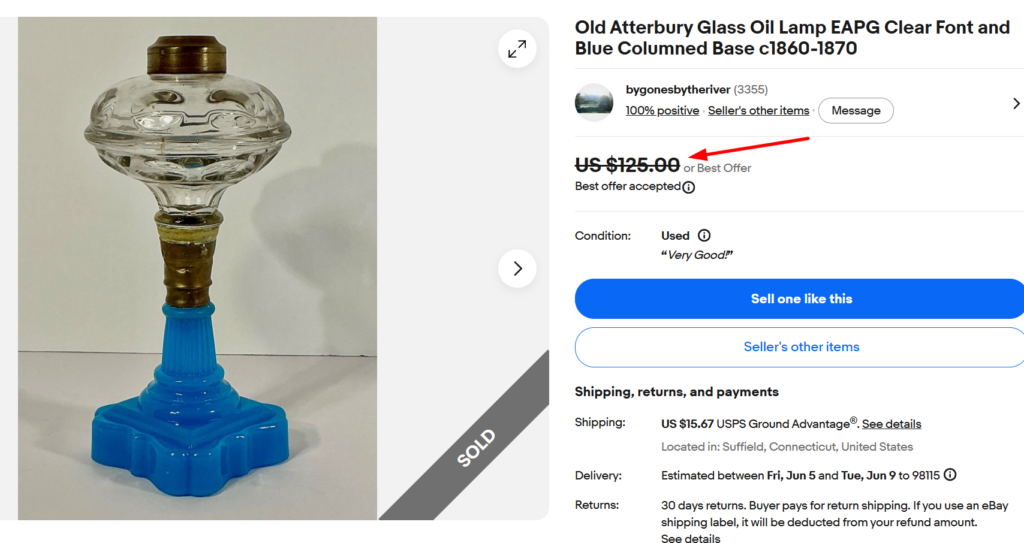
Sold for $125
Atterbury & Co. of Pittsburgh was one of the most prolific oil lamp makers of the kerosene era. Their two-part lamps combined a clear pressed glass font with an opaque colored base, most often in blue, amber, or clambroth white.
The brass connector and original burner add real value. Atterbury patterns like Heart and Star have been heavily reproduced, so check mold sharpness and base color depth.
- Estimated Value: $80 – $300
- Production Years: c. 1860–1890
- What to Check: Original burner, brass connector
- Quick Notes: Colored bases are worth more than clear ones.
5. Davidson Pearline – Jug & Sugar Set (c.1889 onward)
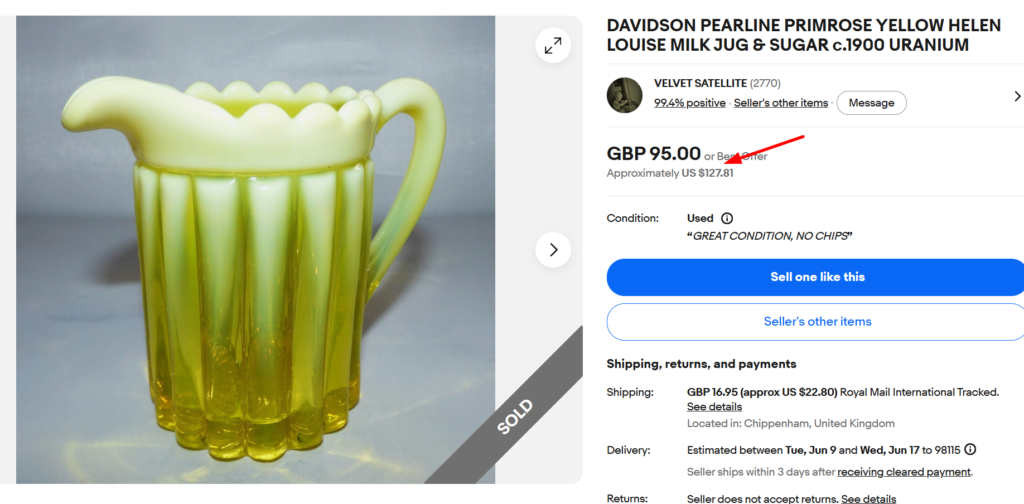
Sold for $125 (pair)
The most famous English pressed glass innovation of the Victorian era. Patented by George Davidson & Co. in 1889, Pearline fades from a colored body (blue, yellow, or clear) to an opaque white opalescent rim.
The yellow “Primrose” version is uranium glass and fluoresces bright green under UV. Davidson marked most pieces with a British registration number on the base. Sowerby made similar opalescent pressed glass during this era.
- Estimated Value: $80 – $400
- Production Years: c. 1889–1914
- What to Check: UV reactivity, base number
- Quick Notes: Primrose yellow glows green under UV
6. Boston & Sandwich Glass – Open Salt (c.1825–1850)
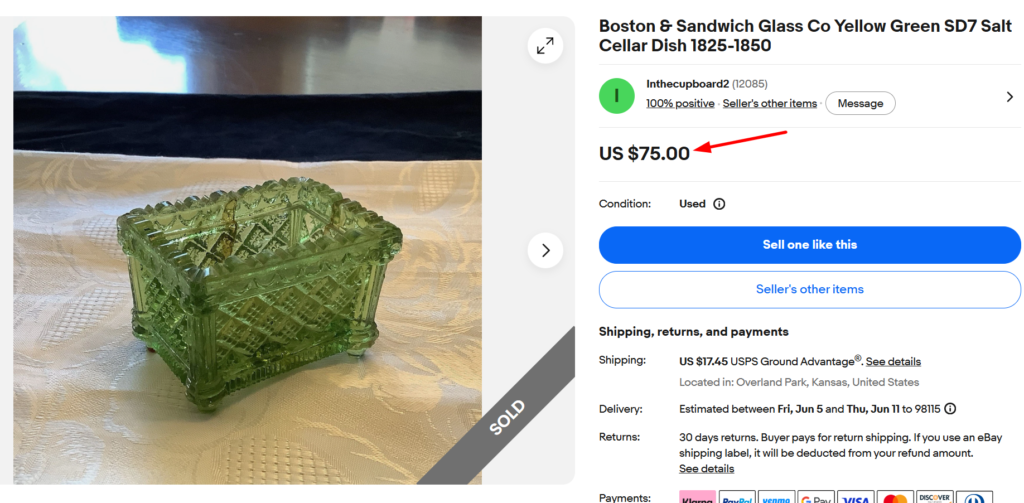
Sold for $75
Open salts were among the first things American factories ever pressed, back when salt was a luxury worth showing off on the table. This one is the SD7 shape from Boston & Sandwich.
Lacy examples from about 1825 to 1850 carry an all-over stippled design on boat, basket, or gothic shapes.
The Boston & Sandwich Company made the famous riverboat salt, the only piece the company ever marked with its name. Colored or marked examples can clear $200 today.
- Estimated Value: $40 – $250
- Production Years: c.1825–1850
- What to Check: Stippled background, documented shapes
- Quick Notes: Colored examples are far rarer
7. Imperial Glass Cape Cod – Decanter (1932)
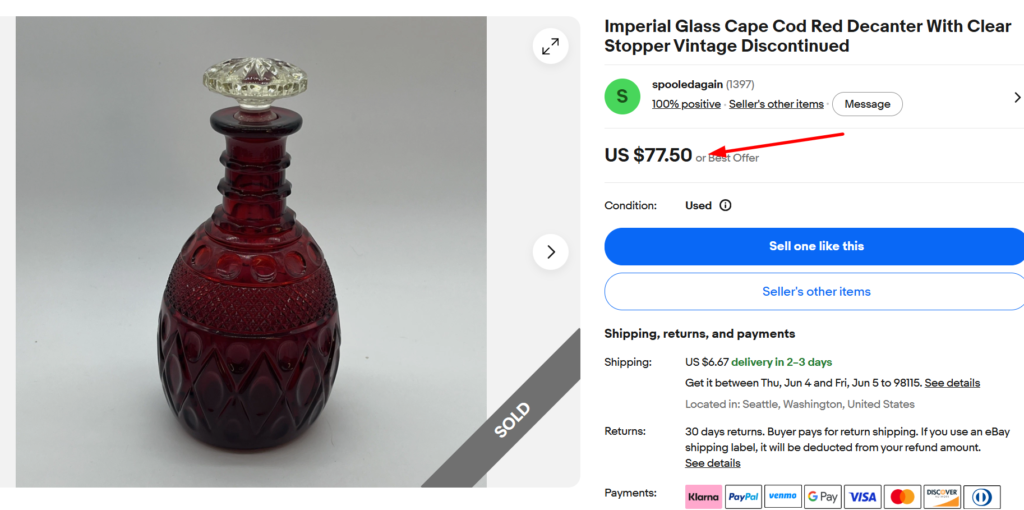
Sold for $77 (with Stopper)
Imperial introduced Cape Cod in 1932 as a Mother’s Oats premium and kept it in production until the company closed in 1984. The pattern features a band of small impressed circles and diamonds around each piece.
Ruby red and amber Cape Cod pieces were only made from 1932 to 1936, making them the most-hunted variants. Crystal pieces from any year are common. Also, look for the “IG” intertwined mark to spot post-1940s pieces.
- Estimated Value: $40 – $250
- Production Years: c. 1932–1984 (ruby 1932–36)
- What to Check: Impressed circles and diamonds, “IG” mark, color rarity
- Quick Notes: Ruby red pieces are the most desirable.
8. Gillinder & Sons, Westward Ho – Butter Dish (1879)
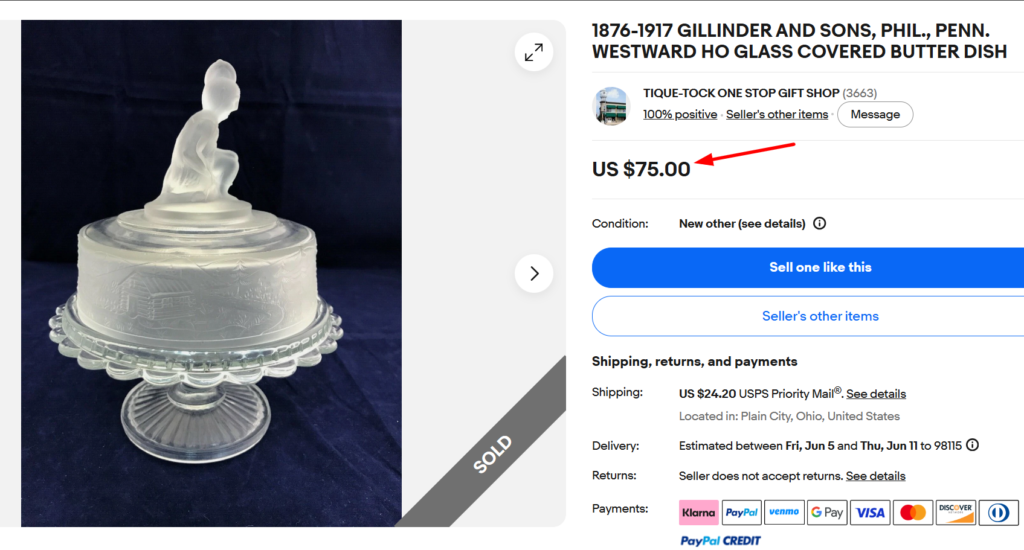
Sold for $75
A Centennial-era icon featuring frosted relief panels of charging buffalo, leaping deer, and a settler’s log cabin. Originally advertised as “Pioneer,” the pattern was soon renamed Westward Ho.
Covered pieces have a kneeling Native American finial, a visual hook that makes it instantly recognizable.
Note that the original 1879 production was always clear glass with frosted figural elements. Any colored version is a 20th-century reproduction.
- Estimated Value: $150 – $700
- Production Years: c. 1878–1890
- What to Check: Frosted finish, clear body
- Quick Notes: Colored versions are reproductions.
9. Gillinder & Sons Frosted Lion – Compote (1876)
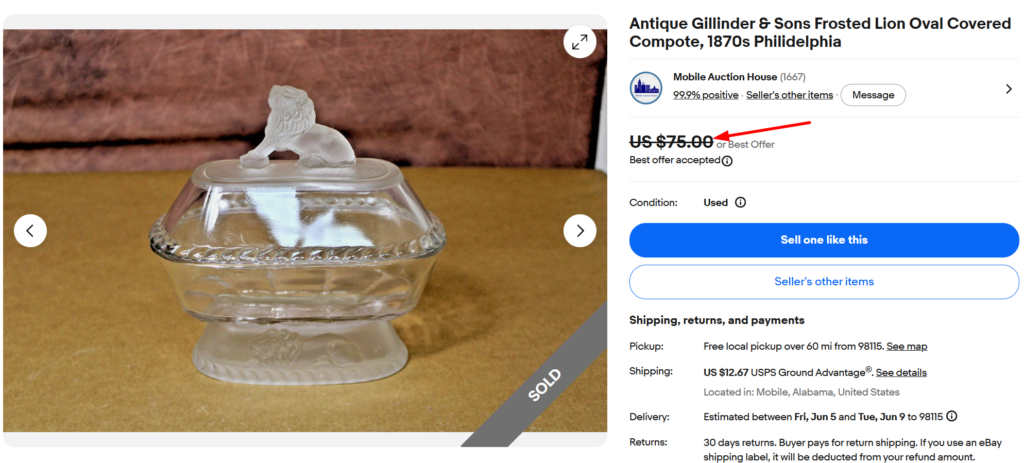
Sold for $75
Gillinder introduced this pattern at the 1876 Philadelphia Centennial Exhibition, where they ran a working glass factory inside the fairgrounds. The frosted lions appear in various poses, with crouched finials, lion-head stems, and reclining handles.
Original pieces contain lead and fluoresce blue under UV light. Reproduction lions look harsh and almost grotesque compared to the originals’ more pleasant expression. Examples with Intact frosted finials are worth premiums.
- Estimated Value: $80 – $600
- Production Years: c. 1876–1877
- What to Check: UV blue fluorescence, frost quality
- Quick Notes: Repros’ lion faces look harsh
10. George Duncan Three Face – Salt Shaker (1878)
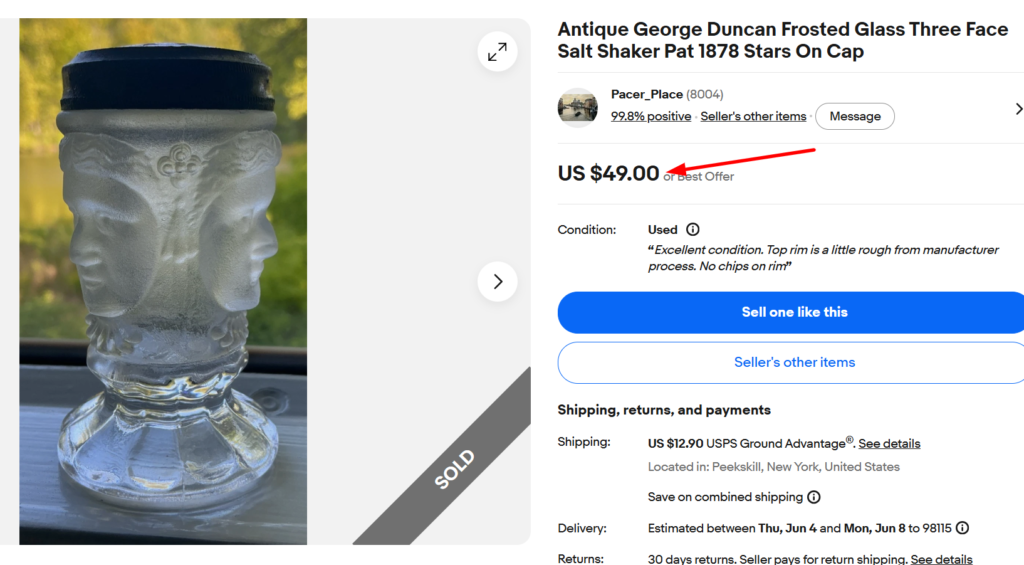
Sold for $50
This is the most-reproduced rare pattern in American pressed glass. The stem features three frosted women’s faces designed by John Ernest Miller in 1878, reportedly modeled on his wife, Elizabeth.
The original Duncan production ran until the 1892 factory fire destroyed the molds. Reproductions started in the 1930s and continue today.
The originals have an elongated neck (6.5″+ tall) and crisp facial detail, while repros are shorter with chalky frost and grayish glass.
- Estimated Value: $40 – $300 (original)
- Production Years: c. 1878–1892
- What to Check: Stem height, frost texture
- Quick Notes: Massively reproduced since the 1930s, so check authenticity.
11. Boston & Sandwich Bellflower – Salt (1840s–60s)
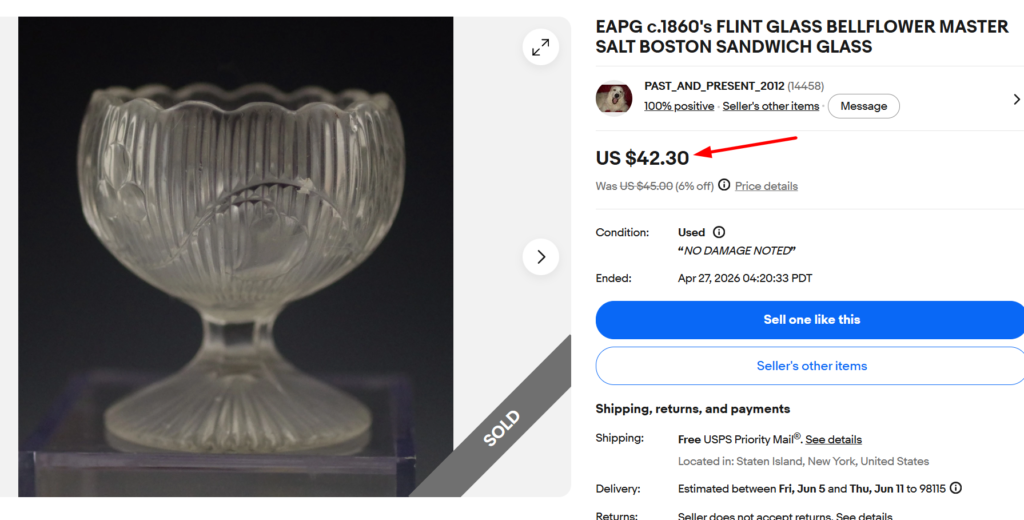
Sold for $42 (single)
A master salt is the larger central salt cellar that sits in the middle of a Victorian dinner table. This Boston & Sandwich version uses the same Bellflower pattern as the creamer, with vertical ribs and drooping flowers in flint glass.
Master salts are noticeably bigger than individual salts and often footed. The flint formula gives a bell-like ring when tapped.
- Estimated Value: $35 – $150
- Production Years: c. 1850s–1870s
- What to Check: Bell-like ring, rim chips
- Quick Notes: Master salts larger than individual salts.
12. Indiana Tumbler & Goblet Co. Dewey Amber Dish
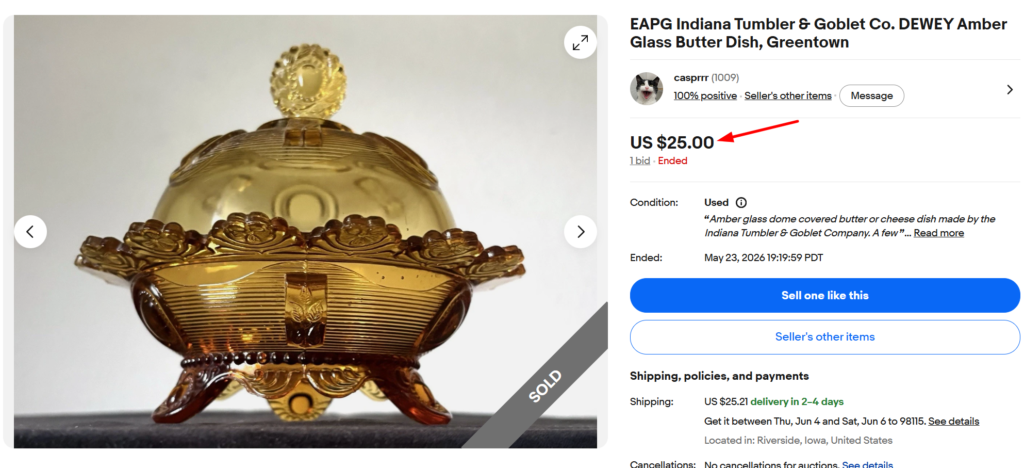
Sold for $25
Indiana Tumbler & Goblet introduced the Dewey pattern in 1898, named after Admiral George Dewey of Spanish-American War fame. The Greentown plant pressed Dewey in clear, amber, blue, canary, emerald green, and rare chocolate slag glass before the 1903 fire ended production.
The butter dish form has been reproduced, so check the mold sharpness and color depth. Chocolate glass examples command the strongest prices.
- Estimated Value: $25 – $200 (chocolate higher)
- Production Years: c. 1898–1903
- What to Check: Mold sharpness, color depth
- Quick Notes: The butter dish has been reproduced.
13. Westmoreland Paneled Grape – Punch Bowl (1940s–80s)
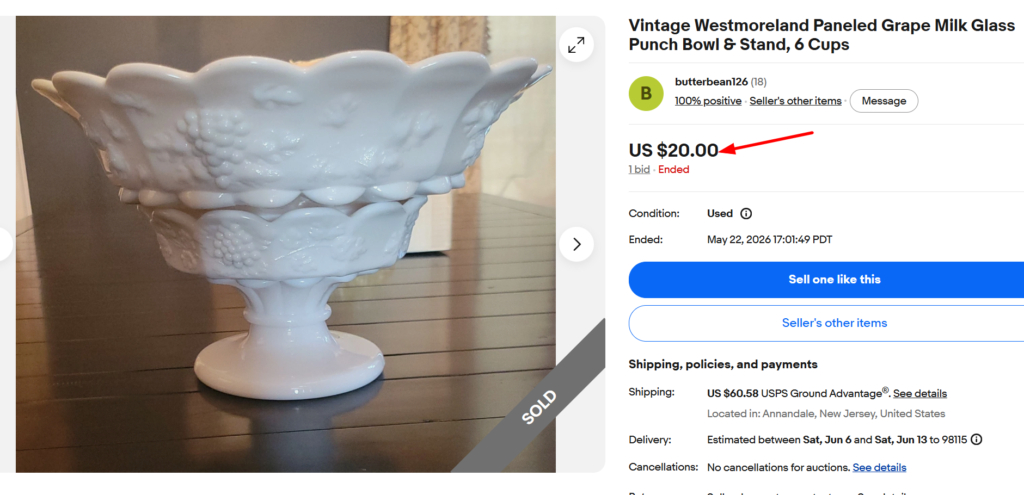
Sold for $20
Paneled Grape is Westmoreland’s most-collected pattern, made in heavy white milk glass from 1940 until the factory closed in 1984. The design features raised grape clusters with leaves and vines on vertical paneled bodies.
Full punch sets with the original stand and twelve cups regularly clear into the hundreds. Look for the “WG” stacked mark on post-1949 pieces, and pay close attention to spot Indiana Tiara reproductions from the 1970s.
- Estimated Value: $150 – $500 (full sets)
- Production Years: c. 1940–1984
- What to Check: “WG” mark, milk glass weight
- Quick Notes: Tiara repros are lighter than originals.
14. McKee Brothers Feather/Doric – Pitcher (1896–1905)
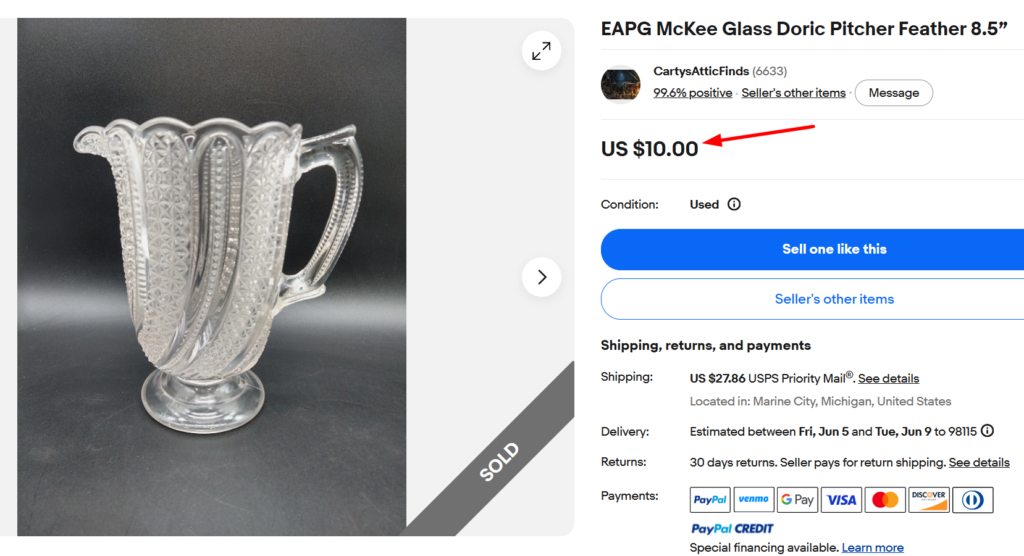
Sold for $10
McKee Brothers’ original mold name for this pattern was “Doric,” but collectors know it as Feather. The design is a bold radiating feather motif fanning from the base of each piece.
Look-alike patterns were made by Beatty-Brady and Cambridge, but McKee originals show sharper mold detail and a slightly heavier feel. Green examples sell for two to three times the price of clear.
- Estimated Value: $10-$80 (clear examples) $50–$200 (green examples)
- Production Years: c. 1896–1905
- What to Check: Mold sharpness, color variants
- Quick Notes: Green versions are premium-priced.
What Makes Antique Pressed Glass Valuable?
After working through identification, the next question is value. Why does one pressed glass piece sell for $20 and the next for $2,000? It comes down to a handful of factors that stack on top of each other:
- Rarity of the Pattern – Short production runs are the biggest single value driver. Holly Amber’s five-month run is the extreme example. Patterns made for only a few years (Westward Ho, Frosted Lion, certain Cape Cod colors) command a serious premium.
- The Maker – Identified pieces from prestigious factories, like Boston & Sandwich, Bakewell, Gillinder, Hobbs Brockunier, and Fenton, sell for more than unidentified pieces. Confirmed maker attribution through marks or documented patterns adds real money.
- Color – Within almost any pattern, clear pieces are the cheapest, and rare colors are worth multiples. Cobalt blue, cranberry, vaseline (uranium), amberina, and chocolate slag all command big premiums. Color rarity often matters more than form rarity.
- Form Scarcity – Common forms (tumblers, plates, small bowls) are cheap. Rare forms (covered cheese dishes, water sets, punch bowls with all their cups, oil lamps) sell for much more, even in common patterns. A complete punch set is worth way more than the bowl plus random cups.
- Condition – Chips, cracks, repairs, and worn frost reduce value dramatically. A 30% discount for a small rim flake is typical. Significant damage can drop a $400 piece to $100. Worn frost on a Three Face goblet or Frosted Lion bowl knocks the value down hard.
- Completeness – Original lids, stoppers, finials, and matching pieces multiply value. A covered butter dish with its original cover is worth two to three times the dish alone. A goblet set of six is worth more per piece than six individual goblets.
- Provenance & Authenticity – Documented original ownership, the right glass formula (flint vs non-flint), correct mold details, and verified maker all matter. A piece confirmed authentic against a reproduction can be worth five to ten times more.
- UV Reactivity – Vaseline and uranium glass pieces that fluoresce green under blacklight sell instantly to a dedicated collector base willing to pay premiums for the right glow.
To summarize, vintage pressed glass identification comes down to four moves. Confirm it’s pressed, match the pattern using EAPG resources, date it by glass formula and pattern, and identify the maker. Doing so, you can tell whether you have a valuable antique pressed glassware or reproductions.