

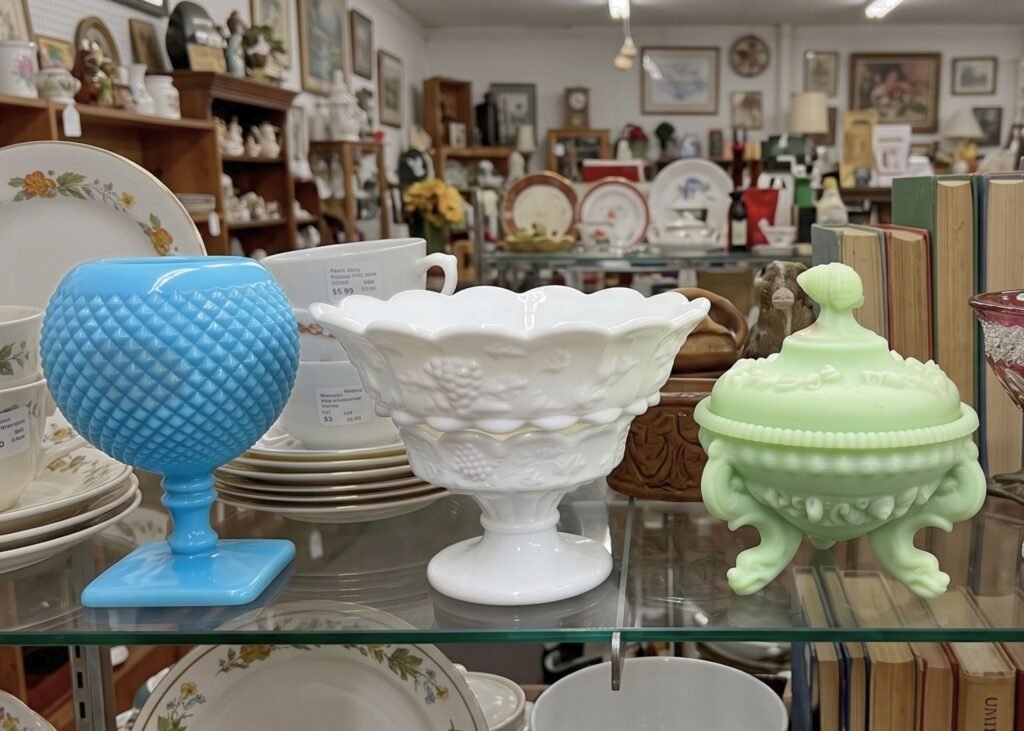
An old, heavy white milk glass bowl with a small “WG” pressed into the base could be a $15 flea market find or a $300 collector’s piece. Westmoreland glass has a wide value range, and most people have no idea which pieces are worth the money.
The Westmoreland Glass Company ran out of Grapeville, Pennsylvania, from 1889 until it closed on January 1, 1984, and for most of that time, it was one of America’s finest milk glass makers. More than 40 years later, the original pieces are now collectible.
This guide walks you through how to spot the real Westmoreland glass, which patterns and colors actually matter, and what determines their value.
How Much Is Westmoreland Glass Worth?
Most Westmoreland glass sells for $5 to $30 per piece on eBay. Common Paneled Grape, Beaded Edge, and English Hobnail pieces are plentiful. But the value can quickly go up to $100 to $500+ for the right features.
Here are the four features that matter the most:
- Color rarity – A green or cobalt English Hobnail vase is usually worth much more than the same piece in clear.
- Pattern – Short-run patterns, and the well-known patterns collectors build sets around, usually sell for more.
- Completeness – A pitcher without its tumblers, or a punch bowl without cups, loses much of its value.
- Condition – Chips, cracks, and stains wear off prices quickly. Even a hairline crack can cut the price of a good piece sharply.
Based on these factors, you can value your vintage Westmoreland glass pieces using the following tiers:
- Common pieces: $5 to $30. Single milk glass plates, salt and pepper shakers, small candy dishes, and unmarked pieces.
- Mid-range collectibles: $40 to $150. Colored English Hobnail, complete Paneled Grape punch bowl sets, Old Quilt sets, hand-painted Beaded Edge plate sets, uranium pieces, and Mary Gregory plates.
- Higher-end and rare: $200 to $600+. Rare-color hen on nests, Della Robbia stained sets, verified Line 1940 lamps.
12 Westmoreland Glass Pieces Collectors Chase (With Sold Prices)
Below are the Westmoreland pieces collectors actively hunt these days, drawn from patterns Westmoreland is most famous for. Learn how to spot them and what they’re worth.
1. Hen on Nest Covered Dish in Cobalt Blue Slag
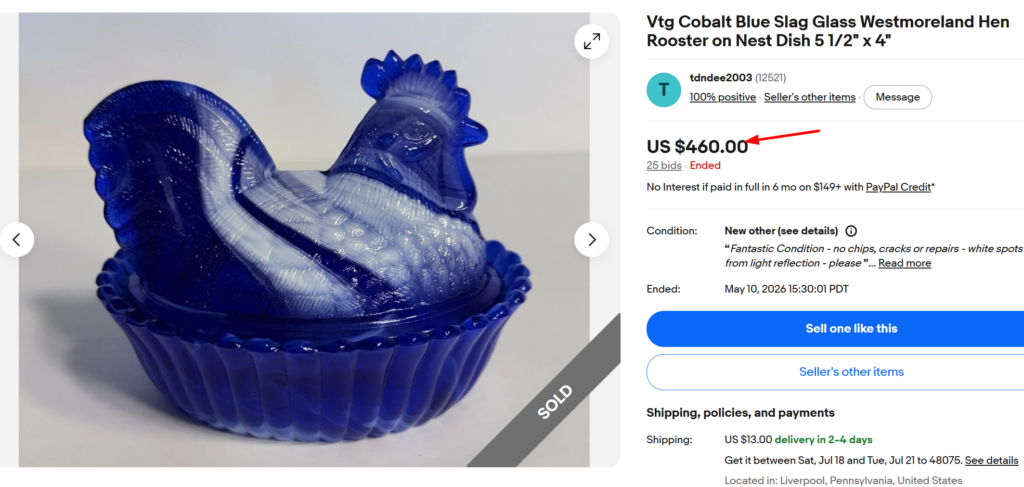
Covered hen dishes are among Westmoreland’s best-known pieces. And many makers like Indiana Glass and L.E. Smith made look-alikes, so the details matter.
The classic version is white milk glass with a red-painted comb and a basketweave base. But it’s the rare colors that collectors hunt. Cobalt blue, cranberry, uranium yellow, and marbled slag versions are all worth premiums.
To check the marking on a Westmoreland hen on nest, look for the WG logo inside the hen lid or on the nest base; many hens are marked on both. Many hens have no mark at all, and hens from molds reused after 1984 can carry it too.
- Estimated Value: $40 to $460 (colored versions; rare slag colors at the top)
- Production Years: Early 1900s to 1984 (milk glass peak 1940s to 1960s), colors vary
- What to Check: WG mark, basketweave base, comb style
2. Thousand Eye Fairy Lamp
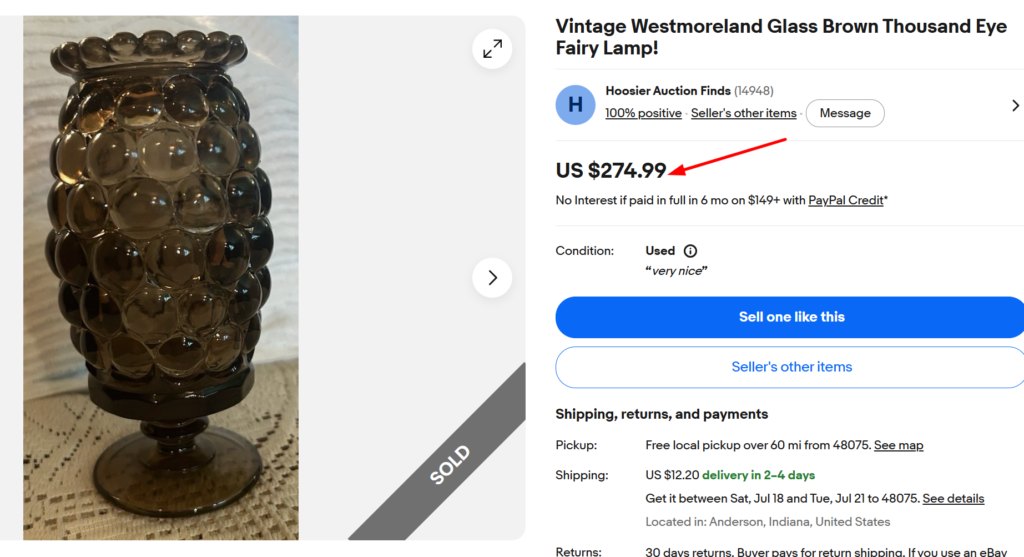
Westmoreland’s Thousand Eye pattern is a hobnail-style design with small, tightly packed dome-shaped bumps covering the surface. Fairy lamps, the two-piece lamps with a footed base and a matching domed shade, in this design, are quite desirable.
The smoky brown color is one of the hardest Thousand Eye colors to find. Most collectors are used to seeing this pattern in clear, milk glass, or ruby. Brown was a shorter production run, so it regularly sells for over $200.
- Estimated Value: $200 to $350
- Production Years: 1970s
- What to Check: Two-piece fit, dome hobs, base
3. Paneled Grape Milk Glass Punch Bowl Set
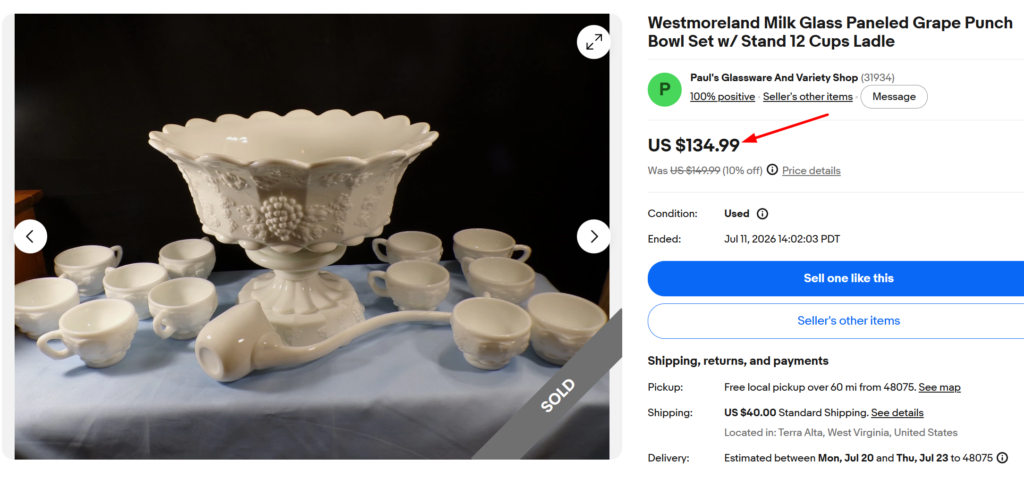
Paneled Grape is the pattern that made Westmoreland popular among milk glass collectors. It features raised clusters of round grapes with detailed leaves and vines in repeating panels. Over 100 different pieces were made in this pattern.
The punch bowl set is the most desirable one. A complete set has the pedestal bowl, matching cups with hooks, and the milk glass ladle.
- Estimated Value: $100 to $200 (complete sets)
- Production Years: 1946 to 1984
- What to Check: Cups, ladle, hooks, WG mark
4. Argonaut Shell Candy Dish in Green Satin
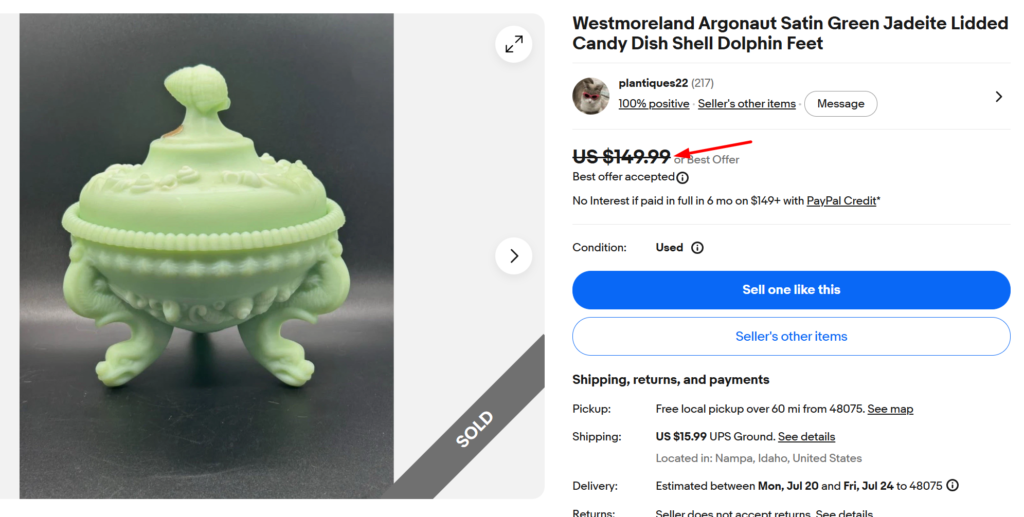
The Argonaut Shell copies an older French design with dolphins and shells from about 1908. You can identify it by the three dolphin feet base, a shell-shaped bowl with a rope-twist rim, and a shell finial on the top of the lid.
Most collectors find it in white milk glass. The satin green jadeite version is much less common and, hence, more valuable. The presence of the lid decides the value.
- Estimated Value: $100 to $200
- Production Years: Late 1950s to 1984
- What to Check: Dolphin feet, shell finial, satin finish
5. English Hobnail Blue Milk Glass Pedestal Vase
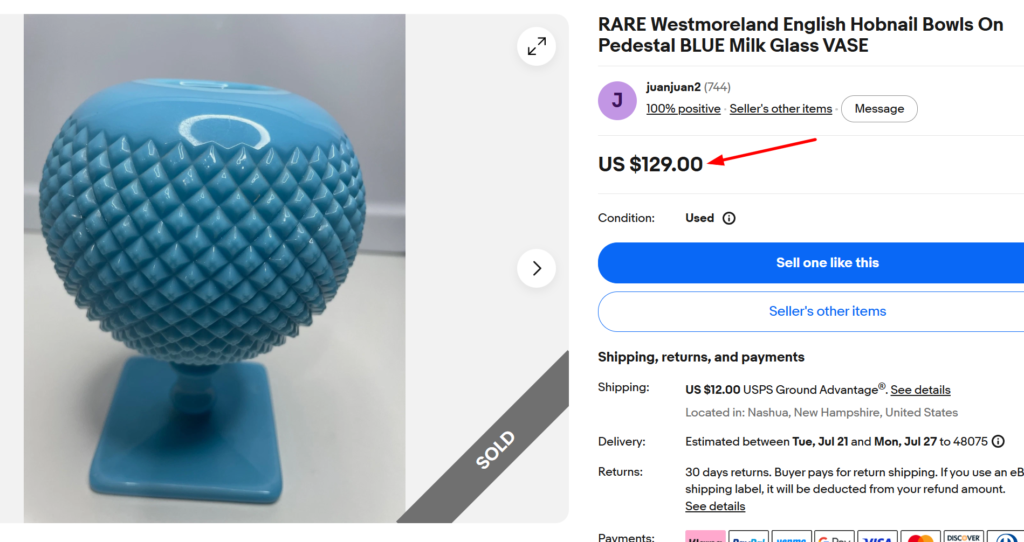
English Hobnail is one of Westmoreland’s longest-running patterns, dating back to the 1920s. The pattern shows a diamond grid of raised, faceted hobs, unlike the separate, pointed hobs on Fenton glass; that diamond shape is your quickest ID.
Most English Hobnail was made in clear or white milk glass. So the blue milk glass pieces are much harder to find.
- Estimated Value: $80 to $175
- Production Years: 1920s to the 1980s
- What to Check: Diamond grid hobs, square pedestal foot
6. Della Robbia Punch Bowl with Stained Fruit
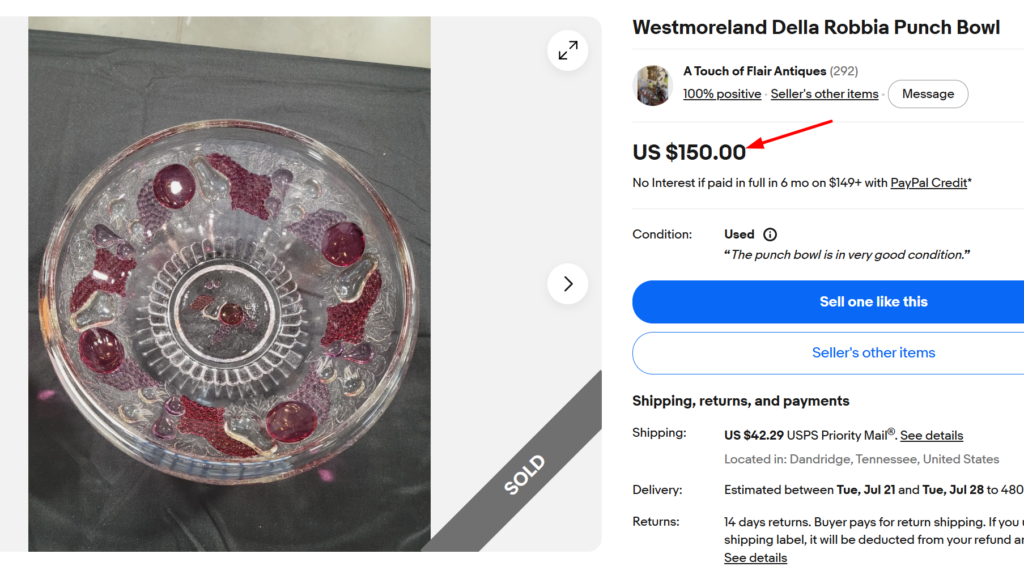
Della Robbia was introduced in the late 1920s and made for decades after, and it is a Westmoreland pattern that flies a little under the radar. The design shows a wreath of molded fruit and leaves around the bowl.
Collectors love the versions where each fruit was hand-stained in different colors, like red, purple, marigold, and green. Plain crystal Della Robbia is generally affordable.
- Estimated Value: $75 to $250
- Production Years: Late 1920s to the early 1980s
- What to Check: Fruit wreath, colored staining, wear
7. Bramble (Maple Leaf) Milk Glass Basket
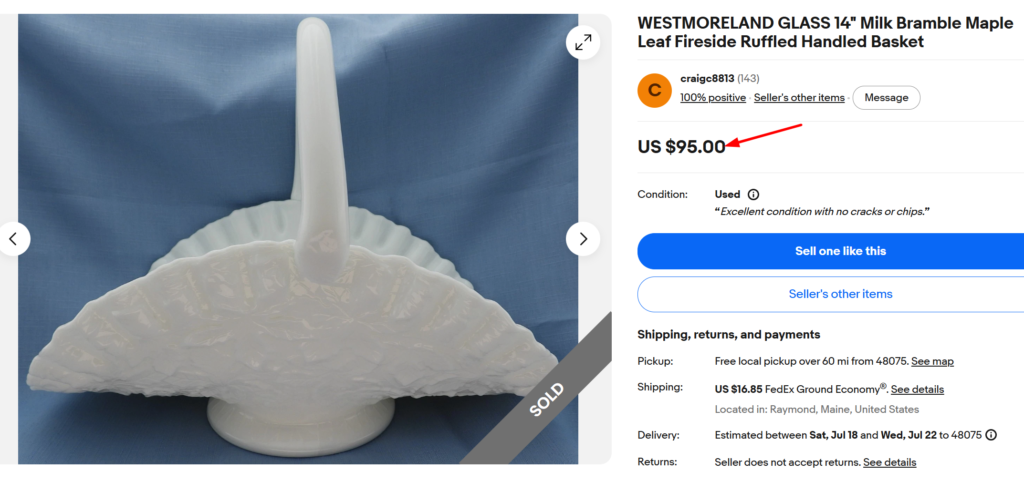
Bramble, also called Maple Leaf, is a Westmoreland milk glass pattern with molded maple leaf and vine details wrapping around the piece. It appears on creamers, sugars, plates, and larger showpieces like this 14-inch fireside basket.
Collectors chase the big handled baskets for two reasons: first, they were made in smaller numbers than the tabletop pieces. Second, the tall arched handle is fragile. So an intact example, without chips or cracks, is a rare find.
- Estimated Value: $75 to $150
- Production Years: Started in the 1920s; peak production: 1940s to 1970s
- What to Check: Ruffled rim, molded leaves, handle
8. Old Quilt Milk Glass Pitcher
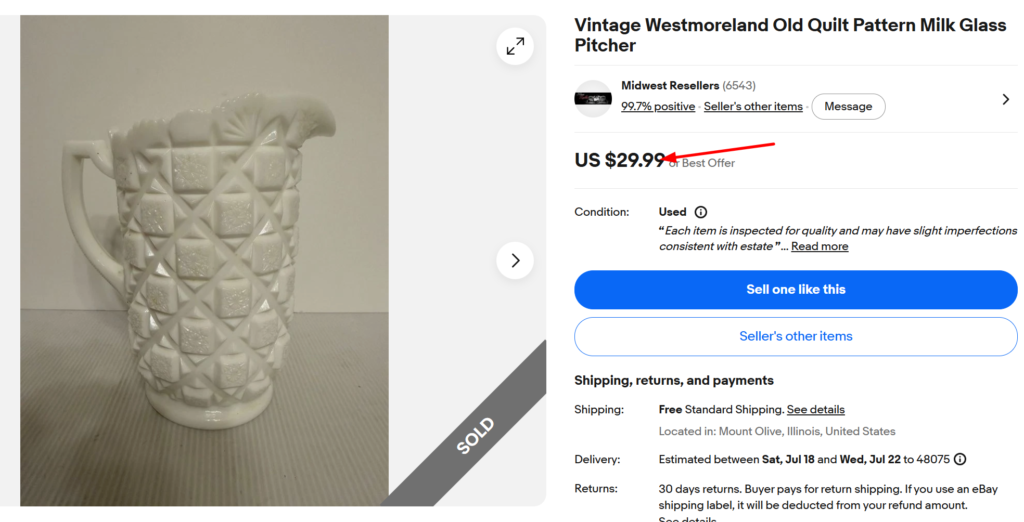
Old Quilt is Westmoreland’s pattern #500, an older design made in milk glass from about the 1940s until 1984. The design is a diamond-quilted texture that looks a bit like a woven blanket pressed into the glass. It came in milk glass, carnival, slag, and sometimes with hand-painted color accents.
Water sets are the most collectible pieces. A pitcher with all six matching tumblers is harder to find; single pitchers are quite common and affordable.
- Estimated Value: $25 to $40 (pitcher alone); $95 to $300 (pitcher & tumblers)
- Production Years: 1940s to 1984 (milk glass)
- What to Check: Diamond-quilted texture, matching tumblers
9. Waterford/Wakefield Ruby Stained Compote
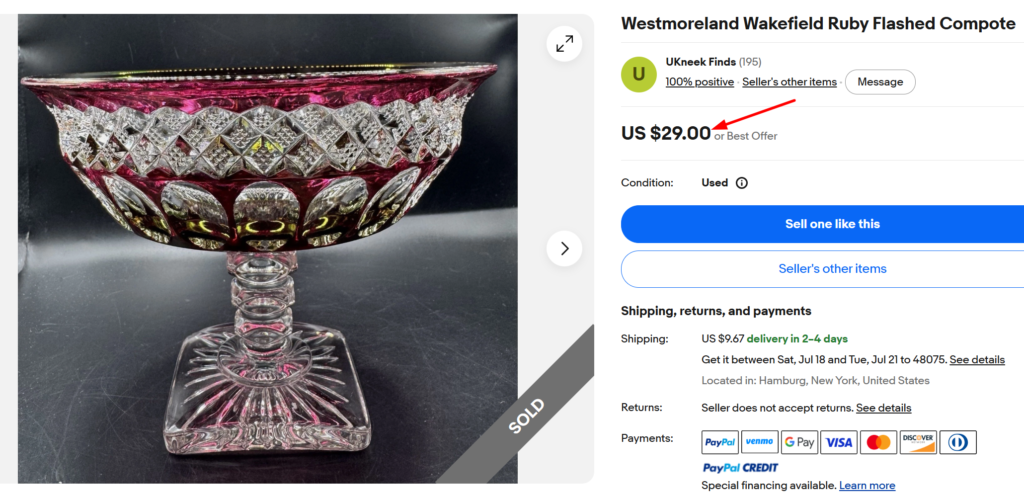
Waterford, also called Wakefield, is a pressed pattern with thumbprint bowls and a rayed base. Westmoreland made this pattern from the mid-1920s to the early 1980s, and ruby stain is its best-known finish.
Note that the ruby is not solid glass; it’s a thin red stain applied over clear pressed glass. And because it is a stain rather than a solid ruby, the color can wear off with heavy dishwasher use. So, an intact condition is the real value driver.
- Estimated Value: $25 to $100 (more for sets)
- Production Years: Mid-1920s to the early 1980s
- What to Check: Stain wear, thumbprint bowl, mark
10. Uranium Vaseline Glass Slipper
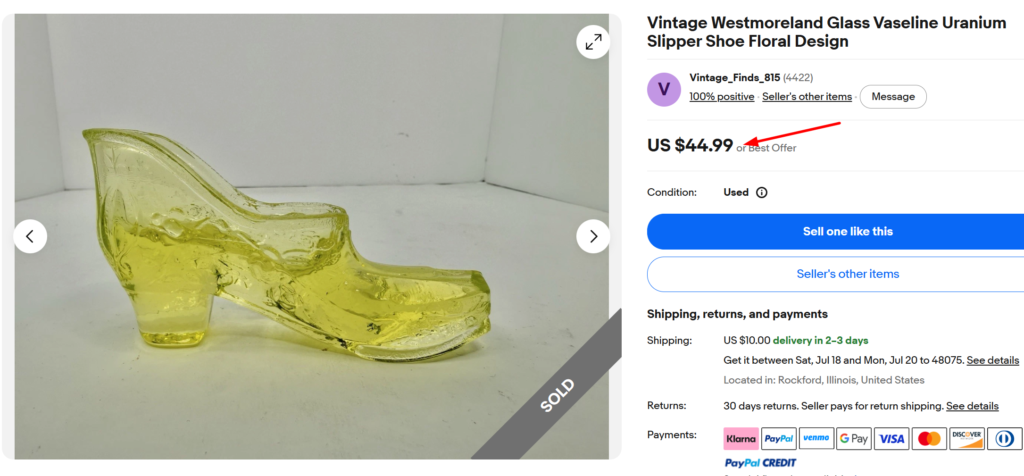
Westmoreland made pressed glass slippers and shoes, many in a Daisy and Button style, from the early 1900s onward. The uranium versions are the ones worth collecting. These have a distinctive yellow-green tint and glow bright green under blacklight.
Always look for a WG or keystone W mark on the base first, plus that glow test. Reproductions from Mosser and Rosso used old Westmoreland molds, so the mark alone is not enough. Also, the glow confirms uranium content, not age.
- Estimated Value: $40 to $120
- Production Years: Early 1900s onward (no US uranium glass 1942 to 1958)
- What to Check: UV glow, mold seams, mark
11. Westmoreland Owl Toothpick Holder
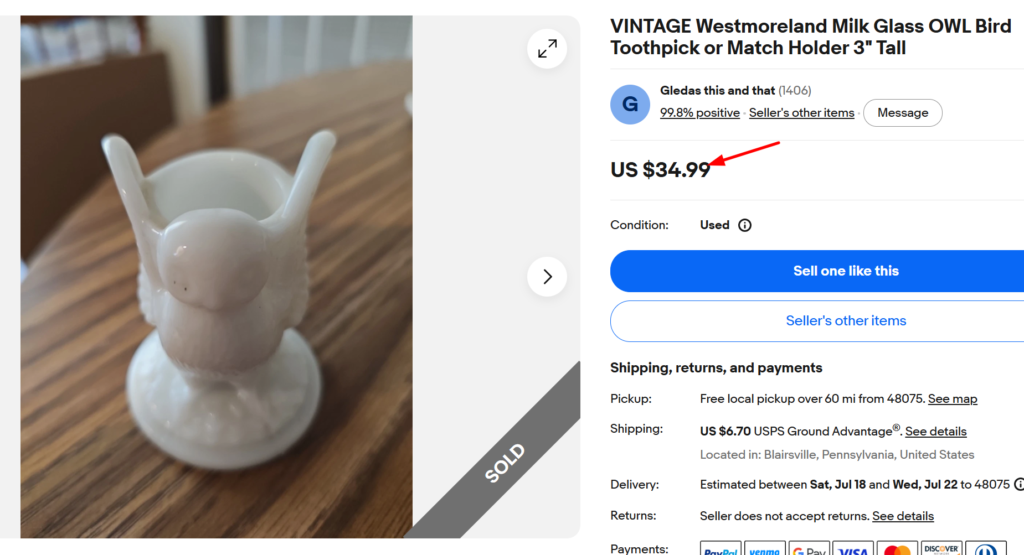
The little owl toothpick holder is a Westmoreland favorite, and they made it in a rainbow of colors from the 1970s onward, including milk glass, cobalt satin, purple slag, green, amber, and uranium. The owl sits on a round base.
Milk glass and clear versions are common and cheap. But the rare colors, especially purple slag and uranium, are the ones collectors chase. Original paper labels can up the value.
- Estimated Value: $20 to $95 (color-dependent)
- Production Years: Started in 1912, reissued in the 1940s–1980s
- What to Check: Color rarity, WG mark, glow
- Quick Notes: Purple slag is hardest to find
12. Beaded Edge Milk Glass Plate with Fruit
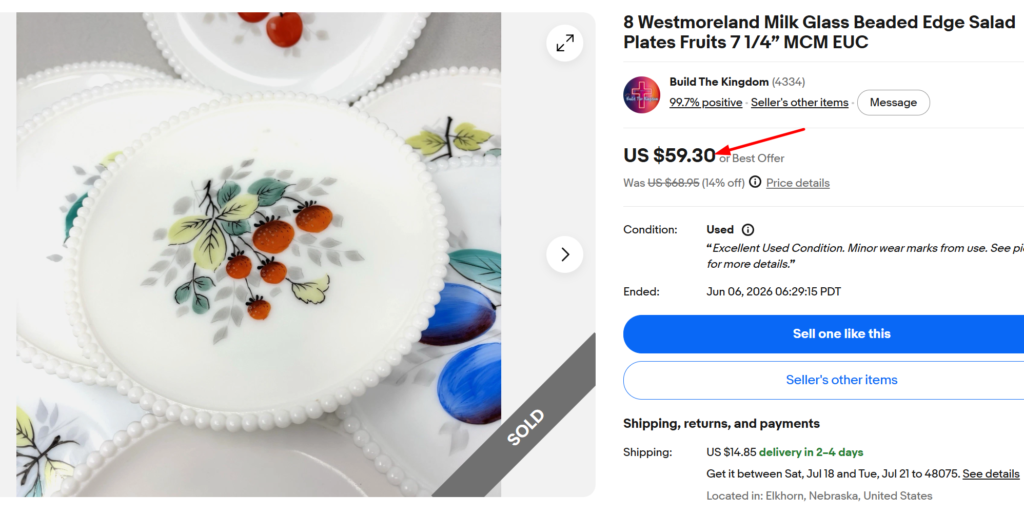
Beaded Edge is a simple pattern with a single row of small beads around the rim of plates and bowls. On its own, plain Beaded Edge is an affordable Westmoreland pattern. But the plates decorated with hand-painted fruit are more collectible.
Peaches, strawberries, cherries, and mixed fruit designs are common. Many plates were sold in mixed sets with a different fruit on each, like the set of 8 above.
- Estimated Value: $5 to $25 per plate; about $60 for a set of 8
- Production Years: 1940s to the early 1980s
- What to Check: Painted fruit in the center, bead ring, wear
Westmoreland Glass Marks: How to Identify Authentic Pieces
Knowing what’s valuable only helps if you know whether what you have is genuine. A lot of Westmoreland is unmarked, especially the earlier pieces, so identifying those pieces can be challenging. But the marked ones are easy to date.
The Keystone “W” Mark (1912 to 1946)
The first proper Westmoreland mark was a capital W inside a keystone shape. That keystone refers to Pennsylvania, which is known as the Keystone State. You will find this mark impressed into the base of pressed tableware and some early milk glass.
The National Westmoreland Glass Collectors’ Club dates it to 1912, and the WG mark replaced it on the tableware lines in 1946. It was not used on every piece, so an unmarked early piece is not automatically a fake.
The Intertwined “WG” Mark (1946 to 1984)
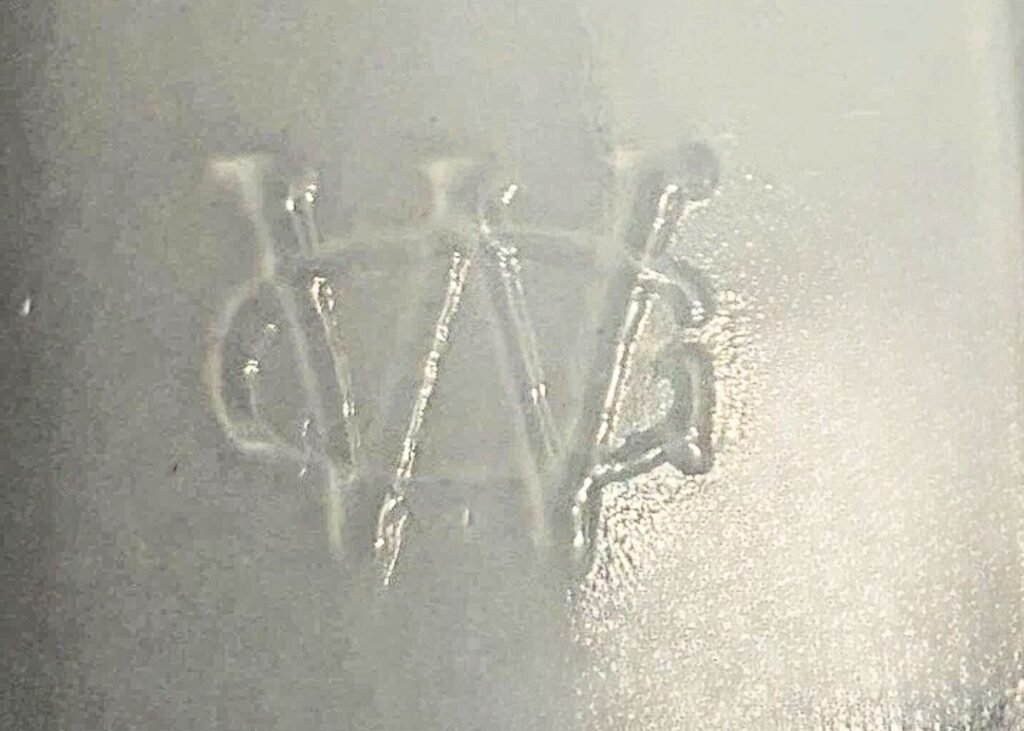
In 1946, Westmoreland switched to its most popular mark. It is a capital W overlapping a capital G, molded right into the base of the glass. If you see this mark, you are usually looking at a piece made between 1946 and 1984.
Run your fingertip across it. On authentic pieces, the WG feels slightly raised and clean. Some molds got tired over the years, so a faded or shallow WG is normal on later production. That is not a red flag by itself.
Paper Labels and the Grossman Mark
Westmoreland used paper labels from about 1906 onward, and they kept using them right up to the end. But since most labels on old pieces are long gone, they aren’t very useful.
But if you find one intact, that not only confirms authenticity, but it also adds to the value.
After St. Louis broker David Grossman bought the factory in the early 1980s, a new mark was added: the word “Westmoreland” in a semicircle above a “W”. Pieces with the Grossman mark are the newest and usually the least valuable. The mark was never removed from the molds, so it also turns up on later reproductions.
What to Do with Unmarked Pieces?
As I said earlier, a lot of Westmoreland has no mark at all. So how do you tell? The best way is to match the piece to a known pattern and check the glass quality.
Most Westmoreland patterns are unique, and the milk glass is dense, opaque, and has a distinct cold white tone. It feels heavy in the hand compared to newer reproductions.
So, if your piece is unmarked, but the pattern matches something Westmoreland made, and the glass has that cold, dense feel, you are probably safe calling it Westmoreland.
Reproduction molds exist, though. Companies like Plum, Rosso, and Mosser used Westmoreland molds after 1984, and some pieces still carry the old WG mark. Color and decoration are usually the giveaway in these later pieces.
Plum Glass, started in 1985 by former Westmoreland workers, marked its own glass with a “P” inside a keystone, so don’t mistake it for the early keystone W.
Common Westmoreland glass is affordable enough to start with, and the rare ones are still findable if you know what you are looking at. Start with the keystone W mark, the intertwined WG, and the specific patterns above to spot real collectibles.
Found this guide useful?
Save it for later
Share it with someone
Keep the old finds coming
New guides and finds worth looking for, delivered to your inbox.
Keep exploring
More guides in Vintage Glass
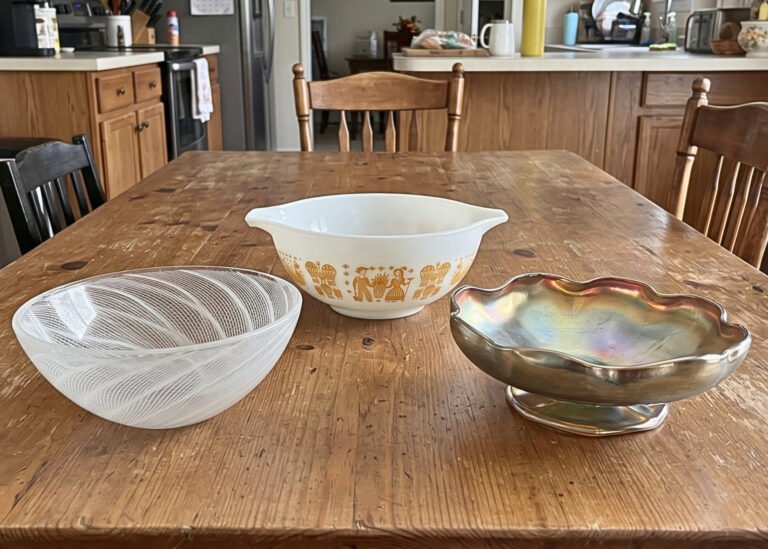 13 finds13 Old Glass Bowls Worth Money: Top Makers, Patterns & ValueTop sale $797
 11 findsOld Libbey Glassware: How to Spot Rare Vintage PiecesTop sale $595
 12 findsCollectible Red Glass: 12 Rare Vintage Pieces to Look For TodayTop sale $550
 9 finds9 Types of Vintage Tea Cups That Are Highly Collectible TodayTop sale $289