
Vintage tea sets are one of those quiet corners of the antiques world where a few dollars at the right yard sale can turn into a real find. The challenging part is knowing what you’re actually looking at.
This guide walks you through how to tell vintage from antique, how to read maker’s marks, what really drives value, and rare tea sets worth money so you can spot similar pieces yourself.
Is the Tea Set Antique or Vintage?
People use the two words around like they mean the same thing, but they don’t. Vintage sets generally refer to anything between 20 and 99 years old. Antique is a stricter club, reserved for pieces that are at least 100 years old.
So a 1960s Royal Albert set is vintage. A 1910 Nippon set is an antique. Both can be valuable, but antique sets usually pull higher prices.
How to Identify an Old Tea Set? 5 Simple Steps
Identifying a vintage tea set isn’t guesswork. Every piece leaves clues, and once you know what to look at, the process gets fast. Pick the cup up first, and check the following details:
1. Read the Maker’s Mark on the Base
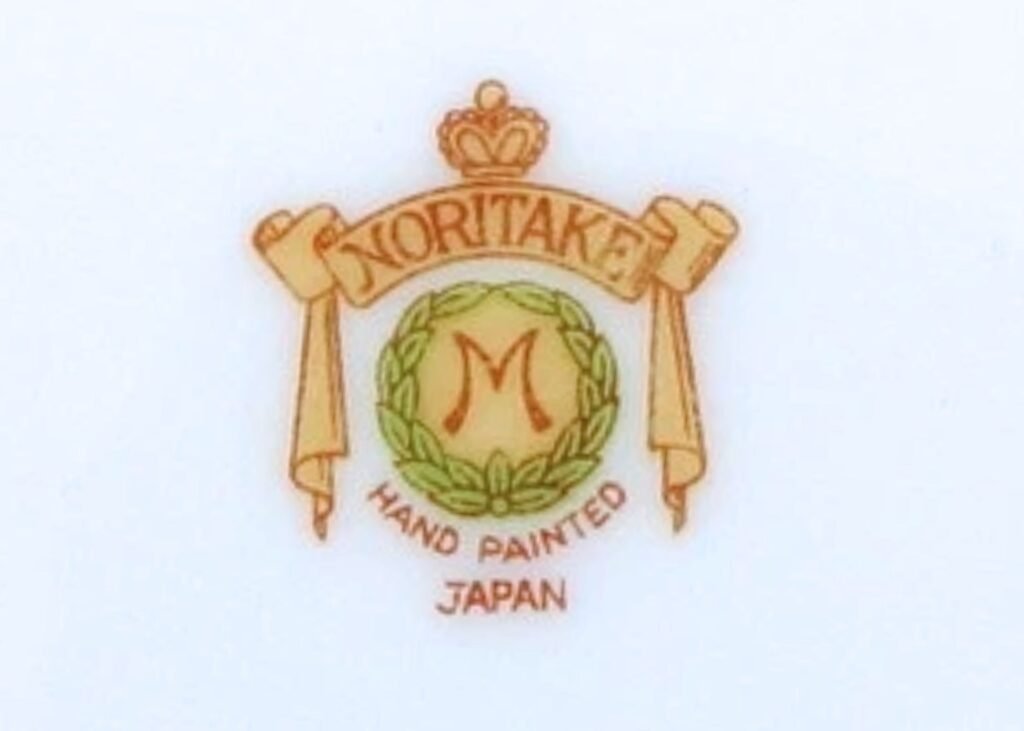
The backstamp, which is the printed or stamped mark fired onto the base, is where dating gets precise. A backstamp usually shows the maker’s name or symbol, a country of origin, and sometimes a pattern name or number.
ID Note: Vintage marks tend to be under the glaze, while modern reproductions often sit on top of it. Run your fingertip across the mark. If it feels smooth and glassy, it’s under the glaze. If it feels raised or slightly rough, be careful.
Here are the marks you’ll run into most often, and what they tell you:
- Noritake M-in-Wreath (Japan) – A capital M inside a laurel wreath, standing for the Morimura family. Used from around 1911 into the 1940s. If it’s paired with “Hand Painted Nippon,” the piece dates before 1921.
- Meissen crossed swords (Germany) – Two blue crossed swords painted under the glaze, in continuous use since 1722. Check that the swords sit under the glaze rather than being printed on top.
- English silver hallmarks – Four small stamps in a row on the underside. A lion passant means sterling, and a crown (Sheffield), anchor (Birmingham), or leopard’s head (London) tells you the city. A single date letter pins the year exactly.
- Gorham lion-anchor-G (USA) – A lion, an anchor, and a script G stamped side by side, followed by “STERLING.” This trio confirms Gorham sterling silver every time.
- Royal Albert bone china (England) – A crown mark with “Royal Albert Bone China England.” The pre-1962 backstamp on Old Country Roses always outperforms later reissues.
- Shelley shield (England) – A shield-shaped “Shelley England” mark, sometimes with a pattern number underneath. Pieces made between 1896 and 1966.
- Kutani China (Japan) – Signed “Kutani” or “Kutani China,” often with a small Mount Fuji symbol and the five-color palette of red, blue, yellow, green, and purple.
- Country-of-origin stamps – “Nippon” points to 1891 to 1921. “Made in Occupied Japan” narrows the piece to 1947 to 1952. “Made in China” as a stamp usually means post-1919 for the American market.
2. Identify the Material
Tea sets were made with different materials in the past. Here’s how you can spot an old set by material:
Bone china is thin, translucent, and rings clearly when you tap it with a fingernail. Hold a teacup up to a light bulb. If you can see the shadow of your fingers through the wall of the cup, it’s bone china.
Regular porcelain is thicker and mostly opaque.
Silver hollowware feels heavy and cool, and sterling should always be stamped somewhere on the base or foot. Silver plate is lighter and often carries the letters “EPNS” or “EP” instead of “sterling.”
3. Date It by Style and Pattern
Angular handles and geometric designs indicate Art Deco and thus suggest the 1920s and 1930s. Scalloped designs painted with hand-painted flowers suggest an Edwardian or early Victorian design.
Floral designs with gold rims from the 1950s and 1960s would be chunky designs. Style alone is not enough, but when combined with the marking, it becomes a classic clue.
4. Check the Country-of-Origin Stamp
Where a set was made shapes its value more than how pretty it looks. Here’s the quick tour of the origins that matter most:
- English – Wedgwood, Royal Doulton, Royal Albert, and Shelley set the standard for exquisite bone china, which is sought after most by collectors in America.
- Japanese – Noritake, Kutani, and Satsuma produced great quantities of hand painted porcelain for export to the West from the late 1800s onward, and have export marks that provide clear dating information on antiques.
- German – Meissen created European hard-paste porcelain in 1710 and continues to use its crossed swords mark. Bavarian factories like Schumann Arzberg flooded mid-century American estate sales.
- Chinese – Export tea sets span the 18th-century Famille Rose through the 20th-century Rose Medallion, and real Qing-era pieces get harder to find every year.
- American Silver – Gorham, Reed & Barton, and Tiffany produced full multi-piece sterling services during the Victorian and Edwardian luxury boom.
This one is huge for dating Japanese and Chinese pieces. “Nippon” almost always means pre-1921. “Made in Occupied Japan” narrows the piece to 1947 to 1952.
“Made in China” as a stamp mostly means post-1890, and specifically post-1919 for the American market. English pieces sometimes carry “Made in England” or “English Bone China” as part of the mark.
What If Your Tea Set Has No Markings?
This is more common than you think. Plenty of legitimate antique tea sets have no marks at all, especially early Meissen pieces where the glaze was skipped on the base, and early American silver made before hallmarking became standard.
So an unmarked piece isn’t necessarily fake. Look at construction quality, hand-painted brushwork, and the weight of the piece. If it feels right and looks hand-decorated, take it to a specialist.
12 Vintage Tea Sets That Turn Up in the Resale Market
Below are 12 tea sets featuring valuable materials, top makers, and origins that every antique china collector should look for.
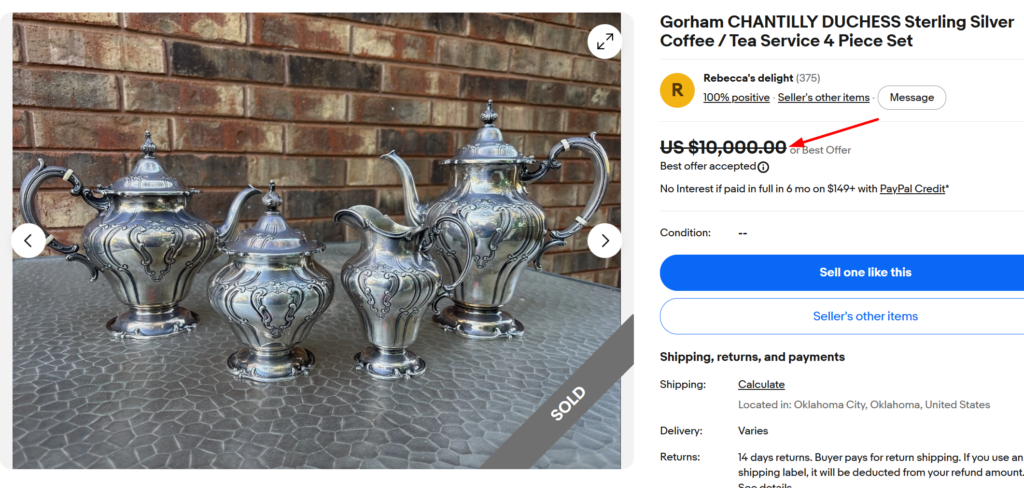
1. Gorham “Chantilly” Sterling Tea/Coffee Service
Sold for $10,000
Gorham’s Chantilly (1895) remains the most popular American sterling pattern ever made. The Duchess variant features heavier Rococo scrollwork on the teapot, coffeepot, creamer, and sugar bowl.
Authentic pieces must have the lion, anchor, script G hallmark followed by “STERLING.” Full four-piece services in Chantilly Duchess are the most expensive vintage tea sets in the secondary market today.
Value Tip: People usually add their monograms on silverware; no monogram means higher value.
- Estimated Value: $6,000 to $10,000+ for full sets
- Production Years: 1895 to present
- What to Check: Lion-anchor-G plus STERLING
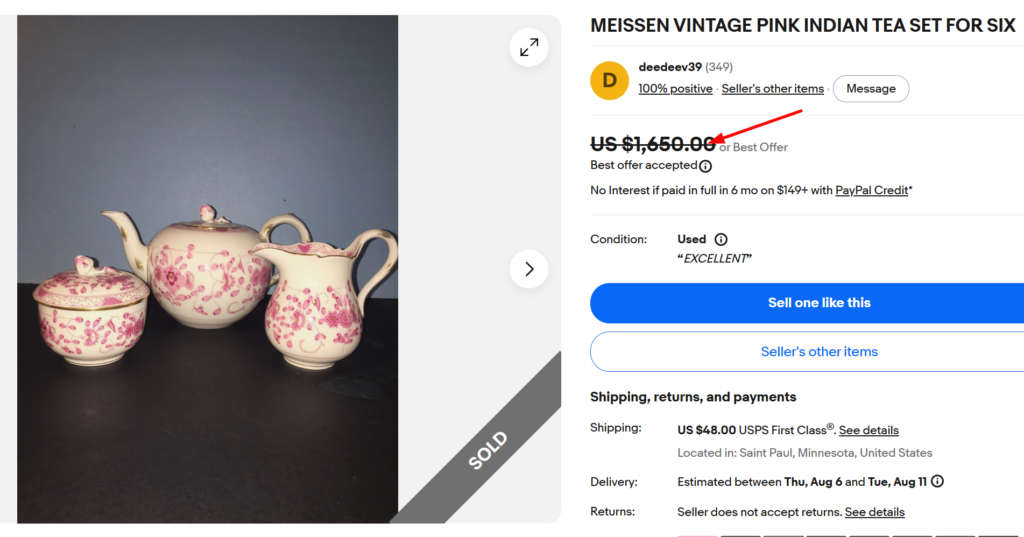
2. Meissen “Pink Indian” Tea Set
Sold for $1,650
Meissen’s Pink Indian, known in Germany as Indisch Rosa, dates back to the 1740s and copies a Chinese Kakiemon pattern. The design shows sprays of pink flowers and vines on white porcelain with gilt trim.
The set carries the famous crossed swords in underglaze blue. Complete tea sets in excellent condition regularly pull four-figure prices.
- Estimated Value: $1,200 to $2,000+ for complete tea sets
- Production Years: 1740s to present
- What to Check: Crossed swords under the glaze
- Quick Notes: Beware modern lookalikes with printed marks
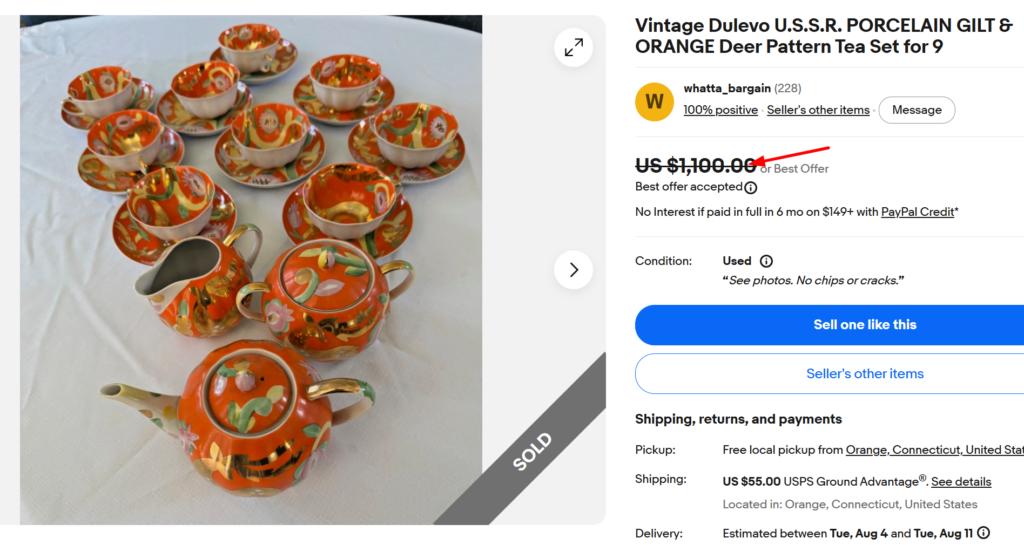
3. Dulevo USSR Porcelain “Gilt & Orange Deer” Set
Sold for $1,100
Dulevo is the famous Russian porcelain factory founded in 1832 near Moscow. Their bold gilt-and-orange hand-painted sets from the mid-20th century are increasingly collectible outside Russia.
The set carries a Soviet-era factory stamp on the base. Complete tea sets for 9 in excellent condition are uncommon, especially with no chips to the gilding; gilt wear drops value.
- Estimated Value: $800 to $1,200 for complete sets
- Production Years: 1950s to 1980s (Soviet era)
- What to Check: USSR-era Dulevo factory stamp
4. D&C Limoges “Hand-Painted” Tea Set
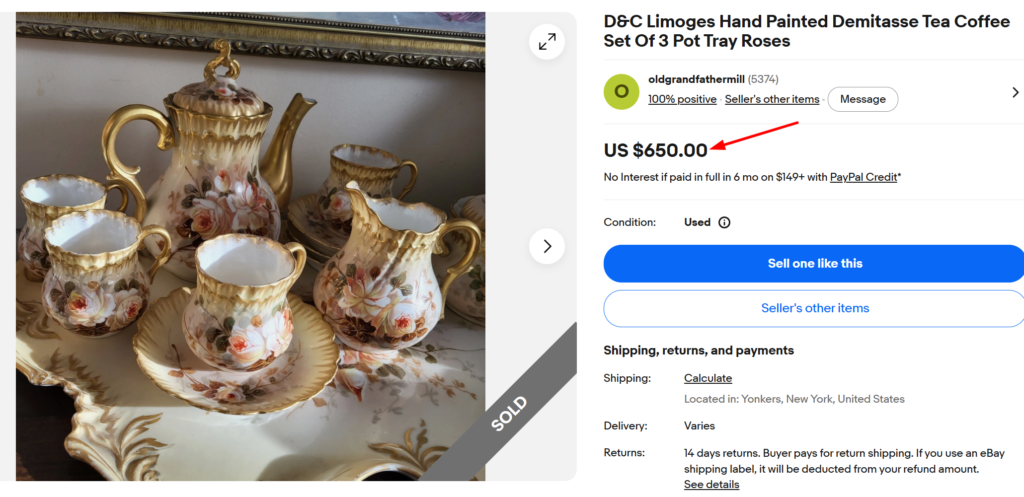
Sold for $650
D&C stands for Delinieres & Co, a Limoges factory active from 1875 to 1900. This green D&C mark over “France” is what dates it. The set shows hand-painted pink roses with heavy gold gilding on scalloped porcelain shapes.
Full sets with the original tray are much rarer than the cups alone, and that tray is what pushes the price up.
- Estimated Value: $500 to $800 for sets with a tray
- Production Years: 1875 to 1900
- What to Check: Green D&C mark plus France
5. Royal Albert “Old Country Roses” Set
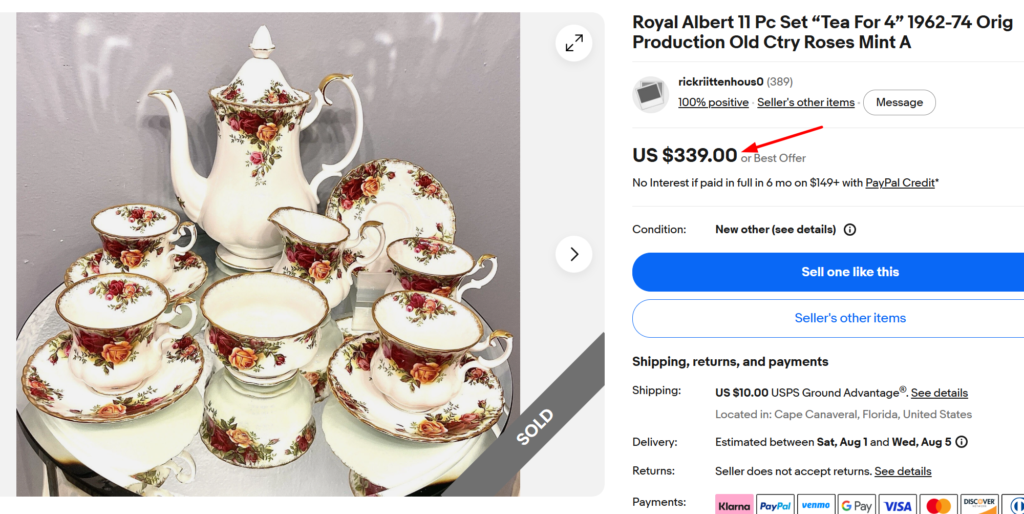
Sold for $340
Old Country Roses is the most recognizable English tea set pattern in the world, in continuous production since 1962. Collectors specifically chase the original 1962-1974 production with the earliest backstamp reading “Royal Albert Bone China England.”
The pattern shows pink, red, and yellow roses on white bone china with heavy gold trim. Complete “Tea for 4” sets from this window are the ones to grab.
ID Note: Later Old Country Roses reissues use different mark styling.
- Estimated Value: $250 to $400 for early “Tea for 4” sets
- Production Years: 1962 to 1974 (original period)
- What to Check: Original 1962-74 English backstamp
6. Shelley “Dainty Blue” Bone China Tea Set
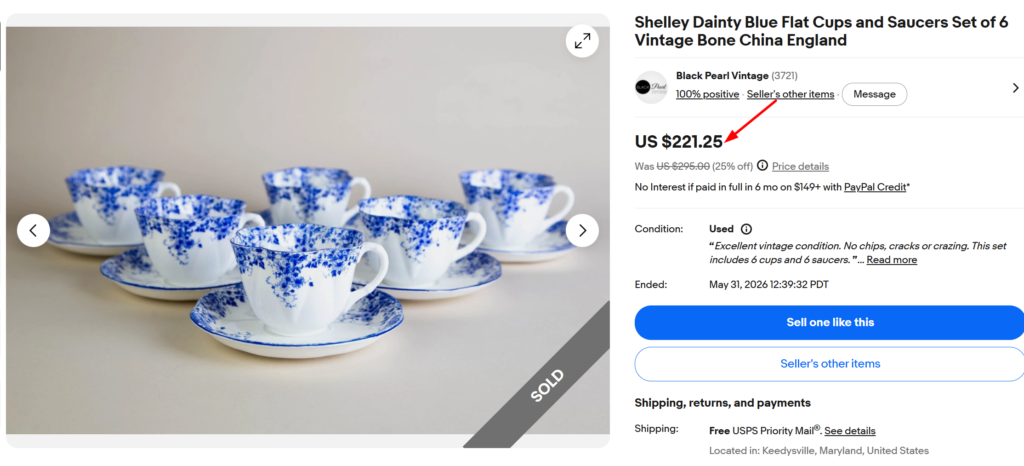
Sold for $220
Shelley’s Dainty shape was designed by Rowland Morris in 1896 and stayed in production until Shelley closed in 1966. Dainty Blue, pattern 051/28, features blue flower sprays with fluted six-lobed handles.
Look for the shield-shaped “Shelley England” backstamp. Sets of six matching cups and saucers with no chips, cracks, or crazing bring the strongest prices.
- Estimated Value: $200 to $300 for sets of six
- Production Years: 1896 to 1966
- What to Check: Shield-shaped Shelley backstamp
7. Noritake “Nippon” Hand-Painted Tea Set (Pre-1921)
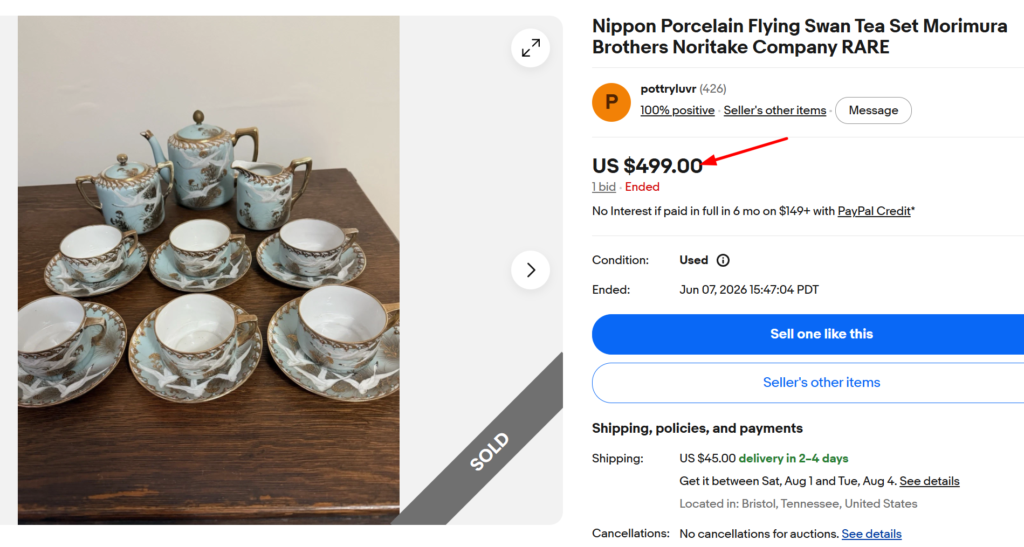
Sold for $500
Noritake pieces marked “Nippon” always date before 1921. This Flying Swan pattern by the Morimura Brothers shows white cranes flying against a soft blue-gray ground with heavy gilt borders.
The rare Morimura mark is what pushes the value here. Complete Nippon-era sets with the original teapot, creamer, and six matching cups and saucers are getting harder to find every year.
- Estimated Value: $350 to $600 for complete Nippon sets
- Production Years: 1891 to 1921 (Nippon era)
- What to Check: Morimura mark plus Nippon
- Quick Notes: Nippon always beats later Japan marks
8. Coalport “Indian Tree” Tea Set
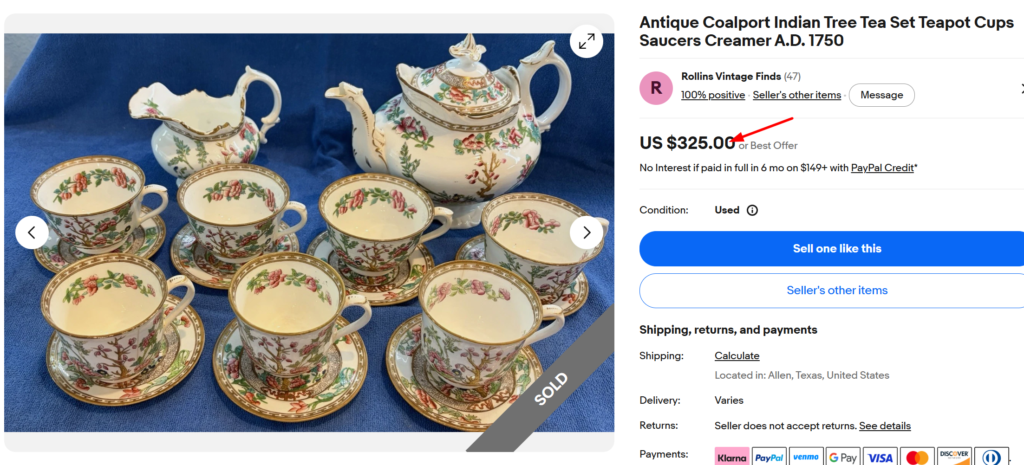
Sold for $325
Coalport introduced the Indian Tree pattern in 1801, featuring a flowering branch with pink and blue blossoms against a cream ground. The base reads “Bone China. Coalport. Made in England. EST. 1750” with the fluted, scalloped edge that separates Coalport from later Minton and Aynsley versions.
Sets with the teapot, creamer, and matching cups and saucers are worth the most.
- Estimated Value: $250 to $400 for complete tea sets
- Production Years: 1801 to mid-20th century
- What to Check: Fluted scalloped edge
- Quick Notes: Coalport version brighter than Johnson Brothers
9. Wedgwood Jasperware Capner Tea Set
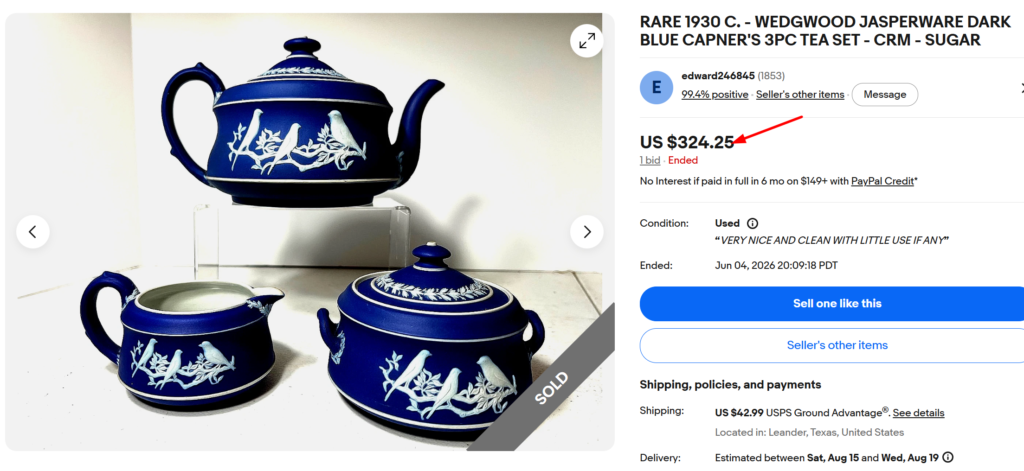
Sold for $325
Wedgwood introduced Jasperware in 1774, and the dark blue version with raised white bird-and-branch reliefs is the classic look. This Capner’s shape teapot, creamer, and sugar trio dates around 1930.
Look for the impressed “WEDGWOOD” mark on the base and a matte, unglazed body. Complete trios in strong condition are collectors’ favorites.
- Estimated Value: $250 to $400 for 3-piece trios
- Production Years: 1774 to present
- What to Check: Impressed WEDGWOOD mark on base
10. Meissen “Blue Onion” Tea Set
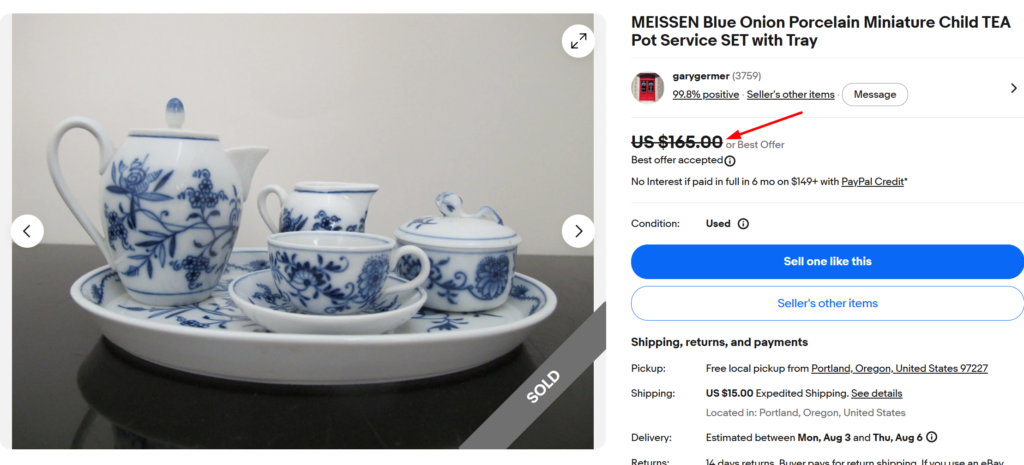
Sold for $165
Blue Onion (Zwiebelmuster) is Meissen’s most enduring pattern, introduced in 1739. The design isn’t actually onions but stylized Chinese pomegranates and peaches copied from earlier Chinese porcelain.
Miniature or child-sized sets with the teapot, creamer, sugar bowl, cup, saucer, and tray are less common than full-sized versions. The crossed swords under the glaze confirm authenticity.
- Estimated Value: $120 to $250 for miniature sets
- Production Years: 1739 to present
- What to Check: Crossed swords under the glaze
- Quick Notes: Modern reproductions from Bavaria exist
11. Royal Doulton “Bunnykins” Tea Set
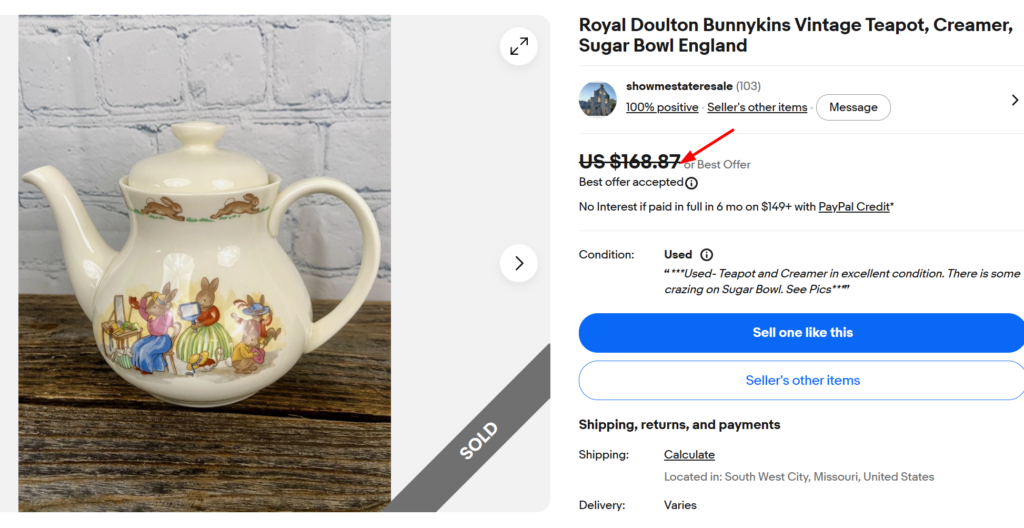
Sold for $170 (3 pieces)
Royal Doulton Bunnykins originated in 1934, and the design was by Barbara Vernon. Items manufactured between 1934 and 1952 are what collectors seek because most items from that time were for children’s use and were broken.
Therefore, finding a teapot, a creamer, and a sugar set intact is rare. Also, even with light crazing on one piece, complete groupings do well.
- Estimated Value: $130 to $200 for teapot trios
- Production Years: 1934 to present
- What to Check: Barbara Vernon’s signature on the base
- Quick Notes: Casino-shaped teapots are the hardest to find
12. Paragon “Rockingham Green” Tea Set
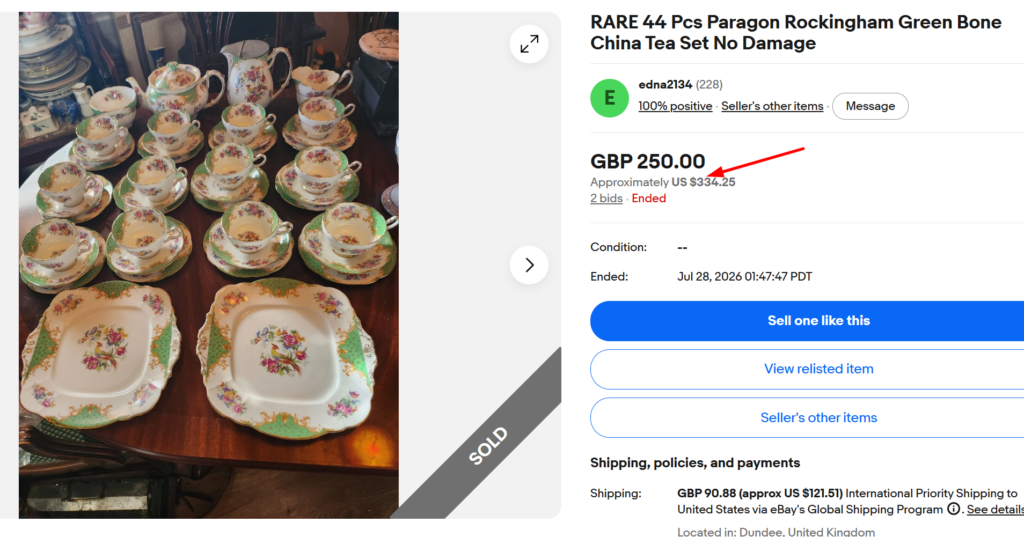
Sold for $335
Paragon’s Rockingham Green shows a bird of paradise motif with pink flowers against green panels with heavy gold trim. The base carries the crown Paragon backstamp and “Made in England.”
Large 44-piece sets in undamaged condition are legitimately hard to find, since most got broken up over the decades. Also, gilt wear directly impacts the value.
- Estimated Value: $300 to $450 for large complete sets
- Production Years: 1957 to 1974
- What to Check: Crown Paragon mark, England
How to Value a Vintage Tea Set (What Drives the Price?)
Most vintage tea sets are not worth thousands. Common bone china sets from mid-century England usually sell for $50 to $200 complete. Silver plate tea sets often bring $80 to $250.
But the value goes high for rare makers, short production runs, or hand-painted antique pieces. The six things that drive antique tea sets’ value are:
- Maker and brand – Meissen, Sèvres, Shelley, and early Wedgwood always outperform lesser-known factories.
- Age and rarity – Older is not automatically better, but a Nippon-era hand-painted set beats a 1970s reissue every time.
- Pattern and discontinuation – Discontinued patterns collectors are still trying to fetch higher prices than common patterns still in production.
- Completeness – A full 21-piece set with matching cups, saucers, teapot, creamer, sugar bowl, and a cake plate is worth far more than the sum of the individual pieces.
- Condition – Chips, cracks, hairlines, and worn gilt can drop value by 50% to 80%. Crazing (fine cracks in the glaze surface) is less punishing but still hurts.
- Provenance – Original boxes, receipts, and family history that tie a set to a specific era or person add real premium.
If you have an old set you’ve been curious about, start with the maker’s mark and the country-of-origin stamp, then run a search on sold examples using that maker plus the pattern name. That’s how you can tell if it’s a valuable find.