
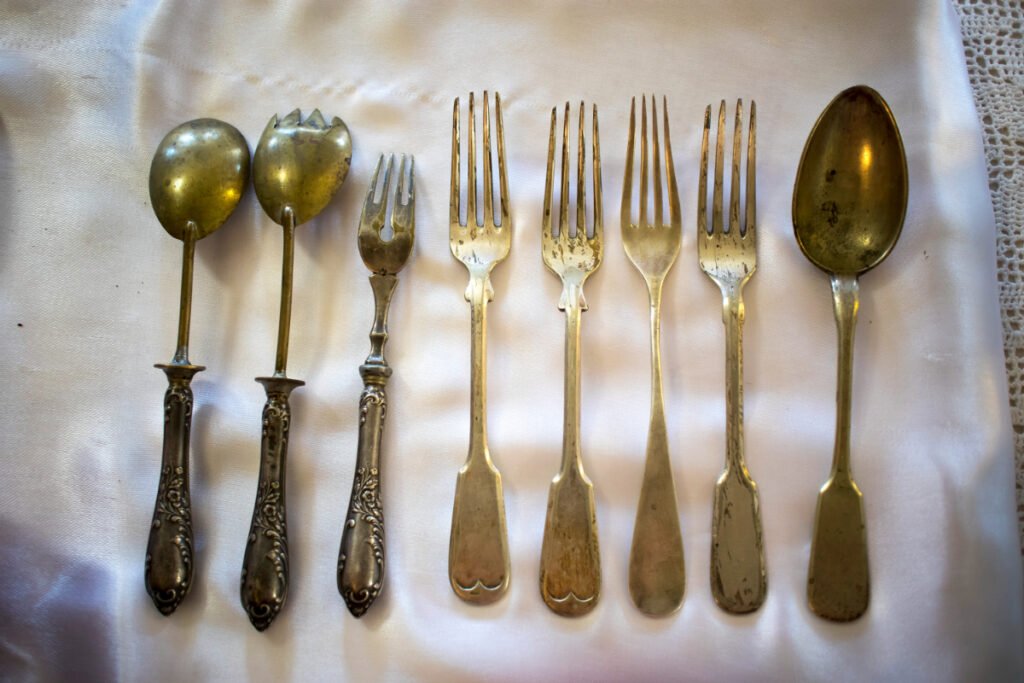
If you have a large set of heavy and ornate, antique silver forks, spoons, or knives in your kitchen drawer, there is a high chance it’s worth a few thousand dollars today.
Antique silver flatware doesn’t hold value solely because of its silver melt value; the maker and pattern play an even more crucial role in determining its worth at estate sales or auctions. This guide shows you how to identify genuine silverware, which patterns collectors chase, and what they actually sell for.
What Is Sterling Silver Flatware? (Sterling vs. Silver-Plate vs. Nickel Silver)
Sterling flatware was immensely popular from the 1840s until the 1940s in America, during which period the majority of the famous patterns came out. But there wasn’t just silverware; there were three variations you must know.
Sterling flatware is made up of 92.5 percent pure silver and 7.5 percent copper. This percentage constitutes the international standard for sterling silver, lending weight, warmth in appearance, and true melt value to the metal.
Then there is silver-plate flatware with a thin layer of silver on a base metal (copper or brass). It may look identical, but it is lighter, more easily damaged with a ding, and will wear out from use to reveal the underlying metal.
The third one is nickel silver, aka German silver or alpaca, which has no silver at all. It is rather a mixture of copper, zinc, and nickel that resembles silver.
This distinction matters because the value gap is huge. A sterling place setting can sell for $200, while the identical-looking silver-plate version might bring $15.
How to Identify Antique Silver Flatware?
Identification of antique silver flatware involves three steps: reading the markings at the bottom, matching the handle to a design, and identifying the manufacturer. Most vintage spoons and knives usually have all three keys. Here’s how to spot them:
The Hallmarks
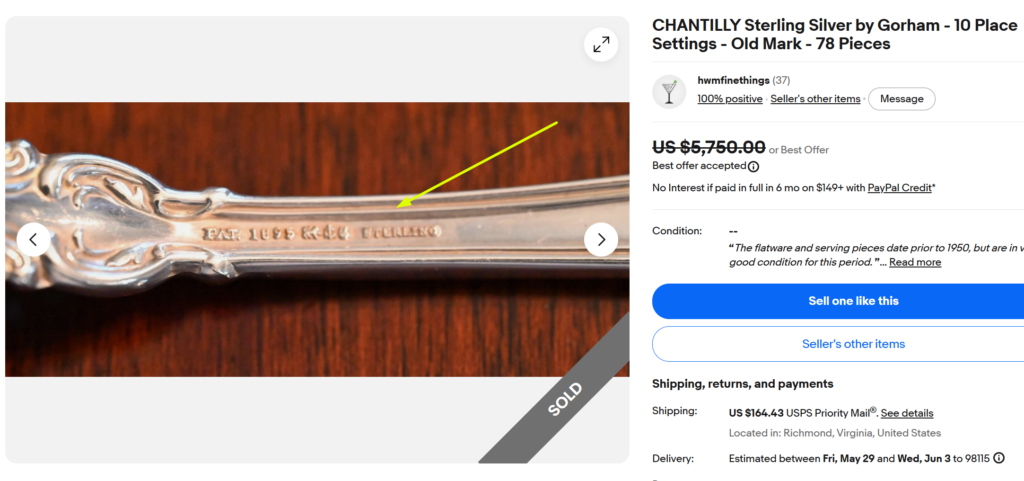
Simply turn over your silverware item and check the back side of the handle adjacent to where the bowl or tines are located. “STERLING” is the marking on all American silver and means it contains 92.5 percent silver. Other items use “925,” which is the same thing.
Older American makers often added their own symbols alongside the word. Gorham, for example, stamps a lion passant (a walking lion facing left), an anchor, and a script capital “G” in a horizontal row.
This Lion-Anchor-G trademark is the standard mark on Gorham sterling. Other makers borrowed similar heraldic symbols from the English silver tradition. Below are a few common American marks at a glance:
- STERLING or .925 – confirms silver content (mandatory on US sterling)
- Lion passant – used by Gorham, Whiting, and some others as a quality mark
- Name of maker’s – usually either in full or as an initial(s), and is impressed on the silverware
- Date code – the Gorham company used letters to denote dates from 1868 to 1884, but from 1885 until 1933, the company used numbers
- Pattern number or name – sometimes stamped, often not
Handy Tip: Pro tip: silver-plate pieces never say “Sterling.” If you see “EPNS,” “Triple,” “A1,” or “1847 Rogers Bros,” it’s plated, no matter how heavy it feels.
The Pattern
The handle is the fingerprint of the pattern. Consider these three factors: the overall form of the handle, the decoration at the end of the handle (known as terminal decoration), and motifs on the handle shaft.
Some popular handle types you must know are:
- Violin-shaped handle with scrolls on either side
- Long shaft tapering to a point where a little floral arrangement rests
- The Renaissance Revival type with scrolls, fruits, and flowers
- Art Deco/Scandinavian Modern style handles are relatively simple
The terminal motif, that little design at the very top, is often the single most useful clue. A buttercup blossom, a rose, a chrysanthemum, an architectural scroll, each maker repeats these across the set. If you spot it on a fork, you’ll see it on every piece of the set.
Lastly, the monogram or initials. These are generally found in the front part of the handle in an oval shape. Monograms do not aid in pattern identification, and more often than not, they decrease resale value (as will be discussed later).
The Makers & Their Marks (Top 10 Names to Know)
These are the names that drive the antique silver flatware market. Knowing the mark is half the identification battle.
- Whiting Manufacturing (Attleboro, MA, 1840) – A lion holding a “W,” very similar to Gorham’s lion (Gorham bought Whiting in 1924).
- Gorham (Providence, RI, 1831) – Lion passant, anchor, script “G,” plus “STERLING” and a date symbol on older pieces.
- Tiffany & Co. (New York, 1837) – “TIFFANY & CO. / STERLING” with a director’s letter or pattern date code.
- Towle Silversmiths (Newburyport, MA, 1882) – A “T” inside a circle or shield, plus “STERLING” and pattern info.
- Wallace (Wallingford, CT, 1835) – “WALLACE” or “R. Wallace” with “STERLING,” sometimes a “W” in a shield.
- Reed & Barton (Taunton, MA, 1824) – An eagle holding an “R” or “R&B,” plus “STERLING”; some early pieces show a lion passant.
- International Silver (Meriden, CT, 1898) – “INTERNATIONAL STERLING” mark or the “International” script.
- Lunt Silversmiths (Greenfield, Massachusetts, 1902) – “LUNT STERLING” along with shield symbol.
- Stieff (Baltimore, Maryland, 1892) – “STIEFF” or “THE STIEFF CO,” along with “STERLING.” It was later changed to Kirk Stieff after 1979.
- Alvin (Providence, RI, 1886) – An “A” inside a fancy crown or shield, plus “STERLING.”
While these marks are reliable identification clues, you can use resources like the Replacements Ltd. pattern finder or brand catalogs when in doubt.
What Makes Silver Flatware Valuable? (5 Value Factors)
Two sets of sterling flatware can look almost identical and be worth ten times different amounts. This value difference comes from the following factors, which you must assess before buying or selling.
1. Maker prestige – The more reputable the maker, the more valuable the piece. Tiffany sits at the top of the list. Even common Tiffany patterns like Faneuil sell for $200–$600 per place setting. Below Tiffany: Gorham, Reed & Barton, Kirk, Whiting, Wallace, and Towle. Wm. Rogers and similar makers are worth the least, as their pieces are almost always silver-plate.
2. Pattern rarity and Desirability – Discontinued patterns with heavy, ornate handles command the highest values. Renaissance Revival and Art Nouveau patterns (think Francis I, Lily, Chrysanthemum) also bring serious money. Simple designs, like Mid-century minimalist ones, often sell for low prices even in sterling.
3. Completeness – For flatware, 80% of the value lies in completeness. A full service for 12 with serving pieces will always sell for far more per piece than orphan forks.
4. Condition – Dents, bent tines, repaired knife blades, and worn pattern details all hurt the value. Also, watch for “rolled” or replaced stainless knife blades on older sets; those are common and acceptable, but then they shouldn’t be advertised as fully original. Also, monograms can drop resale value; collectors want pieces they can engrave themselves, or none at all.
5. Weight and Silver Content – Sterling has a real metal value below which the market won’t go. As of 2026, silver runs around $30+ per troy ounce, so a 1-ounce sterling spoon has roughly $28 of melt value before you factor in collectibility. Heavy patterns with chunky handles are worth more by sheer ounces alone.
14 Valuable Antique Sterling Silver Flatware Pieces to Know About
This list covers the valuable antique silverware pieces and patterns that collectors actively hunt for.
1. Gorham Chantilly Flatware Service
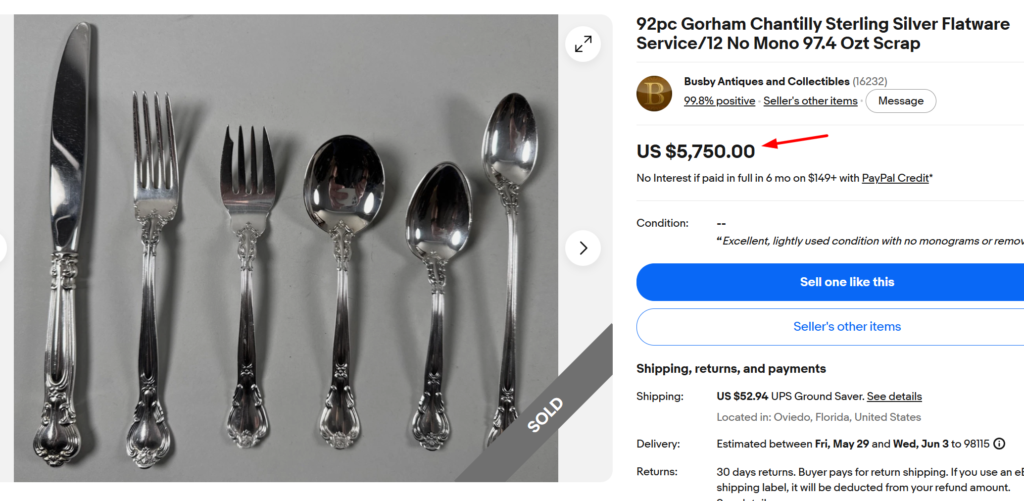
Sold for $5,750 (set of 92 pieces)
Chantilly is the best-selling, most-searched sterling pattern in American history. A full Chantilly sterling silver flatware set has sold for $7,500, and it remains the pattern most often inherited and most often listed on eBay.
The handle features delicate French Rococo scrollwork with a small shell at the tip. Because Chantilly is still in production, there’s a strong secondary market for replacement pieces; individual forks and spoons sell quickly at $30–$60 each.
Watch for the date symbol on older pieces. Pre-1933 Gorham marks are more collectible than post-war production.
- Estimated Value: $40–$80 (singles); $3,500–$8,500 (full 12-place services)
- Production Year: 1895 to present (still produced)
- What to Check: Lion passant, anchor, script “G,” plus “STERLING” and “Chantilly.”
- Quick Notes: The single most popular American sterling pattern ever made
2. Wallace Grande Baroque Flatware Set
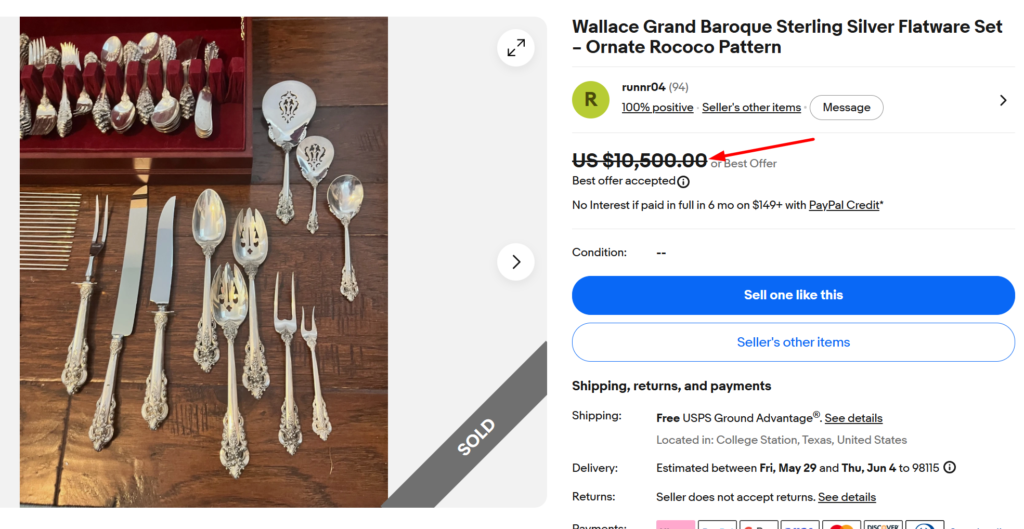
Sold for $10,500 (set of 110+ pieces)
Introduced in 1941, Grande Baroque is known for its classic Renaissance theme, like carved pillars and acanthus leaves. Another key feature is the open work and three-dimensional detail at the end of handles.
Grande Baroque is one of Wallace’s bestsellers, and it’s still in production today. Also, the pattern is among the heaviest of any modern sterling, giving it strong melt-value.
A complete dinner service with serving pieces, around 130 pieces total, sells in the auction or online market for $5,000–$7,000. But watch out for the “Golden Grande Baroque,” those pieces are gold-washed (vermeil) and bring slightly more.
- Estimated Value: $50–$120 (singles); $4,000–$12,000 (service-for-12 sets)
- Production Year: Designed in 1941
- What to Check: “WALLACE STERLING” plus the pattern name on hollow-handle pieces.
- Quick Notes: Heavy, three-dimensional Renaissance-style scrollwork
3. Gorham Strasbourg Flatware Service
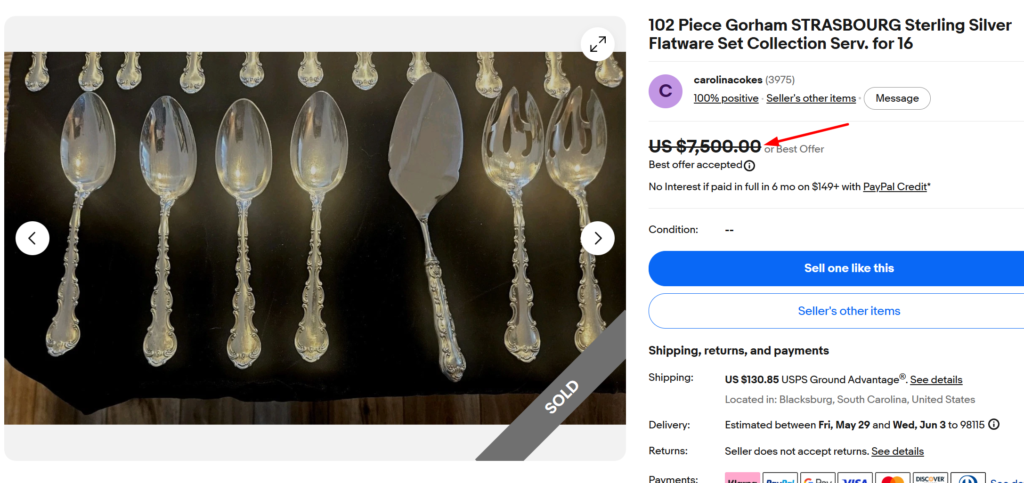
Sold for $7,500 (set of 102 pieces)
Gorham’s Strasbourg looks a bit like Chantilly, but it’s heavier and more ornate. You’ll see tip-heavy scrollwork and plume motifs along with a shiny finish.
Strasbourg has remained a traditional registry plate choice, which even today enjoys good demand not only for replacements but also for full sets. Note that the pre-WWII Strasbourgs are noticeably heavier than those made post-war and generally more valuable.
- Estimated Value: $40–$80 (singles); $4,000-$8,000 (service of 12 to 16)
- Production Year: 1897 to present
- What to Check: Lion-anchor-G with “STERLING” and “Strasbourg”
- Quick Notes: Rococo plumes and reverse scrollwork.
4. Wallace Rose Point Silverware Set
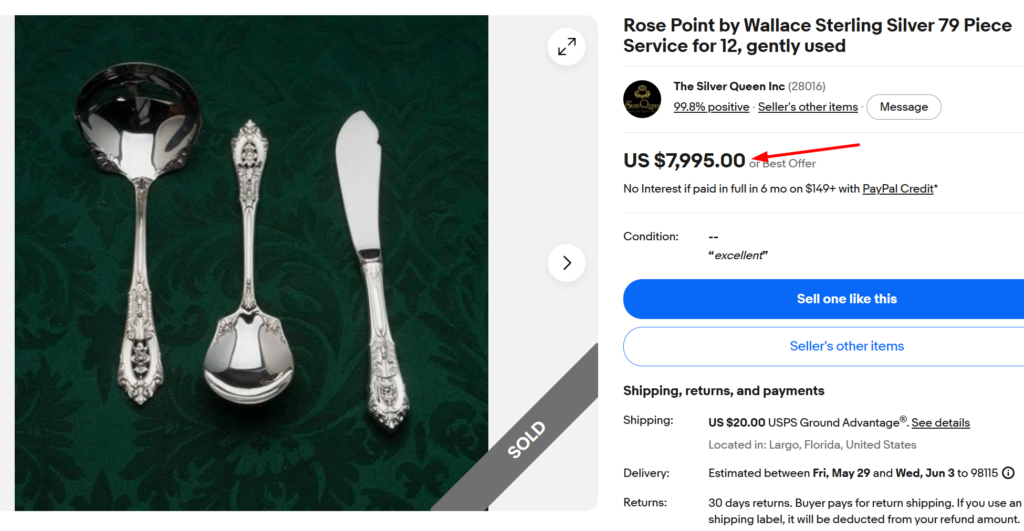
Sold for almost $8,000 (set of 79 pieces)
Wallace’s Rose Point features detailed scrollwork, roses, and a pierced handle, modeled on the look of needlepoint and lacework. This pattern has been continuously popular for over 90 years, making it one of the most widely available sterling patterns.
Today, large place service sets (75+ pieces) can sell for $7,000 or more. Smaller sets have a fair market auction value of $3,000–$4,000.
- Estimated Value: $35–$80 (singles); $3,000–$5,000 (complete services)
- Production Year: 1934 to present
- What to Check: “WALLACE STERLING” plus Rose Point pattern stamp.
- Quick Notes: Pierced lace-like handle with rose & needlepoint motifs
5. Towle Old Master Sterling Flatware Set
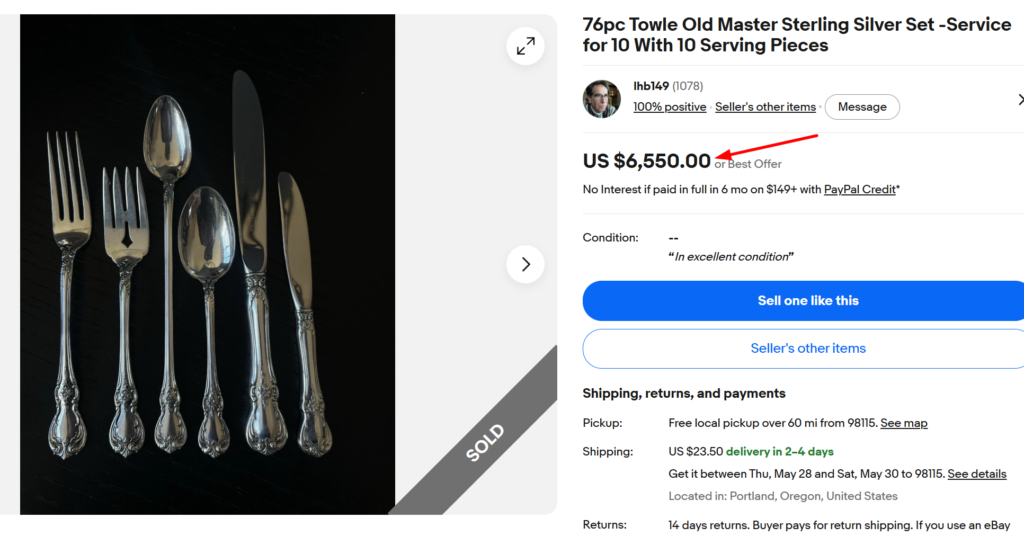
Sold for $6,550 (set of 76 pieces)
“Old Master” has an unusual violin shape handle, crowned by curls of leaves, and featuring a center rosette with tapering tendrils as well as scrolls and flutes on the handle. It is one of the most lasting American sterling patterns, being especially popular in weddings from the 1950s to the 1980s.
While individual place settings are common and sell for $100–$175 each, large sets of 100+ pieces can go up to $10,000 or even higher.
- Estimated Value: $30–$90 (singles); $2,000–$5,000 (full sets)
- Production Year: Introduced in 1942
- What to Check: “TOWLE STERLING” with pattern name; designed by Harold E. Nock
- Quick Notes: Distinctive violin-shaped handle with a center rosette.
6. Tiffany & Co. Chrysanthemum Fish Knife Set
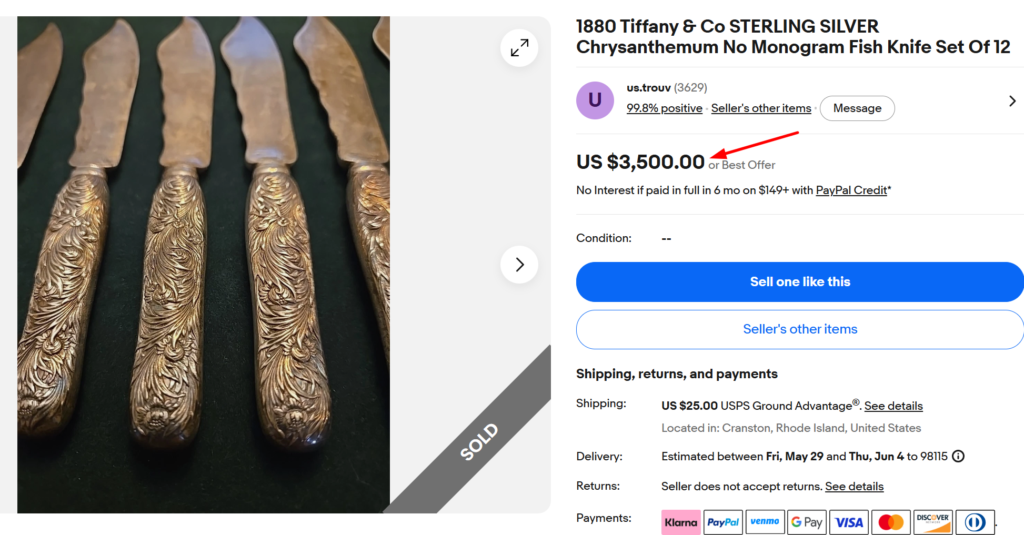
Sold for $3,500 (set of 12)
The Chrysanthemum is known as one of the prettiest and most lavish creations by Tiffany, designed by Charles T. Grosjean with Baroque forms and a nature theme. Its distinctive feature is that the design is etched on both sides of each piece, doubling the time spent to create it.
Tiffany discontinued Chrysanthemum in 1934, but later revived and sold it until 1955 due to popular demand. The entire 207-piece set has fetched over $40,000 in auctions. Even a single teaspoon in good condition can bring $300+ today.
- Estimated Value: $300–$800 (singles); 1,000-$10,000 (partial sets)
- Production Year: Introduced 1878, patented 1880, discontinued 1955
- What to Check: “TIFFANY & CO. STERLING PAT. 1880 M” stamped on the back
- Quick Notes: Tiffany’s most famous and valuable pattern
7. Alvin Chateau Rose Silverware Set
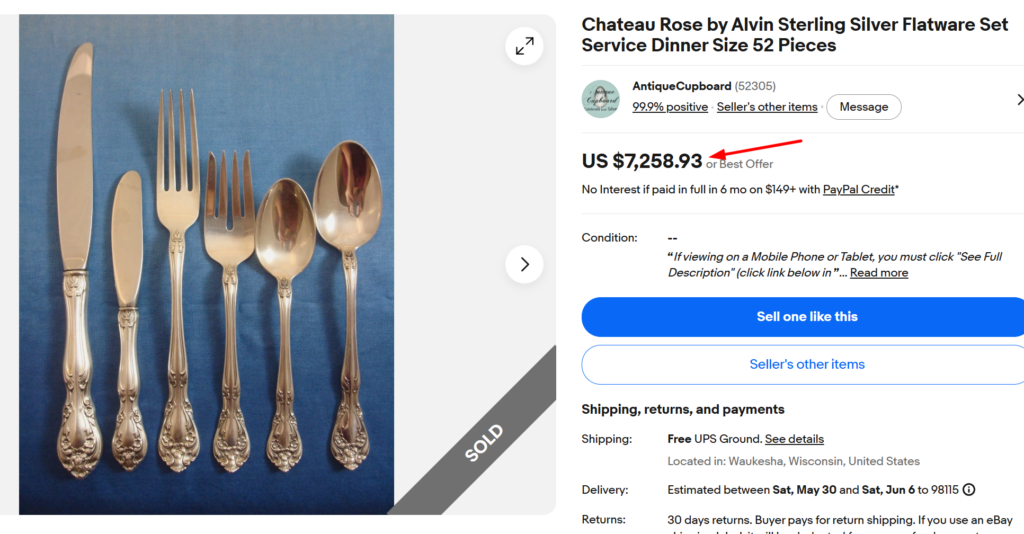
Sold for $7,260 (set of 52 pieces)
Produced from 1940 to 1991, Chateau Rose features an elaborate, crisp floral design, along with a scalloped tip and a unique, glossy finish.
Chateau Rose runs at the mid-tier of collector demand, with solid value, but not the premium of Tiffany or Reed & Barton patterns. However, large sets of 50+ pieces can still command stunning prices.
- Estimated Value: $30–$70 (singles); $1,200–$3,000 (small services)
- Production Year: 1940 to 1991
- What to Check: “ALVIN STERLING” with Chateau Rose pattern name
- Quick Notes: Scalloped tip with elaborate floral design.
8. Reed & Barton Francis I Service
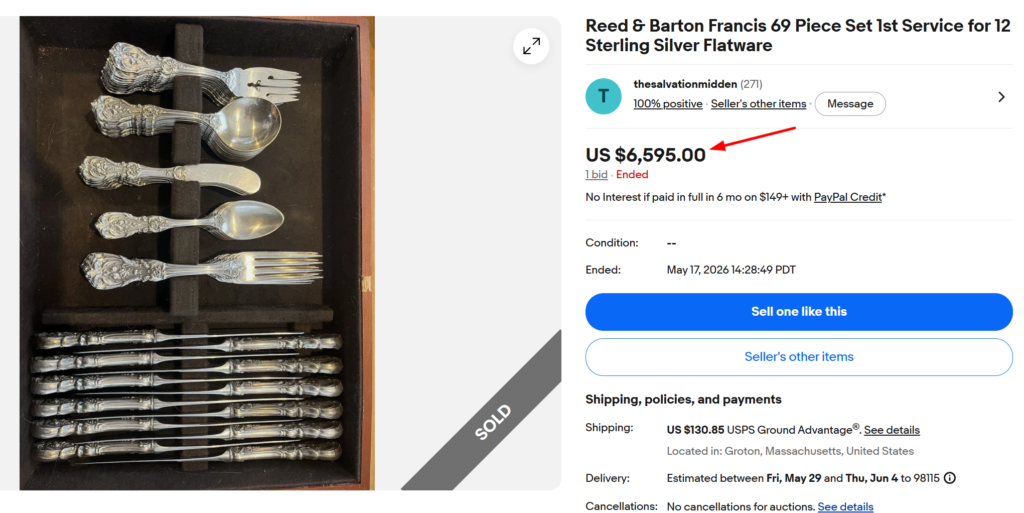
Sold for $6,595 (set of 69 pieces)
Francis 1st was designed by Ernest Meyer, a French silversmith. The design contains 15 different fruit-and-flower clusters; each piece shows one of these detailed designs on the handle.
This pattern has been made continuously since 1907 until the time when production ceased in Taunton. It is one of the most enduring sterling patterns ever created.
Gathering a complete set involves tracking down all 15 designs within the place settings, which makes it highly collectible/
- Estimated Value: $60–$150 (singles); $4,000–$15,000 (complete services)
- Production Year: 1907 to 2019
- What to Check: “REED & BARTON STERLING” with Francis I pattern name; older pieces have an eagle mark.
- Quick Notes: Each piece has a different fruit-and-flower motif.
9. International Prelude Sterling Service
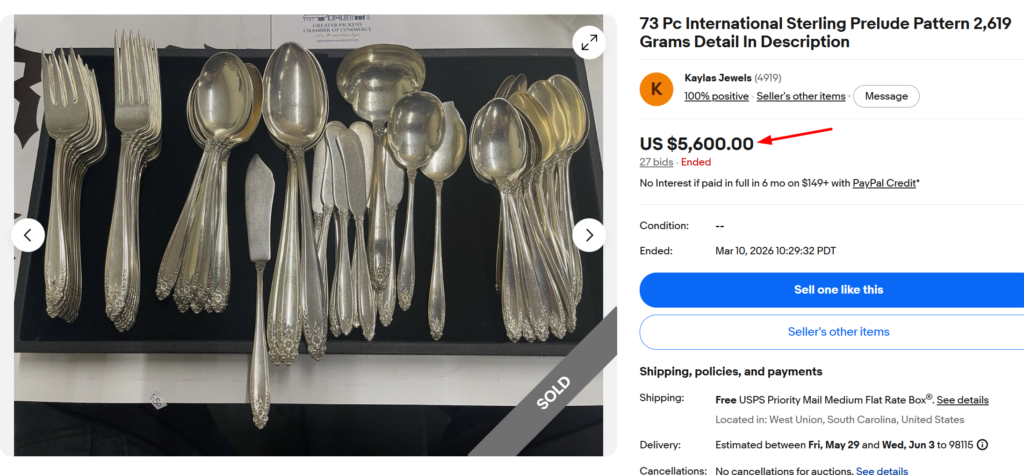
Sold for $5,600 (set of 73 pieces)
The Prelude pattern was created by Alfred G. Kintz. It has a scallop-shaped tip with a flower garland design. Also, Prelude has a bevel edge and a bright polish.
Prelude is one of the most common mid-century sterling patterns due to its popularity among brides in the period from the 1940s to the 1960s. Although there are plenty of them, prices remain high for large services.
- Estimated Value: $30–$80 (singles); $2,800–$6,500 (complete services)
- Production Year: 1939–2026 (just recently discontinued)
- What to Check: “INTERNATIONAL STERLING” with Prelude pattern name
- Quick Notes: Slender handle with a floral garland at the tip.
10. Gorham Buttercup Flatware Service
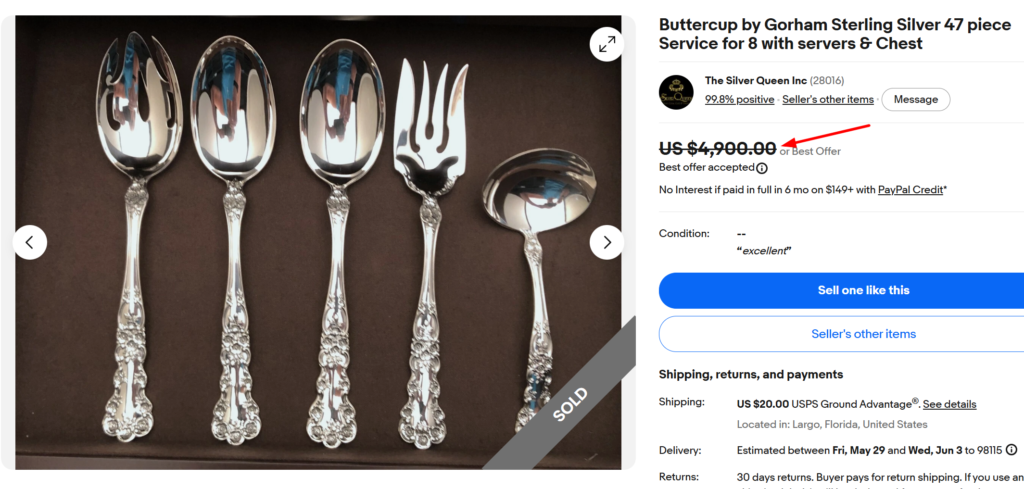
Sold for $4,900 (set of 47 pieces)
Buttercup was first introduced in the reign of Queen Victoria and was manufactured between 1899 and 1950. It has an elaborate design on the handle, including a motif of buttercups, scrolls, and leaves.
This is one of those patterns where the condition really matters. The fine floral detail wears down over decades of polishing, and worn pieces drop in value fast. A 12-place Buttercup set with a box usually sells for $1,700–$2,500 today.
- Estimated Value: $35–$75 (singles); $1,500–$4,500 (complete sets)
- Production Year: 1899 to around 1950
- What to Check: Lion-anchor-G mark, plus “STERLING” and Buttercup pattern stamp.
- Quick Notes: Floral pattern with buttercup blossoms running down the handle
11. International Royal Danish Sterling Flatware
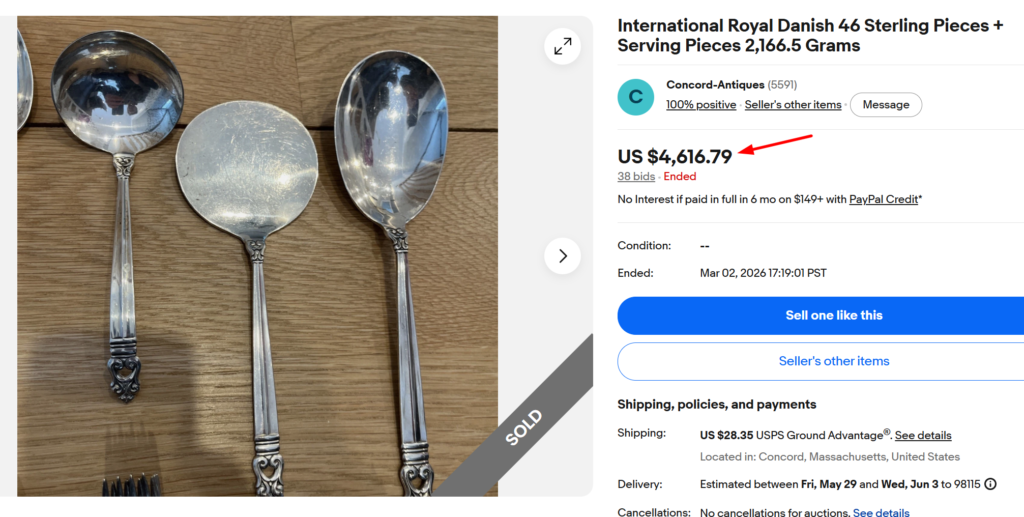
Sold for $4,615 (set of 46 pieces)
The Royal Danish pattern takes its influence from the traditional artistry of Scandinavia, with bold openwork even on the knife handles, and fluted columns providing surfaces for the play of light along its slender lines.
A 12-place service in excellent condition has a retail/insurance value of approximately $5,900, with resale typically around half of that. Royal Danish has held its value better than most mid-century sterling patterns because of its distinctive, recognizable design.
- Estimated Value: $60–$130 (singles) $3,500–$6,000 (full services)
- Production Year: Introduced in 1939
- What to Check: “INTERNATIONAL STERLING” stamped on the back; Royal Danish pattern name.
- Quick Notes: Scandinavian-influenced design with fluted columns and bold openwork.
12. Tiffany & Co. Audubon Silver Place Setting
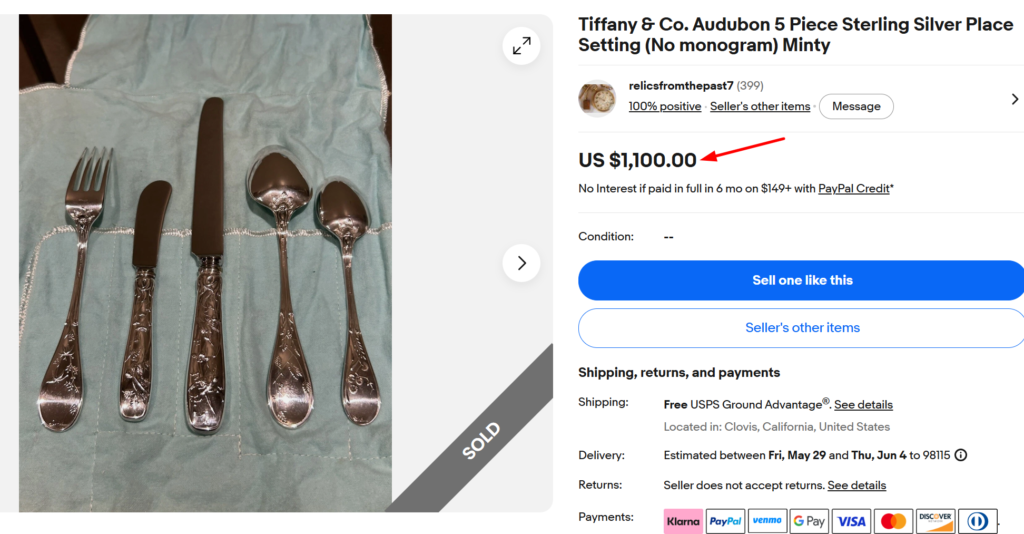
Sold for $1,100 (a place setting)
Tiffany’s Audubon is a pattern featuring eight different types of birds and flowers derived from Japanese art dating back to the 19th century. The pattern, initially known as “Japanese,” was reintroduced in 1956 as Audubon.
Each piece showcases a distinct bird species, like quails, ducks, or herons, which makes complete sets highly collectible. An intact Tiffany & Co. Audubon set can fetch over $10,000 today.
- Estimated Value: $200–$600 (singles); $5,000–$16,000+ (full sets)
- Production Year: Introduced in 1871 as “Japanese,” reintroduced as Audubon in 1956
- What to Check: Look for “Audubon” or earlier “Japanese” markings with TIFFANY & CO. STERLING
- Quick Notes: Original set features different motifs on each piece.
13. Stieff Rose Pattern Flatware
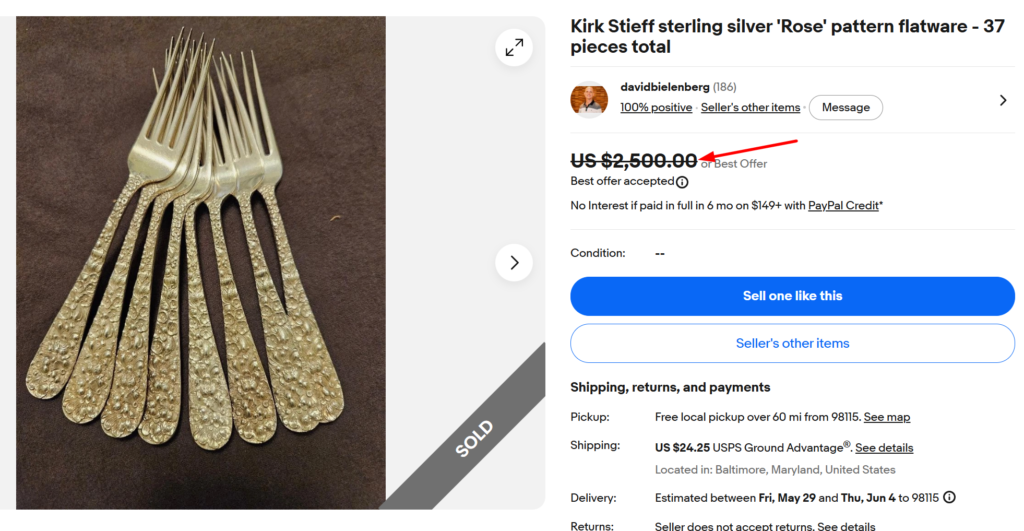
Sold for $2,500 (set of 37 pieces)
The pattern was originally known as Maryland Rose until the 1920s, then Rose, and later renamed Stieff Rose to avoid confusion with other makers’ Rose patterns. The central characteristic is the large, deeply embossed rose at the top of each handle.
Service-for-8 sets typically go in the $2,500–$3,000 range. The pattern is heavy, hand-chased on older pieces, and considered one of the finest examples of Baltimore silversmithing.
- Estimated Value: $40–$100 (singles); $2,000–$5,000 (full sets)
- Production Year: First debuted in 1892 (originally “Maryland Rose”)
- What to Check: “STIEFF STERLING” stamp; later pieces may say “KIRK STIEFF.”
- Quick Notes: Repoussé floral design with a large central rose.
14. Wallace Sir Christopher Flatware
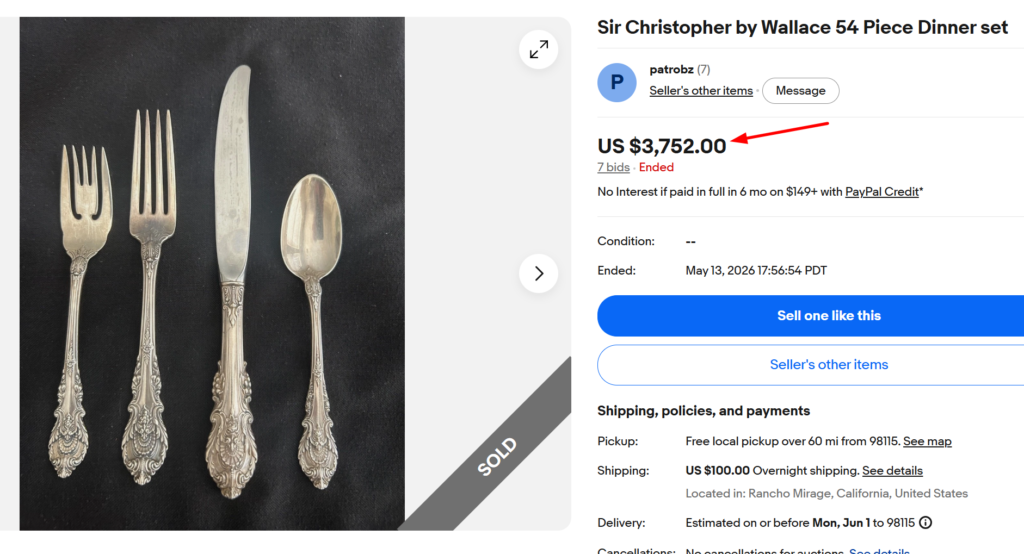
Sold for $3,750 (set of 54 pieces)
The pattern was inspired by royal architect Sir Christopher Wren and features High English Renaissance styling with a center shell symbolizing the sea, surrounded by foliage, fruit, and flowers.
You’ll see heavy, ornate, and clearly hand-finished even on later production pieces. So, make sure to check the production date.
As for value, large sets of 120+ pieces have been sold for over $8,500. Smaller service-for-8 sets usually run $1,500–$4,000 at auction.
- Estimated Value: $50–$130 (singles); $4,000–$9,000 (full services)
- Production Year: Introduced in 1936, since been discontinued
- What to Check: “WALLACE STERLING” with Sir Christopher pattern name
- Quick Notes: Named for British architect Sir Christopher Wren.
To summarize, most inherited sterling silver flatware sells closer to scrap value. But then there are a few patterns, like the ones shown above, which hold extremely high value because demand for them has stayed steady for decades. So, always check the maker, hallmark, and pattern before trading anything.