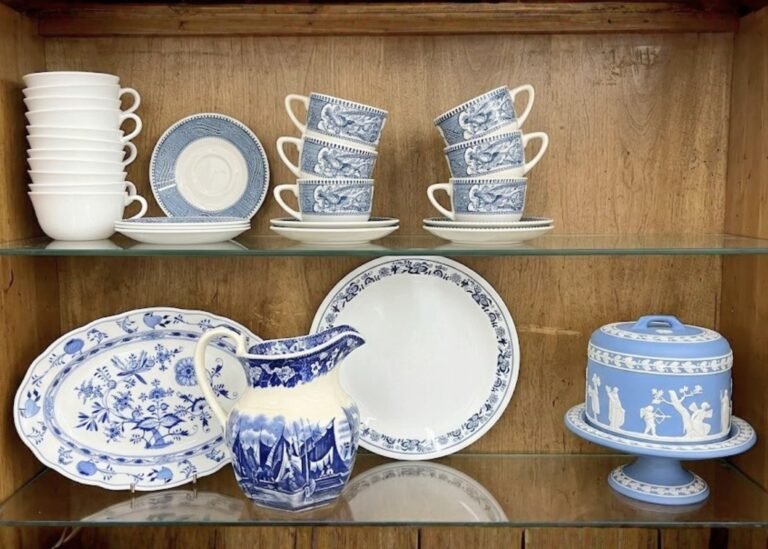

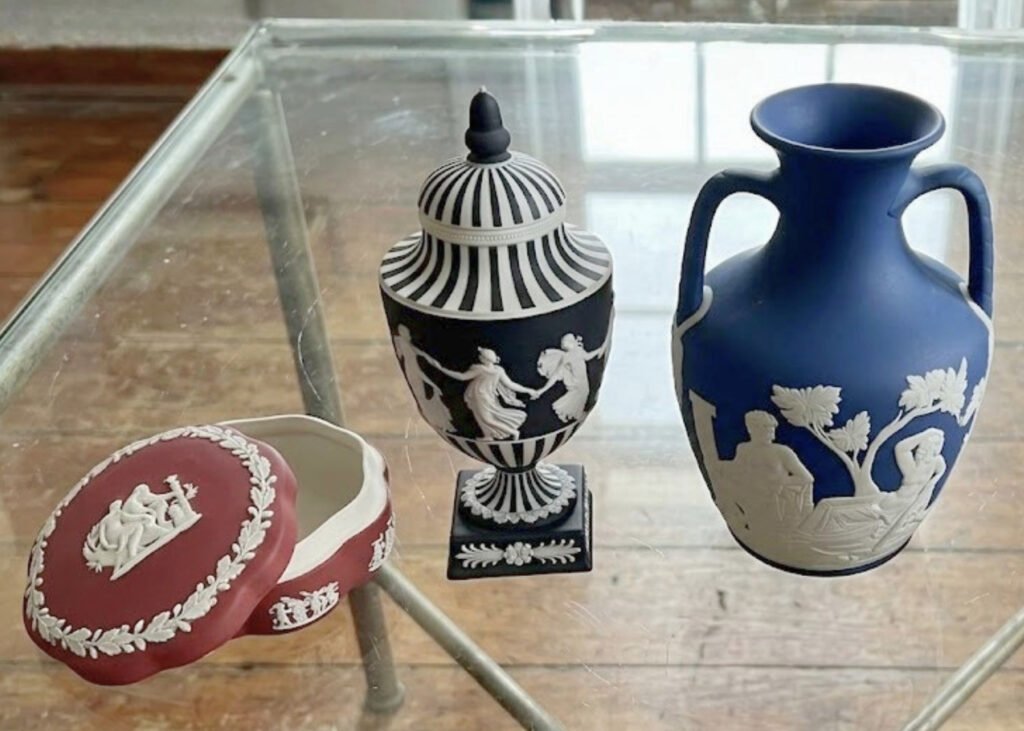
Wedgwood jasperware stands out from other ceramic dishes thanks to its matte finish and applied white designs. It was made in several colors and forms, which is why some pieces sell for only $10-$20 at a gift shop, while other pieces can realize as much as $5,000 at an auction.
But you don’t really need to be an expert to sort out the difference. You just need to know where to look. This guide walks you through the marks, the colors, the dating tricks, and the most collectible jasperware finds.
What Is Wedgwood Jasperware?
Wedgwood’s jasperware is an unglazed, matte-finish stoneware with raised white classical figures applied to a colored background. Josiah Wedgwood invented it in Staffordshire, England, around 1774–1775 after hundreds of trial firings, and the company has produced it more or less continuously ever since.
The most familiar version is that soft pale blue with white cherubs, muses, or Greek-style figures, often called Wedgwood Blue or Portland Blue.
The material itself is a fine, hard stoneware that feels almost like matte chalk to the touch. The white relief figures (called sprigs) are molded separately and applied by hand before firing. That single detail separates real jasperware from knockoffs.
Easy Checks to Identify Genuine Wedgwood Jasperware
Jasperware has been copied for over 200 years, plus Wedgwood itself has changed marks so many times that a piece stamped “Wedgwood” could be from 1785 or 1985.
Identification depends on three things: the body, the sprigs, and the mark on the base. Here’s how to check these.
1. The Visual Check
Pick the piece up and feel it before you look at anything else. Weight and surface tell you almost as much as the markings.
Genuine jasperware feels dense and slightly cool, with a matte, unglazed surface that has a faint chalky texture. The body of repros feels lighter and often has a slight gloss or plasticky sheen.
Also, run your fingernail across a figure. The white relief figures should sit raised off the background, not flush with it. You should feel a distinct step where the sprig meets the body. On repros, the “figures” are usually printed or transferred flat onto the surface, so your fingernail passes right over them with no bump.
Sharpness matters too. On a real piece, the faces, drapery, and toes on the little figures are crisp, sometimes almost photographic. Blurry, soft, or slightly melted-looking sprigs are a red flag.
2. Wedgwood Marks and What They Tell You
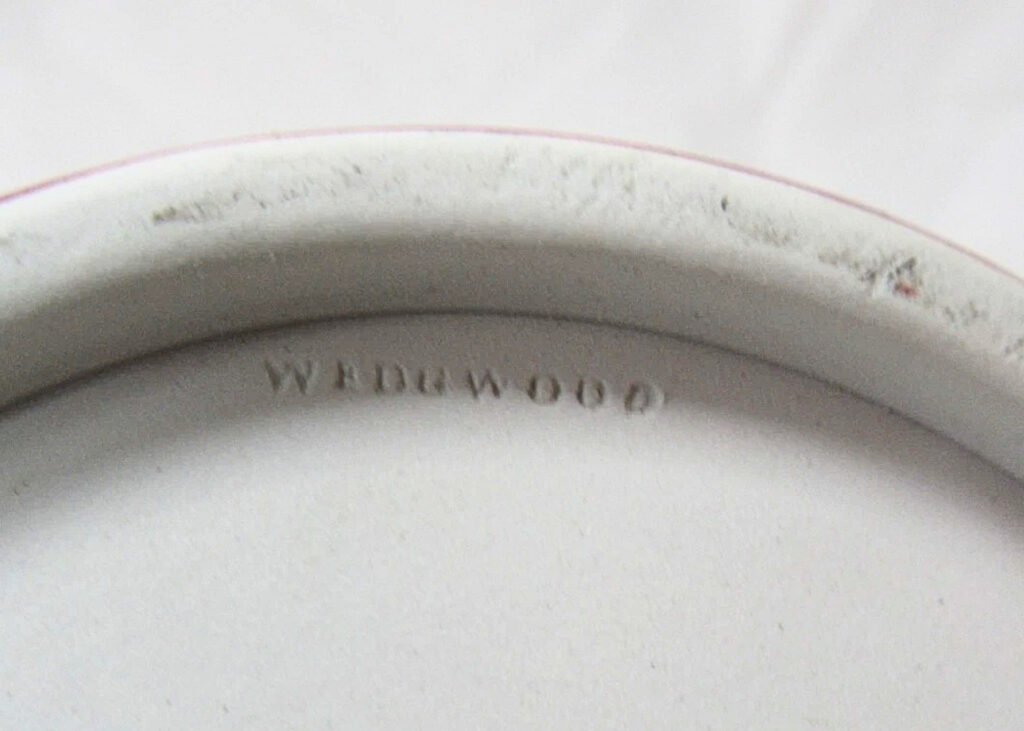
Marks are where dating gets precise. Wedgwood has used the same basic impressed name for over 260 years, but the small details around it have changed regularly.
Learning the changes in the marks helps you narrow a piece to within a decade or two. Here’s a quick glance at the evolution of the Wedgwood mark:
- 1759 to 1769 – Early impressed “Wedgwood” in movable type, often uneven or slightly arched. Rare, and mostly on earthenware rather than jasperware, which didn’t exist yet.
- 1769 to 1780 – “Wedgwood & Bentley” mark, used during the partnership. Anything with “& Bentley” is a very early piece and worth a proper appraisal.
- 1780 to 1891 – Single impressed “WEDGWOOD” from a solid slug. Clean, level, no country of origin.
- 1860 to 1929 – A three-letter date code was added alongside the main mark. First letter is the month, second is the potter, third is the year. The year sequence starts with O = 1860 and runs A to Z, then repeats with “England” added.
- 1891 to 1908 – The word “ENGLAND” appears next to WEDGWOOD, in response to the U.S. McKinley Tariff Act.
- 1898 onward – “MADE IN ENGLAND” starts to replace the older “ENGLAND” mark, becoming the norm by 1908.
- 1929 onward – A two-digit year code was introduced. So a piece stamped “57” was made in 1957, “63” in 1963, and so on. A sans-serif version of the “WEDGWOOD” name also came in around this time.
- 1970 to present – Standard mark is “Wedgwood Made in England” as a single impressed or printed stamp, often paired with the two-digit year.
Expert tip: If the mark says “Wedgwood & Co” or “Wedgewood” (with an extra E), it’s not the famous Wedgwood at all. “Wedgwood & Co” was Enoch Wedgwood, a completely separate Staffordshire maker. “Wedgewood” alone is almost always a modern reproduction or a decorative import.
3. Jasperware Colors: Common vs Rare
Color is the single biggest driver of value in jasperware, more than form, more than age, sometimes even more than condition.
Solid black jasper was produced from 1778 to 1826 and then again from 1844 onward. Pale blue solid jasper dates from 1775 to 1826. Dark or deep blue almost always points to before 1820. So if you have a solid dark-blue piece with no country mark, you’re likely looking at something well over 200 years old.
Wedgwood has produced jasperware in roughly 30 documented colors, but only a handful appear regularly on the secondary market.
The common colors (plentiful, but still collectible):
- Pale blue / Wedgwood Blue / Portland Blue
- Sage green
- Dark blue / cobalt
- Black basalt jasper
- White (solid white with colored sprigs)
The rare and valuable colors where the money is:
- Crimson dip – Produced from around 1910 through the mid-1930s. Crimson was so difficult to fire consistently, and the white sprigging so prone to bleeding into the red ground, that Wedgwood eventually stopped making it.
- Yellow / primrose yellow – It’s one of the rarest standard colors, and can sell for three to five times the equivalent blue.
- Lilac / light purple – uncommon and highly collectible, especially in Victorian-era pieces.
- Tri-color and multi-color jasperware – pieces with two or three applied sprig colors on a colored ground.
- Terracotta, caneware, and taupe – occasional short-run colors that surface at auction and get bid up quickly.
ID note: The further a piece strays from pale blue, sage green, or black, the bigger the color premium. But any yellow, lilac, crimson, or tri-color piece deserves a closer look and probably a professional valuation.
4. Signs of a Reproduction
As I told you, repro Jasperware is everywhere, especially in trinket boxes, small vases, and jewelry-style pieces. The signs on these are consistent:
- The body feels lightweight and slightly slick.
- The color is often too bright or too even, like it came off a paint chart.
- Sprigs are painted, printed, or molded as part of the body itself instead of being applied separately, so there’s no raised edge.
- Backstamps are printed rather than impressed.
- You’ll often see modern shortcuts like “genuine bone china” or made-in-somewhere-else stamps that Wedgwood never used on jasperware.
What Makes Wedgwood Jasperware Valuable?
The value of antique Wedgwood Jasperware can range from $40 to a whopping $1,000 or more. Six main things that move the price are:
- Color comes first. A pale blue jug in perfect condition might bring $40. The same jug in crimson could bring $1,500. Same shape, same size, same age, radically different market.
- Age matters uniquely; older is better, but only up to a point. Anything pre-1860 with the earlier marks is premium. Late-19th-century and Edwardian pieces (1880–1910) are usually most collectible. Mid-20th-century pieces from the 1950s and 60s can still be desirable if they’re in a rare color or form.
- Form and size drive the top end. Large vases, urns, plaques, and tea services command the highest prices. Small trinket dishes, ashtrays, and pin trays are low-tier pieces, even in rare colors.
- Condition is critical because the jasperware is unglazed. Chips, cracks, staining from moisture, worn sprigs, and repaired sections all hurt value. A crimson piece with damage can still beat a perfect blue piece, but a perfect piece always beats a damaged one in the same color.
- Marks and provenance confirm authenticity and reveal what they’re actually getting. A well-preserved backstamp with a readable date code adds confidence, and confidence adds dollars.
- Subject matter also matters. Pieces featuring the Portland Vase design, the Dancing Hours figures modeled by John Flaxman, or Homeric and mythological scenes carry named-design premiums.
Most Valuable Antique Wedgwood Jasperware Pieces & Colors to Know
Below are 10 high-value Jasperware pottery pieces, depending on colors, designs, and forms, and what they sell for today.
1. Portland Blue Jasperware Portland Vase
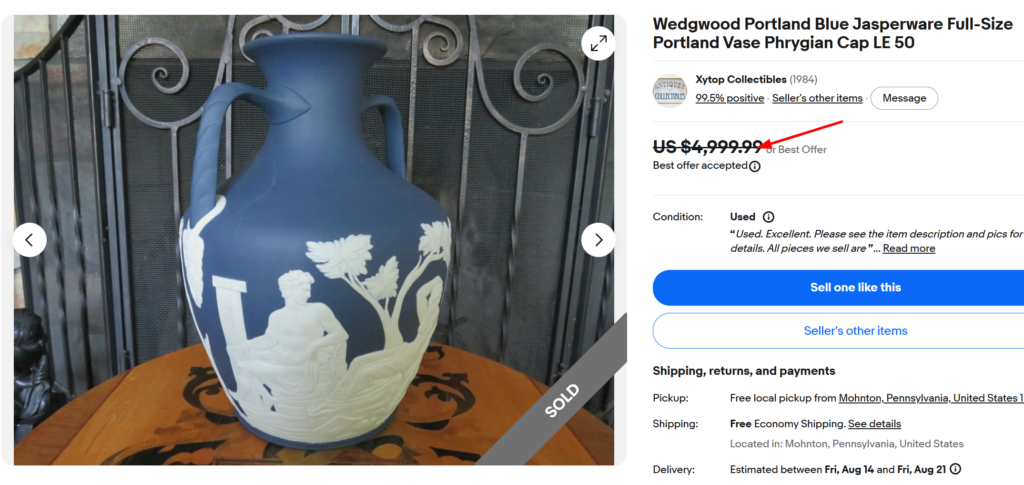
Sold for $5,000
The Portland Vase was Josiah’s most famous project. He spent four years and more than a thousand trial pieces trying to copy the Roman cameo glass original from the British Museum.
His first successful edition came out in 1790, and the design has been reissued in every era since. The values depend heavily on which edition you have.
First-edition 18th-century examples are museum-grade and effectively priceless. Late-19th-century versions in solid black or dark blue jasper regularly clear $1,000.
Modern 20th-century reissues in the standard pale blue tend to range from $200 to $500. Check for the “Portland Vase” backstamp on later editions.
- Estimated Value: $200 to $1,200+
- Production Years: First issued 1790, ongoing
- What to Check: Blue-black ground, applied Portland scene
2. Tri-Color Jasperware Urn
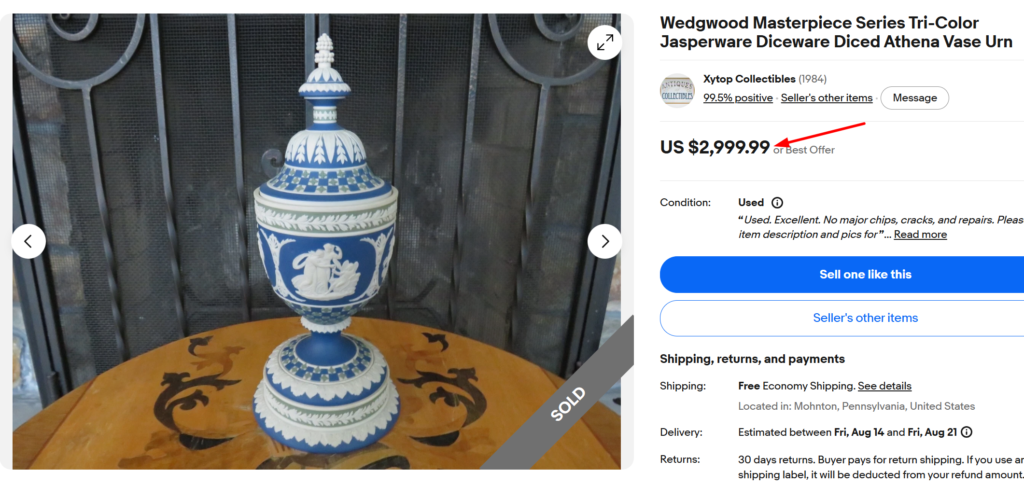
Sold for $3,000
Tri-color jasperware combines a colored body with sprigs applied in two additional colors. Making one involved firing three separately colored clay batches at once without any of them bleeding or shifting position.
Wedgwood pulled it off, but only for short production windows, and the results have always been priced accordingly.
Even smaller tri-color pieces like scent bottles or bud vases regularly sell for $600 to $1,500.
- Estimated Value: $600 to $4,000+
- Production Years: Late 18th century onward, always limited
- What to Check: Two or more sprig colors on a colored ground
3. Black Jasper Urn
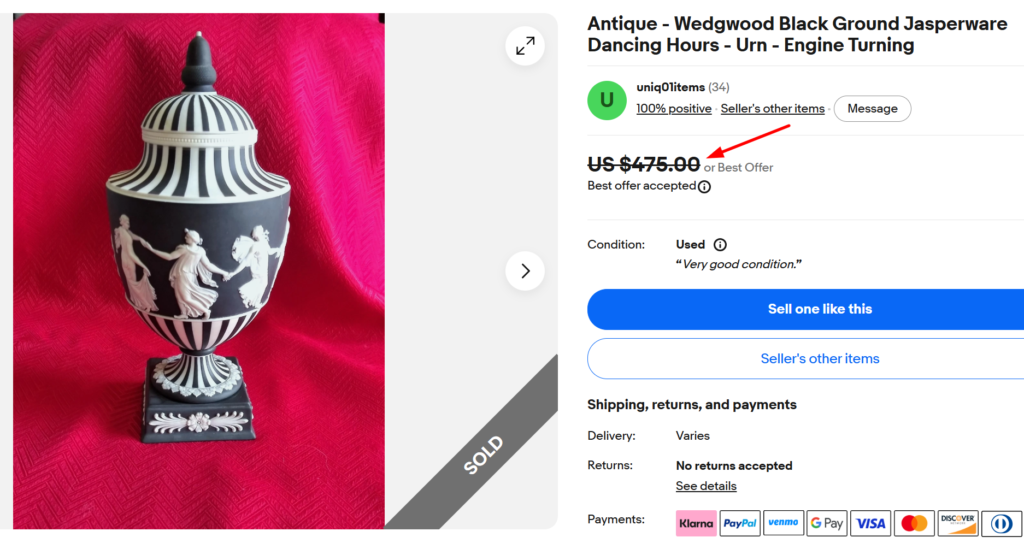
Sold for $475
Black basalt jasper is a favorite among serious collectors because of the contrast between. Original solid black jasper from 1778 to 1826 is genuinely rare. The 1844 revival era through the early 20th century produced most of what you’ll actually find on the market today.
Larger urns, especially those with lids and pedestal bases, are worth the most today.
- Estimated Value: $200 to $800
- Production Years: 1844 to present (revival era)
- What to Check: Deep matte black, sharp white figures
4. Blue Jasperware Dancing Hours Vase/Urn
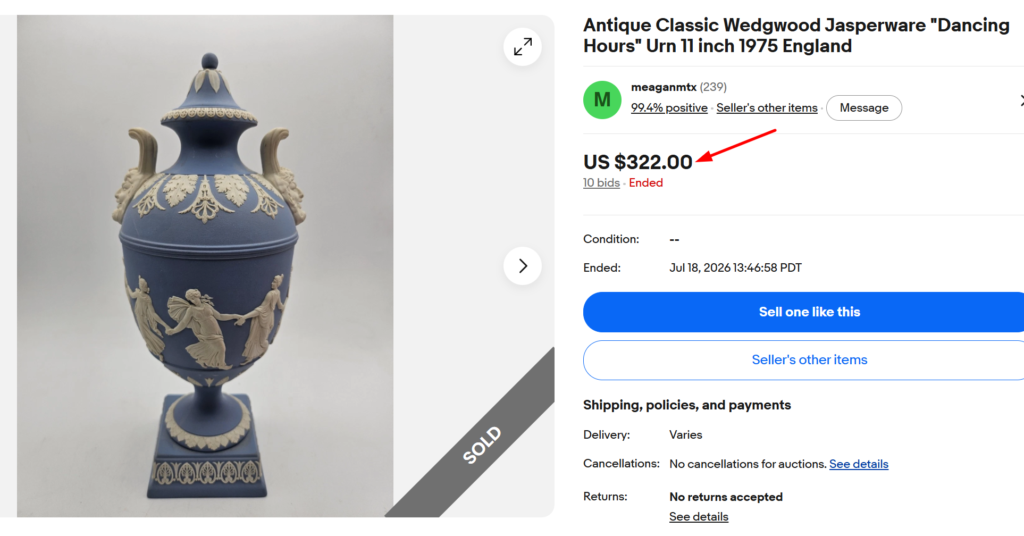
Sold for $322
The Dancing Hours pattern is probably the single most recognizable jasperware design. Modeled by the sculptor John Flaxman in 1778 for Josiah Wedgwood himself, it shows a procession of classical female figures in flowing robes, holding hands or garlands.
Because the pattern has been produced for nearly 250 years, dating is the key. A 19th-century blue Dancing Hours vase with a clean impressed mark and no country stamp brings serious money. A 1960s reissue with a 2-digit year code is worth less.
- Estimated Value: $150 to $600
- Production Years: Design from 1778, produced continuously since
- What to Check: Impressed mark, crisp sprig detail, no hairlines
- Quick Notes: Original John Flaxman design, endlessly reissued
5. Primrose Yellow Jasperware Vase
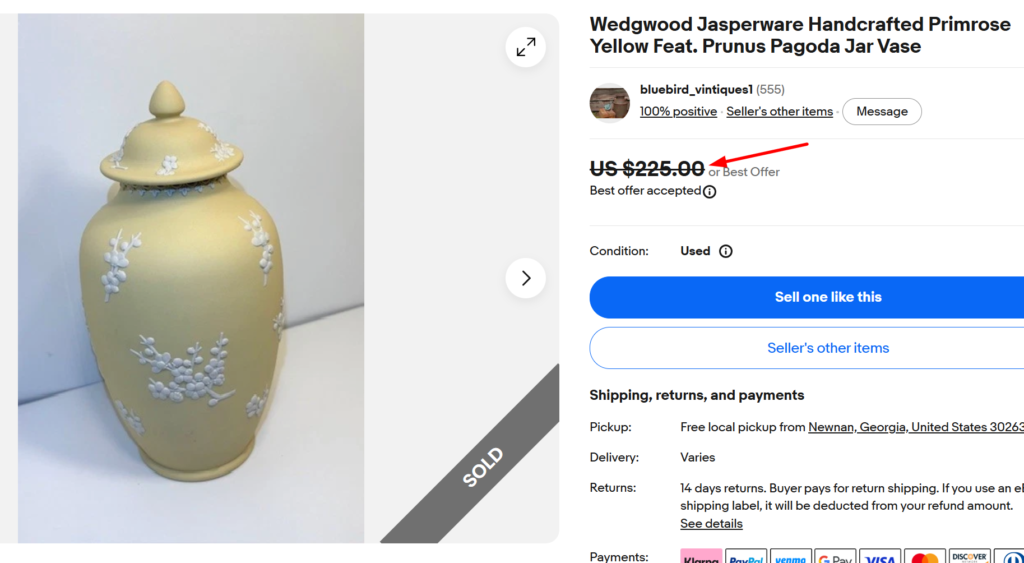
Sold for $225
Yellow is the rarest of Wedgwood’s regularly produced colors and often the hardest to spot. True primrose yellow jasperware is a warm, saturated color, close to fresh butter or old ivory keys.
Anything paler is probably cream stoneware or a completely different Wedgwood body.
A Wedgwood primrose yellow Prunus Blossom trumpet vase in good condition can bring $400 to $900 on eBay alone, and larger footed vases with black basalt sprigging (a classic Wedgwood contrast) can push over $1,000.
- Estimated Value: $300 to $1,500+
- Production Years: Sporadic 19th and 20th centuries
- What to Check: Deep primrose (not cream) ground
6. Crimson Dip Jasperware Piece
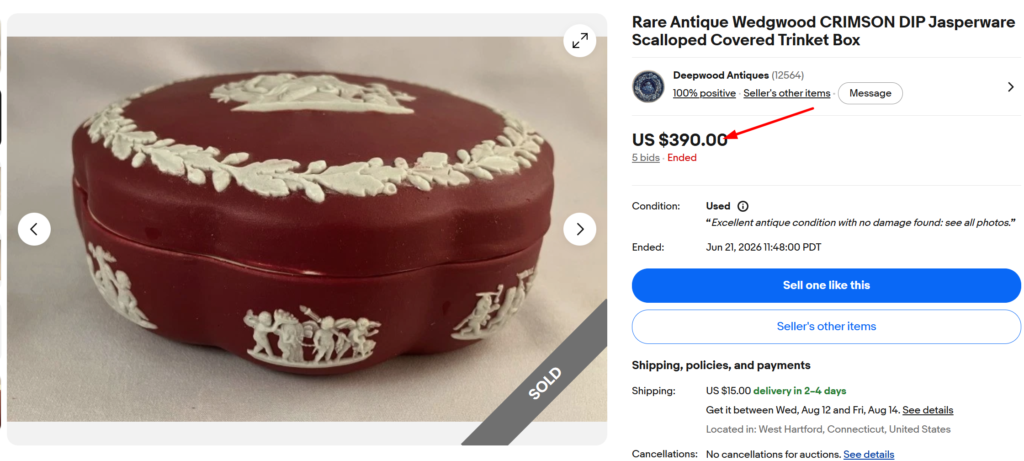
Sold for $390
Crimson dip is the most-wanted Wedgwood color. Production started around 1910 and largely stopped by the mid-1930s because the crimson slip kept bleeding into the white sprigs during firing, ruining a huge percentage of every batch.
The key identifier is that the original crimson pieces were dipped, not solid, so the interior is white while the exterior is deep crimson. Any solid red piece where the interior matches the exterior is either a much later “wine” jasper attempt or an outright reproduction.
- Estimated Value: $800 to $5,000+
- Production Years: Circa 1910 to mid-1930s
- What to Check: White interior (dipped, not solid), impressed mark
7. Dark Blue Jasperware Candlesticks (Pair)
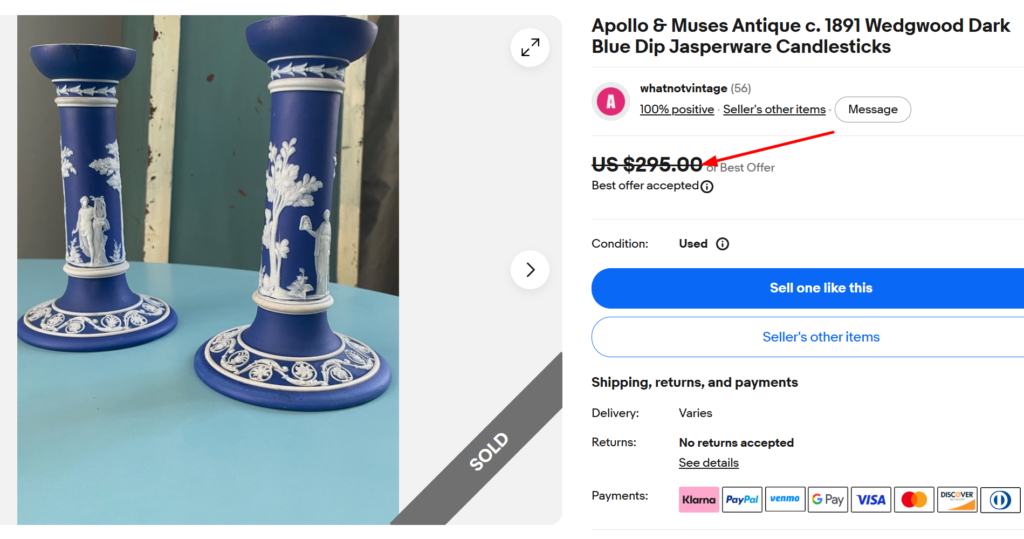
Sold for $295
Candlesticks are one of the most collectible Jasperware forms. And pairs are more collectible, especially in rarer colors other than common pale blue.
Solid deep blue pieces largely date before 1820, so a pair of dark blue candlesticks with an impressed mark alone (no country name) is worth investigating properly. Later dark blue is still collectible, just less exciting for serious collectors. Look for matching wear patterns on the bases, which suggests the pair has stayed together.
- Estimated Value: $200 to $700
- Production Years: Classical dark blue: mostly pre-1820
- What to Check: Deep cobalt tone, matching pair
8. Sage Green Trinket Box with Classical Relief
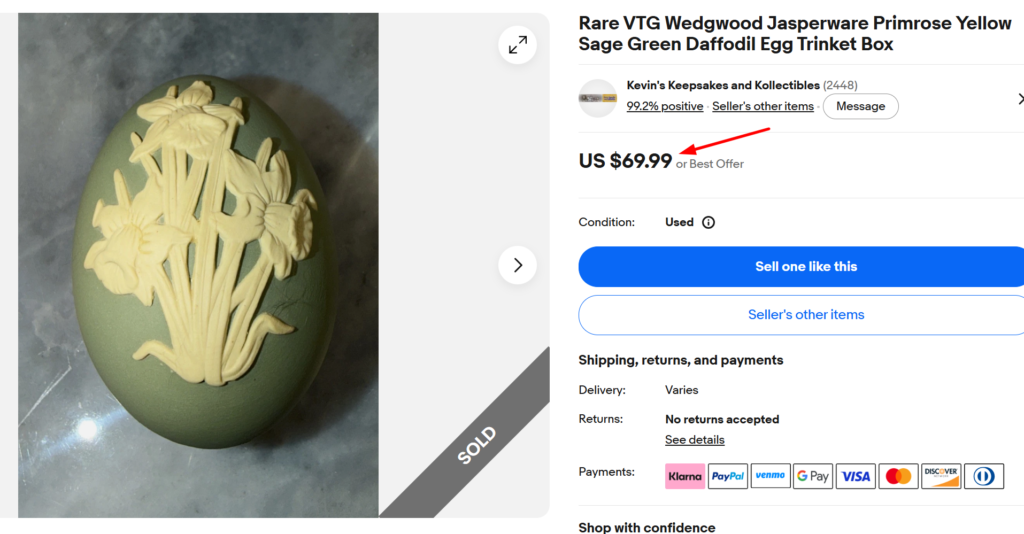
Sold for $70
Sage green is the second most common jasperware color after pale blue, and it appears in small pieces like trinket boxes, pill boxes, and lidded dishes. Most surfaces at estate sales for $10 to $30, but can actually resell for $40 to $120, depending on size and condition.
The key isn’t rarity but identification. Look for the impressed “WEDGWOOD MADE IN ENGLAND” plus a two-digit year. Anything from the 1930s and 40s trends slightly higher than 60s and 70s production, but not by much.
- Estimated Value: $40 to $120
- Production Years: Sage green has been common since the 1930s
- What to Check: Two-digit year code, tight lid fit
9. Pink Jasperware Trinket Box
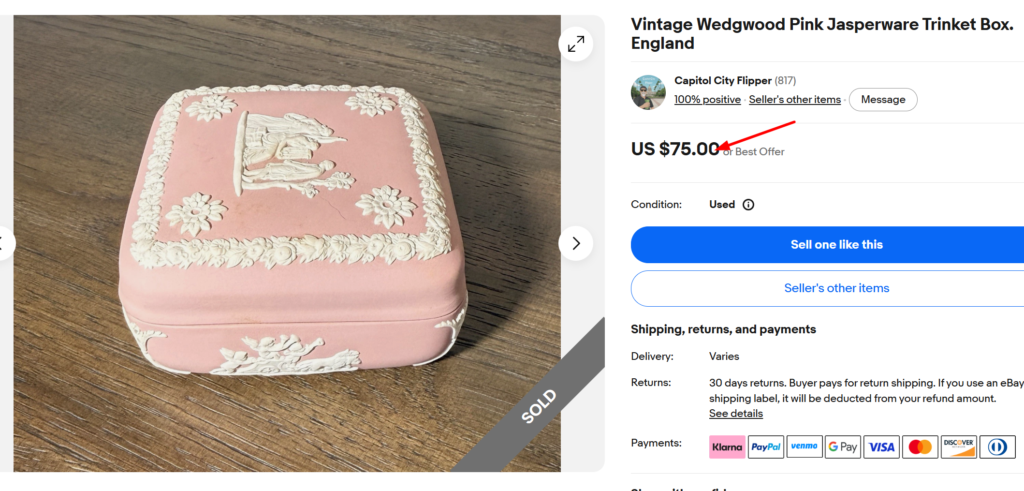
Sold for $75
Pink jasperware is a slightly confusing category. The soft, chalky pink most people recognize was introduced in 1957 and appears on plenty of bud vases, egg boxes, and Dancing Hours pieces from the late 20th century.
Those are common and sell in the $80 to $180 range. The two-digit year code on the base does most of the work here. Anything stamped “57” through “85” is standard modern pink.
Genuinely early pink jasper (pre-1930) is a different animal and edges toward the lilac and mulberry colors. Those are much scarcer and can bring several times the modern pink prices.
- Estimated Value: $80 to $250
- Production Years: Introduced in 1957, various runs
- What to Check: Two-digit year code, pastel pink ground
- Quick Fact: Modern pink is common; earlier pink is not
10. Jasperware Sterling Silver Cameo Ring
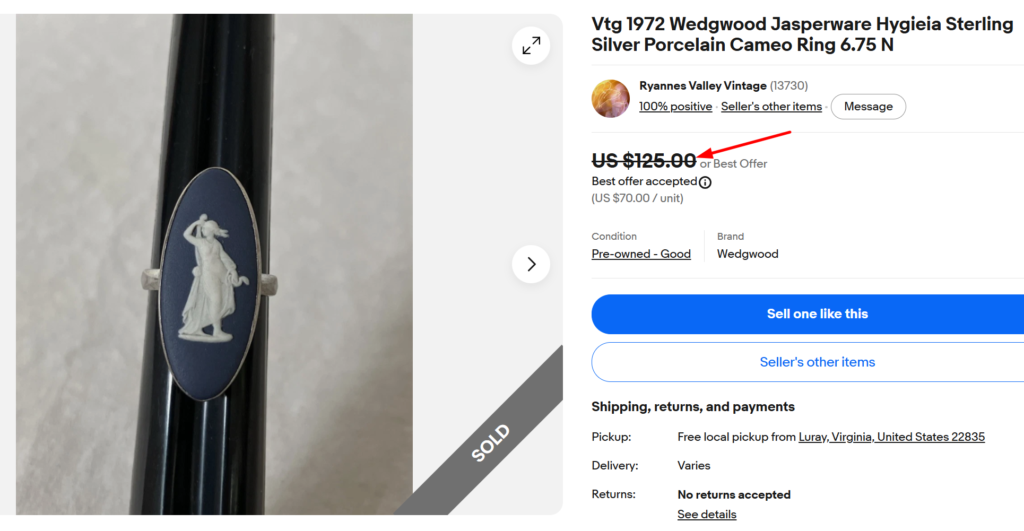
Sold for $125
Wedgwood cameo jewelry took off in the 1960s and 70s when small blue-and-white jasper cameos got mounted into sterling silver rings, pendants, and brooches.
Blue cameos are common and sell in the $60 to $150 range, depending on the mount quality. Yellow, lilac, or black jasper cameos in sterling settings regularly bring $200 to $400. A 14K gold Wedgwood cameo brooch or ring with diamond accents can sell for over $500.
ID Note: Check the back of the mount for both a Wedgwood impressed mark on the cameo itself and a metal hallmark (925 for sterling, 14K or 585 for gold).
- Estimated Value: $60 to $300
- Production Years: Popular from the 1960s onward
- What to Check: Genuine sterling mount, small oval jasper cameo
The key thing to remember with Wedgwood jasperware is that color, not age, drives the value of what you’ll actually find. Learn the mark sequence, learn to feel the difference between raised sprigs and printed decoration, and always flip the piece over before you decide what it’s worth.