

Stoneware pottery came to America in the early 1700s with German and English potters who settled in New York and Pennsylvania. It’s made with clay that’s fired hot, around 2,200°F, which seals the walls tight and makes the pieces safe for storing food items for months on end.
Many small potteries turned them out through the 1800s, but the icebox and Mason jars replaced crocks by the 1920s. So anything you find from before that window is a real antique. But knowing which crock is valuable is tricky.
This guide will help you find out whether your old stoneware crocks are worth anything, identify what you have, and find the real values.
What Makes an Antique Stoneware Crock Valuable?
You can hold two stoneware crocks that look almost identical, yet one might be a $50 piece while the other might bring $2,000 at auction. The whole difference comes down to six factors explained below:
- Maker attribution is the most important one. A signed Cowden & Wilcox, Norton, or Remmey will always beat an unmarked crock of similar age and size. Marked pieces give collectors provenance, and provenance moves prices.
- Decoration comes second. Plain crocks and pieces with simple bee sting cobalt swipes usually stay in the $50 to $200 range. Freehand cobalt birds, deer, flowers, and figural scenes push into the $400 to $2,500 range. And rare motifs like lions, dogs, ships, patriotic emblems, or human figures can hit five figures at the specialty auctions.
- Size also matters a lot for value. Common 3 to 6 gallon crocks bring less than either tiny 1 gallon pieces or the huge 15 to 30 gallon storage crocks. Both extremes bring a premium because far fewer of them survived.
- Condition is where the value changes fast. Watch for hairline cracks, star cracks (spreads out from one point), and rim chips. A small chip on a common crock might not sting much, but on a rare decorated piece, it can cut the value by 30 to 50 percent.
- Rarity of the mark or form is another deciding factor. Some potteries only operated for a handful of years or had a fire that wiped out most of their stock. Pieces from those short-lived operations are genuinely scarce and get bid hard when they surface.
- Provenance and history boost the value up. Crocks with dated inscriptions, merchant advertising for a named store, or a documented ownership chain carry a real premium over generic examples.
11 Most Valuable Antique Stoneware Crocks to Find at Thrift Stores
Depending on the value factors above, below are listed some of the most valuable stoneware crocks. Each one holds its value due to certain features that are worth checking out.
1. Red Wing Bee Sting Salt-Glazed Crock
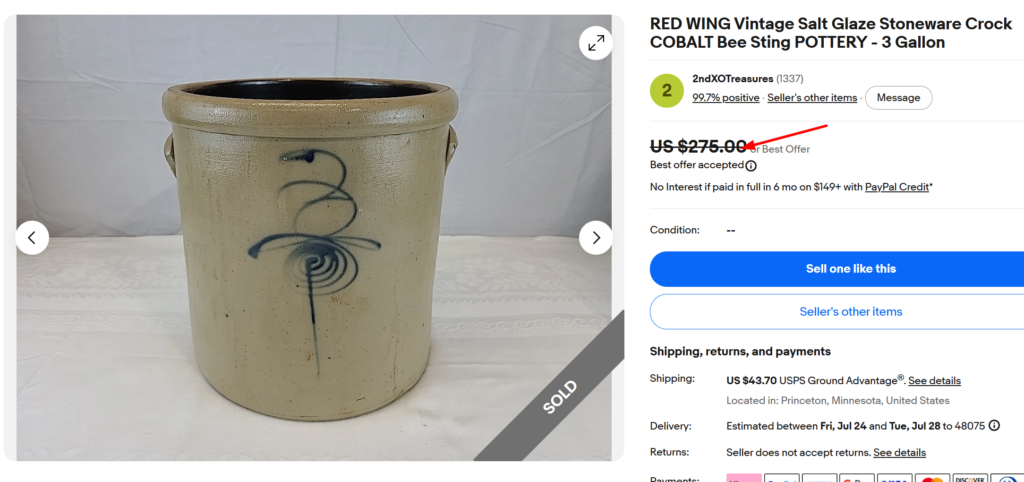
Sold for $275
The bee sting is Red Wing’s most recognized cobalt pattern, showing a slash shaped like an insect stinger sitting right below the gallon number.
Salt-glazed versions predate the 1896 shift to Bristol glaze, so any bee sting with that grey orange-peel surface is genuinely early. Larger sizes and pieces with the elephant ear or birch leaf stamps bring the biggest money.
- Estimated Value: $150 to $600
- Production Years: 1880s to 1896
- What to Check: Cobalt stinger, salt glaze texture
- Quick Notes: Pre-1896 examples are worth double
2. J. & E. Norton Bennington Floral Crock
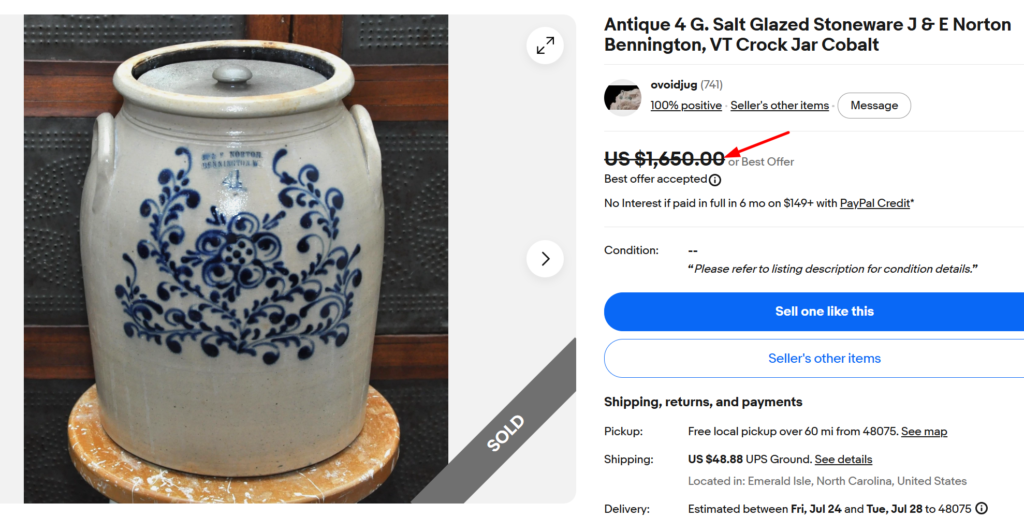
Sold for $1,650
J. & E. Norton floral crocks come from the short 1850 to 1859 partnership window, which makes any signed piece a strong collector target.
The cobalt work is slip-trailed freehand, usually a large central flower flanked by trailing leafy vines that spread across the front. Look for the impressed “J. & E. NORTON, BENNINGTON, VT” stamp above the gallon number.
- Estimated Value: $600 to $2,500
- Production Years: 1850 to 1859
- What to Check: Slip-trailed cobalt floral, Bennington stamp
3. Cowden & Wilcox Cobalt Daisy Jug
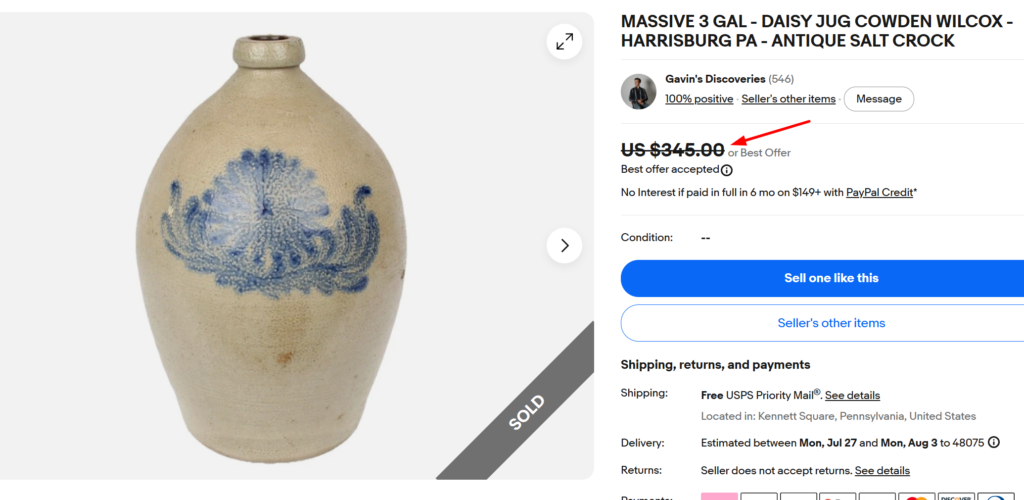
Sold for $345
Cowden & Wilcox from Harrisburg is one of the most identifiable Pennsylvania makers thanks to those folky cobalt florals and freehand floral brushwork.
The crocks often have a bulbous ovoid shape, often with applied ear handles at the shoulder. Rare double-stamped examples, where the maker’s mark got impressed twice on the same piece, carry a strong collector premium.
- Estimated Value: $300 to $1,500
- Production Years: Late 1850s to 1870s
- What to Check: Freehand cobalt tulip/daisy, impressed maker’s stamp
4. N.A. White & Sons Utica NY Cobalt Tree Crock Jug
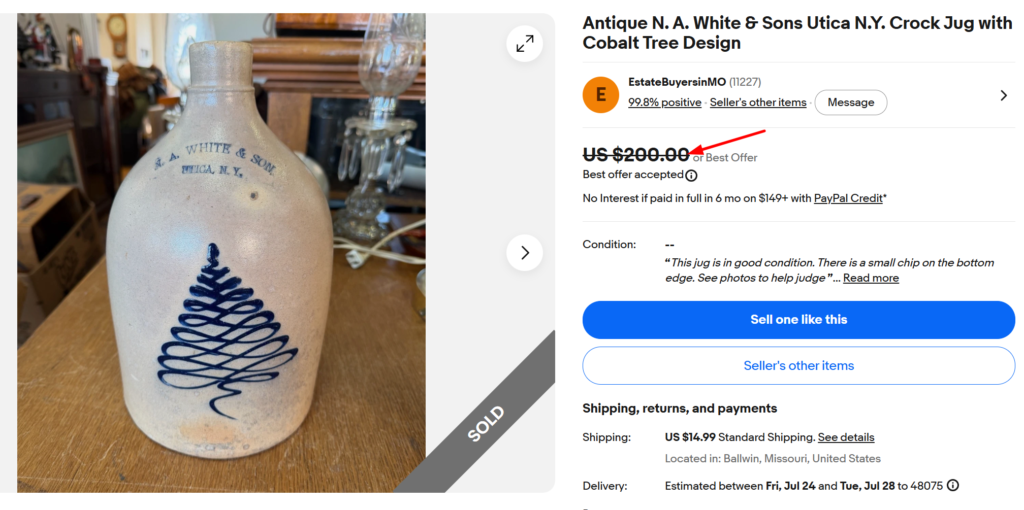
Sold for $200
N.A. White & Sons out of Utica ran from the 1860s onward and became one of the most collected Central New York makers. The cobalt tree design is a signature freehand motif, brushed in a zig-zag “feather” pattern that mimics a stylized evergreen.
Look for the “N.A. WHITE & SON, UTICA, N.Y.” impressed stamp near the shoulder to confirm attribution before paying big premiums.
- Estimated Value: $200 to $900
- Production Years: 1860s to 1890s
- What to Check: Cobalt tree motif, impressed Utica stamp
5. E. & L.P. Norton Bennington Floral Crock
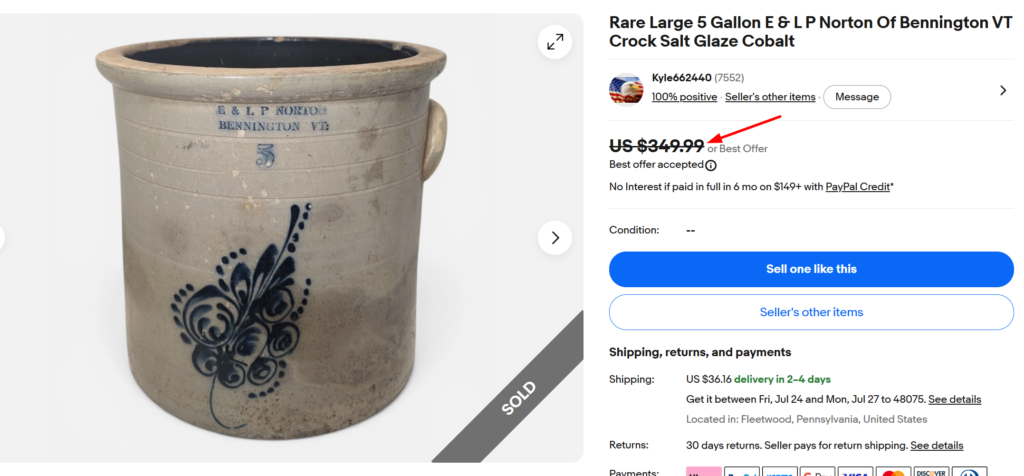
Sold for $350
This specific mark pins the crock to the 1861 to 1881 Norton partnership window. Floral decoration is what you’ll see most often on these antique pieces.
The cobalt work here is usually brushed rather than slip-trailed, so the edges are softer than on earlier Nortons. Also, small applied ear handles and a brown Albany slip lining are typical, so check these details first to confirm authenticity.
- Estimated Value: $250 to $900
- Production Years: 1861 to 1881
- What to Check: Cobalt floral spray, ear handles, Albany slip interior
6. Western Stoneware Maple Leaf Crock
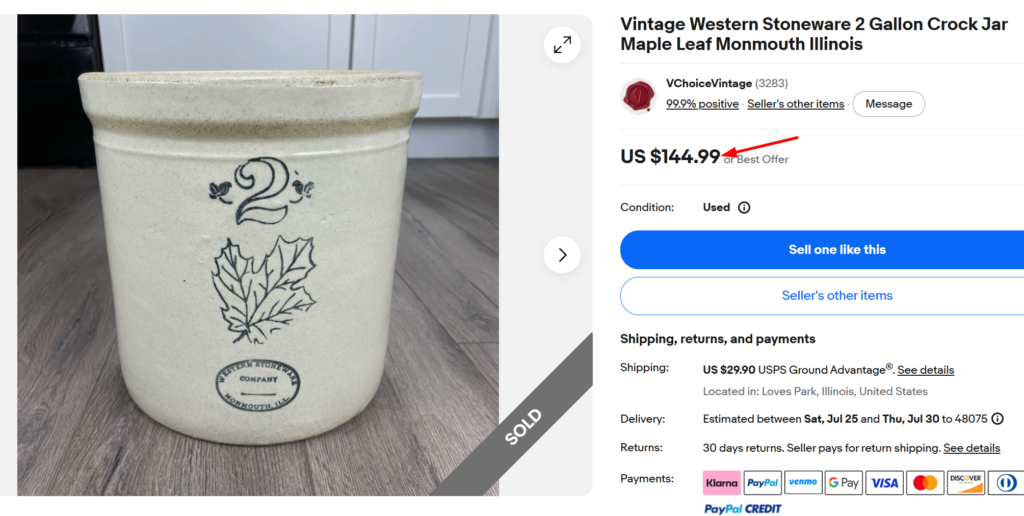
Sold for $145
The maple leaf is one of the most common stamps in American stoneware. Western Stoneware kept using it from 1906 until roughly 1930, so you’ll need to rely on the plant number and glaze to date the piece precisely.
Advertising crocks with a local merchant’s name printed on the side are the most desirable among Western examples.
- Estimated Value: $60 to $300
- Production Years: 1906 to 1930
- What to Check: Maple leaf logo, plant number, advertising
- Quick Notes: Plant numbers 1 through 7 identify the factory
7. Robinson Ransbottom Blue Crown Crock
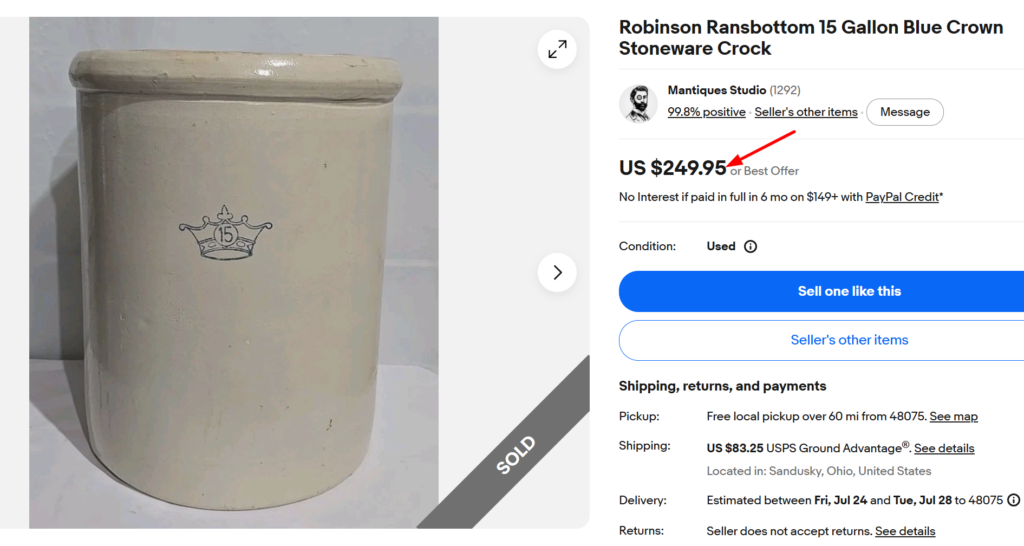
Sold for $250
The RRP blue crown is one of the easiest marks to spot. And if the crown itself is faded, the yellow clay body confirms attribution.
Common sizes are 2 through 6 gallons, with the bigger pieces pulling stronger prices. These are the best entry-level crocks for a new collector because the value stays reasonable.
- Estimated Value: $40 to $300
- Production Years: 1920 to 1970s
- What to Check: Blue crown mark, yellow clay body
8. Cobalt Blue Merchant Advertising Crock
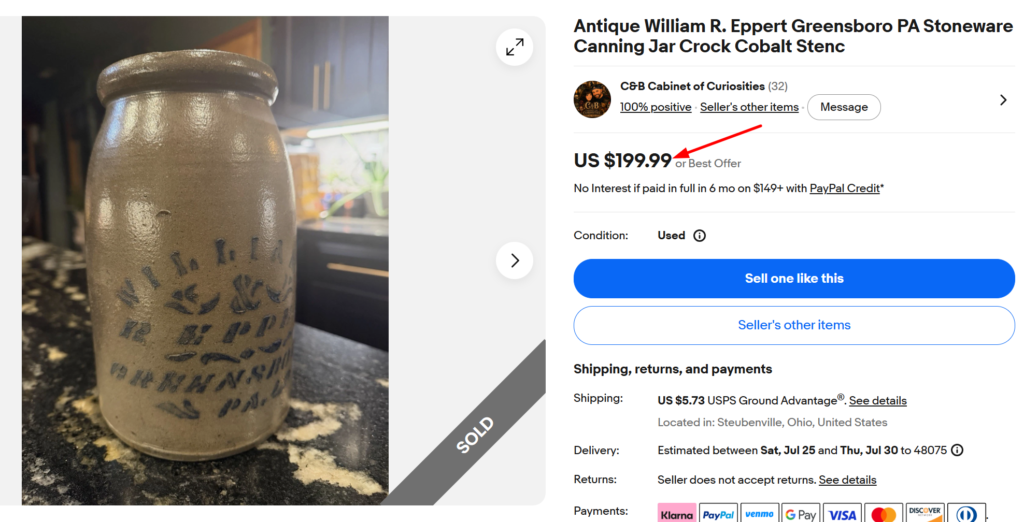
Sold for $200
Advertising crocks were promotional pieces made for local merchants, grocers, and butchers. The store name and town got stenciled in cobalt across the front, usually on a small 1 to 3-gallon size.
Regional collectors chase pieces from their own hometowns, so demand often runs way above what the piece would bring in a general market.
- Estimated Value: $200 to $1,200
- Production Years: 1880 to 1915
- What to Check: Stenciled merchant name, town, state
- Quick Notes: Small sizes and rare towns bring the highest prices.
9. Ovoid Salt-Glazed Crock (Pre-1860)
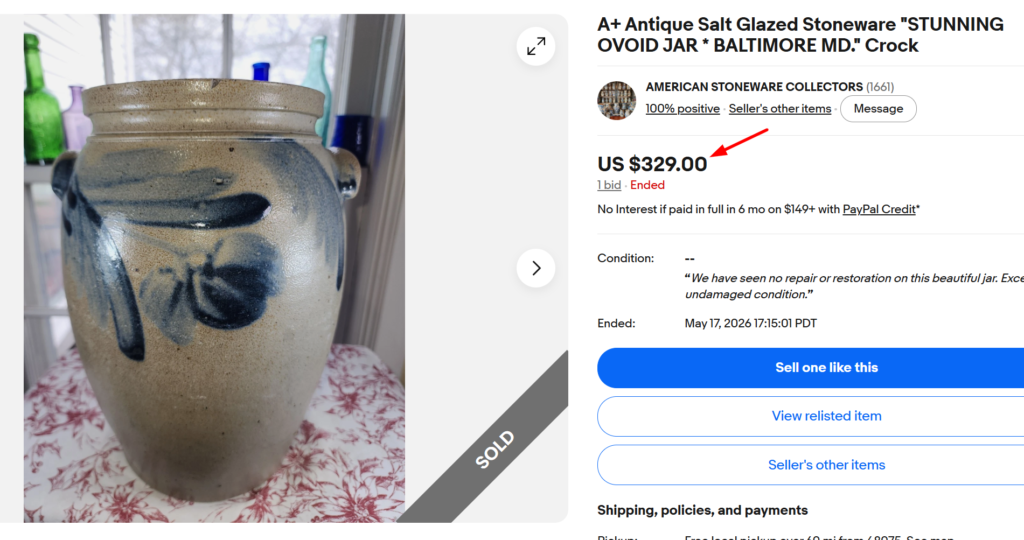
Sold for $330
Ovoid crocks have a distinctive egg shape where the widest point sits at the shoulder rather than the middle. This form is a strong dating clue itself because American potteries mostly moved to straight-sided cylindrical crocks around 1860.
Early ovoid pieces are often unmarked, but they still carry a serious premium just for the rare shape.
- Estimated Value: $250 to $1,000
- Production Years: 1820s to 1860
- What to Check: Egg-shaped body, hand-thrown thickness
10. Butter Churn Crock with Original Lid and Dasher
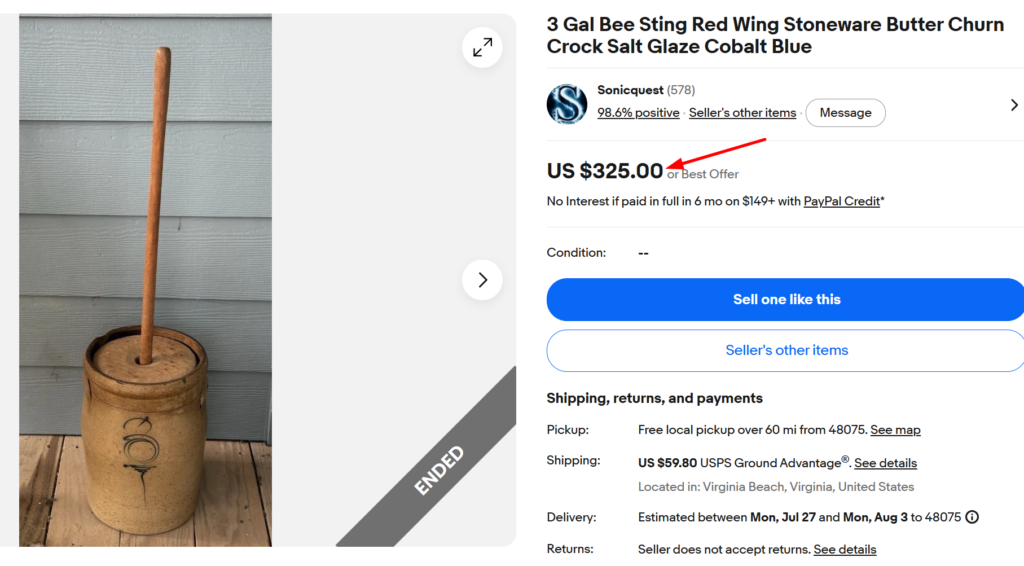
Sold for $325
Butter churn crocks are tall, cylindrical vessels that came with a wooden lid and a plunger-style dasher for churning butter. A marked churn from Red Wing or a Pennsylvania maker with the full assembly is a real specialty piece.
Also, complete sets with all three original parts are much rarer and can be worth 3x the crock-only price, since dashers took heavy use and often cracked or split.
- Estimated Value: $200 to $800
- Production Years: 1860 to 1910
- What to Check: Tall cylindrical form, original lid, and dasher
11. Miniature or Sample Crock (Under 6 Inches)

Sold for $1,275
Miniature crocks were made as salesman’s samples, advertising pieces, and children’s toys. Anything under 6 inches tall from a named pottery is highly collectible because so few of them survived intact.
A miniature Red Wing, Monmouth, or Norton crock with a readable mark can easily outsell a full-size version of the same piece.
- Estimated Value: $200 to $1,500
- Production Years: 1880 to 1920
- What to Check: Under 6-inch height, clear maker’s mark
- Quick Notes: Salesman’s samples are the rarest.
How to Identify Antique Stoneware Crocks?
There are a few clues on vintage stoneware crocks, and once you learn what to look for, you can determine and date authentic ones at an estate sale or garage sale. Here’s how.
Maker’s Marks and Stamps
Marks are the most reliable dating clues. Well, the first step will be to look at the top of the side wall and the bottom of the crock. During the 19th century in America, the majority of potteries would put their mark directly on the raw clay before baking the crock. This is the quickest way to get your ID.
The most common brands you’ll find are:
- Red Wing Stoneware Co. (Minnesota) – Started making crocks in the late 1870s. Hand-painted cobalt decoration through 1896, then switched to stamped decorations. The earliest stamps were the elephant ear and birch leaf shapes, replaced by the now-famous red wing logo from around 1906 until 1967.
- Monmouth Pottery (Illinois) – Set up shop in Monmouth in 1892. Got folded into Western Stoneware Company in 1906. The maple leaf logo showed up around 1902 and stuck around until roughly 1930.
- Western Stoneware Co. (Illinois) – Formed in 1906 when seven small potteries merged. Kept the maple leaf mark inherited from Monmouth. Sometimes you’ll see a small number next to the leaf, and that tells you which of the seven plants made your piece.
- Robinson Ransbottom (Ohio) – Founded as Ransbottom Brothers Pottery in 1901; changed its name to Robinson Ransbottom in 1920 by joining with Robinson Clay Products. Its trademark consists of a cobalt blue crown with numerals or letters inside it.
- Norton family (VT) – It’s one of the longest continuously running potteries (from 1793 through the 1890s). The mark changes with each generation. You’ll see “L. Norton,” “J. Norton,” “J. & E. Norton,” “E. & L.P. Norton,” and “F.B. Norton Co.” Each version from a specific production window.
- Cowden & Wilcox (Harrisburg, PA) – It ran from the late 1850s into the 1870s. The mark reads “COWDEN & WILCOX” impressed near the shoulder, usually paired with folky cobalt tulips and floral brushwork.
- Whites Utica / N.A. White & Son (NY): Active from the mid-1800s into the late 1800s. Best known for large freehand cobalt animals painted across the front, especially birds and deer.
Good to Know: Unmarked pieces aren’t always worthless. Plenty of small country potteries never stamped their work, and most pre-1850 pieces are unsigned. In those cases, check the clay body, glaze color, and shape.
Cobalt Blue Decoration

Most antique stoneware crocks feature cobalt decorations, but they are not all alike. Freehand cobalt designs (birds, flowers, deer, houses, patriotic images) were applied to the crocks before firing, and could make an ordinary $75 crock worth $1,500.
Cobalt decoration by stenciling or stamping was applied starting from about 1880. They look very neat and machine-like and have lower value than hand-painted designs. The most popular design was “bee sting” or “lazy eight”.
Value Tip: The more elaborate and hand-drawn the cobalt, the more the crock is worth.
Gallon Numbers and Capacity Stamps
Most 19th-century crocks bear a number on their front which represents their capacity in gallons. The sizes varied from 1 gallon to 60 gallons for the largest storage pieces. That number is usually stamped or brushed in cobalt above the design.
This also matters for value. Common 3 to 6-gallon crocks are the easiest to find, so they bring less. Tiny 1 and 2-gallon pieces and huge 20 to 30-gallon storage crocks are both scarcer and way more valuable.
Glaze Type as a Dating Clue
The outside glaze is another fast dating tool. Run your finger across the surface and note the color and feel. Here’s what each type points to:
- Salt glaze: Used mainly before 1900. It’s a gray or tan glaze with a slightly bumpy, orange-peel finish. Made by tossing salt into the kiln at peak firing temperature, creating a pitted surface.
- Albany slip: Deep chocolate brown, smooth and glossy. Usually shows up as the inside coating on crocks, and sometimes as the outside glaze on plainer utility pieces from roughly 1830 through 1900.
- Bristol glaze: Creamy white or off-white, smooth and even. Started replacing salt glaze at Red Wing and other big makers around 1896. So if your crock has a bright white exterior, it’s almost certainly post-1900.
Handles, Rims, and Bottom Clues
The thickness of the wall, plus its handmade nature, is a quick way to identify the antique piece from the modern replica. Another sign that the crock is original is the presence of a slight bow in the walls due to being shaped by hand.
As for the handles, applied “ear handles” (small pinched loops attached by hand to the sides) point to 19th-century production.
The rim also tells you a lot. For instance, a flared rim is much more prevalent in crocks made before 1900 than a neat cut rim.
Finally, examine the bottom. The authentic old crock will have an unglazed foot ring on which it rested while baking in the kiln, and you may find bits of kiln dirt stuck to it. A perfect glazed bottom is definitely an indication of a repro.
That gap between a $30 flea market crock and a $2,000 auction crock usually sits in the maker’s mark, the cobalt work, the glaze, and the shape. So once you check those four things, you’ll never walk past a rare find.