
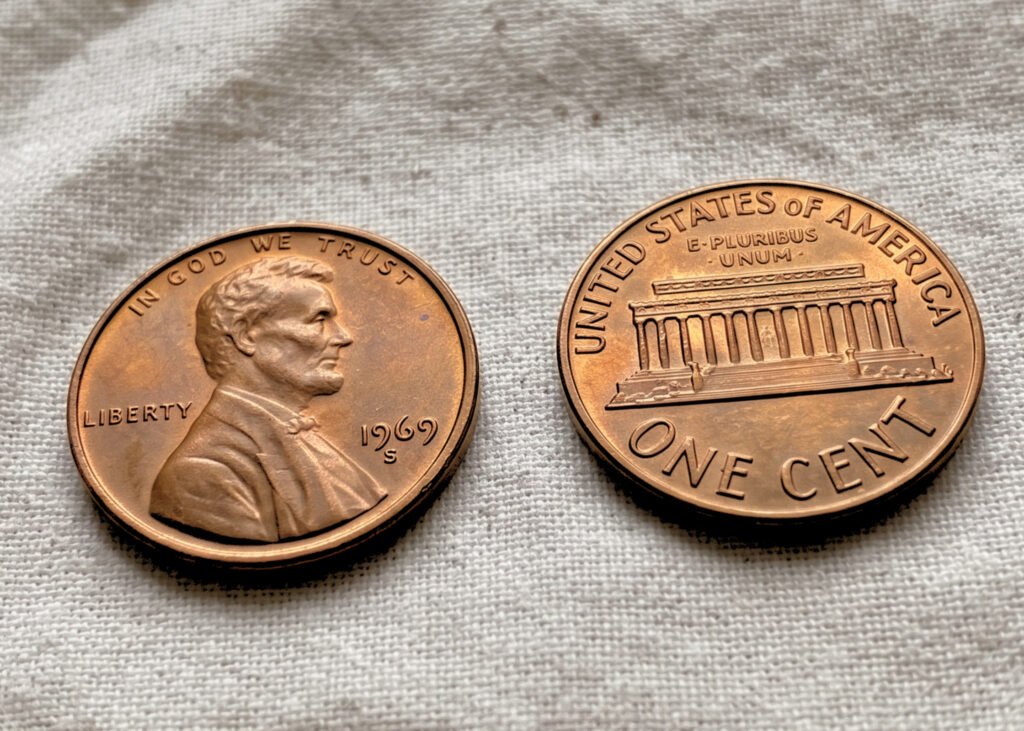
A 1969 Lincoln penny looks quite ordinary at first, but if you see one in sharp condition and in its original red-orange color, it’s worth a closer look. Knowing how to spot an authentic 1969 Lincoln penny, its value factors, rare varieties, and errors will save you from spending or donating a valuable 1969 cent.
A Quick Look at the 1969 Lincoln Cent
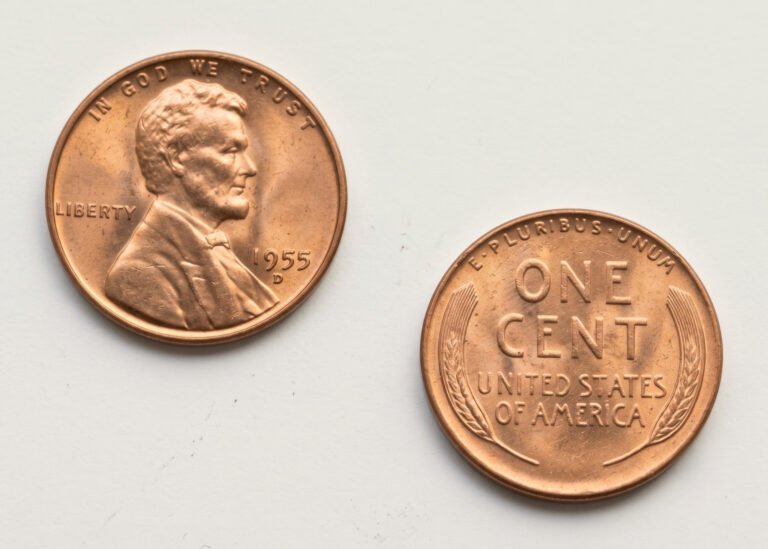
A Lincoln cent from 1969 features the Memorial Building on the reverse and the same Abraham portrait on the front, like all Lincoln pennies.
Apart from the building, you’ll also see “UNITED STATES OF AMERICA,” denomination “ONE CENT,” and motto “E. PLURIBUS UNUM” on the back, while the mint mark and date lie on the front.
This cent is made from an alloy of 95% copper and 5% zinc and weighs 3.11 grams, a composition that lasted from 1962 to 1982.
How to Tell If an Old 1969 Penny is Genuine?
All you need is a 10x loupe, a digital scale, and good light, plus this list of key features to check on a 1969 penny to tell if it’s genuine or not.
Step 1: Find the Mint Mark
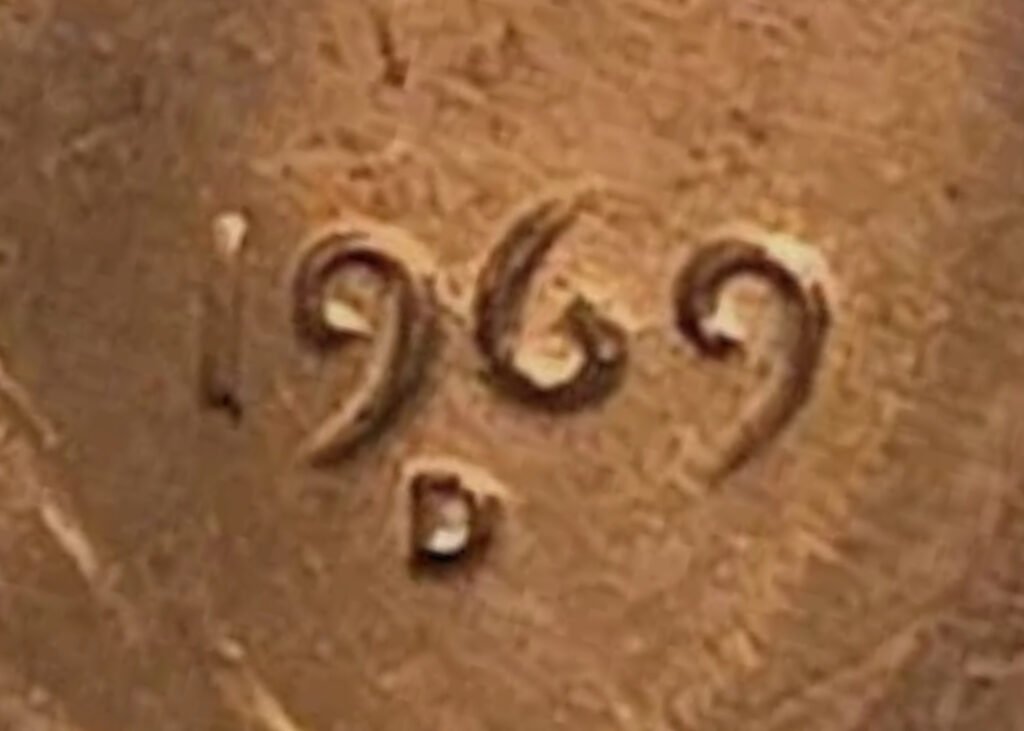
Like every Lincoln penny, the mint mark appears just below the date. No letter means Philadelphia, a D means Denver, and an S means San Francisco.
That letter sets your starting value and tells you which errors are even possible on your coin.
- Philadelphia (No Mint Mark – P): 1,136,910,000
- Denver (D): 4,002,832,200
- San Francisco (S – Business Strike): 544,375,000
- San Francisco (S – Proof): 2,934,631
Step 2: Look for the Designer’s Initials
Flip the coin over and pay attention to the coin’s reverse. Genuine examples show Frank Gasparro’s “FG” just right of the Memorial building near its base, and Brenner’s VDB appears on Lincoln’s shoulder on the front.
Missing initials are usually a sign of an over-polished die rather than a major error.
Step 3: Check the Memorial Building
While you’re on the reverse, observe the steps and lower columns. If they’re faint or gone and the roof looks like it’s floating, you have a floating roof coin. It’s a die-wear issue, not a major minting error.
Step 4: Weigh It and Judge the Color
A normal 1969 cent weighs about 3.11 grams, so anything near 2.27 grams could be struck on a dime blank.
Once the color is confirmed, check the color. Copper coins are also graded based on the colors:
- Red (RD) 1969 pennies keep their mint shine and are worth the most.
- Red-Brown (RB) coins are mixed with red and brown toning. These are mid-tier examples.
- Brown (BN) coins are fully toned. The wear on these 1969 cents is too much and drops their value.
What Makes a 1969 Lincoln Penny Valuable?
Two 1969 cents from the same mint can sell for just one cent or a few thousand dollars. The difference comes from several factors, and grading companies like PCGS and NGC judge each one.
- Grade – Grading happens on the 1 to 70 Sheldon scale. For 1969 cents, real premiums start around MS-66, and the value goes up into hundreds to thousands with the grades.
- Certification – For anything worth over about $100, a PCGS or NGC certification adds trust and usually boosts the price.
- Color – Red coins with full original luster sell for several times more than Brown coins in the same grade.
- Mint mark – The mint mark not only tells about the mintage from a specific mint, but it also decides which varieties are possible. For example, only an S coin can be the famous doubled die.
- Error type – Mint errors are also collectible, but dramatic errors like wrong planchets are worth more than minor issues like floating roofs or die breaks.
Most Valuable 1969 Pennies and Rare Errors to Look For
Let’s take a look at the 1969 pennies collectors actually pay for, from top-grade regular coins to the famous doubled die and the mint errors.
1. 1969-D Penny in Gem Red (MS-67 RD)
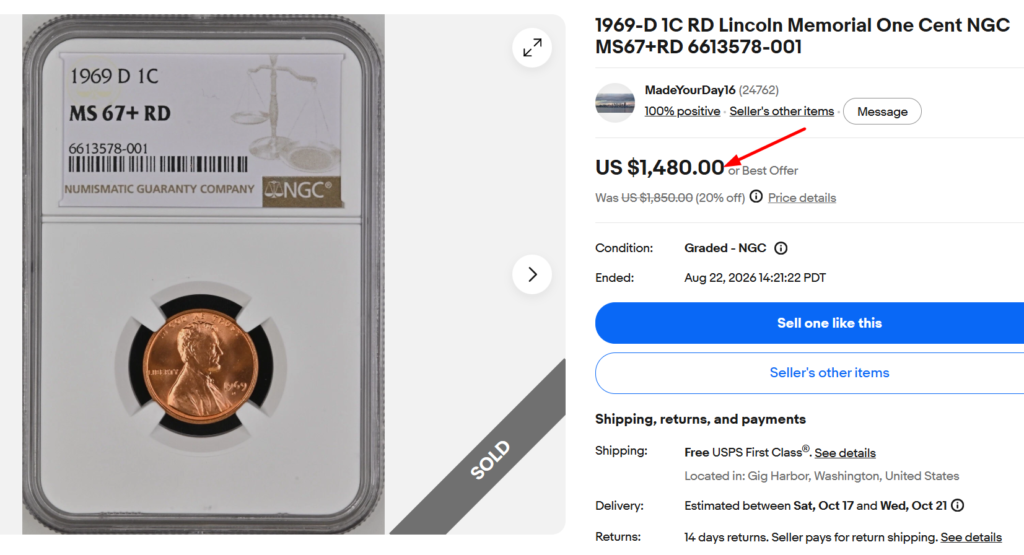
Sold for $1,480
Denver released over 4 billion 1969 cents, more than both Philadelphia and San Francisco combined. So, generally, a 1969-D cent is not worth much.
But due to high mintage, high-grade Red examples are rare to find, which makes them valuable. In 2010, Heritage auctioned off a 1969-D MS-67 Red penny for $7,475.
- Estimated Value: $1 to $7,475 (MS-67 RD record)
- What to Check: Small D under the date
- Quick Notes: Grade and color matter most here
2. 1969-S Penny in Mint State
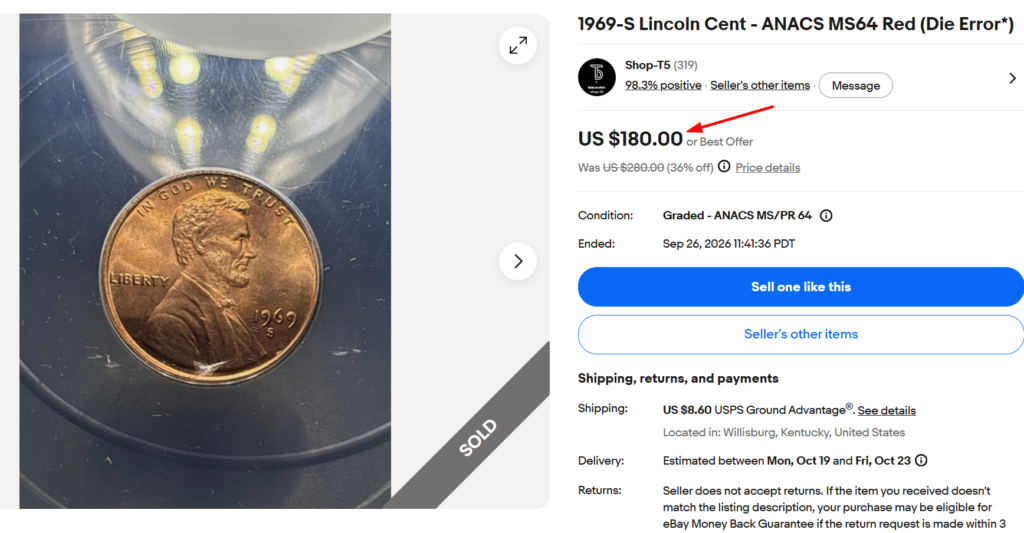
Sold for $180
San Francisco made about 544 million business strike 1969 cents, the lowest number among the three mints that year. So, the 1969-S is the year’s rarest coin, but circulated specimens are easy to find.
But gem red pieces may have premium value. MS-67 Red examples can fetch up to $4,500.
- Estimated Value: $1 to $4,406 (MS-67 RD record)
- What to Check: S mint mark, sharp details
- Quick Notes: Always check for doubled die traits
3. 1969-S Proof Penny DCAM
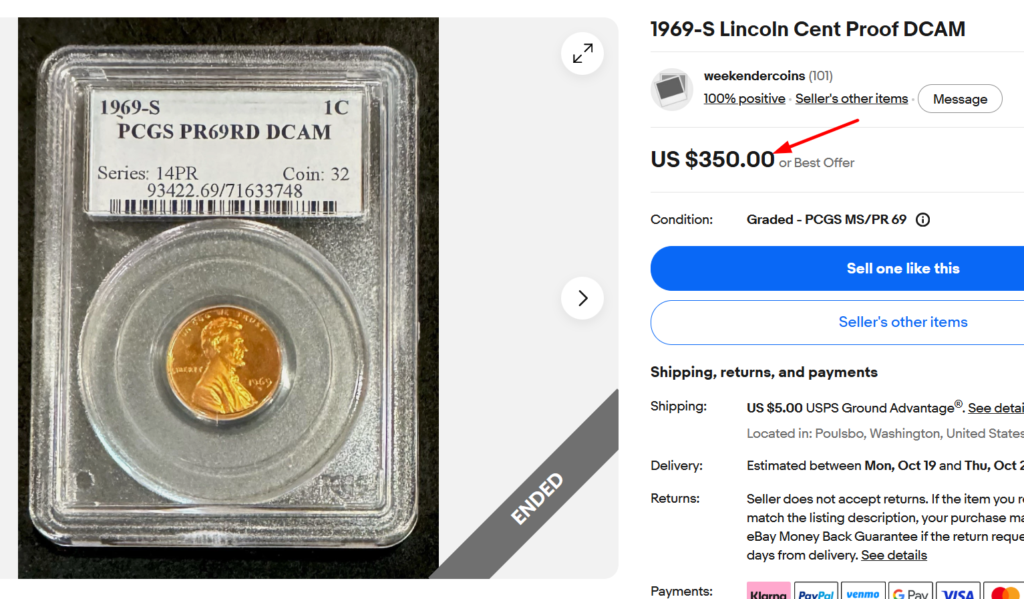
Sold for $350
Along with the business strikes, the San Francisco mint also made about 2.9 million proof 1969 cents. All have mirror-like surfaces, but the finest examples feature a frosted portrait, designated as “Cameo” or “Deep Cameo.”
Standard proofs are worth much, but CAM and DCAM varieties are worth hundreds, with PR-69 grades reaching a few thousand dollars.
- Estimated Value: $2 to $1,725 (PR-69 DCAM record)
- What to Check: Frosted Lincoln on mirror fields
- Quick Notes: Keep it in original mint packaging
4. 1969-S/S Repunched Mint Mark
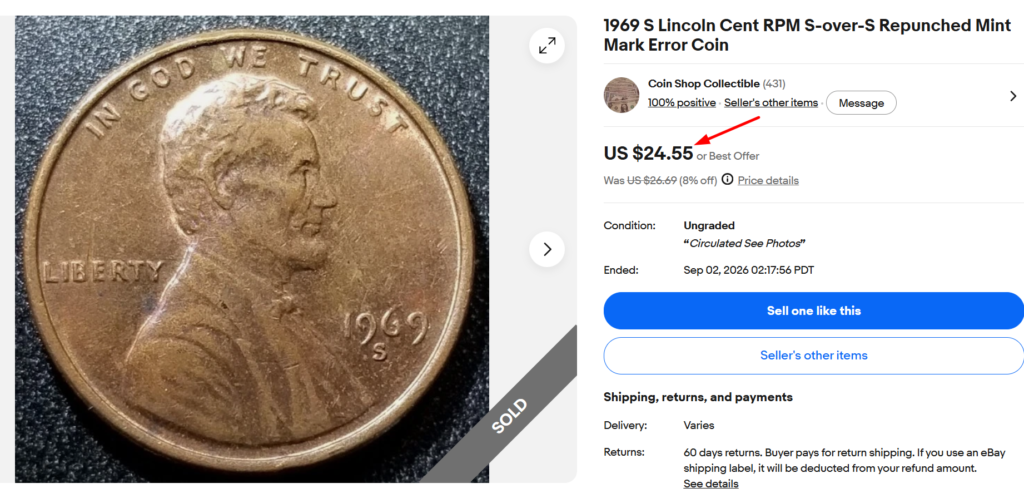
Sold for $24
Back in 1969, mints were using hand-punching to add mint marks into the working dies. Sometimes, if the punch bounced or landed twice, it created a repunched mint mark (RPM), where a second D or S shows beside the first.
Under a 10x loupe, you’ll spot a notch or extra curve on the mint mark letter. The value depends on how bold the doubling/repunch is and the coin’s condition.
- Estimated Value: $5 to $75
- What to Check: Doubled outline on mint mark
- Quick Notes: Match it to a CONECA listing
5. 1969 Penny Clipped Planchet
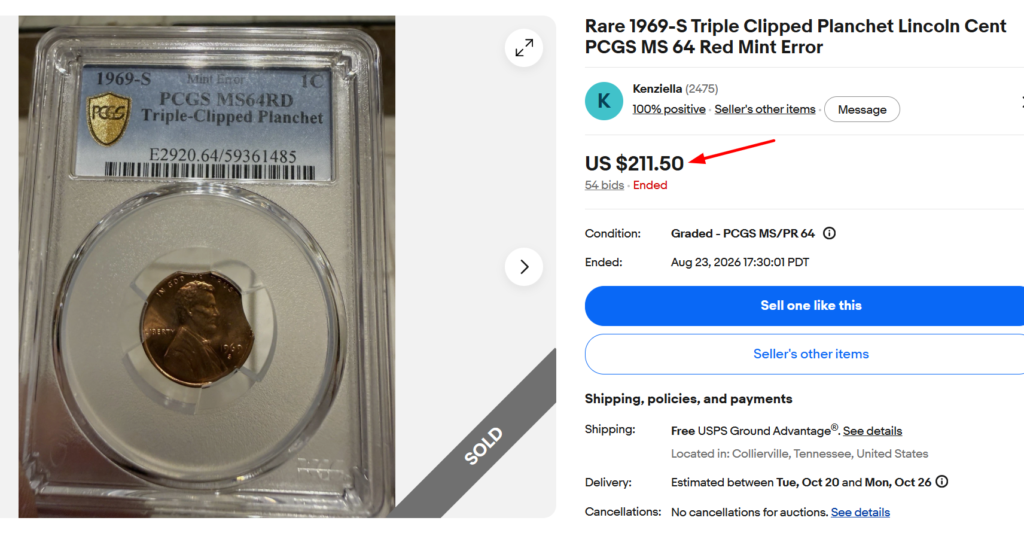
Sold for $211
Clipped planchets result from the blanking press overlapping an area that it has already struck, resulting in a curved clipping on the coin’s edge. Genuine clips have the Blakesley effect, which is a thin rim on the opposite side of the clip.
- Estimated Value: $5 to $50
- What to Check: Weak rim opposite the clip
- Quick Notes: Smooth, straight cuts usually mean damage
6. 1969 Penny Off-Center Strike
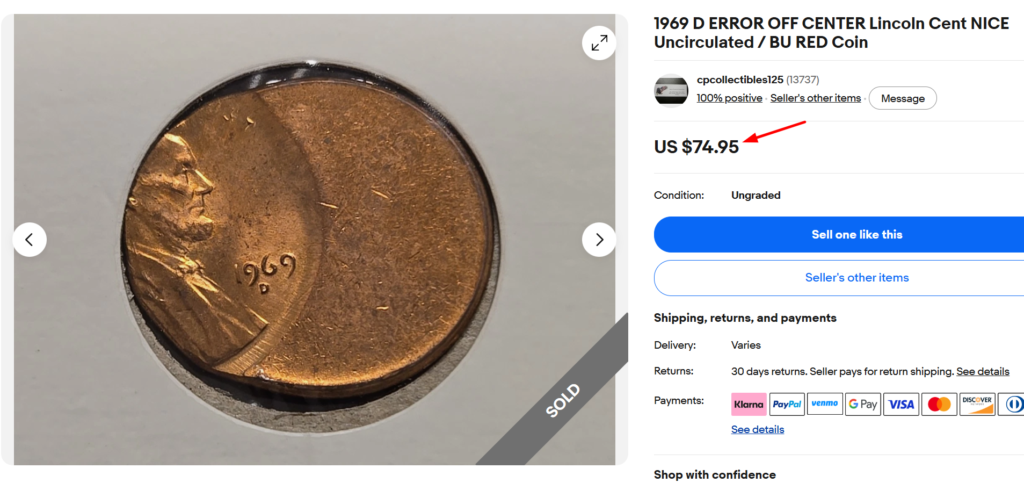
Sold for $74
Off-center strikes occur when the planchet isn’t properly aligned in the press. A part of the design will be chopped off, leaving a smooth curve of uncovered copper on one side.
The sweet spot for an off-center strike is around 30 to 60 percent, with the entire date visible. Without the date, collectors usually don’t pay much attention.
- Estimated Value: $10 to $150
- What to Check: Full date still visible
- Quick Notes: Bigger shift with date, bigger value
7. 1969 Penny Die & Cud Error
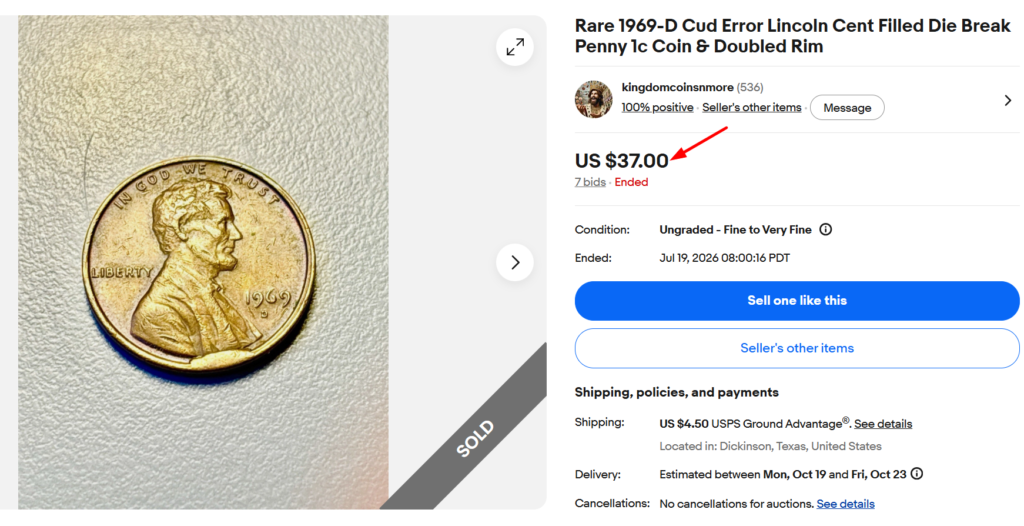
Sold for $37
Cracked dies often resulted in raised lines on the coin through the letters and date. The cud is larger, as a raised blob occurred when part of the die rim broke.
Die cracks are relatively insignificant, so do not expect a lot for this error. However, a large cud on the rim, especially around Lincoln’s portrait, can fetch hundreds.
- Estimated Value: $1 to $100
- What to Check: Raised lines or rim blobs
- Quick Notes: Raised, never incised, on real errors
8. 1969 Floating Roof Penny
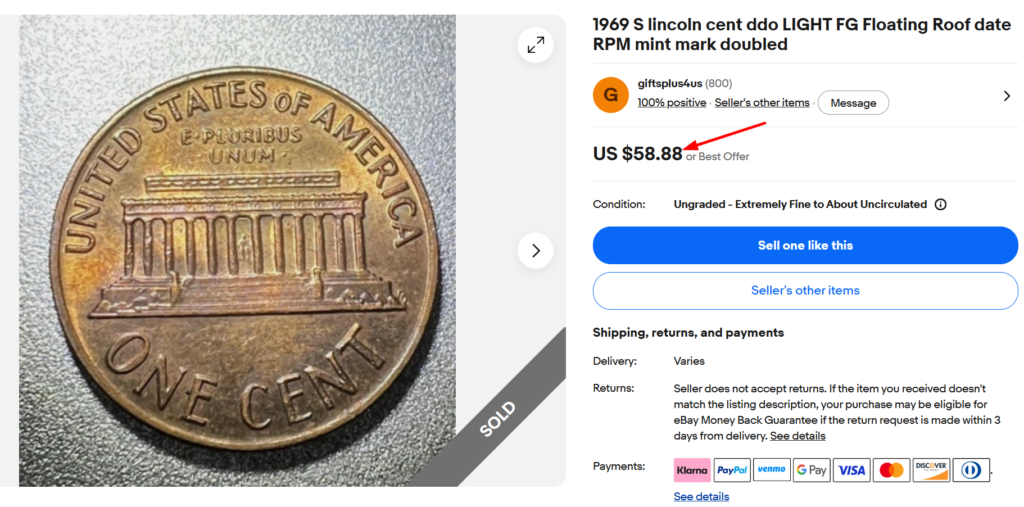
Sold for $58
This is not a mint error, but die wear. Here, the Memorial building looks like its roof is floating because the steps and lower columns are worn out or gone. This happens from over-polishing or clogging of dies.
These varieties can be found on 1969, 1969-D, and 1969-S cents. They cost a few dollars, and additional value is added if the FG initials are missing.
- Estimated Value: $1 to $25
- What to Check: Faint steps and columns
- Quick Notes: Often appears alongside missing FG initials
If you have a 1969 penny in your old jar, this guide will help you know what to look for before you even think about selling.