
Marks on old jewelry are worn, tiny, and often confusing. Most people have no idea what a leopard’s head or a “750” stamp means on their old pieces. So they end up selling a valuable ring for pennies, or paying top dollar for one that’s worth far less.
To save you from making the same mistake, I’ll walk you through valuable antique and vintage jewelry hallmarks, including gold, silver, and platinum. All you need is to get a 10x jeweler’s loupe and some good light to check your piece.
What is a Hallmark on Jewelry?
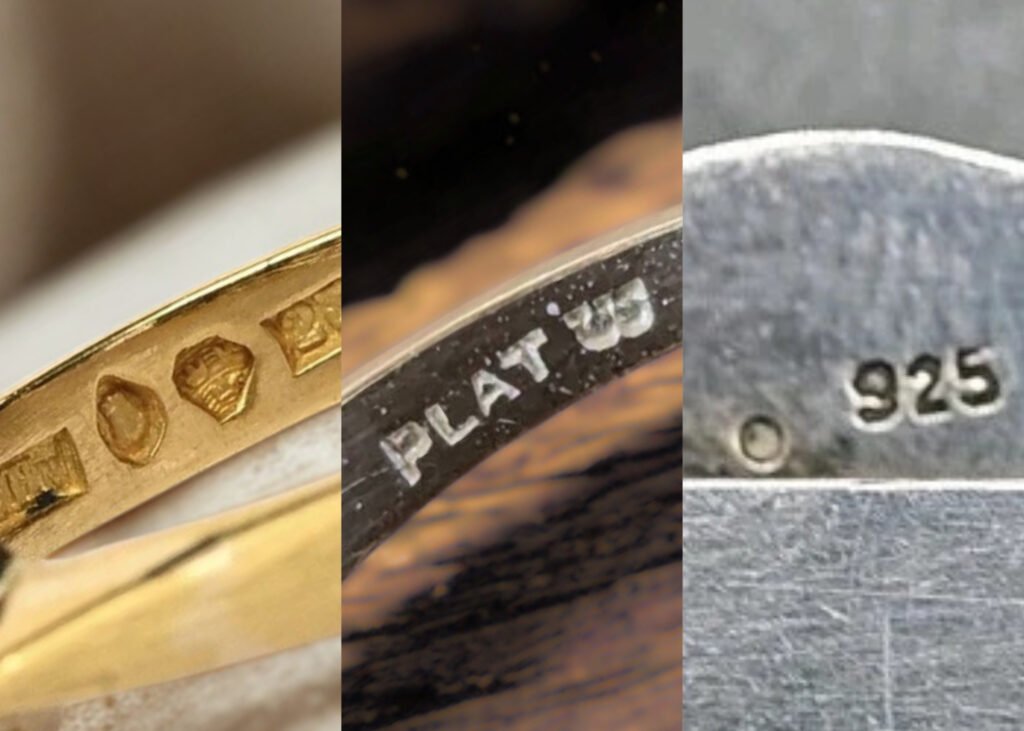
Many people confuse hallmarks with brand and quality marks, which is not what they are. A Hallmark is a group of stamps applied to jewelry by a state-regulated, independent metal purity-testing lab called the assay office.
The maker’s mark is just the manufacturer’s or artisan’s initials and logos. And a quality stamp is the numbers that indicate the metal’s purity, like “14K” and “925.”
The hallmarking system has been used in Britain, France, and the Netherlands for centuries. But American jewelry does not have such specific national hallmarking. The 1906 National Gold and Silver Stamping Act ensured accurate quality stamps. So most American pieces show only a purity number and a maker’s mark, nothing else.
Where to Look for a Hallmark?
The most common spots where a Hallmark appears on old jewelry are:
- inside ring shanks
- on clasps
- along brooch pin backs
- on the small loop that holds a pendant.
- Earring posts
- the backs of cufflinks
Reading Hallmarks on Old Gold, Silver & Platinum Jewelry
A complete set of a hallmark may have up to five distinct stamps. And every stamp answers a different question. Once you know what each stamp stands for, identification and dating old jewelry becomes easier.
The Five Parts of a Classic Hallmark
- Duty mark – the monarch’s head, used from 1784 to 1890. It tells that the tax was paid.
- Maker or sponsor mark – letters (initials) inside a shield-shaped outline.
- Standard mark – It indicates metal purity, like a lion for sterling or “750” for 18 karat gold.
- Assay office mark – This is the city which tested the piece. All major cities have a unique mark, like London’s leopard’s head and Sheffield’s crown.
- Date letter: A letter that changes every year. London has used them since 1478.
Handy Tip: It’s not always a red flag if your old jewelry has only two or three of these. Small pieces like rings and earrings were often partly marked. Plus, decades of wear sometimes rub the marks away.
Gold Hallmarks: Karat Stamps, Numbers and Symbols
Karat Marks vs. Number Marks
There are two kinds of gold stamping systems based on where the jewelry was made.
- American gold jewelry shows the karat count, like “14K” or “10K.”
- European gold jewelry stamps have a three-digit number to denote gold content per thousand; so “585” is 58.5% pure gold and is 14-karat gold.
| Karat | Number Stamp | Gold Content |
|---|---|---|
| 24K | 999 | 99.9% |
| 22K | 916 or 917 | 91.6% |
| 18K | 750 | 75% |
| 15ct (British, 1854 to 1932) | 625 | 62.5% |
| 14K | 585 or 583 | 58.5% |
| 12ct (British, 1854 to 1932) | 500 | 50% |
| 10K | 417 | 41.7% |
| 9ct | 375 | 37.5% |
Antique and Vintage Gold Stamps
The old British gold also has its own marks. A crown next to “18” indicates 18-karat gold since 1798, while a crown with “22” appeared in 1844. So, those crowns are the easiest dating clues for British gold.
Then, there is Victorian gold. In 1854, Britain legalized three lower-karat standards of 15, 12, and 9 karats. They are usually denoted by the karat number followed by a decimal, for example, “15 .625.”
The 15- and 12-karat were discontinued in 1932, so a piece with these markings likely dates back to pre-1932.
Gold-Filled and Gold-Plated Marks
Vintage yellow jewelry looks like solid gold at first glance, but many times it only has a thin gold plating on brass or another base metal. The good thing is that some honest makers stamped the plating clearly:
- GF or “1/20 12K GF” – gold-filled. The 12-karat gold layer makes up one-twentieth of the weight.
- RGP – rolled gold plate, with an even thinner layer.
- GE or HGE – gold electroplate or heavy gold electroplate. A very thin coating.
- R.G. or “Rolled Gold” – Gold layer marks common on British and European pieces.
Silver Hallmarks: Sterling, Coin, Continental, and Plated
Silver was more common than gold to make jewelry in earlier times, so old silver jewelry regularly turns up at estate sales and junk drawers. Identification is slightly difficult because the marks vary a lot by country.
Silver Purity Numbers
Like gold, silver purity is shown as parts per thousand. The higher the number, the purer the silver. The standards you’ll see most often on antique and vintage pieces are:
- 958 – Britannia silver, required in Britain from 1697 to 1720 and optional after.
- 925 – sterling, the most common standard in Britain and the US.
- 900 – coin silver, used by many American silversmiths before sterling took over in the later 1800s. Often marked “COIN.”
- 875 – the same purity as the Russian “84” mark.
- 830 – common on Scandinavian silver.
- 800 – popular in Germany and Italy.
Other Symbols of Real Silver Jewelry
Numbers are a reliable purity clue, but it’s not the only one. Many countries used pictures instead of numbers, which can now help you spot older pieces made before number stamps became standard.
Here are the ones you will see most often:
- Lion passant (walking lion with one paw raised) – English silver since 1544.
- Minerva head – French silver since 1838.
- Crescent moon and crown – German silver since 1888, often next to 800 or 835.
- Kokoshnik (Head of a woman in a Russian headdress) – Russian silver and gold since the late 1890s. The head faces right on items dated 1908 to 1917.
- Eagle with a number – Mexican silver from 1948 to around 1980. The number identifies the workshop.
- Codes like “TA-16” – Mexican silver since about 1980. The “T” is for Taxco.
Signs of “Not Solid Silver”
Some stamps show the word “silver,” but the metal has little or no silver in it. If you see any of these, it’s likely silverplate or a silver-colored alloy.
- EPNS or EP – electroplated nickel silver, a thin silver coat on base metal.
- A1 – this is not a purity mark, but a grade of silver plating.
- Nickel silver, German silver, or Alpaca – copper, nickel, and zinc with no silver at all.
Forged marks are also quite common. For example, a crisp, sharp “925” stamp on a piece that is heavily worn, or a stamp pressed into a soft, lightweight metal, are warning signs.
Platinum Jewelry Markings
Platinum’s history is fixed to specific eras, making it easy to identify and date. The metal became the top choice for fine jewelry in the early 1900s, during the Edwardian and Art Deco eras.
But World War II changed everything. In 1942, the Allied forces began to reserve all platinum for wartime purposes, and white gold replaced platinum in jewelry making.
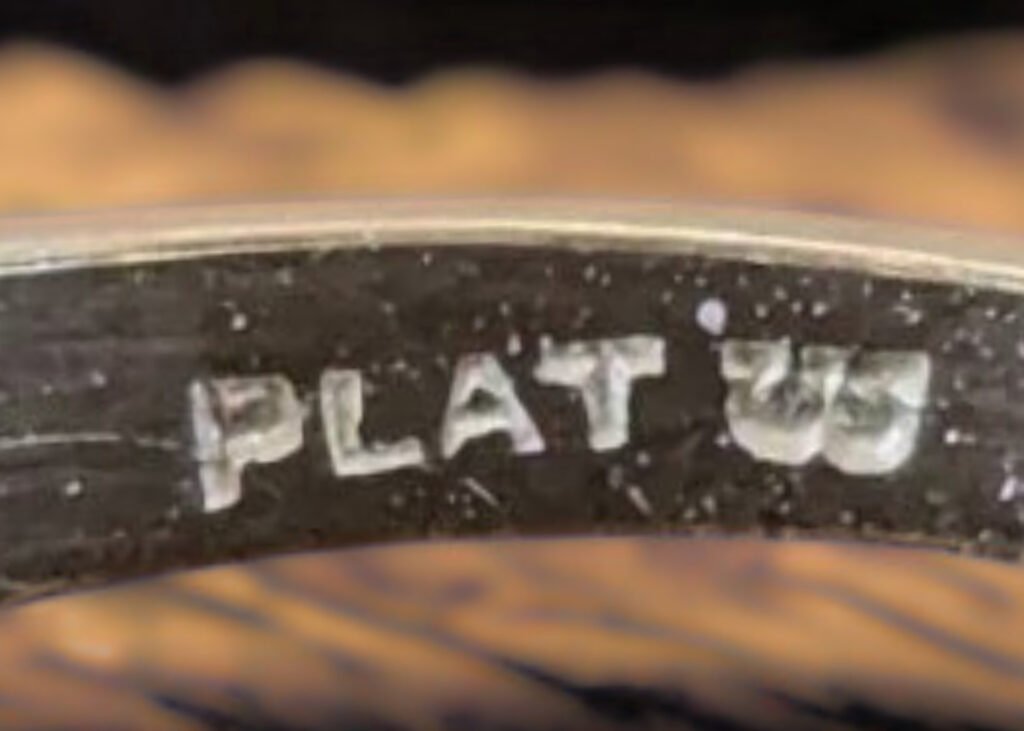
So, a “PLAT” marking on white jewelry is usually a sign of pre- or post-war jewelry. Below are other common markings you’ll see:
- PLAT or PT – platinum.
- PT950 or 950 PLAT – 95 percent platinum, a common standard for modern pieces.
- 900 PT, IRIDPLAT, or 10% IRID – about 90 percent platinum mixed with iridium, a hardening metal. Common on vintage American rings.
- An orb with a cross – the British platinum hallmark, used since 1975.
- A dog’s head – the French platinum mark, used since the early 1900s.
British and International Hallmarks to Know
After the metal, the location mark is the second important part of the hallmark. It’s the symbol for the city or country that tested a piece and is usually the fastest way to trace the origin.
Britain has the most detailed system, so we’ll start there.
British Assay Office Marks
- London: a leopard’s head
- Birmingham: an anchor
- Sheffield: a crown until 1974, then a rose
- Edinburgh: a castle
- Chester: a sword between three wheat sheaves (closed 1962)
- Glasgow: a tree, fish, bird, and bell (closed 1964)
The city mark combined with the date letter will give you the exact year. Each office used its own letter style and shield shape, so you’ll need a date-letter chart for that city. Online charts are free and easy to find.
Marks From Other Countries
| Country | Mark | What It Tells |
|---|---|---|
| France | Eagle’s head, Minerva head, dog’s head | 18K gold, silver, platinum |
| Russia | Kokoshnik plus 56, 72, or 84 | 14K or 18K gold, or 875 silver |
| Germany | Crescent moon & crown | Silver 800 or higher, from 1888 |
| Mexico | Eagle with number, or codes like “TA-16” | 1948 to 1980 or later |
| Italy | Star, number, province code | Made from 1968 on |
What Old Hallmarked Jewelry Sells For
The hallmark proves what metal the old jewelry is, but it rarely sets the price alone. To tell what your antique or vintage hallmarked jewelry is worth, you also need to check the maker, condition, and design.
To show you what I mean, here are a few recent sold examples. These show different hallmarks so you can see how the marks + era + design shape the value.
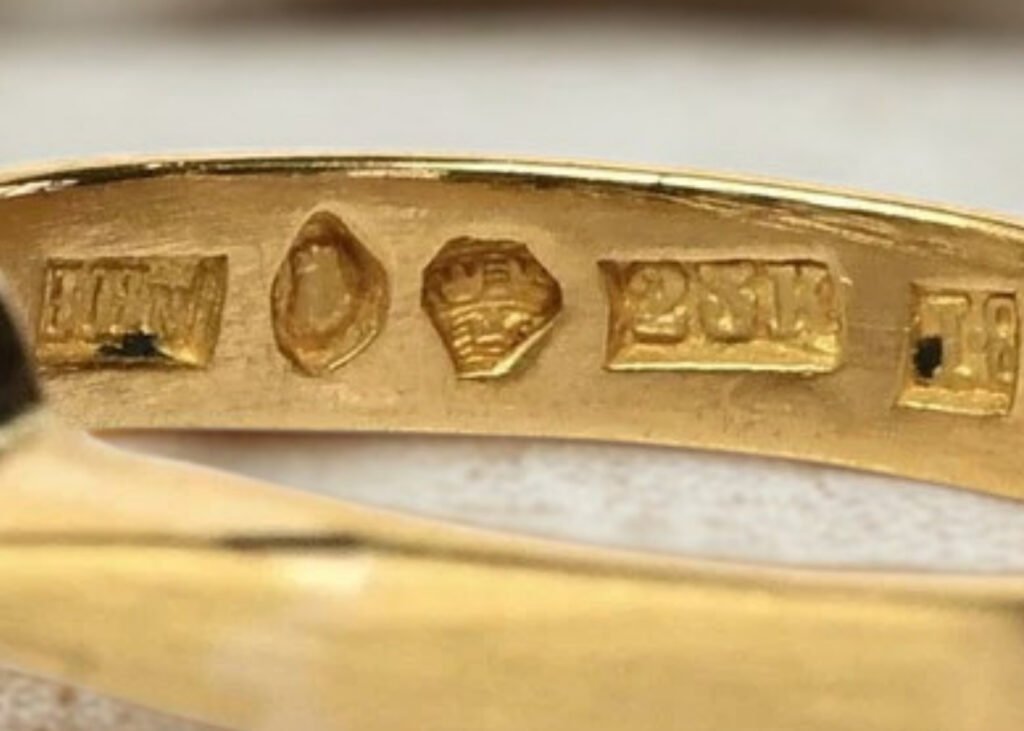
1. 23K Gold Solitaire Ring
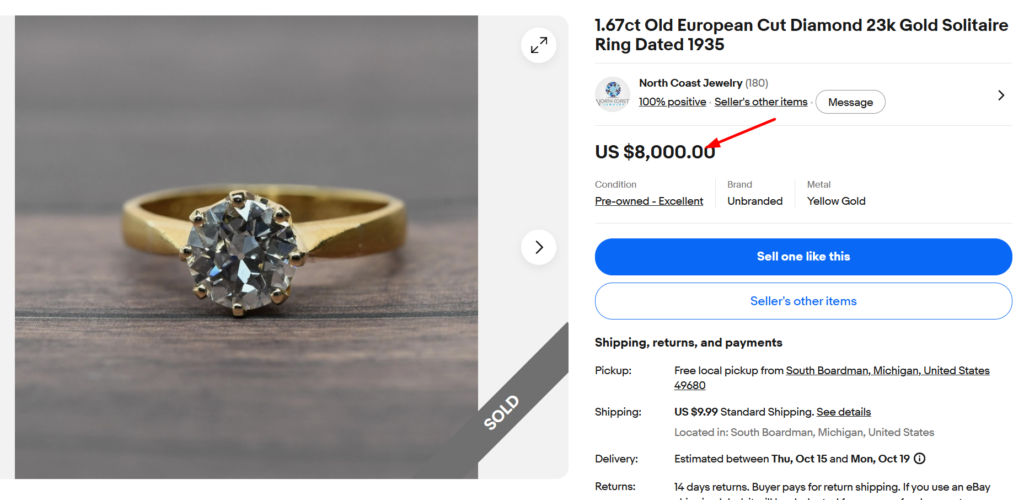
Sold for $8,000
Marks – Maker’s mark, control and town marks, “23K,” date code “I8”
Era – 1935
These marks resemble the Swedish system, which used 23 karat gold and letter-and-number date codes. The “I8” stamp points to 1935. The value of this piece mostly comes from the 1.67 carat old European cut diamond, a cut common before the 1940s.
2. Victorian British 15ct or 18ct gold piece
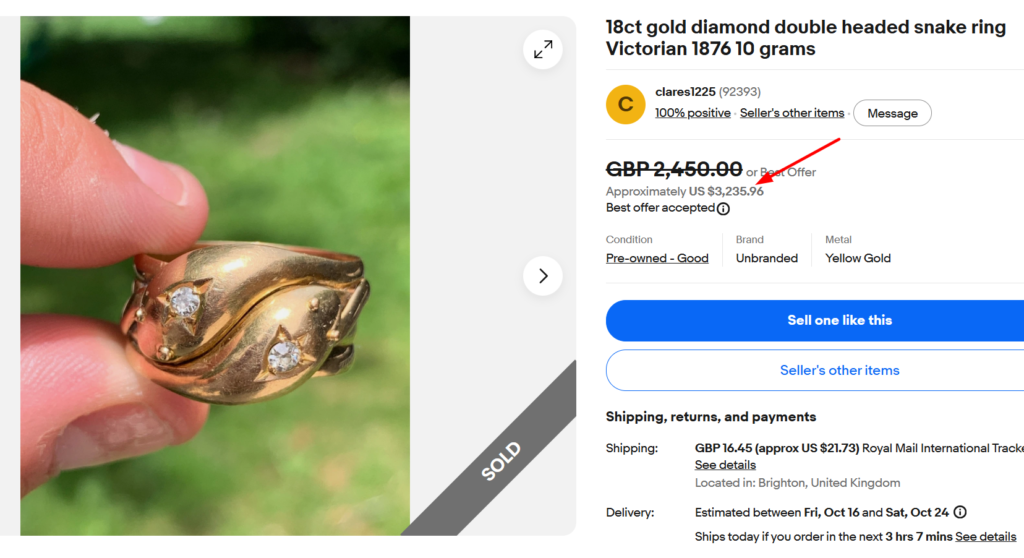
Sold for $3,235
Marks – “18” mark, assay marks, date letter, maker’s initials in an oval
Era – Victorian, 1876
This Victorian ring bears a complete set of British hallmarks on its shank. It includes the “18” standard hallmark and a date letter that places the ring in the year 1876. Hallmarked Victorian snake rings sell on age and design, along with the gold weight.
3. Art Deco platinum ring
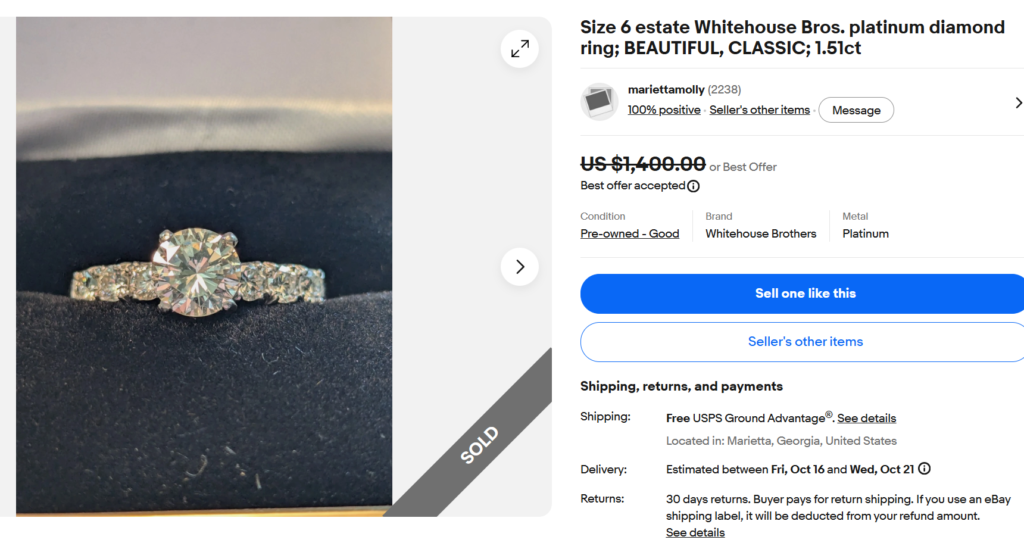
Sold for $1,400
Marks – “10% IRID”
Era – Early to mid 1900s
The “10% IRID” stamp indicates that this ring is 90% platinum with 10% iridium. This mix, as well as the pierced shoulder design, was standard on older American platinum from the same era. A named maker and diamonds further pushed the value.
4. Vintage 925 Sterling Silver Bracelet
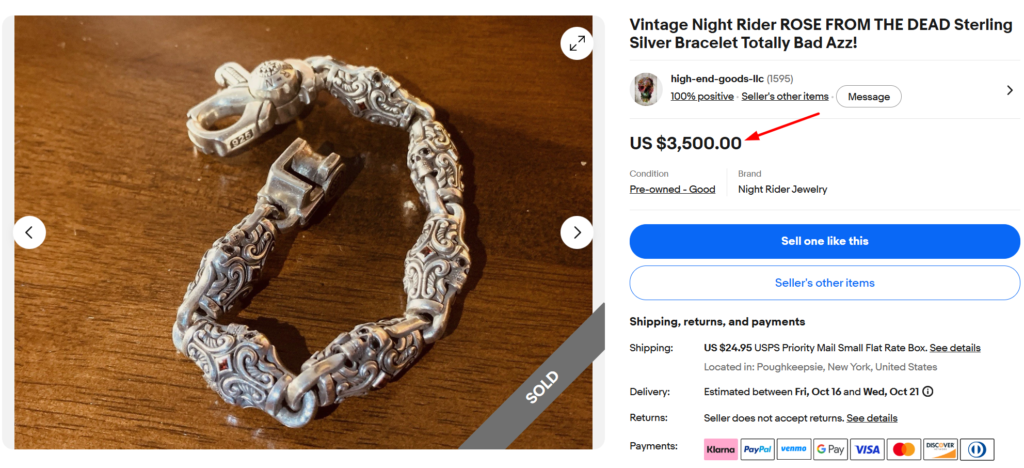
Sold for $3,500
Marks – “925,” Night Rider maker’s stamp
Era: Vintage
This piece shows that sometimes the maker drives more value than the metal. The “925” confirms sterling, but the round Night Rider stamp on the clasp is what drove the $3,500 price. A similar unsigned sterling bracelet would sell closer to its silver weight.
5. Mexico Taxco Eagle Mark Sterling Link Panel Bracelet
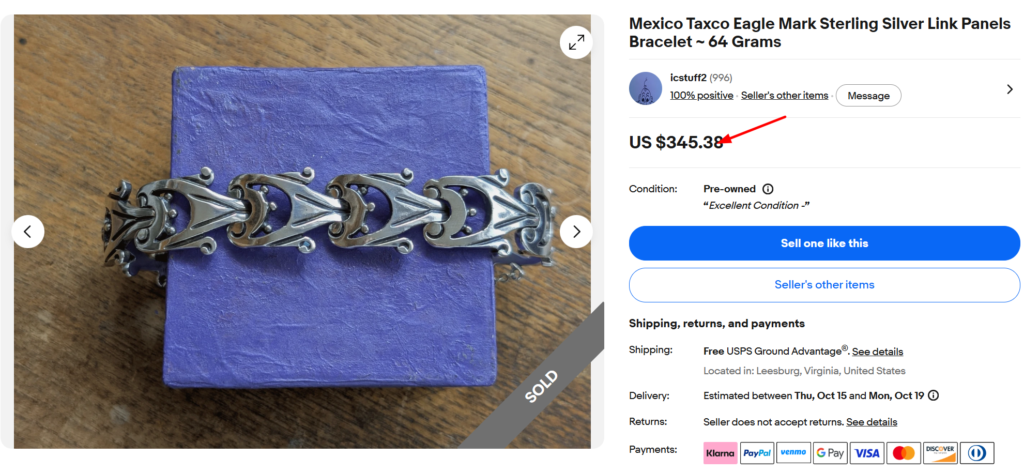
Sold for $345
Marks – “TAXCO MEXICO,” “TD” maker code, “925”
Era – 1948 to around 1980
This linked-panel silver bracelet shows “TAXCO MEXICO” around a “TD” maker code and “925.” An eagle mark points to 1948 to around 1980, while a letter code alone usually means 1980 or later.
Heavy Taxco Sterling bracelets (around 5.0 oz) have sold for up to and over $10,000.
The next time you pick up an old ring or brooch, take a photo of the marks under your loupe and use this guide as a reference to understand them and what they say about the value.