
The history of McCoy Cookie Jars dates back to the late 1930s. From the Nelson McCoy Sanitary Stoneware Company, that made simple stoneware jars and crocks, it changed its name to Nelson McCoy Pottery Company and became makers of decorated pieces.
The cookie jars were sold cheaply through dime stores like Woolworth and JCPenney. So that’s why they still turn up at estate sales today.
The company changed hands a few times after Nelson Jr. retired in 1981, and the Roseville plant closed for good in 1990. Any “McCoy” branded piece made after that isn’t from the original company. And that single fact is what makes vintage McCoy jars collectible today.
What Makes a McCoy Pottery Cookie Jar Valuable?
Most vintage McCoy cookie jars value range from $40 to $150. But a small handful of examples can jump to $500, $1,000, or more, depending on the following four factors.
- Rarity of the mold – Short-run designs like Davy Crockett, Coalby the Cat, and the Circus Horse were made for only a year or two. Common jars like the Strawberry or the standard clown were produced by the tens of thousands.
- Condition – Chips, hairlines, and missing lids reduce the value fast. Even heavy crazing (those spiderweb glaze cracks) drops the price 30 to 50% on premium pieces.
- Cold paint quality – Many rare McCoy jars had painted details added after firing. That paint wears off. So a Mammy jar with crisp original red and white paint can sell for triple what a faded example brings.
- Unusual glaze color – McCoy made the same mold in multiple colors. Standard colors are common, but a jar in an unusual glaze can double or triple the going price. That’s why collectors always check what colors were actually made for each design before buying.
11 Valuable Old McCoy Cookie Jars Collectors Look for
Now, let’s take a look at some of the highest-selling McCoy pottery jars in the secondary market today, along with tips and features to spot.
1. “Freddy” the Gleep Cookie Jar
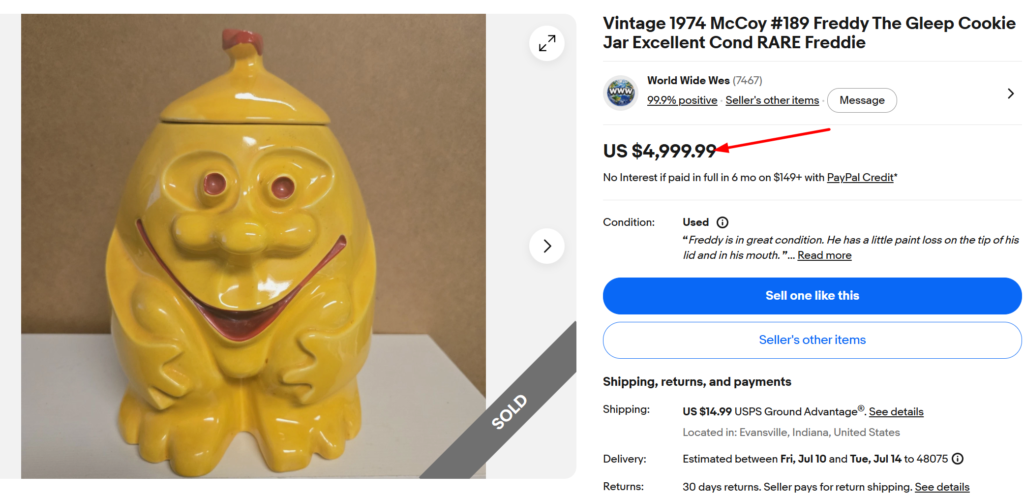
Sold for $5,000
Freddy the Gleep is literally the holy grail for McCoy collectors. It was produced in 1974 as mold #189, and features a yellow blob-shaped character with round red eyes, a wide smiling mouth, and a small red topknot on his head.
Freddy was a short-lived novelty that never caught on with buyers, so very few were sold at retail. That failure at the store is exactly why he’s so valuable now.
Clean examples with intact original paint regularly break four figures at auction.
- Estimated Value: $1,500 to $5,000
- Production Years: 1974
- What to Check: #189 mark, red eyes, topknot condition
2. “Coalby” Black Cat Jar
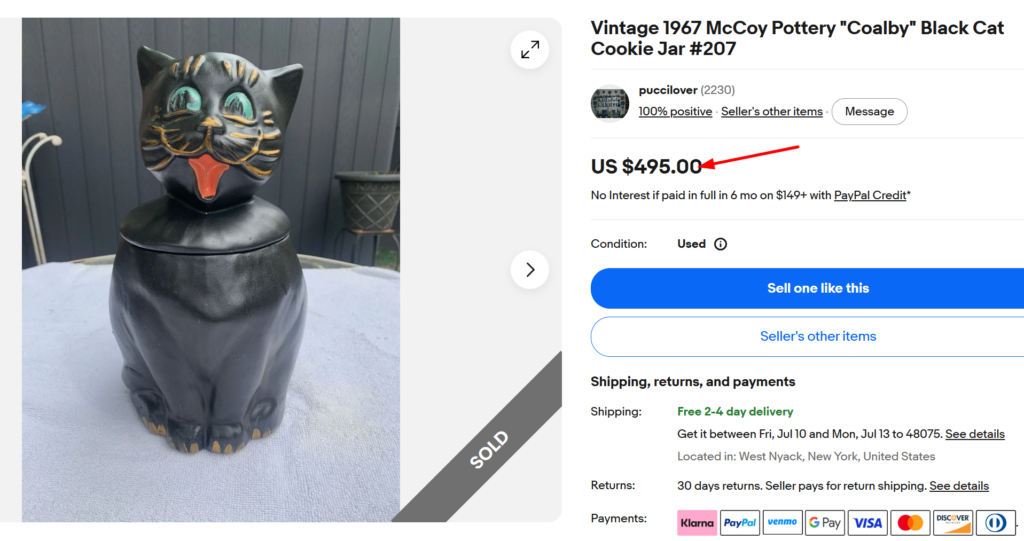
Sold for $495
Coalby (often misspelled Colby) is one of the classic rare McCoy jars, produced in 1967. A short production run of just one to two years makes this jar a premium collectible.
The jar has a matte finish in black glazed with gold cold painted whiskers, paws, and inner ear rims. Its eyes are very bright green in color, and its red tongue is sticking out of its mouth, which gives it that famous mischievous look.
Authentic examples are marked “USA 207” impressed on the base under the glaze.
- Estimated Value: $350 to $500
- Production Years: 1967 to 1968
- What to Check: #207 mark, gold trim, green eyes
3. Jack O’ Lantern Cookie Jar
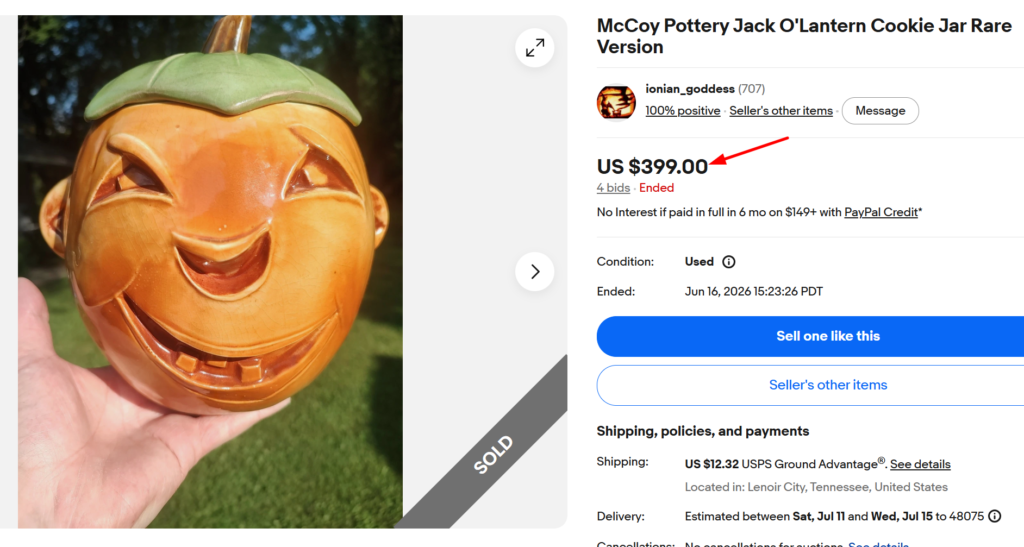
Sold for $400
The McCoy Jack O’Lantern is a rarity. It’s a seasonal jar first produced in 1955, and shows a smiling pumpkin face with cut-out eyes, nose, and mouth, topped by a green stem lid.
The glossy orange glaze and the brown stem are among the key characteristics of this jar. You’ll also see the raised “McCoy / USA” mark on the base.
Halloween collectors compete hard for this jar every fall. So prices spike from September through November each year. Chips on the stem or missing lids drop value fast.
- Estimated Value: $250 to $500
- Production Years: 1955
- What to Check: Green stem lid, cut-out face details
4. “Betsy” Baker Cookie Jar
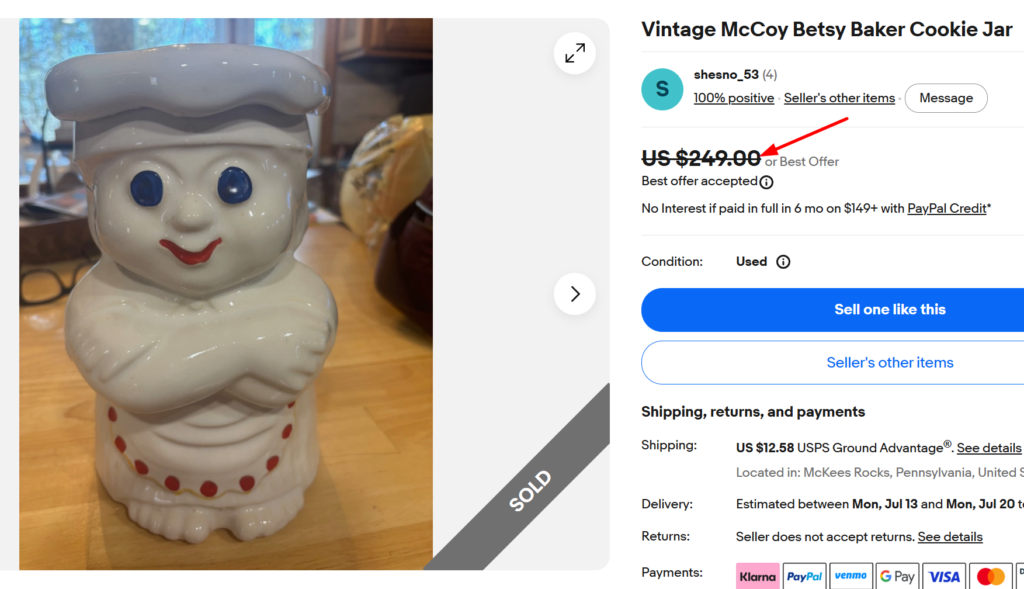
Sold for $250
Betsy Baker is Bobby’s female counterpart. She wears a matching pie-crust chef’s hat with blue eyes and a red smile, and her dress is trimmed with red polka dots and a yellow sash.
Betsy was made in smaller numbers than Bobby, which is why she is much harder to find and brings four or five times the price. As a pair, they can fetch up to $400.
- Estimated Value: $150 to $250
- Production Years: 1970s
- What to Check: Polka dot dress paint, matching pie-crust lid
5. Friendship 7 Space Capsule Cookie Jar
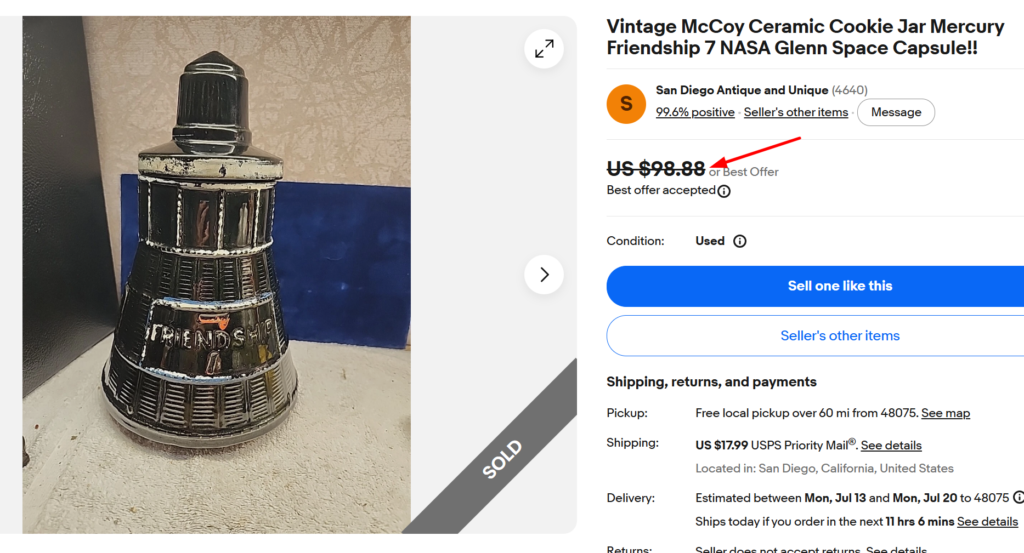
Sold for $98
This McCoy jar comes with a story. McCoy released the Friendship 7 jar between 1962 and 1968 to cash in on the space race craze after John Glenn’s orbital flight. It’s shaped like the Mercury capsule with a dark metallic-looking glaze and “Friendship 7” lettering painted on the front.
This jar was sold in Woolworth’s and other five-and-dime stores across the country. Paint loss on that lettering is the biggest value killer for this one.
- Estimated Value: $80 to $300
- Production Years: 1962 to 1968
- What to Check: “Friendship 7” lettering, ribbed capsule detail
6. Black Mammy Cookie Jar
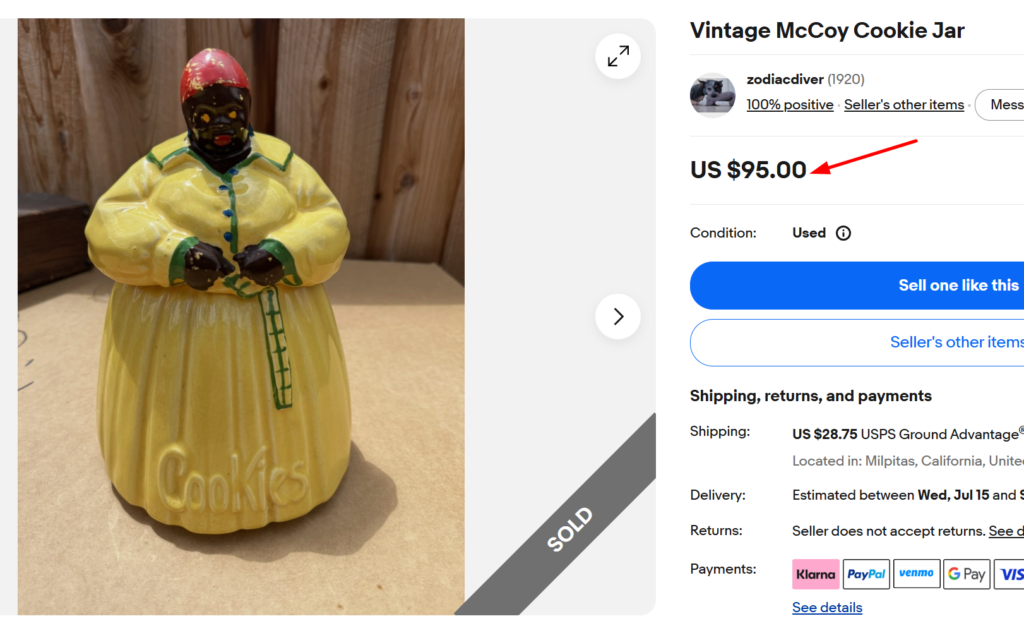
Sold for $95
The Mammy is the most famous and most reproduced McCoy jar of all. This is the yellow-dress version with green trim and a red head wrap, which is one of the original McCoy colorways alongside solid aqua and white.
Mammy #2 originally read “Dem Cookies show am good” across the dress from 1944 to 1947, then changed to just “Cookies” in 1948. So the wording on the front is your first dating clue.
- Estimated Value: $95 to $300 (with paint loss); $1,000+ pristine
- Production Years: 1944 to 1958
- What to Check: Dress wording, original cold paint
7. Wishing Well “Wish I Had a Cookie” Cookie Jar
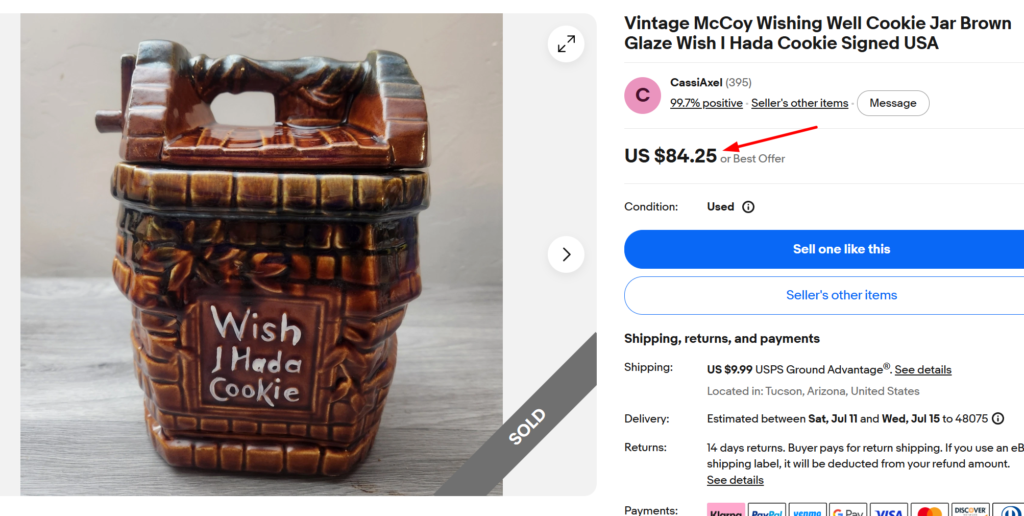
Sold for $85
Produced starting in 1961, the Wishing Well shows a stone-and-brick wishing well with “Wish I Had a Cookie” painted on the front in white lettering.
The brown glaze version is the most common. There’s also a caramel-and-green variation. The lid completes the well shape, so jars missing the lid drop hard in value.
- Estimated Value: $50 to $120
- Production Years: 1961 onward
- What to Check: Original lid, front lettering legibility
8. Clown in a Barrel Cookie Jar
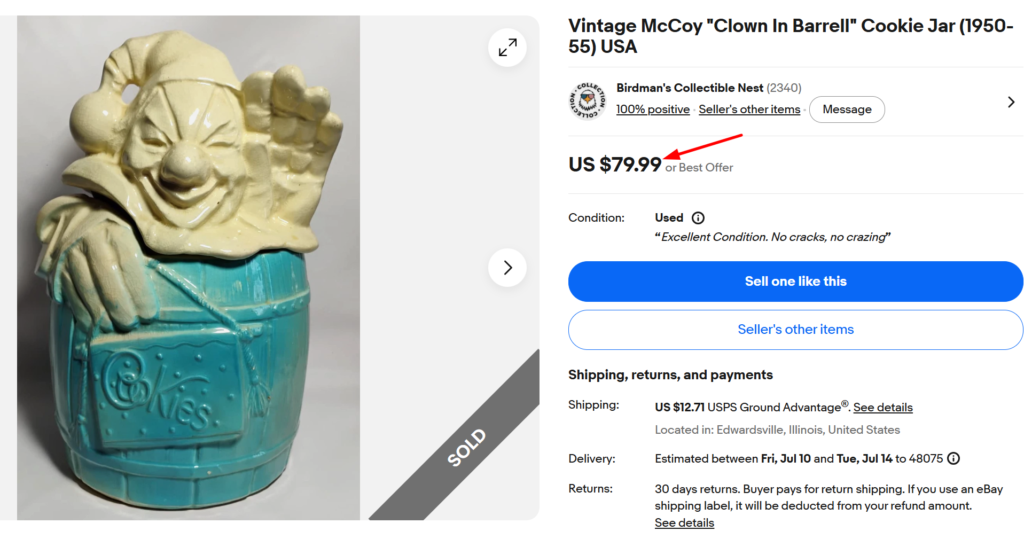
Sold for $80
The Clown in a Barrel is a mid-century classic and one of the more identifiable McCoy jars. It was produced from 1950 to 1955 and marked “McCoy USA” on the base. The barrel came in five glaze colors: aqua, pink, green, yellow, and white, with the clown top left in cream.
Pink and white barrels are the hardest to find, so collectors pay more for those. The aqua version shown here is one of the standard versions.
- Estimated Value: $80 to $200
- Production Years: 1950 to 1955
- What to Check: Barrel glaze color, clean clown face
9. Strawberry Cookie Jar #263
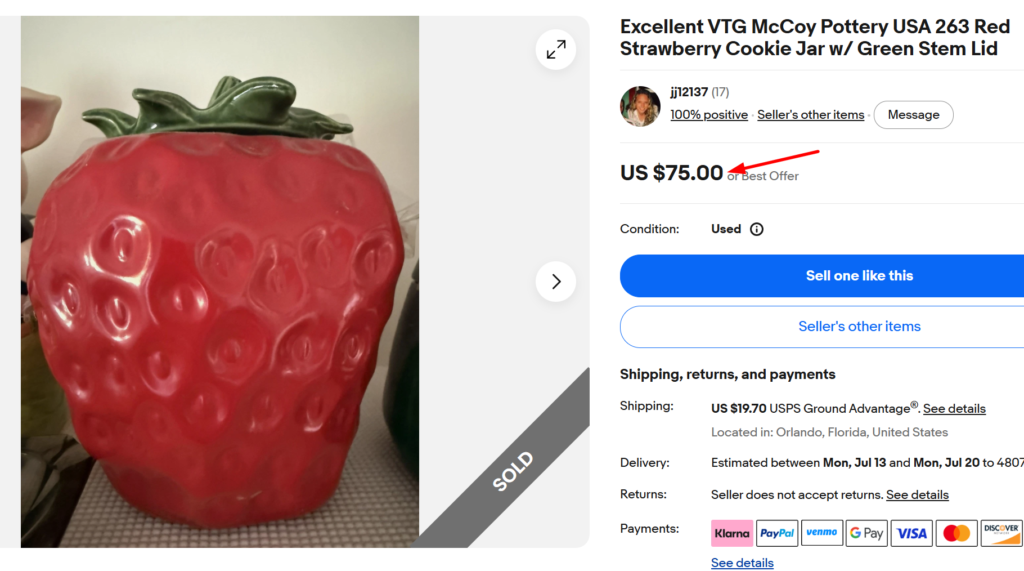
Sold for $75
The Strawberry #263 is a common vintage McCoy pottery cookie jar, which makes it a good start for beginners. It was produced from around 1955 to 1957 in the original run, with reissues later in the 1970s.
The body is a strawberry shape in bright red with a leafy green stem lid. It’s marked “McCoy USA 263” on the base inside the circular McCoy logo. A full-red matte finish and matching green lid is the best example.
- Estimated Value: $50 to $150
- Production Years: 1955 to 1957 (original run)
- What to Check: #263 mark, matching green stem lid
10. Cook Stove Cookie Jar
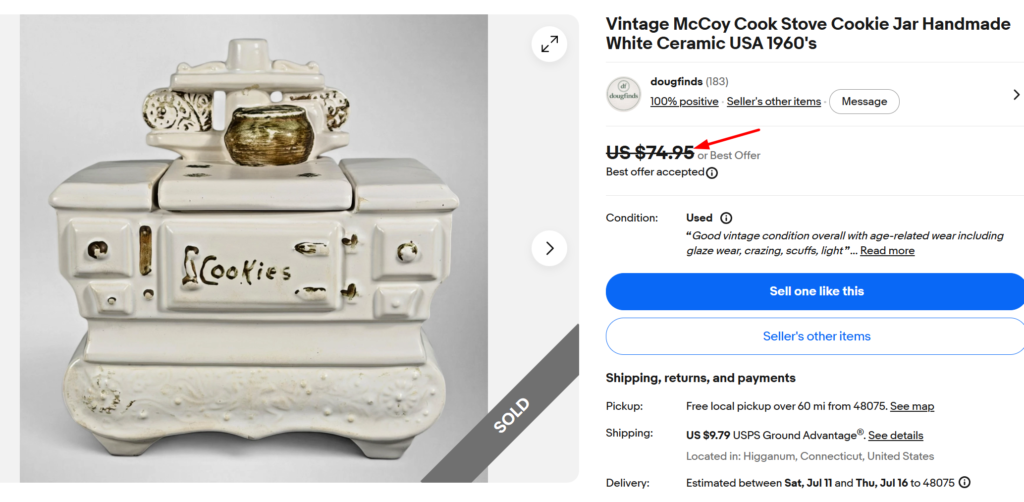
Sold for $75
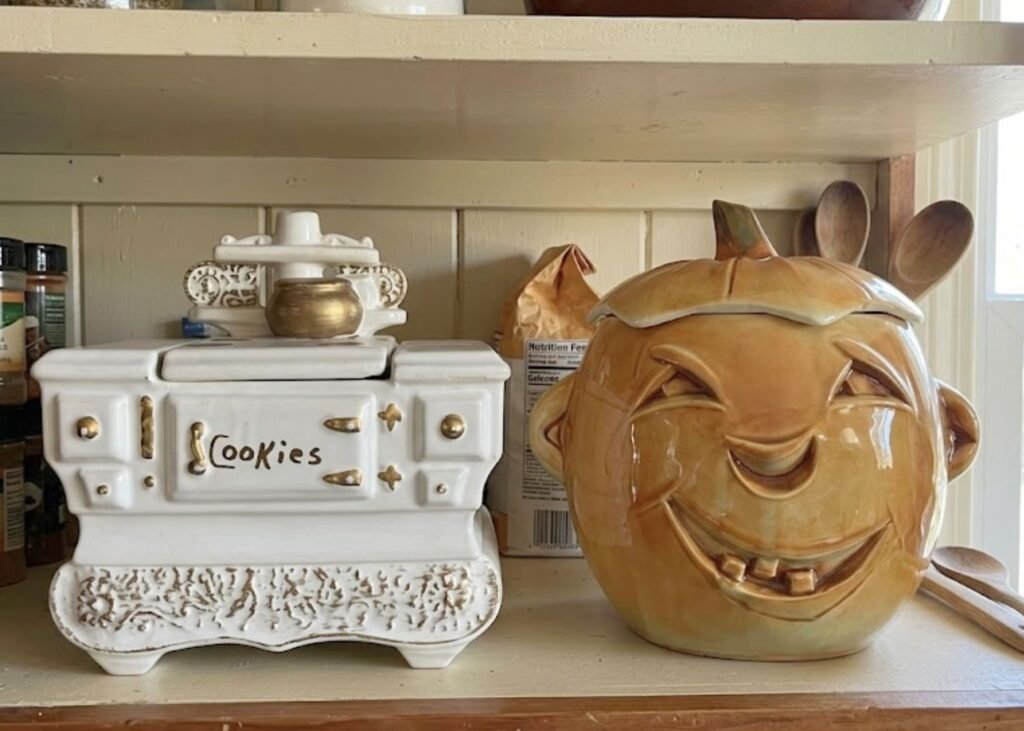
This 1960s McCoy jar is shaped like an old wood or coal cookstove. This one is the white ceramic version with a small kettle on top and “Cookies” written across the oven door in dark brown script. Age-related wear, like glaze scuffs and light crazing, is normal on this jar.
There’s also a black-and-gold version with red rooster accents that many collectors prefer for its dramatic look.
- Estimated Value: $60 to $150
- Production Years: 1960s
- What to Check: “Cookies” script, kettle on top
- Quick Notes: Black version usually sells for more
11. Bobby the Baker Cookie Jar
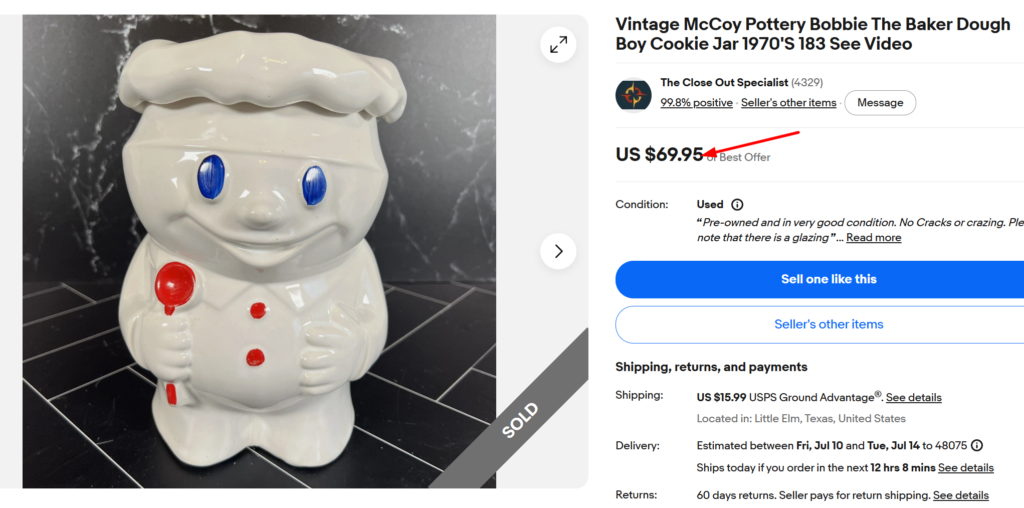
Sold for $70
Most people call this the Pillsbury Doughboy jar, but its real McCoy name is Bobby the Baker (also spelled Bobbie). It’s marked with the number 183 on the base. He wears a chef’s hat that lifts off as the lid, holds a red spoon, and has blue eyes and two red buttons on his front.
McCoy produced this one throughout the 1970s. So the mark often appears alongside the Lancaster Colony logo.
- Estimated Value: $50 to $120
- Production Years: 1970s
- What to Check: #183 mark, red spoon, blue eyes
- Quick Notes: Not licensed Pillsbury, real name Bobby Baker
How to Identify a Genuine McCoy Cookie Jar?
Identifying an authentic McCoy cookie jar can be challenging for beginners. The company made so many designs, and many of them were heavily reproduced, so fakes and look-alikes are everywhere. Here’s how to check any jar in your hands.
Check the McCoy Pottery Marks
The first sign is at the base. Most authentic McCoy cookie jars have a mark impressed or incised into the clay, which means the letters were pressed in before glazing.
Run your fingertip across the mark. You should feel the letters as shallow grooves under the glaze, not sitting on top of it. That texture matters. If the “McCoy” mark feels raised, printed, or painted on, it’s almost always a reproduction.
Plus, there’s often a mold number like 183 or 263 nearby. Those numbers are gold for cross-referencing collector books.
Here’s the rough timeline to date a McCoy jar based on the marks:
- 1929 to 1938: “NM” or “NM USA” for Nelson McCoy. The letters usually overlap. Some early pieces are unmarked.
- 1940 to 1942: “USA” appears with a small half-moon shape.
- 1940 to 1943: “USA” appears with a mountain range design behind it.
- Late 1940s: Some jars are marked “McCoy Handpainted.”
- 1940s to 1950s: The classic incised “McCoy” or “McCoy USA” script. This is the most collected era.
- 1967 onward: A circular “McCoy USA” mark around a stylized design appears. Mold numbers often appear next to it.
- Brush-McCoy pieces: These usually just say “USA” with a “B” number, not “McCoy” at all. Many are misidentified.
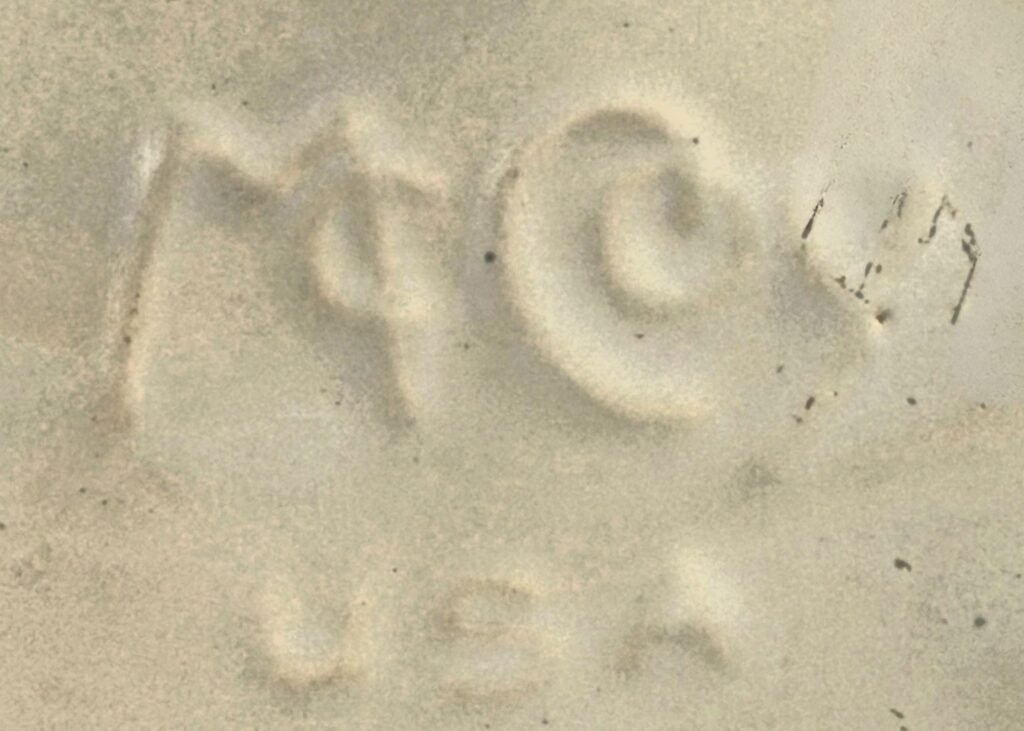
Also, look for the dry foot. That’s the unglazed ring on the base where the jar sat in the kiln. Real McCoy jars show a raw, slightly rough clay ring. Fakes often have a fully glazed or smooth bottom.
Weight, Clay, and Glaze
The jar’s weight can tell you a lot. Authentic McCoy is heavy and dense. Next, the clay body should be a cool gray-buff color where you can see it (usually the dry foot). Bright white or pinkish clay bodies were rarely used by McCoy.
Quick Note: Warm buff-tone clay often means Brush Pottery, which is different.
Look at the glaze next. Vintage McCoy glazes are usually matte or softly glossy with tiny natural imperfections. Reproductions tend to have an overly bright, uniform shine.
Check the Details
McCoy used sharp, fine molds. So details like eyes, whiskers, buttons, and leaves come out crisp. On reproductions, those same details often look soft, blurry, or slightly melted, especially on popular designs like the Mammy or the clown.
Cold paint is another giveaway. McCoy hand-painted decorations on top of the fired glaze on many jars. That paint wears off over decades. So expect faded reds, worn cheeks, and rubbed-off gold trim on genuine older pieces. Perfect paint on a “1940s” jar isn’t authentic.
Tips to Spot a Fake McCoy Cookie Jar
As I mentioned previously, there are a lot of McCoy jar replicas available in the market. What’s more, since the McCoy brand ceased to exist in 1997, it is legal for everyone to use this brand name. So, “McCoy” on the bottom doesn’t mean real.
Judge the following features to spot a fake jar:
- Wrong colors – McCoy produced most jars in only a few specific colors. The Mammy came in aqua, yellow, or white with cold paint. So if you see a blue-dress Mammy or a purple clown barrel, it’s almost certainly a reproduction.
- Blurry mold details – Reproductions are usually cast from a finished original, and the clay shrinks with each firing. So the reproductions are slightly smaller with softer detail, like mushy eyes, less crisp whiskers, and blurred letters.
- Lightweight body – Fakes often use lower-density clay that is noticeably lighter than the real McCoy.
- Wrong mark style – Real McCoy marks are pressed into the clay under the glaze. If the mark looks stamped on top of the glaze, painted on, or applied as a decal, it’s a fake. Also, watch out for oversized “McCoy” text that dominates the whole base.
- Suspiciously perfect condition. A 1940s cold-painted jar should show some paint wear. Sharp reds, unrubbed cheeks, and pristine gold trim on a 50’s jar is a warning sign.
Some McCoy jars can easily sell for a few hundred dollars today. So, if you find a jar at an estate sale, check the marks, research the design, see the weight, paint, and assess the condition to know if it’s valuable.