

Would you believe me if I said that a ceramic cookie jar shaped like Figaro, the kitten from Disney’s Pinocchio, sold for $1,500 on eBay? It really happened!
But are all old cookie jars worth money? No, only some are. Of the 15 jars below, most of them are antique or vintage; the cheapest is a Hull Gingerbread Man that sold for almost $150, and the dearest is that $1,500 Figaro. Everyday unmarked jars usually sell for far less.
From the bright, playful designs of McCoy cookie jars to Shawnee’s piggy jars, here are the most valuable and rare old cookie jars worth money. I’ve also shared some easy tips so you can spot other valuable cookie jars on your own!
15 Most Valuable Antique and Vintage Cookie Jars
The rarest cookie jars are usually short production runs, licensed character designs, and artist-signed pieces, plus colors a maker only tried for a while. Each item below shows a real sale, plus what details to look for.
1. Walt Disney Figaro Ceramic Cookie Jar
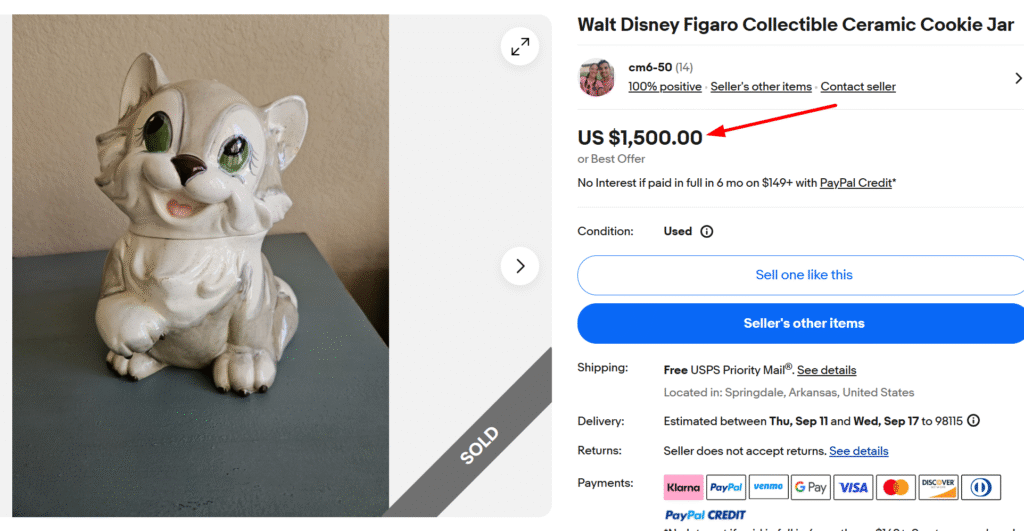
This popular Walt Disney Figaro cookie jar, featuring the iconic cat from Pinocchio, is said to be a Hagen-Renaker piece designed by Don Winton, who sculpted many of that company’s 1950s Disney pieces. It’s made of ceramic, and it’s well-glazed, which beautifully highlights the cat’s features.
You can find the maker’s mark at the base along with Walt Disney Productions. Disney cookie jars are highly collectible and rare due to the popularity of the characters and the company’s licensing controls!
2. Police Car Cookie Jar by Glenn Appleman
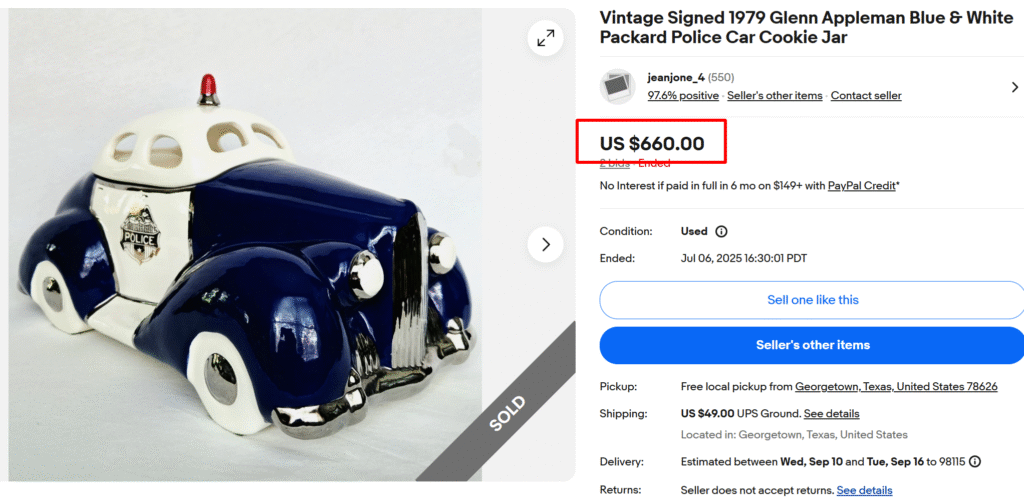
Made by artist Glenn Appleman in 1979, this automotive-themed jar is shaped like a Packard police car in classic blue and white colors, with realistic details like headlights, chrome accents, and police insignia.
Turn it over, and you should find Glenn’s signature, with a scribbled 1979, underneath the car. Signed pieces like this often fetch higher prices than mass-produced jars because of their limited runs and artistic merit.
3. Marilyn Monroe Cookie Jar by Happy Memories Collectibles
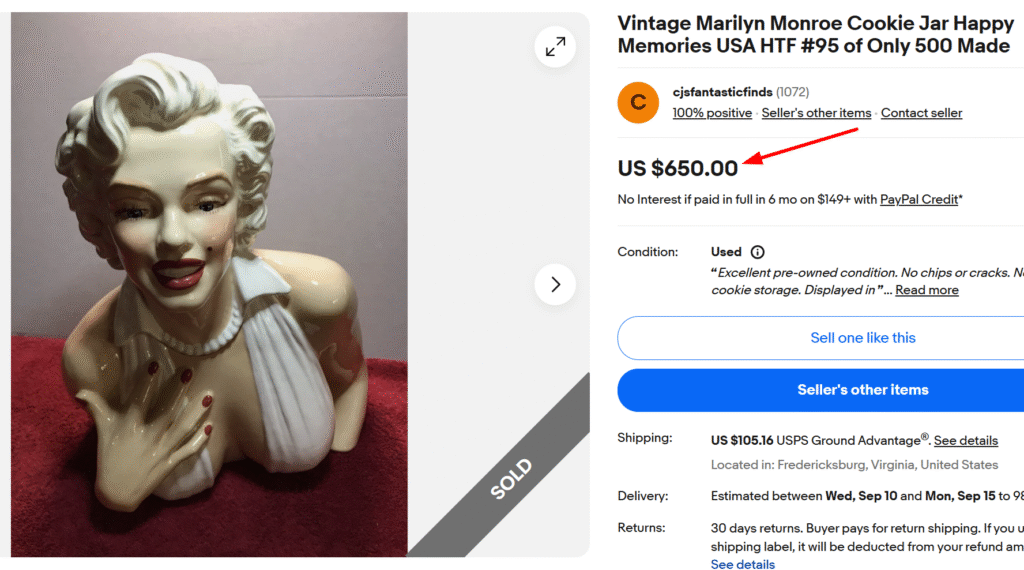
This jar is really a collector’s dream! It’s a limited edition Marilyn Monroe jar released by Happy Memories Collectibles in 1995 with only 500 pieces in total, so it can fetch about $400 to $800 or more.
The jar shows Marilyn in her iconic pose with that famous smile and her popular dress from The Seven Year Itch. What makes this piece extra special is the numbering system; this particular jar is #95, making it part of a very exclusive club.
4. Lapis Dancing Lady Cookie Jar by Fiesta
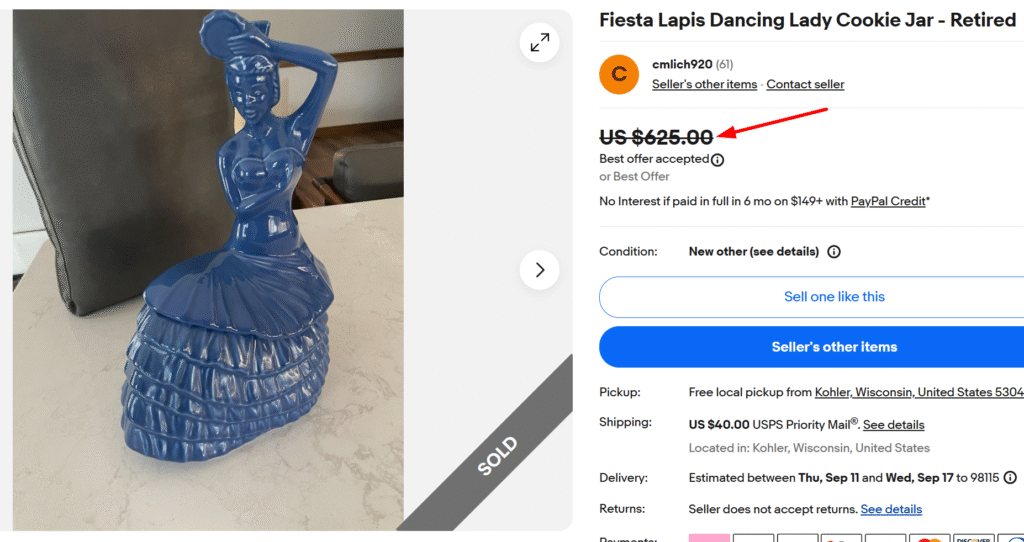
While this one is not really a vintage find, it deserves to be in this list for its rarity! This Fiesta Dancing Lady cookie jar was made by Homer Laughlin from 2013 until March 2023, so it is much newer than the vintage Fiestaware (1936 to 1973).
It’s shaped like a woman captured mid-dance in a flowing dress in deep blue lapis glaze. The cookie jar mold was hand-sculpted by former Hall China Company designer Jose Gimeno.
Since it’s retired, expect it to be worth $400-700 for one in perfect condition.
5. Casper the Friendly Ghost Cookie Jar by American Bisque Pottery
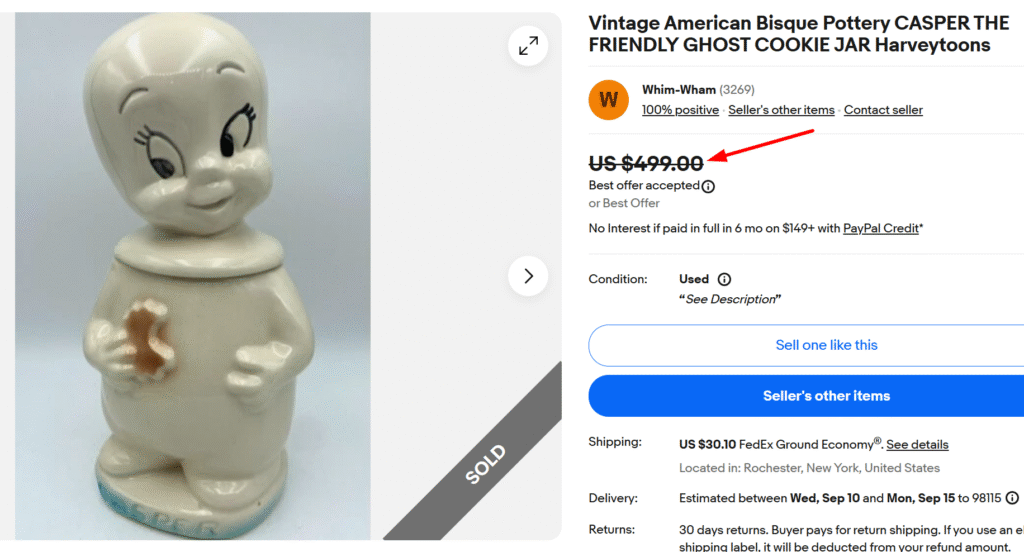
This playful ceramic cookie jar made by American Bisque Pottery features Casper the Friendly Ghost eating cookies. This was part of a limited run, making it highly sought-after today.
These jars must be marked “Harvey Publications Inc USA” on the back, authenticating their connection to the famous cartoon character. You can expect around $400 to $550 for this piece.
6. Cookie Time Cookie Jar by The Abingdon Co.
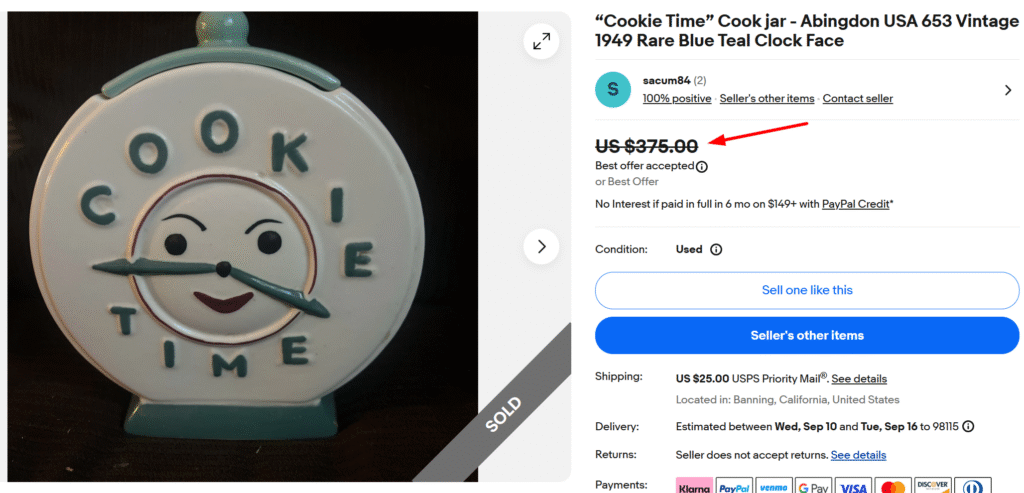
This Abingdon “Cookie Time” clock jar in teal blue is a rare find made between 1935 and 1950. The jar is shaped like a clock with a smiley face on it, and its hands show the time at 3:45 (a classic American time for cookies).
You may also find this jar in white, green, cream, and yellow, but the teal blue is especially sought after. Beware of jars that look the same; try to spot the “Abingdon USA” mark for authentic pieces; this one shows “Abingdon USA 653.”
7. Siamese Cat Cookie Jar by Brush Pottery (1967)
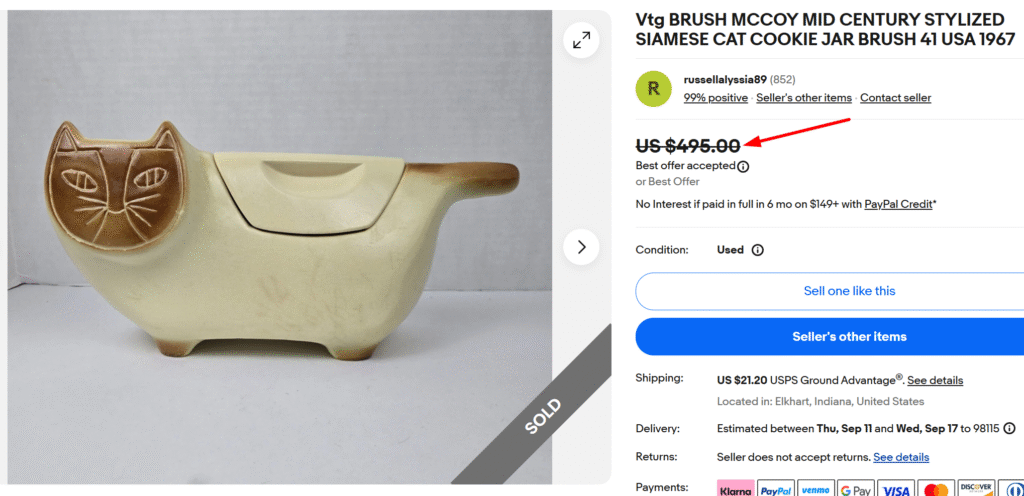
This sleek mid-century jar is shaped like a stylized Siamese cat with brown markings on a cream-colored base. It’s from the Brush Pottery Company of Zanesville, Ohio, which is generally recognized as producing the first ceramic cookie jar!
This jar reflects the company’s modern styling during the space-age design era, and authentic jars are often marked “Brush 41 USA 1967.” A good one in excellent condition, with all its features intact, can fetch $400 to $500.
8. The Smiley Pig Cookie Jar by Shawnee
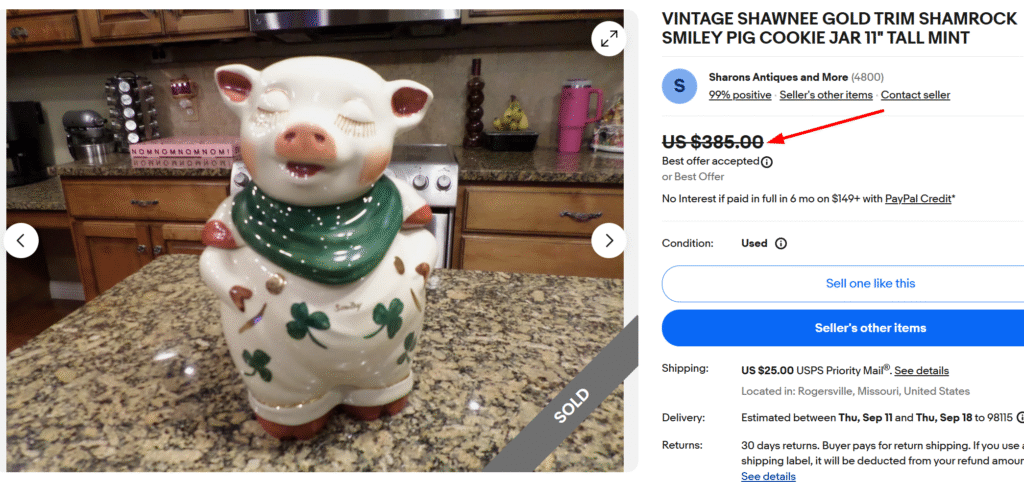
Shawnee’s smiley pig cookie jars are some of the most expensive and desirable pieces among collectors, and Shawnee used the same design for its piggy banks. They are shaped like a standing, smiling pig, with hand-painted details and a scarf.
Made from about 1942 until Shawnee closed in 1961, most of these Pig jars have “closed eyes” with long lashes. So, if you find one with “open eyes,” check the mark closely, as many copies of Smiley are around. Shawnee’s cookie jars are covered in Pam Curran’s book Shawnee Pottery: The Full Encyclopedia (1995), a standard reference for collectors.
9. Flintstones The Rubbles House Cookie Jar
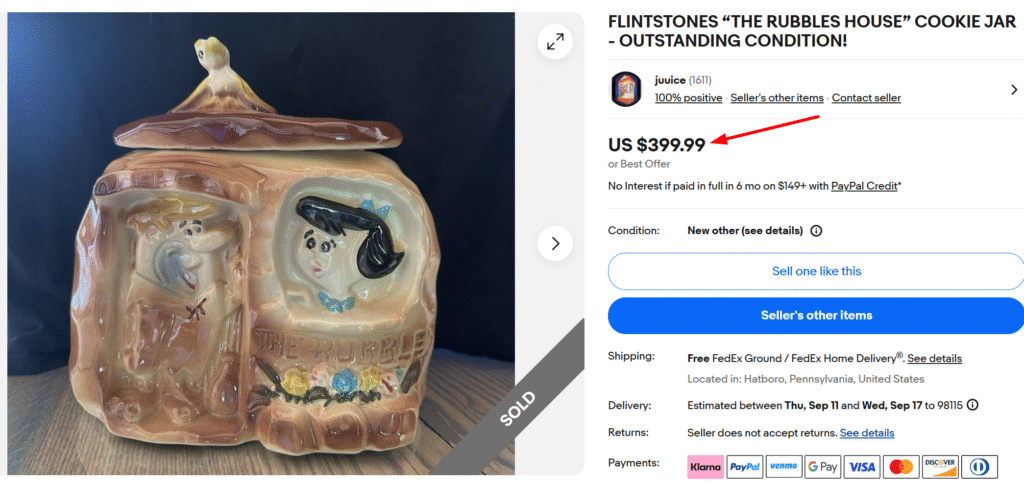
This cookie jar is special because it represents the popular characters of Fred Flintstone and Betty Rubble from the Hanna-Barbera cartoon series. It’s shaped like a prehistoric house, with characters peeking out!
The entire jar is made of ceramic and is finely hand-painted with vibrant colors, giving the characters a lively touch. Licensed cartoon cookie jars like this one are generally more desirable among collectors.
10. Baker Boy Cookie Jar by Lefton
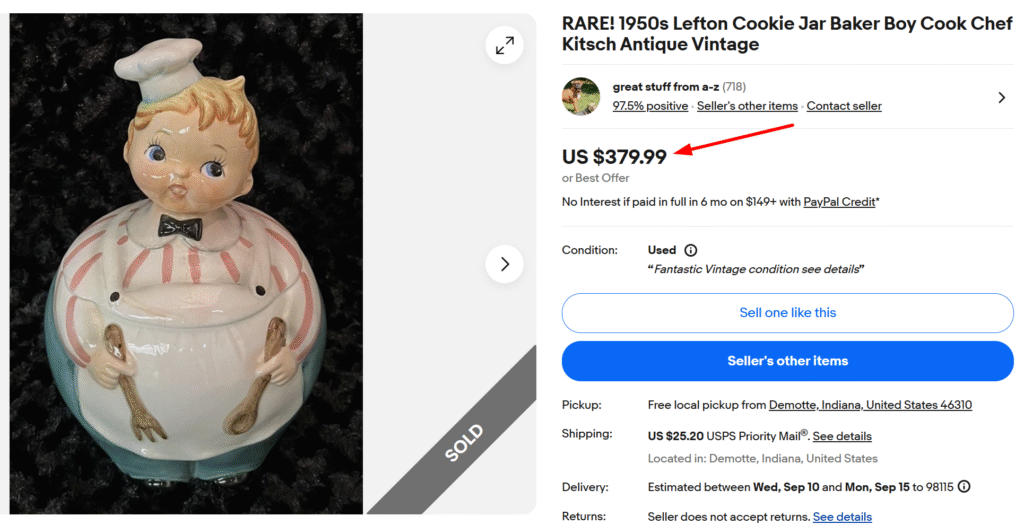
This 1950s Lefton Baker Boy cookie jar is decorated with the classic chef’s hat and apron design, a popular style in mid-century kitchen decor. These are mostly made of ceramic and porcelain with bright colors and hand-painted details, with “Lefton” or “Japan” markings. Genuine, undamaged jars can easily fetch $200 to $500! See more rare 1950s cookie jars in our guide.
11. Peek-a-Boo Cookie Jar & Shaker Set by Regal China
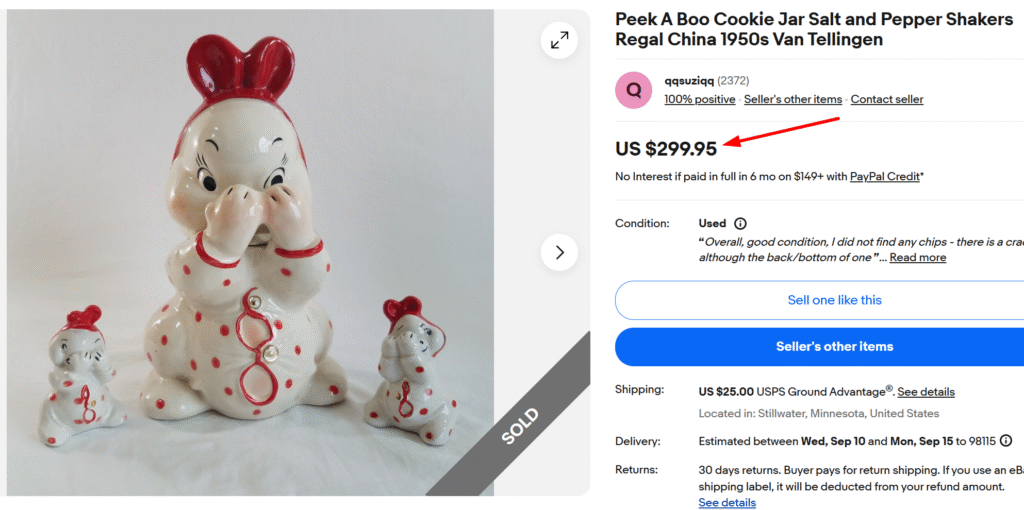
This charming cookie jar set has a strong history that adds to its value. It was designed by Ruth Van Tellingen Bendel, a designer known for Regal China’s character salt and pepper shakers, and released by Regal China around the 1950s.
But what really makes this jar rare is how seldom it turns up. Overall, the playful bunny design with red polka dots and matching salt and pepper shakers makes it a complete package for collectors, fetching $200-$470 at the best.
12. King of Tarts Cookie Jar by Red Wing Pottery
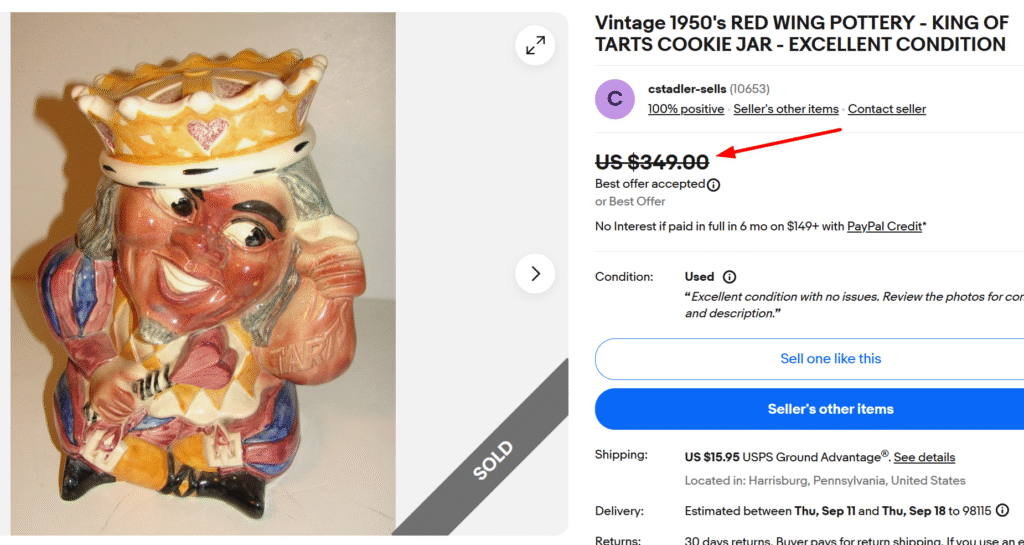
This vintage cookie jar features a royal king character with a crown, a scepter with hearts, and colorful clothing. Made by Red Wing Pottery for a short time, this piece comes in multicolor designs as well as solid colors like pink, blue, and yellow.
Red Wing discontinued this jar in the mid-1950s, and production numbers weren’t made public. The King of Tarts was offered in a 9¾” size with an impressed mark. Even so, recent sales sit in the low hundreds of dollars.
13. Jack O Lantern Cookie Jar by McCoy Pottery
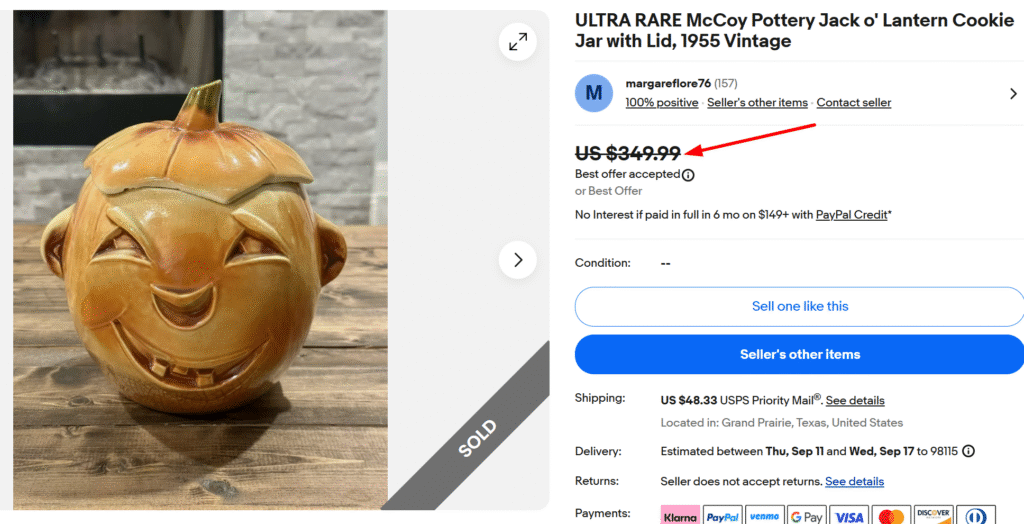
This cheerful pumpkin-faced cookie jar from McCoy is one of Halloween’s most loved collectibles. It’s the iconic Jack O’Lantern jar from McCoy released in 1955, featuring the classic grinning face.
Authentic McCoy Jack O’Lantern jars are pretty hard to find these days, which is why they can sell for $300-$600+ when they’re in good shape. Also, look for the “McCoy USA” mark on the bottom to make sure they’re authentic.
14. Cow Over the Moon Cookie Jar by Robinson-Ransbottom (RRP Co.)
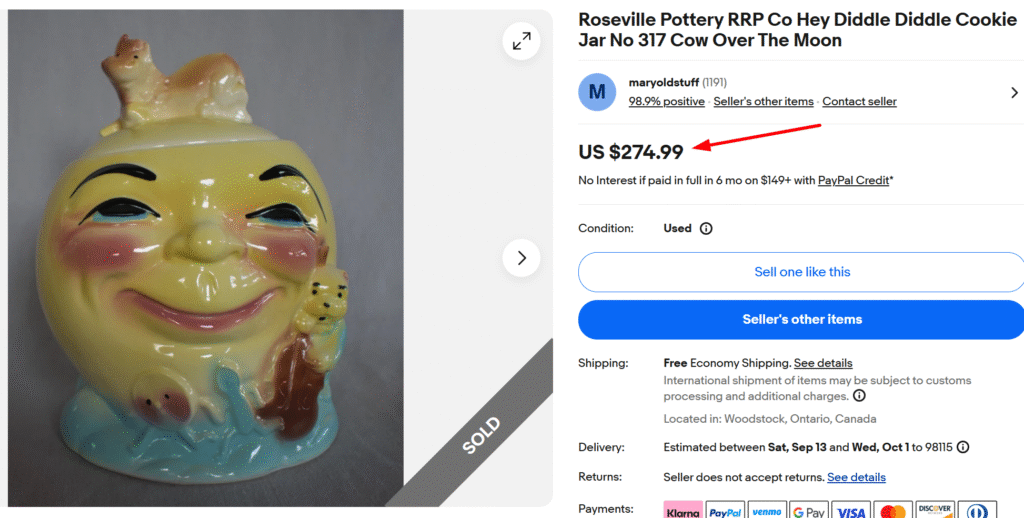
This nursery rhyme-themed cookie jar is a long-time favorite with collectors. Its ball-shaped body is designed to resemble the moon, complete with raised features that bring the classic rhyme “The Cow Jumped Over the Moon” to life.
Most authentic examples carry an impressed mark on the base reading “RRP Co. Roseville, Ohio No. 317” or a similar variation.
Note that RRP Co. is the Robinson-Ransbottom Pottery Company of Roseville, Ohio, not the better-known Roseville Pottery of Zanesville. Sellers often mix the two up because of the marks.
15. Gingerbread Man Cookie Jar by Hull Pottery
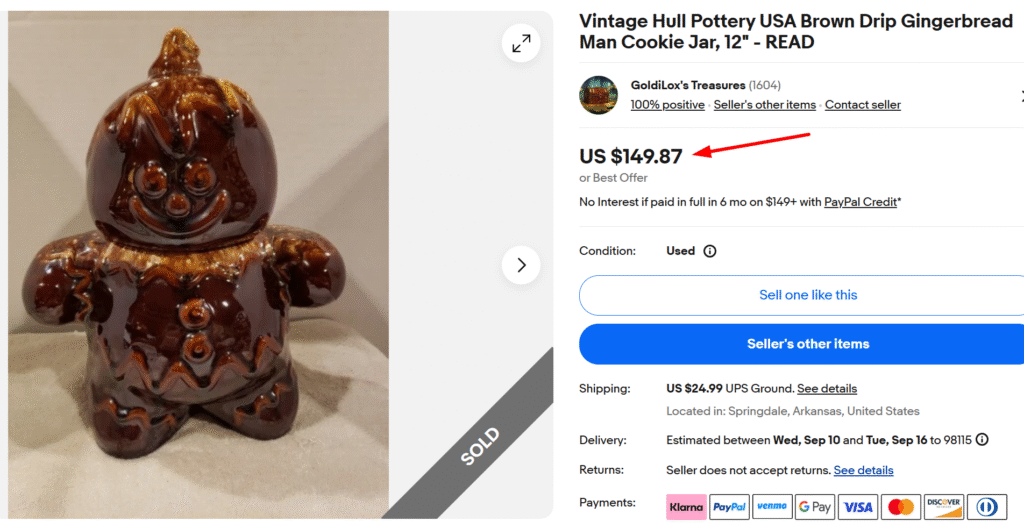
Hull’s Gingerbread Man cookie jar stands about 12 inches tall and features its signature brown drip glaze that was so popular in mid-century America. While the drip glaze is recognizable, look for the “Hull USA” mark stamped on the bottom.
The Gingerbread Man cookie jar is one of Hull’s most recognizable designs. You can expect to pay $50-200 for these jars, based on their condition!
How to Tell If an Old Cookie Jar Is Valuable
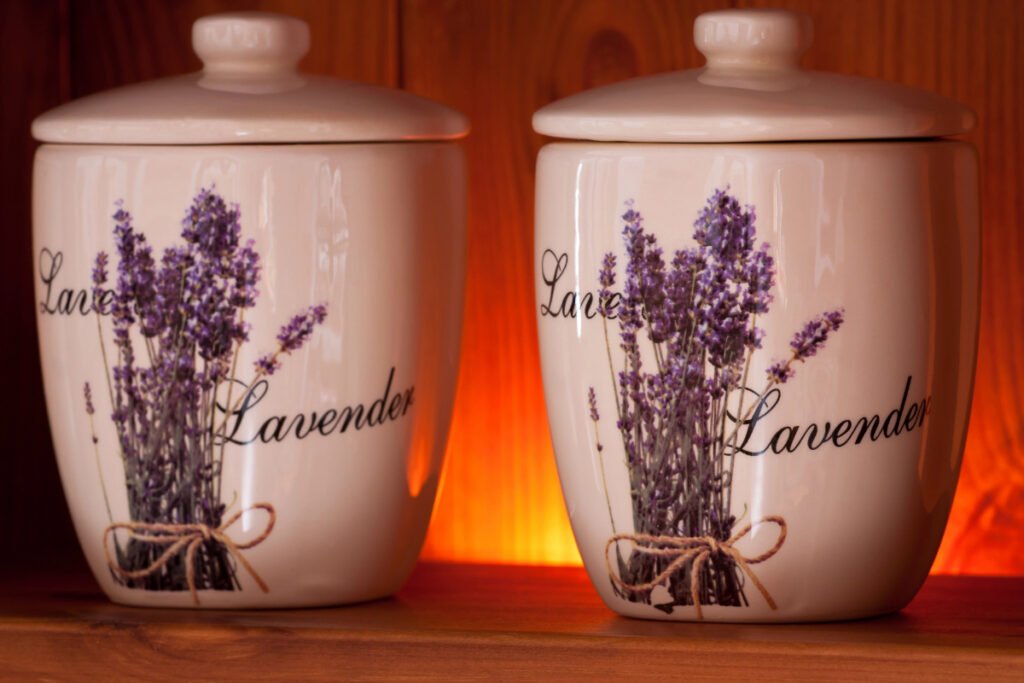
Cookie jars have been a serious collecting field for decades: when Andy Warhol’s 175 cookie jars were auctioned at Sotheby’s in New York in April 1988, they brought about $247,000 against a presale estimate of $5,000 to $7,000, as Deseret News reported at the time.
The real difference between a common old cookie jar and a sought-after collectible comes down to its design, materials, or authentic markings. These six checks will help you identify an authentic jar and judge its value:
Check the Material: Earthenware or Stoneware
Knowing the actual composition may significantly help you spot vintage cookie jars as well as date them, since different materials were used from time to time. Some of the most common materials used in old cookie jars are:
- Earthenware Ceramic: One of the oldest materials that has been used for cookie jars. These are usually lighter and porous where the clay isn’t glazed. Look for clay bodies in either bright white or cream clay, as these indicate that the items are made of earthenware.
- Stoneware Ceramic – Fired in high temperatures, these pieces usually turn out heavier, denser, and non-porous. Examine the unglazed bottom of these jars, and if the clay is darker, like gray, brown, or buff, then it’s likely a stoneware jar.
Check the Maker’s Marks
On cookie jars, markings serve as secret signatures that will help you trace their history. It can be a simple stamp, number, or logo about who made it, when they made it, and just how rare it might be.
You can find these either at the base of the pieces, inside the lid, back of it, or on the side and at the rim areas. Some of the known makers and their markings are:
- McCoy – Their cookie jars would have “McCoy” or “USA” or both on the bottom. Older McCoy pieces may carry only a style number or no mark at all, so a missing mark doesn’t rule a jar out. Check more on our McCoy pottery guide.
- American Bisque Company – The pieces will have “American Bisque” or “USA” with model numbers embossed on them.
- Hull Pottery – Vintage Hull’s marks will have model numbers along with “Hull USA” or “A.E.Hull Pottery Co” impressed on them. Later pieces might also show “Hull Oven proof” imprints.
- Shawnee Pottery – Their items would either have “Shawnee”, “Shawnee USA”, or “USA” marked on the bottom. Their model numbers will usually be like “USA 823”
- Brush Pottery – At the base of the jars, you will find markings of their name, like “Brush U.S.A” or just “Brush”, with model numbers like “W17 USA”.
- Brush-McCoy – Genuine Brush-McCoy wares (1911–1925) are mostly unmarked or carry only an incised style number, not a “McCoy” mark, so they are often misidentified.
Remember: Any piece with a “Brush McCoy” marking (without a hyphen) can indicate a reproduction since their merger ended in 1925, and most cookie jars were produced after that.
Judge the Rarity
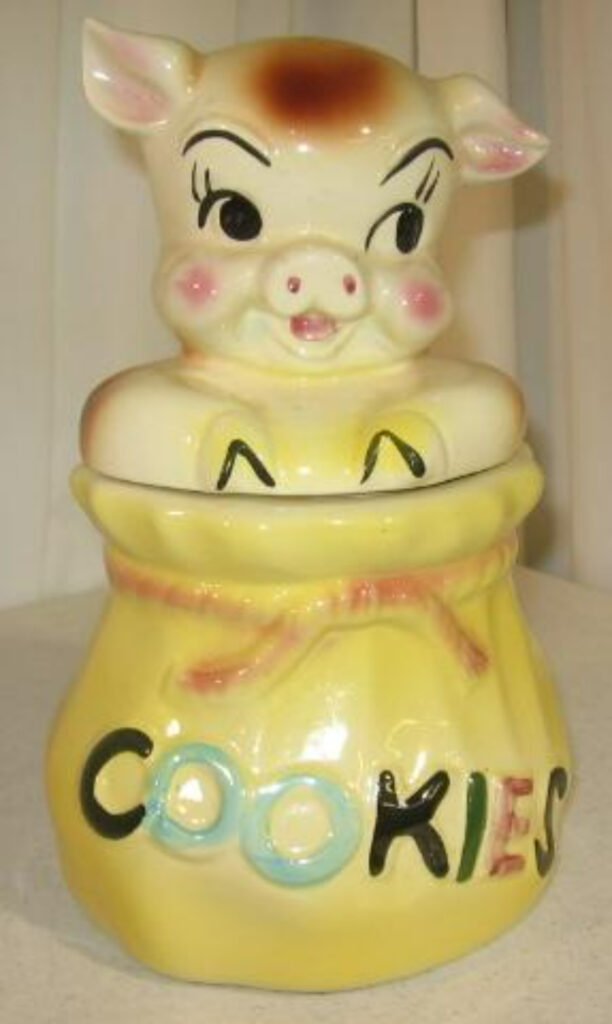
Rarity can turn an ordinary cookie jar into a collector’s prize. But rarity doesn’t simply mean unusualness; the fewer number of cookie jars, limited runs, unique designs, or discontinued designs are also considered rare.
- Low Production numbers – Jars that were made in small quantities or for a shorter time are considered rare, whether promotional jars or store exclusives. Designs that were discontinued after a short time are also desirable, like the Marilyn jar from the list!
- Licensing Restrictions – Licensed jars based on any specific cartoon, movie, or character are also highly desirable, due to limited production. The Flintstone jar, for example. Celebrity or artist-signed pieces are also exclusives, too.
- Design Complexity – Intricate hand-painted details, unusual shapes, or complex glazing techniques that were difficult or expensive to make increase a jar’s rarity. Errors, like misprints, odd glazes, color mistakes, or unusual markings, also boost value.
- Age & Survival Rate – Generally, older cookie jars from the early 1900s to the mid-1900s are most collectible. Why? Because most were broken through daily use, surviving pieces in excellent condition are rare.
Check the Design Quality and Details
To spot old cookie jars, looks matter a lot. Be it the paint on the jar, the sharpness of its features, or even tiny details like the expression or the additional props, these can tell you about the authenticity of the piece.
Fine Craftsmanship
Authentic vintage cookie jars would have crisp, well-defined mold lines. The features would be finely made, the dimensions would be well-proportioned, and the pieces would have consistent wall thickness.
Additional tip: Check the lid fit, as vintage cookie jars would have balanced lids since they were crafted to match the jar’s body.
Period Designs
Antique or vintage cookie jars showcase design trends tied to specific periods. For example, Art Deco jars highlighted geometric patterns and stylized motifs, such as the Abingdon Pottery Deco-style jars.
On the other hand, mid-century modern jars feature clean lines and practical elegance, like the Red Wing stoneware jars that merged utility with aesthetic beauty.
Check the Condition
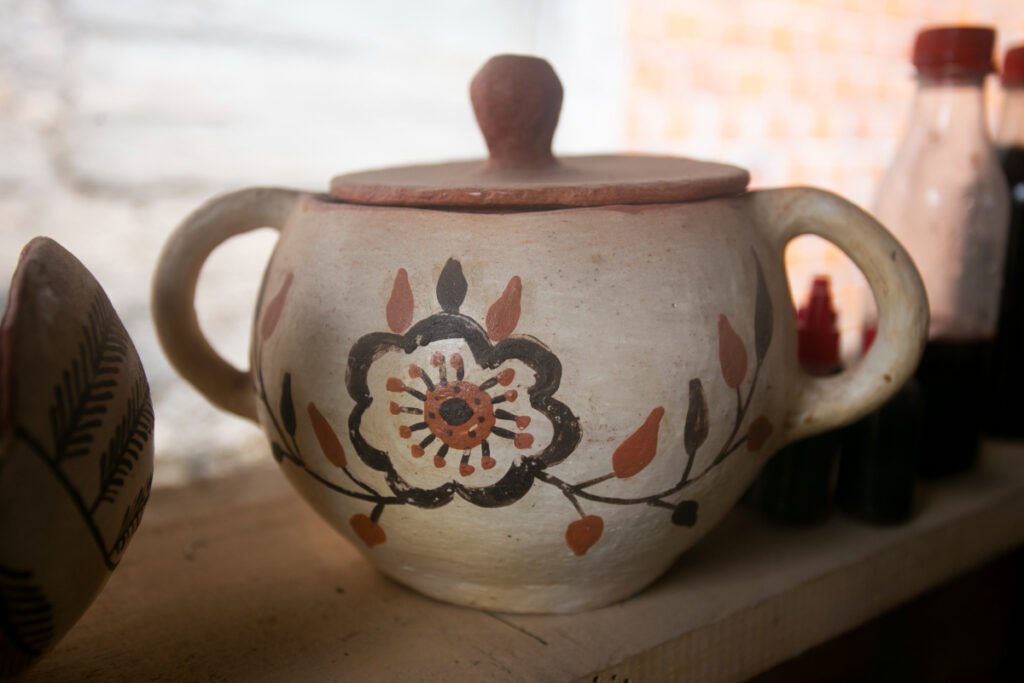
Condition is extremely crucial for old cookie jars. Pieces in near-perfect shape often end up at a good price, while damage like tiny chips, a hairline crack, or even a bit of paint loss can knock down their worth.
So, to assess the right value of an antique cookie jar, consider the following things:
- Barely noticeable and very light crazing retains its value.
- Minimal paint loss in handling areas is acceptable.
- Light interior staining is fine, as it indicates usage over the years.
- Missing pieces like the handles, lid, or any relevant elements can devalue the items.
- Slight hairline cracks that don’t compromise structure can be considered.
- Extensive damage affecting both appearance and function is a big No.
- Poor repairs like a repaint reduce the value.
- Professional restoration (without visible seam lines or glue marks) is okay.
Look for Provenance and Documents
Having proof of record not only helps in authenticating a jar, but also boosts its value. Collectors prefer documentation that can help them trace the history of a piece and find out whether it’s worth the money or not!
Original boxes or packaging with proper markings, tags, etc., are the most important things to look for. Apart from this, manufacturing documents, company records, sales receipts, auction house records (if sold), catalog descriptions, and certificates of authenticity (If any) can also add to the value.
Where to Sell Old Cookie Jars
Once you know what you have, pick the right selling platform using the following clues:
- Common and mid-priced jars: eBay reaches the most buyers. Search the maker and the jar’s name, filter by sold listings, and price yours against sold pieces.
- Rare or signed jars: a regional auction house or an antiques marketplace such as Ruby Lane puts them in front of serious collectors.
- Not sure what you have: post clear photos of the jar and its base in a cookie jar collectors’ group before you sell. Members can often name the maker and spot a reproduction.
So, before you put that old cookie jar back on the shelf, turn it over. The mark, the maker, and a quick look at sold listings will tell you whether it’s a knick-knack or worth real money. Also, see which other vintage kitchen items are worth collecting.
Found this guide useful?
Save it for later
Share it with someone
Keep the old finds coming
New guides and finds worth looking for, delivered to your inbox.
Keep exploring
More guides in Kitchen Collectibles
 13 finds13 Old Glass Bowls Worth Money: Top Makers, Patterns & ValueTop sale $797
 11 findsOld Libbey Glassware: How to Spot Rare Vintage PiecesTop sale $595
 9 finds9 Types of Vintage Tea Cups That Are Highly Collectible TodayTop sale $289
 11 finds11 Rare Antique Victorian Tea Cups to Add to Your Collection (& What They’re Worth)Top sale $3,100