
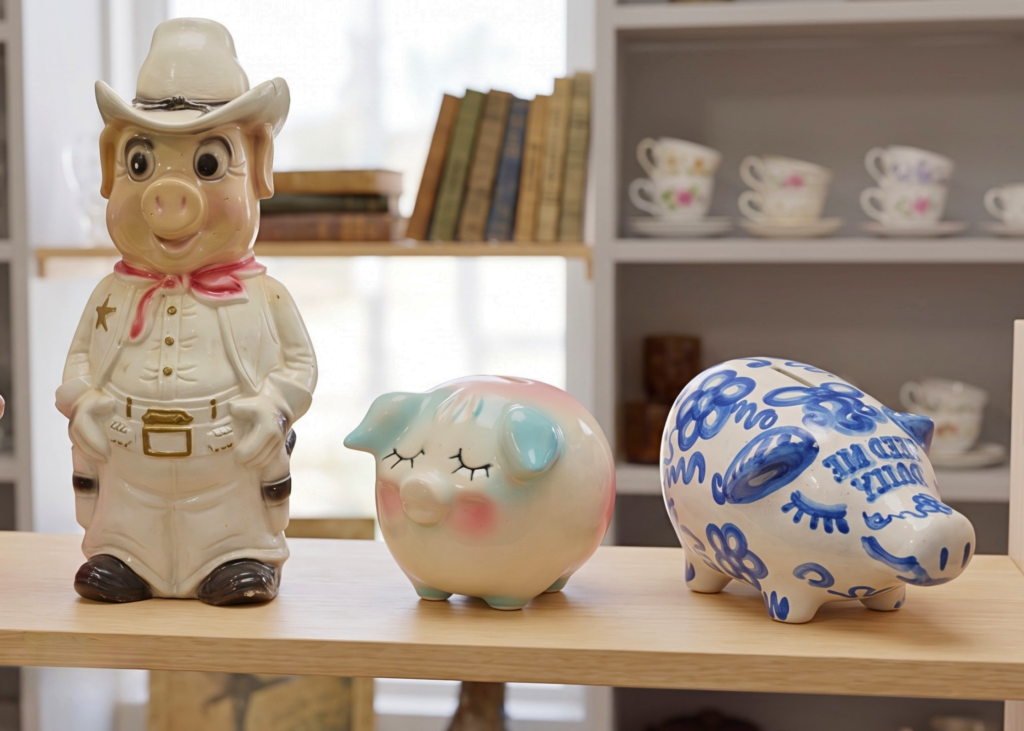
Piggy banks are one of those things people pull out of a grandparent’s closet and set on a shelf without really thinking twice. But some of these little coin holders are worth a lot more than all the pennies inside them.
So, today I’ll walk you through what makes a piggy bank antique or vintage, how to identify the good ones, and how to value them. We’ll also go through real sold examples of the rarest piggy banks collectors chase today.
What Counts as an Antique vs. Vintage Piggy Bank?
This distinction is important before you even begin the identification. Not every “old” piggy bank is an antique. “Antique,” “vintage,” and “collectible/old” all have different meanings in the collecting world.
Antique vs. Vintage vs. Collectible
Generally, antique means 100 years old or older. So in 2026, a true antique piggy bank was made in 1926 or earlier. Vintage covers pieces roughly 20 to 100 years old, so anything from the mid-1920s through the mid-2000s. Collectible is a looser term. It just means people want it, regardless of age.
That means a 1930s Mickey Mouse cast-iron bank is vintage, not antique. But an 1880s J. & E. Stevens cast iron mechanical bank absolutely is.
Still Banks vs. Mechanical Banks
This is another important distinction. A still bank has no moving parts. You drop a coin in the slot, that’s it. Almost every ceramic pig you’ve ever seen is a still bank.
A mechanical bank, on the other hand, has moving parts. You put the coin somewhere and press a lever that triggers an action: a dog barking or a soldier firing a cannon. These were mostly made from cast iron between about 1870 and 1930, and they are the crown jewels of the piggy bank world.
| Type | Era | Typical Material | Value Range |
| Antique cast iron still banks | 1870s to 1920s | Cast iron | $75 to $800 |
| Antique mechanical banks | 1870s to 1930s | Cast iron | $500 to $25,000+ |
| Vintage character banks | 1930s to 1980s | Ceramic, chalkware | $30 to $1,500 |
| Common ceramic pigs | 1960s to 1990s | Ceramic | $10 to $80 |
How to Identify an Antique Piggy Bank?
When you have an old piggy bank in your hand, simply go through the checklist below to identify whether it’s a genuine find.
Check the Material First
Pick the bank up first; its weight will tell you a lot. A cast-iron bank feels seriously heavy for its size, like a small brick. Cast iron is a big deal because it was mostly used before 1940. If you have a heavy iron bank, you’re probably looking at something pre-WWII.
Chalkware (plaster of Paris) feels dense but chalky and warm to the touch. Ceramic feels smooth and cool. Pot metal or zinc feels lighter than cast iron. Glass is simply glass.
Look for Maker’s Marks
Flip the bank over and check the bottom carefully. Serious makers stamped their names into the mold or printed marks on the base. The names to learn are Shawnee, Hull, McCoy, Arthur Wood, Anchor Hocking, Corning, Lefton, Norcrest, Otagiri, and Royal Doulton. Each one has its own style of mark.
For example, a Hull Pottery Corky Pig will say “Pat. Pend. Corky Pig, HP Co/copyright 1957, USA” on the base. A Shawnee Smiley Pig is stamped “Patented Smiley/60/Shawnee USA”.
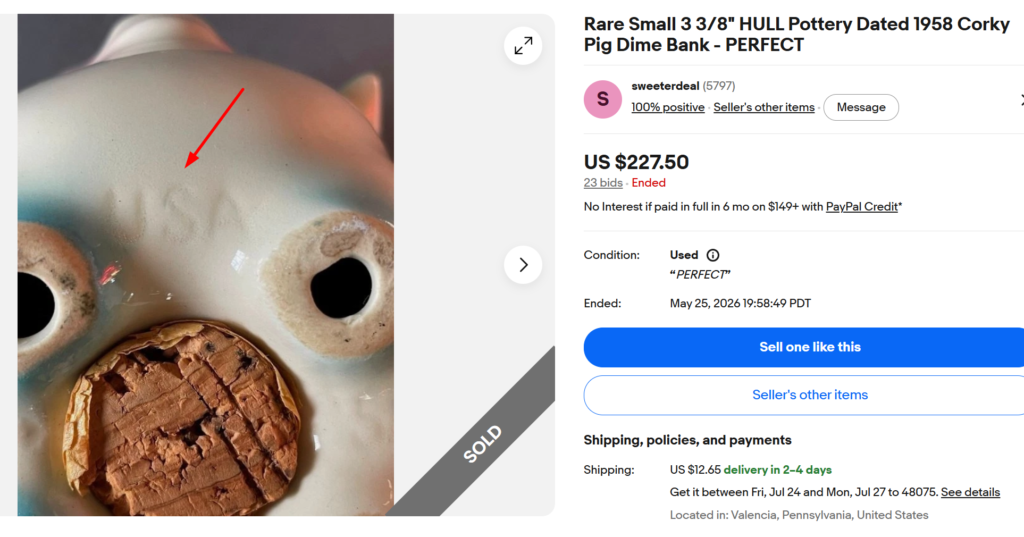
Read the Country of Origin
This is the fastest dating tool. The mark “Made in Occupied Japan” was only used by Japanese exporters from 1946 until April 1952. Seeing this mark is a guarantee that your item is a true post-war item, and the dates are fixed.
“Made in Japan” alone is broader and could be from the 1920s through the 1990s. “England” usually means British potteries like Arthur Wood or Corning’s UK plant.
Check the Coin Slot and Stopper
Old ceramic banks often have a cork stopper on the bottom. That’s what makes the “Corky Pig” a Corky. Cork stoppers were standard from about the 1930s to the 1970s.
Rubber stoppers came in during the 1960s. Plastic screw plugs are usually from the 1980s or newer. If a cork is completely disintegrated or missing, that hurts the value quite a bit.
Look at the Weight, Patina, and Mold Seams
Real old cast iron has a dark, even patina from decades of handling. Fresh reproductions look too clean or have artificially “aged” paint that flakes weirdly. Original mold seams on antique iron banks are tight and clean. Reproductions often have holes that are a little large, paint in colors not seen on originals, and a cast that’s a bit more grainy.
Handy Tip: Cast iron mechanical bank reproductions are common, especially from Taiwan and China in the 1970s and later. If a “Trick Dog” or “Uncle Sam” bank has bright modern paint and feels lighter than it should, it’s likely a repro. Originals came from Connecticut, mostly J. & E. Stevens or Shepard Hardware.
Check the Paint and Glaze
On ceramic banks, look for crazing (the fine spiderweb of cracks in the glaze). It’s normal on genuine mid-century pieces and actually helps confirm age. Perfect glaze on a “1950s” bank is a red flag.
On painted iron banks, original paint has a slightly matte, aged look. Repainted iron banks always sell for less, sometimes a lot less.
11 Valuable Antique & Vintage Piggy Banks That Collectors Chase
These are the rare antique and vintage piggy banks that you should look out for. Some of these are so rare that they can sell for hundreds of dollars today.
1. J. & E. Stevens Cast Iron Mechanical Bank
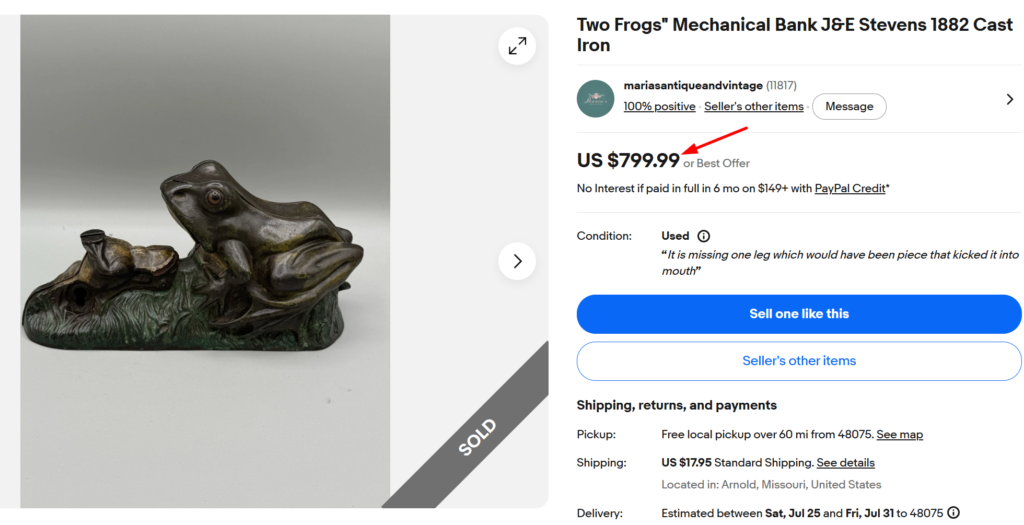
Sold for $800
J. & E. Stevens of Cromwell, Connecticut, is the most important name in American mechanical banks. From the 1870s through the early 1900s, they produced dozens of designs, including the “Trick Dog,” “Uncle Sam,” “William Tell,” “Tammany,” and the famous “Calamity Football” bank. Each one has a moving action tied to coin insertion.
The paint quality on originals is one of the biggest value drivers. Bright, mostly original paint on a working mechanism is what serious collectors chase.
- Estimated Value: $500 to $8,000+
- Production Years: 1869 to the early 1900s
- What to Check: Weight, mold seams, original paint
2. Corning Ware Blue Cornflower Piggy Bank
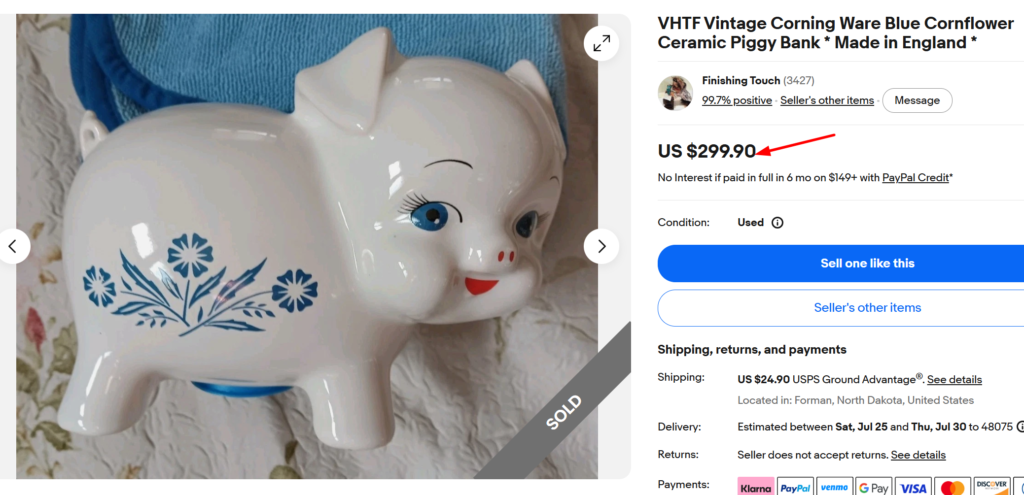
Sold for $300
Produced by Corning Glass Works in the 1980s, these rare banks were made available to Corningware employees for purchase. The bank is white ceramic with the iconic blue cornflower design, red mouth, and a red rubber stopper.
Some are marked “England” on the base, others carry Norwest Bank promotional stickers. They were promotional gifts, not retail products, making them super rare.
- Estimated Value: $150 to $300+
- Production Years: 1980s
- What to Check: Blue cornflower design, red stopper, “England” mark
3. Hull Pottery Corky Pig Piggy Bank
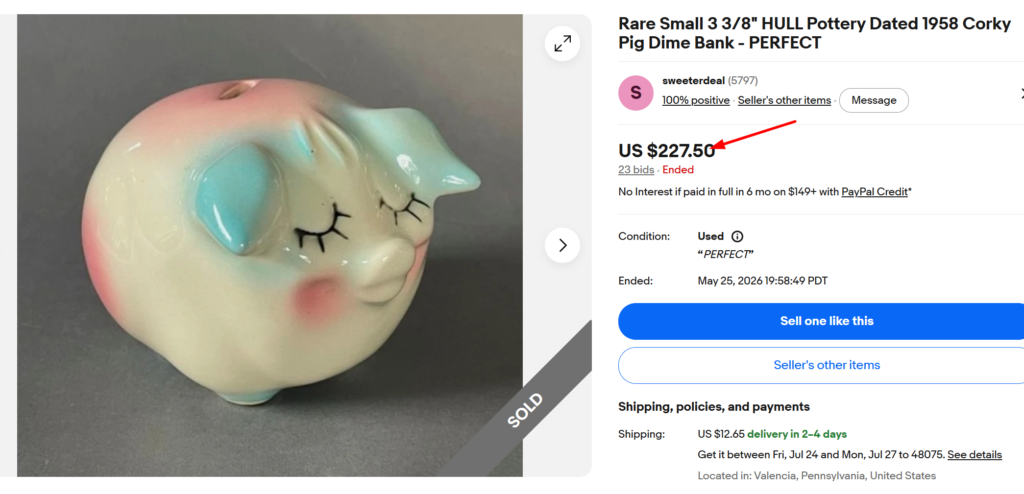
Sold for $230
If you find a chubby ceramic pig with a cork nose and pink and blue coloring, you probably have Corky. Hull Pottery made the Corky Pig starting in 1957, marked “Pat. Pend. Corky Pig, HP Co/copyright 1957, USA” on the bottom.
Standard colors were pastel pink with blue accents, but brown drip glaze, tan, gold, yellow, and rare green versions also exist. The green glaze Corky is the one collectors really want.
- Estimated Value: $35 to $250
- Production Years: 1957 onward
- What to Check: Base stamp, cork nose, glaze color
4. Snoopy Peanuts Ceramic Piggy Bank
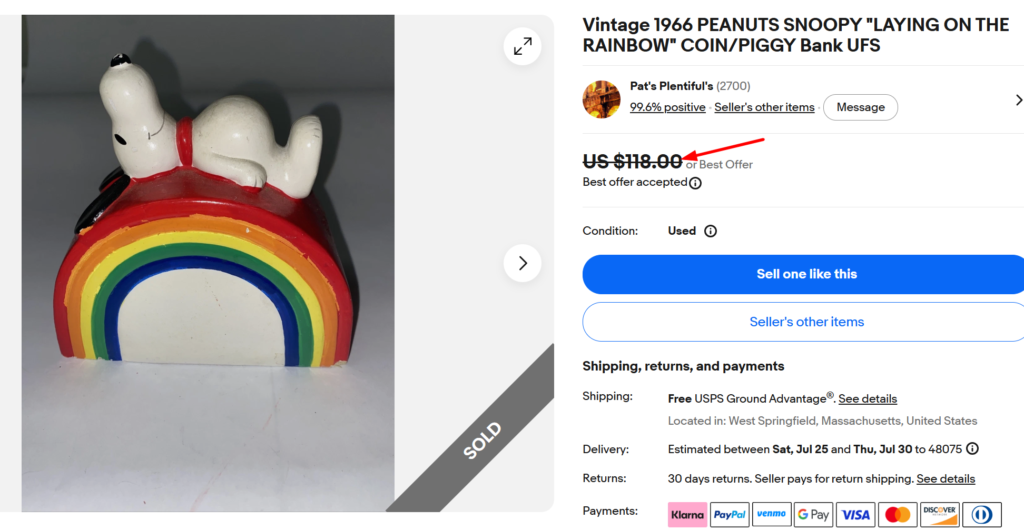
Sold for $118
Snoopy banks are one of the most collected character banks. Various Snoopy variations exist, including Snoopy lying on the rainbow, Snoopy on a circus elephant, Snoopy in a tuxedo, and the most collectible, hamburger versions.
Most authentic vintage examples carry a “United Feature Syndicate” mark with dates like 1958 or 1966. Larger 18-inch Snoopy banks and rare variations like the tuxedo Snoopy can push into serious money.
- Estimated Value: $50 to $400+
- Production Years: 1958 to the 1970s
- What to Check: United Feature Syndicate mark, size, variation
5. Chalkware Carnival Prize Pig Bank
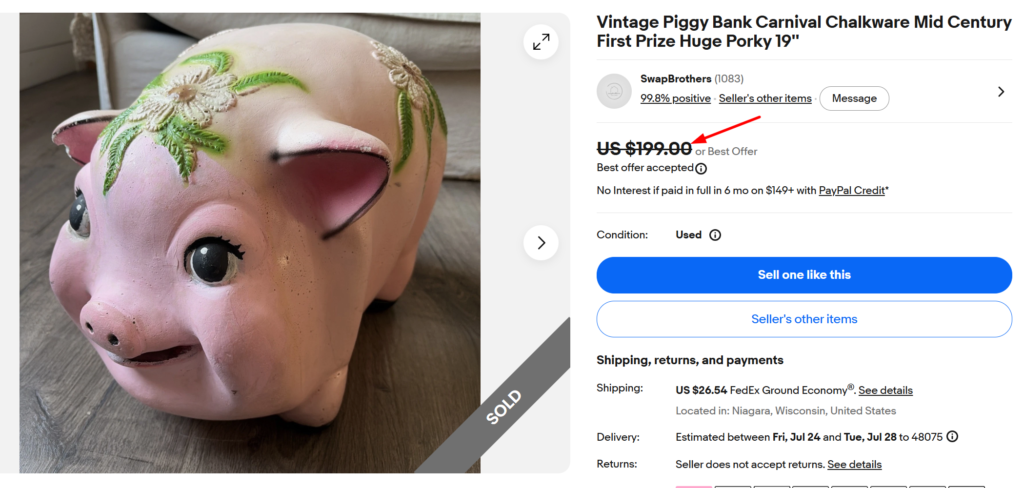
Sold for $200
Carnival chalk is basically chalkware figures popular during the first half of the 20th century as carnival game prizes. Chalkware banks are quite collectible today.
A standard 6-inch chalkware pig is a $10-$20 piece; a large, 19- to 25-inch first-prize “Porky” example with good paint can sell for $150-$400.
Silvestri Bros. from Chicago made some of the biggest and most sought-after examples with signed bases dated to the 1960s.
- Estimated Value: $15 to $400
- Production Years: 1940s to 1960s
- What to Check: Size, paint condition, Silvestri Bros. mark
6. Shawnee Pottery Smiley Pig Piggy Bank
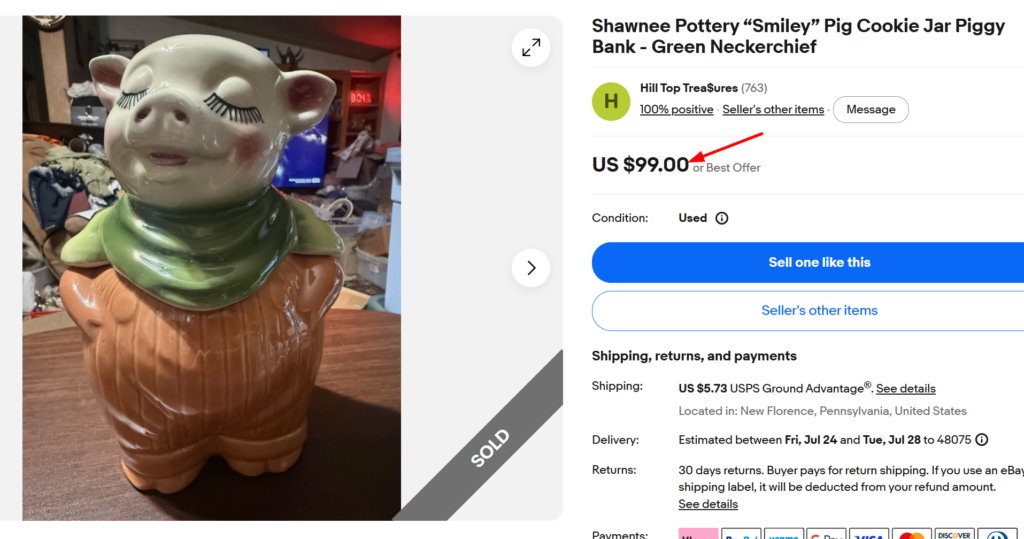
Sold for $100
Shawnee’s Smiley Pig is a crossover of a cookie jar and a piggy bank. Designed by Robert Ganz in the late 1930s, Smiley was made in cream, butterscotch, chocolate brown, and green base finishes.
Smiley is one of the most wanted jars. The bank versions are rarer, especially gold-trimmed clover bud examples, than the cookie jars, but they use the same molds. Watch for the clover bud, shamrock, tulip, and gold trim variations.
- Estimated Value: $100 to $800+
- Production Years: Late 1930s to 1961
- What to Check: Base mark, clover or shamrock decal, gold trim
7. Anchor Hocking Textured Clear Glass Piggy Bank
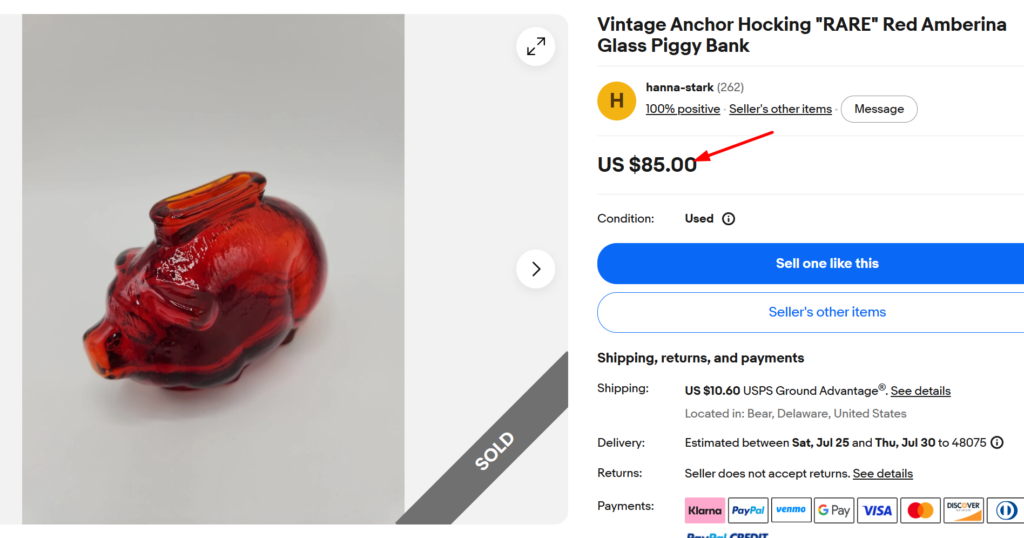
Sold for $85
Anchor Hocking made a chunky textured glass pig bank starting in the early 1970s that has become a collector’s favorite. The most common version is clear, but the red glass version is much harder to find. Marked A5068 on some examples.
A circa 1970s glass Anchor Hocking piggy bank currently holds a value of around $40 to $50 for clear versions, but red or other colored variants push higher.
Note: These banks were made without a bottom opening, so getting coins out required some patience.
- Estimated Value: $25 to $100+
- Production Years: 1970s to early 1980s
- What to Check: Color, model number A5068, no chips
- Quick Notes: Red glass version is much rarer than clear
8. Uncle Sam’s 3-Coin Register Bank by Durable Toy & Novelty
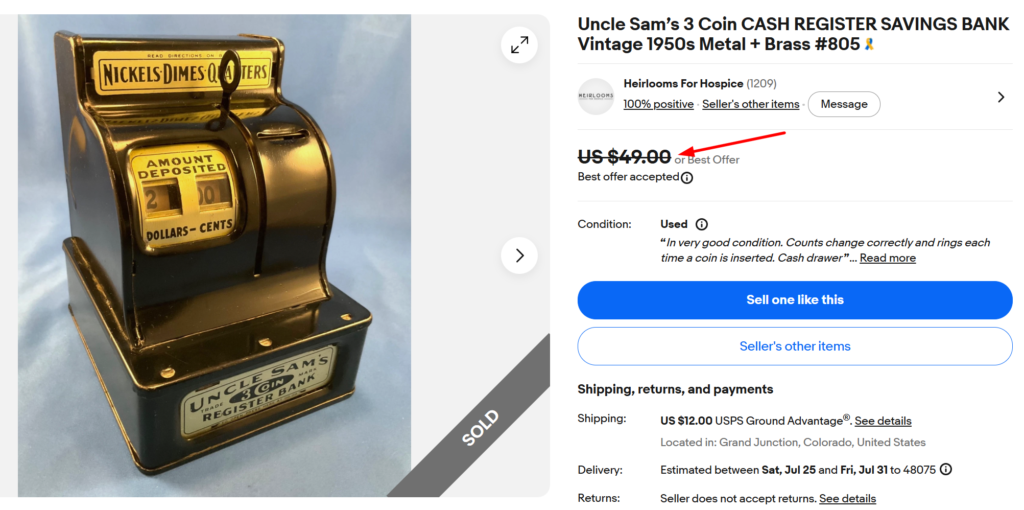
Sold for $50
Uncle Sam registering banks are among the most recognizable American toy banks ever made. The first bank was released in 1907 by the Durable Toy & Novelty Company.
It’s shaped like a mini cash register, and it locks your coins away until you deposit $10 worth of dimes, nickels, and quarters. The banks were sold in several different enameled colors, including black, red, green, and chrome.
Black is the most common. Red versions are rare, and chrome examples from the 75th anniversary edition are the ones collectors chase.
- Estimated Value: $30 to $200, depending on color and condition
- Production Years: 1907 to the early 1980s
- What to Check: Color, working register, intact instructions
9. Libbey Wise Old Owl Glass Piggy Bank
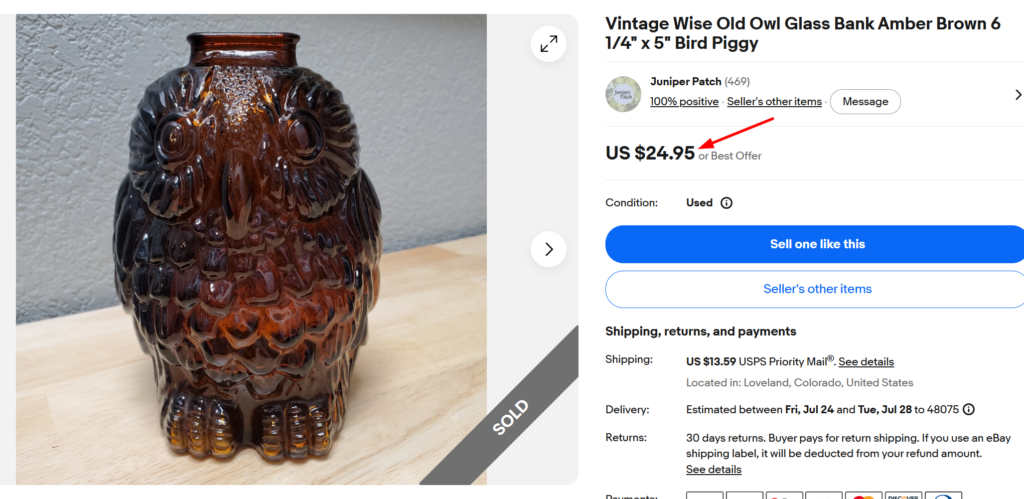
Sold for $25
Not technically a pig, but it’s collectible. Libbey and other glass makers produced the Wise Old Owl bank in embossed pressed glass during the 1970s. The bottom is embossed with the words “Wise Old Owl,” and the front, sides, and back all have deep embossed detail.
Common colors are clear, amber, and smoke. The amber and light root beer versions get the most attention from collectors.
- Estimated Value: $20 to $80
- Production Years: 1970s
- What to Check: “Wise Old Owl” embossed base, no chips
10. Cast Iron Mickey Mouse Piggy Bank
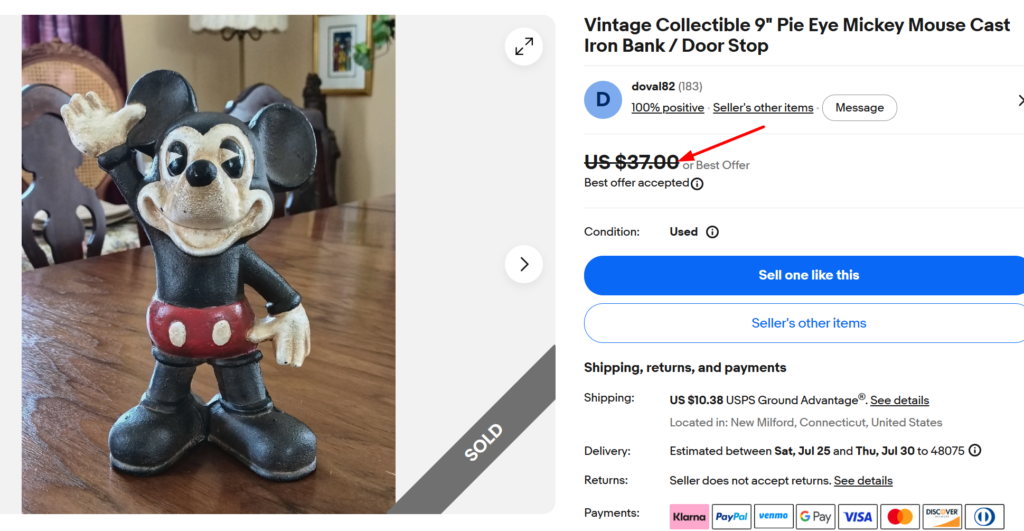
Sold for $38
Original 1930s cast-iron Mickey Mouse banks are Disneyana holy grails. The genuine ones from the early 1930s were made by Zell Products and other small foundries, and they featured the “pie-eyed” Mickey design that Disney used before switching to the modern eyes.
However, pay attention. Most of what you see out there is recent, imported, and unlicensed product, with no collectible value. Genuine 1930s pieces show heavy patina, original paint loss patterns, and no modern markings.
- Estimated Value: $50 to $600 (originals), $10 to $40 (reproductions)
- Production Years: 1930s to 1940s (originals)
- What to Check: Pie-eyed Mickey style, patina, weight
11. Raggedy Ann & Andy Ceramic Piggy Banks
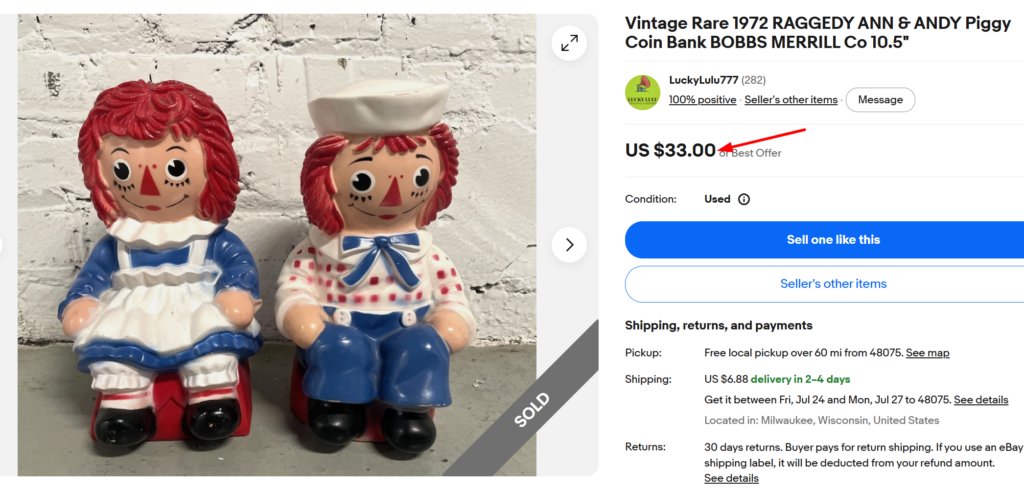
Sold for $33 (for a pair)
Bobbs Merrill Company owned the Raggedy Ann and Andy rights and licensed a series of ceramic banks in the early 1970s. Standard marking reads “1971 The Bobbs-Merrill Company, Inc.” with “Made in Japan” on the base.
These come as singles or pairs, and complete pairs in matched condition are worth more than singles.
- Estimated Value: $25 to $75 (singles), $50 to $150 (pairs)
- Production Years: 1971 to 1972
- What to Check: Bobbs Merrill mark, Japan stamp, matched pair
How to Value Your Antique Piggy Bank?
Finding the real value of an old piggy bank can be challenging, because the value doesn’t depend on any one particular thing, but on five key factors:
- Rarity comes first, always. A common Shawnee Smiley Pig is worth a couple of hundred dollars. A gold-trimmed Smiley with an unusual clover decal can hit four figures. Same maker, same shape, wildly different values.
- The condition is next. Cracks, chips, missing stoppers, repainted surfaces, and broken mechanical actions all drag prices down.
- Maker matters, too, because named makers like Shawnee, Hull, and Royal Doulton always outsell unmarked pieces.
- Mechanical action counts if the bank moves.
- Provenance, meaning a documented history, helps in authentication and adds to the value.
Typical Value Ranges
- Common 1960s to 1980s ceramic banks: $10 to $40
- Named maker ceramic banks (Shawnee, Hull, Arthur Wood): $50 to $400
- Antique cast iron still banks: $75 to $800
- Antique cast iron mechanical banks: $500 to $25,000+
- Character and licensed rarities (Snoopy, Mickey, Uncle Sam): $50 to $3,000+
- Glass banks (Anchor Hocking, Libbey): $20 to $200
Please note that these values are estimated prices based on several sold examples. The final value of a bank depends on the five factors given above, plus what a collector is willing to pay for a piece.
The piggy bank is one of the most sought-after antiques. Whether you own one or bought one at a garage sale, look out for the maker’s mark, know how it works, and gauge its condition so that you do not miss out on something rare.