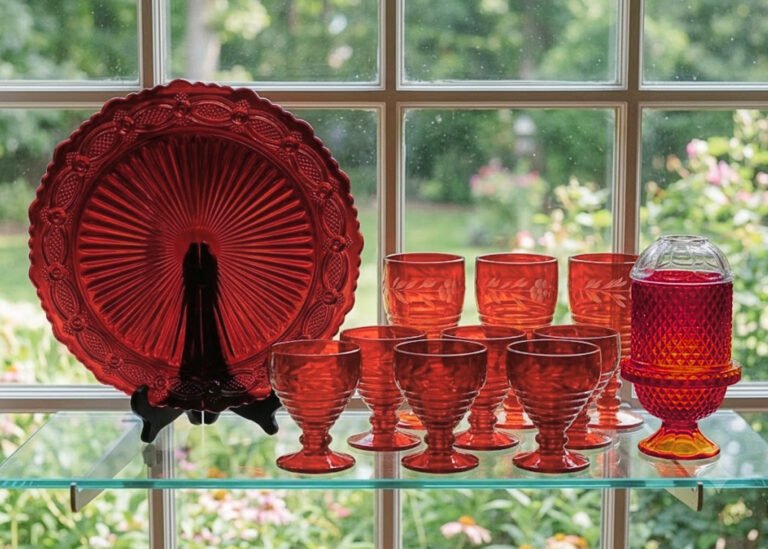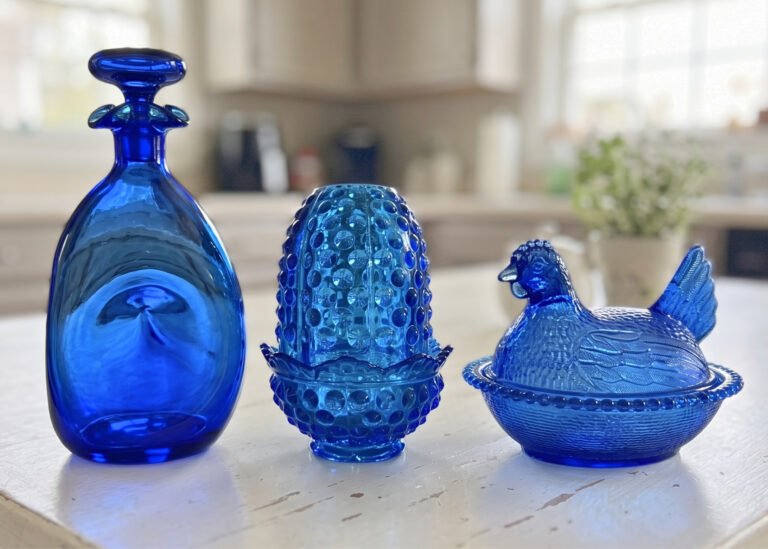

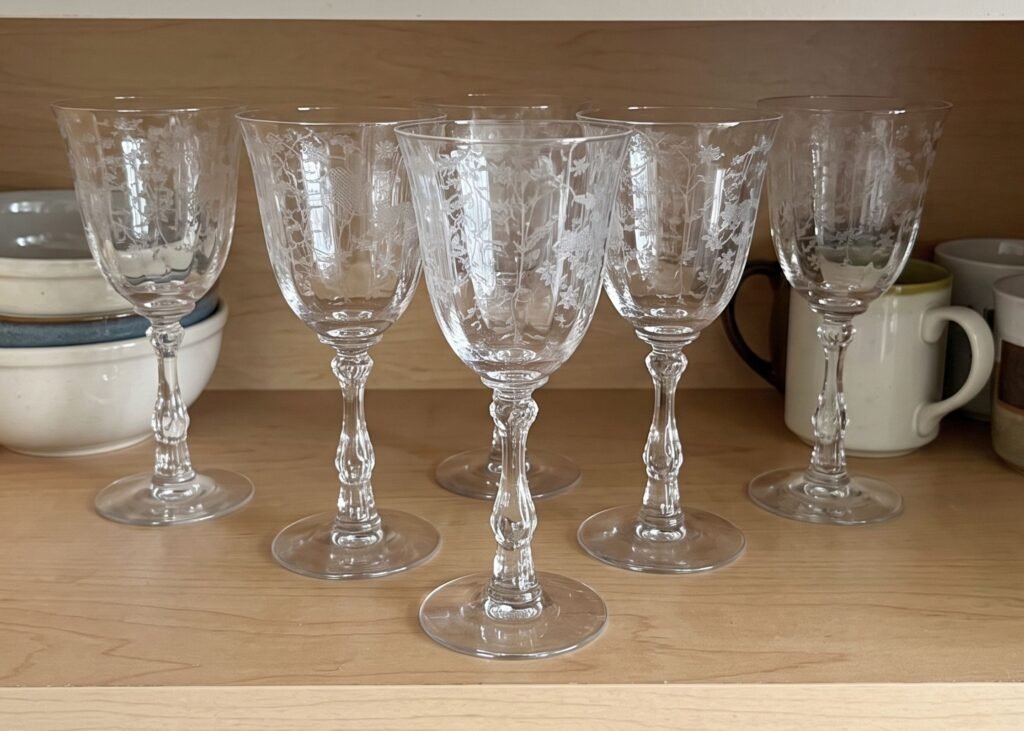
Did you know that every U.S. president from Eisenhower to Reagan had Fostoria on the White House table? That’s one of the reasons why vintage pieces are collectible today.
Fostoria Glass Company started in Fostoria, Ohio, in 1887, then moved to West Virginia in 1891 when the local natural gas ran out. The company operated there for 95 years, closing in 1986 after Lancaster Colony Corporation bought it out.
People use “Fostoria crystal” and “Fostoria glass” interchangeably, but there’s a difference. The earlier pieces were pressed glass, while the premium blown and etched lines were lead crystal with about 24% lead content, which gives real Fostoria its sparkle and clear ring.
Below, you’ll find rare Fostoria crystal patterns and pieces that are actively sold and collected, plus identification tips and value ranges to check your own cabinet.
How to Identify Fostoria Crystal (Marks, Patterns & Clues)
Finding out if a crystal piece is genuinely Fostoria can be tricky because it has no permanent maker’s mark. But there are still ways to identify a real Fostoria piece:
- Paper labels – Fostoria applied gold-foiled paper labels with “Fostoria” in script from the 1920s to the late 1950s. But since these came off while washing, many items you see today have no labels. A piece with the original paper label on the base is genuinely rare and valuable.
- Acid-etched marks – During the 1970’s and 1980’s, Fostoria started to put an acid-etched “Fostoria” signature on select patterns like the Navarre stemware. This signature will be located under the foot of the stemware and indicates that the piece was made after 1970.
- Lenox marks on Navarre – After Fostoria closed in 1986, Lenox continued making Navarre stemware until 1992. Lenox pieces are usually marked “Lenox” on the base. If your Navarre is marked Lenox, it’s not true Fostoria.
- The ring test – Tap the rim of any goblet lightly with your fingernail. Real Fostoria lead crystal produces a clear, sustained bell-like ring. Non-lead reproductions like Indiana Glass Whitehall thud instead.
- Weight and clarity – Genuine Fostoria feels noticeably heavier than modern reproduction glass of the same size. Hold it up to a window. Real lead crystal has bright, lively clarity with no dull patches or milky spots.
- Pattern recognition – Since most Fostoria isn’t marked, patterns are the real identification clues. You can use Weatherman guides and the Long & Seate books for reference. Match the pattern, and you know what you have.
12 Valuable Fostoria Glass Patterns, Colors & Pieces
Now, let’s take a look at which vintage Fostoria crystal patterns and items are most popular among collectors today, how you can identify them at estate sales or garage sales, and what they’re actually worth.
1. American Pattern Beer Mugs
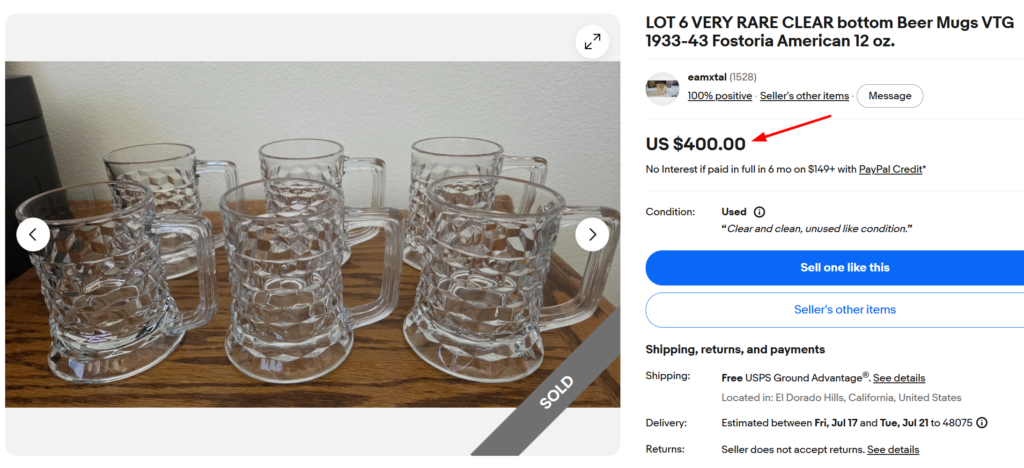
Sold for $400 (set with 6 mugs)
American #2056 is the ice-cube pattern. It’s thick pressed crystal covered in raised three-dimensional cubes, with crisp corners you can feel with your fingertip. The beer mugs are currently the most valuable pieces in this pattern, after punch bowl sets.
It typically pairs a deep-footed bowl, a heavy underplate, twelve cube-handled cups, and a glass ladle. Complete sets with all cups and the ladle intact are worth a lot.
- Estimated Value: $200 to $600 (complete set)
- Production Years: 1915 to 1986
- What to Check: Crisp cube corners, ringing lead crystal
- Quick Notes: Indiana Glass Whitehall is the common look-alike
2. Navarre Blue Water Goblets
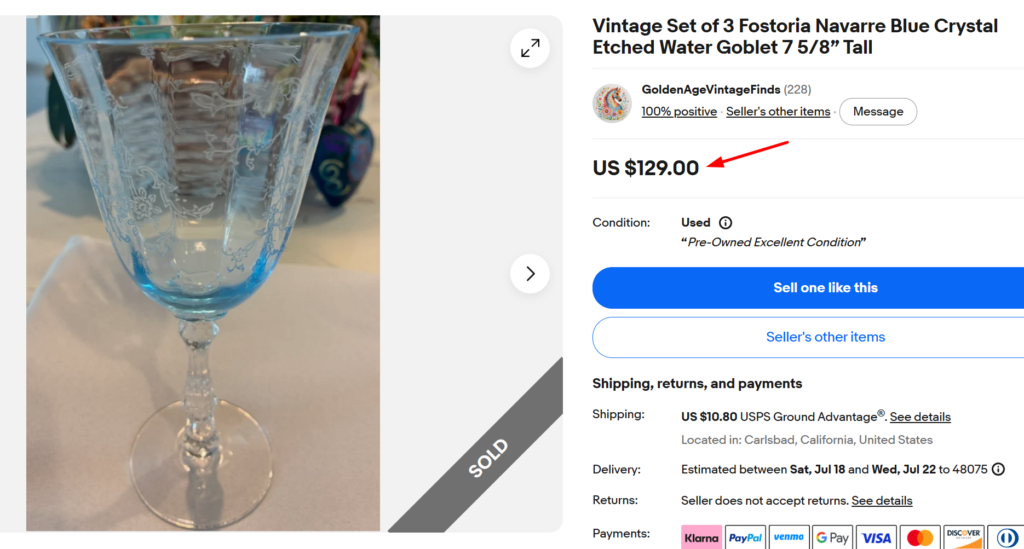
Sold for $130 (single goblet)
Navarre is a deeply acid-etched pattern of a small floral bouquet inside curved scroll parentheses, with more flowers scattered around it. The stemware sits on the #6016 blank, which has a tall crystal stem and foot with a colored bowl on top.
Blue Navarre stemware only appeared in 1973, so it’s late production, not Depression-era; still, it’s more collectible than clear pieces.
- Estimated Value: $40 to $120 per goblet
- Production Years: Blue made from 1973 to 1982
- What to Check: Flowers inside scroll parentheses
3. Coin Glass Ruby Red Candy Jar
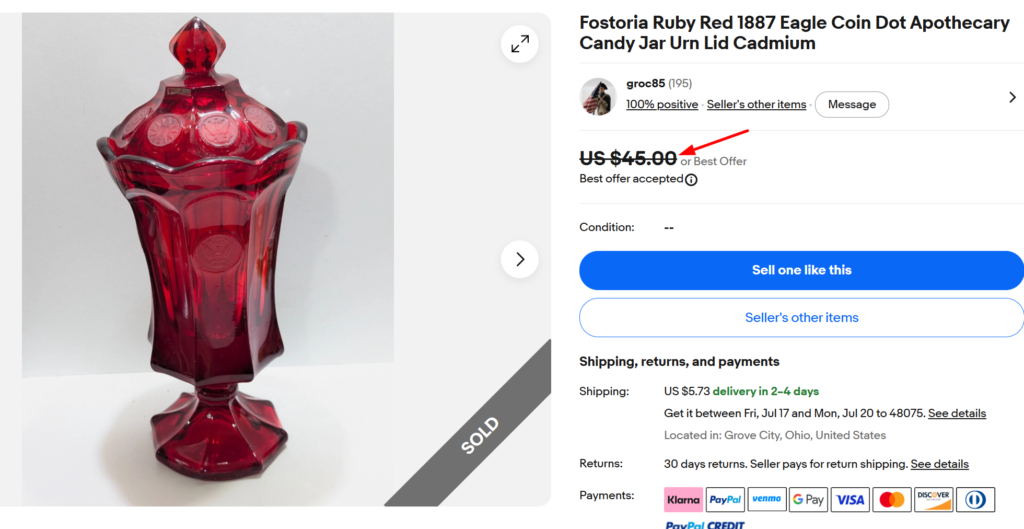
Sold for $45
Coin Glass is a heavy pressed crystal with large raised medallions molded to look like colonial-era American coins.
Four coin designs show up across the line, including an eagle, a colonial head, a torch, and the 1887 date commemorating Fostoria’s founding year.
Interesting Fact: First-quality pieces always have frosted coins, and are usually more valuable; later reissues left the coins unfrosted
- Estimated Value: $30 to $180
- Production Years: Ruby made 1967 to 1982
- What to Check: Frosted coins with 1887 date
4. Heirloom Pink Opalescent Swung Vase
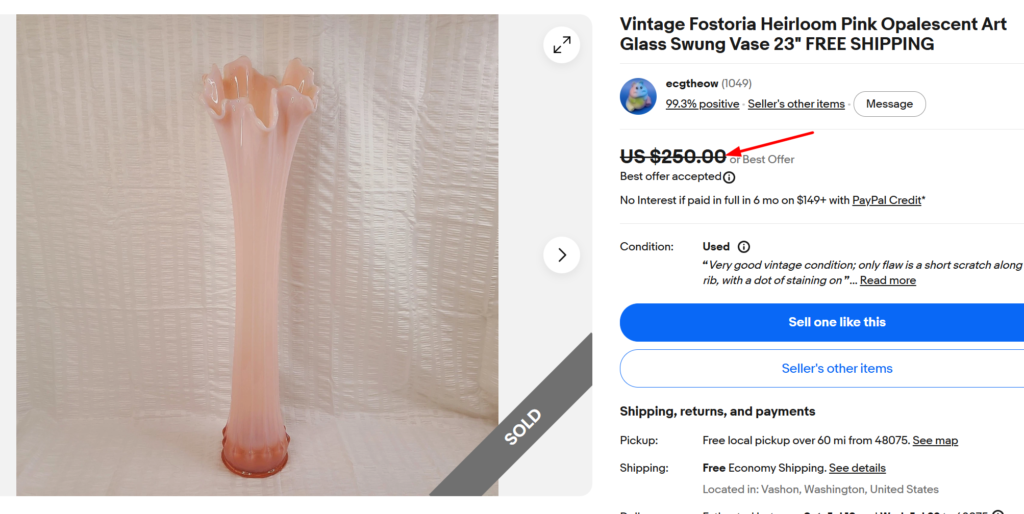
Sold for $250
Heirloom is George Sakier’s opalescent giftware line. The glass has milky white edges that fade into pink, blue, yellow, or green centers. Swung vases are pulled while still hot to create tall, uneven, free-form shapes, usually ribbed or fluted.
The taller pieces, especially the 18 to 24 inch swung vases, are the hardest to find because so few survived without chips.
- Estimated Value: $75 to $300+ (size dependent)
- Production Years: 1959 to 1970
- What to Check: Milky opalescent edges, pulled free-form shape
- Quick Notes: Yellow Heirloom is vaseline glass, glows under UV
5. June Azure Blue Etched Stemware
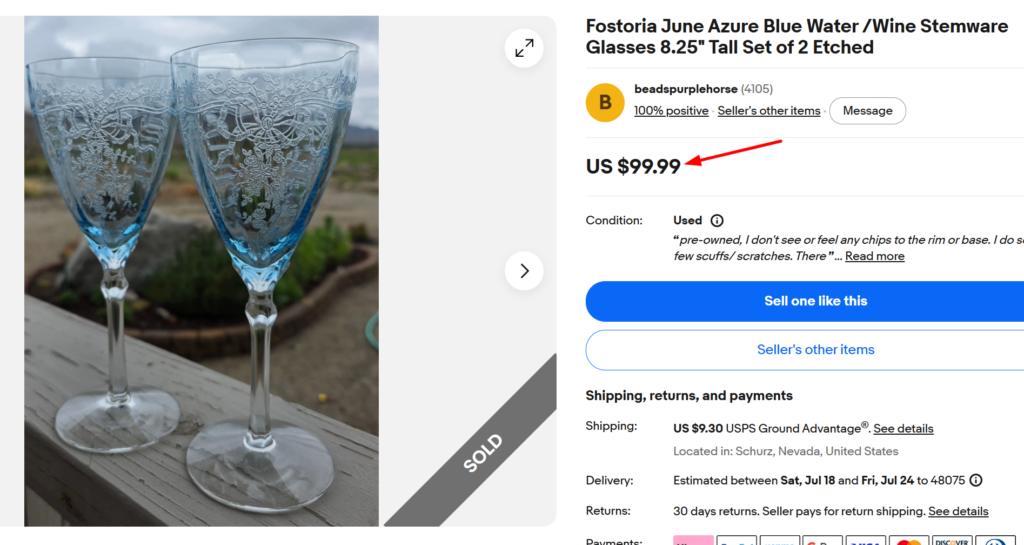
- Sold for $100 (set of 2)
June is an etching pattern featuring garlands, tiny flower sprigs, and flowing ribbon bows tied at intervals. The design was applied to the Fairfax #2375 blank, with stemware on blank #5098. Bowls came in the color, with a clear crystal foot and stem underneath. Complete Azure stemware sets can bring $1,000+ today.
- Estimated Value: $50 to $150 per stem
- Production Years: 1928 to 1952 (blue: 1928 to 1944)
- What to Check: Garland etch with ribbon bows
6. Versailles Pink Water Goblets
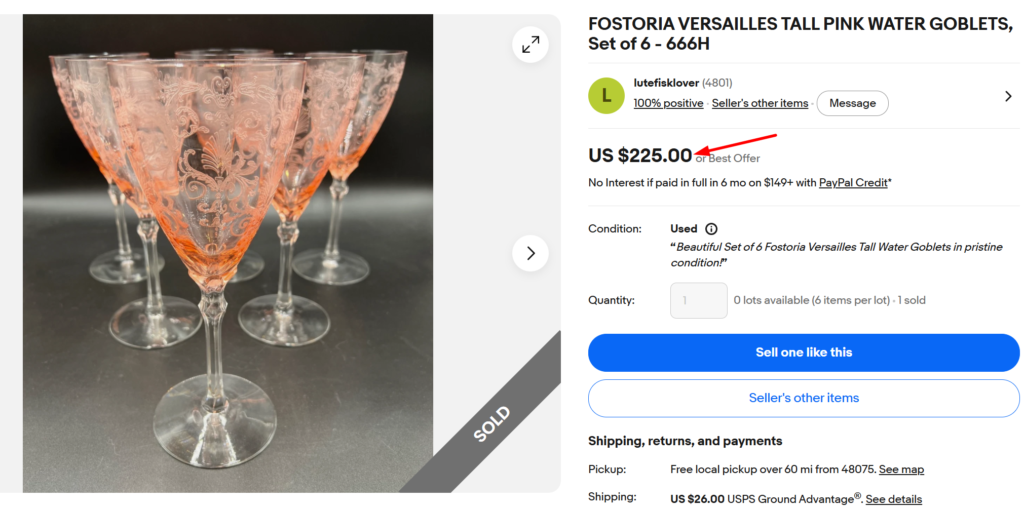
Sold for $225 (set of 6)
Versailles is a formal scroll-and-floral etching applied to plate rims only, leaving the centers bare. It uses the same Fairfax blank as June, but the motif is heavier, with elongated scrolls and larger sprays.
Fostoria made it in pink (Rose), azure blue, green, topaz, and some crystal. Pink production ended in 1944, so anything in pink is genuinely pre-war and more valuable.
- Estimated Value: $80 to $250
- Production Years: 1928 to 1943 (pink)
- What to Check: Rim-only etch, no center design
- Quick Notes: Green Versailles is the second rarest color
7. Baroque Azure Blue Cups & Saucers
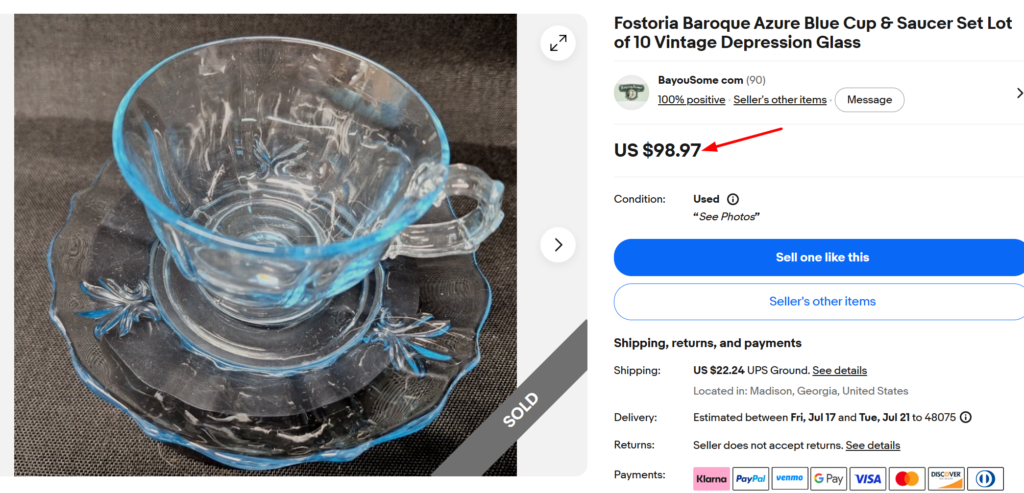
Sold for $98 (set of 10)
Baroque is a molded pressed pattern (#2496) with a scalloped wavy edge, vertical optic ridges, and a fleur-de-lis pressed into most of the pieces. The saucers show the fleur-de-lis clearly on the rims, and the cups carry the same optic ridges, with a shaped handle and scrollwork.
Azure blue was made from 1936 to 1944, so any blue Baroque is pre-war. Gold Tint, the warm amber-yellow color introduced for the 1937 Golden Jubilee, is the rarest Baroque color and runs even higher than blue.
- Estimated Value: $40 to $150
- Production Years: 1936 to 1944 (Gold Tint 1937 to 1944)
- What to Check: Molded fleur-de-lis, wavy scalloped edge
- Quick Notes: Gold Tint Baroque pieces are highly rare.
8. Chintz Etched Crystal Set
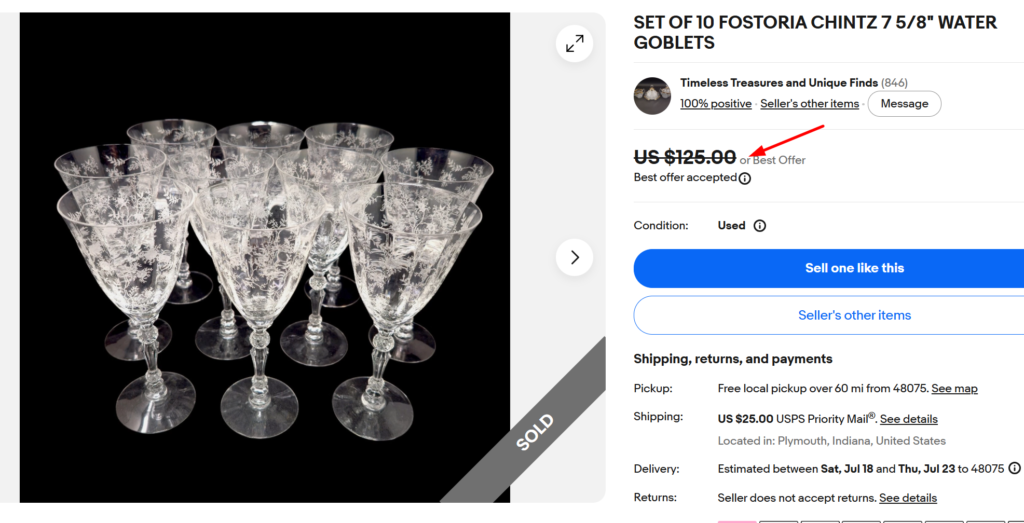
Sold for $125 (set of 10 goblets)
Chintz is a full-body etched pattern with entwined roses, thorny vines, and sharp leaf motifs. The design appears to be spiked and elaborate as compared to other etchings by Fostoria.
It sits on the Baroque blank, so you’ll see the fleur-de-lis between the flower groupings on the rims. Chintz was only made in crystal, never in colored glass.
- Estimated Value: $150 to $500 (set of 6+)
- Production Years: 1940 to 1975
- What to Check: Spiky roses, thorny branches, Baroque rim
- Quick Facts: Only made in clear crystal.
9. Meadow Rose Iced Tea Glasses
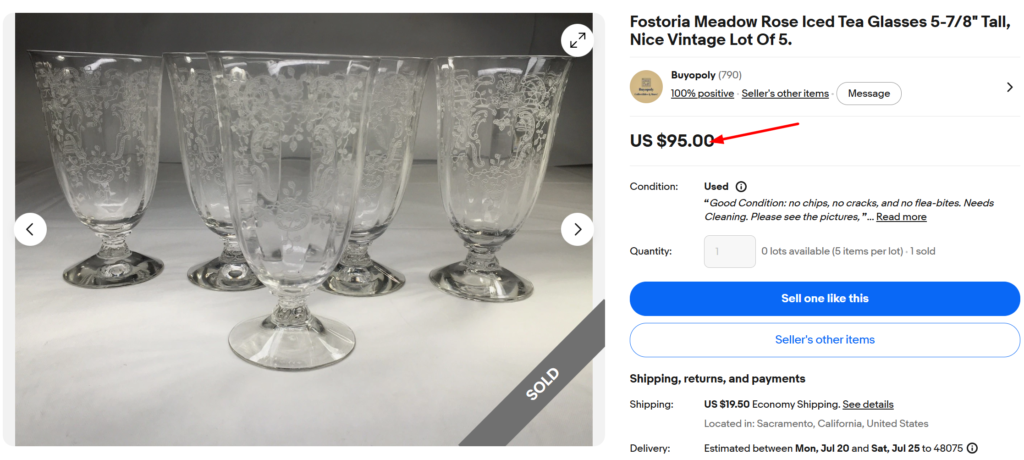
Sold for $95 (set of 5)
People often mix up Meadow Rose with Navarre. Both use scroll parentheses with flowers, both sit on the Baroque blank, and both use the same stemware line.
The difference is the center. The inside of the scroll in Meadow Rose is blank, but Navarre fills the space with flowers. Blue Meadow Rose only came out between 1937 and 1943; therefore, it can be rare and potentially valuable.
- Estimated Value: $100 to $350
- Production Years: 1936 to 1970s (blue: 1937–1943)
- What to Check: Empty center in scroll frame
10. Colony Vase (Pattern #2412)
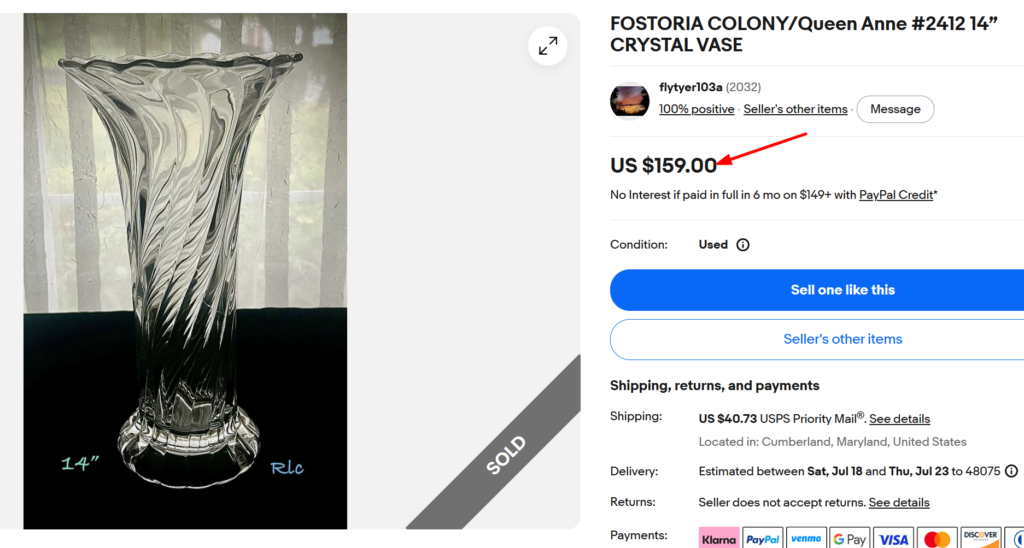
Sold for $160
Colony is a heavily pressed crystal pattern with spiral swirls that run counter-clockwise from the center. George Sakier designed it, and Fostoria pulled some shapes from an older pattern called Queen Anne. The handles have a distinctive curled shape that fits the swirl motif well.
Almost all Colony pieces are clear crystal. Colored pieces are usually from the 1980s, and they were renamed as “Maypole.”
- Estimated Value: $150 to $400
- Production Years: 1938 to 1983
- What to Check: Counter-clockwise spirals, curled handles
- Collectors’ Tips: The 17-inch torte plate can hit $300 by itself
11. Wedding Ring Crystal Stemware Set
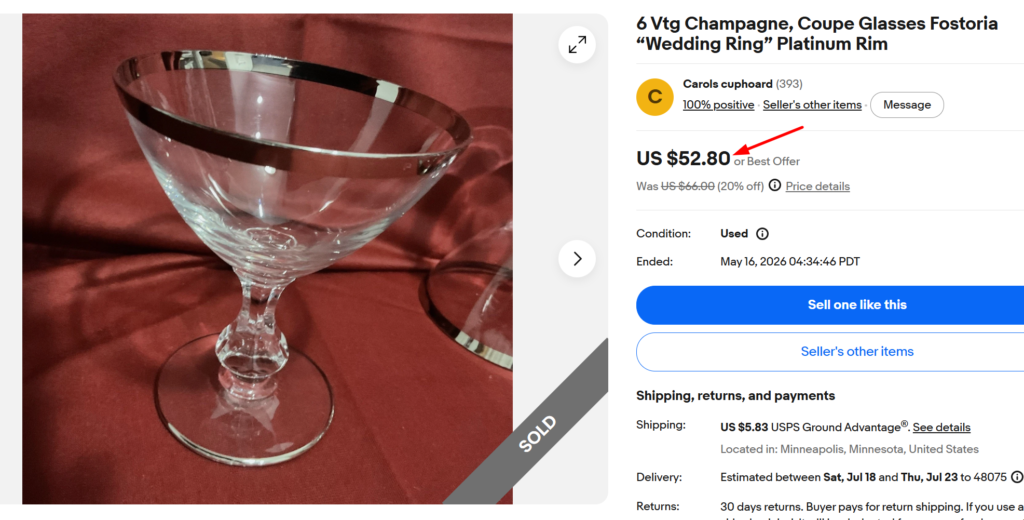
Sold for $52 (set of 6 coupe glasses)
The Wedding Ring is a decoration rather than a pressed pattern. Each piece has a quarter-inch platinum band applied around the rim, sitting on a plain crystal bowl with a faceted hexagonal column stem.
Platinum was chosen over silver because it doesn’t tarnish, but it does wear out with time. And worn platinum trim is a serious value killer for these pieces.
- Estimated Value: $50 to $200 (set of 6+)
- Production Years: 1953 to 1975
- What to Check: Platinum band, faceted hex stem
12. Wisteria Colored Glass (Fairfax or Lafayette Pieces)
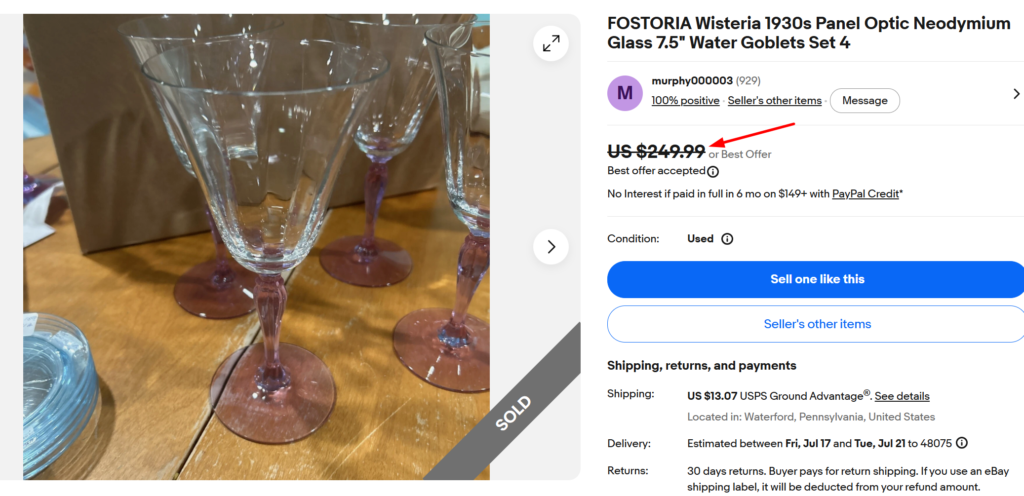
Sold for $250 (set of 4)
Wisteria is one of Fostoria’s rarest colors and probably the most fun to identify. It’s a neodymium-based glass that actually changes color depending on the light.
Under normal daylight, it looks pinkish-lilac, but under fluorescent or UV light, it shifts to a pale blue or greenish tone. That color shift is the giveaway.
Fostoria applied Wisteria to a limited run of Fairfax (#2375) and Lafayette (#2440) shapes during the Depression era. Any piece in Wisteria is rare, and etched pieces in this color, like Midnight Rose or June, are even more desirable.
- Estimated Value: $80 to $400+ (depending on form and etch)
- Production Years: Roughly 1931 to 1938
- What to Check: Color-shift under different light sources
- Quick Notes: Similar to Cambridge Alexandrite; do not confuse
Fostoria vs. Indiana Glass Whitehall (the Biggest Mix-up)
Indiana Glass produced a pattern called Whitehall that looks almost identical to Fostoria American. Whitehall was sold through mass-market stores from the 1960s onward, and it still shows up as “vintage Fostoria” in sales all the time.
There are three ways to differentiate them.
- First, Fostoria American has sharp, crisp cube corners you can feel with a fingertip. Whitehall cubes are softer and slightly rounded.
- Second, Fostoria rings like a bell when tapped; Whitehall thuds because it isn’t lead crystal.
- Third, Fostoria is heavier for its size. If a piece feels light and greasy, it’s probably Whitehall.
How Much Is Fostoria Crystal Worth?
Most vintage Fostoria crystalware actually isn’t worth a fortune. The average piece sells for $10 to $40, and that’s the reality most inherited collections fall into. But some rare pieces can reach up to $500 or even more.
- Individual stemware – $8 to $45 per glass in common patterns. Etched or colored pieces run $40 to $150 each.
- Complete stemware sets (6 to 12 pieces) – $150 to $800, depending on pattern and condition. Navarre, June azure, and Versailles pink can push higher.
- Vases – $25 to $500. Heirloom opalescent swung vases and rare-color Wisteria pieces at the top.
- Bowls and console pieces – $30 to $250. Depression-era colored bowls in June or Versailles bring the most.
- Punch bowl sets – $200-$600 for American, $250-$800 for Coin Glass Bicentennial sets.
- Rare items (Wisteria, Empire green Coin, azure June sets) – $500-$3,000+.
The most important factors influencing the value of a Fostoria crystal piece are:
Pattern (Navarre, June, and Versailles at the top), color (Wisteria, azure blue, and empire green command the biggest premiums). condition (any chip, crack, or dishwasher haze can cut value by 50 to 80 percent), and completeness (sets are worth more than singles).