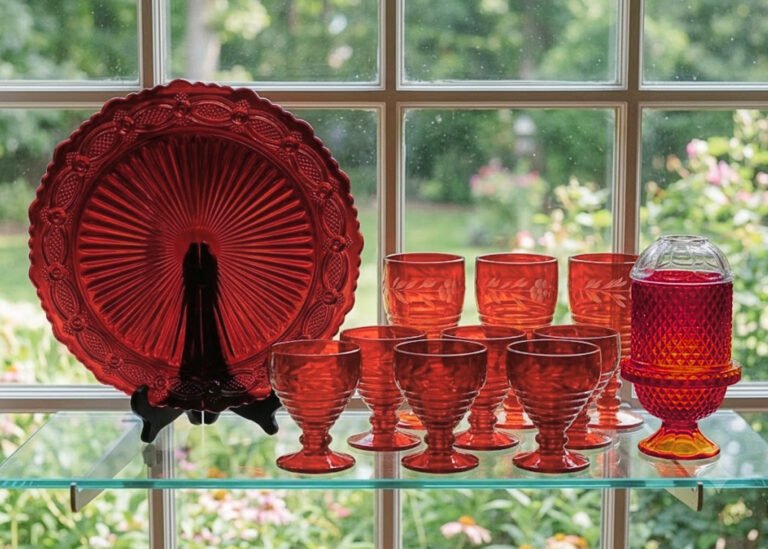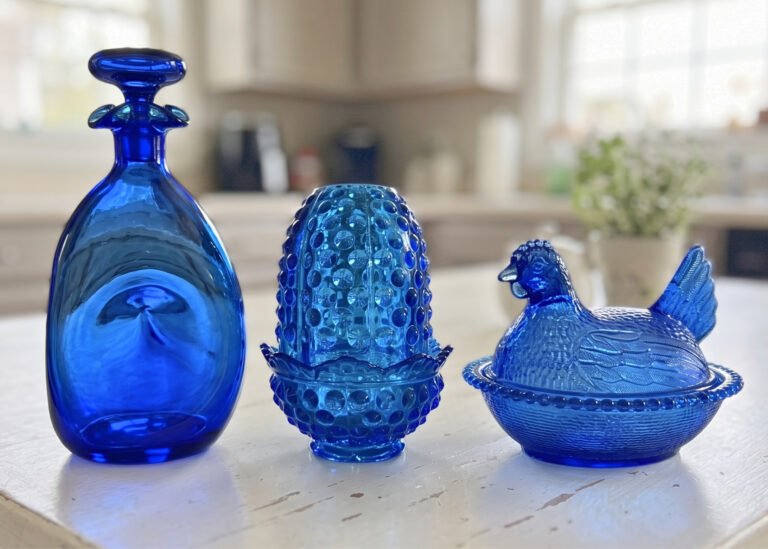

Libbey started as the New England Glass Company, established in Cambridge in 1818. It was leased by William L. Libbey in 1878, and in 1888, his son Edward transferred the branch to Toledo in Ohio.
It was there that the company became Libbey Glass Company in 1892. The company made its name at the 1893 Chicago World’s Fair for its cut glass. Then, Owens-Illinois acquired Libbey in 1935, which makes pre-1935 glass collectible today.
In this guide, you’ll learn to identify Libbey glass and explore the most valuable patterns, lines, and shapes collectors love.
Easy Steps to Identify Genuine Libbey Glass
You can identify genuine Libbey glass using three key signs: the marking (or label) or the date on the item, the design and form, and the glass type. Here’s how to assess these things:
1. Libbey Logo & Markings
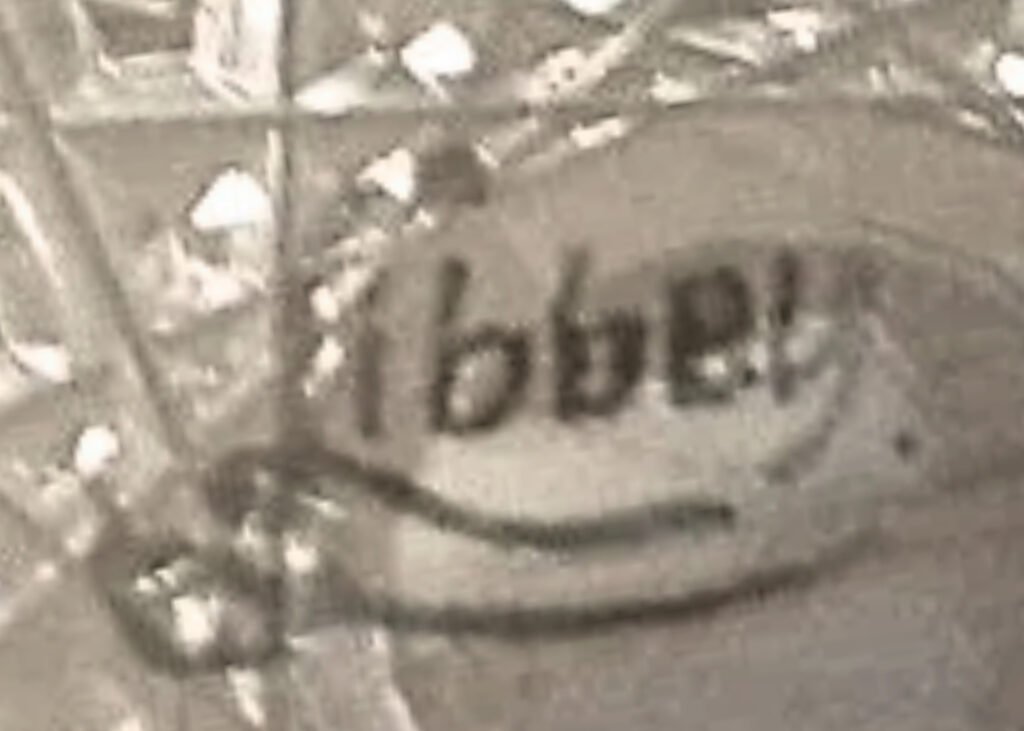
The early Libbey markings were acid-etched, so they look faint and frosted. Hold your item up to the light, and check it near the center of the base. Each type of marking indicates an approximate year range:
- 1892-1896 – Red spread-winged eagle with “Libbey Cut Glass, Toledo, Ohio”
- 1896-1906 – “Libbey” script over sword, most common cut glass mark
- 1906-1910s (approx.) – “Libbey” script with no sword
- 1910’s-1920’s – “Libbey” in a circle, then inside a double circle
- 1924 onwards – Embossed cursive “L” in double ring, then a broken circle (1937), single circle (1955), then “L” with no circle.
The star-in-a-circle mark
Libbey copyrighted a star-in-the-circle mark in 1901 to be used on glass blanks it supplied to other cutting shops. So, an item with such a mark means that the glass was produced by Libbey, but it could have been shaped elsewhere.
Warning for Collectors: “The banner” mark that says “The World’s Best” is not etched onto any Libbey glass products. These fakes appeared in the 1970’s.
2. Patterns, Forms & Catalogs (for Unmarked Pieces)
Many genuine Libbey pieces have no markings whatsoever. Most pre-1896 cut glass pieces didn’t have any markings, while many patterns from about 1905 never got trademarks. Mid-century paper labels also wore away after a few decades, leaving you with only one way to identify your piece – the pattern and form.
So, for cut glass, compare your piece with catalog reprints of Libbey pieces from 1886 to 1920, looking for repeated major design elements such as hobstars (multi-pointed stars cut into the glass) and fans.
Mid-century Libbey glass is all about design and shape.
For instance, most Silver Foliage and Golden Foliage come in classic tumblers designed by Freda Diamond, along with a frosted ring behind the leaves. Likewise, Stemware lines like Silhouette and Embassy feature unique stems that you can’t confuse with any other shape. Then, Maize looks like an ear of corn.
So, once you recognize some distinct Libbey shapes and design elements, identifying unmarked items becomes much easier.
3. Type of Glass
Genuine Libbey American Brilliant cut glass is made from lead crystal glass. So, when you pick it up, it feels noticeably heavier and much clearer than ordinary glass.
Next, tap the edge of it with your fingernail. Real Lead crystal makes a ringing sound, while pressed glass makes only a clunking sound.
Then, rub your finger on the cuts; the edges of hand-cut glass are sharp and will have deeply cut grooves. Molded glass edges are rounded, with flat and unpolished recesses and even mold marks.
Good to Know: Some newer pieces might have been molded and hand-finished. So, they would have sharp cuts, but not deep ones like ABC glass.
What Makes Vintage Libbey Glass Valuable?
Generally, most vintage Libbey glasses are worth $5 to $20, while decorated mid-century collections can go from $40 to $300. Signed cut glass and early art glass, however, can command prices far into the thousands.
So what’s the difference between a $10 tumbler and a $2,000 bowl? There are actually just five factors.
- Era – Age is the key factor. The hand-crafted glass and pre-1935 Owens-Illinois takeover art glass is worth the most. 1930s luxury series come next, and mid-century machine-made tumblers are the mid- and low-tier pieces.
- Signature – A clear, acid-etched signature on the cut glass adds substantial value since it identifies the artist. The same goes for Amberina and Libbey-Nash items. But an unsigned item with a cataloged pattern is also valuable.
- Pattern Rarity – Patterns like Harvard are plentiful, so they’re worth less than rare ones like Florence. This is also applicable to 1950s glass. Silver Leaf and Golden Foliage are popular, but simple, nameless tumblers have low collector interest and value.
- Condition – It is difficult or even impossible to repair condition issues for glass. Rim chips, flakes, and sick glass (cloudy haze that cannot be washed) seriously drop the value. For Foliage glasses, dishwashing kills the value because of silver and gold wear.
- Completeness – Collectors usually tend to pay more for complete matching sets, which include boxes, caddies, stands, or cups. Punch bowls with their stands and cups, or boxed Snow White sets, will command a much higher price than individual items.
11 Most Valuable Vintage Libbey Glass Patterns and Pieces
Let’s discover the Libbey patterns, lines, and pieces collectors compete for, ranging from antique cut glass and art glass to mid-century barware.
1. Libbey American Brilliant Cut Glass Punch Bowls
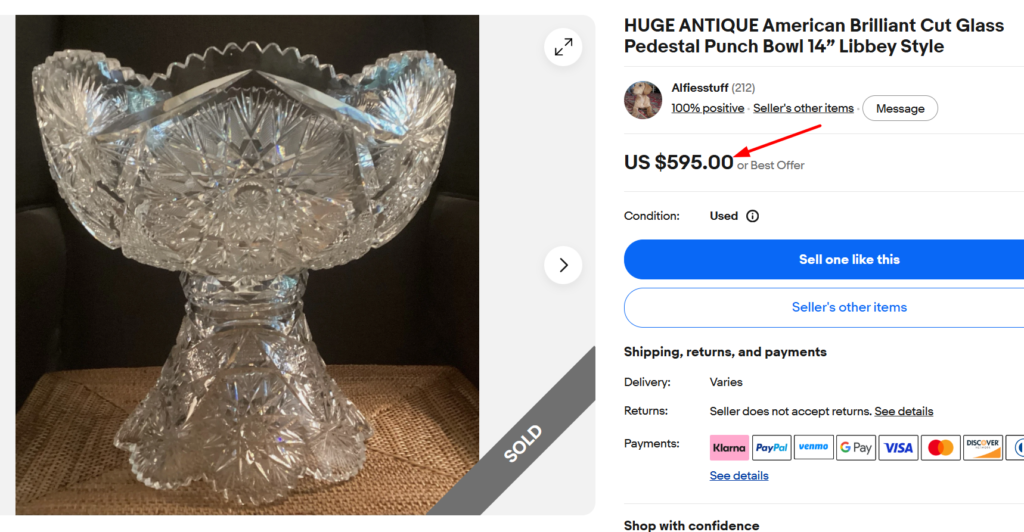
Sold for $595
The punch bowls were the showstoppers of the American Brilliant Period, known for the deep-cut lead crystal from about 1876 through 1917. Libbey cut these bowls in patterns like Colonna and Corinthian.
They were normally sold as two-piece bowls with matching bases. So, the sword signature and matching cups definitely make them the best vintage Libbey items.
- Estimated Value: $500 to $5,000+
- Production Years: 1890s to 1910s
- What to Check: Two-part bowl, matching stand
2. Patented Cut Glass Patterns (Harvard, Kimberly, Wedgemere)
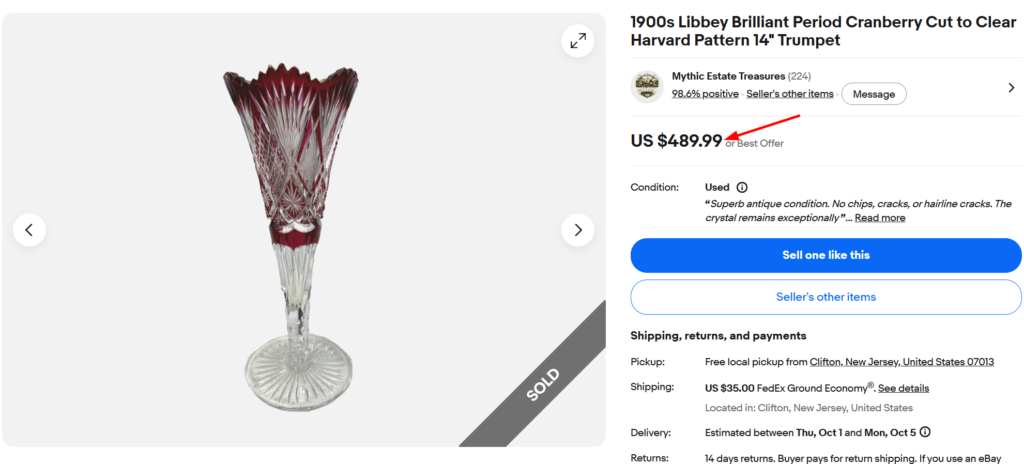
Sold for $490
Libbey patented many of its cut designs, including Stratford from 1889, Wedgemere from 1891, Kimberly from 1892, and Corinthian from 1896. Sultana and Neola followed later.
The most popular patented Libbey pattern you’ll run into most often is Harvard, first advertised in 1889. Clear examples have moderate values, but rare cut-to-clear pieces can fetch a few hundred to over a thousand dollars.
Rarer patterns like Florence bring even more money, simply because far fewer pieces were ever cut back then.
- Estimated Value: $150 to $1,500
- Production Years: 1889 to about 1906
- What to Check: Hobstars, sharp miter cuts
3. Amberina Art Glass (1917 Revival)
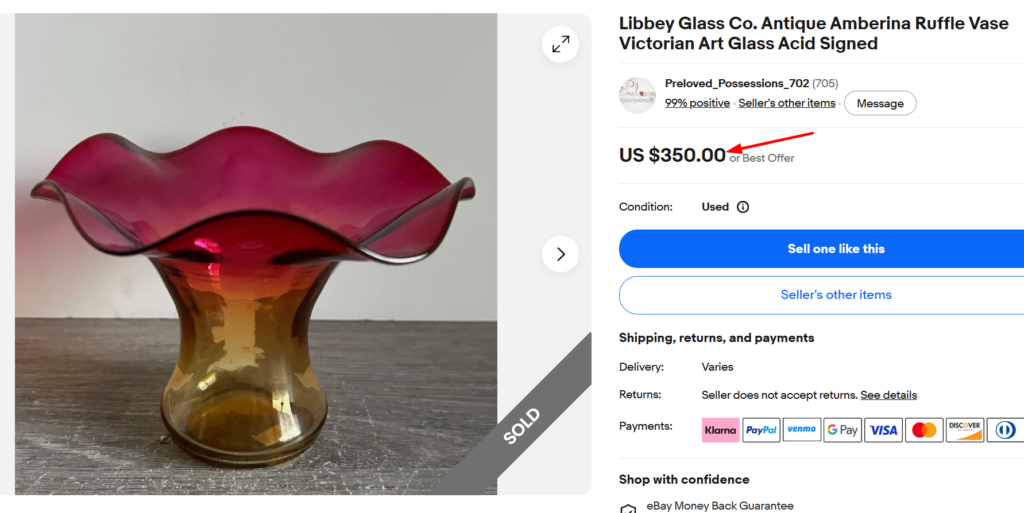
Sold for $350
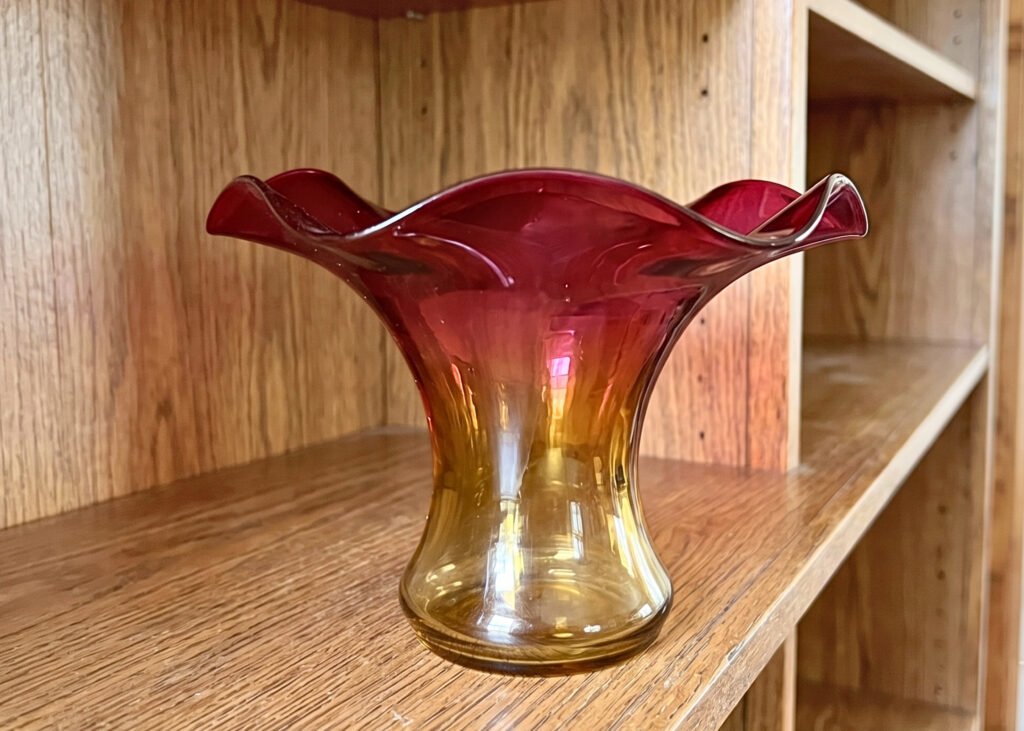
Amberina is a heat-sensitive glass that changes color from amber on the bottom to ruby red on the top. Joseph Locke and Edward Libbey patented it in 1883, and then Libbey reintroduced it in Toledo in 1917.
The Revival Amberinas have an acid-etched signature reading “Amberina” and the name of Libbey on the base. Tall vases and footed bowls sell for the best prices.
- Estimated Value: $300 to $2,500
- Production Years: 1917 (original 1883 to 1890s)
- What to Check: Amber-to-red shading, etched signature
4. Libbey Maize Glass
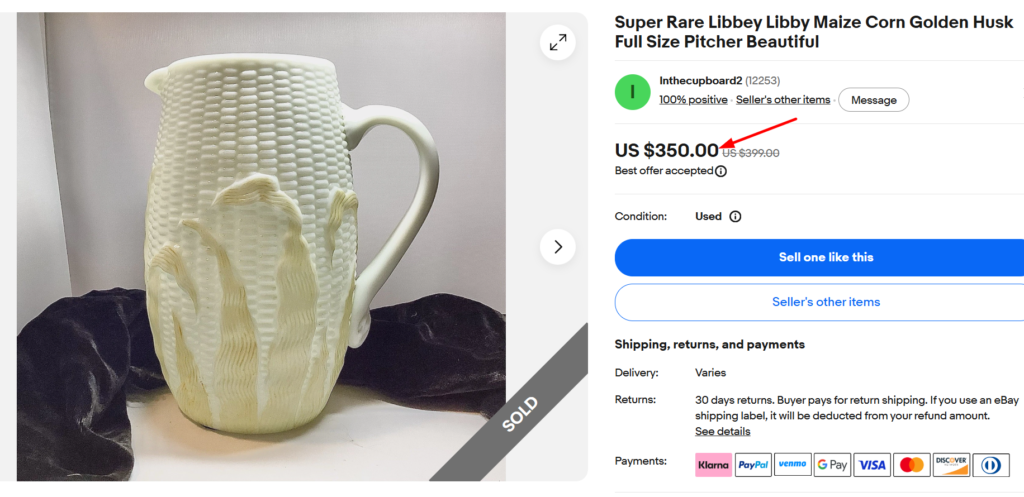
Sold for $350
Maize glass resembles corn ears. It was designed by Joseph Locke for Libbey around 1889. It basically features light yellow, white, or light green kernels and green husk leaves.
There was a special version with blue or red husks, which is quite rare and more collectible than the yellow-green one, especially syrup pitchers and celery vases.
- Estimated Value: $75 to $1,500
- Production Years: About 1889 to 1890s
- What to Check: Corn kernels, colored husk leaves
- Quick Notes: Maize oil lamps are highly rare.
5. 1893 World’s Columbian Exposition Souvenirs
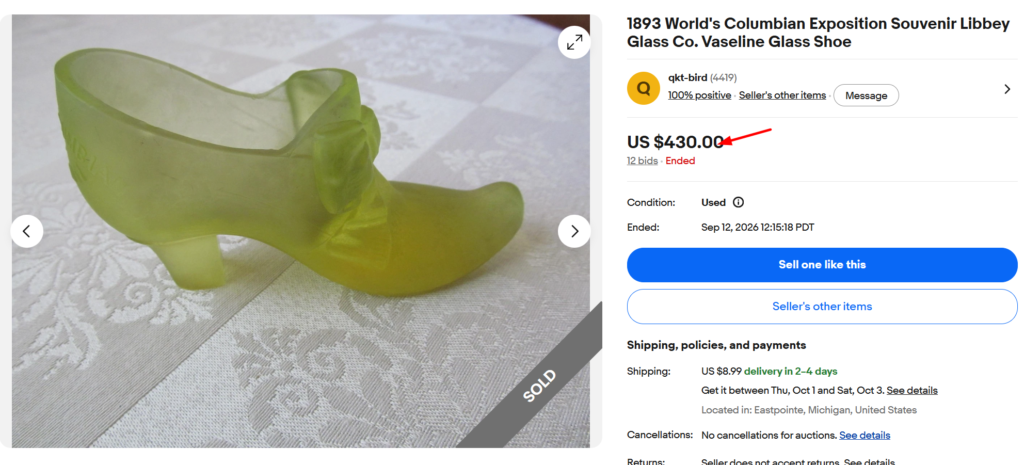
Sold for $430
Libbey had a working glass factory exhibit at the 1893 Chicago World’s Fair, where Attendees could buy items that were made right before their eyes. Liberty Bell paperweights are marked “Made at World’s Fair by Libbey Glass Co.”
Frosted glass shoes with “World’s Fair 1893” printed on the toes are also common; Vaseline (glowing green) glass shoes are more valuable than clear ones.
- Estimated Value: $50 to $500
- Production Years: 1893
- What to Check: “World’s Fair 1893” markings
6. Libbey-Nash Series Glasses
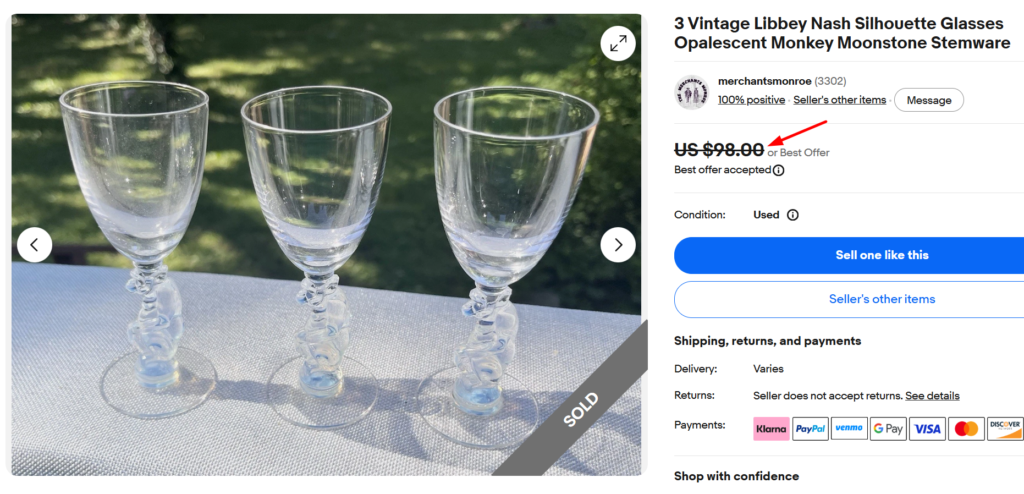
Sold for $98 (set of 3)
A. Douglas Nash, whose father ran Tiffany’s glassworks, designed this hand-blown luxury line with cutting, overlays, and threading. But high prices didn’t suit Depression budgets, so it lasted only from 1933 to 1935. The Malmaison pattern, nicknamed “Skyscraper,” has square stems and a script Libbey signature on the base underneath.
- Estimated Value: $100 to $600 per piece
- Production Years: 1933 to 1935
- What to Check: Square stems, script signature
- Quick Notes: Only two years of production
7. Libbey Embassy Stemware
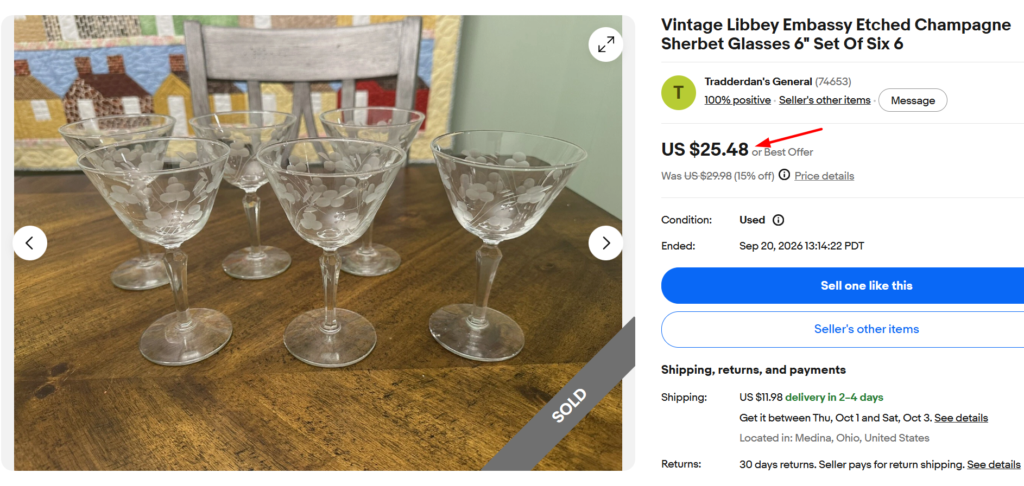
Sold for $25 (set of 6)
Embassy was made in 1939 by Walter Dorwin Teague and Edwin W. Fuerst to furnish the State Dining Room at the New York World’s Fair. It has blown lead-glass bowls coupled with tall, pressed and ribbed columnar stems.
The museum connection of this line ensures a constant demand among collectors.
- Estimated Value: $75 to $250 per stem
- Production Years: Introduced 1939
- What to Check: Tall ribbed columnar stems
8. Libbey Snow White and the Seven Dwarfs Tumblers
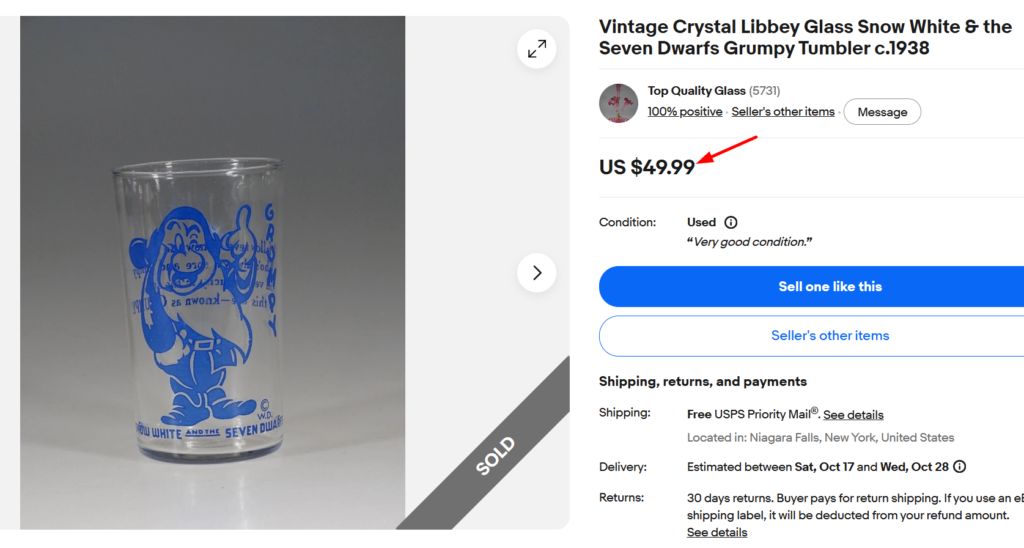
Sold for $50 (single)
Libbey made licensed “Snow White” tumblers, sold as dairy glasses in boxed store sets in 1938. A complete set has eight tumblers, each representing an individual character, with one-color tumblers being more common to find.
Two-color sets are even rarer to find and, hence, more valuable. A complete boxed set is the rarest and is worth several times more than individual tumblers.
- Estimated Value: $150 to $1,000
- Production Years: 1938
- What to Check: Character graphics, verse text
9. Libbey Hostess Sets
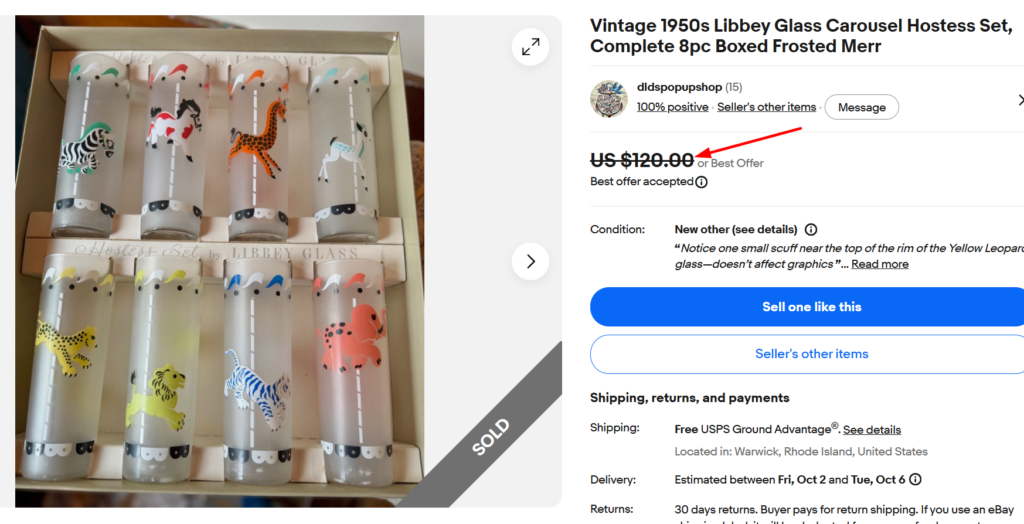
Sold for $120 (boxed set)
In about 1945, Libbey began marketing the Hostess Sets. These were sets of eight tumblers patterned with themes like birds, animals, and more, and often came with caddies made of brass or wire metal.
Atomic starburst and gold patterns have become favorite mid-century designs. For these sets, completeness is the key value driver; loose glasses are worth a fraction.
- Estimated Value: $40 to $150 per set
- Production Years: From about 1945
- What to Check: Eight matching tumblers, caddy
10. Libbey Silver Leaf (Silver Foliage) Glasses
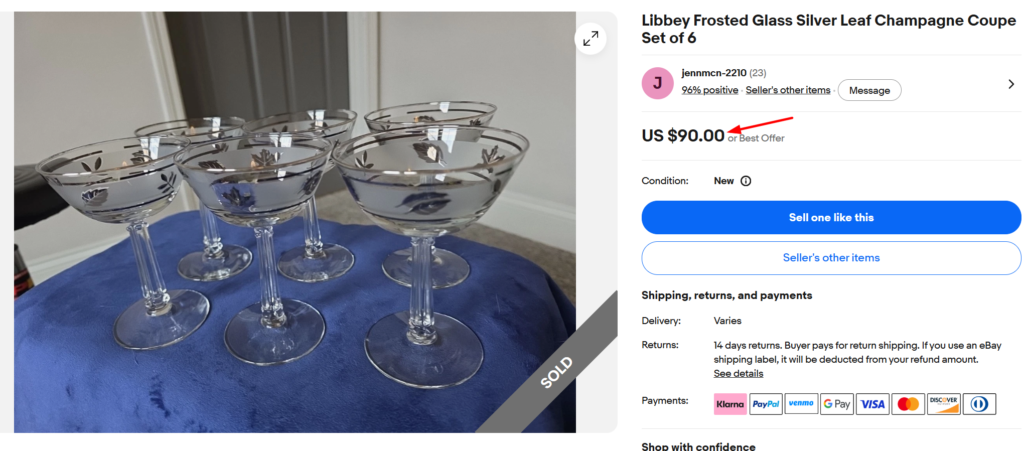
Sold for $90 (set of 6)
Silver Foliage, aka Silver Leaf, glasses feature silver leaves overlaid on a frosted border. This pattern was produced between the late 1950s and the late 1970s in several different forms, including Freda Diamond’s tumblers.
The rarest and most expensive versions will be sets of tall tumblers with pristine silver leaf decoration.
- Estimated Value: $50 to $300 per set
- Production Years: Late 1950s to late 1970s
- What to Check: Silver leaves, frosted band
- Value Note: Dishwasher wear ruins the silver
11. Libbey Golden Foliage Glasses
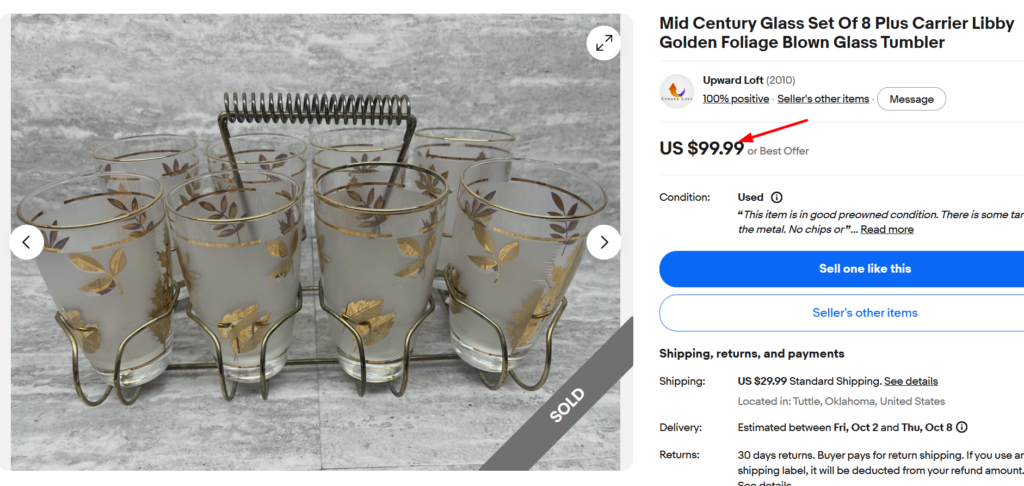
Sold for $100 (set of 8 with caddy)
Golden Foliage is basically the gold version of the Silver Leaf, featuring 22k gold leaves against a frosted background. It was more popular than the Silver Leaf.
So popular that many manufacturers recreated it. You can spot the original Libbey pieces by the Libbey “L” cursive stamp on the bottom.
- Estimated Value: $40 to $250 per set
- Production Years: Late 1950s to early 1980s
- What to Check: Gold leaves, cursive L base
Vintage Libbey glassware can be valuable if you take a closer look. So, find the mark on the base, pin down the era and pattern, and check sold prices for that exact pattern before you buy, discard, sell, or donate anything.