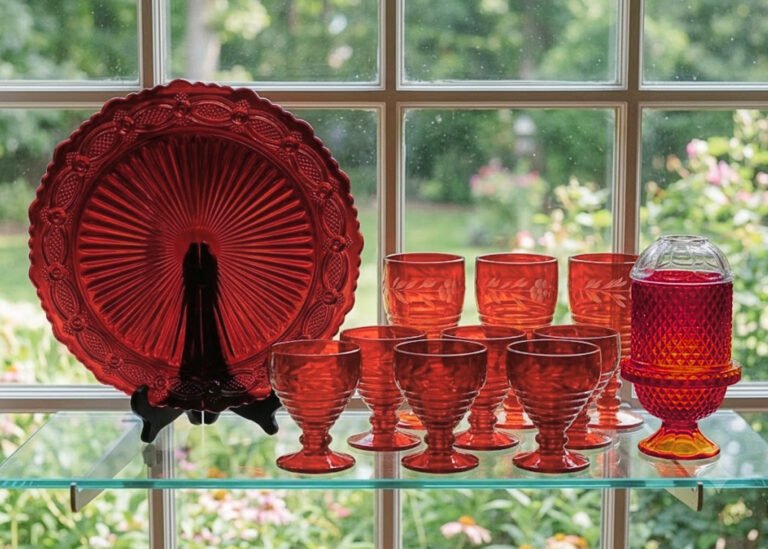

The making of uranium glass started in Bohemia in the 1830s. Chemist Josef Riedel added uranium oxide to the batch, and the result was the yellow-green glass that glows.
Early Bohemian pieces are still called Annagelb (yellow) and Annagrün (green). American makers picked it up by the 1880s. But the real boom came during the Depression, when Anchor Hocking and Hazel-Atlas made a lot of cheap tableware.
Then, in 1943, the government took over all the uranium supplies. Limited production resumed in the 1950s, and even today, smaller companies are making uranium glass.
But it is quite difficult to recognize authentic vintage pieces. In this guide, I’ll explain how to identify uranium glass, whether it’s safe, what determines its value, and which pieces should be collected.
Uranium Glass vs. Vaseline Glass vs. Depression Glass
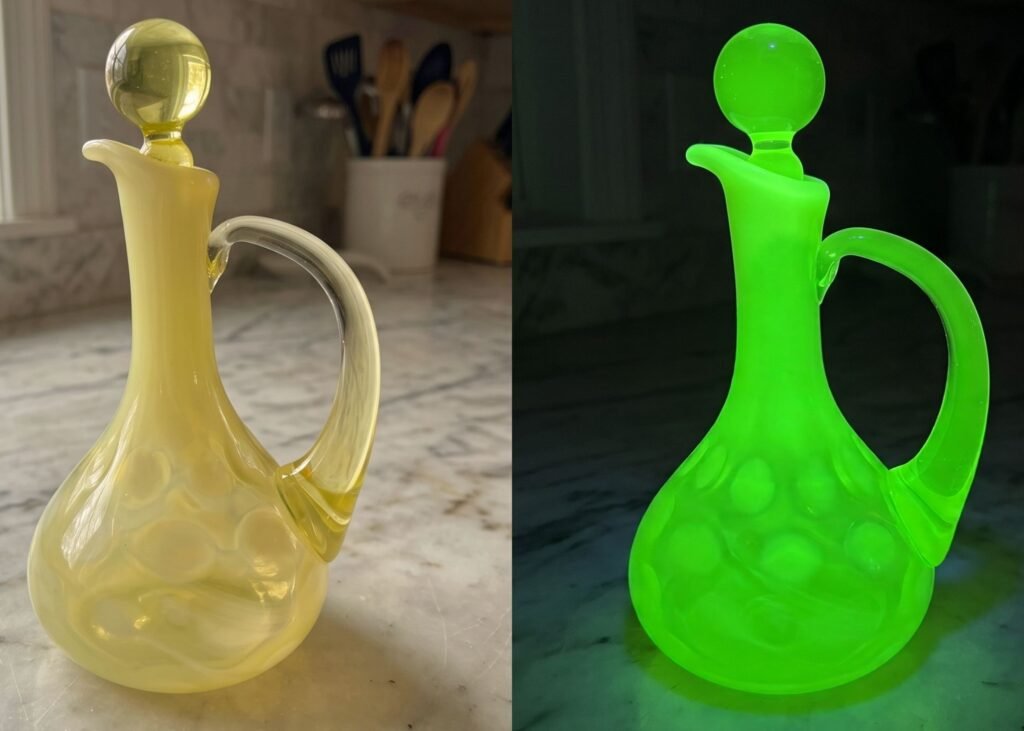
Uranium glass is the umbrella term for any glass containing uranium oxide, usually 0.1% to 2% by weight. It all glows green under UV light because of fluorescence.
- Vaseline glass is the transparent, pale yellow-green that reminded people of petroleum jelly back in the 1920s. So all vaseline glass is uranium glass, but not all uranium glass is vaseline.
- Depression glass is named by when and how it was made. It’s the machine-pressed, cheap tableware from roughly 1929 to 1939. A lot of green Depression glass happens to contain uranium, but plenty of pink, blue, or amber Depression glass doesn’t.
The Rainbow of Uranium Glass Colors
Most people think of uranium glass as classic transparent yellow-green. But it actually shows up in several shades because makers combined uranium with other minerals.
Green is the most common. After that, you’ll see canary yellow (also called topaz), the opaque ivory of custard glass, and the pink-to-yellow shading of Burmese. Blue, pink, red, and purple uranium pieces are the rarest because most of these were made without uranium.
But each color glows green under UV light, no matter what color it looks in daylight. That’s the giveaway.
Is Vintage Uranium Glass Safe?
Yes, for the most part. Uranium glass only has small amounts of uranium, usually 0.1% to 2% by weight. The radiation levels are barely above the natural background you’re already exposed to outside.
The Nuclear Regulatory Commission considers it safe for display and handling, and the uranium is chemically bonded inside the glass, so it won’t leach out under normal conditions.
That said, most collectors avoid drinking or eating from uranium pieces regularly. And never use a piece with chips or cracked rims near food.
10 Valuable Vintage Uranium Glassware Pieces Worth Collecting
Below are some of the most collectible pieces from top makers that come in the uranium glass and sell for stunning prices.
1. Fenton Hobnail Topaz Opalescent Epergne
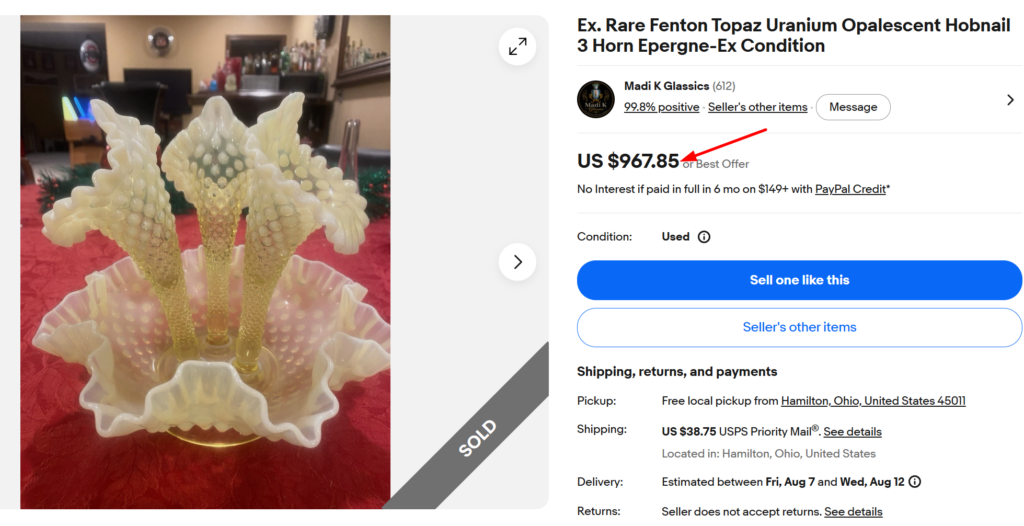
Sold for $970
Fenton’s Hobnail pattern has those little raised bumps all over the surface, kind of like tiny dew drops. The Topaz Opalescent hobnail color is what serious collectors chase.
It’s a canary yellow uranium glass with milky white opalescent edges. Production only ran three years because the war shut down uranium access, so surviving pieces like the cookie jar and three-horn epergne are super rare.
- Estimated Value: $150 to $2,500+
- Production Years: 1941 to 1944
- What to Check: Raised bumps, opalescent white edges
- Quick Notes: Pre-1970 pieces are unmarked; verify with UV
2. Fenton Persian Medallion Fairy Lamp
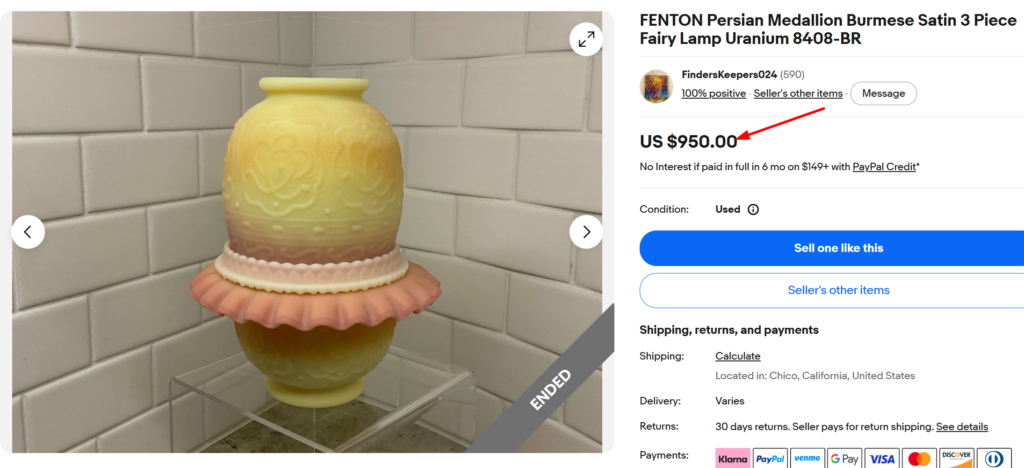
Sold for $950
The Persian Medallion pattern shows an intricate medallion design molded into the glass. In the custard satin uranium version, the three-piece fairy lamp is the piece to watch for. All three parts glow green under UV.
Complete sets with both pieces in mint condition are what drive the value; missing shades or replaced parts drop the value fast.
- Estimated Value: $75 to $250
- Production Years: 1970s to 2000s
- What to Check: Three-piece complete set, medallion pattern
3. Mosser Uranium Hen on Nest
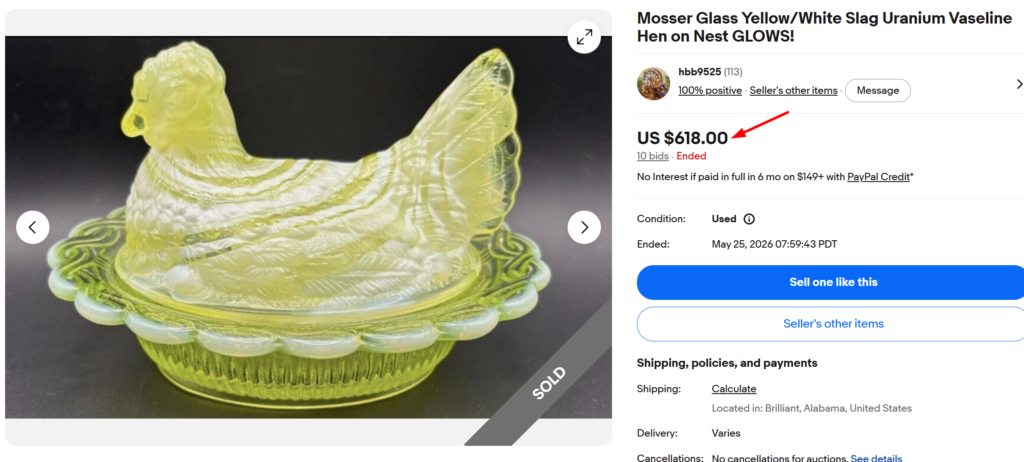
Sold for $620
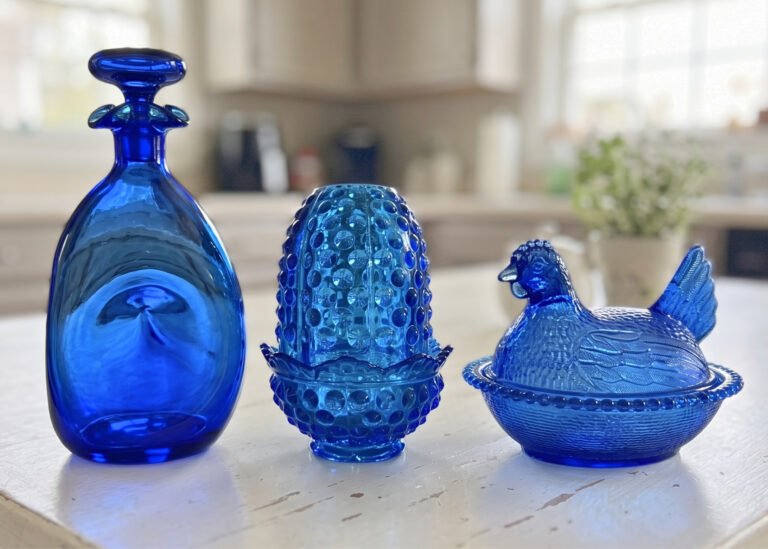
The Hen on Nest is a classic novelty covered dish that goes back to Victorian times. Mosser started making them in vaseline uranium in the 1970s and still does. So these aren’t antique, but the vintage 70s and 80s pieces are quite collectible now.
Watch for the “M” mark under the tail to spot genuine examples. The split-tail version and cobalt “Cobaline” runs are the desired ones.
- Estimated Value: $40 to $200
- Production Years: 1970s to present (Mosser)
- What to Check: “M” mark under tail, split tail feathers
4. Mount Washington Burmese Footed Vase
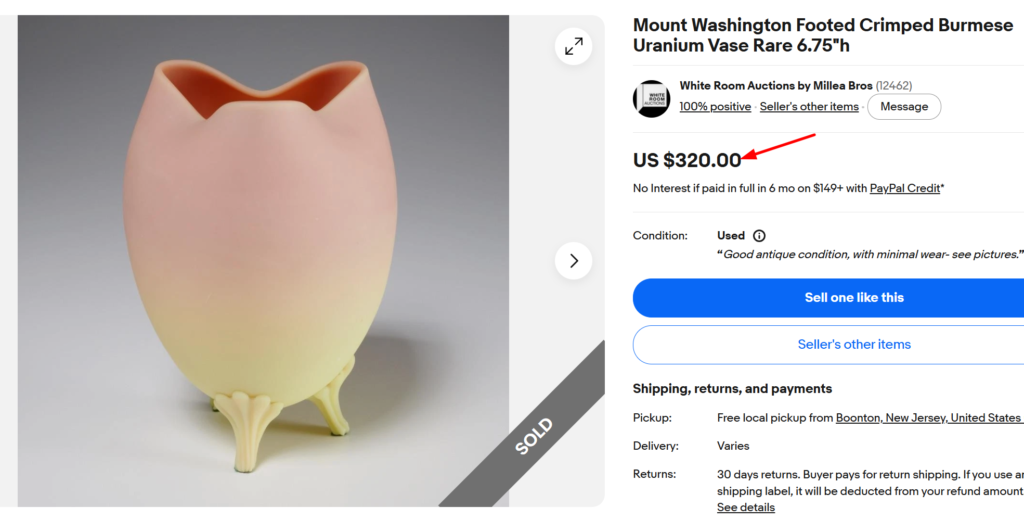
Sold for $320
Burmese sits at the top end of the uranium glass value. Mount Washington patented it in 1885, and the color shades naturally from salmon pink at the top to lemon yellow at the base, thanks to uranium and gold in the batch.
Every genuine piece glows green under UV. Fairy lamps and small footed vases are the most collected forms. However, reproductions are common, so check the marks.
- Estimated Value: $400 to $1,500+
- Production Years: 1885 to c. 1900
- What to Check: Pink-to-yellow shading, satin finish
- Quick Notes: Both American and Webb versions glow green
5. Cambridge #3011 Statuesque Nude Stem
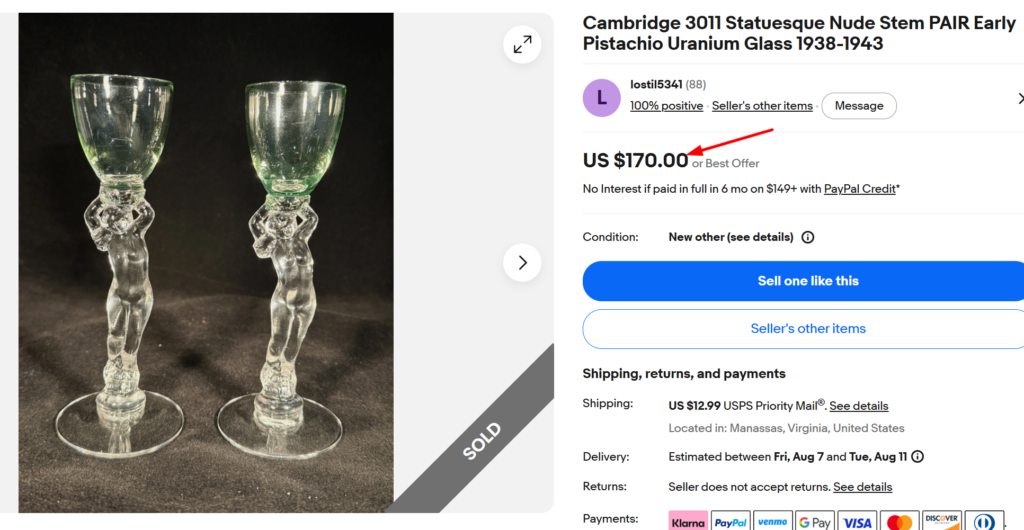
Sold for $170 (pair)
The Statuesque line, often just called “Nude Stems,” has a figural stem shaped like a nude female figure supporting a clear or colored bowl. Cambridge made it in cobalt, amethyst, amber, crystal, and a rare vaseline uranium version.
The vaseline color is among the most valuable, so a single vaseline goblet pulls high prices.
- Estimated Value: $200 to $800 per piece
- Production Years: 1931 to 1958
- What to Check: Figural nude stem, three sizes
6. Anchor Hocking Cameo Ballerina Tumbler Set
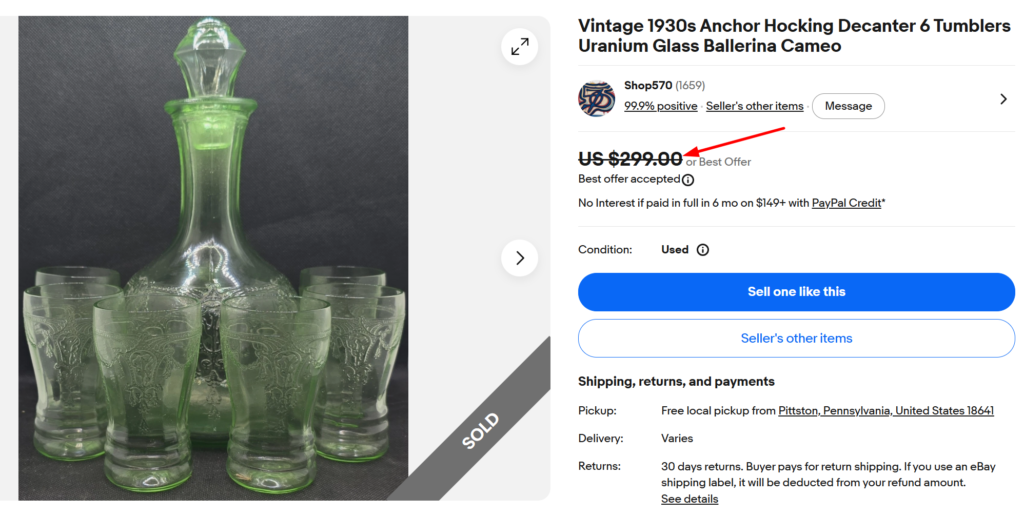
Sold for $300 (set of 6)
Cameo, nicknamed “Ballerina,” features a small dancing figure etched into the glass, surrounded by scrolls and floral swags. The pattern only ran for four years, all in the classic green uranium formula, with limited runs in yellow, pink, and crystal.
Green Cameo is what glows under UV. Covered candy jars, footed vases, and salt-and-pepper shakers are the desirable forms.
- Estimated Value: $50 to $400+ per piece
- Production Years: 1930 to 1934
- What to Check: Etched dancing girl, floral swags
7. Anchor Hocking Princess Uranium Pitcher
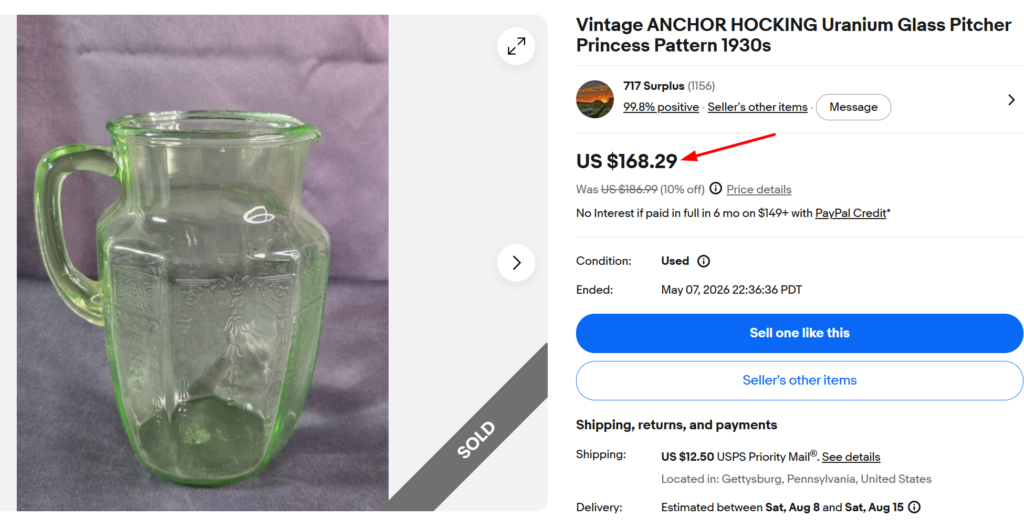
Sold for $170
Anchor Hocking’s “Princess” features ornate scrolls around the rim and floral swags around the body, with sharp corners on the lidded pieces. It was made in green, pink, topaz, and apricot yellow. But only the green contains uranium and glows.
The pitcher is the desirable form because fewer survived than plates and cups. Covered butter dishes and cookie jars run even higher.
- Estimated Value: $100 to $500+ (green forms)
- Production Years: 1931 to 1935
- What to Check: Mold-etched scrolls, pointed finials
8. Bohemian and European Satin Uranium Vase
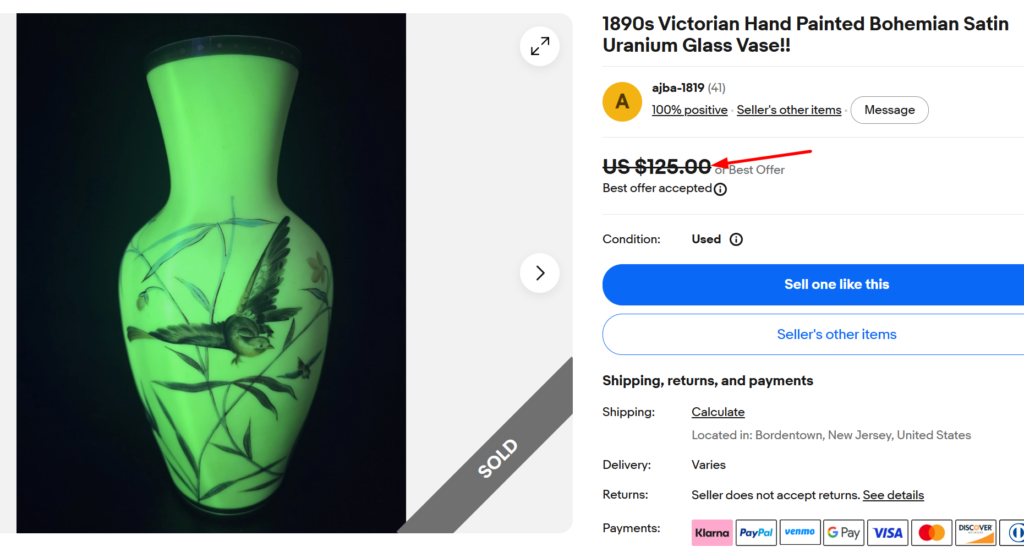
Sold for $125
European makers produced some of the most inventive uranium glass of the Art Deco era. Walther & Sohne, Stölzle, and Jobling all made pressed pieces with bold geometric styling and stepped shapes.
These pieces are usually unsigned but identifiable by catalog patterns. Jobling marked some with a raised registration number, which helps date them to 1935.
- Estimated Value: $100 to $700+
- Production Years: c. 1920 to 1940
- What to Check: Stepped geometric shapes, frosted finish
9. Hazel-Atlas Florentine “Poppy No. 1” Pitcher
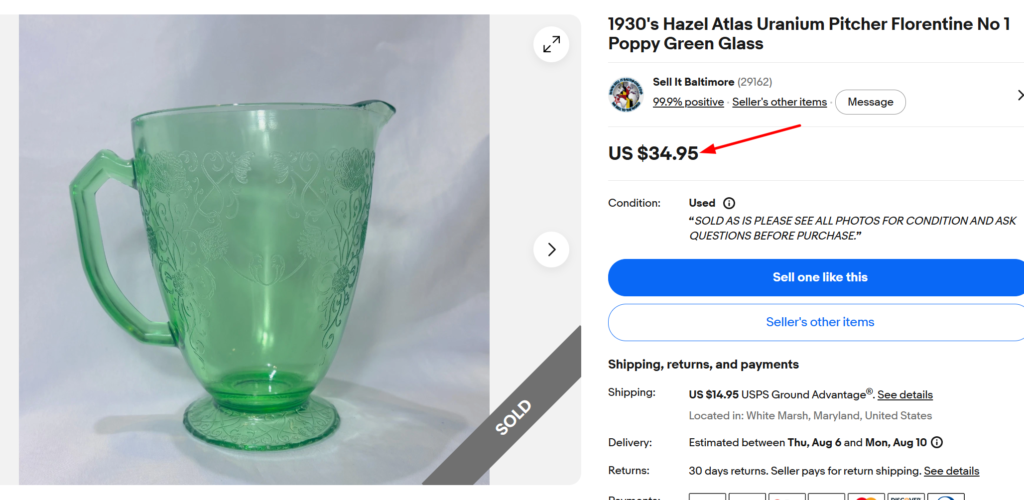
Sold for $35
Florentine No. 1, also called “Poppy No. 1,” has embossed poppy flowers and a distinctive, scalloped, hexagonal base. Among green, pink, yellow, and cobalt pieces that Hazel-Atlas made, uranium examples are the most collectible.
Full luncheon sets and pitchers are desirable shapes. To identify genuine pieces, watch for the “H over A” mark on the base.
- Estimated Value: $30 to $300+ per piece
- Production Years: 1932 to 1935
- What to Check: Poppy flowers, scalloped hex base
10. Northwood Custard Grape and Cable Cups
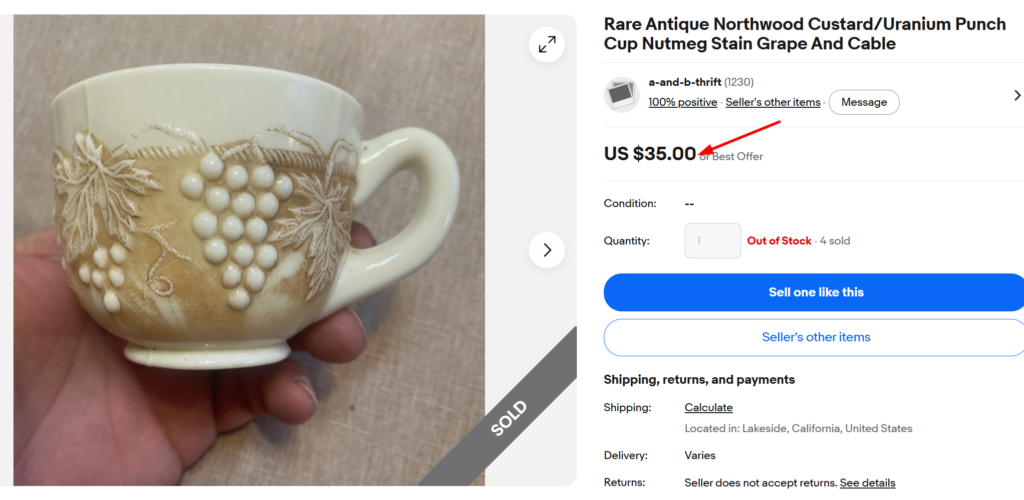
Sold for $35 (set of 4)
Grape and Cable is one of the most iconic American pattern glass designs ever made. It shows heavy grape clusters and vines wrapped with a cable border, all molded in high relief. In custard, the ivory-cream color glows a soft mossy green under UV.
Look for the “N” underlined in a circle on the base. Fruit bowls and covered butter dishes are the sought-after forms.
ID Note: Custard glows softer than transparent uranium
- Estimated Value: $75 to $600+
- Production Years: c. 1908 to 1918
- What to Check: Grape clusters, cable border, “N in circle” mark
How to Identify Real Uranium Glass: 4 Easy Steps
Identifying uranium glass isn’t hard once you know its key features. But telling the vintage stuff from modern reproductions takes a little more work. Use the following tests:
1. The Blacklight Test
Grab a 365nm UV flashlight. This is the wavelength that makes uranium glass glow brightest. Longer wavelengths like 395nm work too, just not as dramatically. Take the piece into a dark room and shine the light directly at the glass.
Real uranium glass glows a bright, almost electric green. Not a dim shimmer, not a subtle tint. Also, it should look like the piece is lit from inside.
Modern non-uranium glass might reflect a little UV but won’t fluoresce. Some highlighter-based fakes try to mimic the glow, but they fluoresce yellow-white instead of green.
ID Tip: A phone’s flashlight or store blacklight bulb won’t work for this test.
How to Spot Uranium Glass Without a Blacklight
No UV light? There are still clues. In natural daylight, vintage uranium glass has a slightly oily, greasy-looking sheen that regular green glass doesn’t have. The color also shifts depending on the light, going from pale yellow-green outdoors to a warmer green under incandescent bulbs.
Then check the weight. Older pieces feel heavy and dense for their size because early formulas used more glass.
And check the base. Hand-finished pieces from the 1800s show a pontil mark, which is the rough spot where the piece was broken off the blowpipe. Machine-made Depression pieces have smooth bases but often show mold seams running up the sides.
2. The Geiger Counter Method
Uranium glass is technically radioactive, so a Geiger counter will pick it up. A basic handheld counter runs about $150 and confirms what your UV light already told you.
Most collectors don’t bother, but it’s useful for verifying rare or expensive pieces before you drop real money.
3. Common Makers & Marks
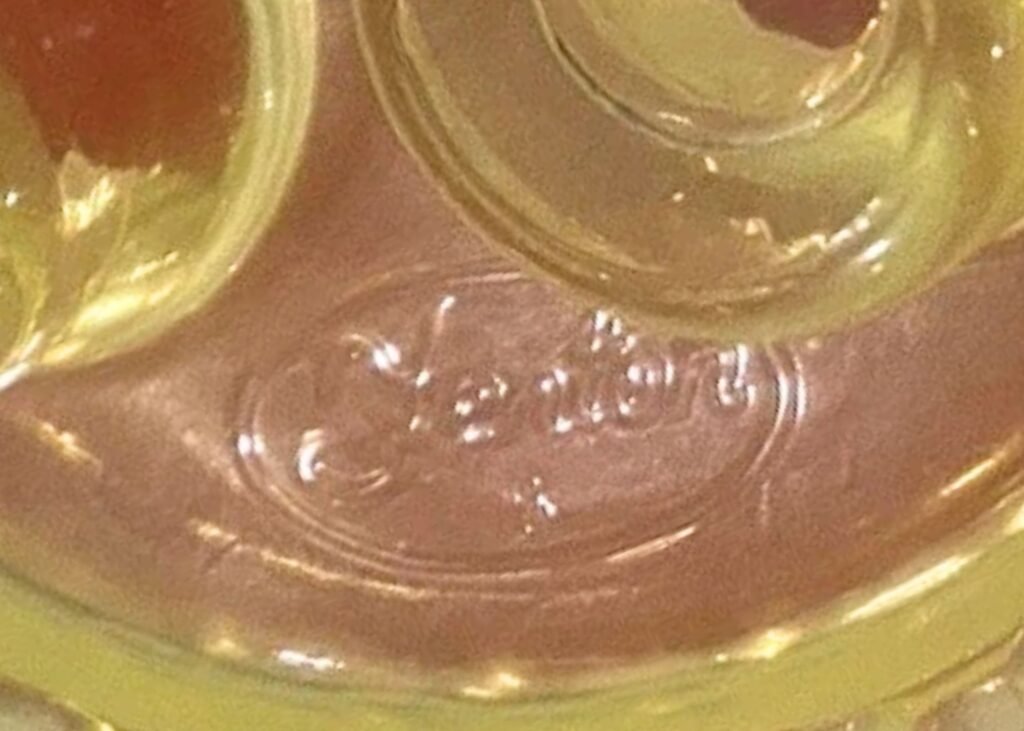
Marks are useful, but most vintage uranium glass is unmarked. Depression era factories used pattern names in their catalogs, not stamps in the glass. But certain makers did leave marks, and knowing them helps.
Cross-reference the marks below against the pattern you’re looking at:
- Fenton – Pre-1970 pieces are unmarked. From 1970 onward, they carry a raised oval “Fenton” mark. An “8” under the “n” means 1980s, “9” means 1990s.
- Anchor Hocking – An anchor with a capital “H” inside it. Used from the mid-1930s through the 1960s. Early Depression pieces are often unmarked.
- Hazel-Atlas – An “H” over an “A” on the base. Used from the 1920s through the 1950s.
- Northwood – An “N” underlined and enclosed in a circle. Used from about 1905 to 1915.
- Cambridge – A “C” inside a triangle, introduced in the 1920s. Pre-1920 pieces are usually unmarked.
- Mosser – A large “M” with a line under it. This is a modern maker, so seeing this mark means the piece is newer.
4. Colors, Patterns, and Design Clues
Beyond marks, the construction itself tells you a lot. Pressed patterns with sharp, machine-made edges and visible mold seams running up the sides point to Depression era pieces from the 1920s and 30s.
Blown glass with irregularities, thin walls, and hand-worked rims points to Victorian pieces from before 1915.
Check the base too. Hand-finished pieces from the 1800s show a pontil mark, which is the rough spot where the piece was broken off the blowpipe.
Finish also matters. Custard glass has an opaque ivory-cream look and glows a softer, Mossier green. Burmese shades range from pink at the top to yellow at the base, and they’re some of the most valuable uranium glass out there.
What Makes Vintage Uranium Glass Valuable?
All uranium glass glows, but not every piece is worth chasing. Most common pieces sell for $15 to $50, but certain pieces can pull $200, $500, or even $2,000+ at auction. The difference in values comes down to six factors:
- Rarity is the biggest driver. Short production runs, wartime discontinuations, and limited color runs all push prices up.
- Maker matters too. A signed Fenton, Cambridge, or Northwood piece will outsell an unmarked one of the same form every time.
- Color is another value driver. Standard transparent green is common, so it stays cheap. Cobalt blue, canary yellow, aqua, and pink uranium pieces command a premium because they were made in much smaller quantities.
- Condition matters a lot. A chip on the rim of a vase can knock 50% off the value in one shot. Even faint dishwasher haze can drop a piece from $80 to $20.
- Form matters as well. Common tumblers and small plates stay affordable. But large centerpieces, epergnes, lidded candy dishes, pitchers, and figurals command real money because fewer survived.
- Provenance adds more value. Original boxes, documented estate history, or signed artist pieces can add 50% to 200% to the base value.
Vintage uranium glass rewards the collectors who slow down and check. A UV flashlight in your pocket at the next estate sale can turn a $10 gamble into a $400 find, or save you from paying $200 for a reproduction.