

Rare antique cameos are miniature portraits and scenes carved in relief from shell or stone. This jewelry has been around for thousands of years, dating back to the ancient civilizations of Greece and Rome, and plenty still sit in old jewelry boxes.
Later, during the Renaissance period, cameos reappeared. They stayed fashionable through the 18th century, and by the 19th century they were a signature of Victorian jewelry: pendants, brooches, and rings containing dainty ladies’ profiles, mythological figures, or sentimental vignettes like hearts and flowers.
The lady on most cameos is an idealized profile, a maiden or a goddess rather than a portrait of a known woman, although royalty and statesmen were carved too. Let’s take a look at some rare cameos plus tips to know what your cameo is carved from, how to date it, and what makes one valuable.
Are old cameos worth anything?
Many are, but the price depends on the material, the carving, and the setting. The cameos below range from $200 (for a shell brooch) to $5,000 (Victorian hardstone pendant); carved hardstone pieces in gold settings fetched the most here, while most fall between $240 and $1,300.
14 Rare Antique and Vintage Cameos Worth Money
The following examples are real antique and vintage cameos sold (or listed) recently. The list will tell you which designs are collectible today.
1. Victorian 18K Diamond Carved Hard Stone Cameo Pendant
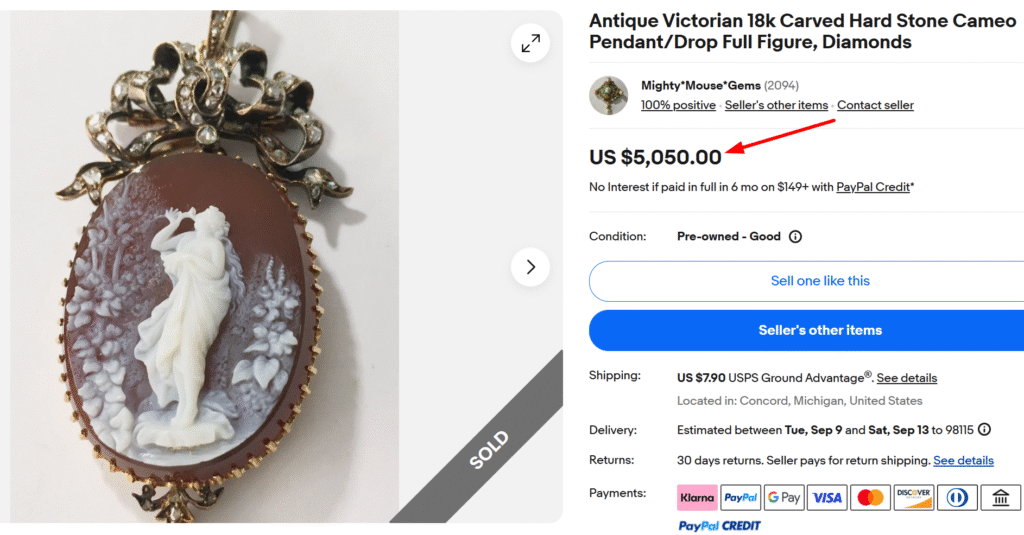
- Brand: Unmarked
- Manufacturing Period: 1830s-1900s
- Material: 18K Gold, Diamond & Hard Stone
- Item: Pendant
This is the most expensive piece, and for good reason. It’s carved from hard stone (likely agate), which requires much more skill than shell carving. Then, there is an 18K gold setting with diamonds that makes it a luxury piece. Such Victorian-era cameos with this level of craftsmanship are rare finds; this one sold for $5,050.
2. 14K Gold Coral Cameo Brooch
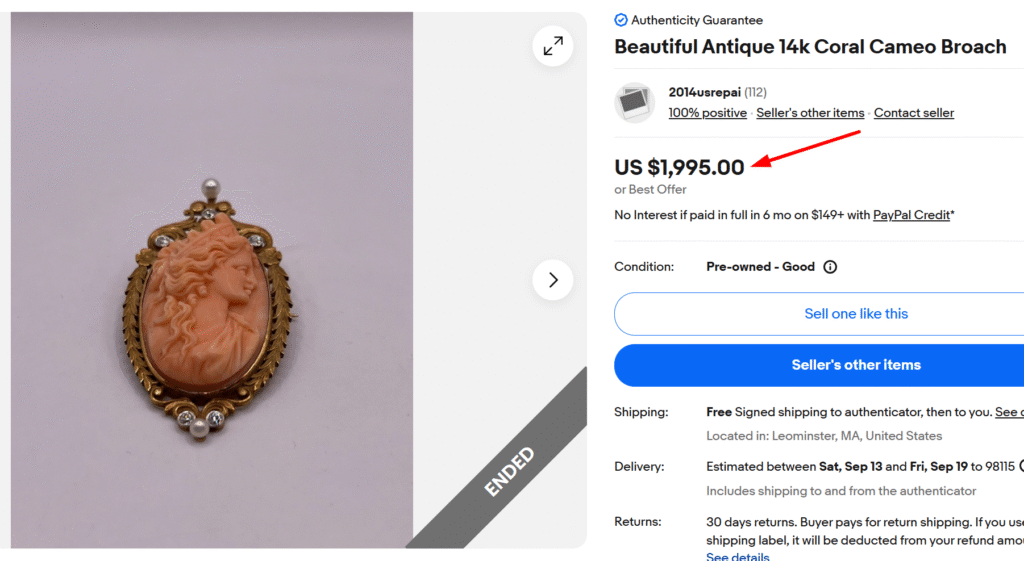
- Brand: Unmarked
- Material: 14K Gold, Coral, Pearl
- Item: Pendant/Brooch
This expensive piece shows why antique coral cameos are so valuable. Coral was particularly prized during the Victorian period, and authentic, highly carved coral cameos from that era are growing rarer.
The 14K gold setting with intricate details, pearls and small diamonds, and the craftsmanship of the carving explain why it was listed at $1,995.
3. Victorian Carved Amethyst Cameo Pendant Pin
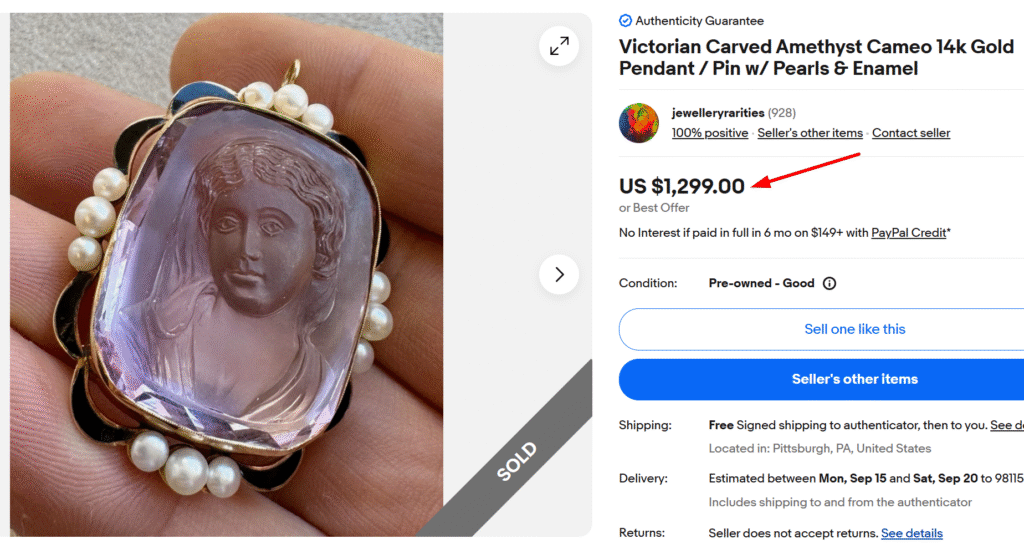
- Brand: Unmarked
- Material: 14K Gold, Amethyst, Pearl, Enamel
- Item: Pendant/Pin
This striking Victorian piece features a cameo carved from amethyst, a semi-precious stone that’s much more valuable than shell. Hard stone cameos like this required exceptional skill to carve and were luxury items, and this one sold for $1,299.
The pearls, enamel work, and 14K gold setting add to its value. Amethyst cameos from the Victorian era turn up far less often than shell ones.
4. Neoclassical Greek Gods in Chariots Shell Cameo Bracelet
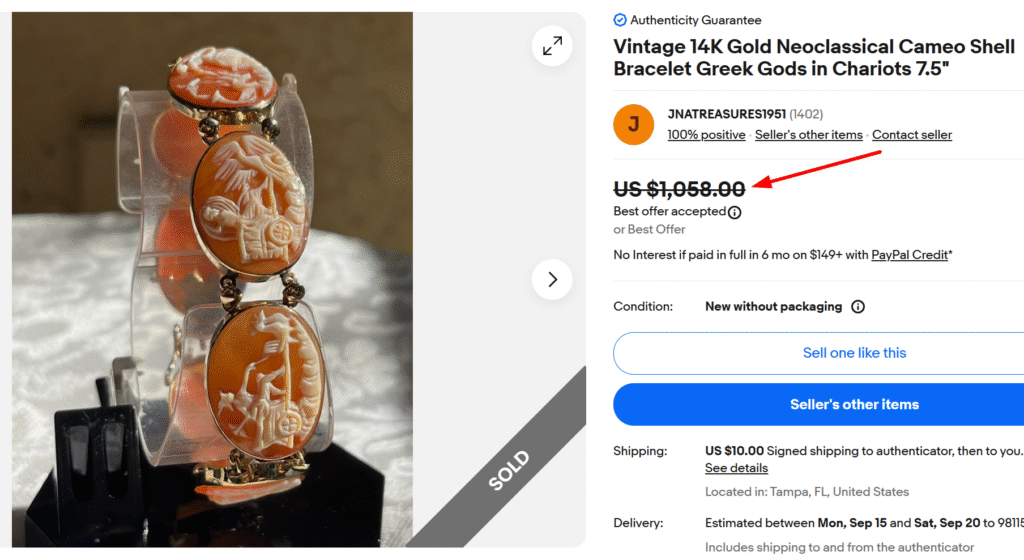
- Brand: Unmarked
- Manufacturing Era: 1920s-1930s
- Material: 14K Gold, Shell
- Item: Bracelet
This impressive 7.5-inch bracelet features multiple shell cameos depicting Greek gods in chariots, a true example of the neoclassical revival style. The 14K gold links and large size make this a substantial piece. At roughly 100 years old, it sits on the line between vintage and antique.
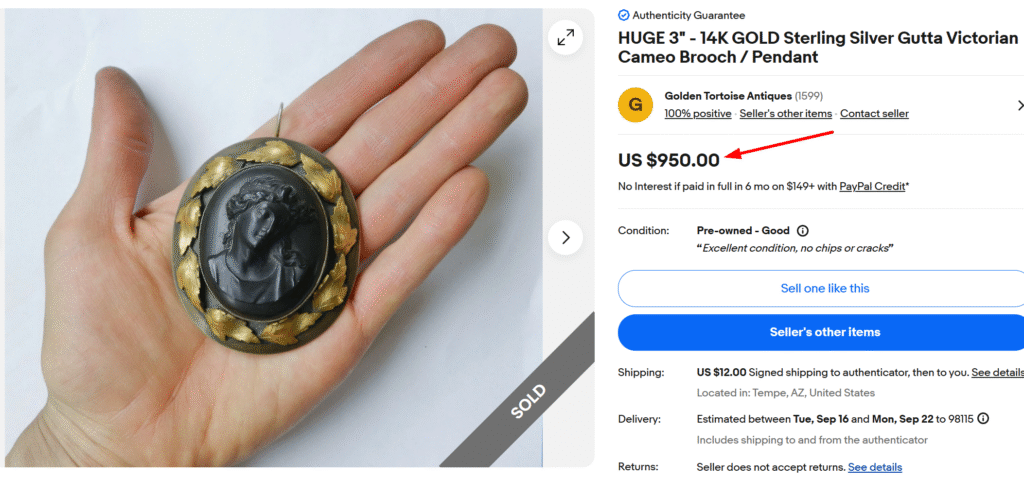
5. Large Victorian Gutta-Percha Cameo Brooch Pendant
- Brand: Unmarked
- Manufacturing Period: 1860s-1880s
- Material: Gutta Percha
- Item: Brooch/Pendant
This massive 3-inch Victorian cameo is listed as gutta-percha, a natural plant latex that was molded into cameos and mourning jewelry in the mid to late 1800s. Gutta-percha was used for mourning jewelry as a dark, easily molded stand-in for jet, which was in short supply.
Today, good examples with precious metal trim sell well; this one, framed in 14K gold and sterling, sold for $950.
Victorian gutta-percha pieces are also collectible today because the material eventually became brittle, and many examples didn’t survive.
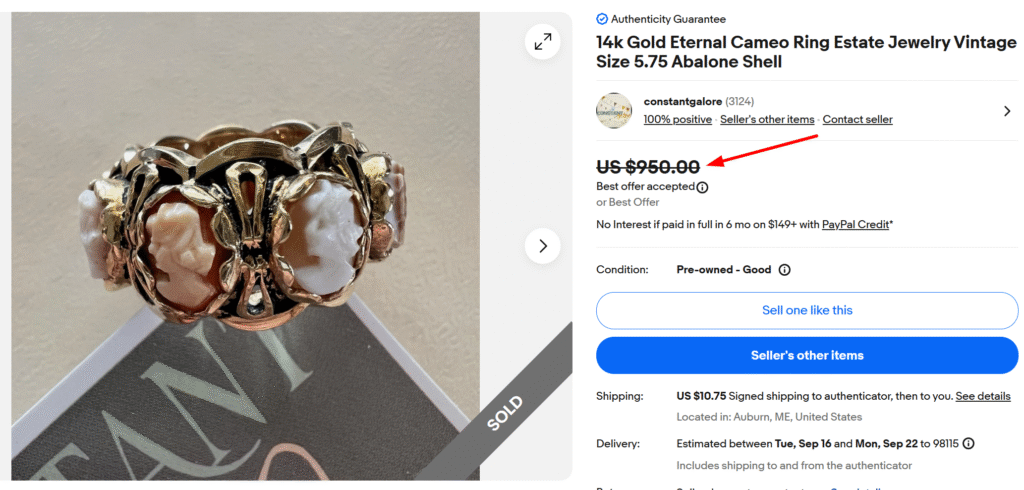
6. 14K Gold Abalone Shell Cameo Ring
- Brand: Unbranded
- Manufacturing Period: Mid-20th century
- Material: Gold and Abalone Shell
- Item: Ring
Abalone shell cameos are less mainstream than traditional shell cameos, and the natural iridescence of the abalone means that each piece is unique. The rainbow colors that shift in light give abalone cameos a distinct look that collectors love.
When set in 14K gold, these pieces combine the organic beauty of the shell with precious metal, creating pieces that are beautiful and valuable.
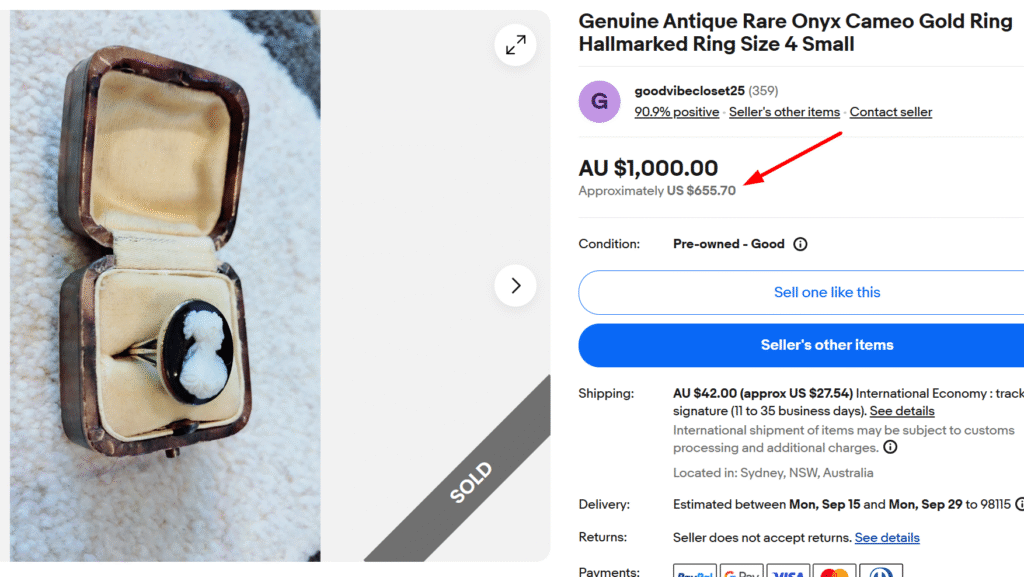
7. Gold Onyx Cameo Ring
- Brand: Hallmarked Only
- Manufacturing Period: 1870-1890
- Material: Gold and Onyx
- Item: Ring
This small Victorian onyx cameo ring demonstrates that even modest pieces can be valuable when they’re genuine antiques with proper hallmarks. Hard stone cameos were usually more expensive, and Victorian examples in good condition command premium prices.
The fact that it’s hallmarked (officially stamped with gold purity marks) adds authenticity and value. It also came in an old leather ring box, and it sold for AU $1,000 (about US $656).
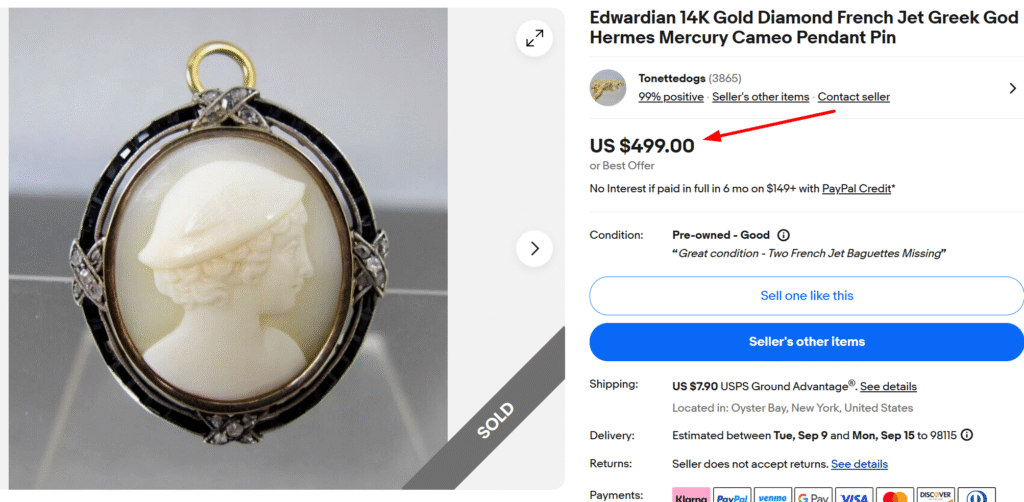
8. Edwardian Gold Greek God Hermes (Mercury) Cameo Pin
- Brand: Unbranded
- Manufacturing Period: 1900-1920s
- Material: 14K Gold, Diamond, French Jet
- Item: Pendant/Pin
This beautiful Edwardian piece features French jet (black glass made to look like real jet), which was worn widely for mourning in the Victorian era and stayed in use into the Edwardian years. The cameo is of the messenger god (Mercury or Hermes) with a winged hat and caduceus staff.
French jet was often used as a more affordable alternative to real jet, and pieces with mythological subjects like Mercury were fashionable. The 14K gold and diamond accents make this a quality piece from the early 1900s period. It sold for $499.
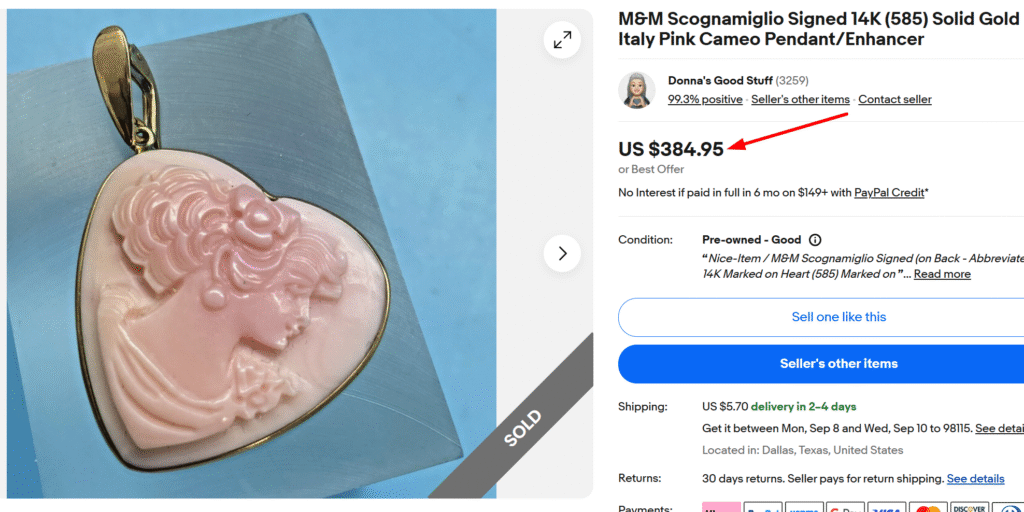
9. M&M Scognamiglio Signed 14K Pink Cameo Pendant
- Brand: M&M Scognamiglio
- Material: 14K Gold, Pink Cameo (material not stated)
- Item: Heart-shaped Pendant
Scognamiglio is a well-known name in Italian cameo carving. This heart-shaped pink cameo is signed M&M Scognamiglio on the back and mounted in 14K (585) Italian gold. The listing calls it simply a pink cameo, so it may be pink shell rather than coral.
If it were coral, it would be worth more, since natural coral costs more than shell. The signature is what lifts this one. Also, the 585 (14K) stamp on this pendant suggests a 20th-century piece rather than a Victorian one.
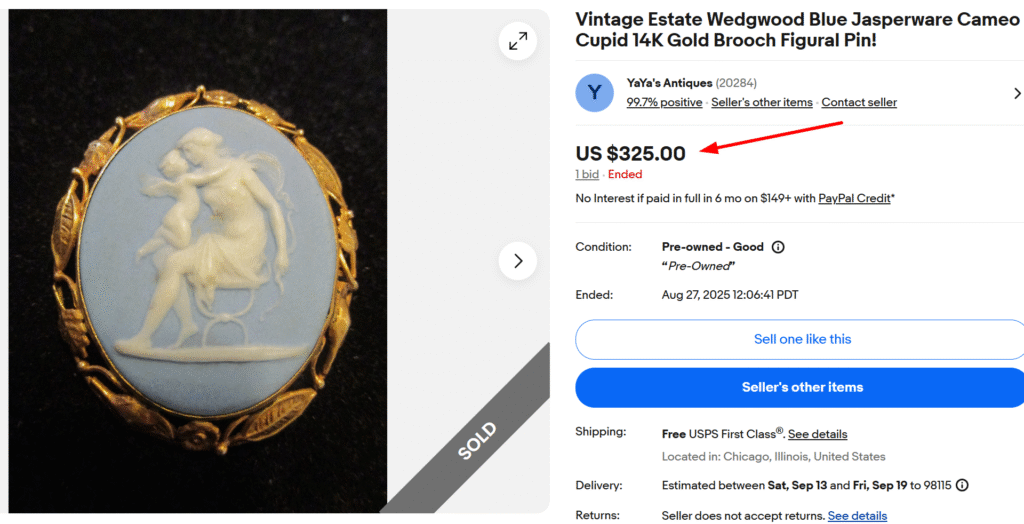
10. Wedgwood Blue Jasperware Cupid Cameo Brooch
- Brand: Wedgwood
- Material: Blue Jasperware
- Item: Brooch Pin
This piece features Wedgwood’s famous blue jasperware with a white cupid figure, set in 14K gold. Wedgwood has been making these cameos since the 1700s, and they’re known for their crisp, detailed relief work.
The blue and white pattern is the epitome of Wedgwood, and when it’s encased in real gold, it’s considerably more pricey. Cupid motifs are popular with collectors.
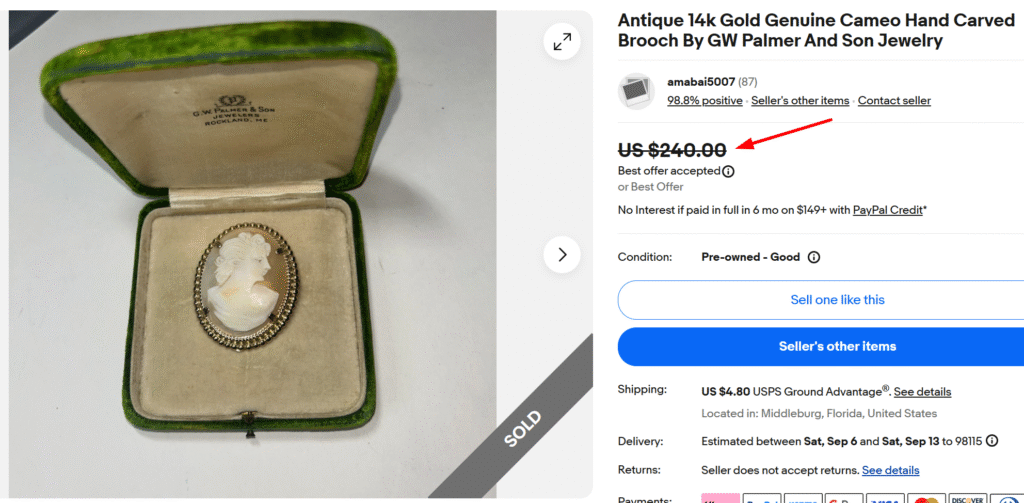
11. 14K Gold Hand-Carved Shell Cameo Brooch in a G.W. Palmer & Son Box
- Brand: G.W. Palmer
- Manufacturing Period: 19th to 20th century
- Material: Gold and Shell
- Item: Brooch
This 14K gold shell cameo brooch came in a green velvet box printed “G.W. Palmer & Son, Rockland, ME.”, which looks like the jeweler that sold it rather than the carver.
Jewelry boxes often get discarded, so a cameo still in its original box is a small bonus for buyers. The seller asked $240 and accepted an offer.
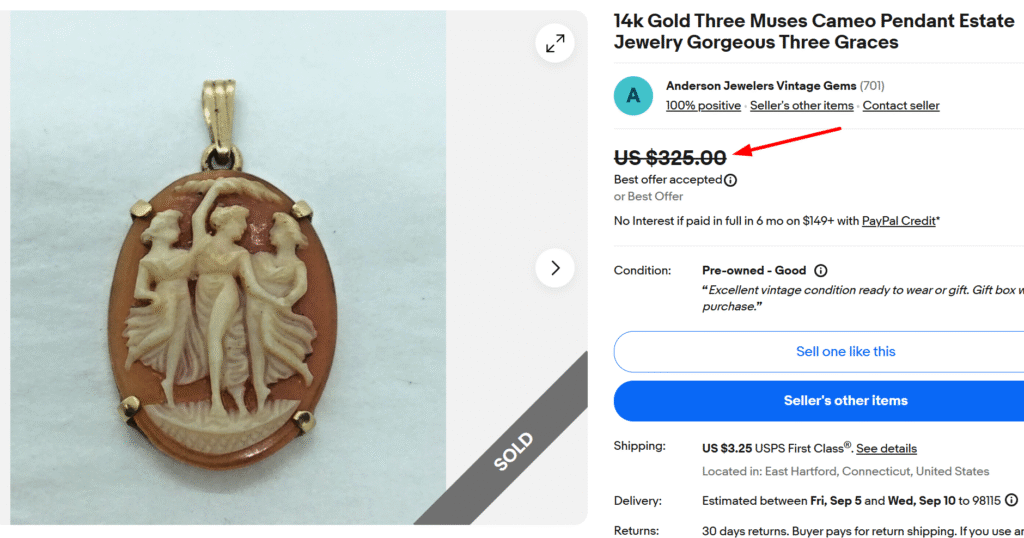
12. 14K Gold Three Graces Shell Cameo Pendant
- Brand: Unbranded
- Manufacturing Period: 20th century
- Material: Gold and Shell
- Item: Pendant
This shell pendant shows three women in flowing robes, set in 14K gold with prongs and a bail. The listing calls them both the Three Muses and the Three Graces; a group of three is the Graces (there were nine Muses).
Three Graces cameos are popular with collectors, and this one was listed at $325 with an offer accepted.
13. Gold Soldier’s Cameo Men’s Ring
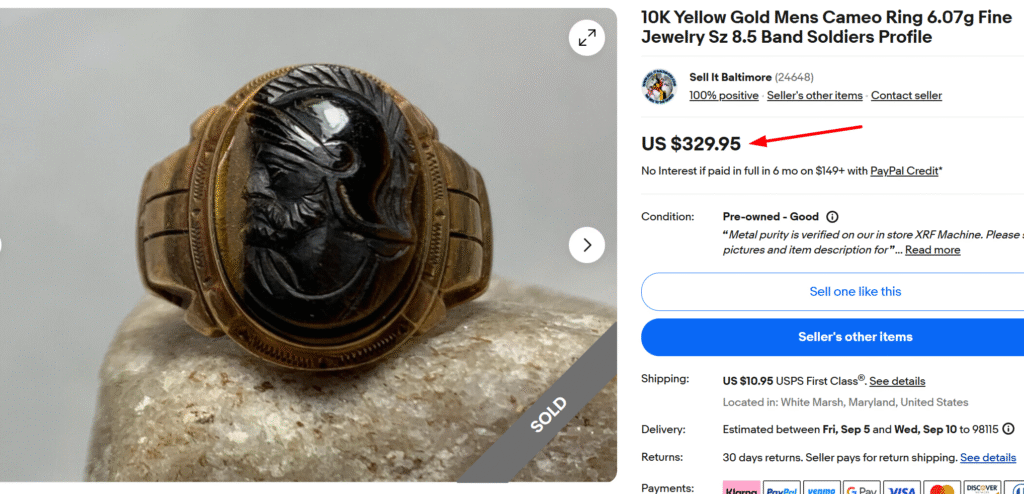
- Brand: Unbranded
- Manufacturing Period: 1940s-1960s
- Material: Black stone and Gold
- Item: Ring
This men’s cameo ring from the mid-20th century features a Roman soldier carved into a black stone and set in 10K gold. Rings like this often show military or classical heads, usually in a black stone such as onyx. This 6.07-gram ring sold for $329.95.
14. Antique Lava Cameo Gold & Sterling Earrings
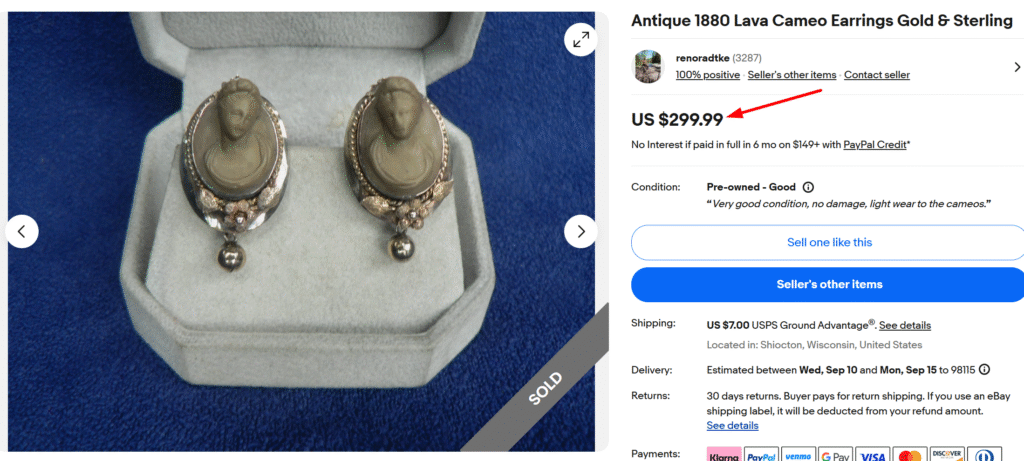
- Brand: Unbranded
- Manufacturing Period: 1880s
- Material: Gold, Sterling, Lava Stone
- Item: Earrings
These 1880 lava stone cameos are a good example of the Victorian tourist trade from Italy. According to GIA, lava cameos were carved from lava from the remains of Pompeii, and travelers bought them as souvenirs of their European tour.
The combination of gold and sterling with lava shows quality craftsmanship from the 1880s period. The pair sold for almost $300.
How to Identify Authentic Antique Cameo Jewelry
Identifying authentic cameo jewelry is more than learning its history. Each piece tells you a different story, whether it was hand-carved or molded, a Victorian piece or a modernist work.
The quick test for whether a cameo is real: look for tool marks and undercutting around the face and hair (missing on molded glass and plastic copies). A shell cameo also has a gently curved back and lets light through from behind. The details below cover materials, carving, marks, and settings.
Cameo Materials: Shell, Stone, Lava, Coral & Glass
Antique cameos were made of different materials like shell, hardstones, coral, or Lava, but with time, their compositions evolved. So the material is your first clue to what you have. Here are the most important ones:
Shell Cameos
Most common in the Victorian era, shell cameos were mostly made of conch, helmet, or cowrie shells. According to GIA’s guide to cameos, common carving shells include the orange-toned cornelian shell (Cassis rufa) and the dark brown sardonyx or emperor helmet shell (Cassis madagascariensis).
The colors of these shells are usually in white relief on pink, orange, or brown. These pieces are often lighter and warmer than other materials.
Hardstone Cameos
This dense material was a favorite for Renaissance cameos. It feels distinctly cool to the touch, and its carved lines stand out with striking clarity. You can often find them in sharp color contrasts like black onyx with a white figure, or sardonyx’s brown and white bands.
GIA notes that onyx, sardonyx, carnelian, jasper, and quartz became favorite carving stones after large agate and carnelian deposits were found at Idar-Oberstein in Germany in the 16th and 17th centuries.
Rough agate and carnelian still turn up on some shorelines, such as Lake Superior and the Oregon coast; our guide to valuable beach stones shows which ones collectors pay for.
Lava Cameos
A 19th-century, Italian-based material that features low color contrast. Despite the name, experts note that most “lava” cameos were carved from a soft volcanic stone or limestone from the area around Vesuvius, not hard lava, in muted creams, grays, browns, and greens.
Coral Cameos
Jewelry made of this material was mostly popular in Mediterranean workshops, from the 19th to the 20th century. The hues of these coral works are typically found in red-orange, light pink, or cream.
Ivory and Bone Cameos
These are among the earliest cameo materials from the 18th and 19th centuries. You would find genuine ivory or bone cameos with patterns of crossed lines, sometimes referred to as cross-hatching.
Be careful when selling one: trade in elephant ivory is restricted in the US and many other countries.
Glass Cameos
Glass cameos are molded rather than carved, which became popular in the 19th and 20th centuries. While they lack the depth of shell or stone, their vivid colors and affordability made them widely accessible for vintage costume jewelry makers.
Carving Details and Quality
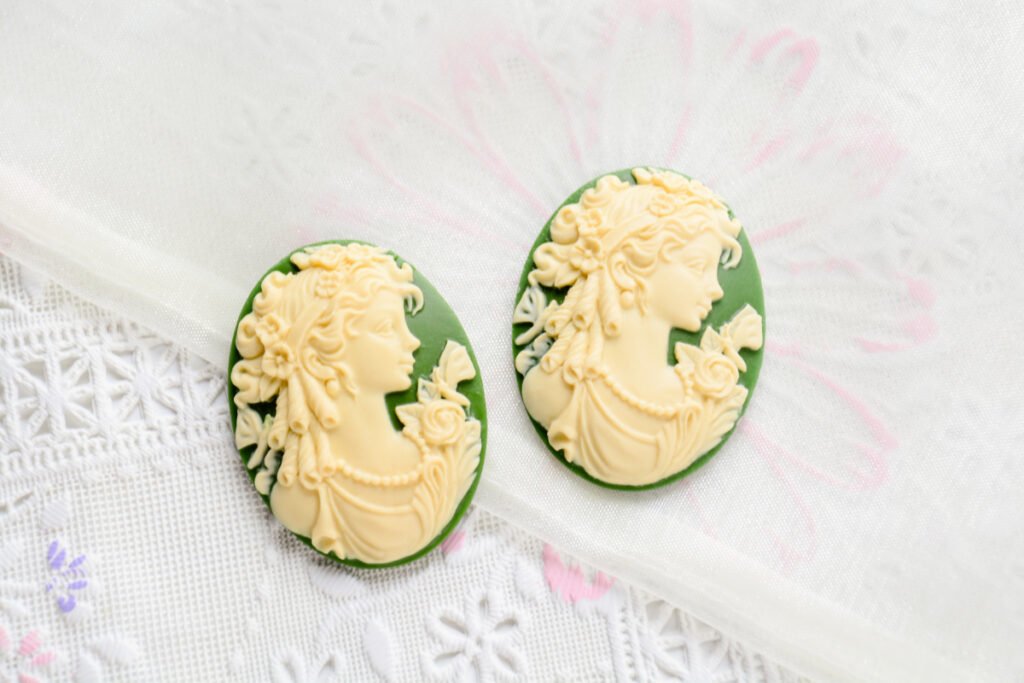
The heart of a cameo lies in its carving, be it fine undercutting, depth, and delicate lines that reveal the hand of a skilled artisan. Here is what to look for.
On authentic antique cameos from the pre-1900s, you will see subtle irregularities and fine tool marks from the hand-carving process. The shapes of these pieces will also come with the natural curves of the materials.
The relief, height, and depth will also have some variations, and no two pieces will have the same geometric precision.
On the other hand, machine-made cameos usually have an overly smooth, almost snow-like surface with perfect uniformity. They lack the deep undercutting like the hand-carved pieces that give a lifelike 3D shadow.
The reliefs are usually monotonous, and all the jewelry appears identical and repetitive.
Makers’ Marks & Hallmarks
A piece of jewelry with its maker’s mark is like icing on a cake. It automatically makes the pieces credible, easy to verify, and most importantly, trustworthy. This comes in various forms, be it the maker’s name, hallmarks, year, and so on.
These impressed marks are usually found beneath the cameo, on the back, inside pendants, or within openable settings. So here’s a list of some known makers and their imprints who made such cameo pieces.
- Giovanni Pichler (Rome, 1734–1791) – One of the most celebrated gem engravers of his time, he often signed his cameos in Greek letters, “ΠΙΧΛΕΡ” (Pichler).
- Nathaniel Marchant (Rome, then London, 1770s–1816) – Known for his neoclassical gems, mostly intaglios, he usually signed simply “MARCHANT.”
- Johann Lorenz Natter (Germany, then Italy and London, 1705–1763) – A master of portrait gems who usually signed “NATTER,” often in Greek-style letters.
- Giuseppe Girometti (Rome, 1780–1851) – Famous for fine detailing, he signed most of his cameos simply “GIROMETTI.”
- Pietro Girometti (Rome, 1811–1859) – Son of Giuseppe, who continued the tradition; he also signed “GIROMETTI,” so father and son are hard to tell apart.
- Benedetto Pistrucci (Rome, then London from 1815) – Best remembered for the St. George coin design; he used a tiny Greek letter λ (lambda) on his earlier pieces, and the signature “PISTRUCCI” on formal or neoclassical pieces.
- Niccolò Amastini (Rome, 1780–1851) – An exquisite engraver whose cameos are often signed “MASTINI,” “N. MASTINI,” or “N: MASTINI.”
- Georges Bissinger (Paris, 1860s–1880s) – A German-born engraver known for Renaissance-style portrait cameos; signed pieces carry the name “BISSINGER.”
- James Ronca (London, mid to late 19th C.) – An English carver of shell and hardstone cameos who made Queen Victoria and Prince Albert portraits for about 30 years; signed pieces read “RONCA.”
Signed works by these engravers are rare, and many are in museums and private collections, so have any signature checked by an expert. GIA also names Tommaso Saulini, his son Luigi Saulini, and Giovanni Noto as 19th- and 20th-century Italian carvers who signed their cameos.
Along with the brand’s name, you’ll often find hallmarks that show metal purity and origin. On American cameos from the 19th–20th century, you’ll usually see marks like 10K, 14K, and 18K (for gold) and “925” for Sterling.
In Europe, the hallmarks look a bit different; for instance, 375 means 9K (quite common in British cameo jewels ), 585 stands for 14K, and 750 indicates a higher-end 18K gold, which was especially popular in premium European cameos.
Setting Type & Construction Clues
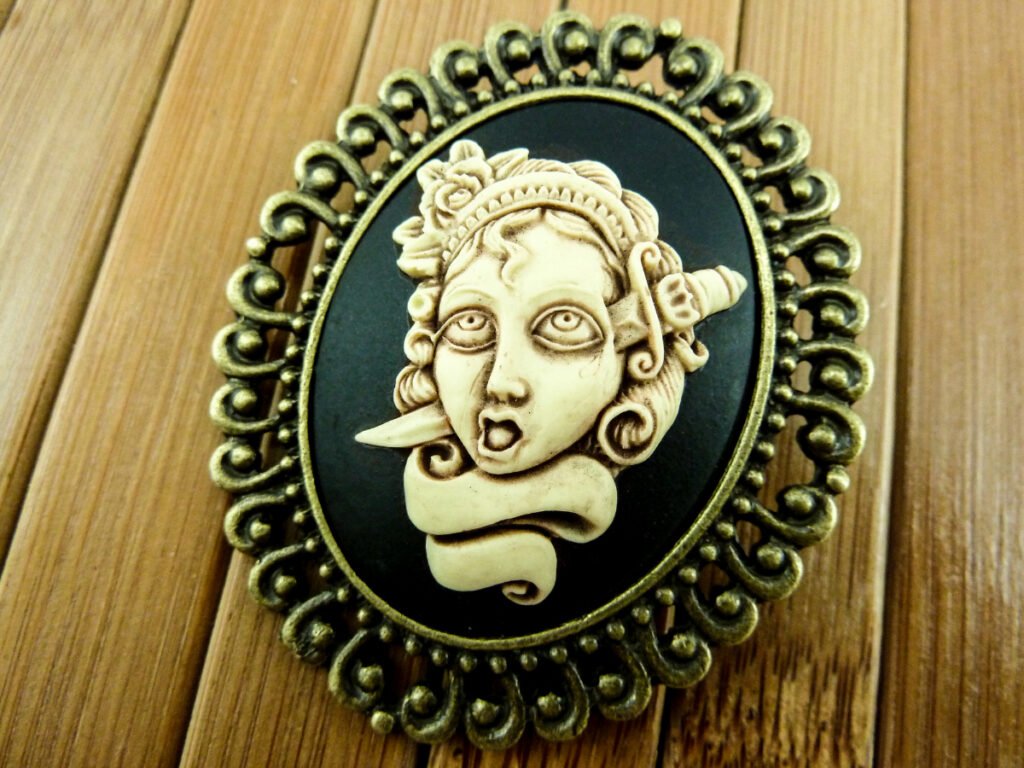
Authentic cameos will often reveal their age and origin by the way they’re made. The settings, joint details, the mechanisms, and all such construction features offer reliable clues to spot real pieces. Here are the main ones:
Hinge & Clasp Mechanisms
Antique cameo jewelry, specifically brooches and pendants, had variations in their hinges and clasps over time, which is why collectors start by dating old brooches by the clasp. For instance:
- Before about 1900 – A simple C-clasp with no lock and a long pin, usually on a tube hinge.
- Mid to late 1800s onward – Some European pieces have a barrel (trombone) catch, a small tube that slides over the pin tip to lock it.
- Late 1800s and later – Safety catches gradually replaced the plain open C-shaped catch. A rollover safety catch points to the 20th century, so on a cameo sold as Victorian it usually means a later piece or a replaced clasp.
Backplates and Wax Backs
Genuine antique cameos usually have solid silver or gold backplates with some weight to them. Very thin or hollow backs usually indicate later pieces.
On the other hand, some early Italian shell cameos were reinforced with a thin layer of red or brown “biscuit” wax to protect the shell. Modern fakes, however, often use epoxy or uniform resin layers instead.
Catch Plate
In antique cameo brooches, the catch plate (a little part that holds the pin in place) was usually made from a small metal strip raised just above the backplate, with a rounded end to lock the pin tip.
Modern reproductions often use catch plates that are flat and stamped out of sheet, which makes them look less refined.
Bezel & Prong Settings
Real hardstone and shell cameos are usually held in place with a handmade metal rim, called a bezel. Since it’s made by hand, the rim can look a little uneven, and sometimes you’ll even see tiny blobs of solder where it’s joined.
In some Victorian and Edwardian pieces, rather than a rim, little hand-twisted spikes or prongs were utilized, typically six to eight of them to secure the cameo. If those prongs all look too perfect or like they were pressed by a machine, that’s a sign it’s probably a newer reproduction.
Mount Decoration and Metalwork
In the late 1800s, craftsmen decorated mounts with fine wire scrolls (filigree) and tiny beads (granulation). Each piece was carefully made and soldered one by one. In modern pieces, these details are usually cast or molded, looking flatter.
Safety Chains & Loops
In Victorian and Edwardian times, many cameo brooches had safety chains (a small chain to keep the brooch from falling off if the clasp opens). These were attached to small handmade wire loops soldered near the clasp.
5 Things That Make Antique Cameo Jewelry Valuable
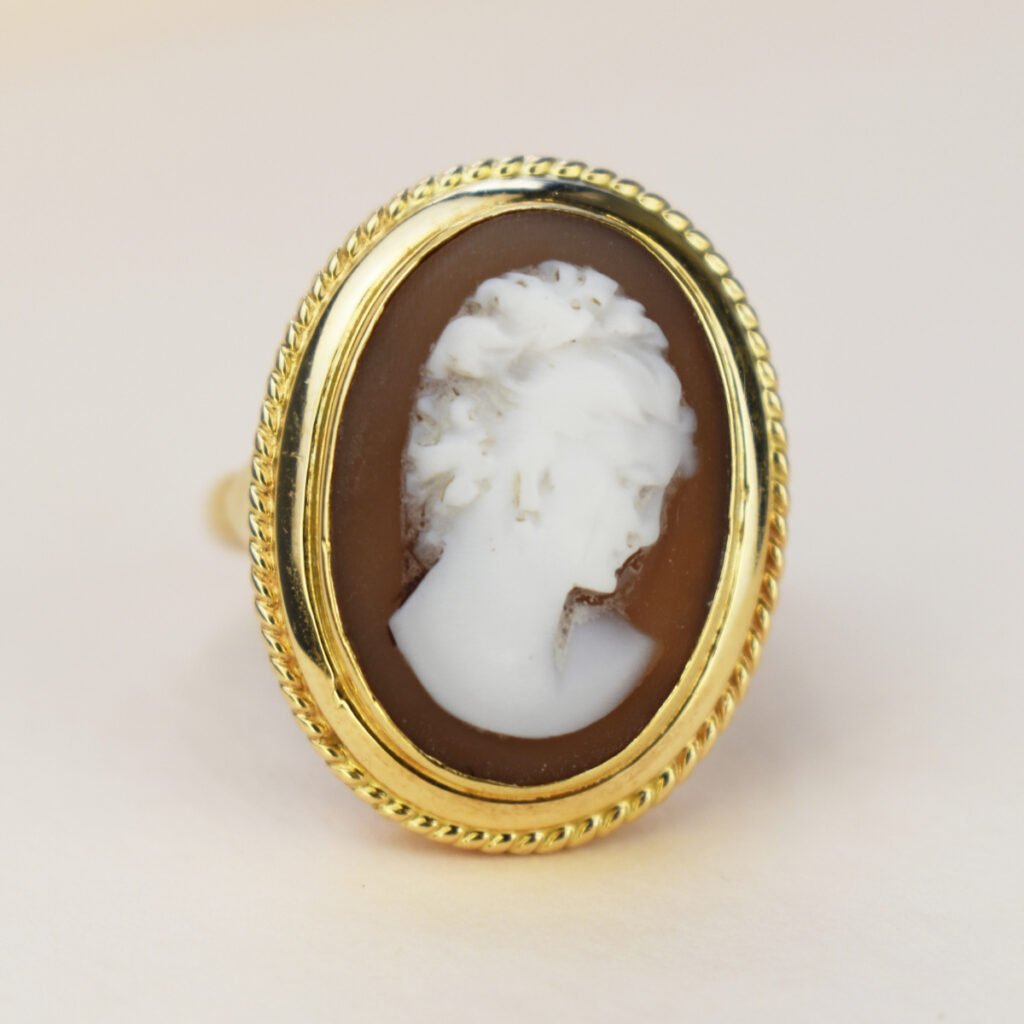
A cameo’s value depends on its features, age, craftsmanship, and condition. GIA also points to the material, the subject, and the artist’s signature. Here are 5 factors that set a vintage cameo’s value:
Age & History
An older cameo, even if quite worn off, will often be considered rare because of its historical value. That said, Renaissance cameos (15th and 16th centuries) and earlier pieces command premium prices.
Similarly, 19th-century pieces are typically worth more than 20th-century cameos, featuring modern and cheap materials, like bakelite and artificial stones.
To date an antique cameo, you can use clues like markings and design details. But not every old piece is really “old”; some are made to look old. So, check the following signs of age:
- Fine, irregular hairline cracks on shell cameos (due to the expansion and contraction of the material)
- Less translucence (aged shells) developing a subtle matte finish
- Subtle color shifts (pink shells might turn orange over time)
- Subtle surface patina on stone cameos
- Natural oxidation on gold and silver settings
Carving Quality
The sharpness and precision of the carving can significantly impact a cameo’s value. Fine cameos display lifelike detail, delicate hair strands, defined facial features, and depth in the folds of clothing, and collectors love them for that.
Pay attention to the following details:
Relief Depth
Deeply carved figures that have high relief, just like a 3D structure, are often valued more. Crisp undercuts also produce natural shadowing beneath the features, like the hair strands, drape folds, etc.
Detailed Work
Authentic pieces with detailed work, like noticeable eyelids, tear ducts, or expressive mouths, show high-end work, making these pieces more worthy.
Proportion
If you find balanced head-to-body ratios or harmonious scale in the features of the cameos, then these are authentic pieces of an earlier time. Craftsmen from the pre-19th century and earlier ensured that their work had well-defined proportions.
Surface Finishing
Seamless blending of relief layers is highly sought after by collectors. Cameo jewelry having no abrupt edges or tool marks indicates original production.
Setting Quality
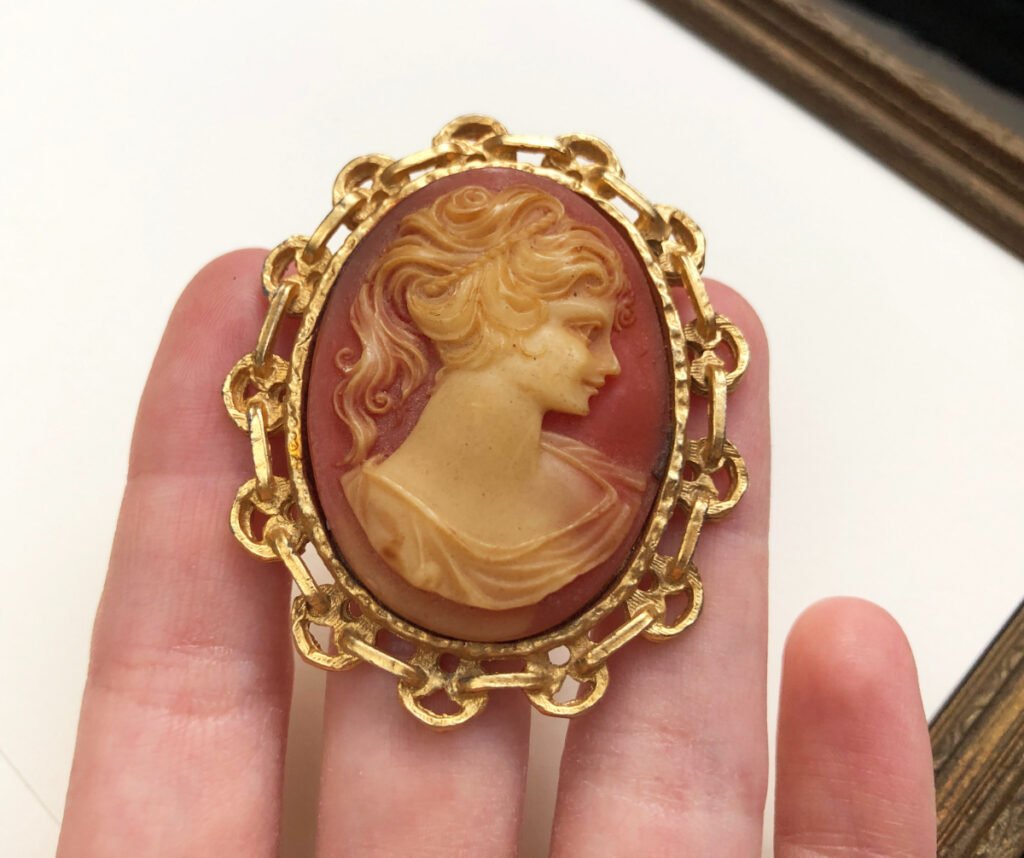
In addition to the cameo itself, the setting also has a huge impact on value in several ways:
- Metal Type and Purity – Gold cameo pieces, especially 14K and 18K, are considered more valuable than silver. And silver is more valued than base metals.
- Craftsmanship – Pieces of decorative work, heavy engraving, enamel, or jewels can provide an additional touch and value to the cameo.
- Originality – Ideal settings are original, untouched ones; however, proper restorations can be okay with some, but modern repairs generally devalue it.
- Hallmarks & Maker’s Marks – Stamps and famous workshop marks prove authenticity, so they typically boost the value of the antique cameo jewelry.
Condition
Like all other antique jewelry pieces, condition is a critical factor in the valuation of antique cameos, because serious damage can cut a piece’s value sharply.
So, whether buying or selling, look for these red flags:
- Chips or cracks, specifically in vulnerable materials like shell & stone cameos
- Deep cracks damaging the structure
- Flattening or loss of carving details in the cameo
- Replaced or extensively repaired mounts
Some flaws are acceptable, though, such as:
- Light surface crazing or hairline cracks
- Subtle metal corrosion or scratches in the mount without any structural damage
- Tarnishing in metal settings
Provenance
Because cameos were worn so widely, a documented history is what sets one apart from thousands of similar pieces.
Make sure to look for original boxes as well as authentic documentation, such as original sales receipts, listings in auction catalogs, exhibition records from museums (if displayed), or any estate papers that connect a cameo to an aristocrat or celebrity.
Such proof can add noticeably to your cameo’s value.
Where to Sell Antique Cameo Jewelry
Where you sell depends on what you have:
- Gold-set shell cameos and everyday pieces: eBay works well. Search sold listings for the same material, size, and gold mark, and price yours against what actually sold, not against asking prices.
- Hardstone, coral, lava, or signed cameos: an auction house with regular jewelry sales, or a dealer in antique jewelry, reaches buyers who pay for carving quality.
- Not sure what it is: ask a jeweler or appraiser to confirm the material and test the metal before you list it.
Before you buy or sell, run through the material, carving, setting, and condition checks above; together they tell you most of what a cameo is worth.
Found this guide useful?
Save it for later
Share it with someone
Keep the old finds coming
New guides and finds worth looking for, delivered to your inbox.
Keep exploring
More guides in Jewelry
 8 findsAntique Victorian Jewelry: How to Identify, Value & Spot Rare StylesTop sale $886
 10 finds10 Valuable Vintage Trifari Jewelry Designs & How to Identify ThemTop sale $4,000
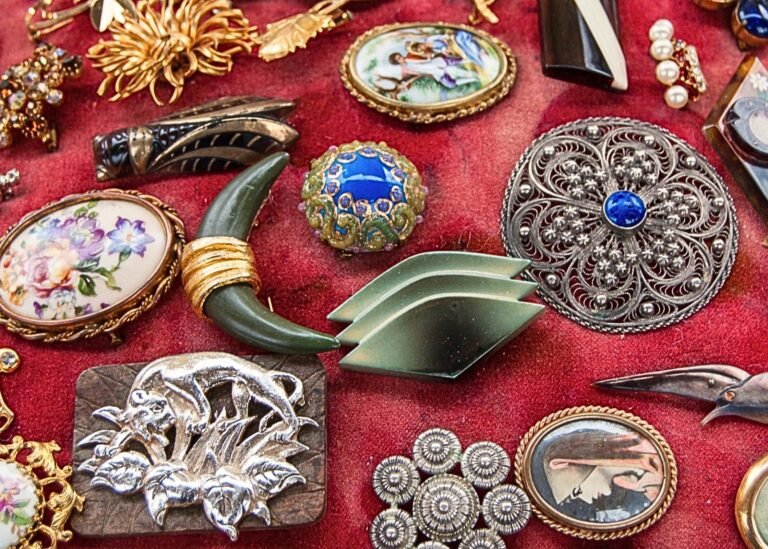
 14 findsVintage Costume Jewelry Brooches: Identification, Value & 14 Rare FindsTop sale $1,650
 12 findsAntique Pocket Watches Worth Money (Brands, Rare Models & Identification Guide)Top sale $2,499