
Did you know that First Lady Mamie Eisenhower wore Trifari jewelry for both inaugurations? It is this prestige that gives Trifari a place as one of the most recognized brands of costume jewelry.
Trifari was founded in New York way back in 1918 and became one of America’s leading makers of costume jewelry by the 1930s. The designer Alfred Philippe headed the studio from 1930 to 1968, designing the most collectible items today.
In this guide, you will learn to read Trifari marks, date pieces by decade, and see rare finds that recently sold for serious money.
How to Identify Vintage Trifari Jewelry (Marks, Signatures & Dating)
Spotting genuine Trifari jewelry is not really challenging because every real piece carries a mark somewhere. The trick is knowing which mark points to which decade, to find out if the piece is really vintage.
Is Trifari Jewelry Real Gold or Silver?
Vintage Trifari costume jewelry is generally gold-plated base metal, often over Trifanium alloy made by Trifari. In World War II, because of a lack of zinc and other base metals due to their utilization during the war, Trifari started using sterling silver, at times gold vermeil.
Those sterling pieces are stamped “Sterling” alongside the Trifari mark, and they’re some of the most valuable Trifari you can find. But solid gold Trifari does exist, though it’s very rare and mostly limited to a small 1970s fine jewelry line.
The Trifari Signature Marks by Era
Because the Trifari signature changed a lot over the years, it’s the fastest way to date a piece. Below is a simple timeline you can use.
- KTF (pre-1937): Stands for Krussman, Trifari, Fishel. The earliest mark you’ll see, and pieces with this stamp are almost always pre-war and highly collectible.
- Trifari script (1935 onward): Simple cursive “Trifari” without a crown. Common in late-1930s work.
- Crown Trifari (1937 to mid-1950s): The famous little crown sitting above “Trifari.” This is the golden-era mark, and it’s what most serious collectors hunt for.
- Crown Trifari with © (mid-1950s to 1980s): Same crown, but now with a copyright symbol. Introduced around 1955.
- Trifari TM (1980s): Trademark symbol added. Pieces are still nice, but less collectible.
- Pat. Pend. or patent number: Sometimes stamped alongside the main mark. If you see one, you can look up the patent to date the piece down to the exact year.
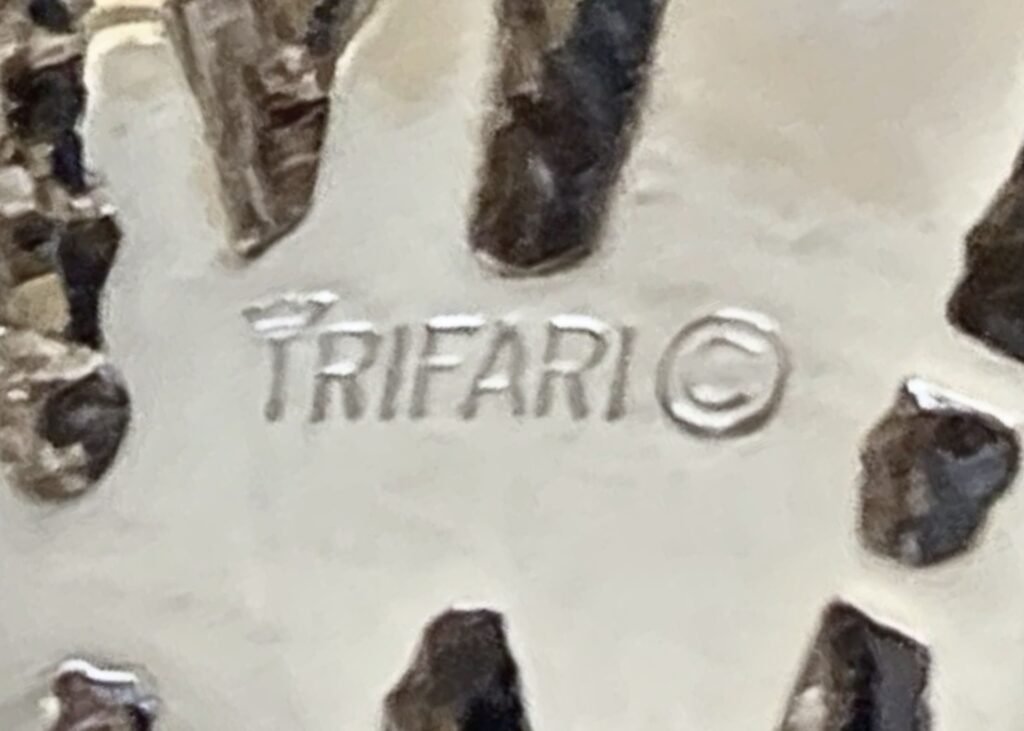
Where to Find the Mark on a Piece
Marks are small and easy to miss, so know where to look.
- On brooches, check the back plate near the pin catch.
- On necklaces, look at the clasp itself or a small oval tag hanging near it.
- Earrings carry the mark on the reverse, usually near the clip or post.
- Bracelets are stamped on the inside of the clasp or on the tongue of a box clasp.
Alfred Philippe – The Designer Identification
If the Trifari item in question has monetary value, there’s a good chance that its design was created by Alfred Philippe. He worked with the company from 1930 to 1968, and his trademark style is seen in the best-selling pieces.
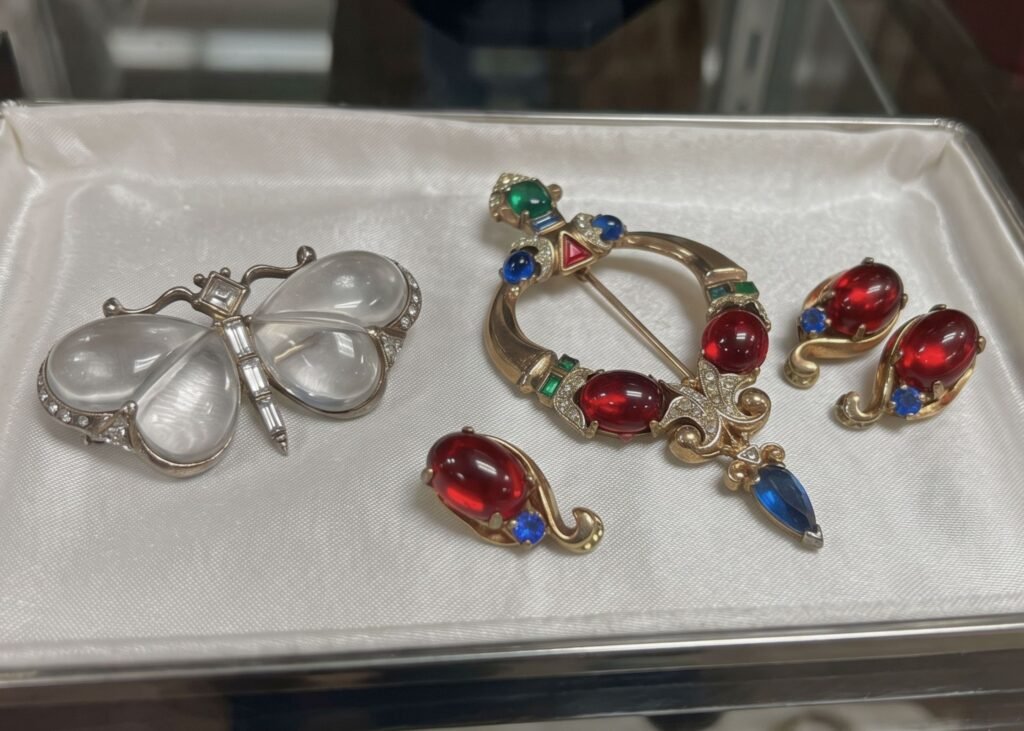
Look for invisible-set stones where the gems sit flush with no visible prongs. This was his Cartier trick, and Trifari was the only costume maker doing it well. His Jelly Belly figurals, animals with a clear Lucite center belly, and fruit salad pieces are icons of 1940s costume jewelry.
Philippe’s designs are also usually the ones with named collections. Starflight Fireworks, Jewels of India, Moghul, L’Opera, Fontainebleau. If a Trifari piece has a collection name, research its history first.
Dating Trifari Jewelry by Decades
After the mark, the design style itself tells a lot about vintage Trifari jewelry. Here’s what each decade looked like:
- 1930s: Art Deco geometric shapes, KTF-marked dress clips, early crown motifs.
- 1940s: Sterling silver bases due to wartime metal restrictions, Jelly Bellies, patriotic red-white-blue pieces, retro bows and ribbons.
- 1950s: Rhinestone-heavy floral sprays, invisible sets, matched parures with brooches, earrings, and necklaces.
- 1960s: Bold themed collections like Jewels of India and Starflight, larger scale, more color.
- 1970s onward: Modernist styles, Diane Love’s ancient-inspired pieces, and declining collectibility for most everything else.
Most Valuable Trifari Jewelry Finds Worth Money
Below are the 10 Trifari pieces that generally fetch premiums today. Pay attention to the design details to spot these rare finds in a lot.
1. Alfred Philippe Poinsettia Star Brooch
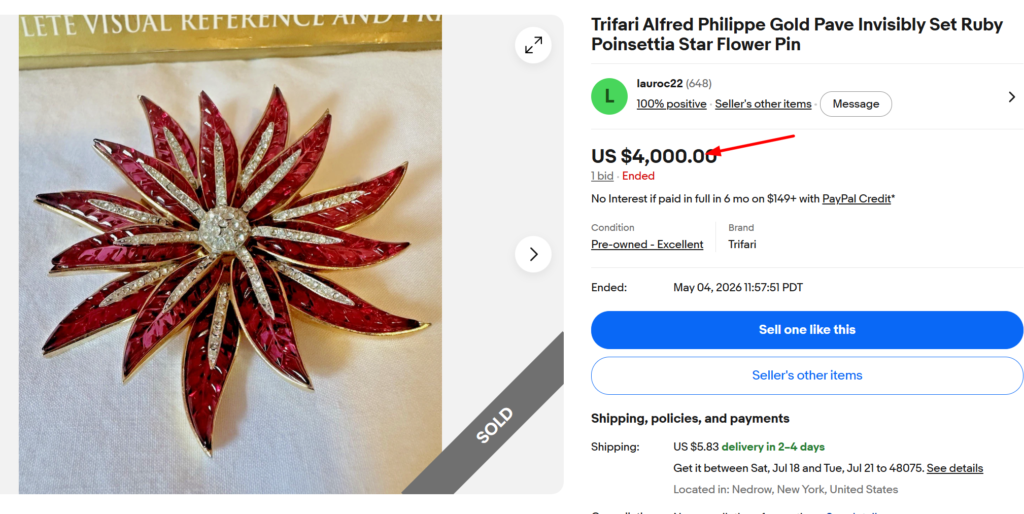
Sold for $4,000
This is one of Philippe’s most spectacular designs. It uses invisibly set ruby glass, where the red stones slot together like tiles with no prongs showing.
He borrowed the trick straight from his Cartier days. The piece was featured in Women’s Wear Daily in June 1961, and ruby colorways are the rarest.
- Estimated Value: $3,000 to $5,000
- Production Years: circa 1961
- What to Check: Invisible-set ruby glass
- Quick Notes: Published in WWD, rare ruby colorway
2. Modernist Diamante Bowknot Set
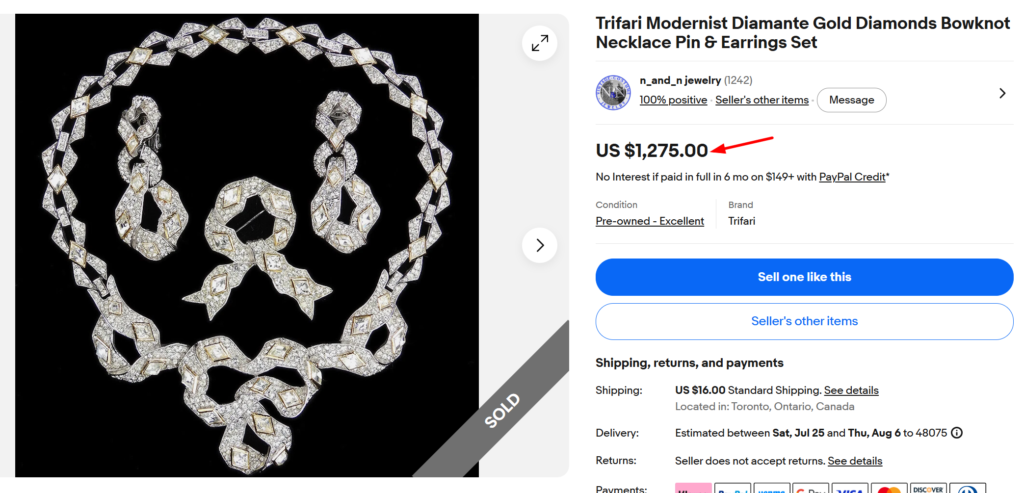
Sold for $1,275
This is a full Trifari parure: necklace, brooch, and matching earrings, all signed. The design uses a repeating bowknot motif with pavé rhinestones and larger bezel-set diamante crystals.
Complete parures are where Trifari value multiplies. A single piece might sell for $200 to $300 alone, but together the set climbs well past $1,000 because collectors love matching sets.
- Estimated Value: $1,000 to $1,500 (complete set)
- Production Years: 1950s to early 1960s
- What to Check: All three signed, matching finish
3. Sterling Clear Jelly Belly Brooch
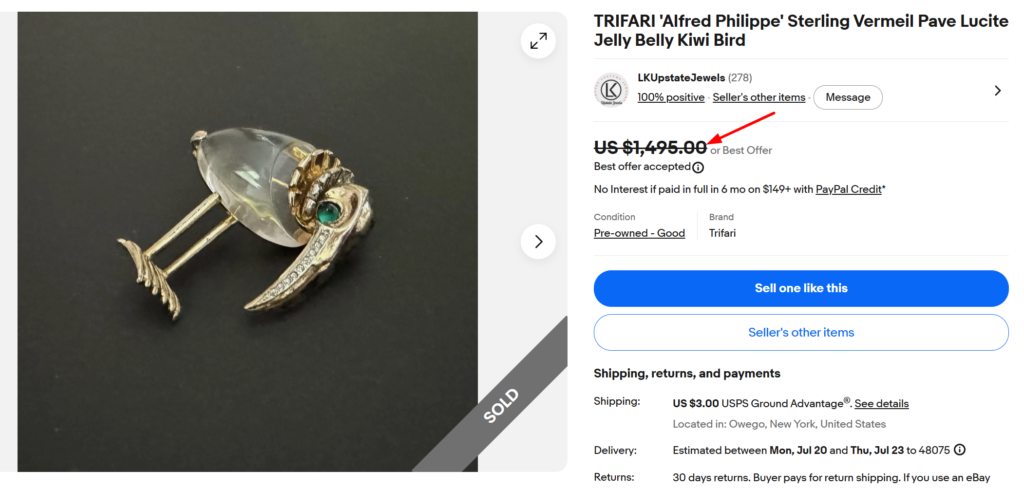
Sold for $1,500
Sterling Jelly Bellies are Trifari’s most valuable pieces. During WWII, Trifari switched to sterling silver because base metals were rationed, and Philippe used the moment to create some of his finest figural work.
Kiwi figurals are much rarer than fish, penguins, or poodles. Always check for both “Sterling” and “Trifari” stamps on the back to confirm authenticity.
- Estimated Value: $1,200 to $1,800
- Production Years: 1942 to 1945
- What to Check: Sterling stamp, clear Lucite belly
4. Joseph Wuyts Enamel Rhinestone Mermaid Pin
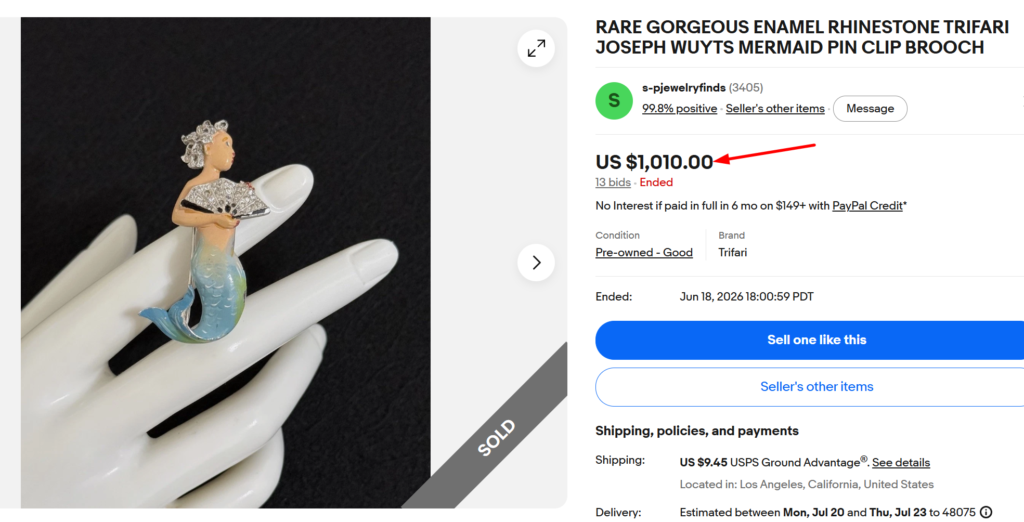
Sold for $1,010
Joseph Wuyts was a freelance designer who created figural pieces for Trifari during the mid-1960s. His mermaid brooches are book pieces, meaning they’re documented in collector references; that published status adds real value. Check for painted enamel skin, a blue-green tail, and a fan of clear rhinestones.
- Estimated Value: $800 to $1,200
- Production Years: circa 1965
- What to Check: Painted enamel face, rhinestone fan
5. Crown Trifari Diane Love Crescent Moon Choker
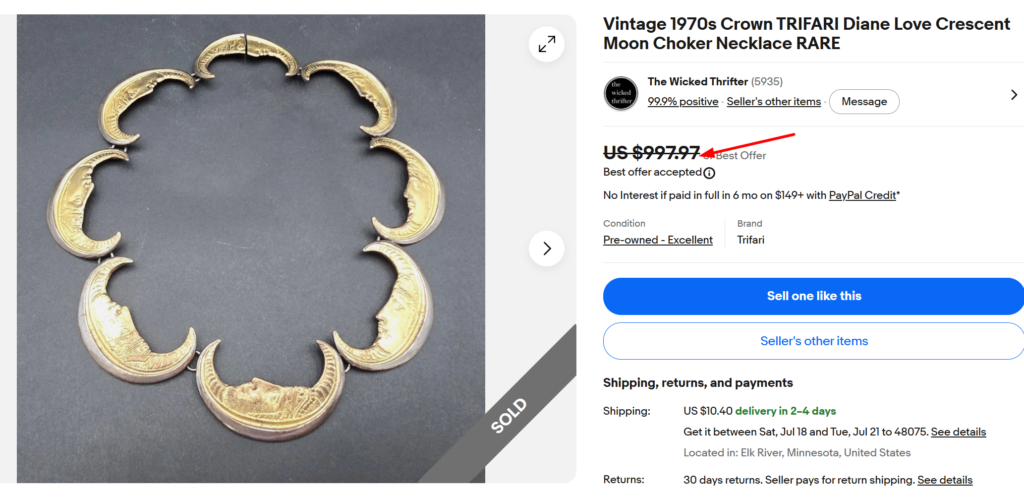
Sold for $995+
Diane Love designed for Trifari in the early 1970s, borrowing from ancient art and ethnic motifs. This choker uses eight linked crescent moons with a carved face on each one.
Her pieces were only marked “Trifari” on the metal. Her name lived on paper hang tags that almost always got lost. So collectors ID these by style, not signature.
- Estimated Value: $600 to $1,000
- Production Years: 1970 to 1974
- What to Check: Faces on each crescent
6. Starflight Fireworks Flower Brooch
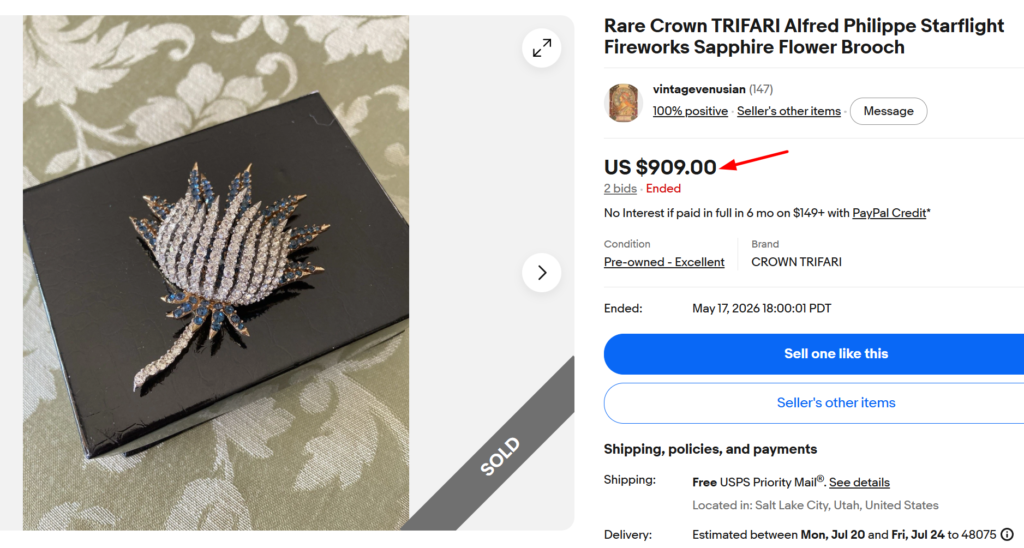
Sold for $910
The Starflight collection came out in 1966 as one of Alfred Philippe’s last major designs before retirement. This example features sapphire blue rhinestones on the tips and pave clear stones through the body, all shaped like a bursting firework.
Sapphire versions are harder to find than the standard clear ones, especially signed pieces.
- Estimated Value: $700 to $1,000
- Production Years: 1966
- What to Check: Sapphire tips, rhodium finish
7. Fruit Salad Brooch
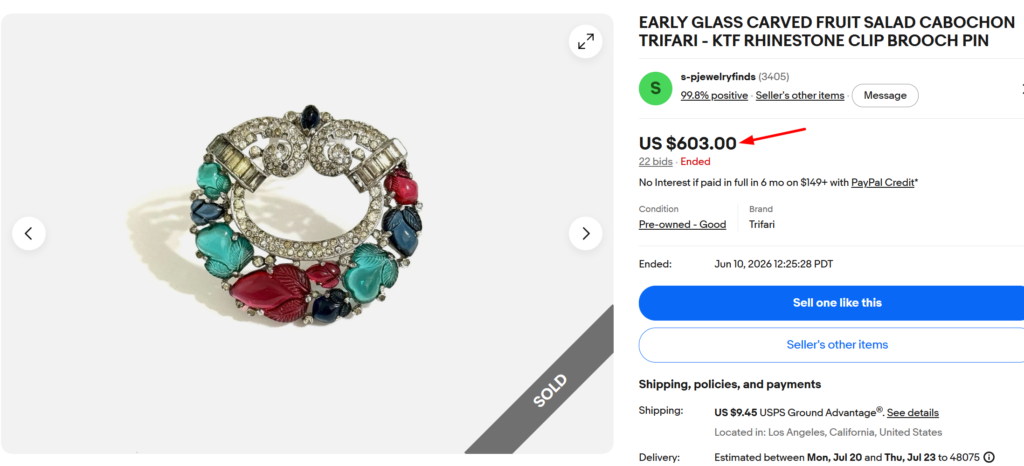
Sold for $603
Fruit salad pieces use carved glass shaped like miniature fruits and leaves in ruby, emerald, and sapphire tones. The KTF mark dates this one to before 1937, which makes it a genuine pre-war piece.
Philippe adapted the technique from Cartier’s “tutti frutti” style. The double-prong dress clip on the back confirms early production, which is more valuable than later pieces
- Estimated Value: $500 to $800
- Production Years: early 1930s to 1937
- What to Check: KTF mark, carved glass fruits
- Quick Notes: Dress clip fitting confirms pre-1937
8. Crown Trifari Alfred Philippe Moghul Jewels Brooch
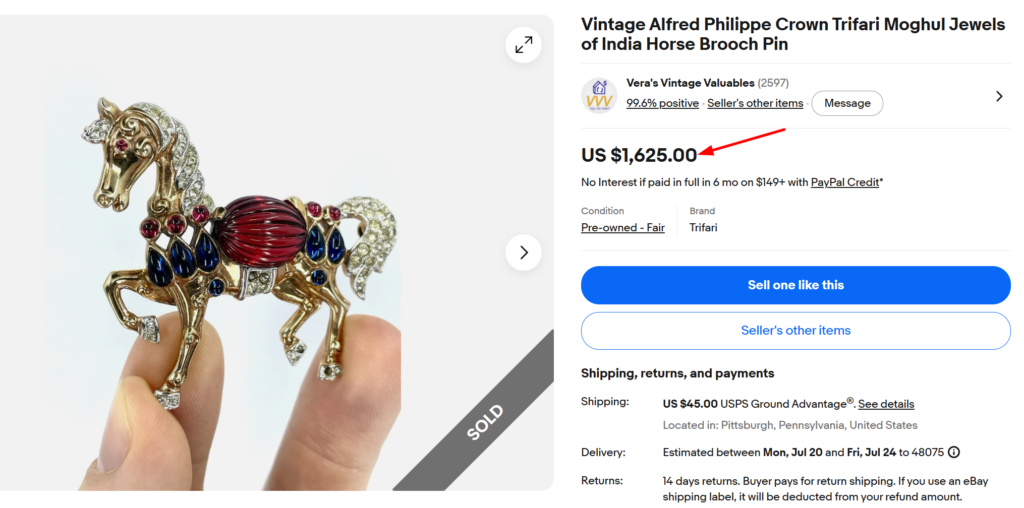
Sold for $1,625
The Jewels of India collection launched in the early 1960s and drew from Mughal-era Indian jewelry. Carved glass cabochons in ruby, sapphire, and emerald tones, all set in mixed gold and rhodium plating.
Animal figurals like this horse are much harder to find than the necklaces and earrings. Watch for the 1980s revival marks, though, since originals are worth more.
- Estimated Value: $1,200 to $2,000
- Production Years: 1960 to 1965 (original)
- What to Check: Ruby melon-cut center stone
- Quick Notes: Watch for 1980s revival reissues
9. Colored Jelly Belly Butterfly Brooch
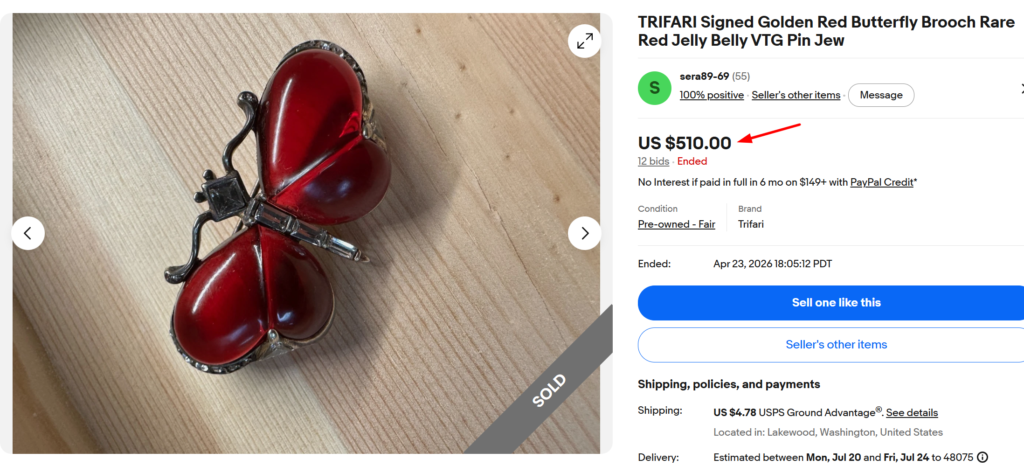
Sold for $510
Jelly Bellies are famous on their own, but colored glass belly versions like this butterfly are much rarer than the standard clear ones. Wings are formed from two ruby cabochons with a rhinestone body between them.
- Estimated Value: $400 to $700
- Production Years: 1942 to 1945
- What to Check: Ruby cabochon wings, sterling mark
10. Patriotic Bow Brooch
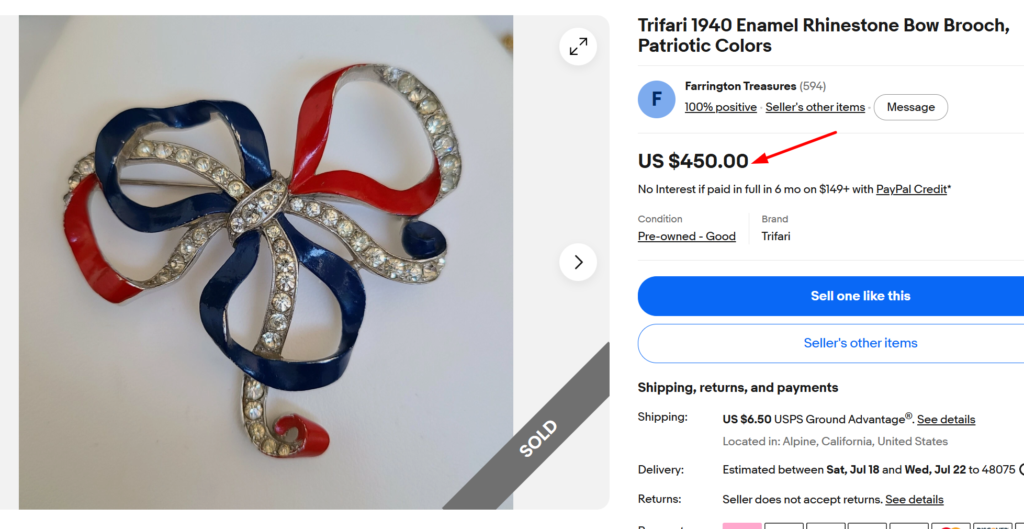
Sold for $450
Wartime Trifari is a collectible category of its own. This bow brooch uses red and blue enamel with clear rhinestones, an asymmetric, loose bow shape that’s classic Retro-era work.
Enamel condition makes or breaks value here. Small chips are normal, but heavy loss can cut down serious value.
- Estimated Value: $350 to $600
- Production Years: circa 1940 to 1945
- What to Check: Enamel condition, red-white-blue
What Determines the Value of Vintage Trifari Jewelry?
Most vintage Trifari brooches and pieces are worth $40 to $150, and a nice signed piece with good design might hit $200 to $400. But the rarest designer pieces regularly cross $500 and can climb well past $1,500 or more.
The six factors that decide where a Trifari piece lands on the value scale are:
- The mark: KTF and early Crown Trifari beat later marks every time.
- The designer: Alfred Philippe pieces command a premium, and named-designer pieces like Diane Love or Joseph Wuyts add another layer.
- The design category: Jelly Bellies, fruit salads, and figural animals sell for way more than plain rhinestone brooches.
- Materials: Sterling silver era pieces (roughly 1942 to 1945) are rare and desirable.
- Condition: Original stones, working clasps, and no plating loss all matter.
- Completeness: A full parure (matching necklace, brooch, and earrings) can sell for double what the pieces would bring individually.
Next time you’re at an estate sale or scrolling online sales, use this guide to know what you’re looking at. The best Trifari pieces usually hide under the marks, the designer’s signature, and design details.