
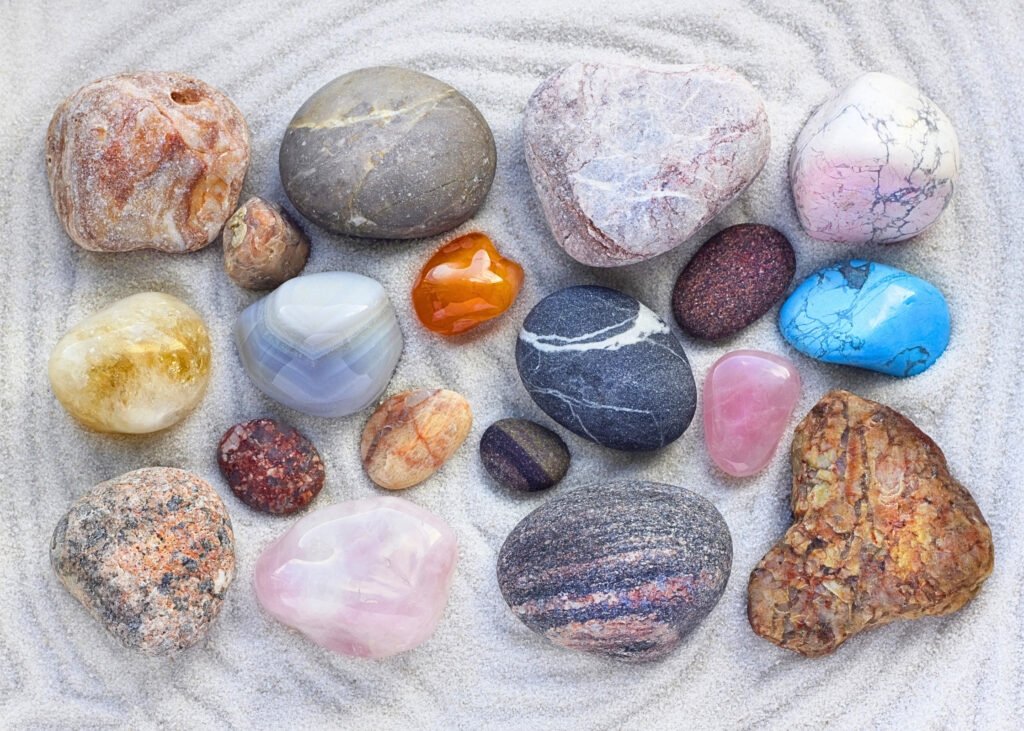
Everyone loves a good stroll at the beach. But most people walk right past the stones lying on the beach. But the truth is that a pocketful of “just rocks” from a shoreline can quietly include finds that collectors will pay real money for.
Rare beach stones don’t always stand out by their appearance. They sit there looking like a plain gray pebble until you wet them, backlight them, or run a UV torch over them.
So let’s go through some of the most valuable and collectible beach stones, how to spot each one, and how much they can be worth today.
Quick Checks to Identify Valuable Stones & Rocks
Before we get to know the valuable beach stones, learn these four quick checks that separate the keepers from the throwbacks:
- Wet the stone (color and pattern jump out)
- Backlight it with a flashlight (agates and chalcedony glow at the edges)
- Scratch-test it against glass (anything harder than 6 is likely quartz-family)
- Shine a UV light on it after dark (some of the best finds only reveal themselves that way).
Now, let’s explore the valuable beach stones every collector should be able to identify on sight.
Rare & Valuable Beach Stones Collectors Look For
Not every stone below is technically “rare” in the geological sense. From Petoskeys, which are locally common but found in only one small region, to Yooperlites, these stones are worth a close look.
1. Lake Superior Agate
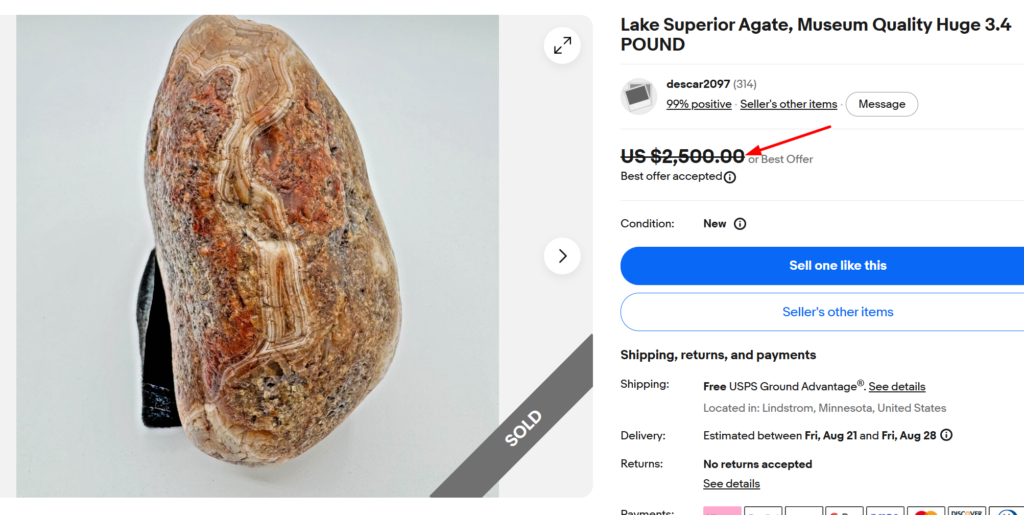
Sold for $2,500
Lake Superior agates are the crown jewel of beachcombing. They formed inside gas pockets in ancient lava flows and got scattered across the Great Lakes region by glaciers.
The classic tell is concentric banding in red, orange, and white, wrapping around itself like the walls of a fort. That’s why the pattern is also called “fortification.”
About 95% of Lakers are marble-sized. Anything over a pound is a highly valuable find, worth $1,000.
- Estimated Value: $5 to $500+ ($500 – $2,500 for larger size)
- Production Years: Naturally formed ~1.1 billion years ago
- What to Check: Fortification banding, waxy translucent surface
2. Petoskey Stone
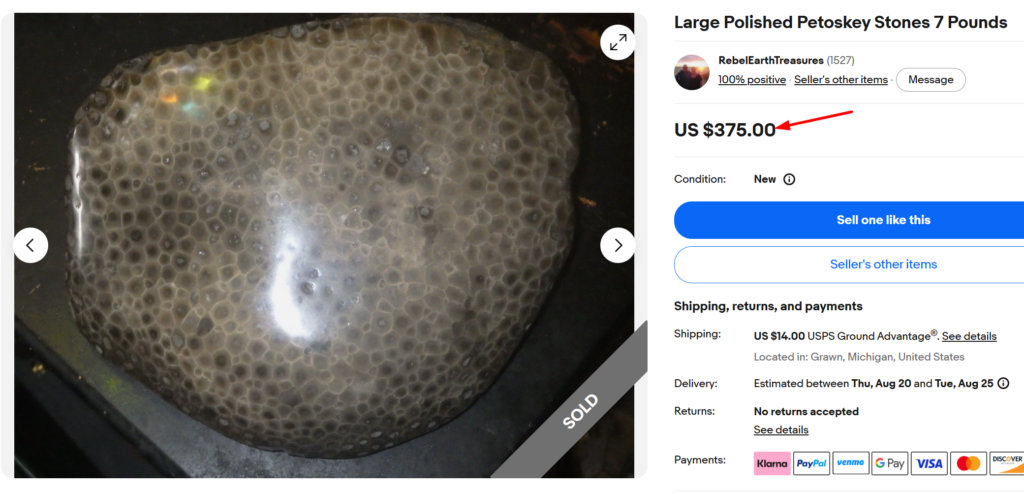
Sold for $375
Petoskey stones are fossilized colonial coral from the species Hexagonaria percarinata, and they became Michigan’s official state stone in 1965.
They are dry and look like plain gray limestone. But wet the surface, and you see the classic six-sided “rays of the rising sun” pattern that makes them easily recognizable.
You’ll mostly find them along the beaches of Little Traverse Bay and up through the northern Lower Peninsula. Large polished specimens with tight, complete hexagon patterns are most collectible.
- Estimated Value: $5 to $500+
- Production Years: Devonian fossil, ~350 million years old
- What to Check: Six-sided “sunburst” hexagonal pattern
3. Yooperlite (Fluorescent Sodalite Syenite)
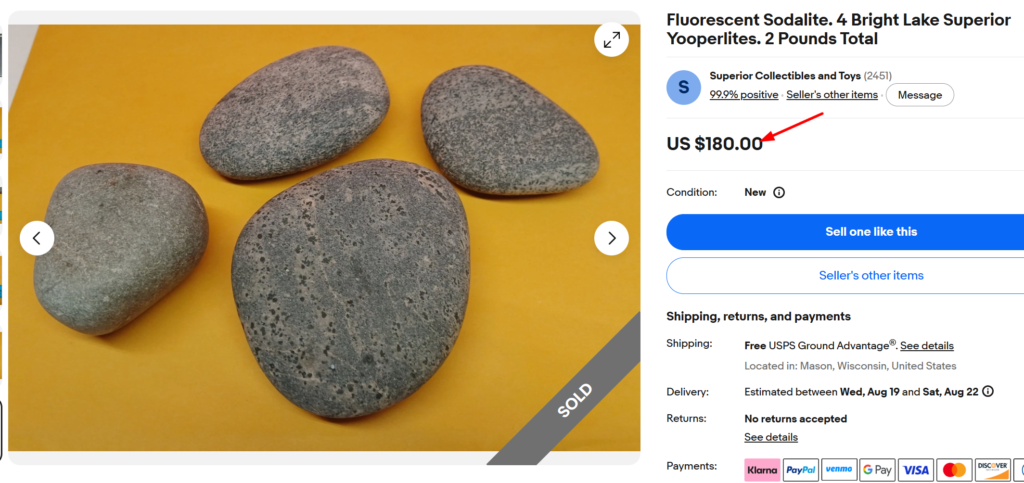
Sold for $180
Erik Rintamaki discovered and named Yooperlites along the shores of Lake Superior in 2017. The discovery was published in Mineral News in 2018.
These are actually syenite rocks rich in fluorescent sodalite. In regular daylight, they look like ordinary gray beach pebbles, but under a shortwave UV flashlight, they glow vivid orange and yellow like fire trapped in stone.
The best hunting is at night along Michigan’s Upper Peninsula. A UV light is a must.
- Estimated Value: $15 to $200+
- Production Years: Discovered and named in 2017
- What to Check: Bright orange glow under 365nm UV light, plain gray in daylight.
4. Chlorastrolite (Isle Royale Greenstone)
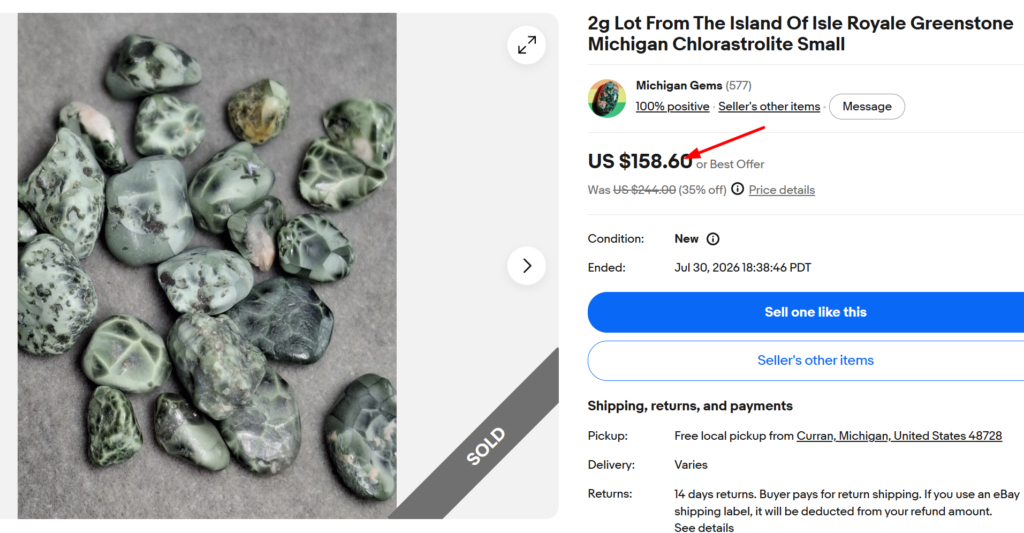
Sold for $158
Chlorastrolite is a pumpellyite variety which became Michigan’s official state gem in 1973. What makes it collectible is the distinctive “turtleback” or “alligator” pattern: tight segmented cells of dark and light green like a mosaic.
Most pieces you find are bean-sized rounded pebbles from Keweenaw Peninsula beaches. Collecting from Isle Royale itself has been prohibited since 2000, which is why old specimens are quite valuable.
ID Note: Collecting is banned inside Isle Royale National Park.
- Estimated Value: $20 to $500+ (bean-sized to cabochon)
- Production Years: Michigan state gem since 1973
- What to Check: Bluish-green “turtleback” segmented pattern
5. Beach Agate (Oregon Coast)
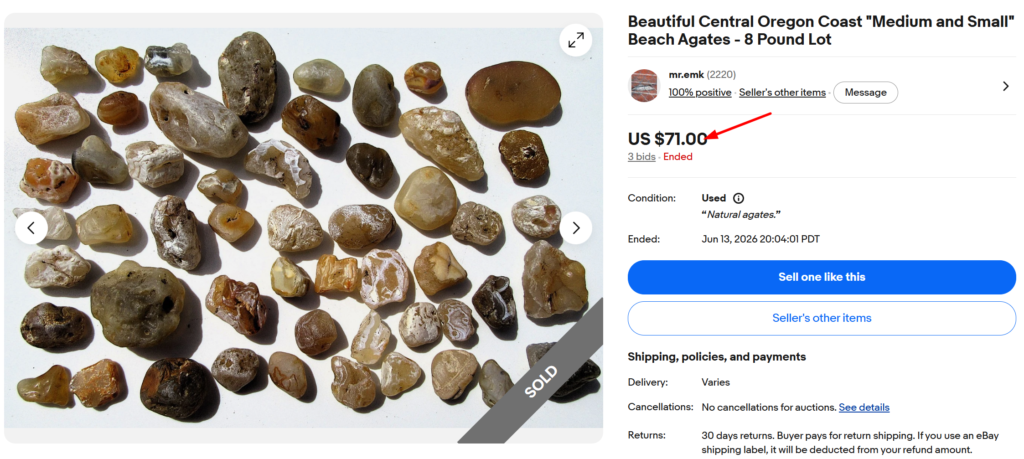
Sold for $70 (lot of 8 pounds)
The Oregon coast is famous for beach agates, especially around Lincoln City, Newport, and Yachats. These are chalcedony nodules eroded out of ancient basalt flows and tumbled smooth by the surf.
Colors run from clear and honey-yellow to blue and carnelian orange; the rare enhydro varieties (with water trapped inside) are most collectible.
Quick Facts: Winter and early spring are prime time because storms strip sand off the gravel beds where agates hide. Also, Oregon limits collecting to one gallon per day and three gallons per year, so it stays sustainable.
- Estimated Value: $10 to $200+
- Production Years: Naturally formed, ancient volcanic origin
- What to Check: Translucent, glows at edges when backlit
6. Leland Blue Stone
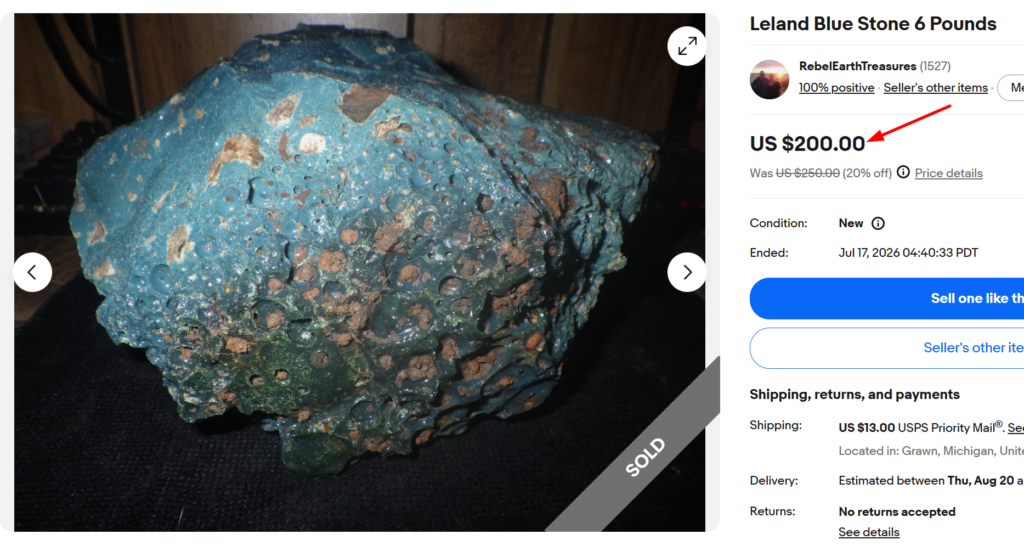
Sold for $200 (6 pounds)
Leland Blue isn’t technically a natural stone. It’s slag glass, a byproduct of iron smelting at the Leland Lake Superior Iron Company that operated from 1870 to 1885.
When the company went bankrupt, they dumped their slag piles into Lake Michigan, and the waves have been washing pieces back onto the beach ever since.
The stone is soft and often pitted with air bubbles from the smelting heat, so intact larger pieces are surprisingly hard to find.
Quick Facts: Only about 2 percent of that slag has the classic blue color collectors want.
- Estimated Value: $10 to $100+
- Production Years: ~1870 to 1885 (iron smelting era)
- What to Check: Vivid blue, glassy, small air-bubble pits
7. Pudding Stone (Jasper Conglomerate)
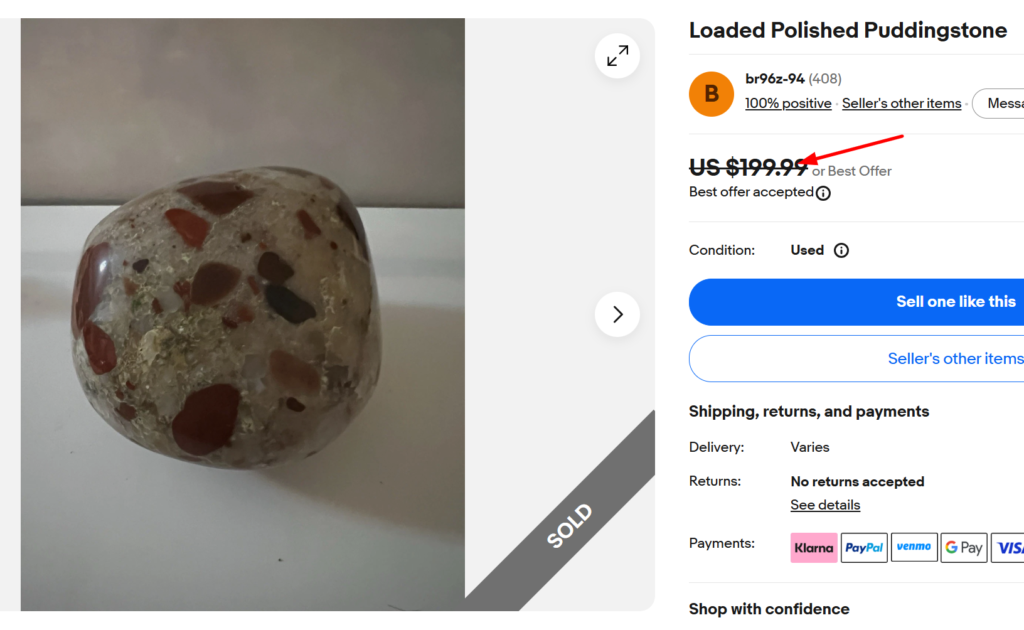
Sold for $200
“Pudding Stones” are conglomerates named by early Europeans because of their resemblance to raisin plum pudding. The key feature is a reddish jasper rounded gravel that has been cemented within a creamy white quartzite base.
The rocks were created in Canada roughly 2.3 billion years ago and moved to Michigan on the Laurentide glacier around 24,000 years ago.
You must look for them along Lake Huron beaches, especially near Drummond Island and St. Joseph Island in Ontario. The bigger and more colorful the clasts, the better.
- Estimated Value: $5 to $75+
- Production Years: ~2.3 billion years old, glacier-transported
- What to Check: Red jasper pebbles in white quartzite matrix
8. Baltic Amber
It’s not really “stone” at all. Baltic amber is fossilized pine resin that washes up on the beaches of Poland, Lithuania, Latvia, and along Denmark and southern Sweden. Amber with insect or plant inclusions can be worth many times more than clear pieces.
ID Note: Genuine amber is soft (2–2.5 Mohs), floats in salt water (add approximately two tablespoons of salt to a glass of water), is warm to the touch, and has a distinctive pine smell if touched by a hot needle. The plastics and copals are going to sink or smell like burnt plastic.
- Estimated Value: $15 to $500+ per piece (higher with insect inclusions)
- Production Years: Fossilized resin, 44 to 60 million years old
- What to Check: Floats in salt water, pine scent when heated
9. California Nephrite Jade (Big Sur)
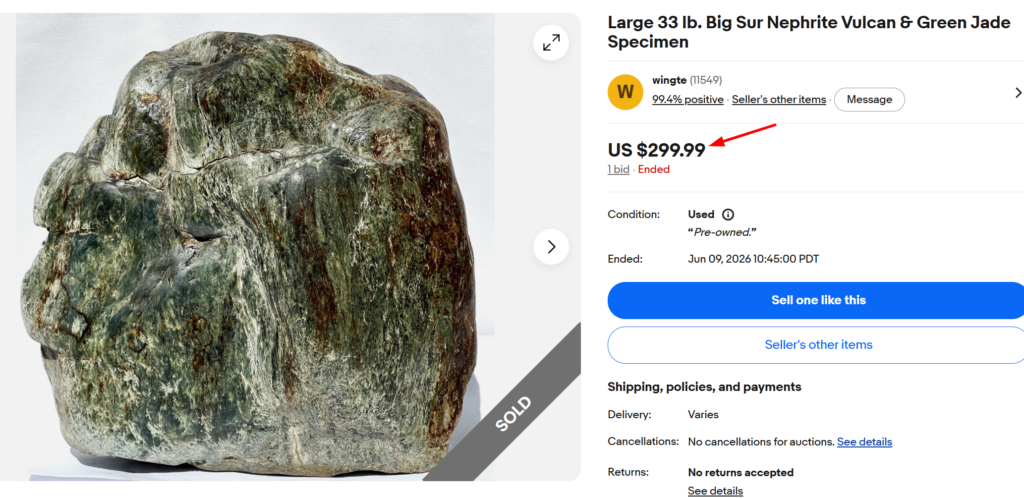
Sold for $300
California nephrite is the only known underwater nephrite deposit in the world. It shows up on the beaches of Big Sur, especially around Jade Cove where Plaskett Creek meets the ocean.
The stones range from creamy olive to deep green and even black (the rare “Boots” jade). They feel noticeably heavier than a similar-sized rock because of nephrite’s high density.
ID Note: Test candidates by trying to scratch them with a steel knife. Real jade won’t scratch (Mohs 6 to 7), but serpentine and similar look-alikes will.
- Estimated Value: $40 to $500+ (recent Big Sur sold listings)
- Production Years: Naturally formed metamorphic rock
- What to Check: Heavy for its size, waxy sheen, deep green
10. Carnelian
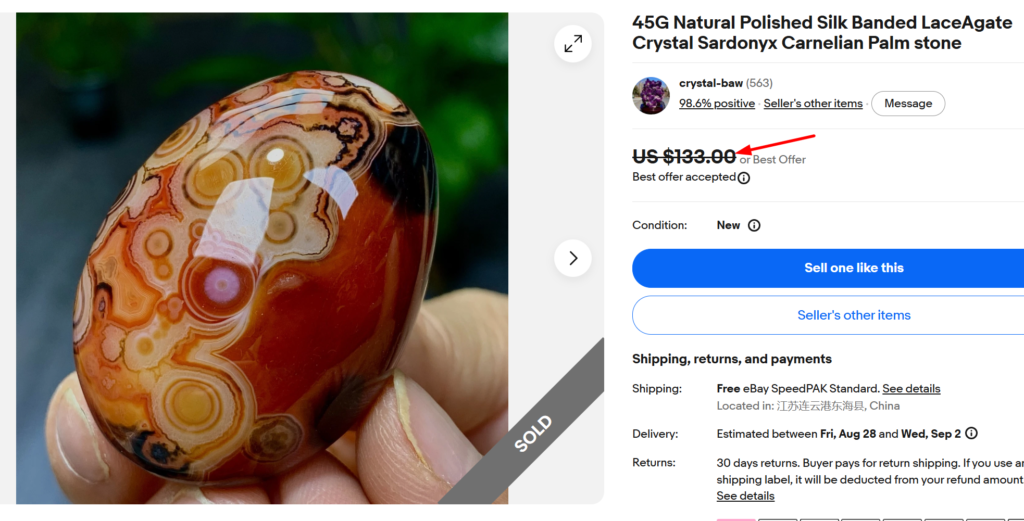
Sold for $135
Carnelian is a red-to-orange translucent chalcedony colored by iron oxide. It’s shown up on beaches used by humans for gemstone tools and beads since ancient times.
In North America, you can find small pieces along the Lake Michigan and Lake Superior shorelines mixed in with the agates.
Watch out for cheap dyed agate sold as carnelian.
ID Note: Hold a suspected carnelian up to strong sunlight; real carnelian glows warm orange at the thin edges. Natural pieces show hazy, uneven color while dyed material looks perfectly uniform.
- Estimated Value: $5 to $80+ per specimen
- Production Years: Naturally formed chalcedony variety
- What to Check: Translucent red-orange, glows warm when backlit
11. Hag Stone (Holey Stone / Adder Stone)
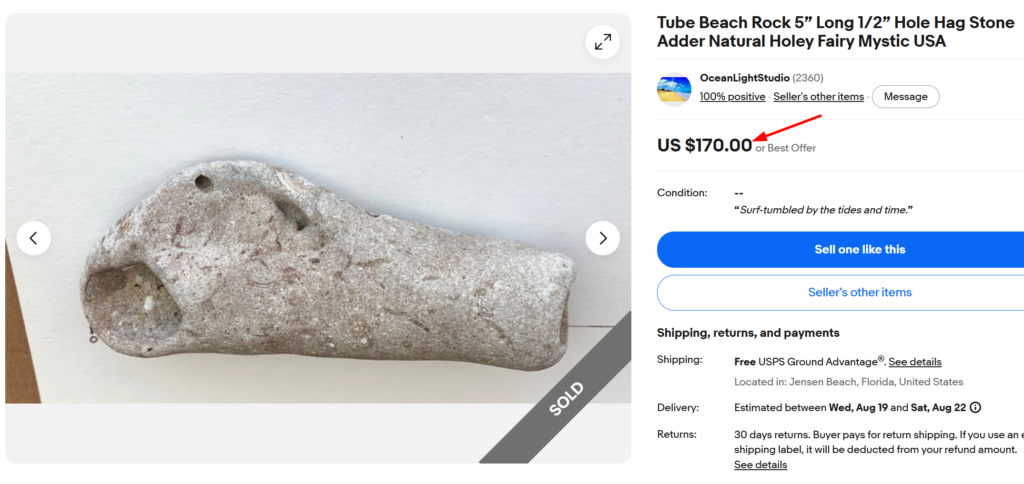
Sold for $170
Hag stones, also called adder stones, witch stones, or Odin stones, are simply pebbles with a naturally formed hole worn all the way through by water action or by piddock clams boring through soft rock.
They’re mostly flint on UK and East Coast beaches. The stone itself is nothing special mineralogically, but they’ve carried protective folklore for centuries and now sell steadily to jewelry makers, craft buyers, and folk-magic collectors.
Fakes with drilled holes are common, so look for a naturally smoothed, off-center opening rather than a perfectly round drilled bore.
- Estimated Value: $10 to $60+ (folklore and craft market)
- Production Years: Naturally water-eroded, no set age
- What to Check: Natural hole all the way through
What Makes a Beach Stone Valuable?
You’ve got the twelve stones down. Now here’s what actually drives the price when one of these hits eBay or a rock show.
You’ll find that most beach stone finds sell in the $10 to $50 range. The four-figure sales are only the top 1 percent, which goes for exceptional size, museum-grade pattern, or a documented rare-locale piece.
Here are the key factors that play a role in valuing beach stones and rocks:
- Rarity of type comes first – A Yooperlite from Lake Superior will always outsell a common agate of similar size because collectors know how localized the source is. Same logic for chlorastrolite and Petoskeys.
- Size matters, but not linearly – A one-pound Lake Superior agate isn’t worth ten times a one-ounce piece. It’s worth much more, because large clean specimens are geometrically rarer. That’s why “pounders” are legendary in the rockhounding world.
- Color intensity and pattern quality – A Petoskey with a clean, complete hexagonal pattern beats a partial one every time. A fortification agate with strong red-and-white contrast doubles the price of a washed-out gray one. On Leland Blue, deep vivid blue outsells muddy blue-green three to one.
- Condition kills or makes a sale – Chips, cracks, and heavy pitting all knock value down hard. Natural water-tumbled surfaces beat rough or hammer-broken faces.
- Provenance adds a premium – A jade pebble documented as picked up at Jade Cove in Big Sur, or an agate confirmed from Lincoln City, will always outsell an unlabeled stone. Collectors pay for the story as much as for the mineral.
Lastly, always check the recent sold listings on platforms like eBay. Search for the examples based on the appearance, color, and pattern of your stones to see what similar pieces are selling for. This will help you find an actual reasonable price point.
Next time you’re walking a shoreline, slow down and check the unusual pebbles against this list. One well-identified stone can pay for the trip, and even if it doesn’t, you’ll know exactly what it is instead of tossing a small fortune back into the surf.