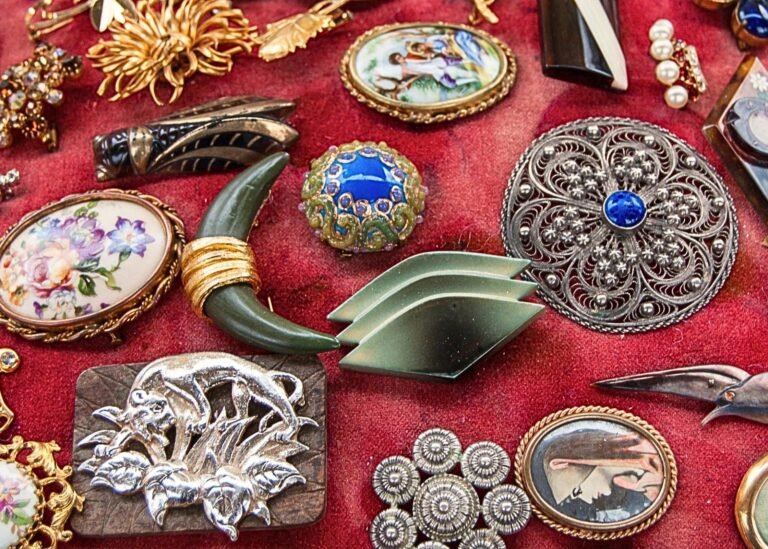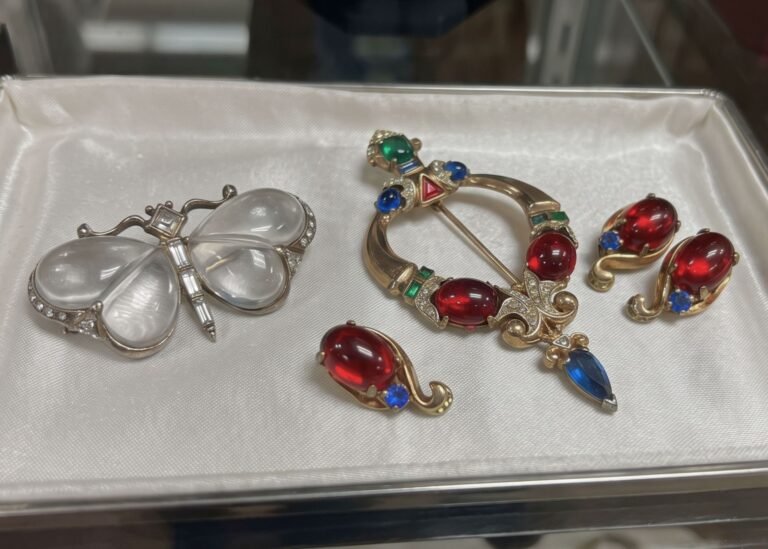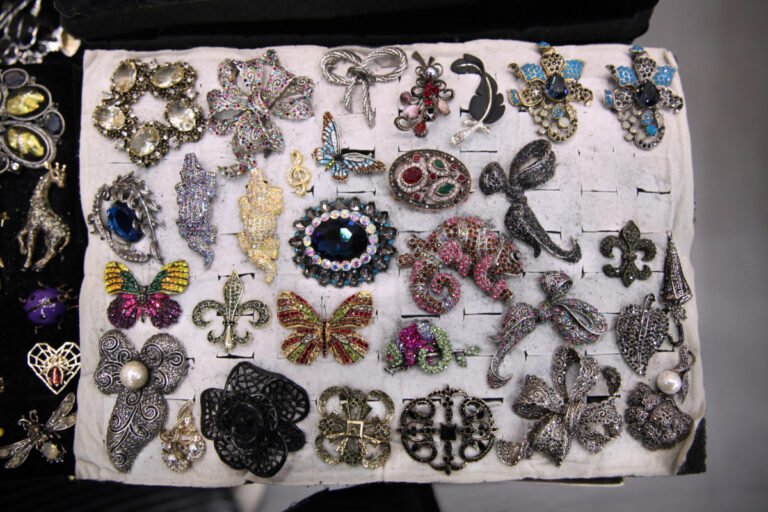

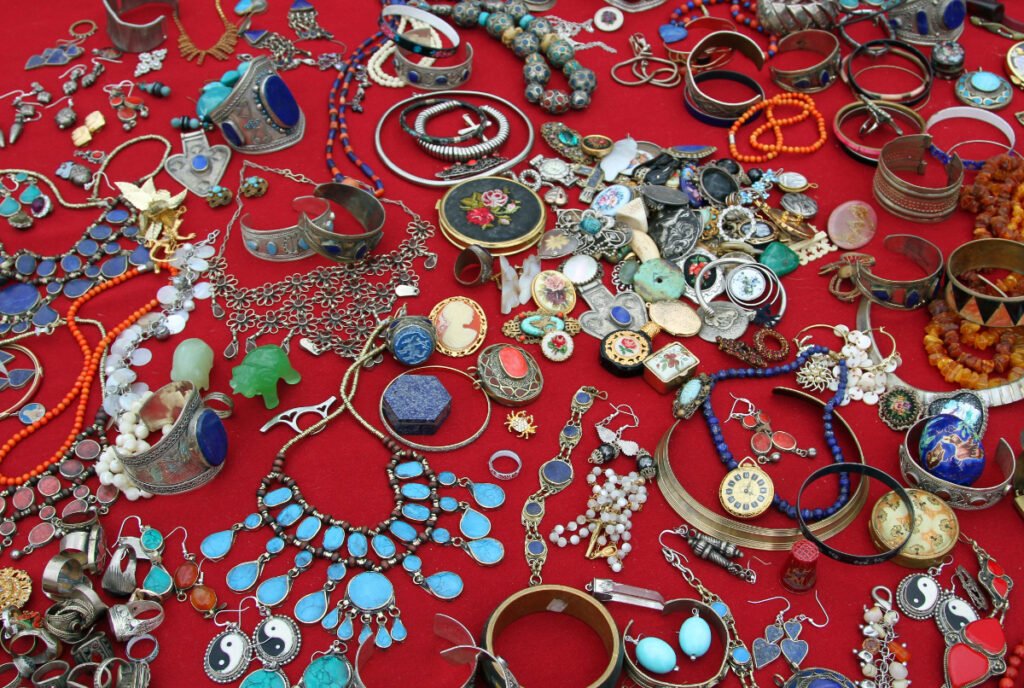
Vintage costume jewelry became popular in the 1920s because of Coco Chanel, who introduced wearing “phony” pieces together with authentic ones. It broke the tradition that jewelry was supposed to be valuable to be desirable.
Many fashion houses followed the trend, and the quality increased. In the 1930s and 40s, high-quality vintage costume jewelry was hand-set, backed with sterling silver, and came with signatures such as Trifari, Eisenberg, and Schiaparelli.
Most of them were manufactured for a limited time period since tastes changed rapidly. This is exactly why they have value in the modern day. Let’s take a look at valuable costume jewelry styles, pieces, and makers, and how to identify real gems.
The Most Collectible Vintage Costume Jewelry Designers
There are only a few designers who make up the majority of the market when it comes to vintage costume jewelry. They are the designers whom collectors seek out by name and whose signed pieces fetch a hefty price.
Here are the most notable designers to know before you buy or sell your costume pieces.
Trifari (1918–present, peak era 1930–1968)
Collectors’ favorites of Trifari were all designed during Alfred Philippe’s tenure as the chief designer for Trifari (1930 to 1968). The designs include Crown brooches (patent applied for 1944), Jelly Belly figurals with clear Lucite bellies, and the Tutti Frutti / Fruit Salad pieces that imitate Cartier stones.
The trademark changes through each period: KTF (1925-mid 30s), Trifari Pat. Pend. (1930s), crown-over-T (1937-1955), crown plus copyright (1955-1969), and crownless with copyright (1970s-80s).
Miriam Haskell (1926–present, peak era 1926–1960)
Haskell’s signature look is layered hand-wired beadwork, baroque faux pearls, Russian gold-plated filigree backing, and asymmetrical floral forms. Chief designer Frank Hess (1926-1960) is credited with most of the iconic designs.
The pieces were generally unsigned until 1947. A horseshoe-shaped plaque was used for a brief period in 1948, after which an oval cartouche marked “Miriam Haskell” came into use from 1950 onwards.
Eisenberg (1914 dress co., jewelry from 1930s–present)
Eisenberg is known for big, bold rhinestone work. The Eisenberg Ice line, with its diamond-bright, clear stones, became iconic in the 1940s. Sterling pieces from 1943-1944 with chunky pavé construction are the most prized by collectors.
Marks went from script E or “Eisenberg Original” (1935-1948) to all-caps “EISENBERG” (1945-1958), with a copyright symbol added after 1955. The “Eisenberg Ice” mark in an oval cartouche appears on both 1940s pieces and the 1970s revival.
Coro (1901–1979)
Coro’s most collectible pieces came out of designer Adolph Katz’s team in the 1930s and 40s. Coro Duette, the patented two-clip brooch; the Coro Craft sterling line; and the items marked Pegasus from 1945 to 1955 are what you need to remember.
More expensive pieces were made under the brand names Corocraft (1937), Francois (1944-1960), or Vendome (1944-1979).
Weiss (1942–1971)
Weiss is best known for rhinestone Christmas tree pins (Albert Weiss popularized the category), smoky “black diamond” rhinestone pieces, and elaborate floral and butterfly figurals. The brand used high-grade Austrian and Swarovski stones.
Signatures included WEISSCO, ALBERT WEISS NY, WEISS NY, and most commonly the “Weiss” or “Weiss ©” oval cartouche dating to 1951. A lot of Weiss pieces were sold without signatures and only had paper labels, so a piece with its signature intact increases in value.
Vintage Costume Jewelry Designs by Era
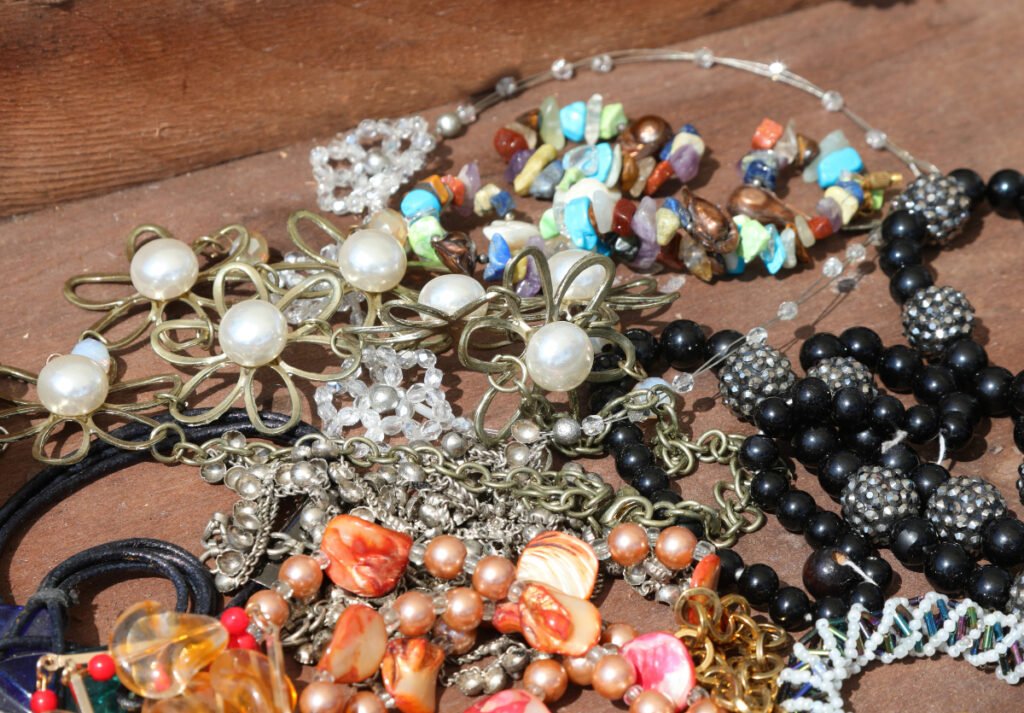
Each era of costume jewelry has its own dominant materials, styles, and designers. Knowing what an era “looks like” lets you date pieces at a glance, even before you flip them over to check the mark.
Here are the main periods and their key features:
- Victorian (1837–1901) – Jet, mourning jewelry, and paste stones dominate. Heavy filigree, hairwork lockets, cameos, and seed-pearl set pieces. Construction is hand-done with C-clasps and elongated pins.
- Edwardian / Belle Époque (1901–1915) – Light and lacy looking with platinum look-alikes in silver tone with paste diamonds and pearls. Bow and tassel motifs. It pre-dates most named American costume makers.
- Art Deco (1920s–1930s) – Use of geometric shapes, chrome, marcasite, and bold blocks of colors. Introduction of Bakelite bangles, paste set clip brooches, and first Coro Duettes. It is during this period that Chanel.
- Retro / WWII (1940s) – Sterling silver replaces pot metal due to rationing. Big bows, oversized florals, and “Hollywood” pieces dominate. Trifari sterling Jelly Bellies, Eisenberg sterling fur clips, and Bakelite patriotic pins are this era’s stars.
- Mid-Century (1950s) – Full rhinestone parures, aurora borealis crystals (introduced 1956), and matched sets. Weiss, Eisenberg Ice, Hollycraft, and West Germany pieces all peak. Pastel colors, baby bird pins, and big confetti Lucite.
- Mod / Space Age (1960s) – Enamel pop colors, oversized statement pieces, geometric Lucite, and bold plastic. Juliana (D&E) is at its height. Crown Trifari moves into brushed gold-tones with pearls.
- Bohemian / Disco (1970s) – Everything gold, ethnic designs, massive chains, and tassels. Trifari features collections from designers Diane Love and Kunio Matsumoto. Licensing for Schiaparelli slows down.
- Power / Maximalist (1980s) – Large shoulder pad brooches, huge fake pearls, Chanel CC jewelry, and bold chains. The work of Karl Lagerfeld at Chanel has made Gripoix glass popular again.
12 Rare & Valuable Vintage Costume Jewelry Finds
The following is a list of some of the most valuable old costume jewelry pieces and styles. Each piece tells about the style, the maker, and what makes one example worth $100 versus another worth $2,000.
1. Trifari Jelly Belly brooch
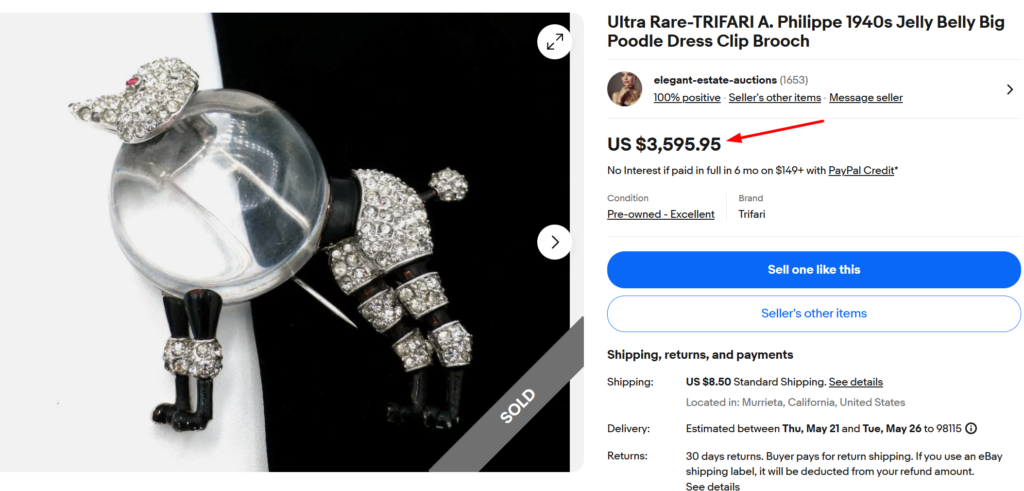
Sold for $3,600
The Jelly Belly is the holy grail of mid-century costume jewelry. Alfred Philippe designed these for Trifari starting in 1943, using a clear Lucite “belly” surrounded by sterling silver and rhinestones.
The figural shapes (poodles, fish, birds, spiders) drive prices into four figures. Always look for the patent number, the “STERLING” stamp, and the Crown Trifari mark on the back to confirm authenticity.
- Estimated Value: $1,500–$3,500
- Production Year: 1942–1944 (sterling era, peak Alfred Philippe)
- Line: Crown Trifari Sterling, Alfred Philippe
- Characteristics: Large Lucite belly, sterling silver pavé body, enameled details, dress clip or pin back
- Quick Notes: Confirm the “STERLING” mark on the back.
2. Schiaparelli Surrealist Pierced Lip Brooch
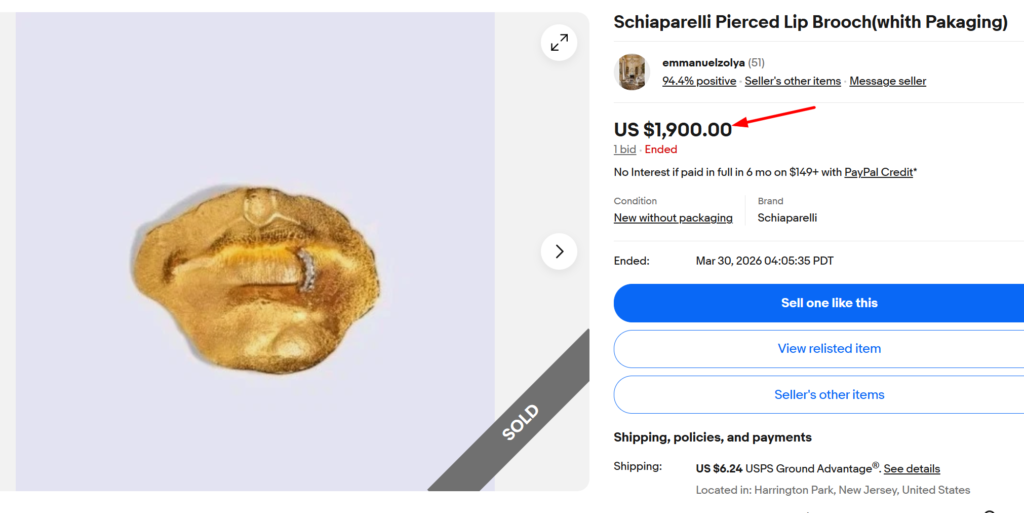
Sold for $1,900
The surrealist pieces (eye brooches, lobster pins, lip brooches, telephone earrings) are what made Schiaparelli’s name in jewelry. Most iconic designs trace back to the 1930s collaboration with Salvador Dali and Jean Cocteau.
The pierced lip brooch is one of the more famous motifs, inspired by Dali’s “Mae West Lips” sofa. Most pieces on the market are from the licensed era after 1949, made by Ralph DeRosa’s company.
- Estimated Value: $200–$1,200 (1950s-60s licensed); verified 1930s surrealist pieces $2,000+
- Production Year: 1930s (original Schiaparelli) and 1949–1973 (licensed)
- Characteristics: Surrealist motifs, watermelon stones, unusual color pairings, lip/eye/lobster shapes
- Quick Notes: Misspelled “Schiaparelli” is often an authentic early 1970s licensed piece.
3. Chanel Vintage Gripoix Chain
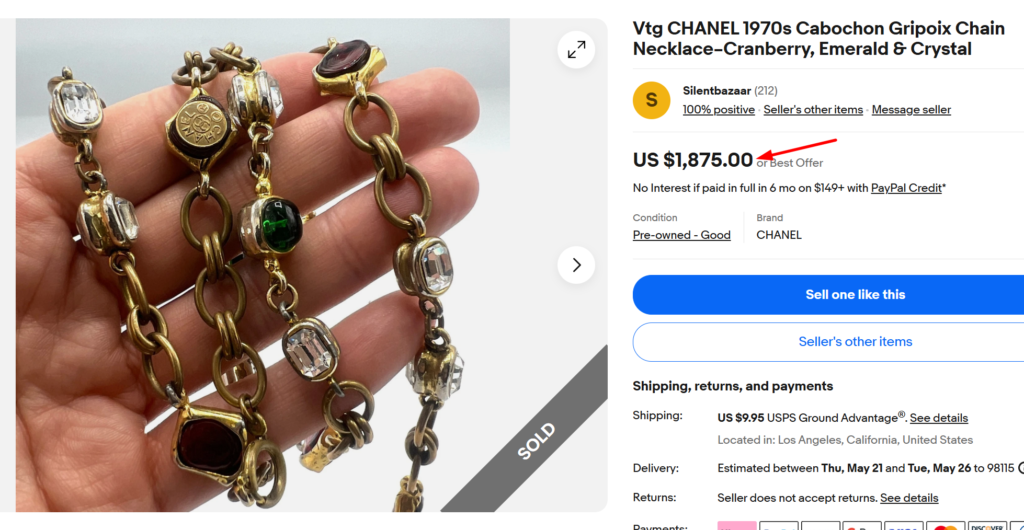
Sold for $1,875
Gripoix is cast glass, handmade by Maison Gripoix in Paris for Chanel since the 1920s. Each cabochon is cast by hand into the metal frame, making each piece slightly irregular in shape.
The chain necklaces from the 1970s have Gripoix cabochons (cranberry, emerald, crystal) that alternate with gold-tone frames, sometimes with an extra link of a CC-stamped plaque. The Chanel logo on the plaque is your guarantee.
- Estimated Value: $1,200–$3,500 (1970s-80s chain necklaces); $5,000+ (verified pre-1960)
- Production Year: 1920s–present (Maison Gripoix); 1970s for chain styles
- Line: Chanel, Maison Gripoix
- Characteristics: Hand-poured glass cabochons, irregular shape, ruby/emerald palette, CC-stamped plaque
- Quick Notes: American makers only used molded glass; pieces sold as “American Gripoix” are misattributed.
4. MB Boucher Sweet Pea Floral Enamel Brooch
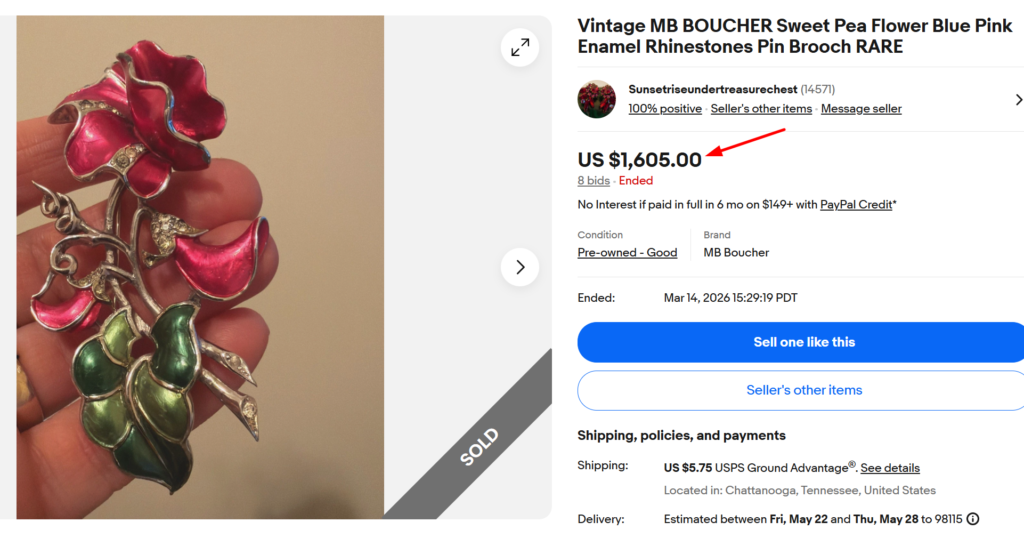
Sold for over $1,600
Before Marcel Boucher created his own jewelry firm in New York in 1937, he was trained by Cartier in Paris. The enamel figural brooches from the 1940s that Boucher designed are among the best examples of costume jewelry ever made.
The sweet pea, orchid, and fruit designs from the late 1930s and 40s are the most desirable. You can spot them by colorful enamelwork along with rhinestones.
Pay attention to the marks to date these pieces: “MB Sterling” mark was used for 1942-1944, the Phrygian cap mark for 1944-1949, and “Boucher” with a four-digit design number after 1955.
- Estimated Value: $500–$2,000 (1940s figural brooches)
- Production Year: 1937–1971 (Boucher company era)
- Line: Marcel Boucher Ltd., Marcel Boucher et Cie, Marboux
- Characteristics: Hand-enameled details, sculptural three-dimensional construction, rhodium plating
- Quick Notes: Enamel loss kills value drastically.
5. Hobé Glass Stones Brooch
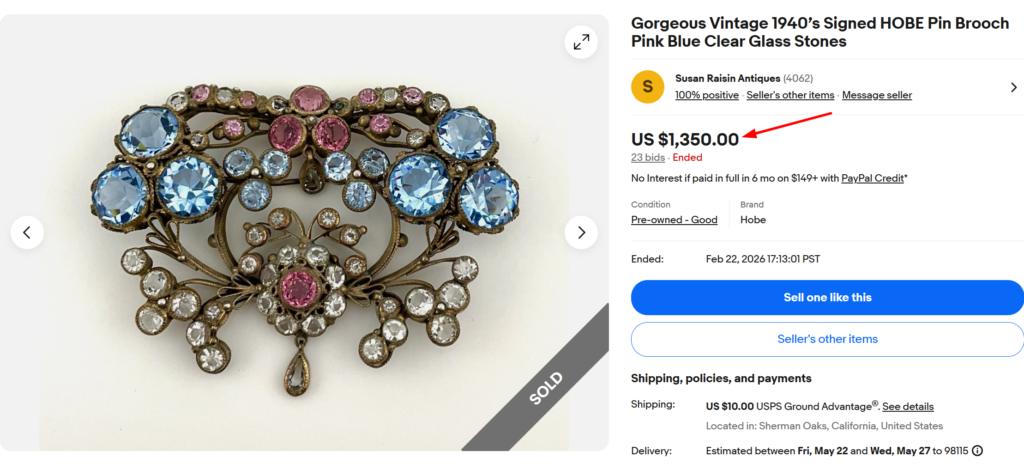
Sold for $1,350
The history of Hobé jewelry begins with a workshop opened in Paris in 1887. The American company began its activity in 1927. The 1940s creations are sought after by collectors: large floral or scroll brooches made of gilt brass filigree with huge colored glass stones from Czechoslovakia.
Pay attention to the signature “Hobé,” which is placed either in a triangular frame (1933-1957) or an oval one (1958-1983). The large pastel glass stones in pink and blue were a Hobé signature.
- Estimated Value: $400–$1,500 (glass stone, good condition)
- Production Year: 1935–1955 (peak collectible era)
- Line: Hobé, signed in oval, triangle, or under crossed swords (pre-1900)
- Characteristics: Oversized colored glass stones, gilt brass filigree, hand-set construction
- Quick Notes: Hobé’s 1930s & 40s sterling pieces are valuable.
6. Coro Duette Double-clip Brooch
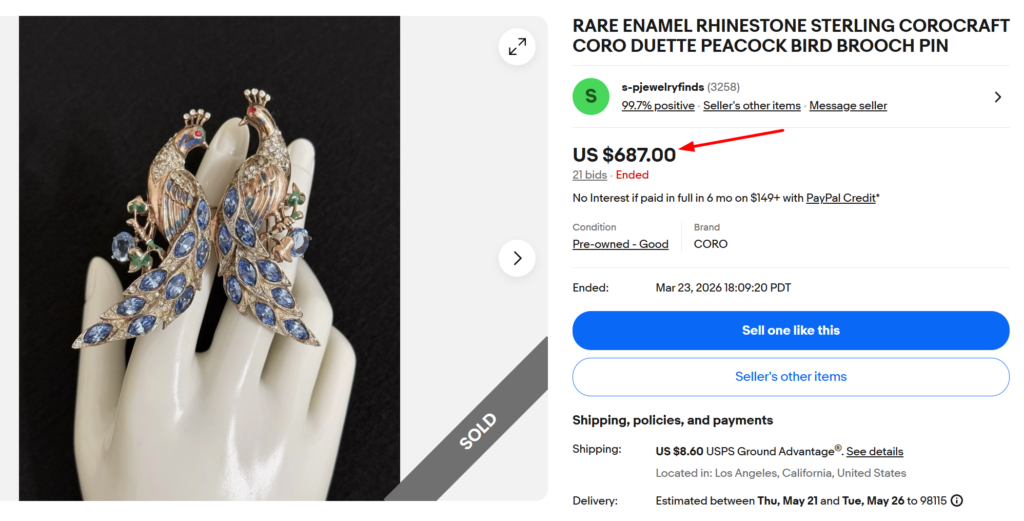
Sold for almost $690
The Coro Duette is one of the cleverest pieces in vintage costume jewelry. Patented by Coro in 1931, the frame holds two dress clips that can be worn together as a brooch or separated and worn on lapels or scarves.
In this category, figural designs, like peacocks and lovebirds Duettes, are considered to be the most sought-after, especially those made of sterling vermeil in the 1940s with enamel and rhinestones.
- Estimated Value: $150–$600; $600–$1,500+ (sterling vermeil figural designs)
- Production Year: 1931–1950s (Duette patent era)
- Line: Coro Duette, Corocraft Sterling Duette
- Characteristics: Two matching dress clips set into a single frame; sterling vermeil construction; enamel and rhinestone figural designs
- Quick Notes: Check the Corocraft, Sterling, and Pat number markings.
7. Miriam Haskell Crinkle Coiled Earrings & Pin
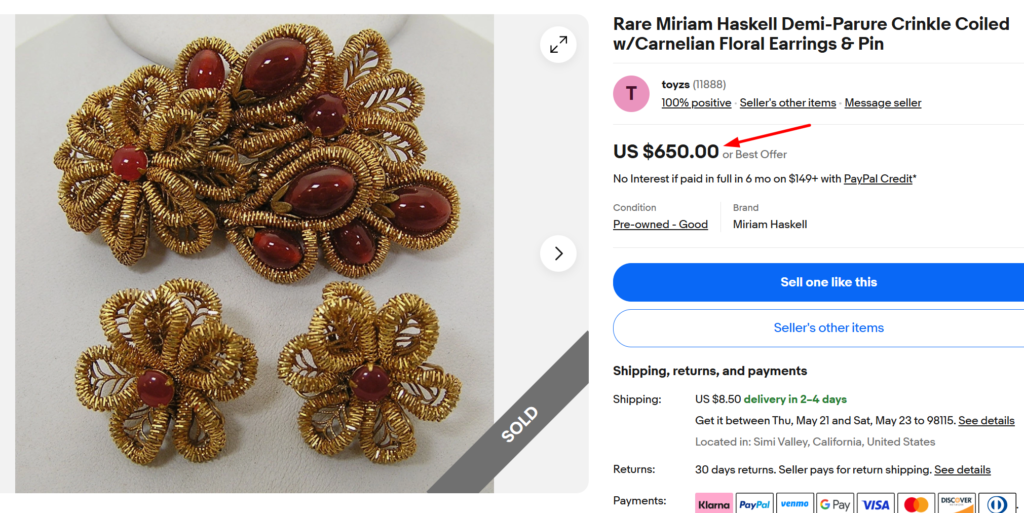
Sold for $650
The crinkled coiled wire designs are some of the most distinctive pieces in the Haskell line. You can spot these by hand-coiled gilt brass wire that forms petals and leaves, with carnelian glass cabochons set in the centers.
Look for the oval Miriam Haskell signature plaque on both pieces in a demi-parure. Matching sets sell at a strong premium over singles since the wirework on each piece had to be hand-coiled to match.
- Estimated Value: $400–$900 (full demi-parure); $200–$400 (single brooch)
- Production Year: 1950s–1960s
- Line: Miriam Haskell, oval cartouche signed
- Characteristics: Coiled gilt wire petals, carnelian glass cabochons, hand-built construction
- Quick Notes: Wire coils can flatten with wear, which reduces value.
8. Ciner Gold Tone Double-Headed Snake Bracelet
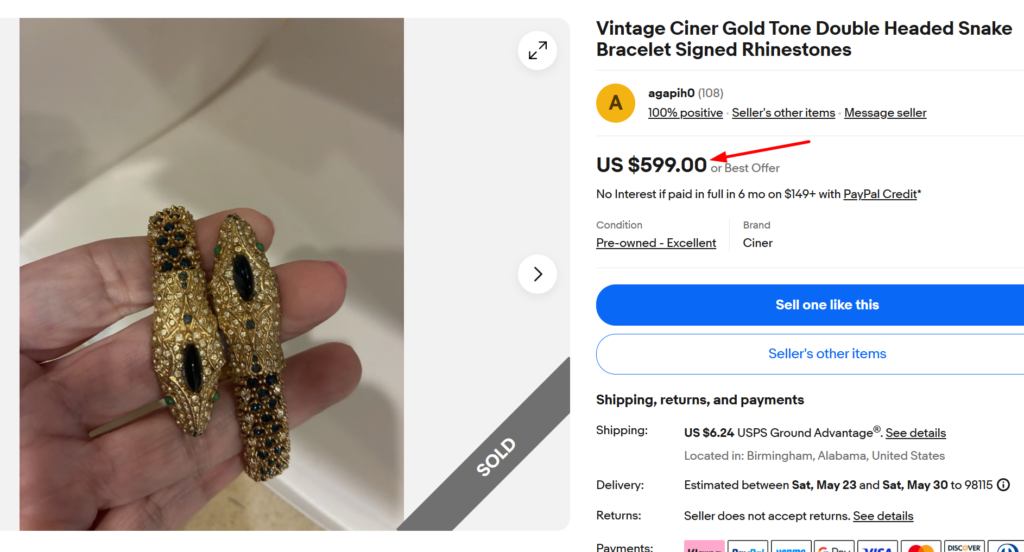
Sold for $600
Ciner is one of the oldest companies making costume jewelry; it was started as a producer of fine jewelry in 1892, but switched over to producing high-quality costume jewelry in the Depression years.
The snake and animal bracelets by Ciner are among the most unique items in their collection. This double-headed snake bracelet features cabochon eyes and pavé crystals along the body as scales.
Most pieces made by Ciner will have the “CINER” signature stamp. If not, it might need more inspection.
- Estimated Value: $400–$900 (snake and animal pieces)
- Production Year: 1960s–1980s
- Line: Ciner, signed in block letters
- Characteristics: Heavy gold-tone plating, pavé rhinestone scales, cabochon eyes, hand-formed bangle
- Quick Notes: Most Ciner pieces are signed.
9. Eisenberg Ice Large Brooch
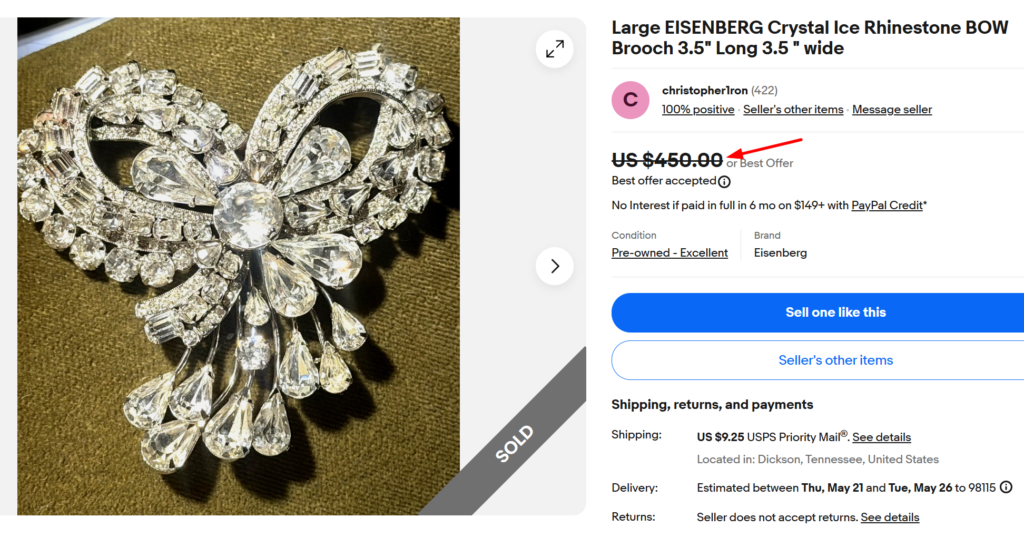
Sold for $450
Eisenberg Ice defined diamante costume jewelry. The key features are big floral sprays, dramatic bow shapes, and dense pavé clusters of clear rhinestones that look almost like real diamonds at a glance.
The most valuable are the larger pieces, 3 inches and up, with all original stones intact. Bow brooches with dangling teardrop rhinestones are particularly sought after.
Marking also determines value, so look for “EISENBERG” in an oval cartouche.
- Estimated Value: $200–$700 (large signed bow or floral examples $400+)
- Production Year: Late 1940s–1958, then 1970s revival
- Line: Eisenberg Ice, Eisenberg
- Characteristics: Dense, clear rhinestone pavé, oversized scale, baguette, and dentelle stones, dangling teardrops
- Quick Notes: Yellowed stones can drop value 50% or more.
10. Miriam Haskell Multi-strand Necklace
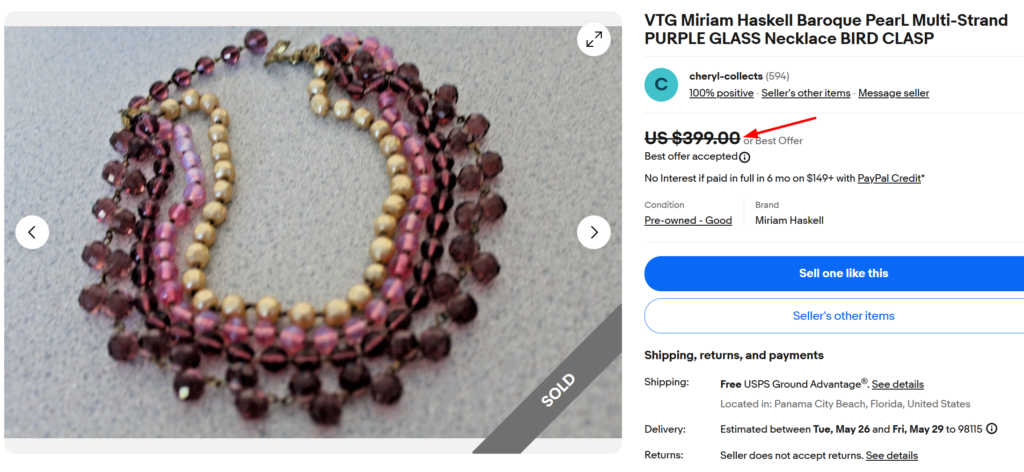
Sold for $400
Multi-strand necklaces from Haskell consist of wire-strung strands of faux baroque pearls and beads arranged in three to five layers. The majority of these items include an ornate clasp that bears the oval stamp of Miriam Haskell.
The most interesting examples are those that combine faux pearls with colored Czech beads (purple, amethyst, jet). In addition, these items have ornate clasps in the form of figures, such as the bird clasp.
- Estimated Value: $250–$800
- Production Year: 1950s–1960s (most signed pieces)
- Characteristics: Hand-wired strands, Czech glass beads, figural or filigree clasp
- Quick Notes: Finish loss in pearls drops value significantly.
11. Juliana (D&E) Five-link Bracelet
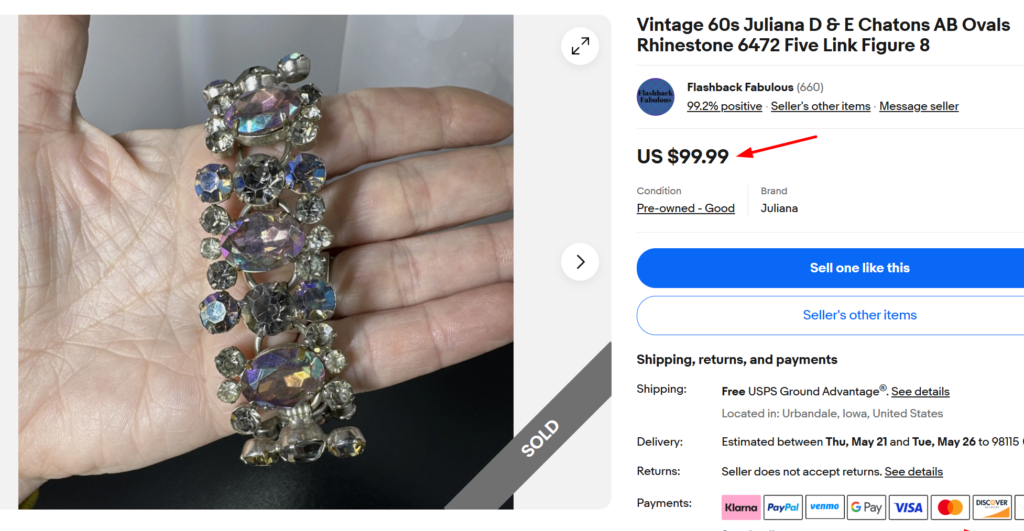
Sold for $100
Juliana (really DeLizza & Elster) is one of the most collected “unsigned pieces” in costume jewelry. The five-link and band bracelet is actually the entry point, being affordable.
These pieces are known for featuring chunky aurora borealis chatons paired with large oval centerpiece stones, prong-set in silver-tone metal.
The back is the key; it shows classic five-link and band construction with figure-eight puddling in the solder. While common forms are affordable, rare watermelon, Easter egg, or rivoli stones can fetch higher prices.
- Estimated Value: $80–$250 (AB chatons); $300–$800 (rare stones)
- Production Year: 1960s (1967 for actual “Juliana” tagged pieces)
- Line: DeLizza & Elster (Juliana, Gloria, or Tara hang tags)
- Characteristics: Five-link and band bracelet, prong-set ovals and chatons, AB rhinestones
- Quick Notes: Authentic D&E uses prong-set main stones, not all glued.
12. Weiss Rhinestone Christmas Tree Pin
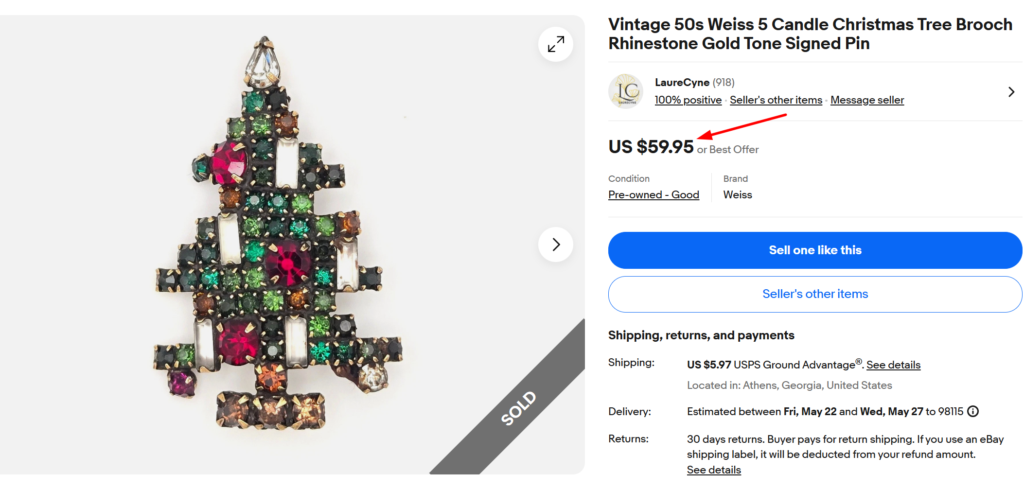
Sold for $60
Albert Weiss made the rhinestone Christmas tree pin a category of its own, and his are the ones collectors actively hunt. The five candles design is the traditional one with green, red, and amber rhinestones and clear “baguette candles”.
The six-candle variety is rarer and more valuable than the five-candle ones. Make sure to check the Weiss oval cartouche with the copyright sign at the back. Many Weiss Christmas trees were originally sold with paper tags, which can add value if found intact.
- Estimated Value: $40–$150 (5-candle signed); $250–$450 (rare 6-candle)
- Production Year: 1950s (the 1951 dated mark is most documented)
- Line: Weiss with copyright on oval cartouche
- Characteristics: Multicolor rhinestone tree, clear baguette candles, gold-tone or japanned setting
- Quick Notes: Markings and labels/tags boost value.
How to Identify Vintage Costume Jewelry (Step-by-Step)
Identifying vintage costume jewelry comes down to a few steps, starting from spotting the mark to verifying the pieces with documented examples. The pieces that are misidentified are usually unmarked.
The following process will help you spot genuine vintage costume jewelry easily.
1. Find and read the Maker’s Mark
Makers change their marks over time, and that is how marks are used to date jewelry.
For example, a Trifari mark “KTF” with an enlarged T will date your piece between 1925 and the mid-1930s. A crown added to this mark makes it 1937-1955, while a copyright symbol added to this gives you 1955-1969.
This kind of marking timeline exists for nearly every major maker. Knowing the key marks from the maker of your piece is the best way to date and identify it.
2. Check the Hardware and Findings
In case you can’t spot any marks, switch to other features, like the hardware. The clasp, the pin stem, the earring back. These small pieces change in predictable ways for decades, making them a very dependable means of dating.
For instance, prior to the 1890s, brooches had an elongated C-clasp, which extended beyond the brooch itself. Around 1900, the safety catch with a rotating wheel showed up. By the 1940s and 50s, the modern roll-over safety clasp became standard.
Likewise, screw-back earrings were popular from about 1900 until the late 1950s. Then, during the 1930s, clip-back earrings replaced screw-back earrings, and both coexisted for several decades thereafter.
Pierced earrings weren’t popular until the late 1960s. So, if a “1940s” piece has modern posts, it’s probably not 1940s at all.
3. Check the Materials and Construction
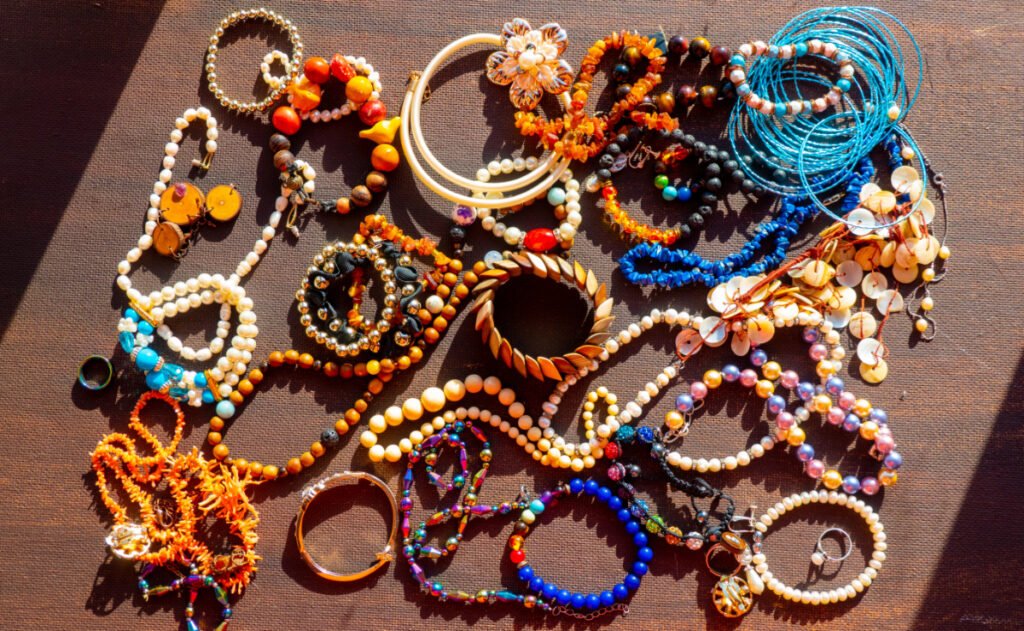
Materials get rationed, replaced, and reintroduced based on what’s happening in the world. Wartime shortages in 1942 made most American costume jewelry manufacturers switch from pot metal to sterling silver, sometimes with a vermeil (or gold-washed) finish.
The true bakelite was produced between 1907 and 1927 in various dark tones such as black, dark brown, and oxblood red. The original material is fragile and dull, rather than shiny and translucent as you’ll see on carved bakelite pieces.
Similarly, the bright butterscotch, apple juice, and cherry red bangles collectors love? Those are Catalin, made from 1928 to the 1940s. Both Bakelite and Catalin pass the same hot-water and Simichrome tests, but Catalin came in the wider color range.
Rhinestones also evolved. Aurora borealis or AB crystals were made by Swarovski and Dior only in 1956. So, any “1940s” piece with AB stones is not genuine at all. Faceted glass cabochons also replaced the foiled pastes that predate World War II.
4. Cross-reference Designer Signatures
After you’ve identified your mark and estimated a date, the final step is comparing it to an authentic designer hallmark. There are plenty of pieces that bear the mark “Trifari” on the back, but they fail to match the correct typeface, cartouche style, or findings for their period.
Check sold auctions on eBay, WorthPoint, and LiveAuctioneers. Search the designer name plus “sold” and compare your piece to the verified examples. Look at multiple angles of the back. The position of the mark, the depth of the stamp, and the surrounding metalwork all matter.
This step is even more important to identify unmarked vintage costume jewelry. Knowing the visual signatures matters as much as reading the actual signature.
The truth about vintage costume jewelry is that most pieces are worth $20-$60, a smaller group is worth $200-$800, and an even smaller minority worth four figures. To know the difference, start with the mark, confirm with the hardware, verify with the materials, and cross-check the designer against real sold examples.