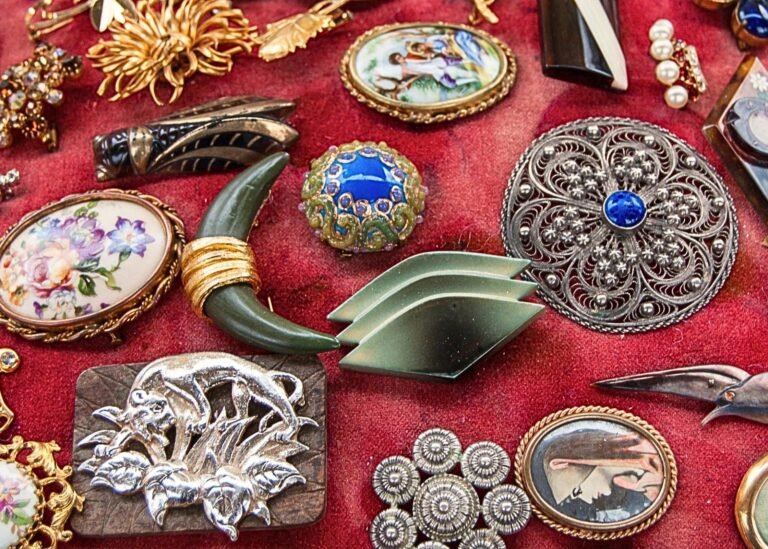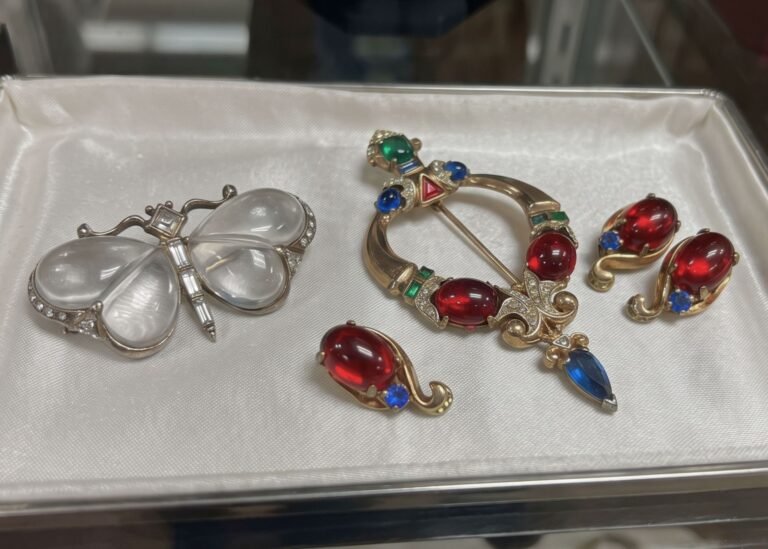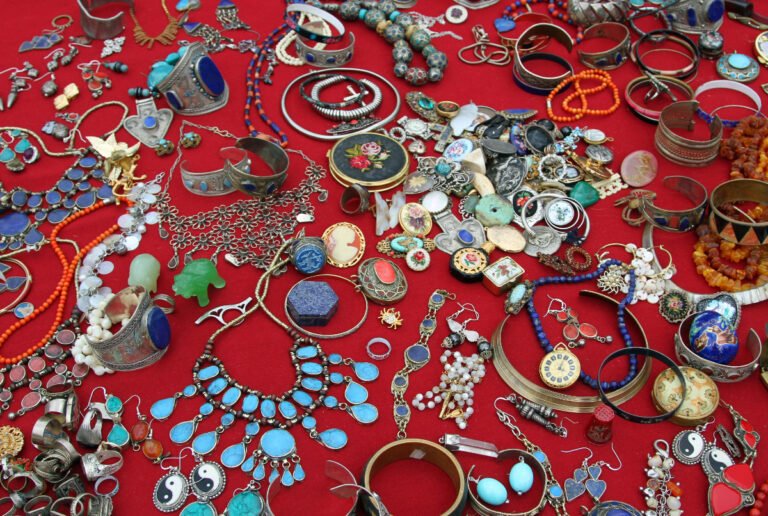

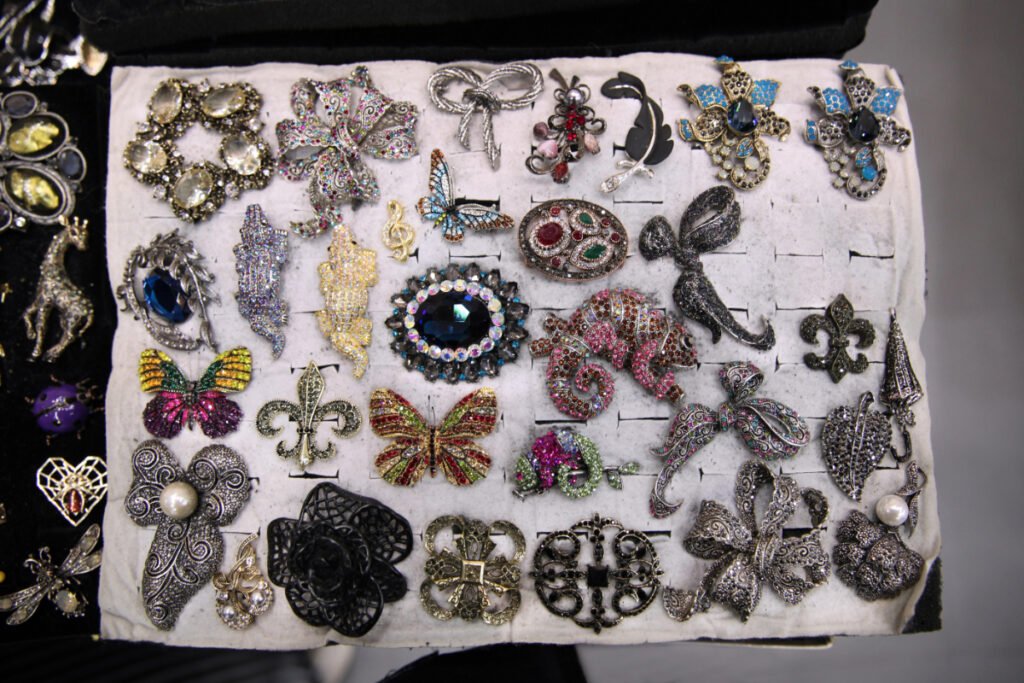
The majority of people who see a vintage brooch branded “Coro” or “Trifari” put it away, thinking it is nothing but some cheap costume jewelry. And that’s a big mistake; some of these costume pieces have been selling for $400 to $2,000 today.
Truthfully, vintage costume jewelry brooches have an odd spot in the market. They’re affordable enough to actually buy, but rare enough that a certain piece can bring a thousand dollars or more.
This guide walks you through what makes costume brooches valuable, how to tell if they’re genuine, and which specific designers and designs are collectible today.
What Makes a Vintage Costume Brooch Valuable? (5 Signs)
Not every old costume jewelry brooch is worth real money. The final value depends on a lot of things, from how well preserved the pieces are to who made them and when. When you know what factors to analyze, you can easily spot a $10 costume brooch from a $1,000 one.
1. Designer Signature (Signed vs Unsigned)
A signature is the single biggest value driver for valuable costume jewelry brooches. A signed Trifari, Eisenberg, or Miriam Haskell piece can sell for ten times more than an identical unsigned version.
Collectors trust the mark because it confirms the maker and era. However, unmarked does not mean that the jewelry is of no value either. Unmarked Miriam Haskell from the twenties and thirties exists as well, as do Czech brooches before World War II, which were not signed either.
For such pieces, construction and hardware are your best clues to identify.
2. Era & Collector Demand
Costume brooches from certain periods tend to fetch more money owing to limited availability or sustained high demand. Victorian-era brooches (1837-1901) are the rarest and most valuable, provided they’re in good condition.
The geometric designs of Art Deco (1920s-1930s) attract collectors worldwide. Figural brooches of the mid-century period (1940s – 1960s) are also hot commodities due to the interest in similar motifs such as Jelly Bellies, Christmas trees, and insect pins.
Brooches from the retro period (1940s) with sterling silver bases are also popular and decently valued today.
3. Premium Materials
Material directly impacts what a costume brooch sells for. Sterling silver pieces (especially Trifari and Eisenberg from 1942–1948) always top the value chart because base metals were rationed during WWII.
Carved Bakelite figurals also command premiums over plain ones. Quality stones drive separation, too. The Swarovski crystals outprice those molded plastic rhinestones.
Foil-backed glass beads, hand-cut Czech glass, and imitation baroque pearls add to the value of the jewelry when they are authentic.
4. Rarity & Condition
Rarity is what separates a $50 brooch from a $500 one made by the same designer. Single-season production runs, low-quantity colorways, and discontinued figural designs all push prices up. Holiday-season pieces from short manufacturing windows are especially hard to find now.
Condition multiplies or kills value depending on which way it lands.
Mint plating, all original stones present and clear, no bent prongs, and a working original clasp can double a piece’s worth. Damaged plating, missing stones, or replaced findings also significantly reduce the value.
5. Provenance & Documentation
Paperwork can raise a brooch’s price more than you think. Original boxes, hangtags, and store receipts add 25–50% to value, especially for pieces from Trifari, Haskell, Eisenberg, and Avon. Mint-in-box examples add the most premiums.
Documented “book pieces” (designs published in reference guides like Julia Carroll’s Costume Jewelry) are highly valuable because attribution becomes provable.
Photographic provenance from vintage ad clippings or magazine spreads also boosts the value.
Most Collectible Costume Brooch Designers to Know
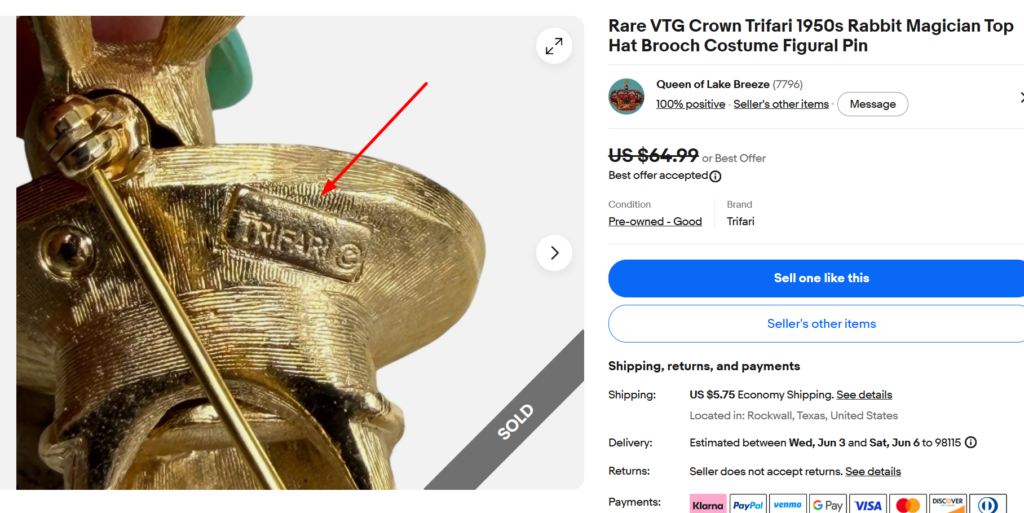
Knowing the designers is one of the most crucial steps in identifying valuable vintage costume brooches. The names below show up over and over in online sales at premium prices.
- Miriam Haskell – While Miriam Haskell jewelry was founded in New York in 1924, the jewelry was actually designed by Frank Hess from 1926 to 1960. These include hand-wired baroque pearl look-a-likes, Russian gilt filigree reverse settings, and bead-clustered designs. The jewelry is unmarked prior to the 1940s and thereafter carries the mark “Miriam Haskell” on an oval plaque.
- Trifari (Alfred Philippe Era) – Trifari’s finest creations came when Alfred Philippe was the company’s head designer (1930-1968). The Jelly Belly figurals, fruit salad, and crown pins from this time are the most coveted. Markings include “KTF” (used in 1937 only), “Trifari” with a crown above the T, and “Trifari Sterling” for wartime pieces.
- Eisenberg Original / Eisenberg Ice – Started in Chicago in 1914 as a clothing company, Eisenberg’s jewelry line took off in the mid-1930s. Pieces use giant Swarovski crystals on heavy pot metal or sterling. Marks include “Eisenberg Original” (mid-1930s–mid-1940s), “Eisenberg Sterling” (1942–1948), and “Eisenberg Ice” (from 1941 onward).
- Coro & Corocraft – Corocraft was the higher-end line from Coro, often sterling during the war. Marks: “Coro Duette Pat. No. 1798867,” “Coro,” “Corocraft,” and “Coro Craft Sterling.” Coro’s Duette (a frame with two detachable clips) was patented in the U.S. in 1931 and introduced in 1935.
- Weiss – Albert Weiss founded his company in New York in 1942 after designing for Coro. Weiss became famous for floral and figural rhinestone brooches, especially Christmas trees. He was the first to use the tree shape for rhinestone pins. Marks: “Weiss,” “Weiss NY,” “Weissco,” and “Albert Weiss.”
- Monet – Founded in 1929 as Monocraft, Monet produced metal monogram pins for use in handbags. The jewelry line was established in 1937. Monet has produced more thick gold metalwork than rhinestones. The signature includes “Monét” with an acute accent, then “MONET” all caps after 1955.
- Avon – Avon’s collectible brooches mostly come from designer collaborations starting in the 1970s. The most-hunted are “KJL for Avon” pieces by Kenneth Jay Lane (1980–2004), plus collections by Elizabeth Taylor and José Maria Barrera. Marks: “Avon,” “K.J.L. for Avon,” and “Kenneth Lane for Avon.”
- Czech / Czechoslovakian Makers – Gablonz brooches, made in Gablonz (now Jablonec nad Nisou), Czech Republic, dominated the costume jewelry export during the 1920s and 1930s. They have ornate gilt-brass filigree and hand-set cabochon glass. These often show marks like “Czechoslovakia,” “Czecho-Slovakia,” or “Made in Czechoslovakia,” though many are unsigned.
14 Most Valuable Vintage Costume Brooches Trending Today
Below are listed some specific vintage costume jewelry brooch designs and styles that collectors actively chase today, and tips to spot them.
1. Plique-à-jour Butterfly Brooch
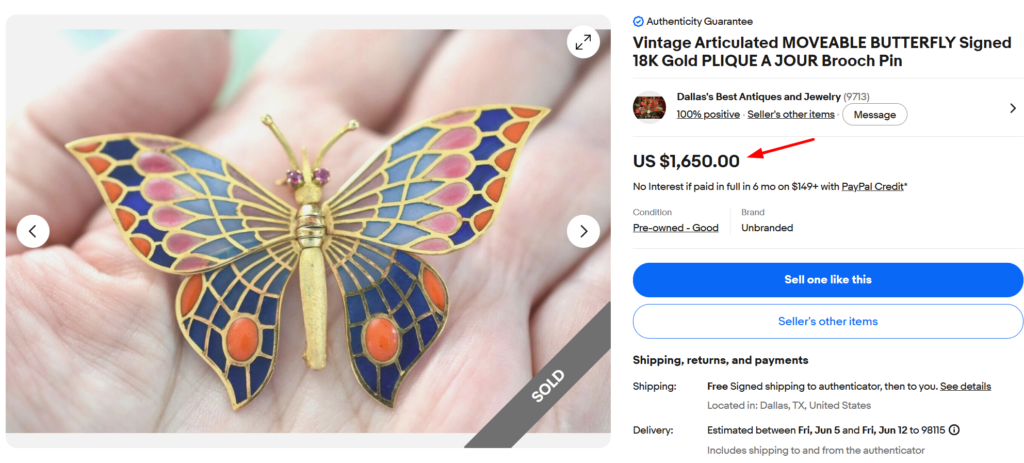
Sold for $1,650
Butterfly brooches were common from Art Nouveau (1890–1910) plique-à-jour enamel masterpieces to mid-century Trifari, Crown Trifari, Boucher, and Coro rhinestone versions.
Wing detail is the key value driver. Open metal work, enamel inlay, or stones set en pave all indicate superior quality pieces.
Antique plique à jour butterflies (where enamels fill open metal cages to form butterflies like stained glass) are the most expensive type and also very rare. Mid-century enamel butterflies from Boucher and Trifari are worth less.
- Estimated Value: $60–$1,800
- Production Year: 1890s–1970s
- Characteristics: Detailed wings, enamel or stones
- Quick Notes: Plique-à-jour examples are most valuable.
2. Antique Jade Costume Brooch
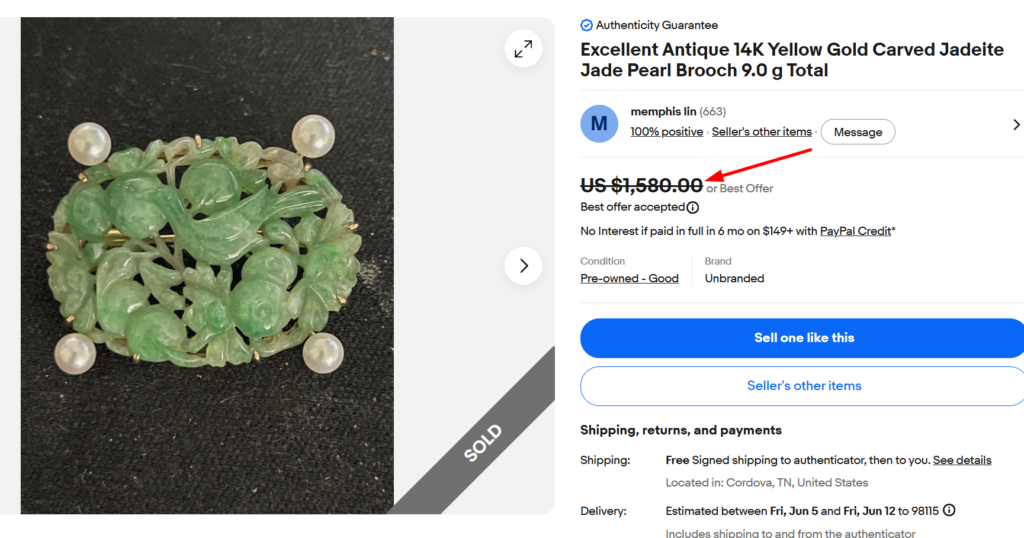
Sold for $1,580
Old jade brooches have carvings made from nephrite or jadeite in light green, white, purple, or dark green colors, mounted in gilt silver or 14 karat gold. Flower designs, including floral heads, leaves, and stems, feature heavily in antique jade brooches; many were made during the Chinese export era (1900-1940).
Pay attention to the color of jadeite. Deep “Imperial” green jadeite is an expensive rarity compared to cheap celadon nephrite. Also, beware of imitation and dyed versions; genuine jade should feel heavy and cool.
- Estimated Value: $120–$1,500 (high value for gold examples)
- Production Year: 1900–1940 mostly
- Value Factor: Imperial green, untreated natural jade
- Characteristics: Carved jade in gilt mount
- Quick Notes: Imperial green commands a big premium
3. Trifari Sterling “Jelly Belly” Figural Brooch
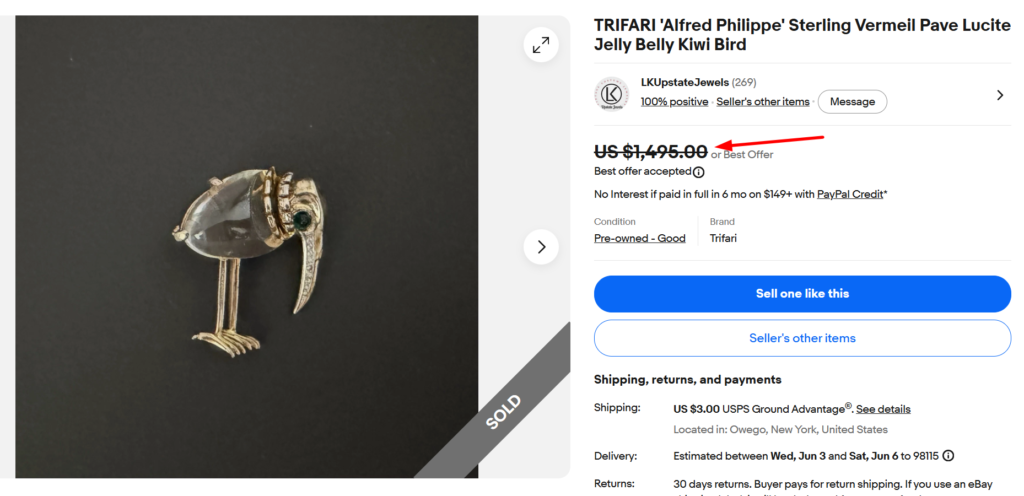
Sold for $1,495
Trifari’s Jelly Bellies are among the most valuable costume brooches. These are figural pins (frogs, turtles, flies, fish, owls, poodles, etc) that feature a Lucite cabochon with a domed top used for the body of the pin.
The Jelly Bellys were invented by Alfred Philippe in the early 1940s, mostly made from sterling silver, gold vermeil, and rhinestones.
The value depends largely on the animal type. The fly is the most affordable starting point, while large birds, fish, and rare dogs command thousands. Genuine Jelly Bellies are marked “Trifari Sterling” with a design patent number.
- Estimated Value: $400–$3,500+
- Production Year: Early 1940s
- Characteristics: Domed Lucite belly, sterling
- Value Factor: Rare animal type, intact Lucite
- Quick Notes: Match patent number to design
4. Antique Micro Mosaic Brooch (Italian Grand Tour)
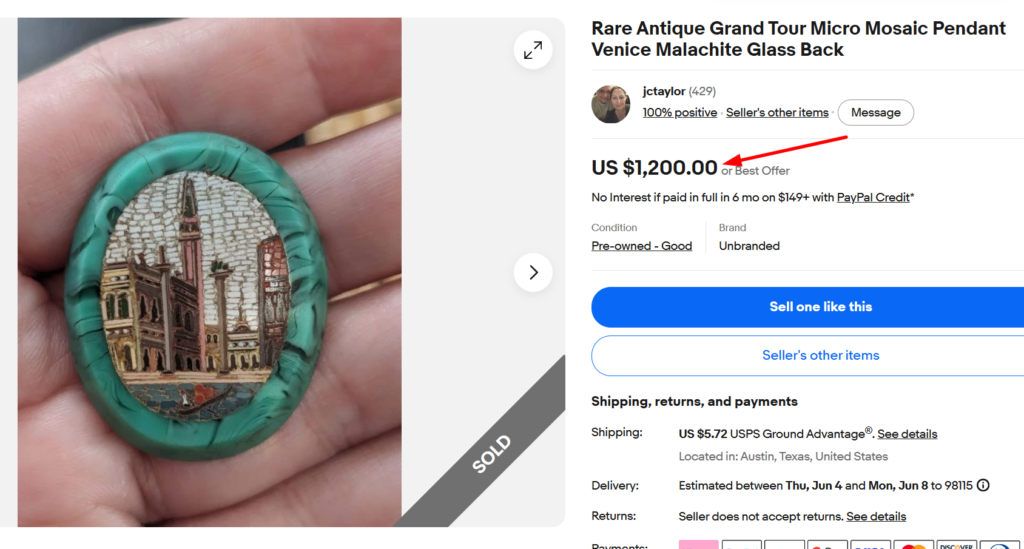
Sold for $1,200
Italian micro-mosaic brooches were mementos of the 19th-century Grand Tour of Italy, where each brooch was crafted by piecing together hundreds of very small pieces of glass to form a picture within its design.
The backs of the pieces are made out of black glass, copper, or gilt metal. The finer the tesserae, the more expensive the brooch.
So, the best examples feature tesserae with nearly invisible gaps between the individual fragments. Castellani-signed pieces from the Byzantine revival are top-tier finds.
- Estimated Value: $200–$2,000+
- Production Year: 1800–1900 mostly
- Characteristics: Tiny glass tesserae mosaic scene
- Value Factor: Fine tesserae, intact mosaic surface
- Quick Notes: Tesserae loss kills value fast.
5. Coro Duette Convertible Brooch
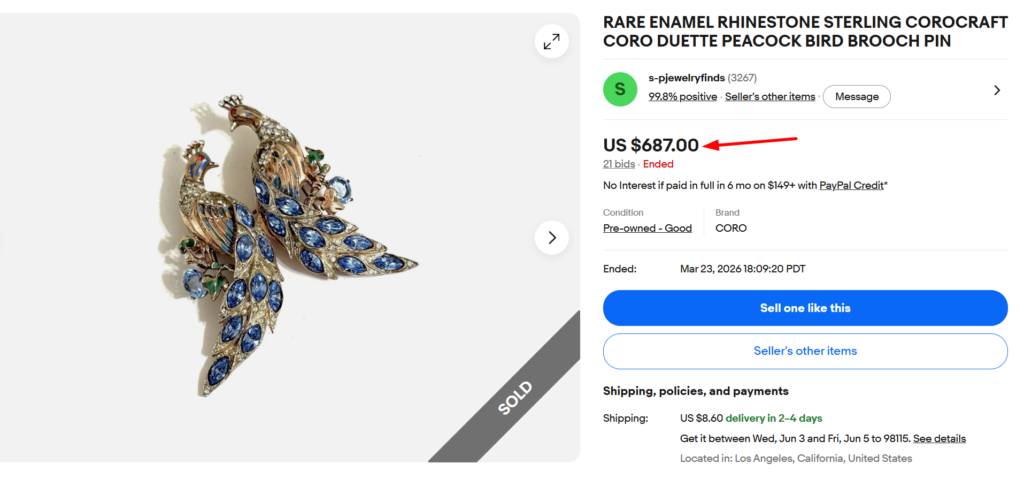
Sold for $687
The Duette is one piece that splits into two, with a brooch frame holding twin removable dress clips. Coro patented the mechanism in 1931 and launched production in 1935 under chief designer Adolph Katz. Figural pairs and Art Deco geometric designs are common.
Complete Duettes (frame plus both clips) bring serious money. Single clips show up far more often because frames got separated and lost over the decades. Stamps to find: “Coro Duette Pat. No. 1798867.”
- Estimated Value: $150–$800
- Production Year: 1935–1953
- Value Factor: Complete frame plus both clips
- Characteristics: Splits into two dress clips
- Quick Notes: Missing frame drops value 60%
6. Neiger Brothers Czech Glass Enamel Brooch
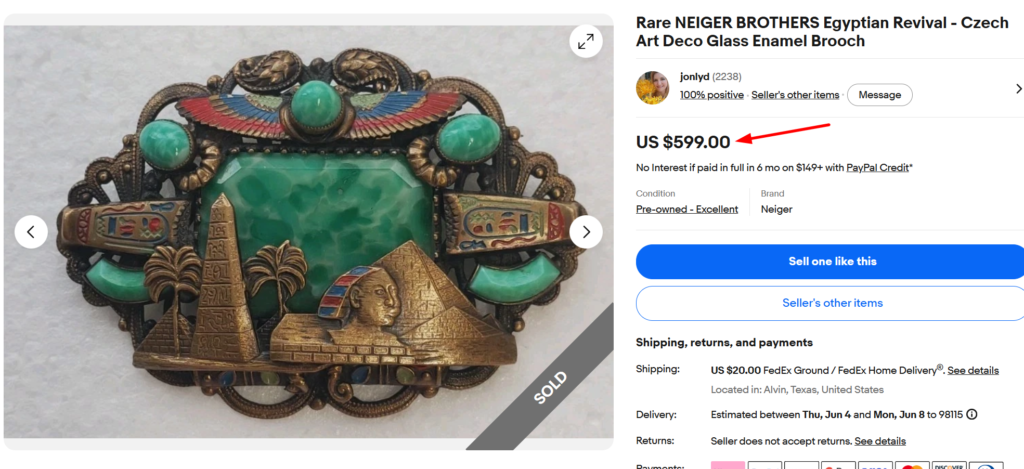
Sold for $600
These designs demonstrate the skill of Gablonz’s craftsmanship through intricate gilt brass filigree backing fashioned in the shape of flowers, baskets, or garlands, set with cut glass stones in various jewel colors.
Most have an oversized cabochon stone that imitates amethyst, ruby, sapphire, or peridot, surrounded by smaller faceted stones.
The Neiger Brothers are the most documented Czech makers, and their pieces command premiums when attributed. Most Czech brooches go unmarked but can be recognized from the heavy filigree, multi-colored glass, and tight prongs.
- Estimated Value: $125–$800
- Production Year: 1918–1939
- Characteristics: Gilt filigree, jewel-tone glass
- Value Factor: Neiger attribution, original stones intact
- Quick Notes: Attribution to a renowned maker can double the value.
7. Miriam Haskell Baroque Pearl Brooch
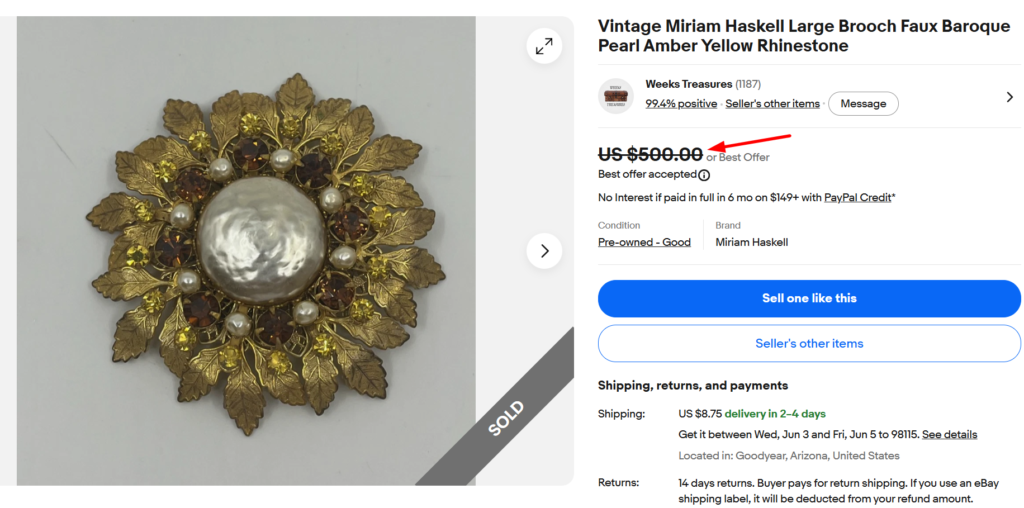
Sold for $500
The baroque pearl brooches by Haskell include irregularly-sized imitation pearls wired onto gilt Russian filigree settings, which may be overlaid with seed pearls and rose mounts. The pin forms are usually bow-shaped, with pendants being among the more popular styles for collectors.
Pre-1947 pieces are unsigned but identifiable by the wire-wrapping technique and the soft yellow tone of the gilt metal. After 1950, look for an oval cartouche stamp reading “Miriam Haskell.”
- Estimated Value: $250–$750
- Production Year: 1924–1980s
- Characteristics: Faux baroque pearls on filigree
- Value Factor: Hand-wired construction, intact pearls, clear markings.
- Quick Notes: Pearl peel reduces value sharply.
8. Miriam Haskell Christmas Tree Brooch
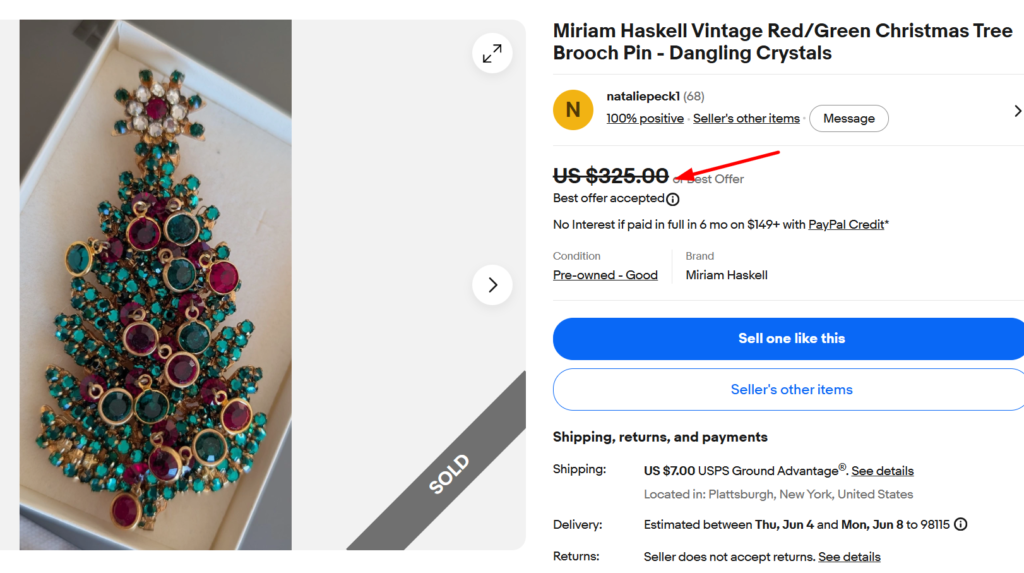
Sold for $325
Miriam Haskell trees feature the brand’s hand-wired construction with the seasonal Christmas tree motif. You’ll see gilt brass branches packed with emerald-green crystals, accented by ruby-red, round bezel-set cabochons that often dangle from small jump rings.
These trees mostly came out of the Robert Clark and Larry Vrba eras (1960s through 1970s). Signed Haskell trees command premiums because they’re noticeably heavier and more elaborate than most competitors.
- Estimated Value: $250–$700
- Production Year: 1960s–1980s
- Value Factor: Signed Haskell, dangling crystal construction
- Characteristics: Russian gilt branches, bezel cabochons
- Quick Notes: Dangling crystals shouldn’t be replaced
9. Elizabeth Taylor for Avon Brooch Pendant
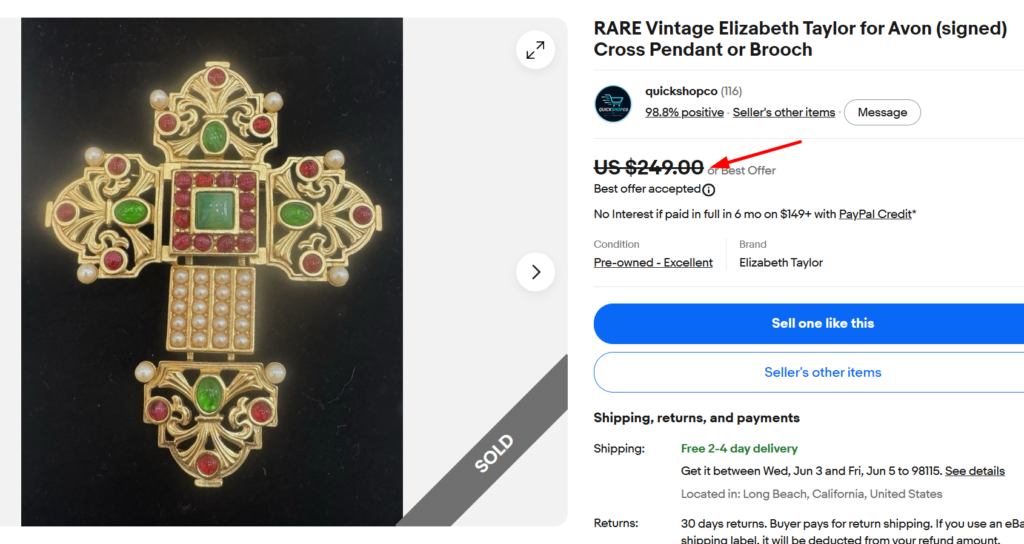
Sold for $250
The Elizabeth Taylor for Avon collection was launched in 1993 and ended in 1997, creating 23 different collections of convertible jewelry that could serve as either a pendant or a brooch.
Design elements were based on Byzantine, Egyptian, and Renaissance styles that reflected her film characters and collectibles.
The cross pieces show gold-plated bases with poured glass cabochons in ruby and emerald tones, plus seed pearls arranged in column formations. Look for “Elizabeth Taylor” stamped on the back for authenticity.
- Estimated Value: $80–$350
- Production Year: 1993–1997
- Characteristics: Byzantine cross, glass, and pearl
- Value Factor: Signed pieces with poured-glass cabochons
- Quick Notes: Original box adds 30% premium.
10. Vintage Owl Figural Brooch
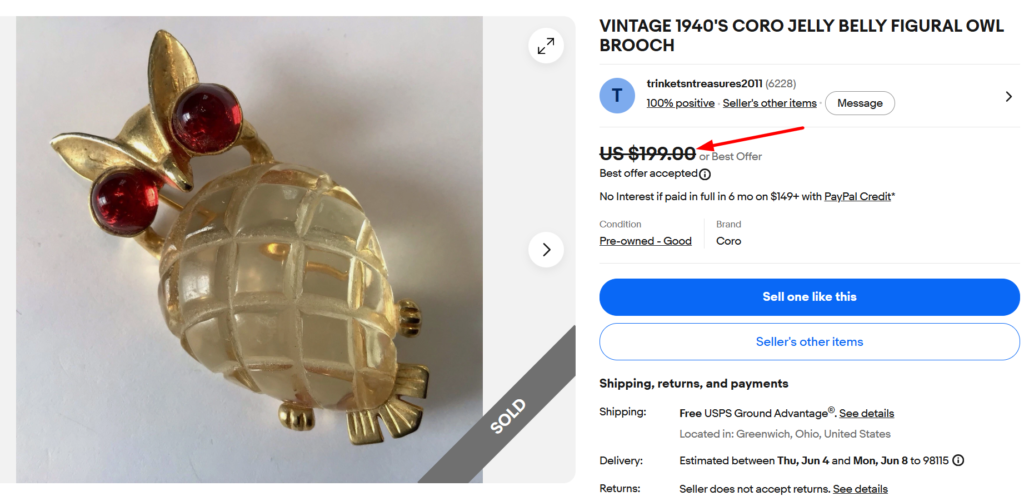
Sold for $200
Owl brooches turn up across nearly every designer and era, but the most collectible come from Trifari (Jelly Belly), Boucher, Coro, and unsigned Czech pieces. Big eyes (usually rhinestones, glass cabochons, or enamel) are the focal point, with rhinestone or pavé bodies.
Mid-century owls (1950s–60s) often have hinged moving heads or trembler springs that make the features wiggle. The 1960s and 1970s owl craze produced thousands of variations, so signed designer pieces consistently outperform unsigned ones at sale.
- Estimated Value: $40–$700
- Production Year: 1940s–1970s mostly
- Value Factor: Designer signature plus trembler heads
- Characteristics: Oversized eyes, figural body
- Quick Notes: Trembler heads add 30% value
11. Enamel Portrait Brooches
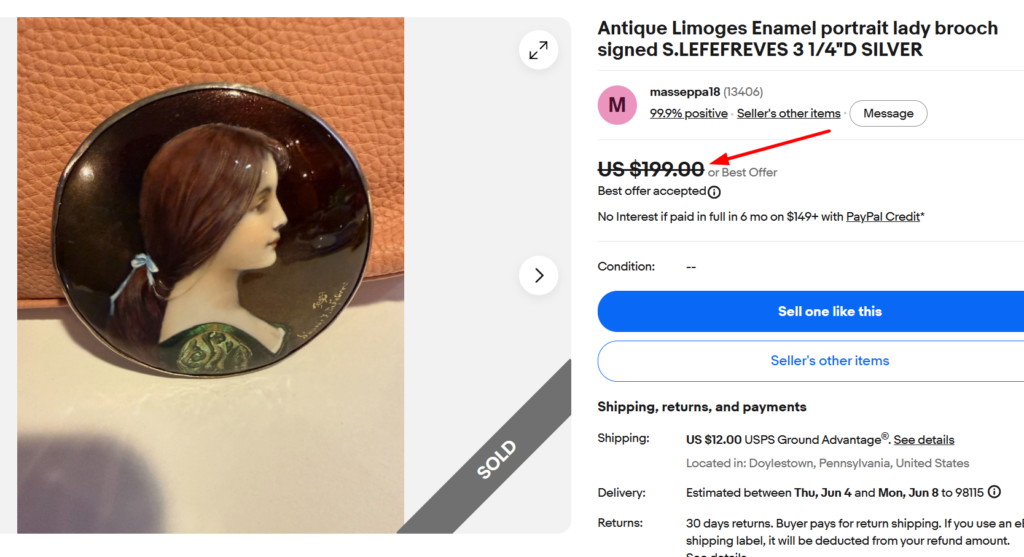
Sold for $200
The enamel portrait brooches have miniature paintings of a woman or child or perhaps some bucolic scene surrounded by an elaborate gilt or silver filigree border. The Victorian or Edwardian era pieces are considered to be typical, while Limoges-style enamels are top-notch.
The antique brooches without portraits that rely on filigree will still employ the fine wire and beadwork metal but will have designs like roses, stars, or geometric shapes. Filigree wire, which is finer and tighter, will fetch more money.
- Estimated Value: $100–$700
- Production Year: 1880–1920 mostly
- Characteristics: Hand-painted enamel or wire filigree
- Value Factor: Hand-painted detail, no enamel cracks
- Quick Notes: Hairline cracks reduce value heavily
12. Eisenberg Ice Signed Rhinestone Brooch
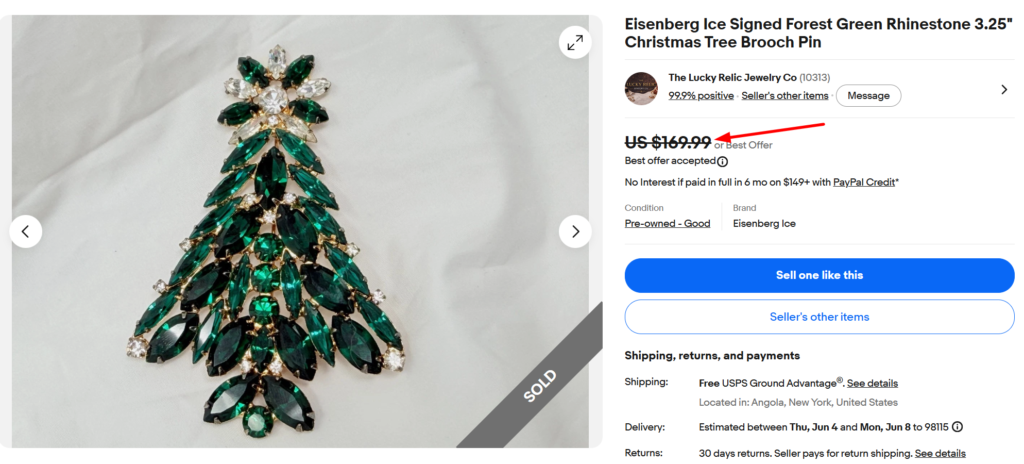
Sold for $170
The Eisenberg Ice brooch collection features giant clear Swarovski crystals mounted in silver metal in prongs. The brooches feature many different motifs, with flowers, star bursts, and bouquet arrangements the most common. The name “Ice” was coined by Sam Eisenberg in 1941.
Earlier Eisenberg Original pieces in pot metal often outvalue later Ice pieces. The biggest tell of a genuine Eisenberg is stone size and clarity. They really do look icy under direct light.
- Estimated Value: $150–$400
- Production Year: 1941–1970s (Ice mark)
- Characteristics: Large, clear Swarovski crystals
- Value Factor: Early Original outvalues later Ice
- Quick Notes: Check stones for yellowing.
13. Marcel Boucher Dragonfly Brooch
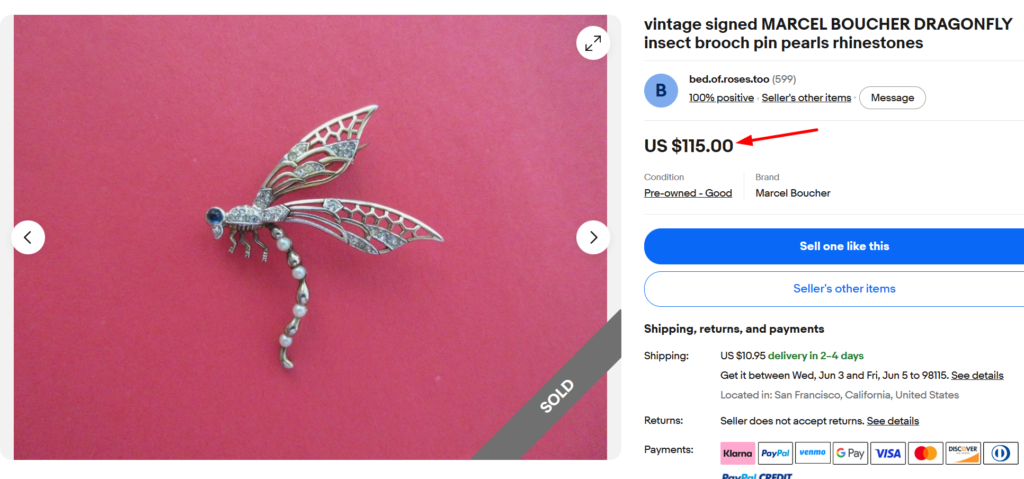
Sold for $115
Marcel Boucher learned jewelry-making in Cartier’s workshop in Paris, and his insect brooches reveal such influences. His dragonfly insects have wings made from pierced and open filigree decorated with rhinestones, segmented pearl tails, and small, round eyes.
From the middle 1940s, Boucher numbered his items, so an authentic back plate would have a four-digit inventory number with the “Marboux” mark or a signature “Boucher”.
The company continued under Davorn Industries after 1970, with original pieces ending in 1971.
- Estimated Value: $100–$600
- Production Year: 1937–1971
- Characteristics: Pierced filigree wings, pearl body
- Value Factor: Numbered piece, intact pavé work
- Quick Notes: Four-digit number confirms authenticity.
14. Weiss Black Diamond Rhinestone Brooch
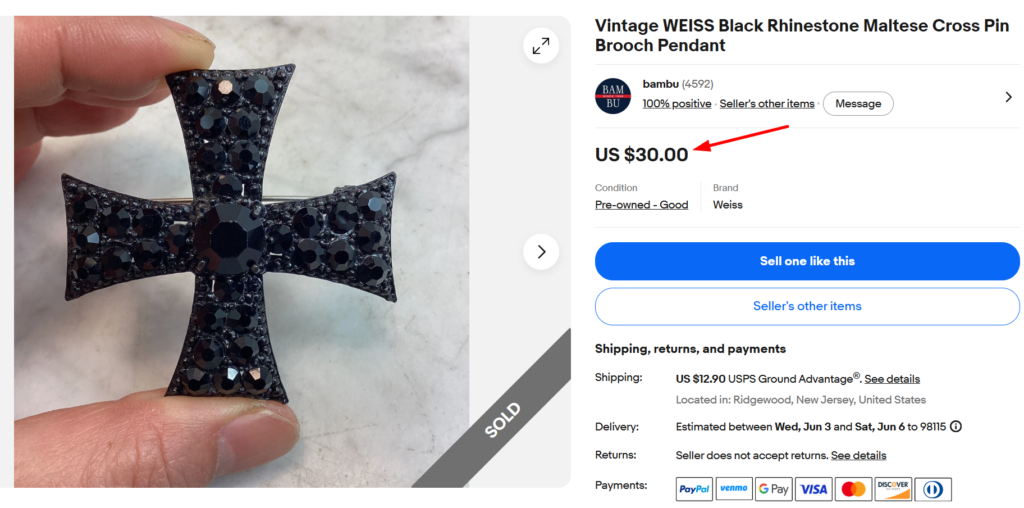
Sold for $30
Weiss created striking brooches from “black diamond” rhinestones – the smoky gray Swarovski crystals that offer strong contrast with the silver-tone metal. Some of the most sought-after are the floral motifs, starbursts, and sprays. Aurora Borealis stones were introduced into Christian Dior through Weiss in the ’50s.
The hallmark of Weiss pieces is usually found in a cartouche at the back with “Weiss” or “Albert Weiss.” Weiss was out of business by 1971, so their brooches are usually limited.
- Estimated Value: $80–$350
- Production Year: 1942–1971
- Characteristics: Smoky-gray Swarovski rhinestones
- Value Factor: Short production run, fully signed
- Quick Notes: AB-coated stones add 25% value
How to Identify Authentic Costume Brooches?
Identifying a genuine vintage costume jewelry brooch takes more than reading the stamp. Many valuable pieces are unsigned, faked, or marked in ways that need decoding.
Use the following checks to tell an authentic piece from modern repros and fakes:
Read the Clasp First
The clasp of an old brooch is the fastest dating tool you have. The most common clasps you’ll see are:
- A simple C-clasp (with no guard) dates the jewelry to before 1900 or to the earliest years of the century.
- The trombone-type safety clasp (sliding mechanism used to retract the pin) is typically found between 1890 and 1950.
- A safety rollover clasp (pin slides under a guard) is typical after 1950.
- Lever back safety indicates the late 1940s production.
For the top value, the original clasp also has to actually still work. Replaced clasps can drop the value by 20–40%.
Check the Pin Length
On genuine antique brooches (pre-1910), the pin extends well past the brooch body, sometimes by half an inch or more. Victorian women pinned through thick fabric, so the longer pin was functional. Reproductions almost always have shorter, pin-flush pins.
This single detail can help you spot fakes. If a brooch is supposedly Victorian but the pin sits flush with the edge, it’s a red flag. The cost of recreating that long pin is something modern reproductions skip.
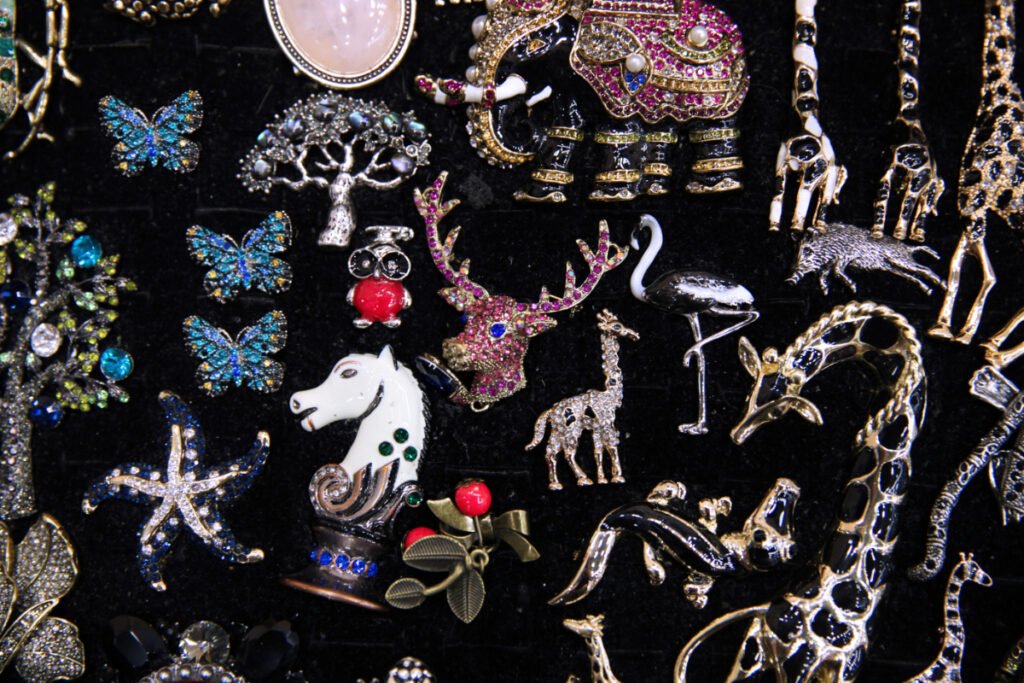
Examine the Stones
A foil backing to the stones indicates that the item was made prior to 1960.
Open-back settings became standard after that.
Also, a good seal is necessary for foil; dark or “dead” stones indicate moisture damage, which hurts the value.
Glass stones will always be more defined than their acrylic equivalents, especially Swarovski crystals. Lastly, prong-set or claw-set stones beat glued ones for both age and value. Glued stones on a “Victorian” piece are not genuine.
Decode the Maker’s Marks
Designers’ signatures changed with time, and thus indicate their age. For example, Trifari started using “KTF” for a year only before switching to “Trifari with crown,” to “Trifari Sterling” due to WWII, followed by the copyright mark after 1955 on “Trifari ©.”
Likewise, Eisenberg used the “Eisenberg Original” signature until the mid-1940s, followed by “Eisenberg Sterling” (1942 to 1948), then “Eisenberg Ice.
Each mark modification narrows the date. However, you should never trust a mark alone. Always verify the construction and base findings, too.
Look at the Findings
The metal components – pin, hinge, clasp, and jump rings – indicate the quality of manufacture. The presence of soldered joints indicates good manufacturing; crimped or twisted findings imply low-quality manufacture.
The hinge type also dates the piece. Tube hinges go with Victorian work, while modern hinges have small bent-wire mechanisms.
Silver findings in a costume jewelry piece will definitely point to WWII-period production (1942-1948), as during that time, base metals were rationed. Trifari Sterling and Eisenberg Sterling are both highly collectible categories.
A vintage costume brooch can be worth a fortune, but only to someone who already knows the marks, findings, and construction details. Always start with the clasps, work through the materials, and learn designer marks to spot the real deal.