

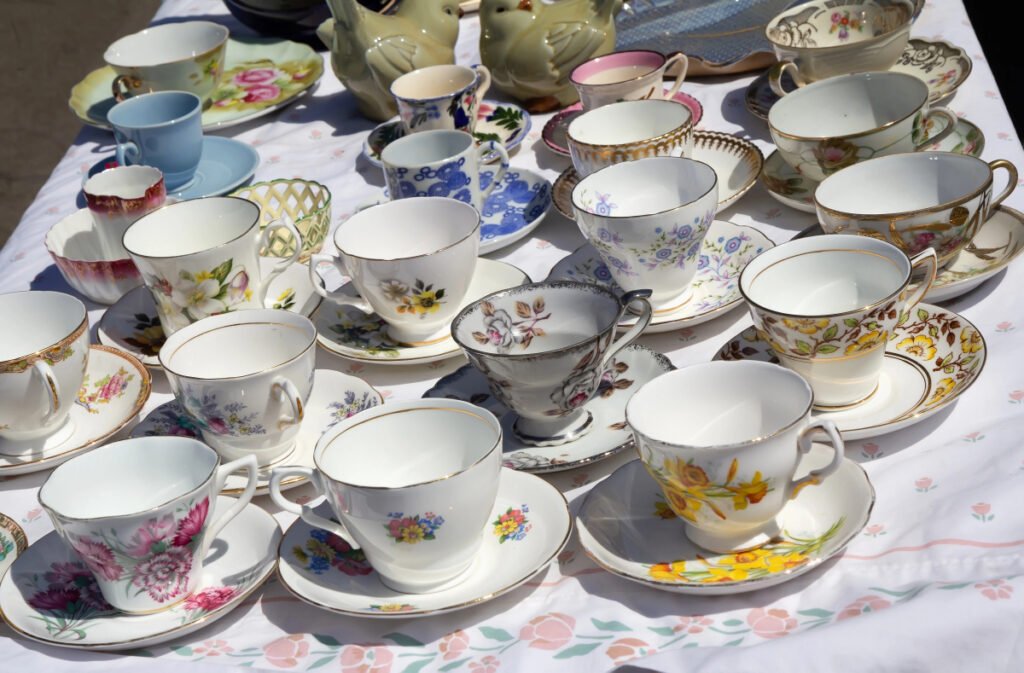
Most of us love having a good cup of tea, don’t we? But sometimes it’s not the tea, but the teacup that grabs more attention, especially if it’s a vintage piece with detailed hand-painted rose designs and golden edges!
But these old teacups aren’t all about their designs, but also their values, with some single cups selling for as much as $5,000 or even more!
Below are 15 rare old teacups with their real prices, followed by the marks, materials, condition, and other checks that decide what an old cup is worth.
Why Are Antique Vintage Tea Cups So Special?
Teacups have been around for hundreds of years now. They first appeared in China, where tea was enjoyed in small porcelain bowls.
Later, tea reached Europe in the 1600s, and people wanted fancy cups to drink it from, and that’s when makers in places like England, France, and Germany started creating such beautiful designs.
In the 1800s, especially in Victorian England, afternoon tea became a big tradition, and since then, teacups weren’t just for drinking; they showed style, status, and good taste. Many were decorated with gold edges, flowers, or hand-painted pictures. (Learn more in our Victorian-era teacups guide).
And that’s what makes them collectible today. Owning a rare one feels extra special because it’s both familiar and valuable.
15 Rare Antique & Vintage Teacups and Their Real Prices
1. Aynsley Burgundy Gilt Tea Cup & Saucer Set
- Brand: Aynsley
- Pattern: Red with gold gilt
- Manufacturing Period: Mid-20th century
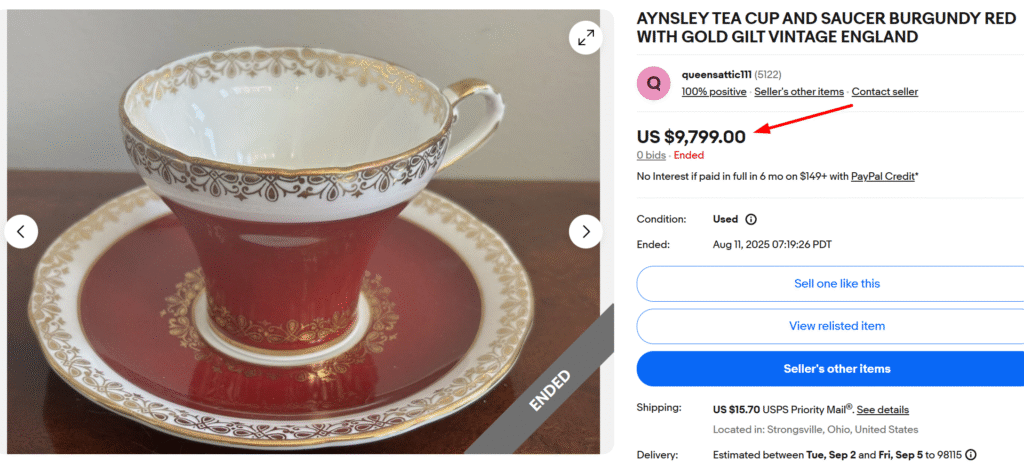
This cup and saucer was listed on eBay at $9,799 (sold via best offer), and it actually makes sense.
This beautiful vintage set from England was made by the well-known maker Aynsley. The cup is shaped like a “corset,” a distinctive style to spot the maker, along with a backstamp!
The patterns are a vivid combination of matching burgundy in the center with golden floral around the rim! You’ll see an elegant handle shaped like a “C” with a matching gold gilt finish, making the whole set catch the eye!
2. Russian Porcelain Gilt Portrait Tea Cup & Saucer By Imperial
- Brand: Imperial
- Pattern: Portrait with Gilt
- Manufacturing Period: Early 19th century
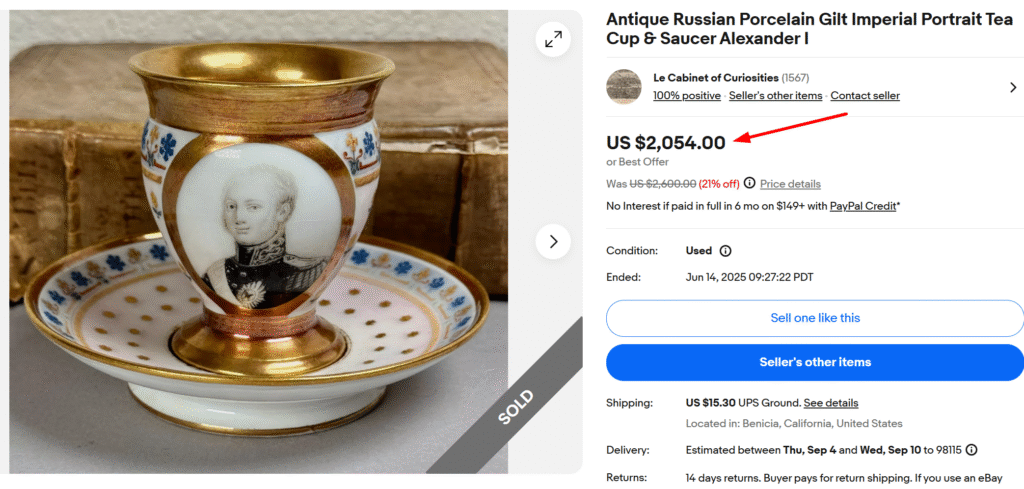
This rare hand-painted Russian cup carries a portrait of Alexander I, who ruled Russia from 1801 to 1825. Shaped like a deep conical bowl, the cup has a flared rim at the top and a short foot. This was a common style in early 19th-century pieces.
You’ll also find a gold gilt interior around the set with dotted patterns of blue and red motifs. The pieces are made of glazed porcelain; pieces with intact glaze (and historical connections) can be worth thousands!
3. Tiffany & Co. Silver Tea Cups with Lenox China Liners
- Brand: Tiffany & Co. and Lenox
- Pattern: Silver Teacup liners
- Manufacturing Period: Unknown
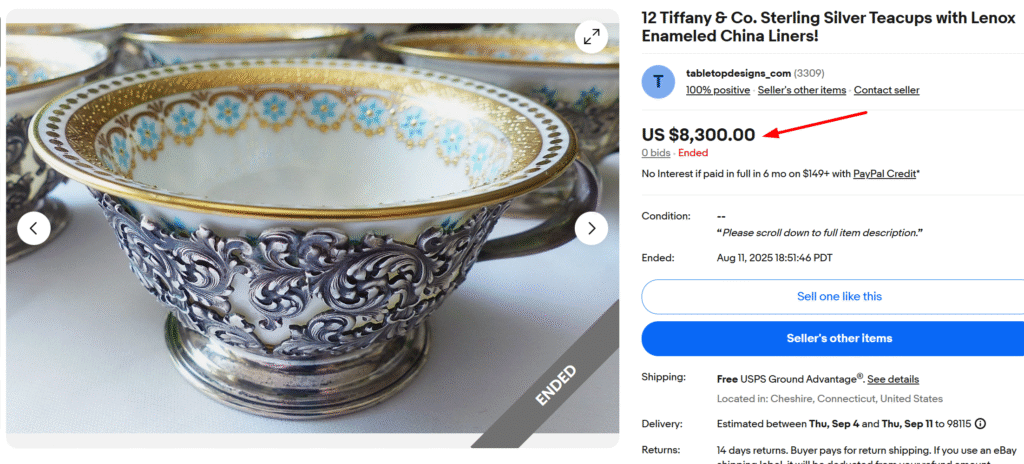
This rare set of 12 combines sterling silver holders by Tiffany & Co. with enameled china liners made by Lenox.
The cups come with their own detachable Sterling Silver holders in swirling floral patterns. Tiffany’s cups often come with the backstamp, so make sure to check for marks like “TIFFANY & Co.,” “STERLING,” or “925” underneath the pieces.
4. Richard Wehsener Dresden Teacup Saucer
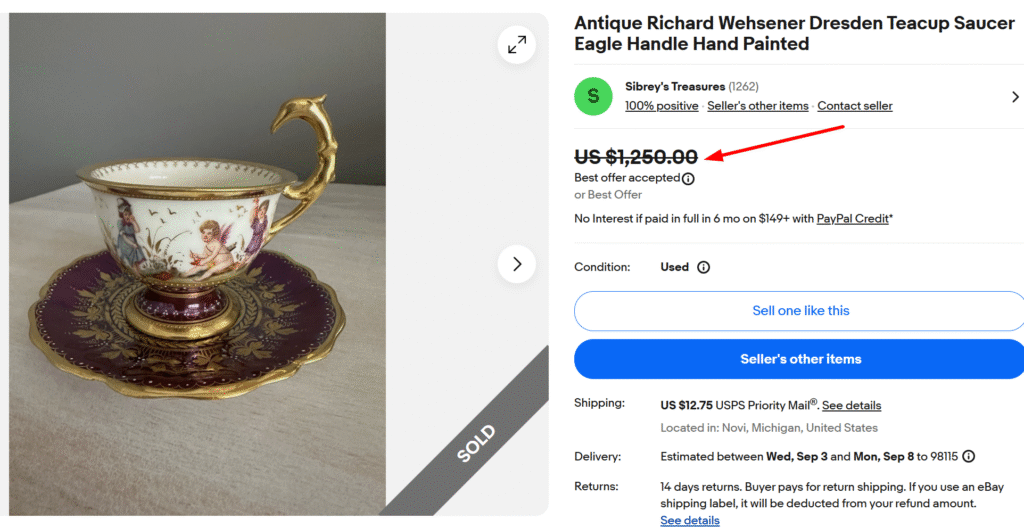
- Brand: Richard Wehsener
- Pattern: Classical Cherubs
- Manufacturing Period: Late 19th to early 20th century
This stunning antique teacup and saucer set is a collector’s dream! Decorated by the Dresden (Germany) porcelain studio of Richard Wehsener, the highlight of this piece is its unique eagle-shaped handle, intricately gilded and formed with remarkable attention to detail.
The cup itself features a delicate hand-painted classical cherub scene, decorated with gold detailing. The accompanying saucer, with a rich burgundy hue and gold gilt designs at the center and edge, shows luxury craftsmanship!
5. Touraine Flow Blue Teacups Set by Henry Alcock
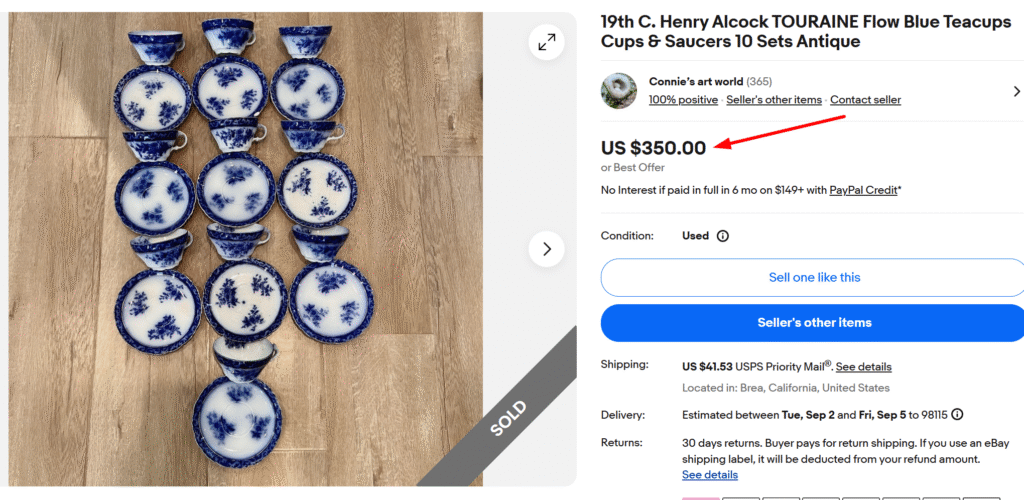
- Brand: Henry Alcock
- Pattern: Touraine Flow Blue
- Manufacturing Period: Late 1800s to early 1900s
This is a beautiful set of 19th-century flow blue teacups and saucers by Henry Alcock & Co! It features the iconic “Touraine” pattern, a classic example of flow blue design where cobalt blue decoration softly “bleeds” into the porcelain, creating a dreamy, blurred effect.
Each cup and saucer showcases delicate floral motifs in deep blue on a white background, framed by ornate borders. Alcock is a well-known English pottery manufacturer; to authenticate the pieces, look for the name stamp on the bottom.
This set of ten sold for $350, about $35 per cup and saucer, which is a typical value for single flow blue cups.
6. Haviland & Co. Hand-Painted Teacup and Saucer
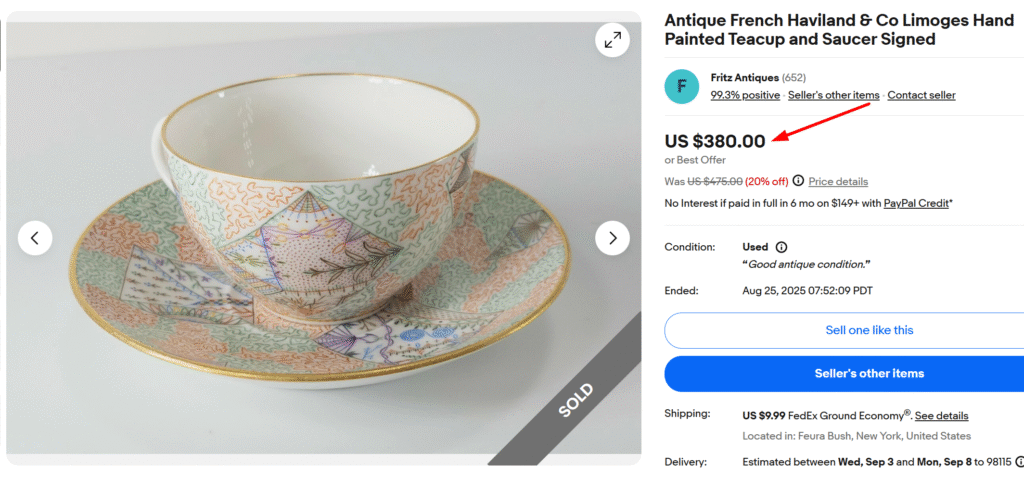
- Brand: Haviland & Co.
- Pattern: Geometric and Floral
- Manufacturing Period: Late 19th century
This sophisticated hand-painted porcelain teacup and saucer is from Haviland & Co., one of the most prestigious Limoges manufacturers in France. The intricate geometric and floral designs in pastel hues create a vibrant patchwork look, with painted fans.
The best part? The piece is signed by the artist. Signed pieces like this one tend to bring more than unsigned ones; this one sold for $380.
7. T&V Limoges France Stamped Holly Cup
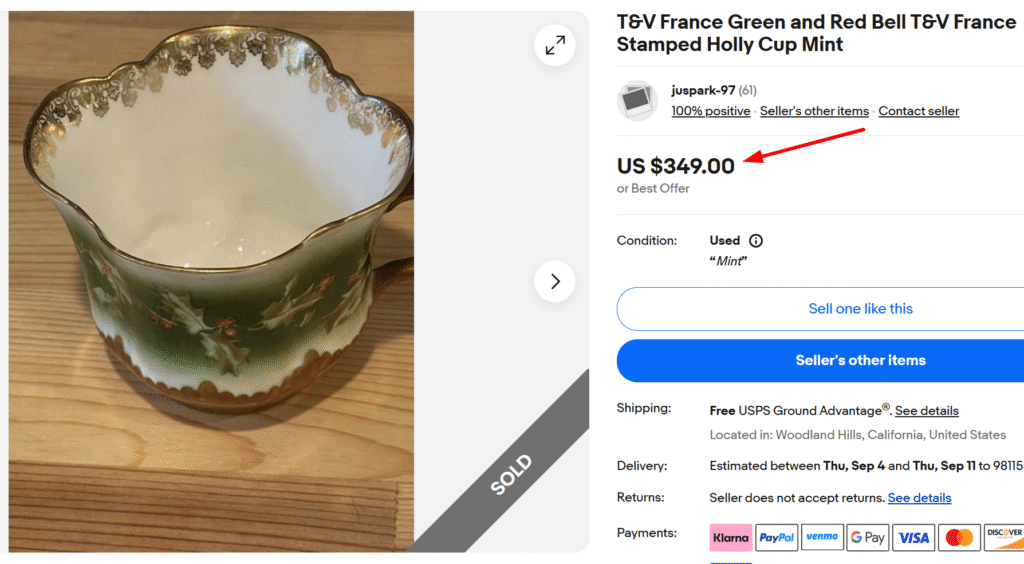
- Brand: Tressemann & Vogt
- Pattern: Festive seasonal theme
- Manufacturing Period: Late 19th to early 20th century
This elegant French teacup is a rare collectible from T&V (Tressemann & Vogt), known for their fine porcelain production in Limoges, France. The cup features a striking holly and bell motif, hand-painted with festive green and red details, making it particularly desirable for holiday collectors!
8. Meissen Teacup & Saucer
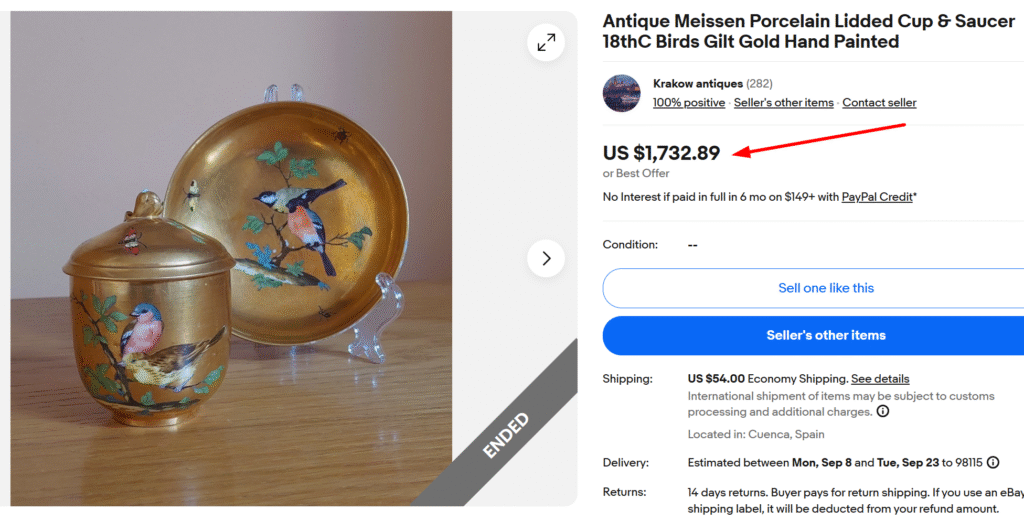
- Brand: Meissen Porcelain
- Pattern: Hand-painted Birds with Gilt
- Manufacturing Period: 18th century
This Meissen porcelain lidded cup and saucer set (described by the seller as 18th-century) is extremely rare due to its hand-painted bird and tree details and a full-on gilded background. Such pieces can be extremely desirable for collectors.
9. Royal Winton Grimwades Tea Cup Set
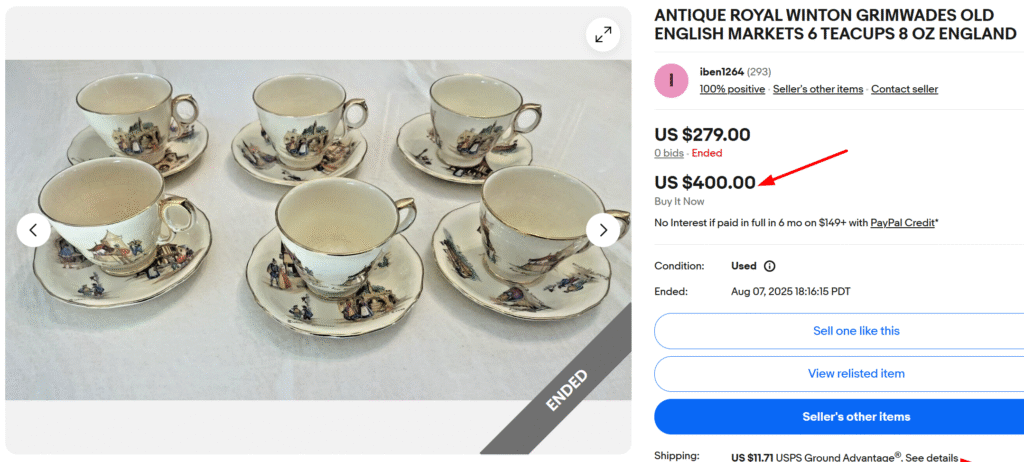
- Brand: Royal Winton by Grimwades
- Pattern: Old English Market
- Manufacturing Period: Mid-20th century
This complete set of six teacups and saucers shows the fine craftsmanship of the renowned English pottery maker, Grimwades’ Royal Winton. Each piece shows exquisite depictions of old English market scenes with silver edging, adding a luxurious touch typical of Royal Winton’s style.
10. Regency Rococo Tea Set (Coalport or Ridgway)
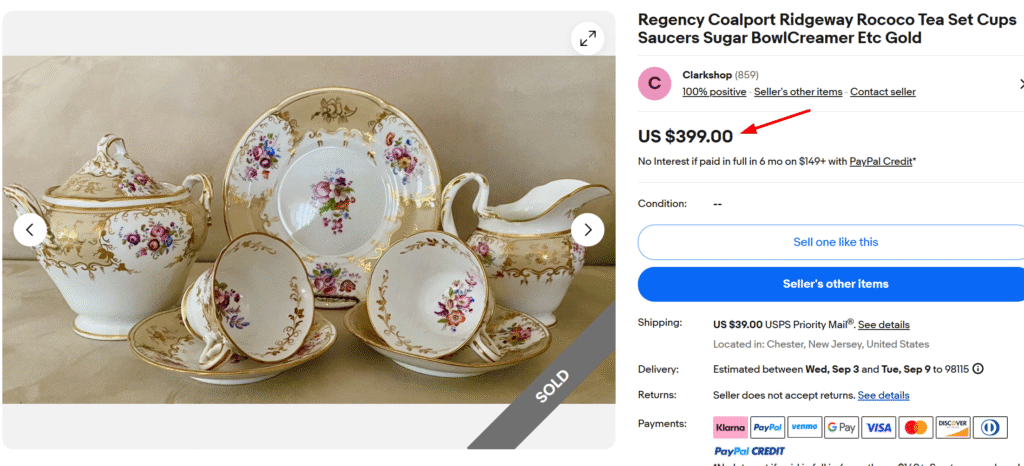
- Brand: Unmarked (attributed to Coalport or Ridgway)
- Pattern: Rococo style
- Manufacturing Period: 1800-1849
This luxurious Regency-era tea set is attributed to Coalport or Ridgway, renowned British porcelain manufacturers of that time. The set includes teacups, saucers, a sugar bowl, creamer, and a dessert plate, all in a rococo style.
The pieces are adorned with vibrant floral sprays, detailed gold filigree, and intricate molding. This design shows pure elegance, representing 19th-century English tea culture.
Many Regency tea sets carry only a painted pattern number on the base, not a maker’s name, so attributions like this one rest on the shape and the pattern.
11. Jewelled Teacup & Saucer Set by Coalport
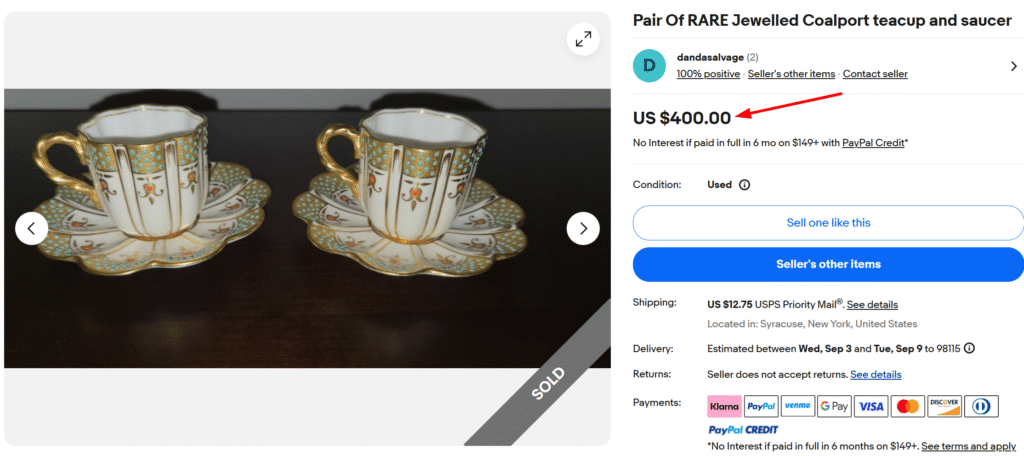
- Brand: Coalport
- Pattern: Geometric
- Manufacturing Period: Late 19th to early 20th century
This exquisite pair of Coalport teacups and saucers features a stunning scalloped design with raised enamel beading (looks like jewels). You can see the delicate floral details and lavish gold gilding all over the pieces.
Jeweled Coalport cups like these usually sell for a few hundred dollars, with the finest bringing more; this pair sold for $400.
12. Shelley Foley Wileman Lilac & Green Tea Cup Set
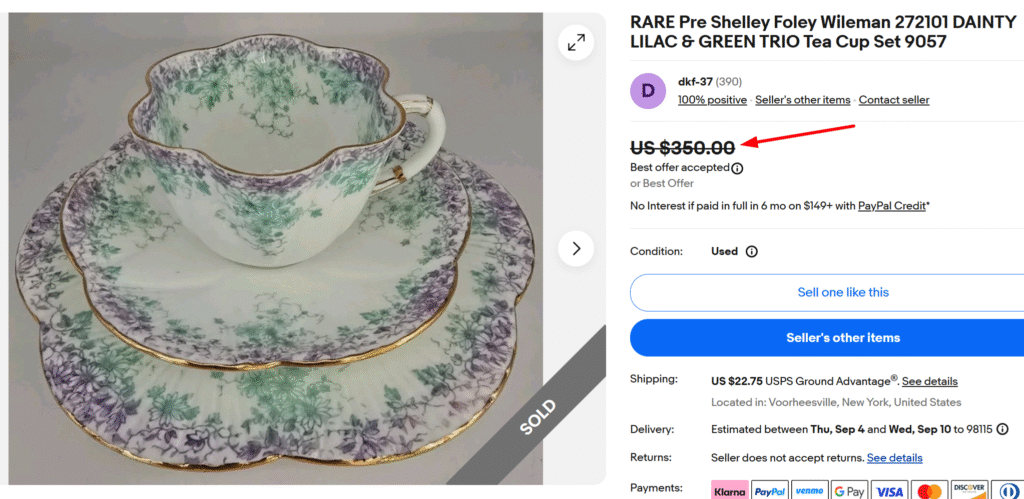
- Brand: Foley Shelley Pottery
- Pattern: Floral Patterns
- Manufacturing Period: About 1896 to 1910
This rare, lovely piece by Foley Wileman is a trio set of teacup, saucer, and plate. It comes in a very “Dainty” shape, decorated in the Lilac & Green floral pattern (pattern number 9057) and the registration number 272101, stamped at the bottom.
The edges have golden gilded rims, highlighting the overall style of the era. This fine craftsmanship of Foley Wileman, which later became Shelley China, is often quite desirable.
Shelley cups in general are popular with collectors because of their thin bone china, delicate shapes like Dainty, and the fact that the factory stopped making them in the 1960s.
13. Wedgwood Jasperware Teacup & Saucer Set
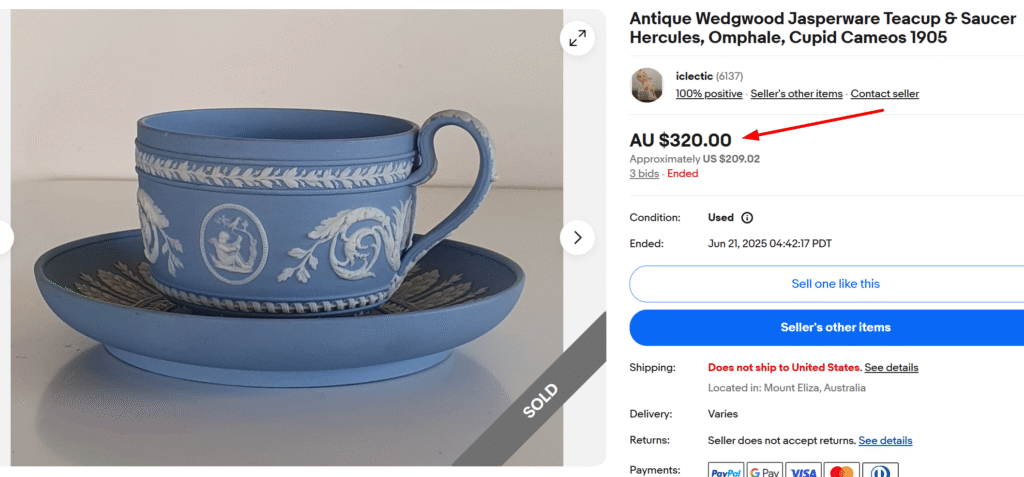
- Brand: Wedgwood
- Pattern: Neoclassical White Cameo Reliefs
- Manufacturing Date: 1905
This exquisite set is an antique Wedgwood Jasperware teacup and saucer, dating back to 1905. Made in Wedgwood’s blue jasperware, it features applied white relief of classical scenes, including Hercules, Omphale, and Cupid cameos.
You can find the brand name at the bottom of these pieces, and some might even have “ENGLAND” imprints. Antique Wedgwood jasperware cups like this one often sell for about $100 to $300; this one sold for about $209.
14. George Robertson’s Marked Handpainted Cup
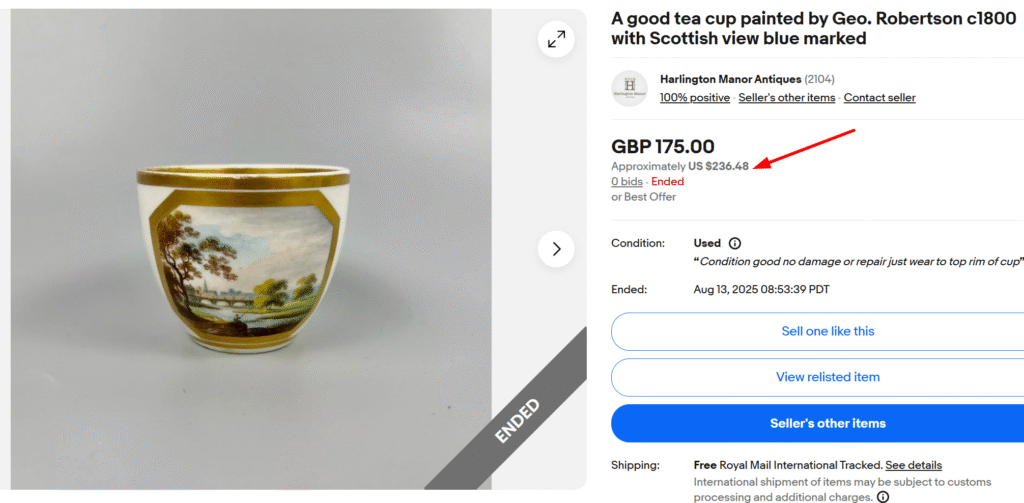
- Maker: George Robertson
- Pattern: Scottish Scenery
- Manufacturing Period: Around 1800
This fine Georgian-era teacup was hand-painted by George Robertson around 1800. Robertson was known for his finely detailed landscape works, and this teacup captures that artistry beautifully. The painting depicts serene countryside views, likely inspired by the Scottish romanticism of the era.
The cup features a delicate Scottish landscape scene, framed with gilded borders. It also has a blue mark (as the listing notes), which adds to its worth.
15. White Cabbage Rose Green Teacup by Paragon
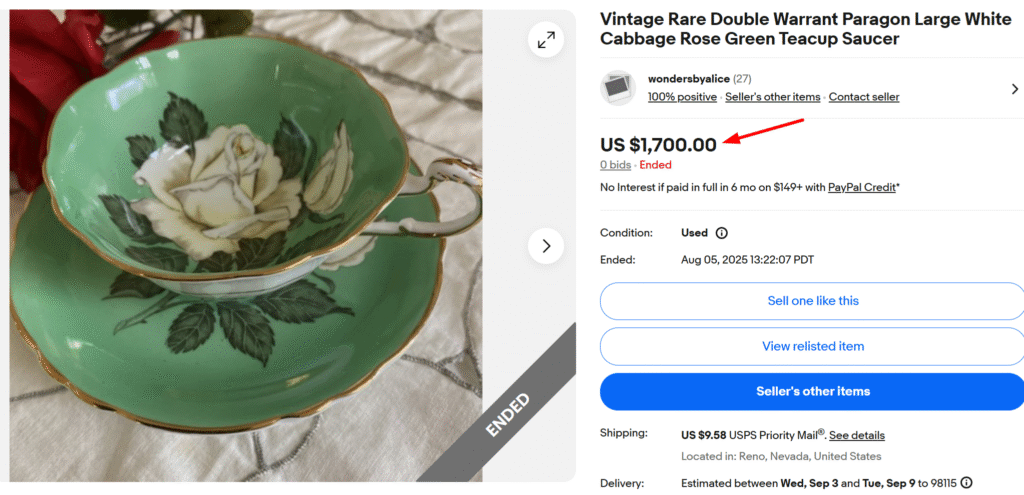
- Brand: Paragon
- Pattern: Cabbage Rose
- Manufacturing Period: 1939-1949
This striking Paragon teacup and saucer features the iconic large cabbage rose pattern, one of the most sought-after designs from the company. The vibrant green background sets off the bold white rose with its lush green leaves.
The set also has fine gilt along the rims and handle. Also, the listing describes the Double Warrant backstamp, which Paragon collectors often look for.
How to Tell If an Old Teacup Is Valuable: 7 Checks
Not every antique teacup will fetch you the same price; some will go for a few dollars, and others for hundreds or more. The secret lies in knowing what collectors want and how they actually value these pieces.
This guide will walk you through the little details that make a vintage teacup special, from makers’ marks and patterns to condition and rarity.
Check 1: Observe the Materials
Materials are the first clue for identifying a valuable teacup because antique pieces were selectively made of precious materials, like porcelain and fine china, unlike modern cups we see today. A few of the most collectible materials are:
- Bone China – A combination of bone ash, kaolin, feldspar, and quartz, bone china was developed in England in the late 1700s and became the classic English teacup material. It looks thinner and even lighter to hold. Bone china pieces need considerable skill, time, and resources, making these pieces expensive.
- Porcelain – Porcelain is the finest form of ceramic made of kaolin, feldspar, and quartz, fired at a high temperature. You will find such pieces with smooth surfaces and a glass-like finish. Porcelain teacups are pure gems!
- Ceramic & Stoneware – These teacups are more common, as they were made to be affordable. They are thicker, heavier, and less refined than Porcelain. Generally, ceramic cups are less valuable, but rare designs can be collectible.
- Silver – Some high-end makers also made sterling silver teacups. You can spot them by hallmarks like “925”, indicating their metal purity.
- Glass and Crystal – These are less common than the above but are often valued because of their decorative element.
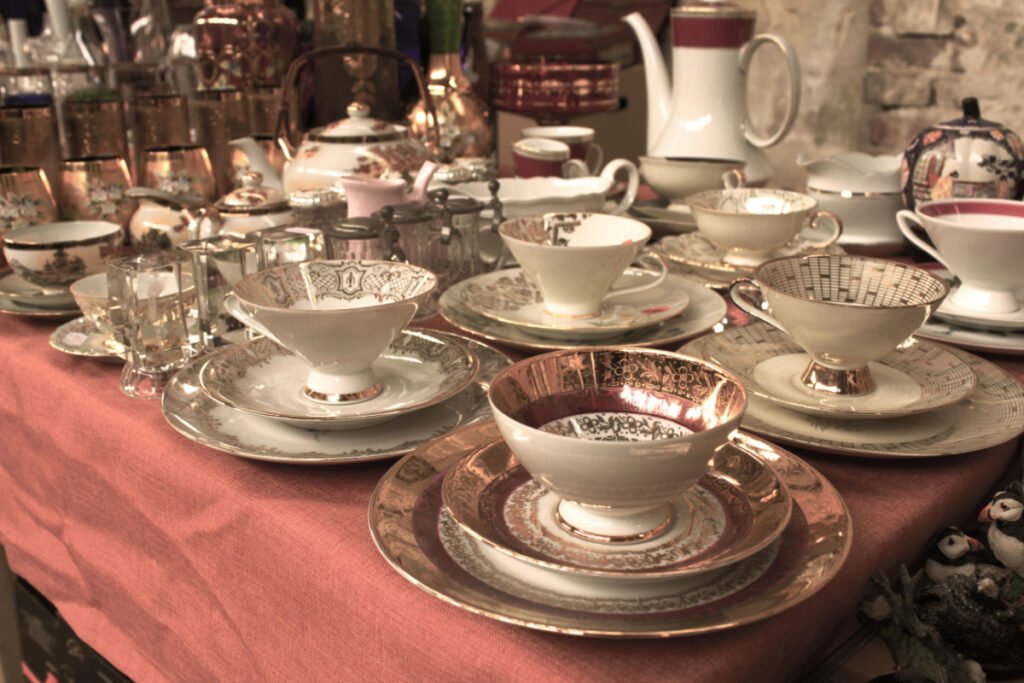
Check 2: Look for Markings
Flip a teacup over and look for markings! Many vintage pieces show some unique names, logos, and numbers at the bottom; signs of their origin and history. These marks can boost the value of a teacup or set as a sign of authenticity, which is a major value factor!
Maker’s Marks:
The most important mark is the maker’s mark, which you can find on the base, either in the center or near the foot rim, or even inside the saucer. These marks will tell you who made the cup.
Always look for a maker’s mark because vintage pieces from renowned makers can be worth A LOT! Some collectible names are “Royal Worcester,” “Meissen,” “Coalport,” “Limoges,” “Royal Doulton,” and “Aynsley”! Many of the same makers turn up in our guide to antique china worth money.
But a famous name alone is not enough, though: Royal Albert, for example, made patterns like Old Country Roses in huge numbers, so single cups usually sell for modest prices; older, rarer patterns and complete sets bring more.
Country of Origin Marks:
A “Made in…” mark helps you date a cup, not directly value it.
Country-of-origin marks became standard on exports to the US from the 1890s, so a cup marked only “England” is usually from after about 1891, and “Made in England” tends to be later still. Some might even just say the country name along with the brand name to verify its origin.
Pattern Registration & Design Numbers:
Many teacups show their pattern number on the base. British pieces may also carry “Rd No” followed by a design registration number, which dates the design (the Foley trio in item 12 shows 272101). These help collectors to cross-reference from original pattern books.
Hallmarks:
Antique teacups made of precious metals, like Sterling Silver or Silver must show specific hallmarks “925” or “Sterling.” Pieces with gilt work may also show hallmarks.
Artist’s Signatures:
Many original vintage hand-painted teacups show the signatures of artists or painters who designed them. A signed piece is usually worth more than an unsigned one in the same pattern.
Check 3: Check the Design Details
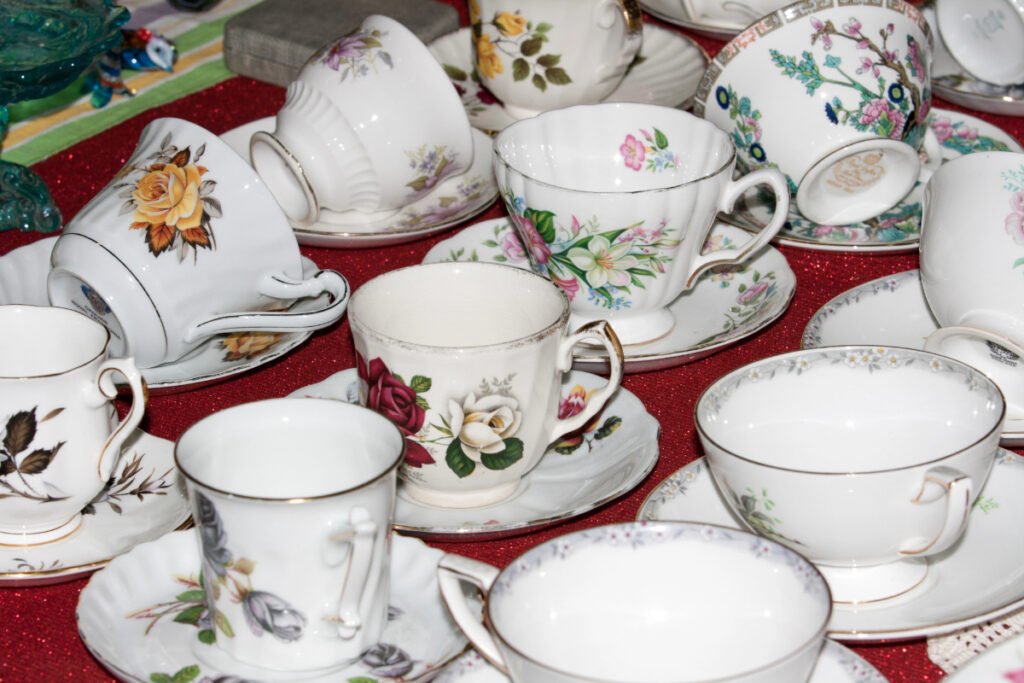
The designs and patterns are one of those first things that would make you go for a vintage teacup because that’s what appeals! But, for antique pieces, designs and design methods showcase the craftsmanship. Some are common, while others are rare and worth a lot!
Hand-Painted vs. Transfer-Printed:
Generally, hand-painted antique cups are like tiny artworks. If you look closely, you’ll see little brushstrokes, small imperfections, and colors that change in depth, making no two cups the same. Genuine handwork makes these cups worth a lot!
On the other hand, transfer-printed cups are more like stamped designs. Patterns repeat perfectly, and under a magnifying glass, you might even see dot-like prints instead of strokes. They’re good, but usually less valuable than hand-painted ones.
Shape and Style:
The way a teacup is shaped says a lot about its maker. Balanced proportions where the height, width, and handle all look “just right” are a good sign of quality.
Also, some cups even have fancy forms like scalloped rims, corset shapes, or fluted bodies, which are harder to make and therefore more valuable.
Gold Decoration (Gilding):
Gold rims and handles are quite common in antique teacups. But not all gilding is equal. Older cups (before the 1850s) used a method that made the gold thick, shiny, and long-lasting. These are typically more premium pieces!
You may even see tiny polish marks from when it was burnished. Whereas, later cups used liquid gold paint, which looked bright but wore off more easily.
Check 4: Check for Complete Sets
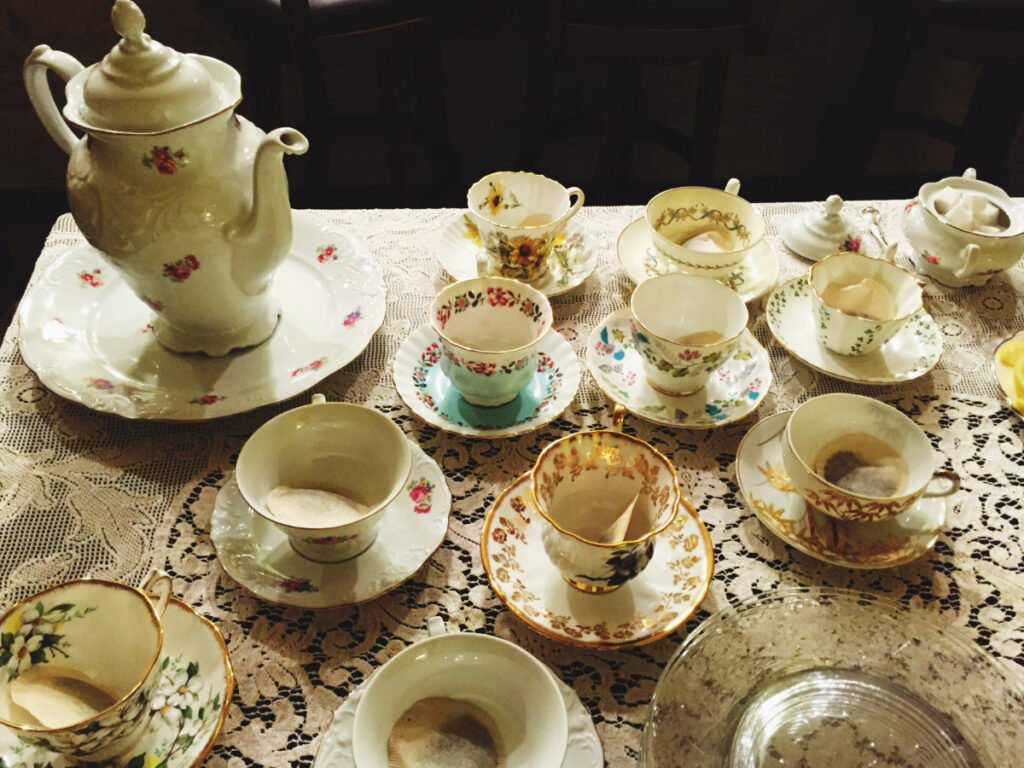
Complete vintage tea sets with saucers and servers often catch a buyer’s attention, since a full matching set is much harder to find than a single cup. So, make sure to look for pieces that are genuinely complete, not married (similar pattern but not identical).
You can do this by comparing the maker’s marks, the prints, style, color, and placement. Moreover, original complete sets would have identical glaze, thickness, pattern, and color as well.
Check 5: Analyze the Rarity
Not all old teacups are rare for the same reason. Some are special because only a few were ever made, while others are rare because of the history they carry or the way they were made. Here’s what adds rarity and value to vintage teacups:
Extremely Limited Pieces:
Some teacups were made in very small numbers. For example, royal families often ordered custom-made cups just for themselves or for special occasions.
Then, factories sometimes created “prototype” cups as experiments, which never went into regular production. Such limited pieces are extremely rare, fetching thousands at auctions and sales!
Historically Significant Pieces:
Other teacups are rare because of the stories they survived. Think of cups that are hundreds of years old, living through wars and everything, but still intact.
Additionally, if cups can be linked to a specific artist or decorator, like a signed painting, a signature on a teacup makes it much more special. At the very top of the market, a tiny Ming Dynasty Chenghua “Chicken Cup” (a wine cup rather than a teacup) was bought for $36.3 million in 2014, a museum-level price that no ordinary teacup comes near.
Difficult or Expensive to Make:
Some teacups are rare because they were incredibly hard to make. Certain designs required multiple firings, special molds, or lots of gold decoration, all of which took extra time and money. Because of this, surviving examples are treasured today.
Check 6: Assess the Condition
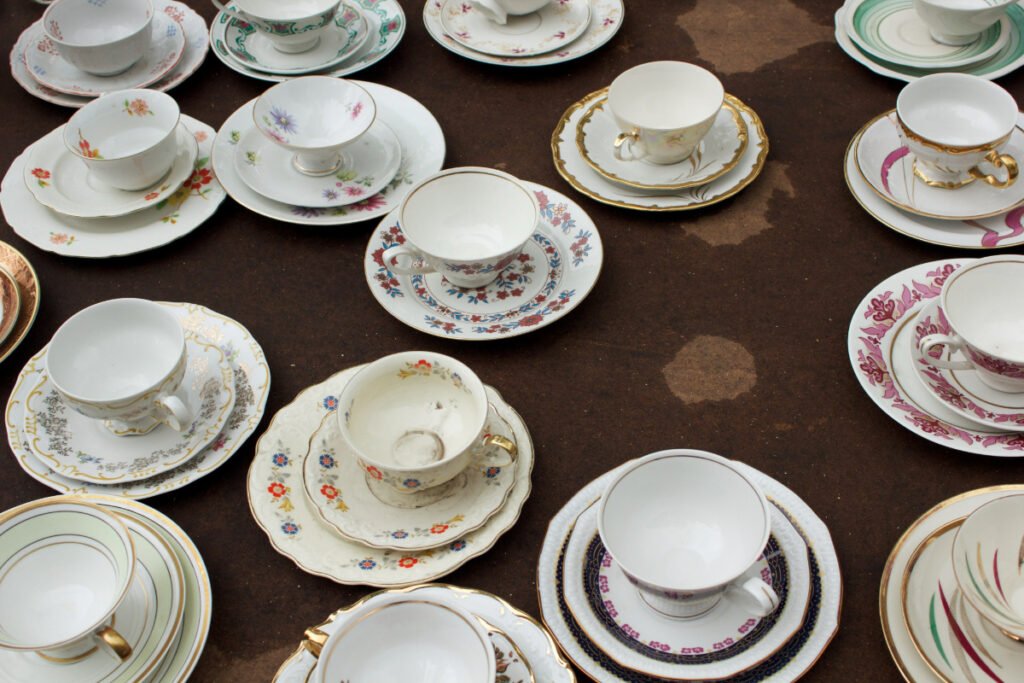
Condition is an influential factor for buyers to evaluate vintage teacups. Naturally, a well-preserved, good-condition piece with no chips and nicks is valued more than a damaged product.
Slight hairline cracks or crazing are often considered fine, but major cracks, complete discoloration, broken rims, or handles can make the piece questionable.
Even if restoration is done, it should look professional and clean. Unevenness and visible glue marks can certainly devalue the cups.
Can you drink out of antique tea cups?
Only with care: old glazes and painted decoration can contain lead, so the FDA advises testing a cup with a home lead-test kit before using it for drinks.
Hand-wash any cup you do use, keep gilded and hand-painted cups out of the dishwasher and microwave, and keep cracked or heavily crazed cups for display.
Check 7: Trace the Provenance
A well-documented history of ownership and the journey from its creation to its current state can add a lot of value to an antique teacup. So, if you’re buying or selling a piece, make sure to check for:
- Museum record – Teacups that were a part of the museum collection with original accession records, like the catalog numbers or approval letters.
- Exhibition history – Pieces that appeared in exhibition displays, scholarly magazines, or research publications.
- Royal attachment – Teacups that were directly associated with aristocracy, that have mentions in the palace inventory records or any gift letter.
- Estate documents – Noble family ownership with original delivery receipts, invoices, or photographs.
- Artist and factory records – Original maker’s document, certificate of authenticity, registration certificate, etc., are highly considered.
If you’re buying or selling, check the mark, the material, and the condition, then look at what similar cups have actually sold for, not what they are listed at, before you settle on a price.
Found this guide useful?
Save it for later
Share it with someone
Keep the old finds coming
New guides and finds worth looking for, delivered to your inbox.
Keep exploring
More guides in Kitchen Collectibles
 13 finds13 Old Glass Bowls Worth Money: Top Makers, Patterns & ValueTop sale $797
 11 findsOld Libbey Glassware: How to Spot Rare Vintage PiecesTop sale $595
 9 finds9 Types of Vintage Tea Cups That Are Highly Collectible TodayTop sale $289
 12 finds12 Rare 1950s Cookie Jars That Are Worth Collecting TodayTop sale $377