
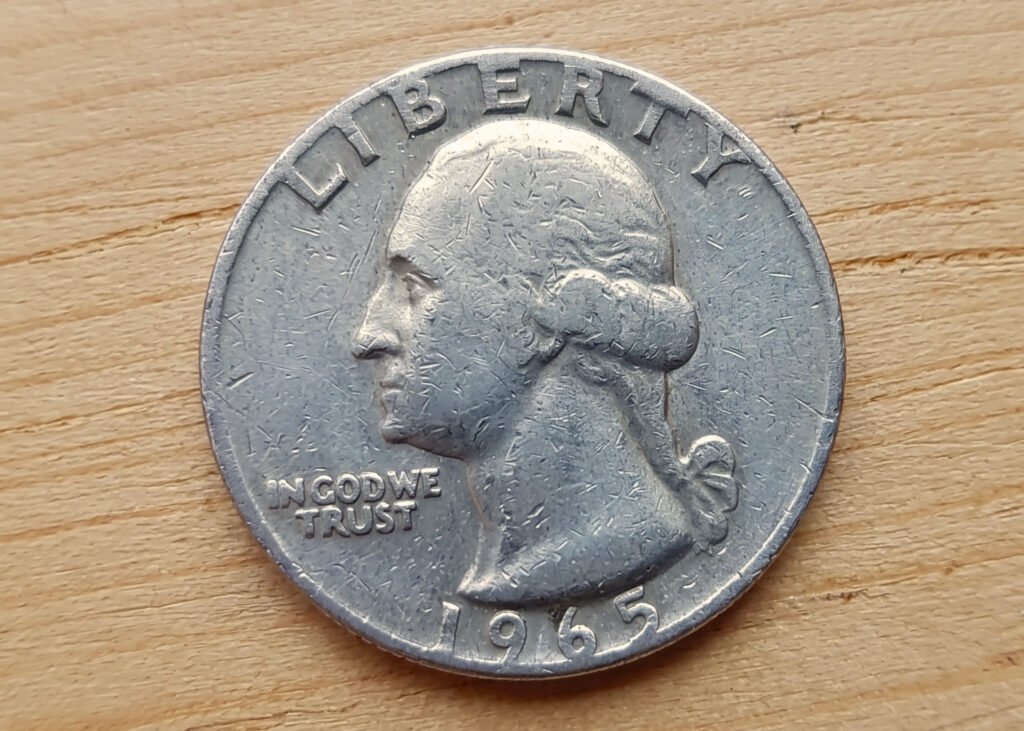
The 1965 Washington quarter is the first clad quarter produced after the enactment of the Coinage Act of 1965, which was signed into law by President Lyndon Johnson on July 23, 1965. The law changed the 90 percent silver quarter into a clad quarter.
The clad quarter coin has a copper-nickel alloy outer layer and a pure copper core. The 1965 date continued until August 1966, minting over 1.8 billion coins.
This massive production makes 1965 Washington quarters fairly common, but some can sell for hundreds to thousands. Let’s find out why!
Is Your 1965 Quarter Real? Here’s How to Identify
Before you get into the values, the first step is to find out whether your coin is genuine. Below are the key things you should be checking first.
No Mint Mark
The mint mark on the 1965 quarter confuses many. Before 1965, the mint mark appeared on the coin’s reverse side, right below the wreath.
But from 1965 until 1967, the Mint removed all mint marks from all coins, mainly to stop people from collecting them.
So, a genuine 1965 quarter will not have a mint mark. If one does, it’s likely a fake.
Clad Quarter Weight
A normal clad 1965 quarter will weigh 5.67 grams, but a quarter minted on a leftover 90% silver blank weighs around 6.25 grams, which will not be difficult to spot on a scale calibrated to 0.01 grams.
Checking the weight can help you spot errors, too. For example, if a quarter weighs around 4.7 grams, it possibly lacks the clad layers. And a lightweight small coin might be struck on a dime or cent planchet.
The Copper Edge
Flip the coin sideways, and you should see a thin copper-colored edge because the copper core is visible between the outer layers on a clad 1965 quarter.
This is another way of identifying an error coin. The silver error coin will have a solid silver-colored edge, with no copper strip.
However, be cautious because the copper edge may be hidden due to wear and dirt.
Special Mint Set Coin
The Mint didn’t release any proofs in 1965. But it produced Special Mint Sets, aka SMS, minted at the San Francisco Assay Office. All 2.36 million SMS sets produced in 1965 have no mint mark.
How to spot it?
Quarters in the Special Mint Set have a satiny surface, sharp design, and highly defined rims unlike the standard-issue quarters (aka business strikes).
Free pieces can easily slip into rolls and cans. The SMS graded by PCGS will be labeled SP.
Is Your 1965 Quarter Worth Anything? & What Makes It Valuable?
Overall, most 1965 quarters are worth exactly 25 cents because they were struck in huge numbers. But errors and certain varieties are rarer to find, so they can fetch much more.
- Grade and Condition – This is the key factor. As per the 70-point Sheldon scale, uncirculated quarters of the highest mint state grade fetch premiums. An MS-66 is worth about $15, but an MS-67 or higher is worth more.
- Metal and Planchet – The composition is critical for 1965 more than any other year. The quarters made from leftover 90% silver stock are a transitional error. This is where the most expensive 1965 quarters are found.
- Error Type – The rarer, bigger, and clearer the error, the more it’s worth. For example, a 50% off-center strike with a visible date is worth more than a 10% one. For 1965 quarters, wrong planchet errors (struck on dimes and cents planchets) are more valuable.
- SMS Cameo Designations – Special Mint Set coins come in two varieties: CAM and DCAM. A plain SMS quarter is common, but a high-grade Deep Cameo is worth more.
- Certification – Buyers usually pay more when a trusted service has confirmed the quarter’s grade, error, and variety. This matters most for silver errors and doubled dies, since fakes and altered coins are common.
Rare 1965 Quarter Errors and Varieties Worth Money
Below are the 1965 Washington Quarters that outprice the common and invaluable examples.
1. 1965 Quarter Struck on a 90% Silver Planchet
Estimated Value: $1,000 to $15,000+
This is among the rarest 1965 quarters. Once the mint switched to clad composition, a few leftover 90% silver quarter planchets slipped into presses, resulting in a rare 1965 90% silver quarter.
Very few are known today and can easily sell for tens of thousands of dollars in Mint State.
- What to Check: 6.25 g, no copper stripe
- Quick Notes: Always authenticate; altered 1964s exist
2. 1965 Quarter Stuck on a Nickel Planchet
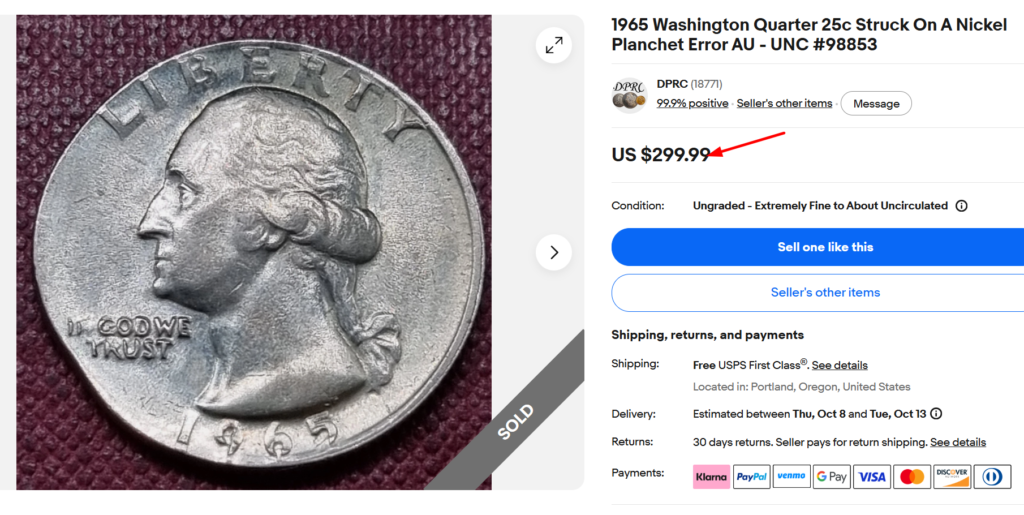
Sold for $300
This is another valuable transitional error, where a 1965 quarter is struck on a nickel planchet. This planchet is smaller than a quarter blank, so parts of the design run off the edge.
Also, these blanks are solid copper-nickel with no copper core. So, you will not see a copper edge. Lastly, the coin weighs about 5 grams instead of 5.67.
- Estimated Value: $100 to $700+
- What to Check: Undersized, about 5.0 g
- Quick Notes: No edge stripe, unlike clad dime errors
3. 1965 DDO FS-101 Quarter (Doubled Die Obverse)
The FS-101 is the most famous quarter variant of the year. As per PCGS, these have obvious doubling on most letters of “IN GOD WE TRUST” and “LIBERTY,” as well as the date and the left side of Washington’s portrait.
Worn DDO 1965 quarters are quite inexpensive, but PCGS or NGC mint-state examples can fetch a few hundred dollars.
- Estimated Value: $50 to $1,500+
- What to Check: Doubled LIBERTY, motto, date
- Quick Notes: Rule out flat machine doubling first.
4. 1965 Quarter SMS Obverse Struck-Thru Error
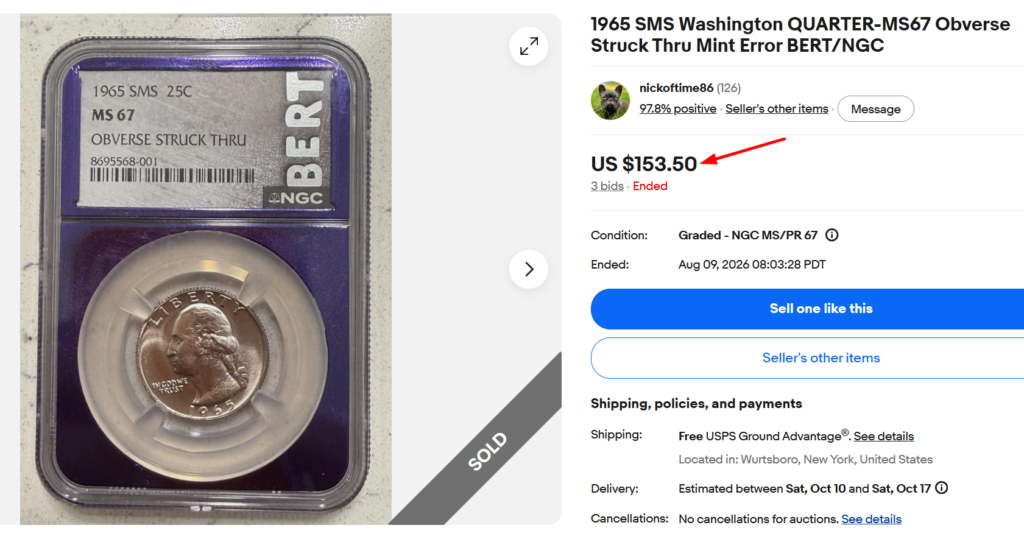
Sold for $153
This error occurs when something gets trapped between the die and the planchet. It could be grease, cloth fibers, or loose metal, and it creates a sunken/weak or missing design.
You can easily spot it on Special Mint Set coins because the rest of the strike is sharp. A top grade makes an SMS error more desirable.
- Estimated Value: $100 to $500+
- What to Check: Sunken or missing design area
- Quick Notes: Retained debris can add extra value.
5. 1965 Washington Quarter Missing Clad Layer
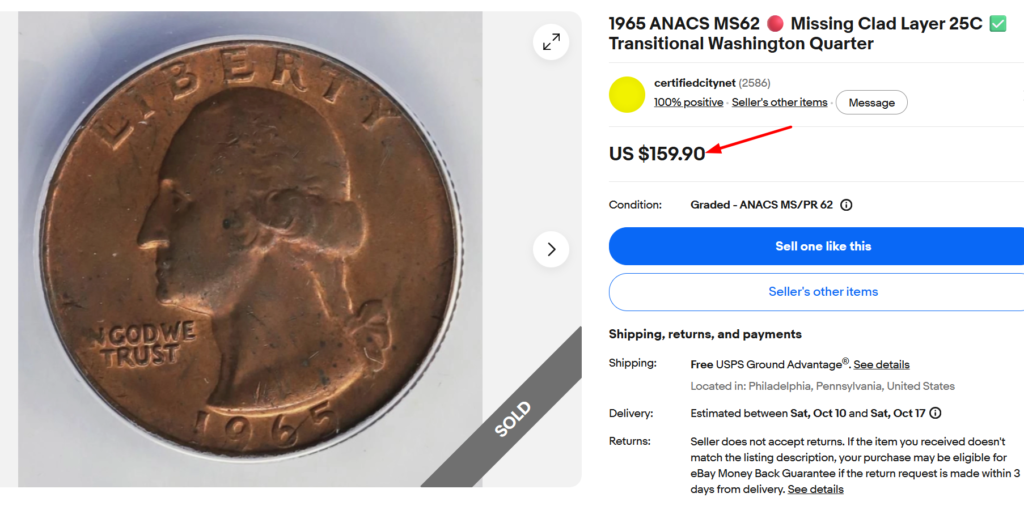
Sold for $160
This is a clad-only error, so 1965 was the first year it appeared. It happens when the copper-nickel outer layers came off before striking, showing the copper core.
So, this coin has a copper color on one face and weighs about 4.7 grams. However, be careful because acid and chemical damage can replicate this error; genuine examples have a crisp, fully struck design.
- Estimated Value: $50 to $400+
- What to Check: Copper face, about 4.7 g
- Notes: Check the crisp design for authenticity
6. 1965 Quarter Off-Center Error
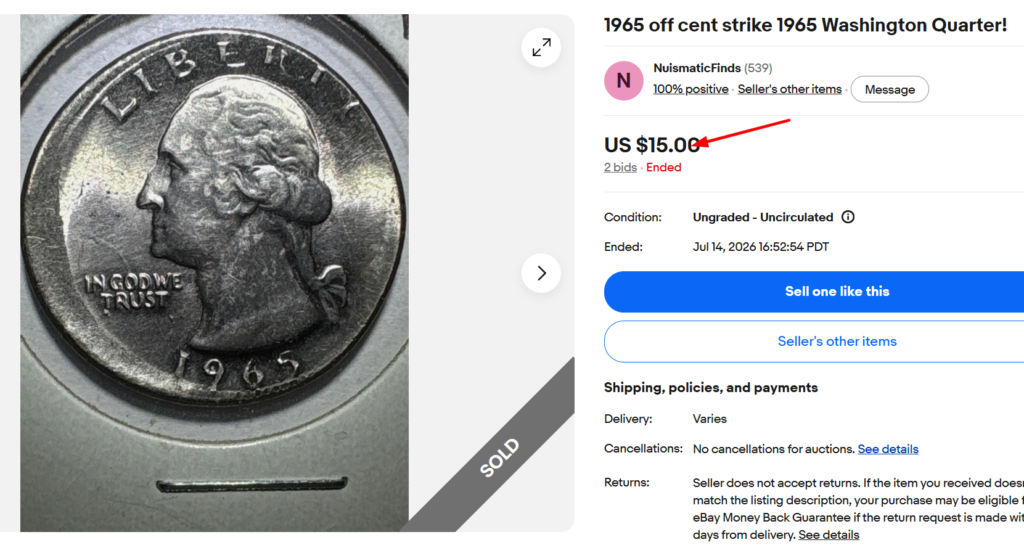
Sold for $15
When the planchet is not aligned in the collar, the design will fall partially on bare metal. The value of this error depends on the degree to which it is off-center. 10-20% off is common, but one that is 50% off-center with a full, visible date is worth much more.
- Estimated Value: $25 to $500+
- What to Check: Blank crescent, full date
- Quick Notes: Date must show for the top value.
7. 1965 Clipped Planchet Quarter
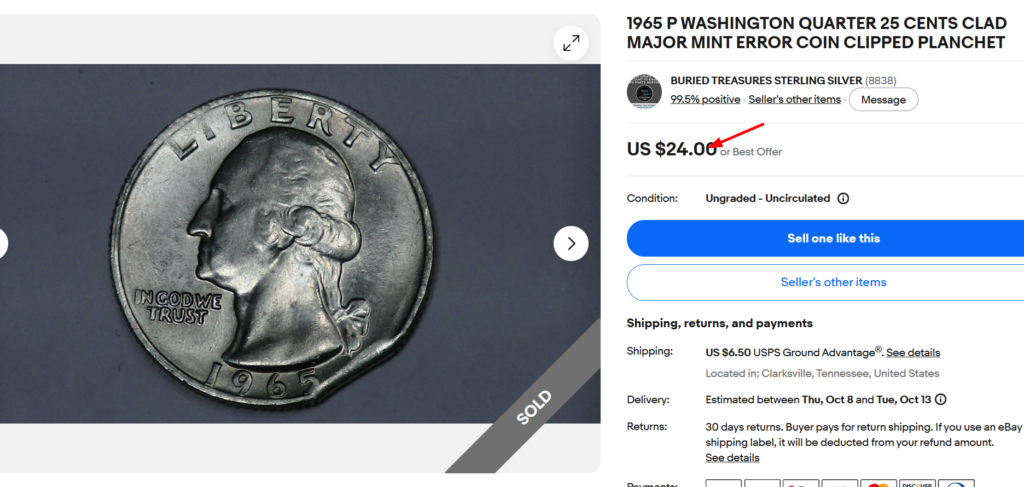
Sold for $24
Clipped planchets come from the blanking press punching into metal that was already cut, creating a curved bite on the coin. A genuine clip shows the Blakesley effect, a weak rim spot directly opposite the clip.
Small clips are worth just $15 to $40, but large ones bring more.
- Estimated Value: $10 to $150+
- What to Check: Curved clip, weak opposite rim
- Quick Notes: No Blakesley effect usually means damage.
8. 1965 SMS Quarter (CAM or DCAM)
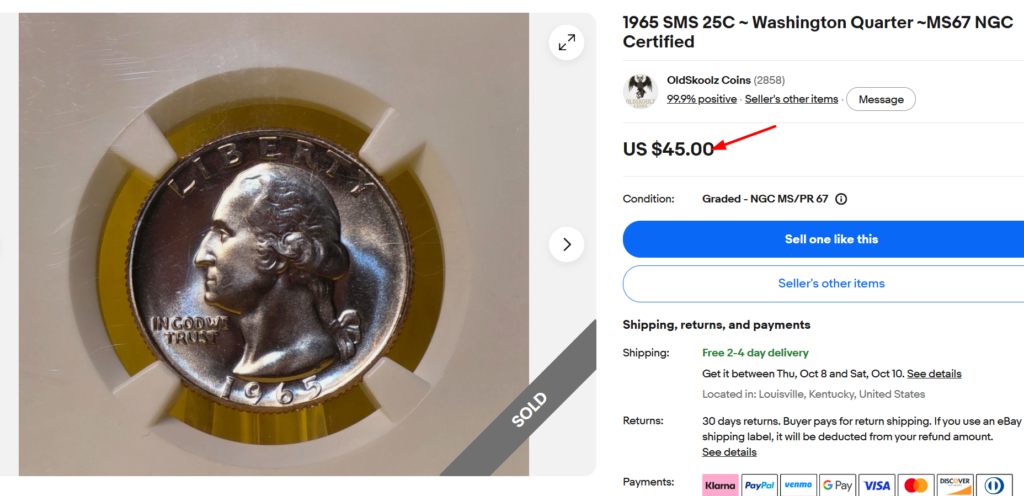
Sold for $45
Most Special Mint Set quarters are common and invaluable. But some strikes came from fresh dies, so they feature a frosted raised design on reflective fields. Grading services designate these coins as CAM (Cameo) and DCAM (Deep Cameo), and these are worth more than standard SMS 1965 quarters.
A regular SP-67 SMS quarter is valued at around $30, while the same grade with DCAM can bring up to a thousand dollars.
- Estimated Value: $3,000 to $5,000+ (SP-67 DCAM)
- What to Check: Heavy frost on both sides
- Quick Notes: Only graders assign CAM or DCAM
Most 1965 Washington quarters sell for pocket change today, but if you know how to spot the rare varieties and errors and how much the coin should weigh, you can tell whether yours is worth something more.