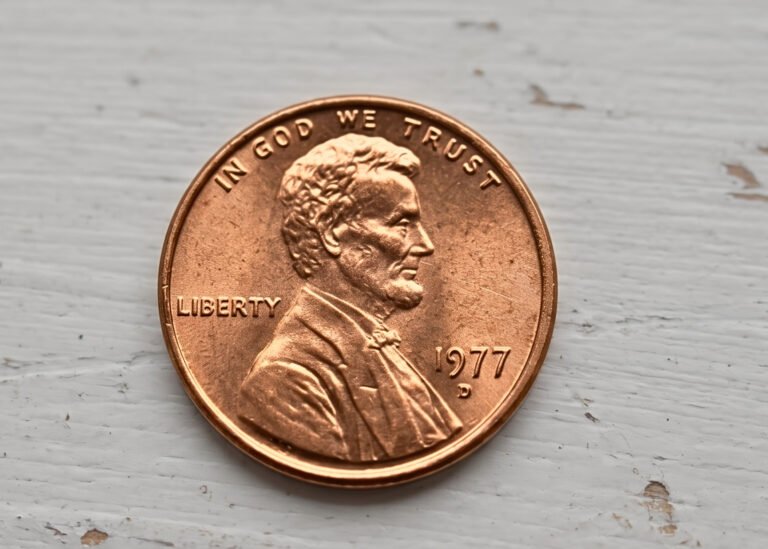

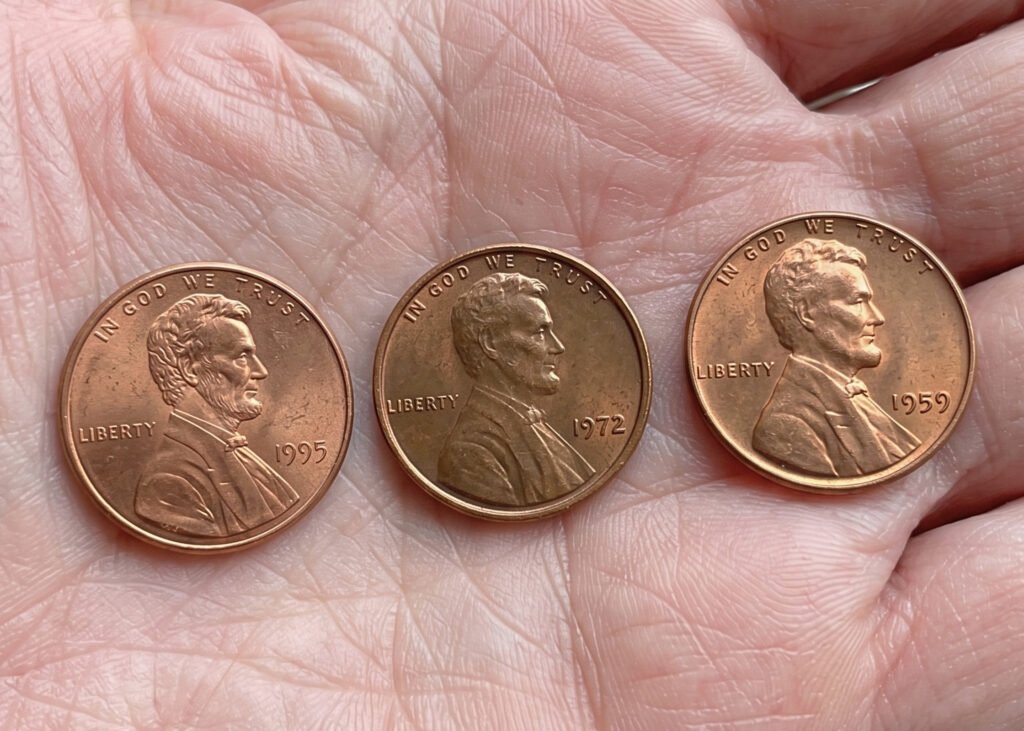
The memorial reverse of the Lincoln penny was designed by Frank Gasparro, and it was struck along with the obverse side created by Victor David Brenner. It was first produced in 1959 to commemorate the 150th anniversary of Abraham Lincoln’s birth.
However, in 2009, the US Mint retired this design to use the four bicentennial reverses, and in 2010, the shield reverse was introduced.
From 1959 to 2008, only a few dates, double dies, and varieties were produced, and they remain among the most desired pennies. Here are the top 13 rare Lincoln Memorial pennies worth collecting.
1. 1995 Doubled Die Obverse Cent
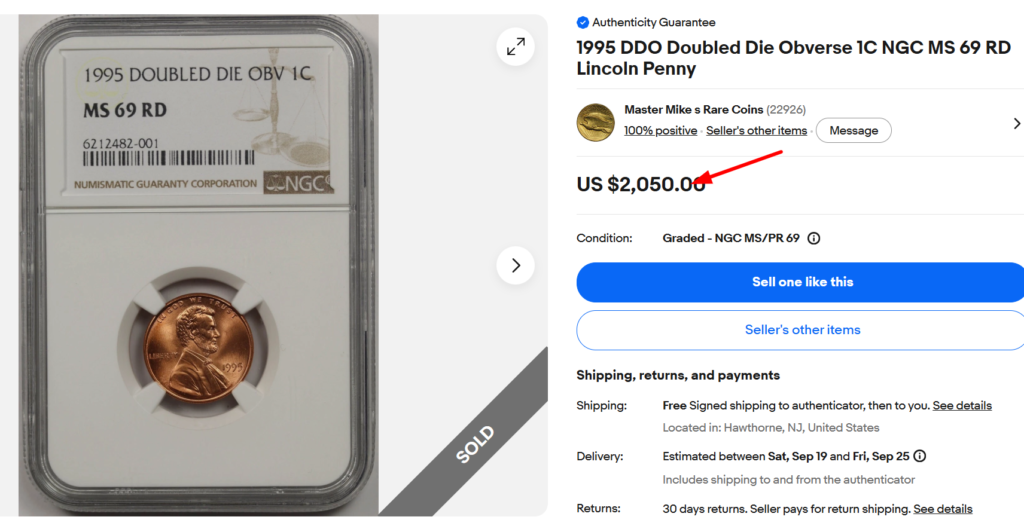
Sold for $2,050
There is dramatic doubling on the 1995 DDO of the words “LIBERTY” and “IN GOD WE TRUST,” and it can be seen even without using a magnifying glass or a loupe.
This DDO was the last one made for the Lincoln cent series before the Mint changed its procedure to use just one die for minting coins in the late 1990s. That makes it quite a popular error Memorial cent.
- Estimated Value: $20 to $150+ Mint State
- Production Years: 1995 (Philadelphia)
- What to Check: Doubling on “LIBERTY” motto
2. 1972 Doubled Die Obverse Penny
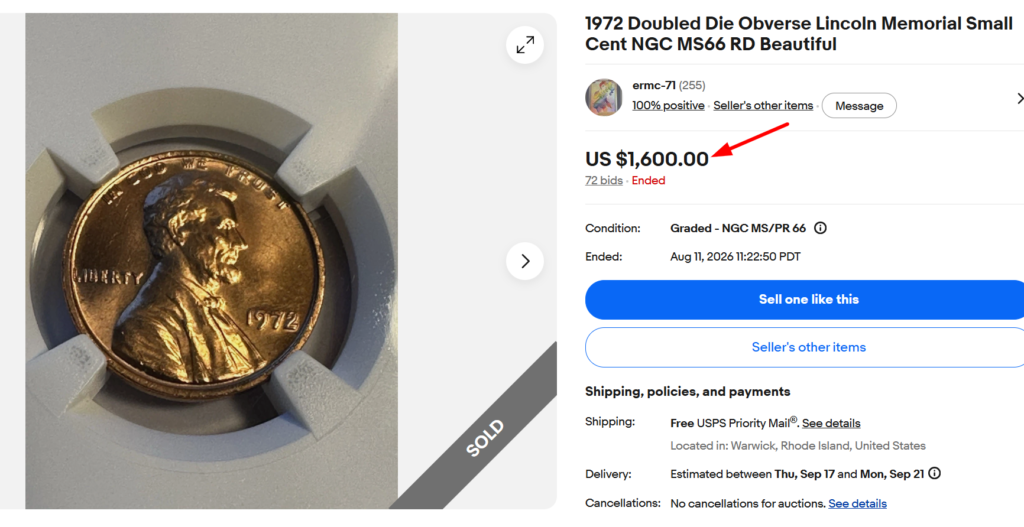
Sold for $1,600
The DDO-001 of 1972 is the best-known doubled die coin from the Memorial era, other than the 1969-S. The doubling is complete in the date, LIBERTY, and IN GOD WE TRUST, and is observable without the use of magnification; hence, even new collectors discover them without knowing.
There are nine 1972 doubled dies, but the FS-101 is the valuable one.
- Estimated Value: $200 to $14,000+ (top grades)
- Production Years: 1972 (Philadelphia)
- What to Check: Bold doubling in date, LIBERTY, and IN GOD WE TRUST
- Quick Notes: FS-101 is the valuable variety, not FS-102
3. 1969-S Doubled Die Obverse

Sold for $600
This coin is one of the gems from the Memorial cents. The separation can be seen clearly on LIBERTY, IN GOD WE TRUST, and the date on this 1969-S DDO. However, since the mint mark was hand-punched after striking, it’s never doubled.
Very few originals are known to exist today. There’s another story about this piece. It was initially considered a fake by the Secret Service, and most of them were confiscated as such.
- Estimated Value: $250 to $1,000 ($25,000 to five figures+ at auction)
- Production Years: 1969 (San Francisco)
- What to Check: Doubling on LIBERTY, date, motto
- Quick Notes: Mint mark must NOT show doubling
4. 1982-D Small Date Copper
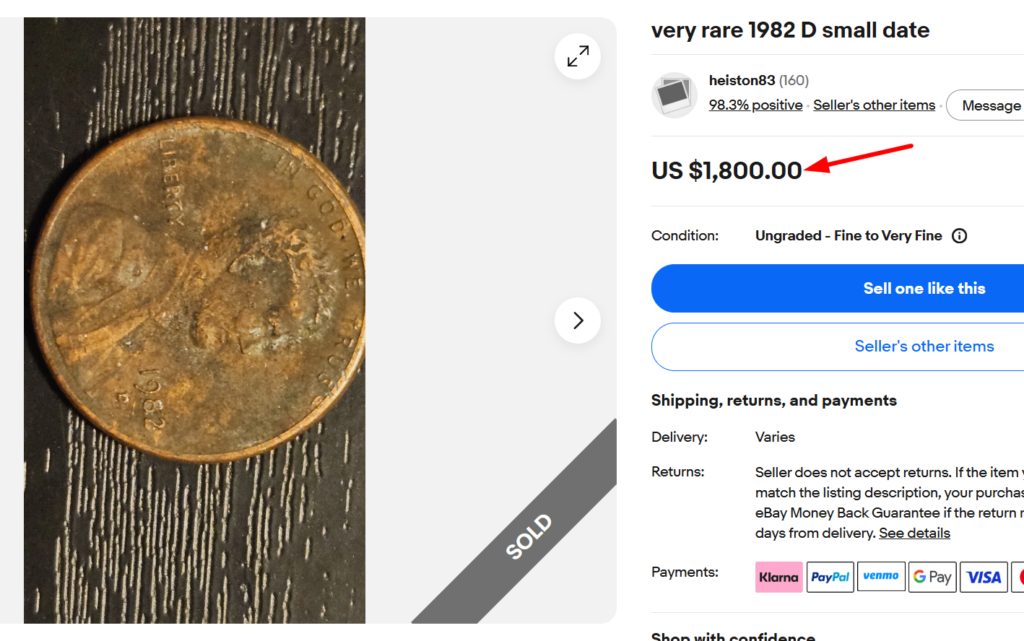
Sold for $1,800
This coin is a transitional error. In 1982, the Mint transitioned from using 95% copper (3.11 grams) to copper-plated zinc (2.5 grams) coins. A few old copper planchet coins made it into circulation, minted from Denver dies with Small Dates.
Only a few such coins have been identified since 2016. The digital scale is your go-to tool to verify it. If your 1982-D Small Date weighs 3.1 grams, then you’ve got yourself a valuable coin.
- Estimated Value: $1,000 to $2,500 (circulated); $8,400 to $18,800+ (graded)
- Production Years: 1982 (Denver, error only)
- What to Check: Small Date, D mint mark, 3.1 grams
- ID Notes: Check the weight first.
5. 1960-D Small Date over Large Date (RPM/OMM)
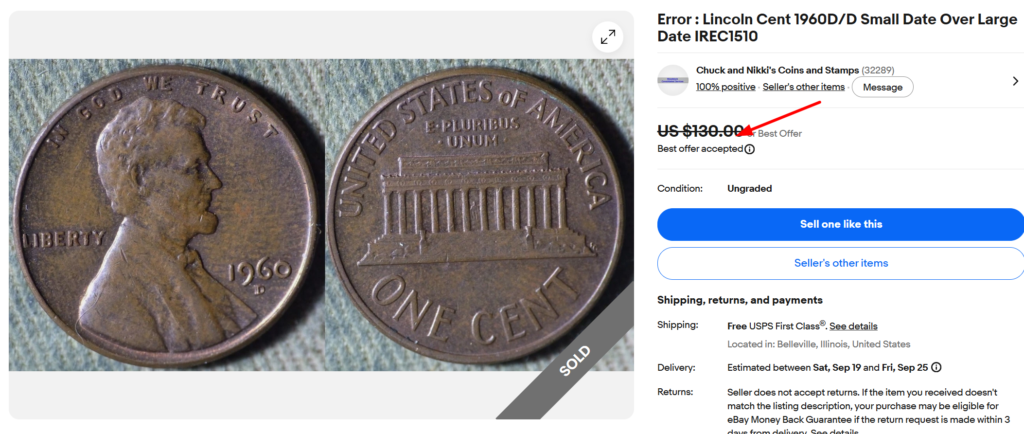
Sold for $130
The 1960 Denver cent was issued in both Small Date and Large Date varieties. In addition, an over-mintmark type with a Small Date die overstruck on a Large Date die exists. This coin is frequently referred to as FS-101 and has a D/D repunched mint mark too. Therefore, it is called one of the most interesting die marriages of the entire series.
The most distinctive feature is the numeral “8” and the base of the numeral “6,” while the mint mark exhibits clear repunching through a 10x loupe.
- Estimated Value: $50 to $400+ certified
- Production Years: 1960 (Denver only)
- What to Check: Small Date over Large Date
- Quick Notes: D/D repunched mint mark boosts value.
6. 1970-S Small Date (High 7 Variety)

Sold for $50+
The 1970-S penny came in two varieties, Small Date and Large Date, and distinguishing between the two can be tricky.
In the Small Date variety, the horizontal line of the numeral 7 aligns with the 1, 9, and 0. In the Large Date variety, the numeral 7 is positioned lower than the rest of the numerals. Also, the LIBERTY is poorly defined on the Small Date variety; it’s an easy way to spot this cent.
- Estimated Value: $20 to $3,000+ in high grades
- Production Years: 1970 (San Francisco)
- What to Check: Top of the “7” level with other digits
- Quick Notes: Weak LIBERTY confirms Small Date variety
7. 1971 Doubled Die Obverse

Sold for $750
The 1971 DDO has excellent doubling on LIBERTY and IN GOD WE TRUST. While not quite as impressive as the 1969-S and 1972, it is still a very difficult doubling die from early in the Memorial series.
Most examples are encountered in circulated condition, so any Red Mint State specimen commands a premium. The 1971-S Proof DDO coin is an even rarer find.
- Estimated Value: $30 to $500+ certified
- Production Years: 1971 (Philadelphia)
- What to Check: Doubling on LIBERTY and motto
- Quick Notes: Machine doubling is common; verify carefully
8. 1983 Doubled Die Reverse Cent
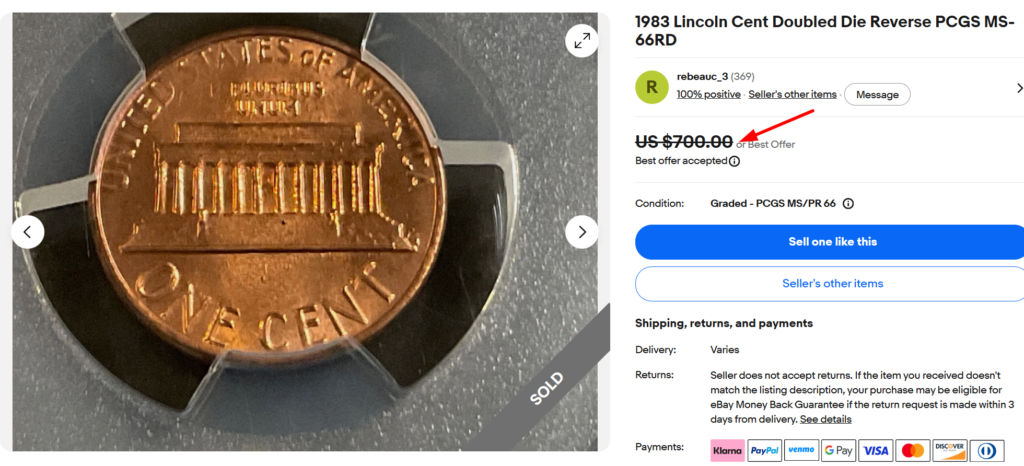
Sold for $700
In 1983DDR, the reverse doubling is the strongest of any Lincoln cent ever, with clear separation present on “ONE CENT” and “UNITED STATES OF AMERICA”. This doubling is Class IV, or shifted-hub doubling, and you can easily notice it at 10x magnification.
Mint State Red 1983 DDR specimens graded MS65 and up are the most valuable ones.
- Estimated Value: $200 to $7,000+ in top grades
- Production Years: 1983 (Philadelphia)
- What to Check: Doubling on “ONE CENT” reverse
9. 1984 Doubled Ear (FS-101)
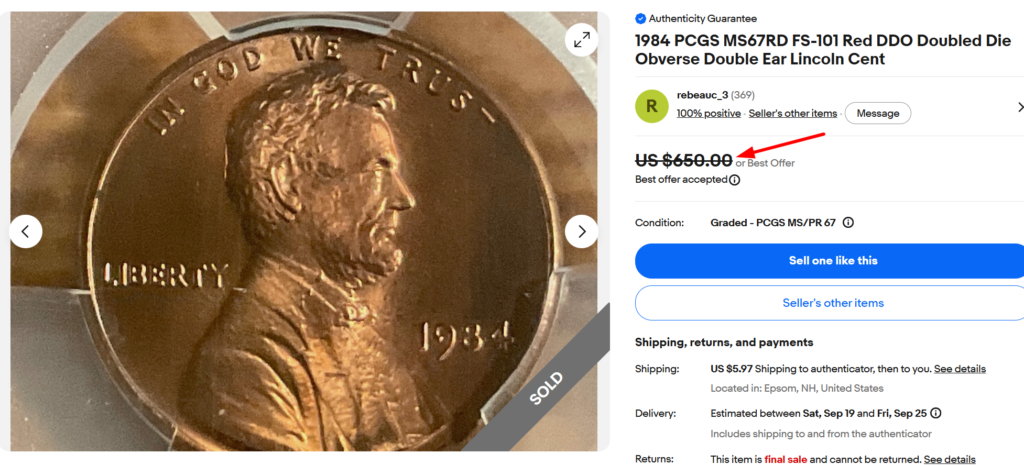
Sold for $650
Known by its nickname, “Doubled Ear,” this particular die type features a definite second ear lobe on the Lincoln penny coin, along with a double bow tie and double beard.
The doubling of the ear lobe can be seen by the naked eye once one knows where to look. The value depends on how strong the doubling is and the coin’s condition.
- Estimated Value: $50 to $2,000+ certified
- Production Years: 1984 (Philadelphia)
- What to Check: Second earlobe below the main ear and the bowtie
10. 1988 Doubled Die Reverse (Reverse of 1989)
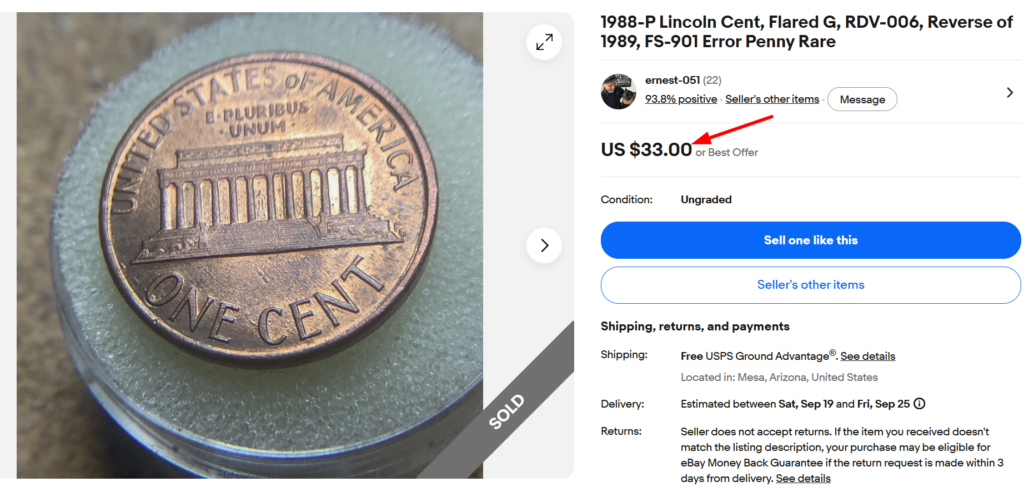
Sold for $35
The 1988 has a rare “Reverse of 1989” type that features a different style of FG initials compared to the usual reverse of the 1988.
This is a minor transitional type that often gets overlooked by most numismatists. However, high-grade Red specimens with the correct reverse have fetched good prices.
- Estimated Value: $50 to $7,000+ (top grades)
- Production Years: 1988 (both mints)
- What to Check: Larger, thicker FG initials
- Quick Notes: Compare FG size to a normal 1988
11. 1992 Close AM Penny
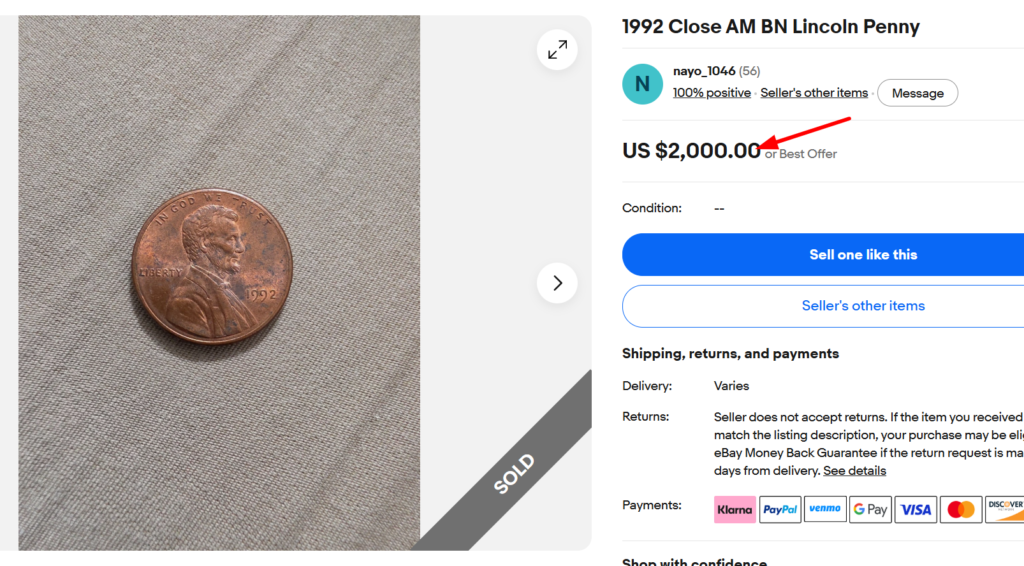
Sold for $2,000
Normal 1992 cents show a Wide gap between the letters A and M in “AMERICA.” But some rare Philadelphia-minted 1992 cents have been made using the reverse die intended for 1993 cents, making the distance between A and M negligible.
Look at the FG initials too, as they are located farther from the Memorial building on the Close AM.
The Close AM varieties are extremely rare, and there are fewer than 10 specimens confirmed.
- Estimated Value: $3,000 to $25,000+ certified
- Production Years: 1992 (Philadelphia error)
- What to Check: A and M in AMERICA nearly touching; FG initials sit distant.
12. 1992-D Close AM Cent
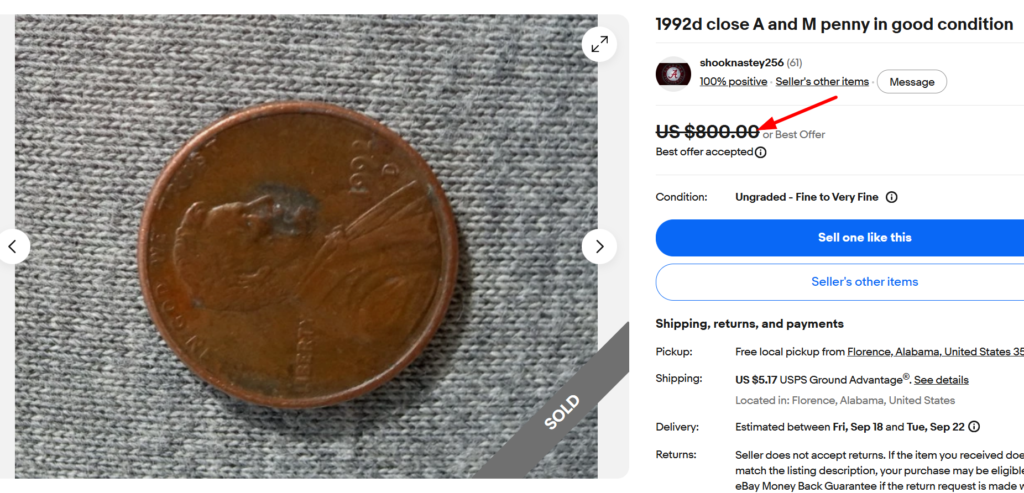
Sold for $800
This is identical to the Philadelphia one, only from Denver, and slightly less unique, with only 30 to 50 specimens known. It is definitely a true four-figure rarity no matter the condition, as the error is completely unforeseen on a 1992 cent.
- Estimated Value: $700 to $14,100 at auction
- Production Years: 1992 (Denver error)
- What to Check: Close A-M spacing, D mint mark
- Quick Notes: Plating blisters can fake this look
13. 1998 Wide AM Cent
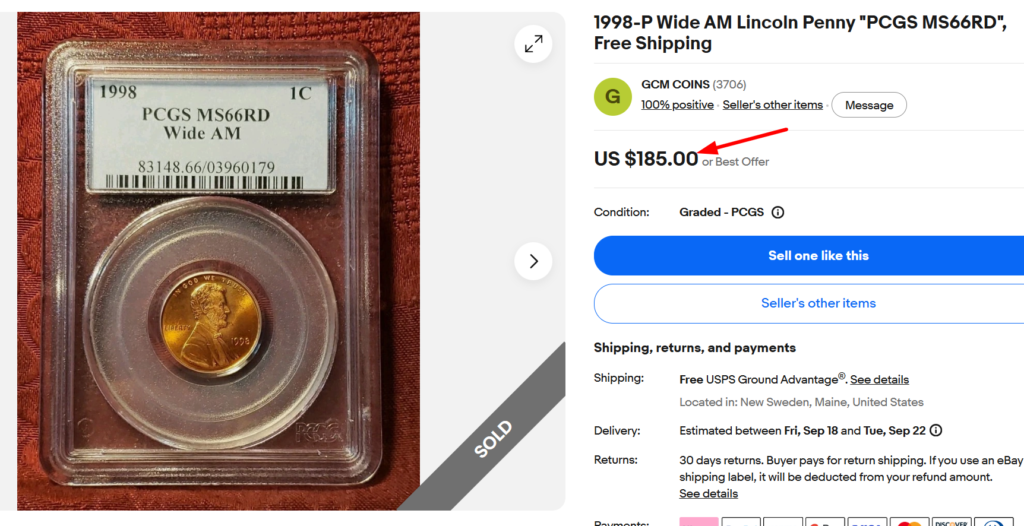
Sold for $185
The business strikes cents beginning in 1993 had a Close AM reverse. However, in 1998, a few were inadvertently struck using the proof reverse die, which had wider spacing. In this particular issue, the A and M letters are well-separated, and the FG initials are near the Memorial.
- Estimated Value: $25 to $500+ certified
- Production Years: 1998 (Philadelphia error)
- What to Check: Wide gap between A and M, FG close to Memorial Building
Before you sell or collect a Lincoln Memorial penny, grab your 10x loupe, digital scale down to 0.01g, and check the details carefully. Once you’ve learned how to spot a Close AM, a Doubled Ear, or a Small Date 1970-S, you might spot some super rare cents.
And if you see anything good, don’t clean it or sell it as-is. Take it to PCGS or NGC for grading and look up its current price on eBay and auction sites, like Heritage Auctions.