
Most people donate or sell away old cameras for a few bucks, thinking they are worth less. But you wouldn’t do that if you knew that some vintage cameras might be worth over $5,000 or more today.
But only some. And that’s why knowing the difference between a valuable and cheap old camera becomes crucial.
In this guide, you will learn how to identify an old camera and what shapes its collector value, along with some examples of valuable models.
How to Identify an Old Antique Camera?
Identifying an old camera requires you to consider four basic things: its maker, date of production, model, and age. Simply work your way through the following things, and you will be able to identify any camera within ten minutes.
Step 1: Spot the Maker’s Mark
The maker’s name is most often clearly marked somewhere obvious. First look at the top plate, right above the lens. If it isn’t there, check the front of the body near the lens ring, then the leatherette side panels, and finally the base plate.
You would find the maker name stamped in one of these spots. Some popular vintage camera makers to watch for:
- German makers – Leica (also engraved as “Leitz Wetzlar”), Zeiss Ikon, Voigtländer, Rollei, Rolleiflex, Contax, Agfa, Kodak Retina (made in Stuttgart)
- Japanese makers – Nikon, Canon, Olympus, Pentax (also marked “Asahi Pentax”), Minolta, Yashica, Mamiya, Fuji
- American makers – Kodak, Polaroid, Bell & Howell, Graflex, Argus, Ansco
- Swedish and Swiss – Hasselblad, Alpa, Compass
If the body has a label reading “Made in Occupied Japan,” then your camera was made between the years 1947 and 1952, when the country was occupied post-war; that in itself adds up to some value for your collectible.
Likewise, “West Germany” and “DDR” point to the decade in which they were produced.
Step 2: Read the Serial Number
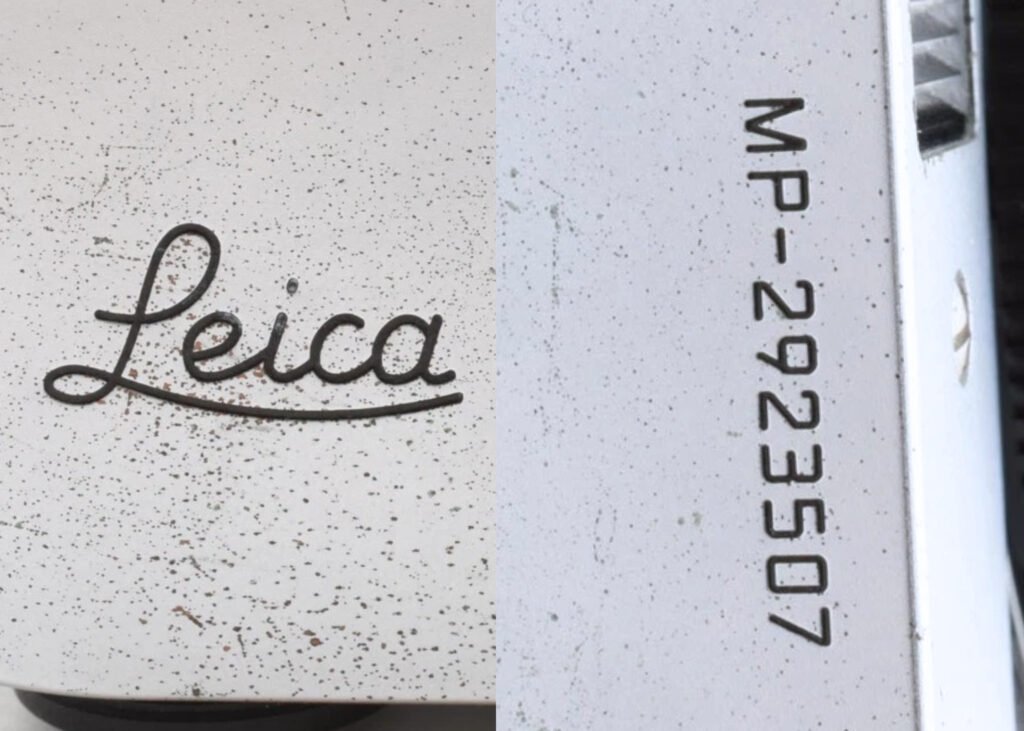
Every authentic camera has a serial number. It’s usually stamped on the top plate near the shutter speed dial, on the base plate, inside the film chamber, inside the back cover, or on the accessory shoe.
Knowing the serial numbers is essential because:
- It helps identify the exact manufacturing year. Leica, Nikon, Canon, and Rolleiflex have all made public serial number-to-year tables that collectors still use today. “Leica serial number list” and “Nikon F serial numbers” searches on the Internet will tell you the manufacturing year and batch.
- It helps spot special variations. It matters because first batches, transitional batches, and limited-production batches can sell for two or three times more than regular batches.
Step 3: Know the Camera’s Type
Your camera’s body shape tells you its format and mechanism and affects its value differently. Here are the most popular types you should know:
- A box camera is a basic rectangular camera with a small window at the top. Typical examples include most Kodak Brownies. They’re inexpensive to produce, produced in millions, and are worth around $15 to $50, but those manufactured before 1910 can be valuable.
- A folding camera features leather bellows that can extend when a door of the camera is opened on the front part. Folding cameras were popular between 1900 and 1950.
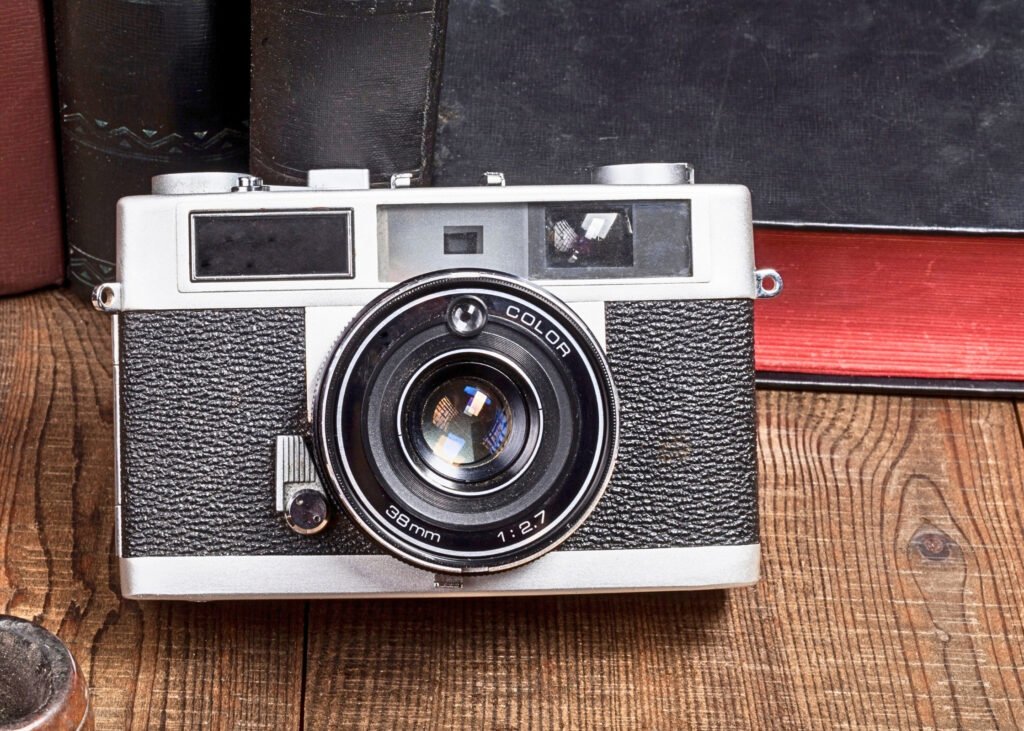
- Rangefinder cameras use a small second window on the top plate to focus. When you look through the viewfinder, you see a small patch that shifts as you turn the focus ring. Leica M-series, Contax IIa, and Canon 7 are classic rangefinders and generally the most valuable.
- SLR (single-lens reflex) cameras show you the image through the actual taking lens using a mirror and prism. The bump on the top is the prism housing. Examples are Nikon F, Canon AE-1, and Pentax K1000.Nikon F, Canon AE-1, and Pentax K1000 are all SLRs.
- TLR cameras have two stacked lenses on the front. One looks through the waist-level finder. These usually shoot 120 medium format film. Some popular TLRs are Rolleiflex and Yashica-Mat.
- Instant cameras such as Polaroid SX-70 and the Land Camera series create prints seconds after pressing the shutter release.
Step 4: Dating Information
In addition to the serial number, some physical aspects can also help you date an old camera.
Film Format
The film type can tell you a lot about a vintage camera. For example, models using 620 and 127 films were built before 1965, and cameras with 220 film support were built in the 1960s. Digital memory cards have only existed since 1990.
Metering Technology
If a camera has no meter at all, it usually dates back to pre-1960. If the camera has a selenium meter (the honeycomb-looking meter above the lens, no battery required), it is from about 1955 to 1970. A CdS or silicon meter that needs a battery is likely from 1965 or later.
Flash Mount
No flash mount indicates it’s a pre-1950 or earlier model. A flash mount without electric contact means that it’s from the 1950s. A flash mount with a center contact and PC sync socket on the front panel is typical for the 1950s onward.
Lens Coating
Uncoated lenses are translucent and have some shine. Single-coated lenses have a light brownish or bluish color, whereas multi-coated lenses have vivid purple, green, or magenta colors, which usually indicates a production year after 1970.
Handy Tip: If the leatherette covering of the body is peeling and showing green/brown fabric under it, the camera is likely a pre-1960s model, since modern reproductions are covered with foam backing.
What Makes an Old Camera Worth Money?
The value of a vintage camera largely depends on five factors, which are:
- Prestige of Brand Name – A Leica will sell ten times better than the same Kodak camera. The more renowned the brand, the more valuable the camera.
- Rarity & Limited Production – Fewer units produced, and/or some special variants are usually pricier.
- Condition – An old camera in working condition is worth much more than a broken one. The shutter should work at all speeds; the metering system must function; light seals should not be tacky.
- Original Accessories – Accessories like the box, instruction book, leather case, shoulder strap, lens set, and warranty card may double the price of a camera if intact.
- Collector Demand – This is subjective. Some models are popular since they are actively used by photographers, while others are just display items.
New, boxed, and fully functional condition may make the camera worth 3 to 5 times more expensive than the same model “shelf queen”.
5 Examples of Highly Valuable Old Cameras
1. Leica M3 (1954 to 1966)
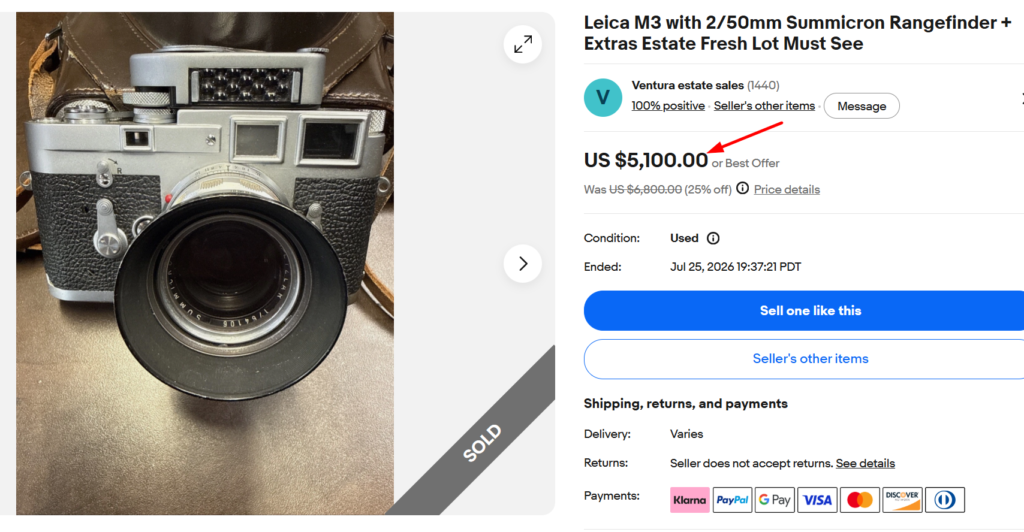
Sold for $5,100
The M3 was the camera that made Leica the standard for collectors. It had the first M-mount bayonet and a combined viewfinder/rangefinder window.
The early double-stroke body numbers with low numbers are the most desirable, especially if the top plate is in excellent condition and the leather is in place.
- Estimated Value: $700 to $4,000+
- Production Years: 1954 to 1966
- What to Check: Serial number, double vs. single stroke
2. Hasselblad 500C/M
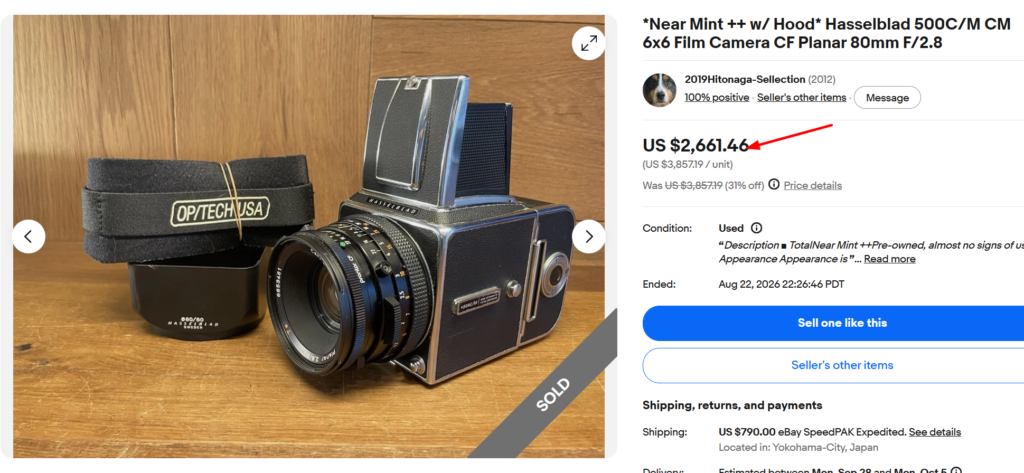
Sold for $2,660
Did you know that NASA used Hasselblad medium format cameras on the Apollo lunar missions? Well, that’s a milestone that still gives the brand an upper hand over others, even for its civilian models.
The model 500 C/M is the workhorse of the V-series cameras, designed to be used together with Zeiss lenses and an A12 film pack. The value goes up for a complete kit.
- Estimated Value: $1,000 to $3,500+
- Production Years: 1970 to 1994
- What to Check: Zeiss lens, film back, waist finder
- Value Notes: Chrome bodies are collected more than black ones.
3. Canon 7 with 50mm f/0.95 Lens
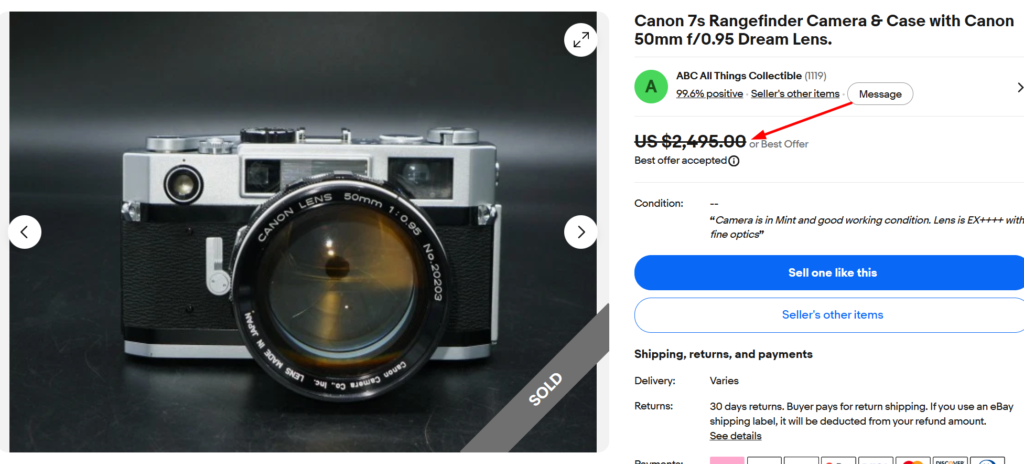
Sold for $2,500
The Canon 7 itself is just a decent, adequate rangefinder camera that can sell for a few hundred bucks. But when the 7 is paired with the Canon 50mm f/0.95 “Dream Lens,” one of the fastest lenses made at the time, the value doubled or even tripled.
It’s mostly the lens that costs a lot, so inspect it properly; the body alone is worth roughly $300 to $600.
- Estimated Value: $2,500 to $5,000+ (with Dream Lens)
- Production Years: 1961 to 1968
- What to Check: Lens presence, glass clarity, meter function
4. Leica IIIf and IIIg Screw-Mount
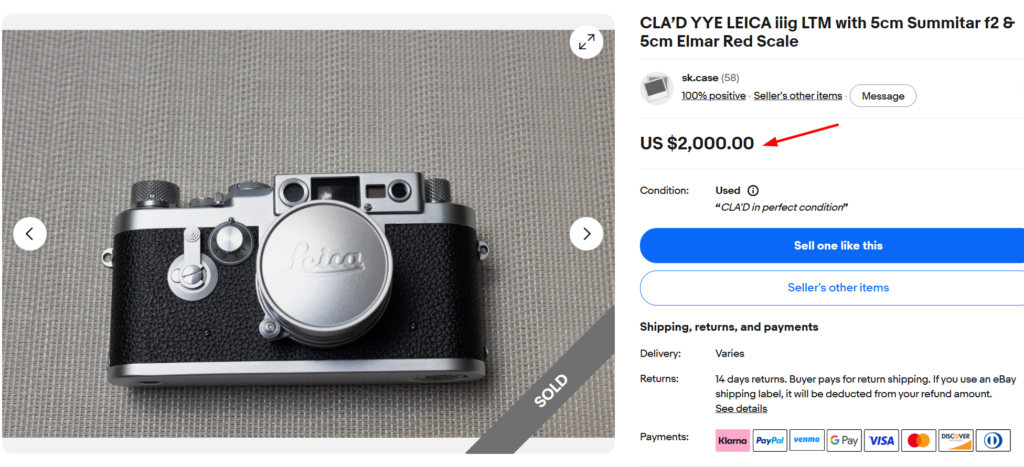
Sold for $2,000
Before the M camera series, there were Leica’s small screw-mount cameras that revolutionized 35mm photography. These included the IIIf, which came with flash synchronization, and the IIIg, which was the final model in the series.
Limited availability and precise Leica construction are what keep up the collectible interest and resale value.
5. Rolleiflex 2.8F TLR
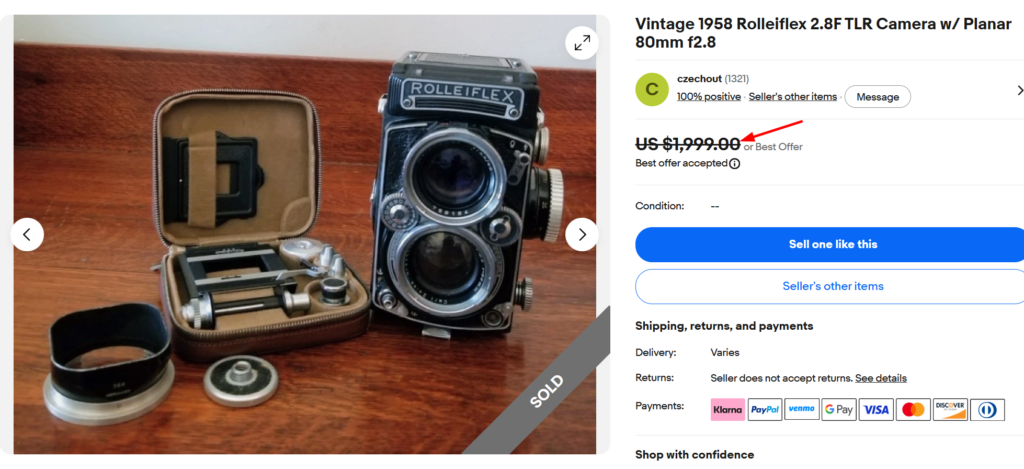
Sold for $2,000
The 2.8F is the top model in the Rolleiflex TLR range. It takes images in 6×6 format using a Zeiss Planar or Schneider Xenotar 80mm lens. The white-faced models, as well as the newer ones designed for 220 film, are more expensive. The meter’s functionality is an important value factor for these models.
- Estimated Value: $800 to $5,000+
- Production Years: 1960 to 1981
- What to Check: Planar or Xenotar lens, white face
- Value Notes: Meter must be working to fetch top value.
Now that you know what you want to look for, grab that old camera off the shelf, check the maker’s name and serial number, and match it against this list. Then search for it online to see what collectors are paying for the same model. That’s the most realistic way to know what your old camera can actually be worth.