

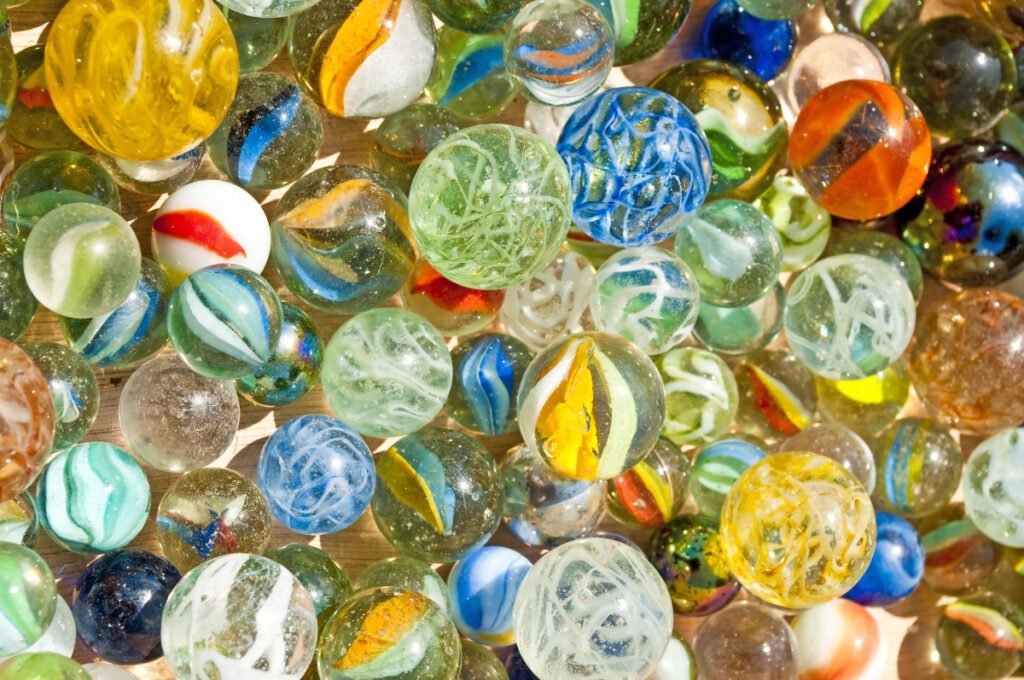
Every family will have some old marbles stored in a jar or coffee can somewhere. The majority will be children’s playthings that aren’t worth much at all. But there could be some old marbles that are worth something.
The gap lies mostly in the way that a marble was made, its design, and its condition. The following are eight types you should look out for, along with simple identification tips.
Are Old Marbles Valuable?
Yes, some antique marbles have value, but not all do. “Cat’s eyes” and other machine-made marbles from the ’50s and on generally fetch only pennies to a dollar each.
The handmade German marbles (between 1850 and 1920) and the early machine-made American marbles (in the 1920s and 1930s) fetch the most money, ranging from $20 to several hundred per marble. And the rarest types, in mint condition and bigger sizes, can cross into the thousands.
Old Glass Marbles Worth Money: 9 Types to Look For
Handmade German marbles make up the bulk of this list, followed by some vintage American machine-made marbles. Most handmade marbles collectors look for come from Germany. Sources differ on the exact years, so the safe span is the mid-1800s into the early 1900s.
1. Onionskin Marbles
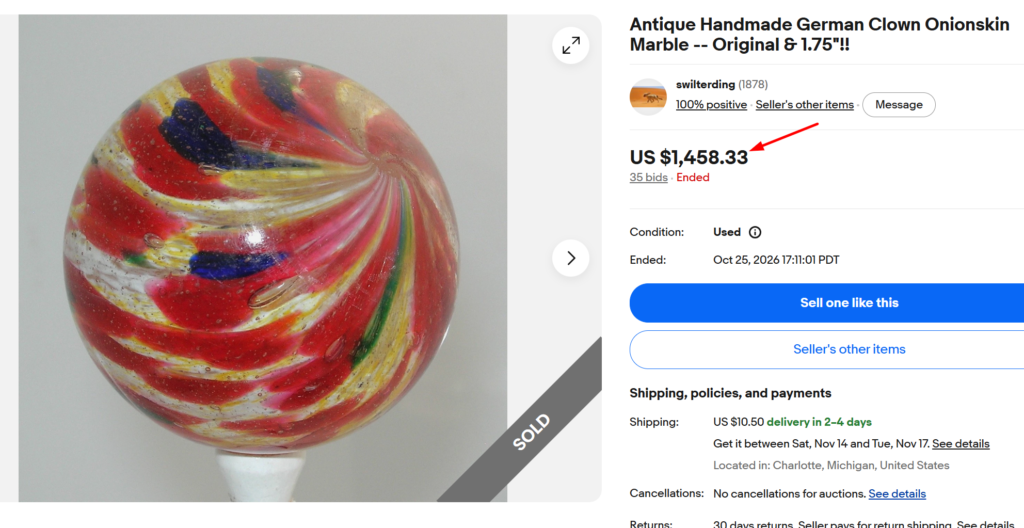
Onion Skins are named so because the inside of the marble looks like the layers of an onion. To make this type of marble, the artist would roll colored glass chips onto a white or yellow base and stretch the colors to cover the entire core.
Paneled onionskins usually show four color sections. Mica flakes and lobed cores push the price higher.
- Estimated Value: $40 to $500+
- Production Years: About 1860 to 1920
- What to Check: Stretched flecks covering whole core
- Quick Notes: Big, mint, mica examples sell best
2. Lutz Marbles
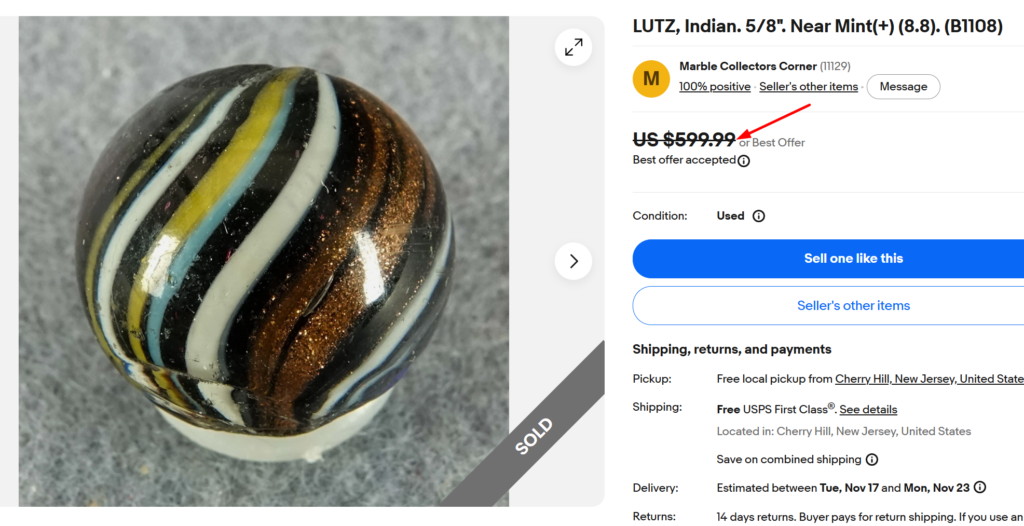
Listed for $599.99, sold via best offer
The Lutz marble has one characteristic that gives away its identity: bands that contain many small speckles of copper. This is ground fine copper, sometimes referred to as goldstone.
It appears in several layouts, such as banded, onionskin, ribbon, Indian, and mist Lutz marbles, and so two Lutz marbles may appear completely different from each other.
- Estimated Value: Too few sales for a range. (One rare pink opaque with red bands sold for over $28,000)
- Production Years: 1860 and 1920
- What to Check: Copper goldstone bands in glass
3. Sulphide Marbles
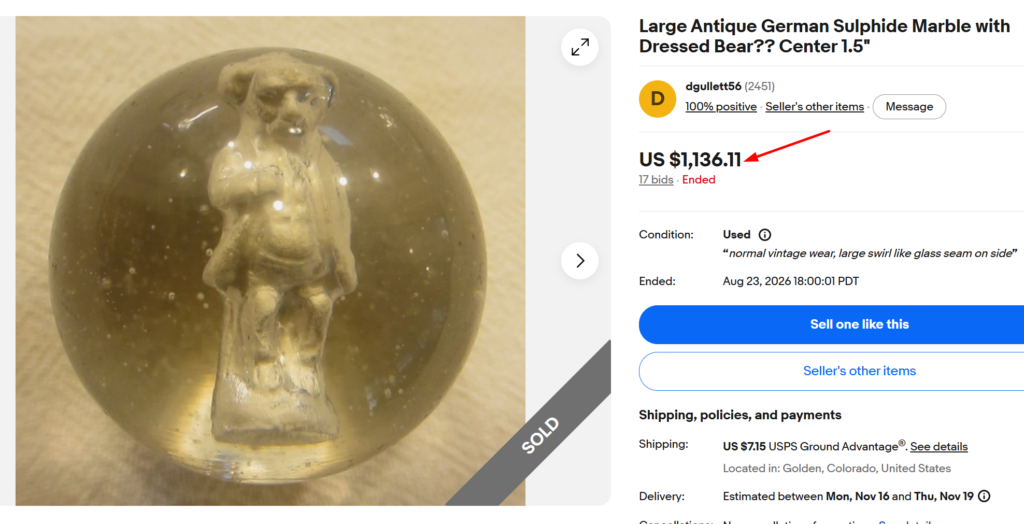
The sulphide marble contains a small white figure enclosed within clear glass. However, the marble does not contain any sulfur. The figure is made from fired clay and is surrounded by a thin layer of air, which gives it a silvery appearance.
The most common figures include animals such as dogs, lambs, and squirrels. Figures of humans, numbers, and painted figures are relatively rare.
- Estimated Value: $48.00 to $6,150 per piece
- Production Years: About 1870s to 1920s
- What to Check: Centered figure, no cracks
- Quick Notes: Two-figure doubles are extremely rare
4. End of Day Marbles
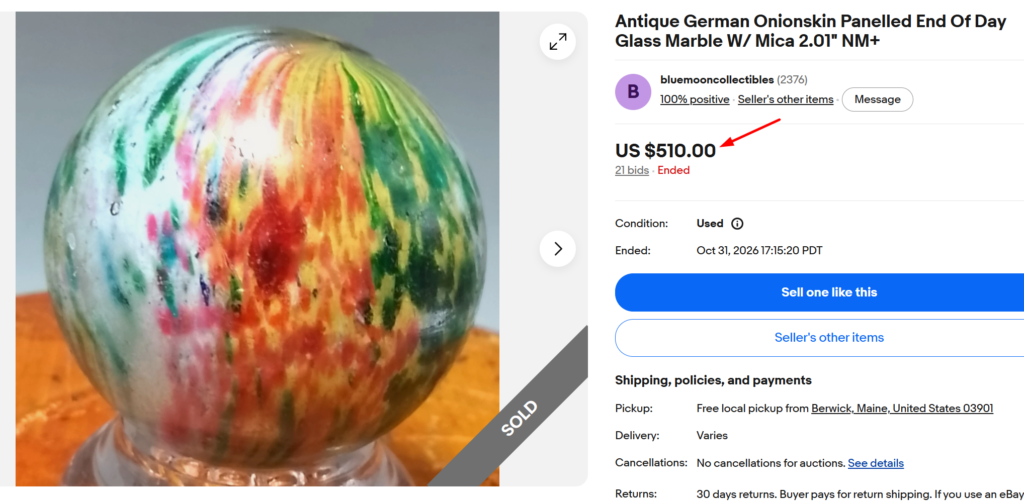
The End of Day marbles are handcrafted marbles that have colored glass speckles. A popular story says that these marbles were made by German workers using leftover glass at the end of a workday. It is an interesting legend, but the marbles were mass-produced items.
Clouds are the kind of marbles you should be looking for. Unlike the onionskins, the speckles on them have never been stretched and therefore remain intact.
- Estimated Value: $75 to $600+
- Production Years: About 1860 to 1920
- What to Check: Unstretched flecks, single pontil
- Quick Notes: More colors usually mean more value
5. Clambroth Marbles
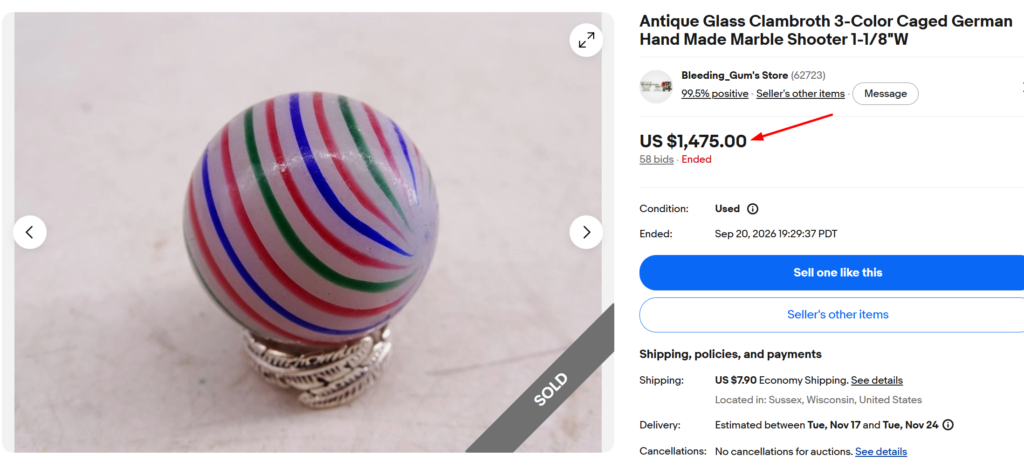
Clambroths have thin colored threads covering an opaque background, which is normally white. In an ordinary clambroth, the threads are evenly spaced around the marble.
The color of the background is significant. Clambroths with black, blue, or any other background apart from white are uncommon, and caged clambroths, which have 30 (or more) threads, are even more uncommon.
- Estimated Value: $75 to $400+
- Production Years: About 1860 to 1920
- What to Check: Evenly spaced surface lines
- Quick Notes: Clear-cased clambroths are rare.
6. Christensen Agate Guineas and Flames
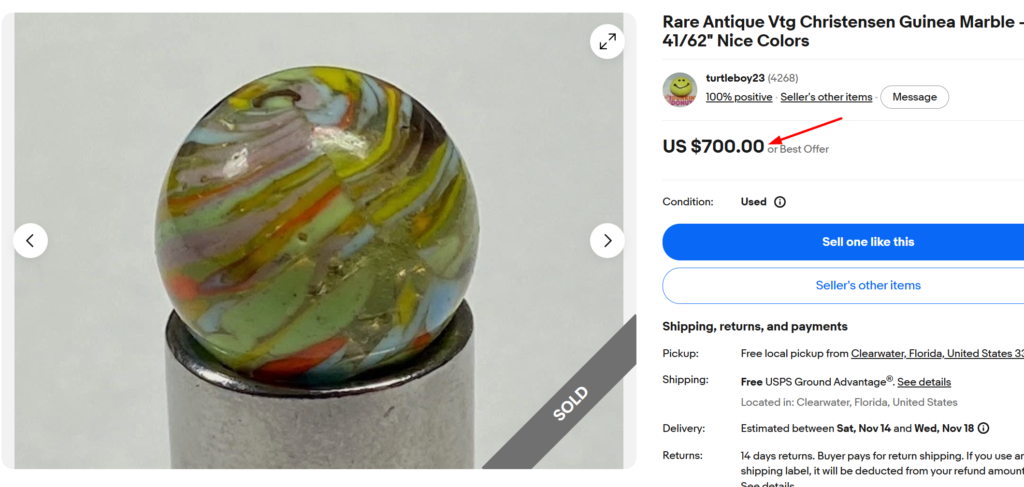
The Guineas were made by the Christensen Agate Company of Ohio, established in 1925 and out of business in the early 1930s, though the exact date varies. However, despite its name, it isn’t associated with Martin Christensen’s former company.
Every Guinea is formed from colored speckles swirled over a clear base. Even now, the marbles made by the company hold the highest value among machine-made marbles at auctions, but fakes are also present.
- Estimated Value: $150 to $1,700+
- Production Years: 1925 to 1933
- What to Check: Specks stretched across surface
- Quick Notes: Bright “electric” colors cost much more
7. Indian Marbles
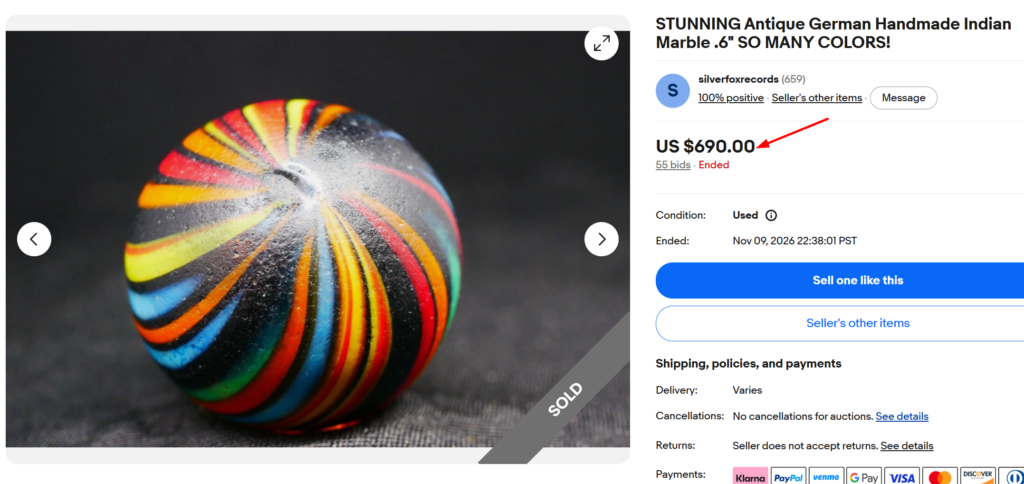
These marbles have an opaque black base with color bands on top of it. Here, coverage will determine value. The higher the coverage on the marble, the more valuable it will become; a highly colored Indian will beat one with a few stripes.
- Estimated Value: $55.00 to $10,455.00 per piece (completed sales in our data)
- Production Years: Not confirmed in our sources yet
- What to Check: Opaque black base, color coverage
- Quick Notes: More colors mean more value.
8. Akro Agate Oxblood and Popeye Corkscrews
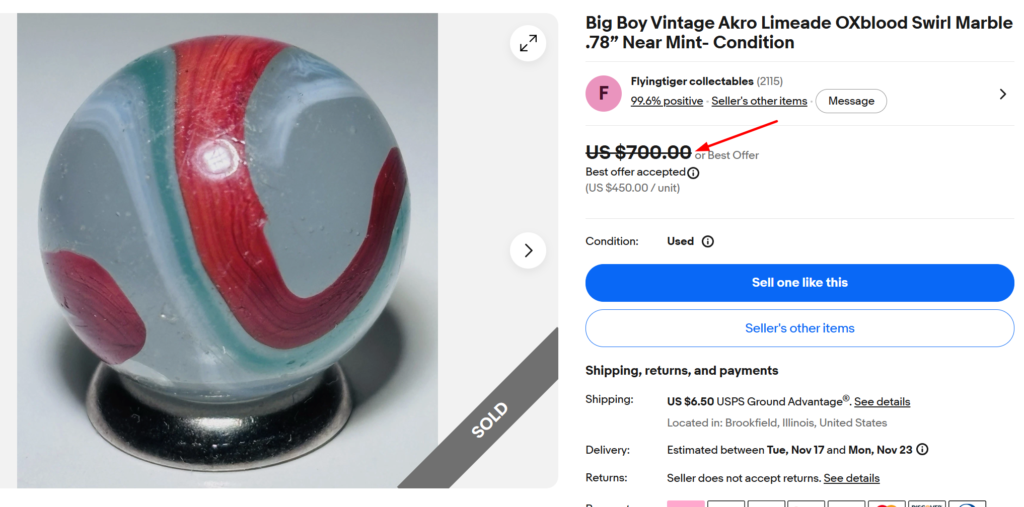
Listed for $700, sold via best offer
Akro Agate was founded in Akron, Ohio, around 1910. The company relocated to Clarksburg in West Virginia, in 1914 because of glass availability and cheap natural gas. Production ended in 1951.
The corkscrews of Akro Agate feature two spirals (or more) that extend from one pole to the other without intersecting. They are called Popeyes because they came in boxes marked Popeye.
- Estimated Value: $15 to $400+
- Production Years: Mid-1920s to 1930s
- What to Check: Spirals that never cross
- Quick Notes: Corkscrews over 1 inch are rare
9. Peltier National Line Rainbo “Superman”
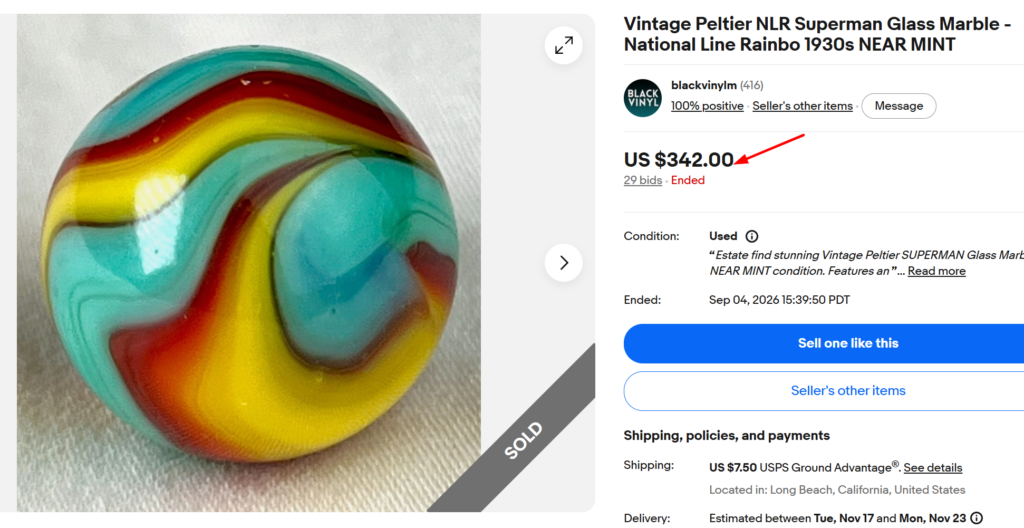
Peltier Glass Company in Ottawa, Illinois, started making marbles around 1927. Its National Line Rainbos came in color combinations that collectors later nicknamed, and the Superman, a light blue base with red and yellow ribbons, is the one most people hunt.
Bumblebee (yellow with black) and Christmas Tree (white with red and green) are other favorites. Aventurine versions and bigger sizes raise the value.
- Estimated Value: $50 to $300+
- Production Years: Late 1920s to 1930s
- What to Check: Two seams, see-through ribbons
- Quick Notes: Opaque-ribbon tri-colors aren’t National Line
How to Identify Old Marbles in 4 Easy Steps
Hold one of the marbles and rotate it gently. This is how these five tests can help you determine the value of a bag of marbles.
Step 1: Look for a Pontil
Handmade marbles have an indication at one end. Every handmade glass marble must have at least one pontil, which is the indication that shows where it was severed from its punty or cane. However, this mark may disappear with polishing.
Machine-made marbles do not have pontils. In 1905, Martin Christensen of Akron, Ohio, obtained a patent for a sphere-rolling machine, which was particularly well-suited for glass. So, a smooth marble may be machine-made, while a polished hand-made marble may not have pontils either.
Step 2: Name the Pattern
Value begins to diverge at the point of pattern. Monochromatic clear and frosted marbles hold little value, and it is nearly impossible to distinguish the manufacturer of any of these marbles. Put these aside and then look for other things.
Learn the terms that do matter. Oxblood, for one, is a specific color, not just any red. True oxblood is opaque rust-red with black filaments, while other makers’ reds are usually see-through without filaments.
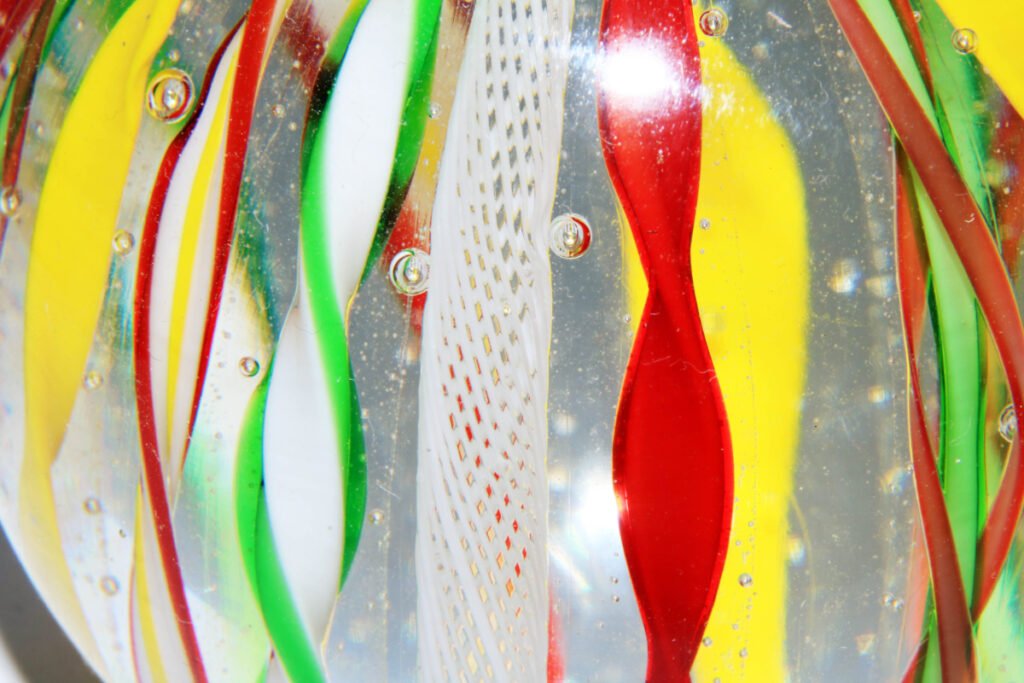
Step 3: Try a Black Light, With Care
The black light can help, but it’s not a reliable way to track age. The conventional sulphides tend to fluoresce when exposed to a black light, while very few of the contested California Sulphides do so.
Some glass glows for a different reason. The Health Physics Society notes that antique yellow or greenish glass can hold easily detectable uranium.
Step 4: Watch for Fakes
Fakes are the final barrier. Replicas of marbles have existed since at least the late 1970s, and there are several varieties of faked Christensen Guineas, so be wary when purchasing expensive examples.
Here’s a quick reference table to distinguish handmade vs. machine-made:
| Feature | Handmade | Machine-made |
|---|---|---|
| Pontil mark | Rough or ground spot at one or both poles | None |
| Seams and cut lines | None | Often a thin seam or tiny shear lines |
| Pattern | No two exactly alike, even from the same cane | Repeats closely from marble to marble |
| Typical era | About 1850 to 1920 | Early 1900s onward |
What Determines an Antique Marble’s Worth?
Two marbles of the same type can sell for very different prices. Old marbles’ value comes down to a handful of factors, and condition sits at the top of the list.
- Grading and Condition – Marbles are graded by collectors on a scale of 10. Chipping, moons (little circular cracks), and wear will lower the score. Buffed or polished marbles cost much less than usual, even rare ones.
- Size – The larger shooters (marbles over 3/4 inch) and larger-than-normal 1-inch versions of smaller marbles are far rarer and more valuable.
- Colors and Patterns – Clear and sharp patterns sell better. Red and oxblood are popular colors, and unusual combinations of colors command higher prices.
- Original Packaging – An intact Akro or Peltier box is worth many times more than the same marbles without packaging. So don’t separate boxed sets.
- Cleaning – You need to use only mild soap and lukewarm water. Using strong chemicals, tumbling, or polishing will destroy the value of your marble.
To get the true value, refer to this marble valuation guide together with recently sold marbles from eBay, not the asking prices.
Where to Sell Old Marbles (& Get an Appraisal)
Where you can sell your old marbles is as important as knowing what you have. Look for eBay old marbles auctions, but look for those that are already sold, because their price shows what people really pay.
As for rare finds, specialized auction firms like Block’s Marble Auctions and Morphy Auctions are best. And as for those wondering who collects antique marbles in the local community, it is best to go to a marble club or a marble show.
Before you sell anything you suspect is rare, having a marble specialist grade or appraise it is a good idea.
Most old marbles are worth pennies, but the right one can surprise you. So sort your jar in three steps: pontil first, then pattern, then condition. That simple routine pulls out any old marbles worth money in a few minutes.
Found this guide useful?
Save it for later
Share it with someone
Keep the old finds coming
New guides and finds worth looking for, delivered to your inbox.
Keep exploring
More guides in Toys & Dolls
 13 findsOld Vintage Matchbox Cars Value Guide (& 13 Rare Models)Top sale $1,670
 19 findsWhat Are the Most Famous Old Toys? 19 Finds Every Collector WantsTop sale $14,500
 12 findsRare Vintage Hot Wheels Cars: How to Spot Them & What They’re WorthTop sale $4,000
 11 finds11 Rare Vintage Barbie Dolls Worth Money & How to Identify ThemTop sale $5,500