
Pull one cup out of your grandmother’s cupboard, and it will be worth $5. Pull the next cup, and it could be worth $500. Chances are, the only difference is what kind of cup it is.
As soon as you know how to recognize the basic types of vintage tea cups, everything else is a piece of cake.
It becomes possible for you to identify the manufacturer, make guesses about the time period, and determine the value of the antique. So here are the 9 types of cups that collectors hunt today.
The 9 Most Popular Types of Vintage Tea Cups
1. Bone China Tea Cups
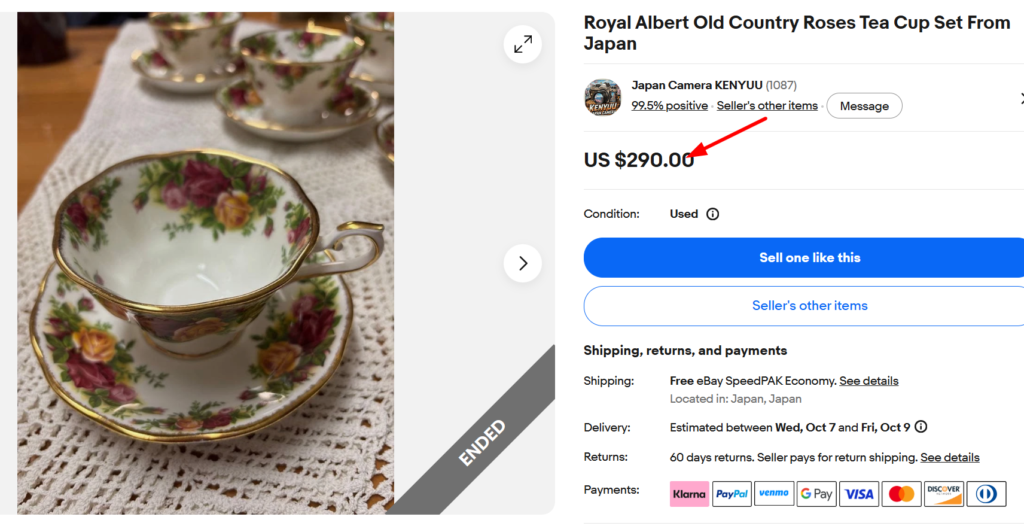
The bone china tea cup is one of the more traditional varieties of English tea cups. It is made with bone ash mixed with the clay, which makes it incredibly thin and translucent in appearance, especially when placed next to the light.
These were produced in the potteries of Staffordshire. The four key companies that made bone china tea cups are Royal Albert, Paragon, Aynsley, and Royal Doulton.
Top collectible bone china tea cups:
- Royal Albert Old Country Roses – the world’s best-selling china pattern, designed by Harold Holdcroft in 1962
- Royal Albert American Beauty, Lady Carlyle, and Blossom Time – classic rose florals
- Paragon Country Lane and Victoriana Rose – hand-decorated with 22-karat gold on many pieces
- Aynsley Pembroke and Cottage Garden – hand-painted bird and floral scenes with gilded borders
- Royal Doulton Carlyle and Brambly Hedge – soft florals in the classic tea cup shape
2. Fine Porcelain Tea Cups (Hard-Paste)
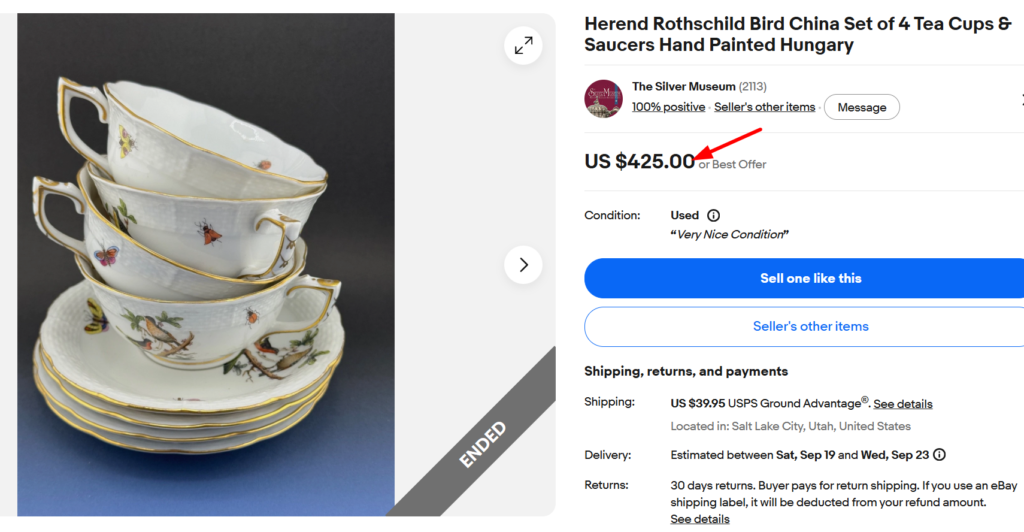
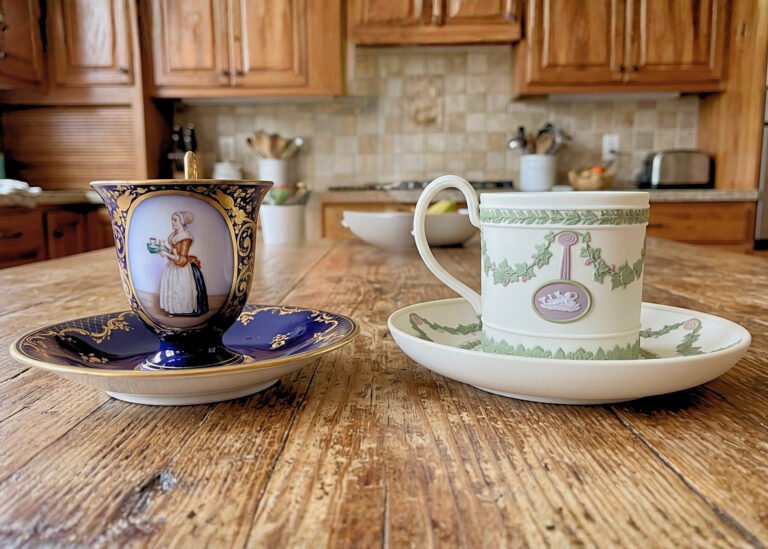
Fine porcelain tea cups are a denser form of bone china; their origin is German in the sense that the breakthrough of European hard-paste porcelain took place at Meissen in 1710. Such tea cups are heavier than bone china cups and have glassy smooth glazing and sometimes astonishing hand painting.
Meissen and Dresden are the two main producers of this kind of cups in Germany, which should be distinguished by their trademarked crossed swords.
Popular fine porcelain tea cups for collectors:
- Meissen Blue Onion – the cobalt underglaze pattern produced since 1731, inspired by Chinese Yuan Dynasty design
- Meissen Ming Dragon – the painted dragon in red or green color with gold edging
- Meissen Rich Court Dragon and Scattered Flowers (Streublumen) – the demitasse style with gold scrolls
- Dresden hand-painted floral pattern – often signed individually by the painter
- KPM Berlin classical scenes – cameo panels with rich gilding
3. Depression Glass Tea Cups
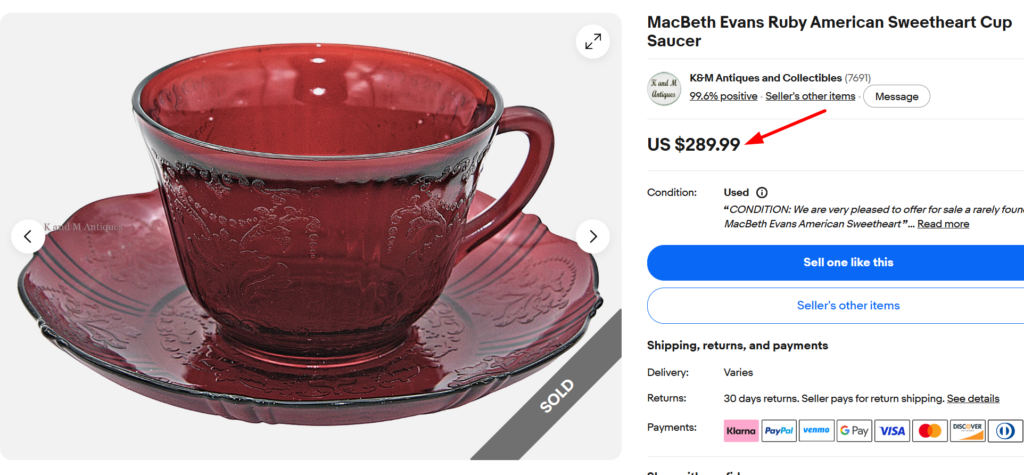
Depression glass refers to machine-pressed glass that was manufactured from the late 1920s up until the early 1940s. These cups were distributed as free items in movie theaters, in boxes of cereal, and as promotional items for gasoline stations.
How to Identify: The tea cups are lightweight, with mold lines that are barely noticeable, along with tiny bubbles visible under a good light source.
This is why many households today still own some. The pink and green colors are most common, while cobalt blue is a rare color.
The top collectible patterns of Depression Era tea cups include:
- American Sweetheart Macbeth-Evans – pink & white Monax with scrolled design (1930-1936)
- Cherry Blossom Jeannette – pink and green cherry branch design (1930-1939)
- Mayfair (Open Rose) Anchor Hocking – large open roses, mostly pink and blue
- Cameo (Ballerina) Anchor Hocking – dancing girl silhouette in green, yellow, and pink
- Royal Lace Hazel-Atlas – the prestige pattern, available in cobalt blue and most sought-after
- Sharon (Cabbage Rose) Federal Glass – overall pink roses
4. Jasperware Tea Cups
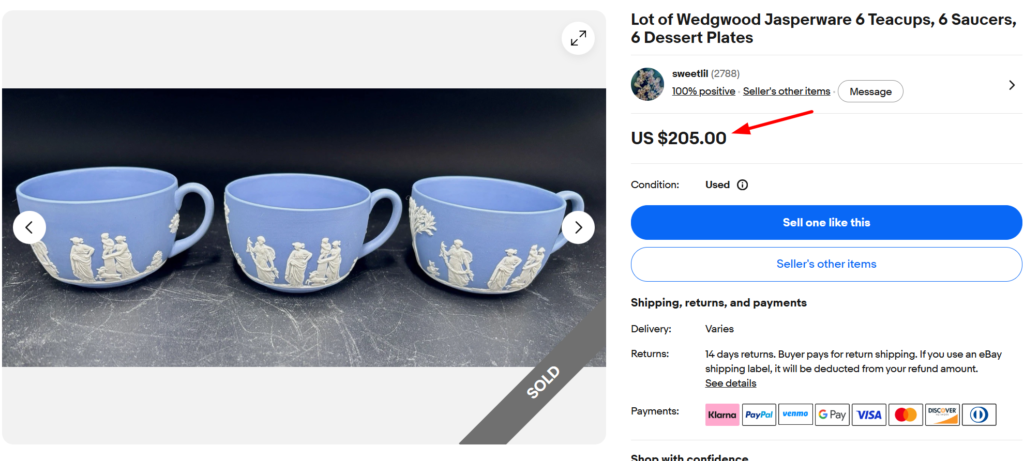
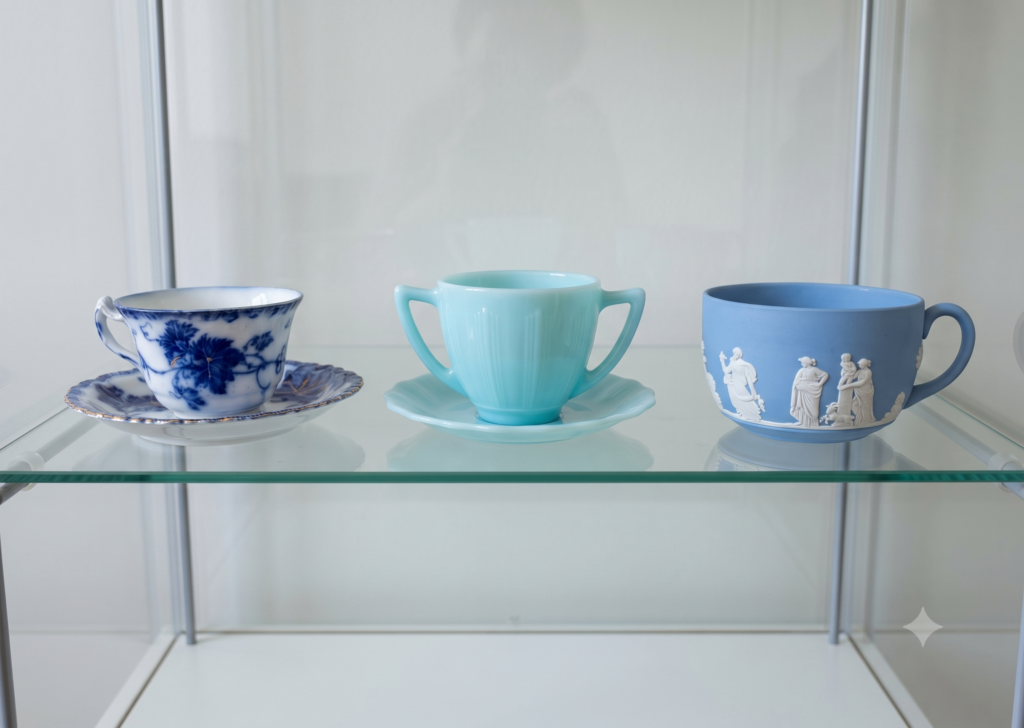
The Jasperware was invented by Josiah Wedgwood in 1774. It is an unglazed fine stoneware that is matte and chalk-like in appearance. It invariably depicts cameo figures in white over colored ground.
The color is the main determinant of the price. While the blue and the sage-green are the popular colors, the lilac, yellow, black, and crimson dip pieces fetch high prices.
Best-selling Jasperware colors and designs:
- Pale (Wedgwood) Blue with classical figures – the most distinctive
- Sage Green with white design – a little rarer
- Lilac dip – sells at three to five times the price of similar blues
- Yellow dip – the rarest standard color
- Black Basalt – actually a different body, but collected along with Jasperware
- Crimson dip (1890s to 1920s) – the holy grail for jasperware collectors
5. Transferware Tea Cups
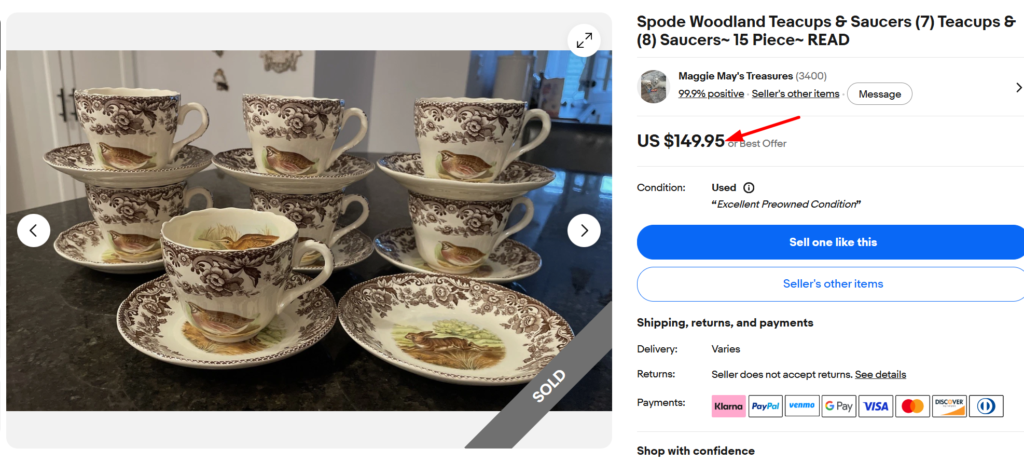
Transferware involved potters printing the design on tissue paper and transferring the design to the teacups before glazing them. This was the reason Staffordshire factories produced sets of teacups so quickly through transferware, hence Blue Willow being found in numerous kitchens for several years.
The colors included blue, black, brown, mulberry, red, and green. Spode was the first to produce Blue Willow, way back in the 1790s.
Popular transferware teacup patterns:
- Spode Blue Willow, produced by Spode, Johnson Bros., Alfred Meakin, and Churchill – featuring the pagoda, bridge, and willow tree scene
- Spode Woodland – famous brown transferware pattern
- Spode Delamere and Blue Italian – ever-popular Staffordshire patterns
- Johnson Bros. Historic America and Friendly Village – American scapes and cottage scenes
6. Flow Blue Tea Cups
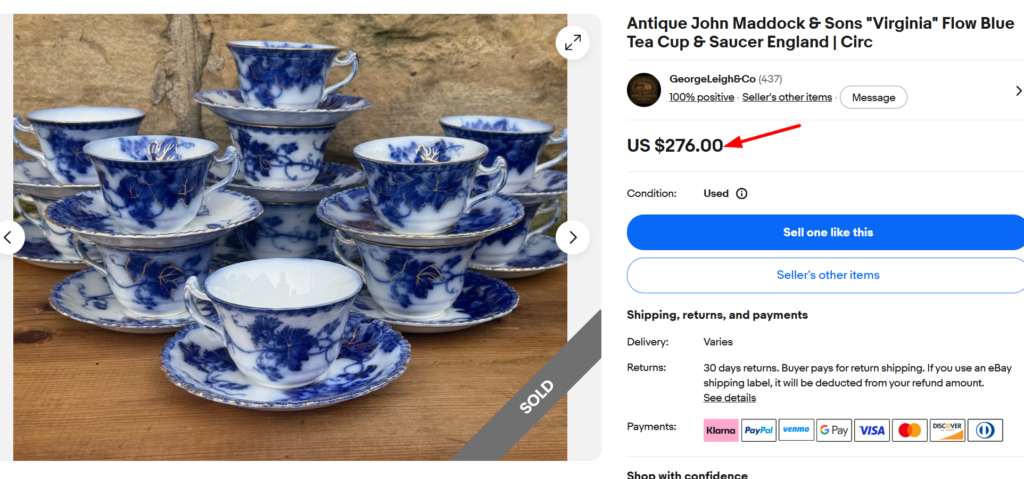
Flow Blue is a delightful mistake of the Victorian Era. Potters accidentally fired their cobalt underglazed wares with volatile materials in the kiln, resulting in a soft and fuzzy flow of blue around the white portions.
Customers appreciated its appearance, and so it became a deliberate production process that remained popular till the beginning of the 20th century.
How to Identify: The composition of tea cups is usually either ironstone or semi-porcelain, making them heavier than fine china.
Top collectible flow blue patterns:
- Scinde by J. & G. Alcock (c. 1840) – a chinoiserie willow, temples, and flowers design
- Touraine by Stanley Pottery and Henry Alcock – floral with scalloped, gilded edges
- New Wharf Pottery Waldorf (1892) – floral center and rim design
- La Belle by Wheeling Pottery – an American flow blue favorite
- Kelvin by Alfred Meakin – late Victorian floral
7. Stoneware and Ironstone Tea Cups
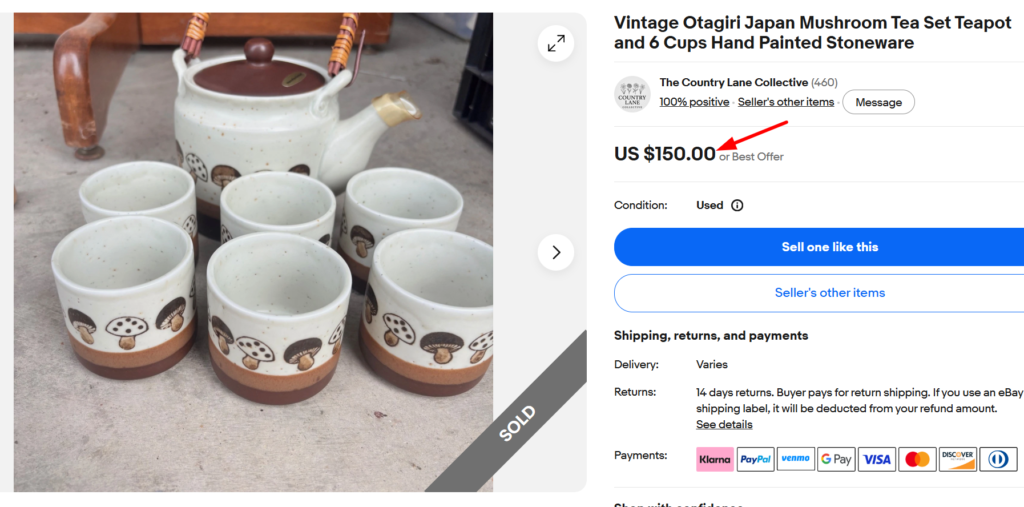
Stoneware and ironstone are the everyday cups of the vintage market. They are heavier, more substantial, and opaque, and they have been made to stand up to everyday use on English farmhouses or American cottages.
Ironstone, which is stoneware with a patent from Charles James Mason in 1813, has a slightly blue or gray color under its clear glaze.
Vintage cups may be either solidly white with a molded decoration or transfer-printed. A mark such as “Ironstone China,” “Semi-Porcelain,” or “British Lion” usually appears on the bottom.
Top collectible stoneware and ironstone teacups:
- Mason’s Patent Ironstone Vista and Regency
- Johnson Brothers ironstone whiteware
- Alfred Meakin Royal Ironstone
- T. & R. Boote white ironstone
- Hall China restaurant stoneware and Autumn Leaf
- Homer Laughlin ironstone teacups
8. Crystal Glass Tea Cups
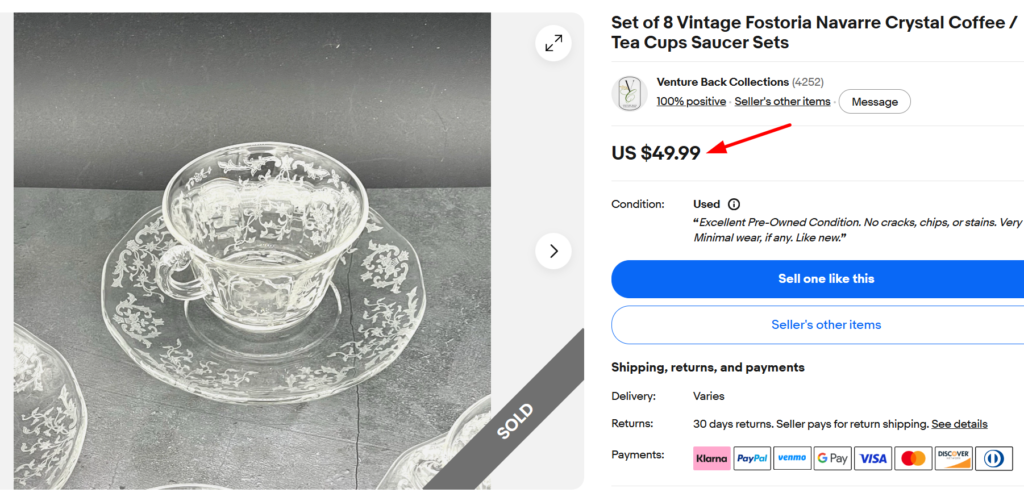
Crystal tea cups consist of lead glass (at least 24 percent lead oxide) which has been cut, etched, or molded into beautiful shapes. They are visibly heavier than plain glass and emit a ringing sound when the rim is tapped.
Tea cups and coffee cups were made mostly in American Brilliant Period factories (between 1876 and 1917) and Irish and English crystal factories from then on. Crystal tea cups from Waterford and Fostoria are the most collectible of all.
Top collectible crystal tea cup patterns:
- Waterford Lismore – the classic diamond and wedge cut, the most recognized Waterford pattern
- Waterford Colleen and Alana – vertical panel cuts with diamond fields
- Fostoria American – the pressed cube pattern, in production from 1915 to 1986
- Fostoria Navarre – etched floral in clear crystal, later in azure blue and pink
- Fostoria June – 1928 to 1952 etched garland and bow design
9. Milk Glass Tea Cups
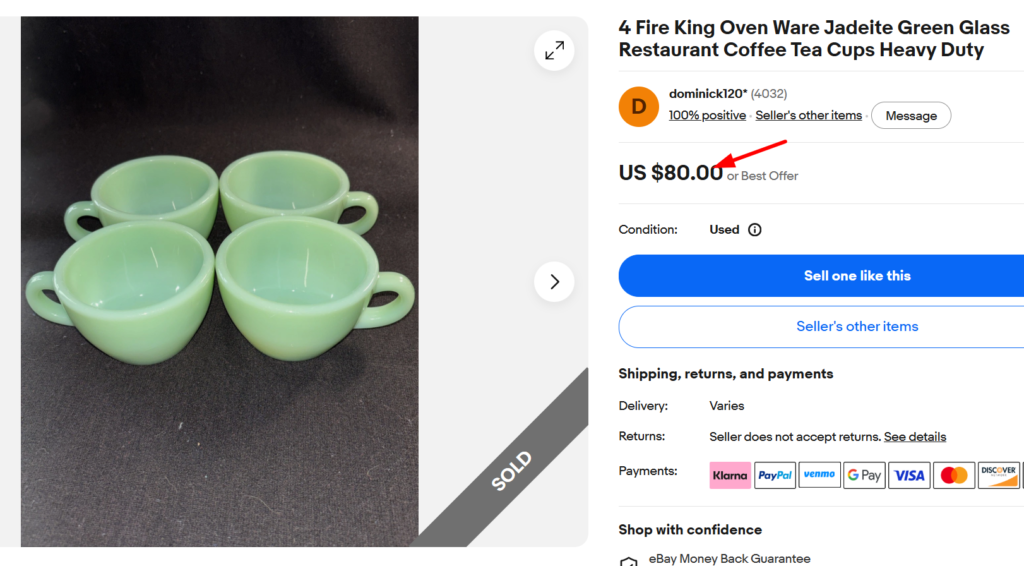
Milk Glass is opaque white pressed glass, and the American version was most popular in the mid-twentieth century. Fenton produced the most famous pattern of milk glass, while the Fire-King range from Anchor Hocking made sure that all diners had milk glass cups everywhere.
Identification Tip: Milk glass is also heavier than Depression glass, having a creamy body that will not turn yellow with time.
Top collectible milk glass teacup patterns:
- Fenton Hobnail in white milk glass
- Fenton Silver Crest – white body with a clear ruffled rim
- Fire-King Jane Ray in jadeite from the 1950s
- Fire-King Restaurant Ware – heavy jadeite mugs and cups made for diners
- Fire-King Bonnie Blue and Turquoise Blue
What Are the Highest-Valued Vintage Tea Cups?
When it comes to highest values, there are always just four key factors involved: the maker, the age, the rarity, and the condition of the teacups. Here’s how these factors work:
A pre-1850 Meissen or KPM cup is worth more than almost any 20th-century cup. Very rare Depression glass colors such as cobalt Royal Lace and ruby American Sweetheart are worth hundreds.
Yellow, lilac, and crimson jasperware by Wedgwood are always worth more than blue. Hand-painted Limoges or Nippon cups with signature marks beat printed patterns every time.
Condition finally determines the price. A hairline crack, chipped foot rim, or worn gilt on Azalea pattern cups can reduce their value by 50 percent or more. Tea cups that include the matching saucers, or even better, side plates too, are always worth more than a single cup.