
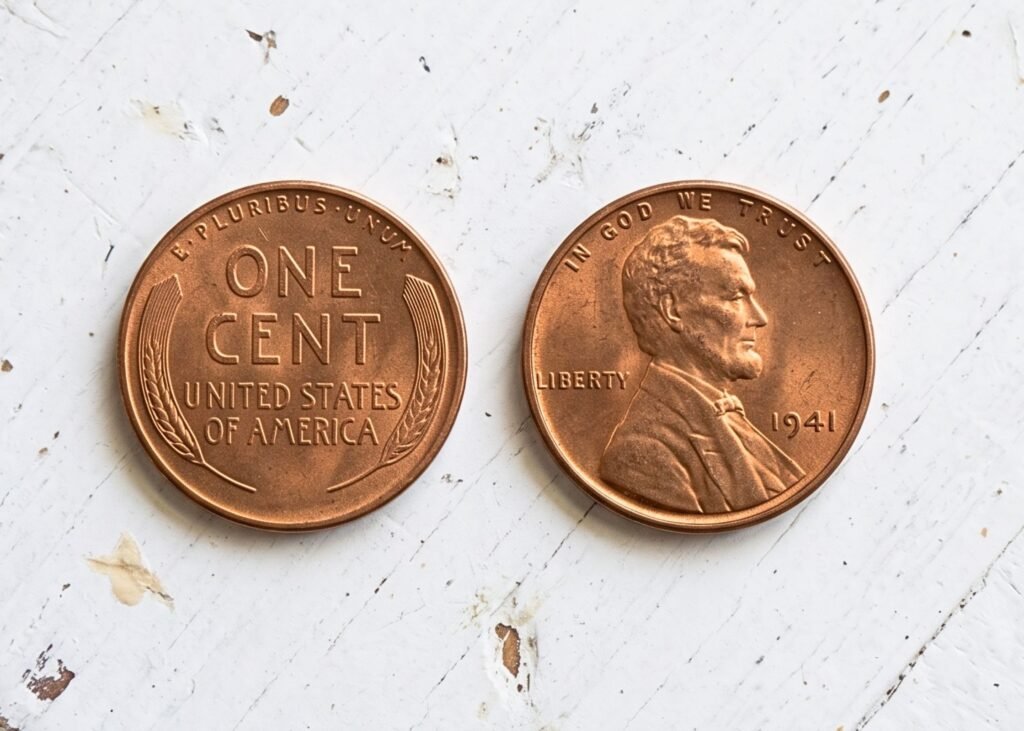
1941 cents are among the most common coins you’ll find in a coin collection. And most 1941 wheat pennies are worth a nickel to a couple of bucks today. But a small handful of them, mostly the errors and top-grade red examples, have sold for anywhere from a few hundred to well over $28,000.
The key is knowing which details determine the value. Let’s walk through what to check, then look at the specific 1941 wheat pennies that collectors pay real money for.
A Brief of the 1941 Wheat Penny
The 1941 wheat penny sits in a special little pocket of Lincoln cent history. It’s the last full year of pre-war copper before wartime metal shortages started messing with U.S. coinage.
The design itself, by Victor David Brenner, had been running since 1909. It shows Abraham Lincoln on the front and two wheat stalks and the denomination “ONE CENT” on the back.
That year, the mint went big.
- Philadelphia struck 887,018,000
- Denver added 128,700,000
- San Francisco made 92,360,000
Plus, the Philadelphia Mint added the 21,100 proofs, totaling over a billion 1941 pennies. So, circulated 1941 cents are everywhere. The valuable ones hide inside that huge pile.
How to Identify a 1941 Lincoln Wheat Penny?
A real 1941 wheat penny checks out on a few simple points. The design, the composition, and the mint mark. Grab a magnifier and let’s go through them.
The Obverse (Front)
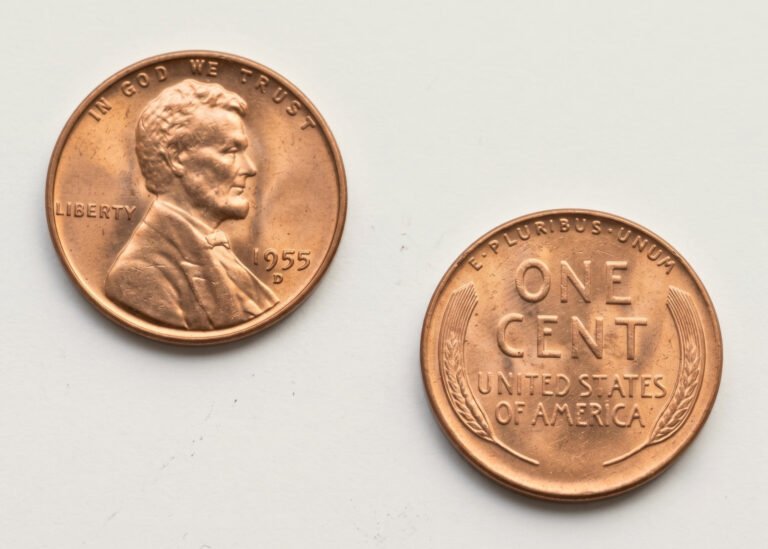
Lincoln faces right, with “LIBERTY” to his left and “1941” on the right. “IN GOD WE TRUST” arcs across the top. Look at the lower edge of Lincoln’s bust, and you should see tiny “VDB” initials for Brenner. That’s normal, and it’s on every 1941 cent.
The Reverse (Back)
Two curved wheat stalks frame the words “ONE CENT” and “UNITED STATES OF AMERICA,” with “E PLURIBUS UNUM” across the top. This wheat design ran from 1909 to 1958.
If yours has the Lincoln Memorial on the back, it’s a much later penny, and you’re looking at the wrong side of history.
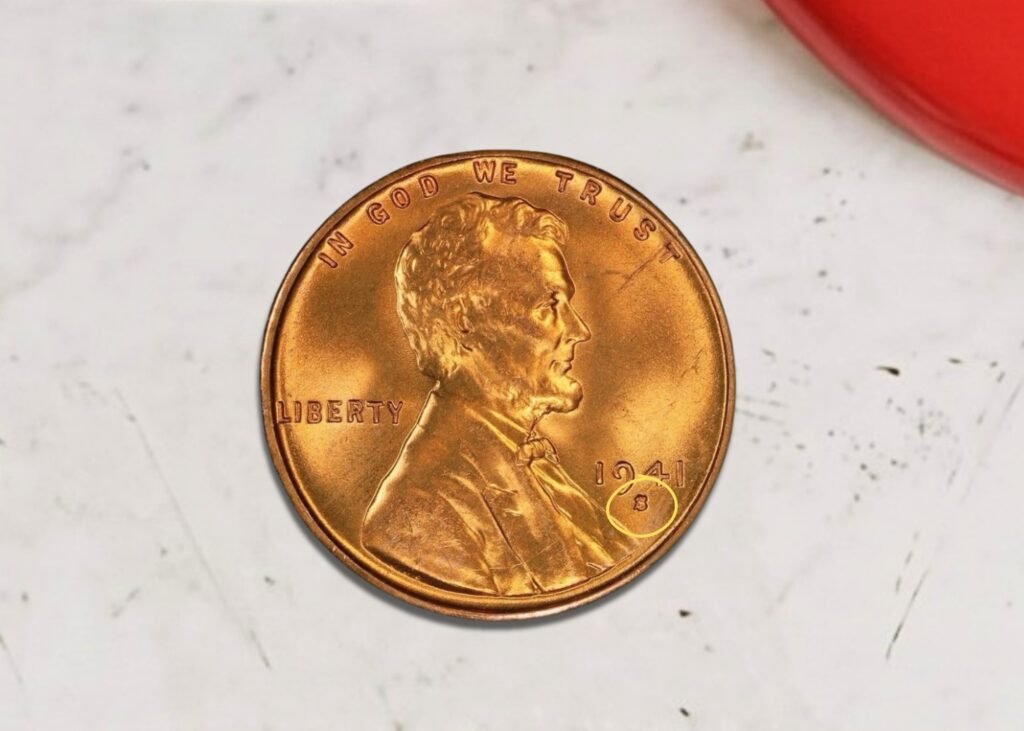
Mint Mark Location
The mint mark sits right under the date on the obverse.
- A tiny D means Denver
- A tiny S means San Francisco
- No mint mark means Philadelphia.
Philly didn’t stamp mint marks on cents back then. So a blank spot below the date is normal, not a mistake.
Weight and Composition
Genuine 1941 wheat pennies are 95% copper with 5% tin and zinc, weighing exactly 3.11 grams at a diameter of 19 mm. Anything noticeably lighter, magnetic, or silver-colored is not a real 1941 issue. And no, real 1941 steel pennies do not exist.
The steel cents came in 1943.
ID Tip – If someone tries to sell you a “1941 steel wheat penny,” it’s either a plated fake or a 1943 coin with the date altered. Every legitimate 1941 wheat cent is copper-colored bronze.
What Makes a 1941 Wheat Penny Valuable?
Before jumping into the actual list, it helps to understand what collectors are really paying for. Because the same coin can be worth 10 cents or $10,000, depending on a few key factors.
- Condition and grade matter more than anything else on this date. Circulated 1941 cents are common and cheap. The real money starts with MS65 pieces and jumps higher at MS67 and above, especially with full original color.
- Color designation is where copper coins get interesting. Grading services use three tags: RD (Red) for coins keeping 95% or more original bright copper, RB (Red-Brown) for mixed toning, and BN (Brown) for fully toned pieces. Red cents are almost always worth the most.
- Mint mark shifts value, too. Philadelphia is the most common, but it has a slightly higher grade ceiling. The San Francisco issue has the lowest mintage and often carries a premium at the top grades. Denver cents are mid-tier.
- Errors and varieties are the wildcards. A confirmed doubled die obverse, a repunched mint mark, or an off-center strike can turn a 5-cent coin into a serious payday.
High-Value 1941 Lincoln Wheat Pennies to Look For
These are the specific 1941 wheat pennies collectors chase, from the everyday date-and-mint mark trio all the way to rare 1941 penny errors.
1. 1941 Brockage Error (Bowl-Shaped Reverse)
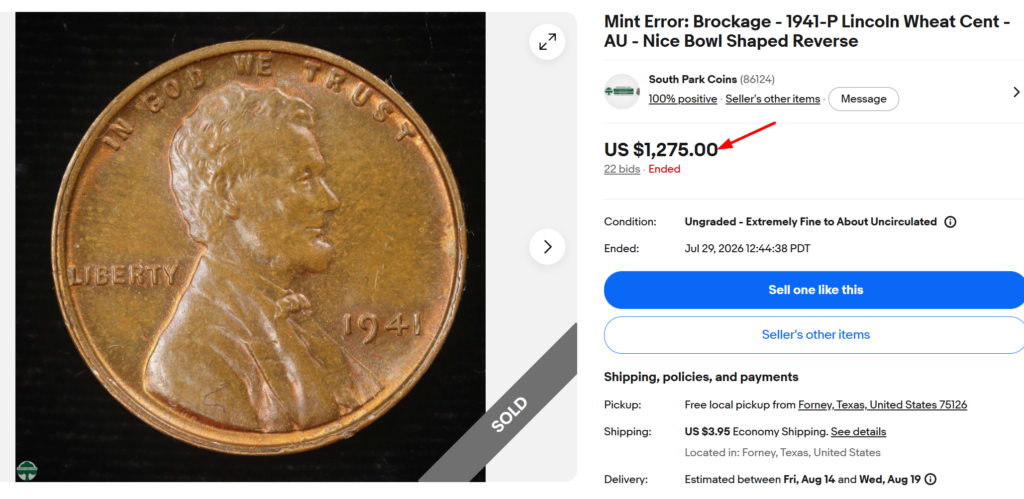
Sold for $1,275
A brockage is one of the wilder mint errors you’ll see. It happens when a struck coin sticks to a die and then presses a mirrored, sunken image into the next blank fed in. The result is a bowl-shaped side with the design incuse and reversed.
Full, well-centered brockages on 1941 cents are genuinely scarce and command strong prices at auction.
- Estimated Value: $300 to $1,500+
- What to Check: Mirrored incuse design on one side
- Quick Notes: Full brockages are dramatic and scarce
2. 1941 Doubled Die Obverse (DDO FS-101)
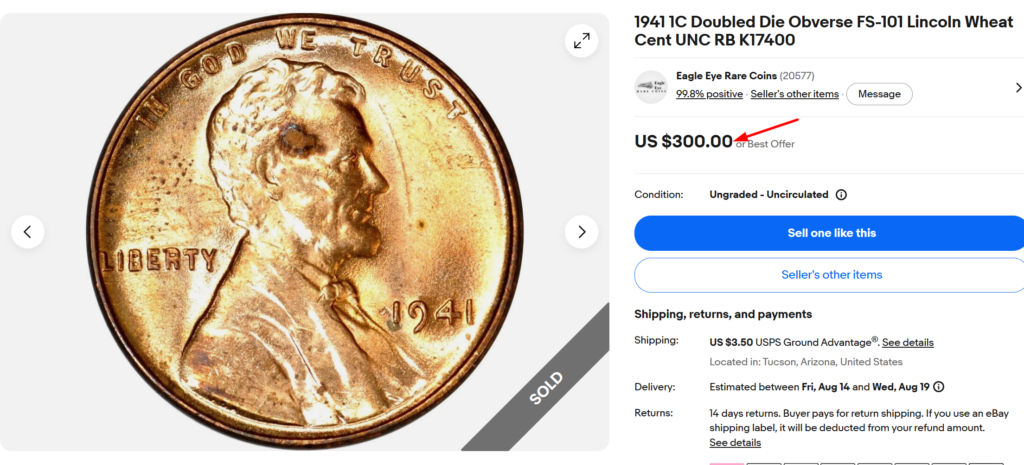
Sold for $300
The 1941 doubled die obverse, cataloged as FS-101, shows clear doubling on the BER of LIBERTY, across IN GOD WE TRUST, and on the 4 in the date. It came from a Class I counterclockwise hub rotation at Philadelphia. Top RD gem examples can easily reach $35,000 in MS67 grade.
- Estimated Value: $200 to $35,000
- What to Check: Doubling on BER in LIBERTY
- Quick Notes: Class I hub rotation, Philly only
3. 1941 Off-Center Strike Error
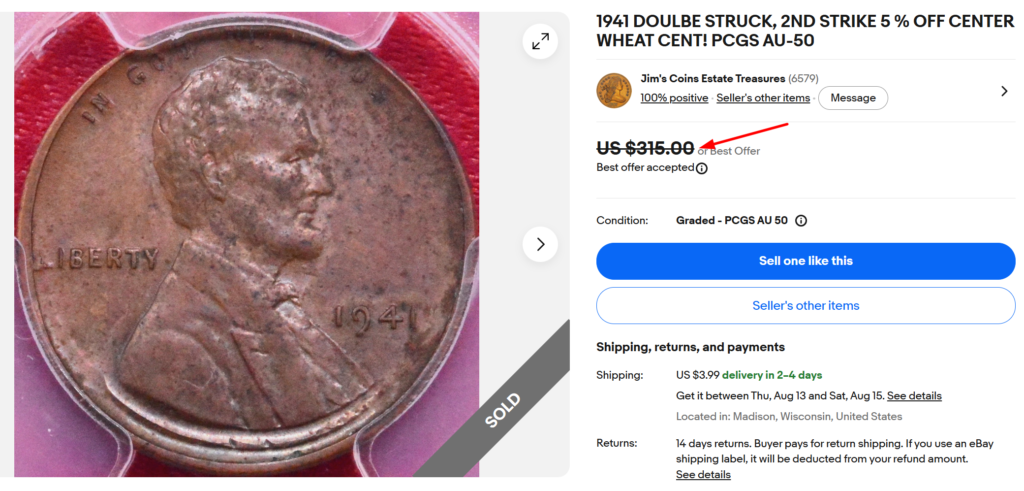
Sold for $315
An off-center strike happens when the blank planchet doesn’t sit correctly under the die. Part of the design ends up missing, and a blank crescent shows on the coin.
The bigger the offset and the more of the date that’s still visible, the more valuable the cent. A dramatic off-center with a full 1941 date can push past $600.
- Estimated Value: $5 to $600+
- What to Check: Design shifted off the planchet
- Value Notes: Value increases with off-center strike and visible date.
4. 1941 DDO FS-102 and FS-103
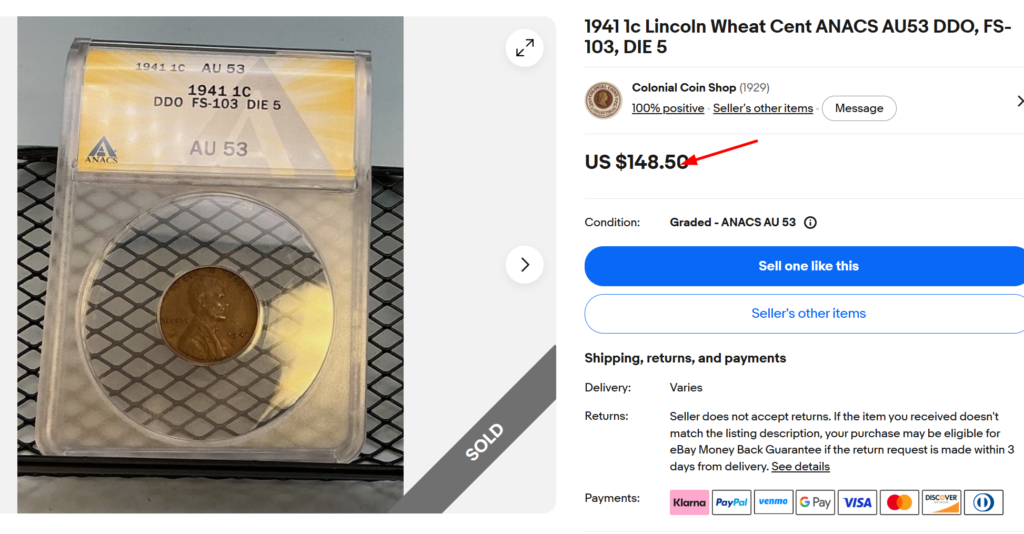
Sold for $150
There are actually three recognized 1941 doubled die obverses, and the lesser-known FS-102 and FS-103 varieties are worth chasing too. The doubling is weaker and less dramatic than on FS-101, but a properly attributed example still brings real money, especially in higher mint-state grades with red color.
- Estimated Value: $50 to $2,000+
- What to Check: Lighter doubling on lettering
- ID Notes: Weaker than FS-101, still collectible
5. 1941 Proof Wheat Penny
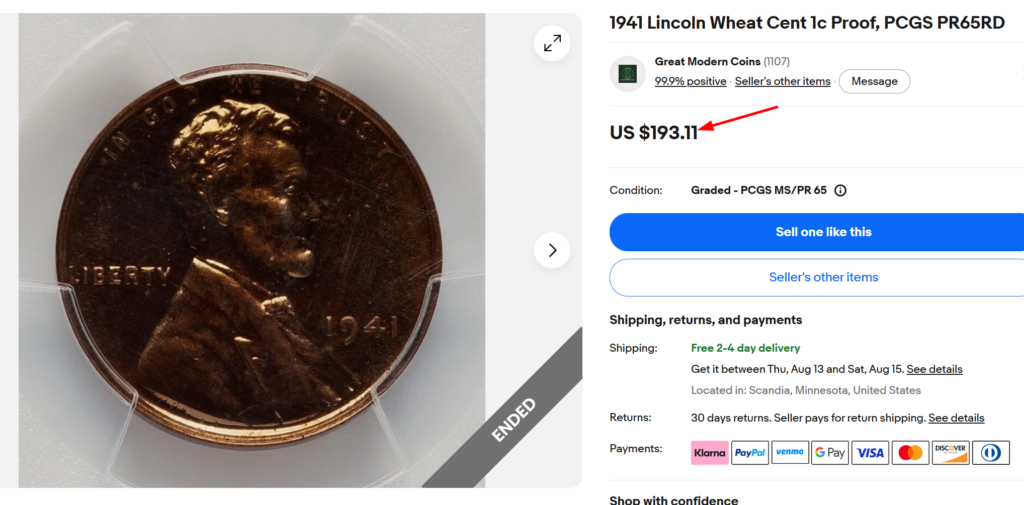
Sold for $195
The 1941 proof is a different animal. Philadelphia struck just 21,100 for collectors, using specially polished dies to create mirror-like fields and razor-sharp details.
Brown proofs are affordable, but full red examples get expensive fast. The highest-grade examples, like PR67 and PR68, can fetch up to $30 at auction.
- Estimated Value: $20 to $28,200
- What to Check: Mirror-like fields, sharp devices
- Quick Facts: Only 21,100 struck, Philadelphia only
6. 1941 Curved Clip Planchet Penny Error
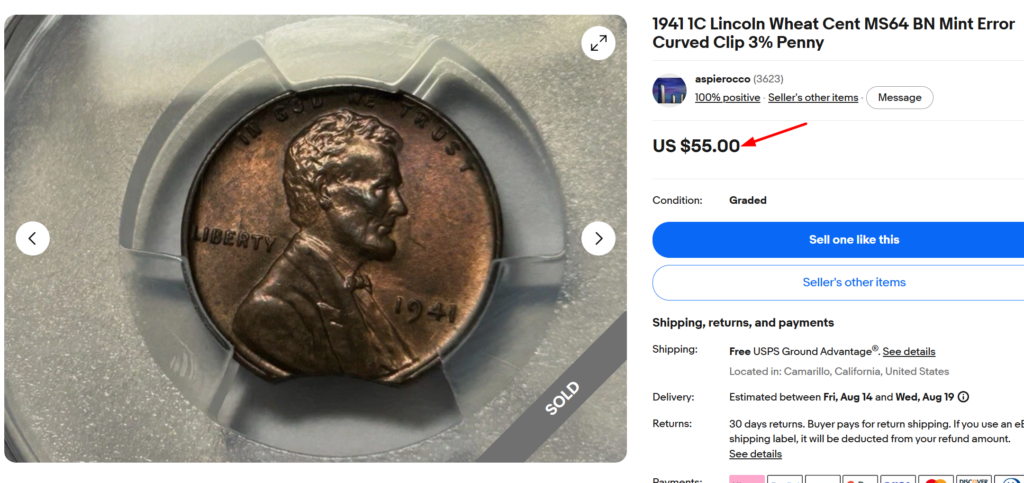
Sold for $55
A curved clip happens when the blank was punched from a copper strip that overlapped a spot where another blank had already been cut, leaving a smooth curved arc missing from the coin’s edge.
Clip size matters, so a bigger, deeper curve on a 1941 penny pulls more collector interest than a tiny nick.
- Estimated Value: $20 to $150+
- What to Check: Curved arc missing from the edge
Most 1941 wheat pennies you’ll come across are worth a few cents because more than a billion coins were struck. But certain pennies with errors, top grades, and the proof issues are worth the most. Look under the date and check the design closely before selling or buying one.