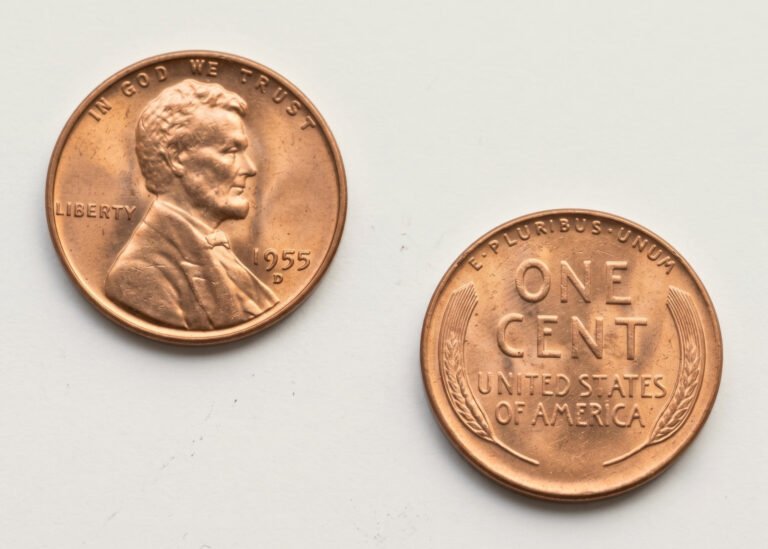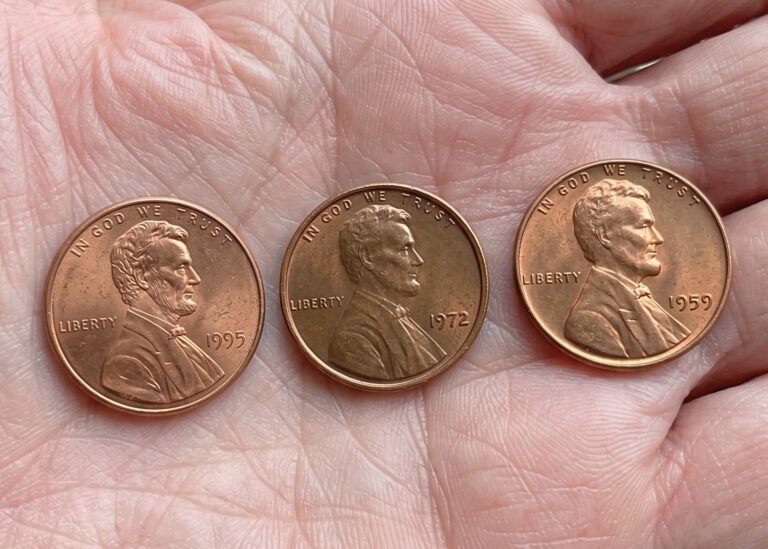

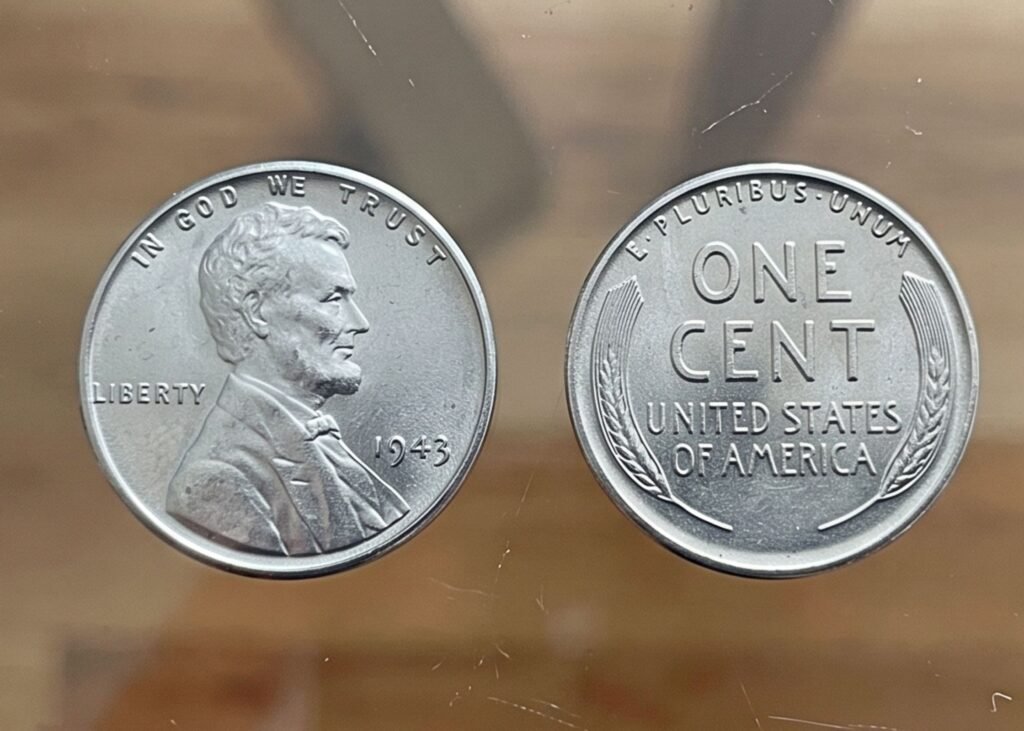
Most people find a 1943 steel penny tucked in an old coffee can or a grandfather’s coin jar. Most cents have a coppery look, but this one is silver-colored, a little rough around the edges, unlike the copper pennies we’re used to.
And that’s exactly why people always ask the same thing: Is a 1943 steel cent worth anything?
This article will show how you can identify a genuine 1943 steel penny and will also provide you with the factors that make it valuable, as well as the varieties and errors that cost a fortune in auctions.
A Quick Look at the Wartime Backstory
The 1943 steel penny exists for a reason. Copper was needed for shell casings and wiring during World War II, so the U.S. Mint switched to zinc-coated steel to make pennies for that one year.
Over a billion were struck across three mints.
- Philadelphia made about 684 million
- Denver produced roughly 217 million
- San Francisco struck around 191 million
However, while their appearance is unique, most of them are not rare at all. The things that make some of these wheat pennies worth money are their condition, mint mark, and a few errors that happened during their production.
How To Tell a Genuine 1943 Steel Penny?
Before talking about values, one should be sure that they have a genuine 1943 penny. Counterfeits are abundant, and a quick check will save you from a lot of trouble. The good news is that telling a real steelie apart from other coins is quite simple.
1. The Magnet Test
Grab a fridge magnet. A genuine 1943 steel penny will stick to it every time because the core is steel. If your coin doesn’t stick, you might have something extraordinary on your hands, like the famous copper error.
But watch out for copper-plated steel fakes; they still stick to a magnet even though they look bronze. That’s why you should use other tests, too.
2. The Weight Test
Weigh the coin. A real 1943 steel penny weighs 2.70 grams. The rare 1943 copper penny weighs 3.11 grams, the same as normal wheat cents.
Quick Tip: Use a small jeweler’s scale that measures to a hundredth of a gram.
3. Visual Check and Mint Mark Location
Real 1943 steel wheat pennies have a silver-gray color, wheat stalks on the reverse, and Lincoln’s portrait on the front.
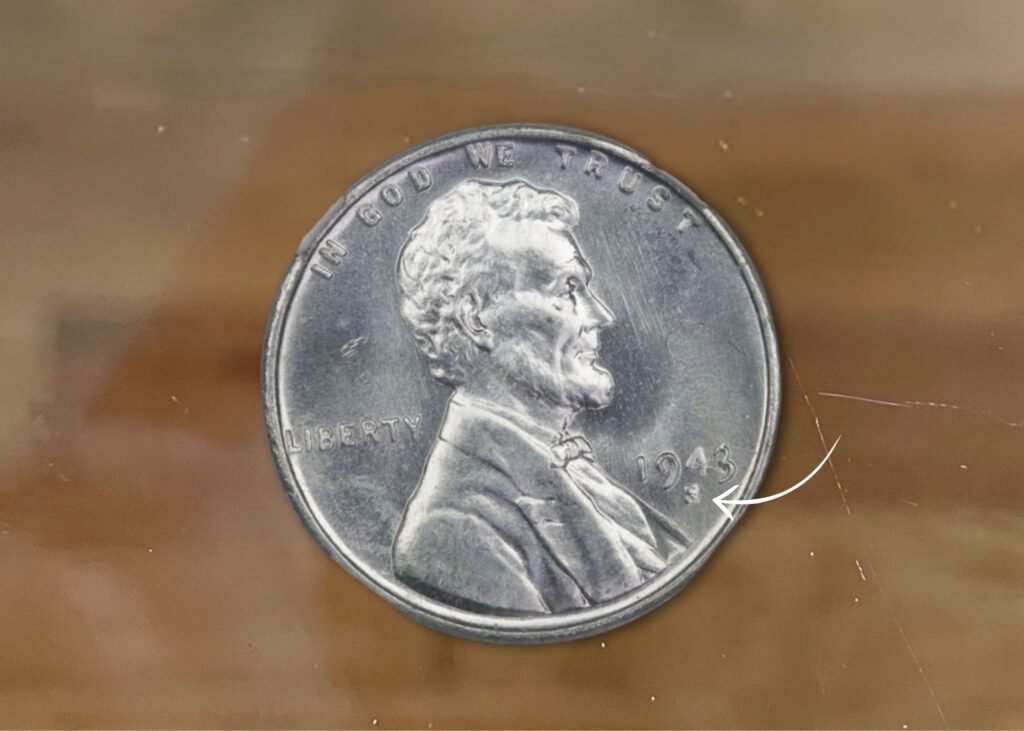
The mint mark sits just below the date on the obverse.
- A D means Denver
- An S means San Francisco
- No mint mark means Philadelphia
If your coin looks brown or copper, but the date reads 1943, that’s your cue to look much closer.
ID tip: Watch for altered 1948 pennies. Some people file down the “8” to make it look like a “3,” creating a fake copper 1943. If the date font looks off or the “3” seems shallow, be suspicious.
What Drives the Value of a 1943 Steel Cent?
The following four things decide what a 1943 steel penny is worth.
- Condition comes first, and grade matters more than most people realize. A worn coin might bring pocket change, but the same coin in gem-uncirculated condition can fetch into the thousands. That’s why professional grading from PCGS or NGC matters for anything that looks pristine.
- Mint mark is the second factor. Philadelphia coins are the most common, so they trade for the least. Denver and San Francisco coins carry small premiums, especially in high grades.
- Errors are the third piece of the puzzle. A doubled die, a repunched mint mark, or an off-center strike can turn a plain steelie into a coin collector’s chase.
- Population data also plays into it. Some varieties have only a few thousand known examples, which is why savvy collectors chase specific error listings rather than just any 1943 penny.
Most Valuable 1943 Steel Pennies and Rare Errors to Know
These are the specific 1943 pennies collectors actively hunt for, the ones that fetch premiums in the resale market and auctions. Each one has a specific look, a specific story, and clear features to check for.
1. 1943-S Silver 1C Struck on a 10C Cent
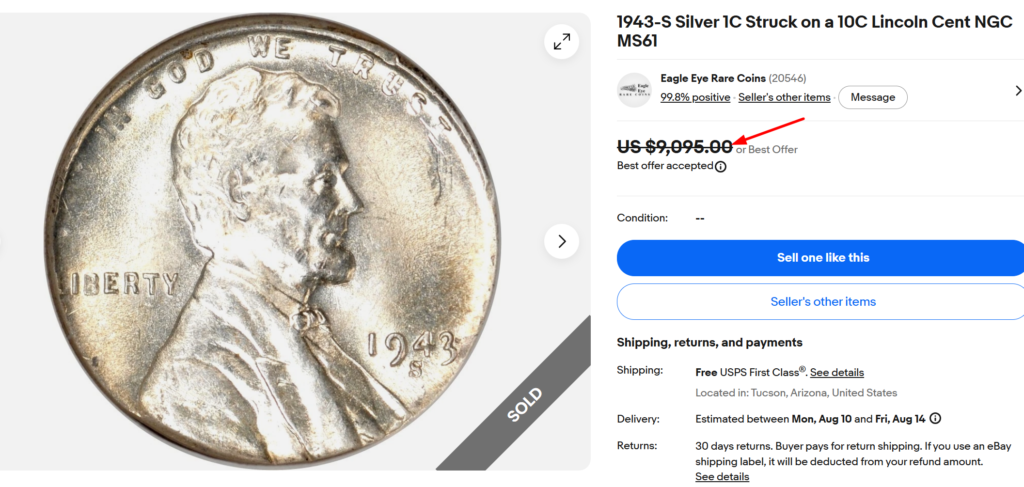
Sold for $9,095
This one is a wrong-planchet error that fascinates collectors because it looks like a silver penny. A dime planchet, made of 90% silver and 10% copper, accidentally fed into the cent press at San Francisco. The result is a Lincoln cent design struck on a slightly smaller, softer blank.
Look for weak, nearly flat rim details on the border, since the planchet skipped the upset mill. The strike itself stays sharp because silver is soft and takes the design well.
- Estimated Value: $9,000 to $9,200+
- What to Check: Silver color, smaller diameter, softer rims
- Quick Notes: Struck on a 90% silver dime planchet
2. 1943 Copper (Bronze) Penny
The 1943 copper penny is the holy grail of American error coins. A few bronze planchets left over from 1942 got fed into the presses at all three mints and struck with 1943 dies.
Fewer than 30 authentic examples exist across Philadelphia, Denver, and San Francisco combined, which is why every genuine one is a headline sale.
- Estimated Value: $100,000 to $1.7 million
- What to Check: Copper color, non-magnetic, weighs 3.11 grams
- Quick Notes: Fewer than 30 known, needs PCGS or NGC certification
3. 1943-D Bronze Cent (Unique)
The 1943-D bronze cent stands alone as the single known Denver example, which makes it the most valuable Lincoln cent ever sold. It brought $1.7 million at auction back in 2010, and a later sale in 2021 pushed the record even higher.
So if you ever find a copper 1943 with a “D” below the date, you may be holding a rare 1943 bronze cent.
- Estimated Value: Over $1.7 million
- What to Check: “D” mint mark, copper tone, non-magnetic
- Quick Notes: Only one confirmed example known to exist
4. 1943-S Bronze Cent
The 1943-S copper cent is the second rarest out of the three copper cents. There are only about five authenticated pieces available, with one of them being auctioned for $504,000.
Since these coins are very likely to be faked, no sensible collector will consider one without its third party grading by either PCGS or NGC.
- Estimated Value: $200,000 to over $1 million
- What to Check: “S” mint mark, copper color, weight of 3.11g
- Quick Notes: Only about five verified examples exist
5. 1943/2-S Overdate (FS-101)
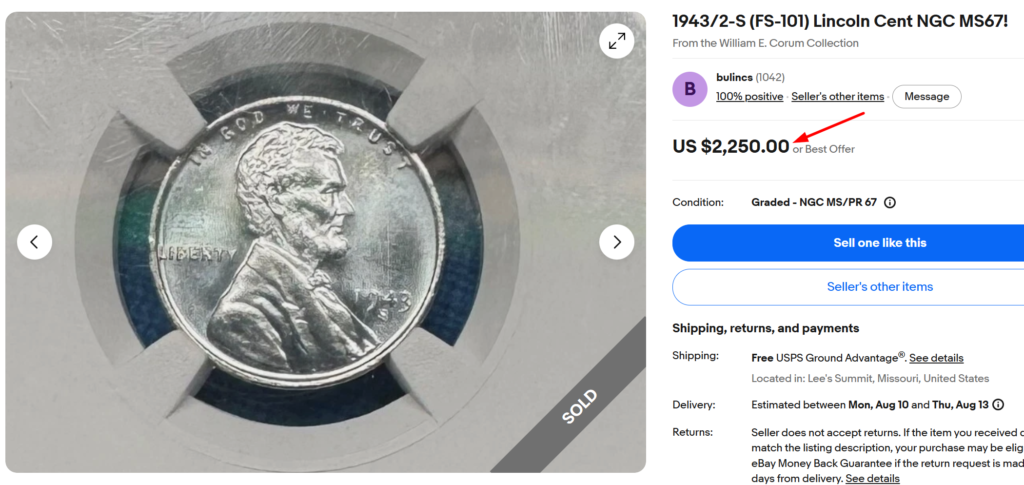
Sold for $2,250
This one is fascinating because it hid in plain sight for nearly 80 years. Long labeled just a doubled die, collector James Elliott spotted the trace of a “2” beneath the “3” back in 2020. Variety specialists confirmed it as a true overdate in 2022, making it the only overdate in the entire Lincoln wheat cent series.
Look for extra metal on the upper right of the “3” under a 10x loupe. An MS67 example sold for $10,000 in 2022, and values keep climbing as more collectors learn about it.
- Estimated Value: $500 to $10,000+
- What to Check: Faint “2” underneath the “3” in date
- Quick Notes: Only overdate in the Lincoln cent series
6. 1943-S Doubled Die Obverse (FS-101)
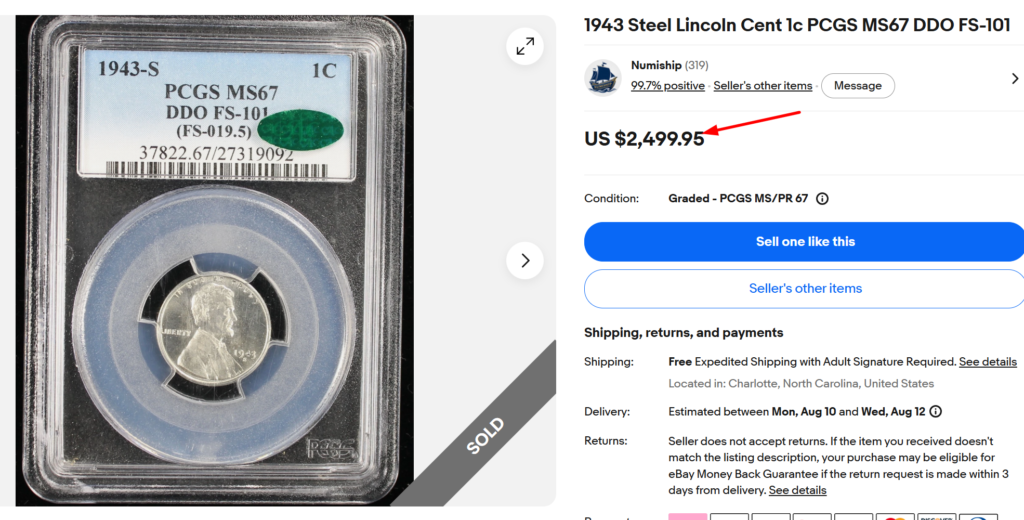
Sold for $2,500
Collectors call this one the “Doubled Eye” variety because Lincoln appears to have a second raised eyelid just below the main one. You’ll also spot bold doubling in the date digits and along the letters of LIBERTY.
Because die chatter is so common on steel cents, it’s better to use a jeweler’s loupe to separate the real cents from ordinary machine doubling.
- Estimated Value: $150 to $1,500+
- What to Check: Doubled eyelid on Lincoln’s portrait, date, and “LIBERTY”
7. 1943 Doubled Die Obverse (Philadelphia FS-101)
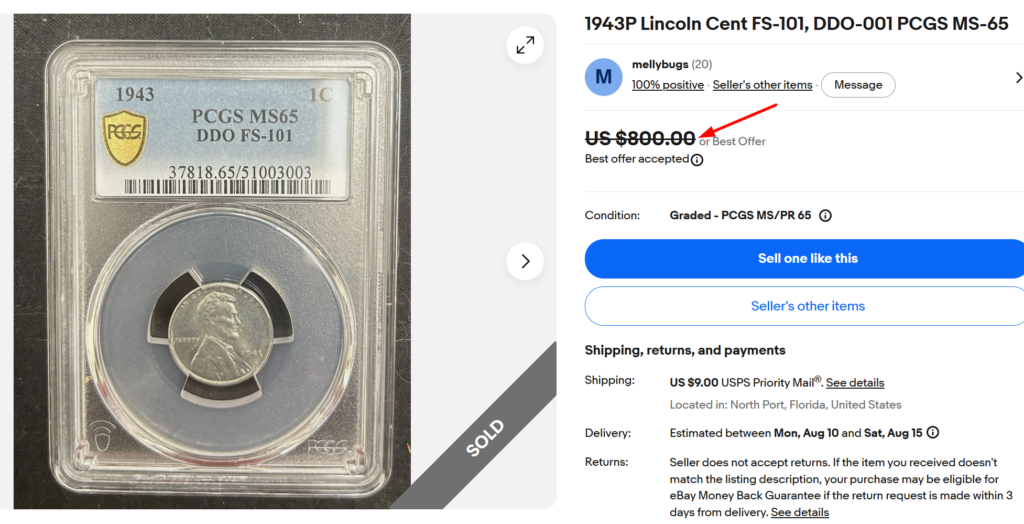
Sold for $800
The Philadelphia doubled die shows split strokes on the letters of LIBERTY, particularly near the rim, and doubling on the “1943” date. Bold examples sometimes show doubling in “IN GOD WE TRUST” too.
It’s more common than the 1943-D and 1943-S variety, but a high-grade specimen still commands strong money.
- Estimated Value: $50 to $1,675 in MS66
- What to Check: Split strokes on LIBERTY and date
8. 1943-D Repunched Mint Mark (FS-501)
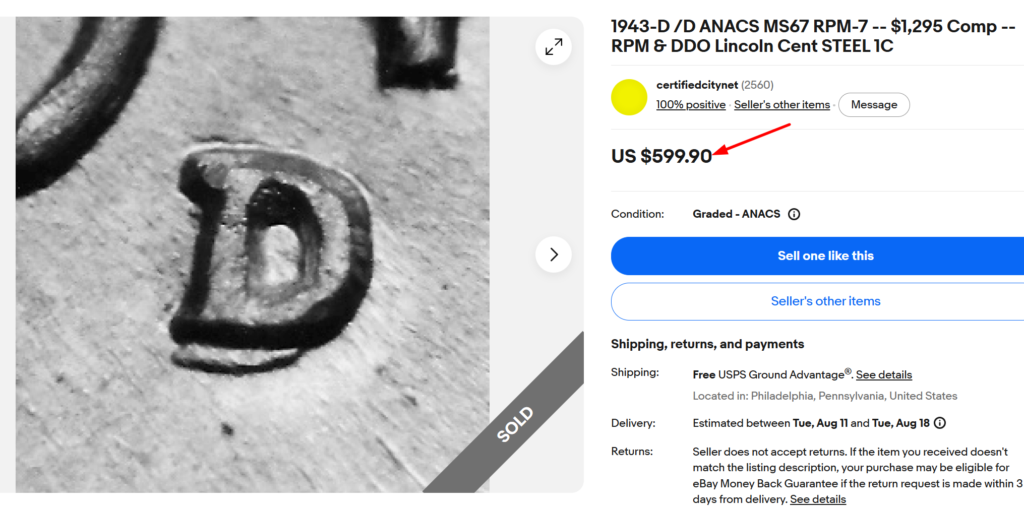
Sold for $600
The Denver Mint hand-punched mint marks back then, so a worker occasionally hit the die twice in slightly different spots. The result on the FS-501 is a clear ghost “D” positioned below and to the left of the main “D.”
It ranks as the #8 most wanted Lincoln cent variety among advanced collectors, and MS67 examples can fetch up to $20,00 at auctions.
- Estimated Value: $70 to $19,500
- What to Check: Ghost “D” below primary mint mark
- Quick Notes: Only 3,000 to 5,000 known examples
9. 1943 Off-Center Strike
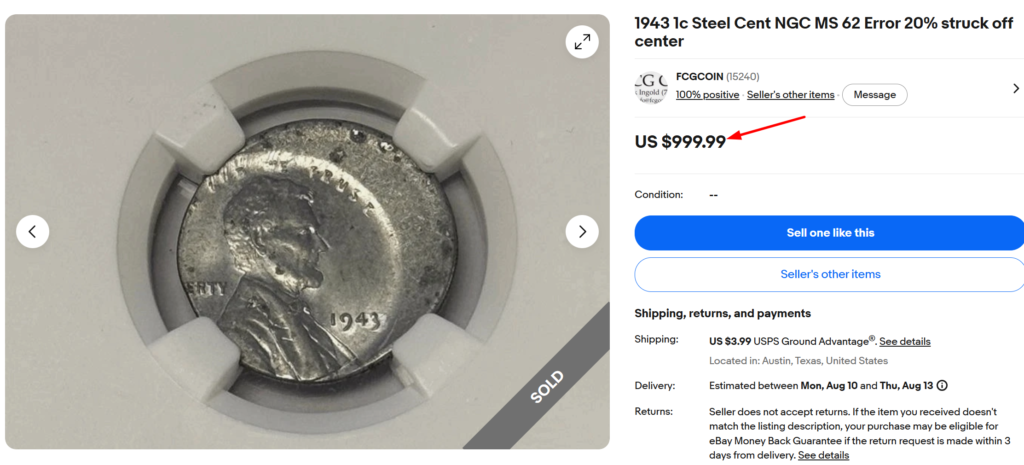
Sold for $1,000
- Estimated Value: $20 to $500+
- What to Check: Blank crescent on one side of the coin
- Quick Notes: A higher off-center percentage means more value
This occurs if the planchet was not properly seated in the die before the coin was struck, producing a bent or curved field area on one side of the coin.
Off-center coins that are small, say 10%, have little value, but large 50% off-center penny errors with the readable date could be worth a few hundred dollars.
10. 1943 Die Break and Cud Errors
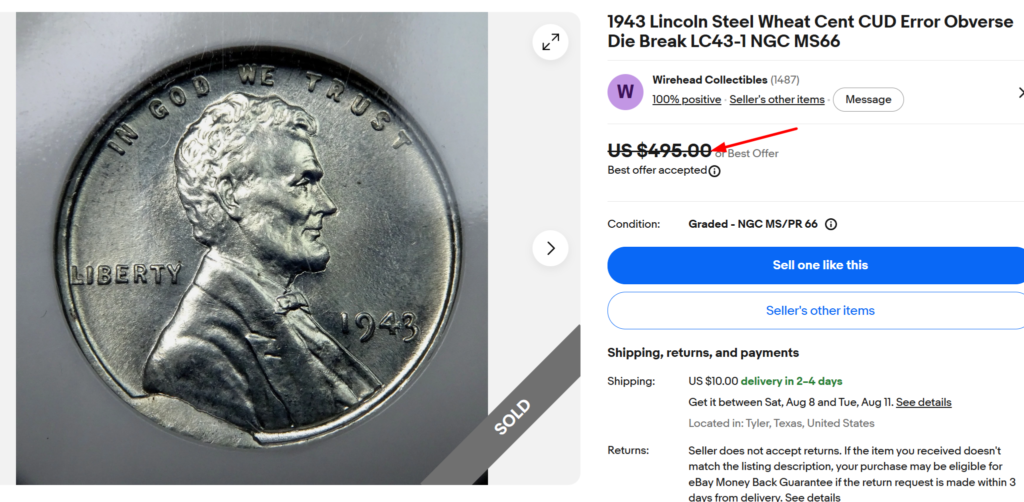
Sold for $495
Steel is much harder than copper, and its dies wore out quickly in 1943. Cracks and chips in the dies left raised lines or blob-shaped “cuds” on struck coins.
Minor die cracks bring small premiums, but a large rim cud on a well-preserved steelie is a real conversation piece for variety collectors.
- Estimated Value: $50 to $500+
- What to Check: Raised blob or bar on coin surface
11. 1943 High-Grade Uncirculated (MS-68 & Above)
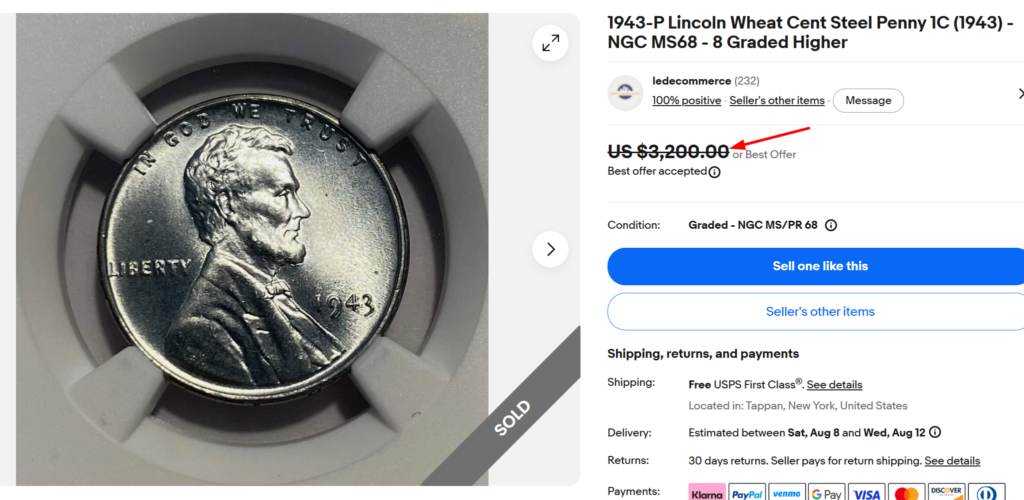
- Estimated Value: $185 to $19,500+
- What to Check: Bright original luster, no spots
- Quick Notes: MS-68+ examples jump 80x in price
Regular 1943 steel pennies get interesting when they’re in near-perfect condition. Zinc is fragile, and most steelies picked up spots, corrosion, or wear over 80 years. So an MS-68 example with bright original surfaces is genuinely tough and can sell for a few thousand dollars.
The majority of steel 1943 pennies will be worth a few cents, but the types above are what make collectors keep sifting through cans of them. So, do not spend your 1943 cent before spending at least five minutes checking whether you have a rare cent.