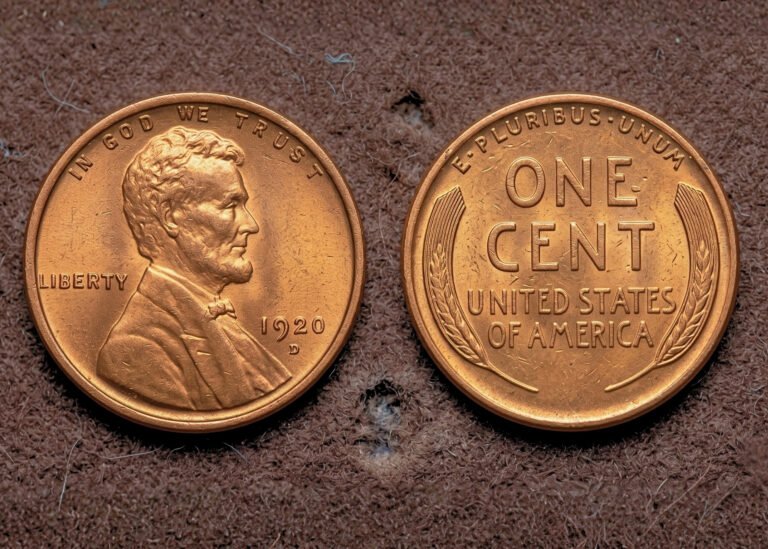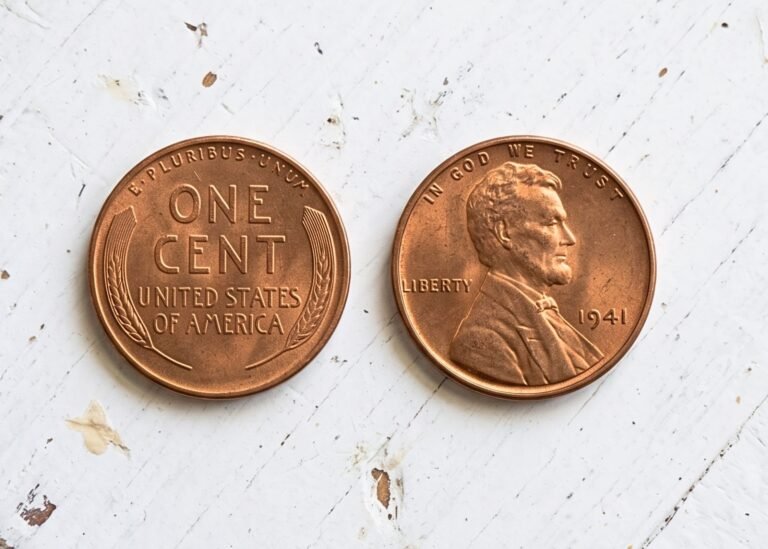

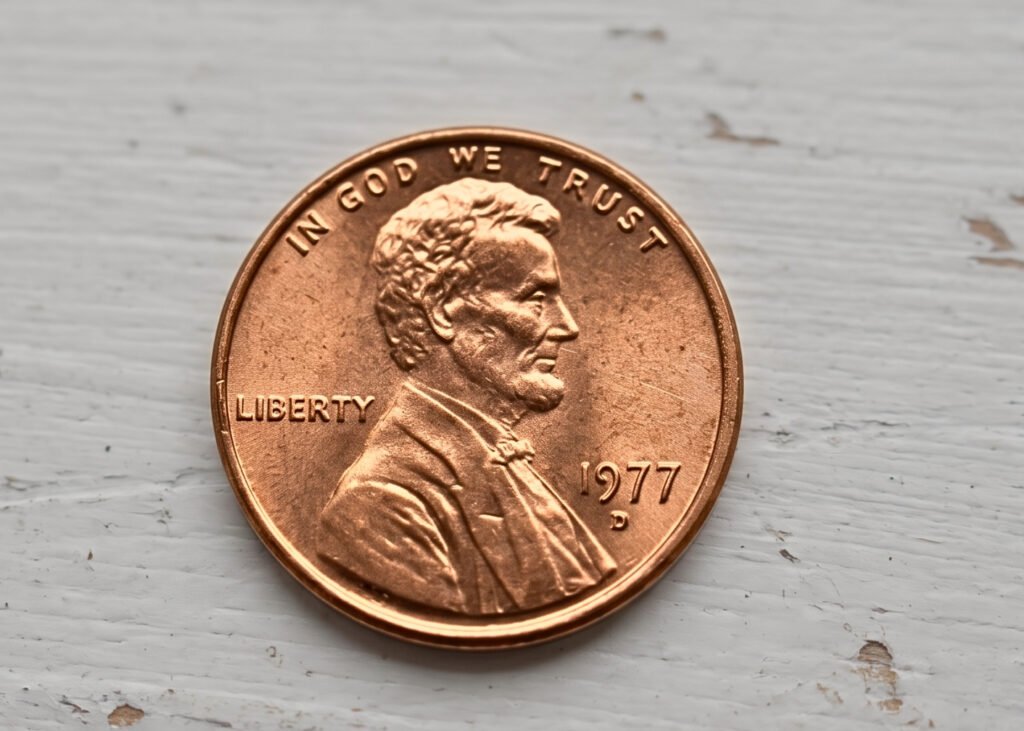
Most 1977 pennies you’ll find in a jar or pocket change are worth exactly one cent. But the same date cent, as rare as the unique aluminum piece, can also fetch tens of thousands of dollars at auction.
So before you spend your 1977 Memorial cent at the gas station, know what to look for. This guide walks you through the quick history, quick identification checks, and the specific varieties you should look out for.
A Quick Look at the 1977 Lincoln Penny
The 1977 penny is part of the Lincoln Memorial cent series, which was in use from 1959 until 2008. Victor David Brenner created the obverse image of Lincoln back in 1909. Frank Gasparro designed the Memorial reverse in 1959 to celebrate the president’s 150th birthday.
By 1977, the country was still striking pennies in the classic 95% copper and 5% zinc alloy. That copper composition would only last five more years before rising metal prices forced the switch to zinc in 1982.
So these coins sit right at the tail end of the true copper penny era, which is one reason collectors still collect them.
How to Spot a Real 1977 Penny Worth Keeping
To make sure you’re looking at a genuine 1977 Lincoln Memorial cent, run through these quick checks.
Verify the design.
Make sure to check the following design elements on your 1977 cent.
- The obverse (front) shows Victor David Brenner’s portrait of Abraham Lincoln facing right, with “IN GOD WE TRUST” above, “LIBERTY” on the left, and the date on the right. Brenner’s “VDB” initials sit along the rim under Lincoln’s shoulder.
- The reverse (back) carries Frank Gasparro’s Lincoln Memorial design, with “E PLURIBUS UNUM” up top, “UNITED STATES OF AMERICA” curving around the edge, and “ONE CENT” at the bottom. Gasparro’s “FG” initials sit to the right of the building.
Check closely for the design; any important missing detail could indicate a forged coin. Besides, it’s these details that usually hide rare minting errors.
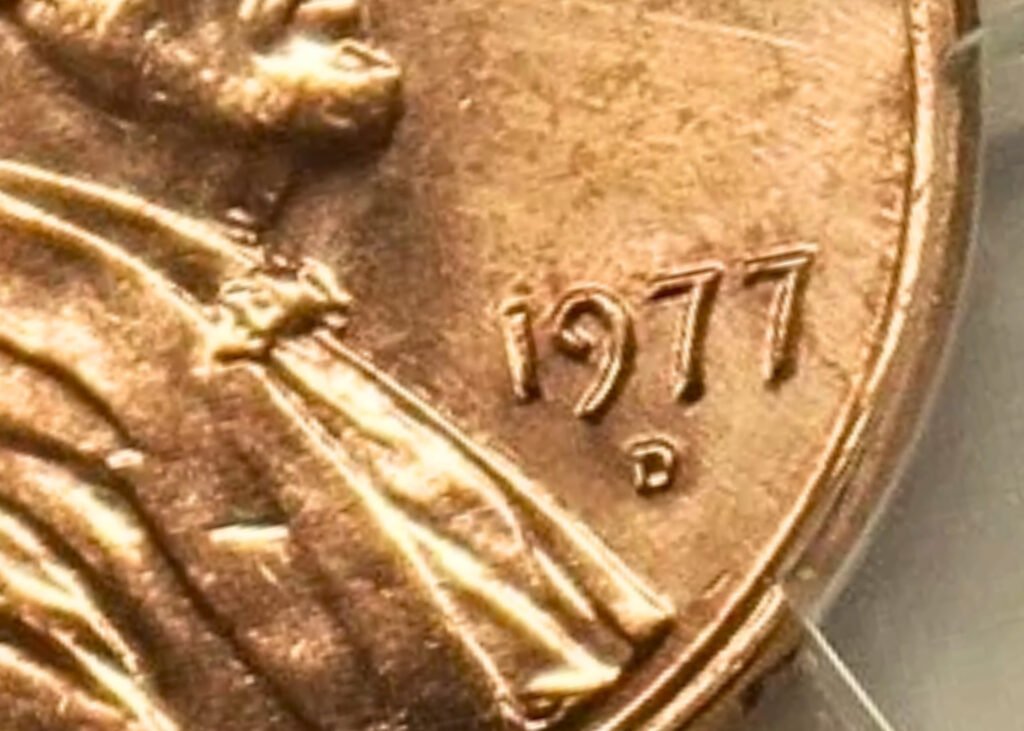
Find the mint mark first.
It sits on the front (obverse), just below the date. A “D” means Denver, an “S” means it’s a proof from San Francisco, and no letter at all means Philadelphia. Philadelphia never stamped a “P” on the cent, so a blank spot there is completely normal and not an error.
Here’s how many pennies each mint produced that year:
- San Francisco (S proof): 3,251,152
- Philadelphia (no mint mark): 4,469,930,000
- Denver (D): 4,149,062,300
Mintage also affects a coin’s value; the lower the mintage, the more valuable the penny.
Check the color next.
Not all the 1977 coins look the same in color. Due to the copper content, these cents get graded three ways:
- Red (RD) for bright original color
- Red-Brown (RB) for partial toning
- Brown (BN) for fully oxidized examples.
Red pieces bring the strongest premiums by a wide margin, sometimes ten times what a Brown 1977 penny would fetch.
Weigh the coin on a scale.
A genuine 1977 Lincoln Memorial penny weighs 3.11 grams and measures 19.05 mm across. Anything way off from that number is worth a second look, especially if it comes in light at around 1 gram.
Grab a magnifier for the details.
A 10x loupe is the minimum for spotting real errors. Look for doubling in “LIBERTY” and “IN GOD WE TRUST,” check the spacing between the A and M in “AMERICA” on the reverse, and inspect the mint mark for any signs of repunching.
What Actually Drives 1977 Penny Value?
The three things that are responsible for a 1977 Lincoln penny value are:
- Condition – This matters more than anything. Coins graded MS-67 or higher can jump from pocket change to hundreds of dollars overnight. Third-party grading from PCGS or NGC also plays a role, since certified coins always trade for more than raw examples of the same quality.
- Color – Color comes in second, with Red designations pulling far more than Brown examples in the same grade.
- Errors and varieties – This is the most interesting factor. A common no-mint-mark penny sells for a cent, but the same coin with a clear DDO or off-center strike can fetch way more.
Most Valuable 1977 Pennies and Errors to Look For
The 1977 Lincoln Memorial pennies below are the ones collectors actively hunt today. Some are worth money for excellent condition, while others come with a rare error.
1. 1977 No Mint Mark Penny (Philadelphia)
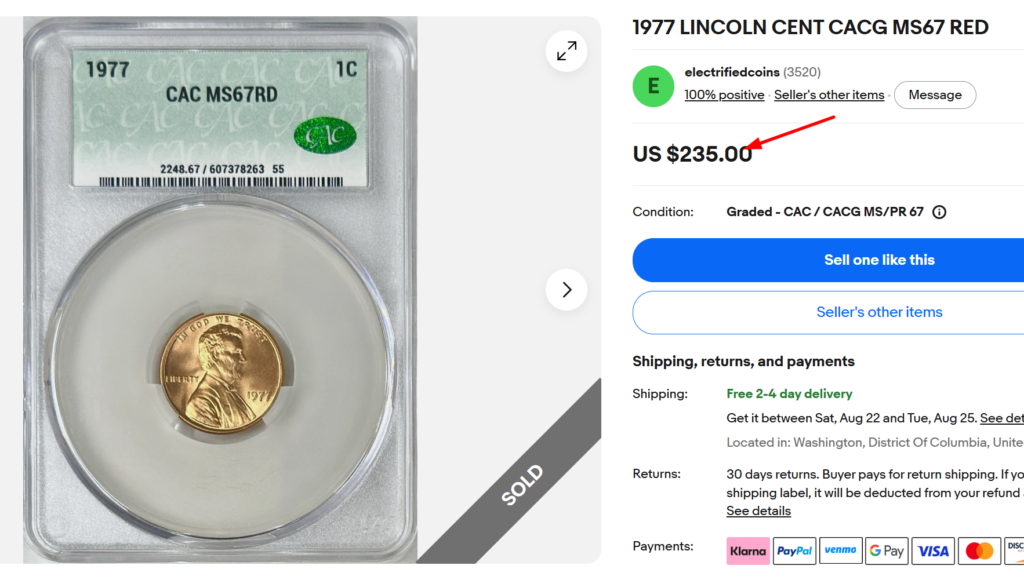
Sold for $235
Philadelphia struck about 4.47 billion of these, so most are worth face value in circulated shape. But the value changes to hundreds and thousands in top grades.
Fewer than 200 examples have hit MS-67 RD at PCGS, mostly because the soft copper scars easily in mint bags. So a truly pristine one with full red luster is a condition rarity.
- Estimated Value: $0.01 to $3,500+
- What to Check: No letter under the date
2. 1977-D Lincoln Penny (Denver)
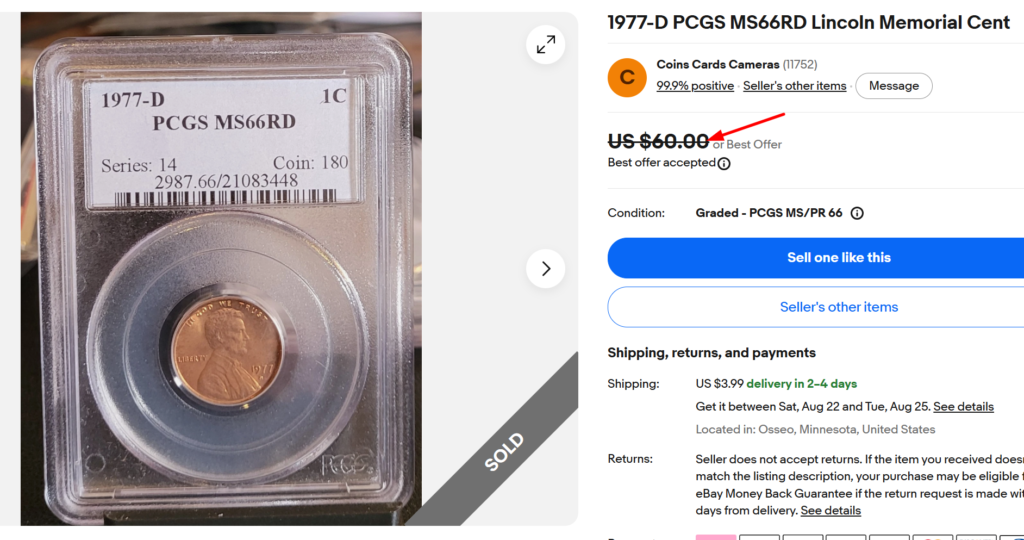
Sold for $60
With a mintage of 4.15 billion, Denver’s 1977 pennies are pretty common; only the top grade examples are worth the money. Only a single 1977-D has ever been certified MS-68 RD by PCGS, which sold for over $7,000 in an auction back in 2016. Any MS-67 RD example is still a serious coin.
- Estimated Value: $0.01 to $7,050
- What to Check: “D” mint mark below date
- Quick Facts: Only one MS-68 RD known
3. 1977-S Proof Penny (San Francisco)
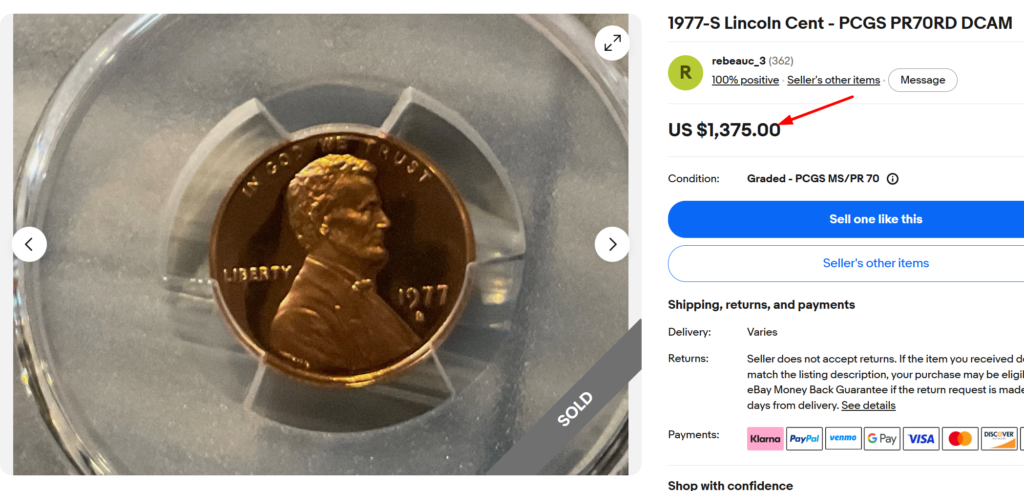
Sold for $1,375
The San Francisco mint made just 3,251,152 of these, and they were struck on polished dies for collector proof sets. You can spot them by their unique shine and contrasting cameo.
Most survived in great shape because owners tucked them away from day one. A standard PR-69 DCAM trades for $15 to $25, but the top-pop PR-70 DCAM can fetch up to $5,000 at an auction.
- Estimated Value: $5 to $7,000
- What to Check: Mirror fields, frosted design
- Quick Notes: PR-70 DCAM commands the highest money
4. 1977 Penny Struck on a 10C Clad Dime Planchet
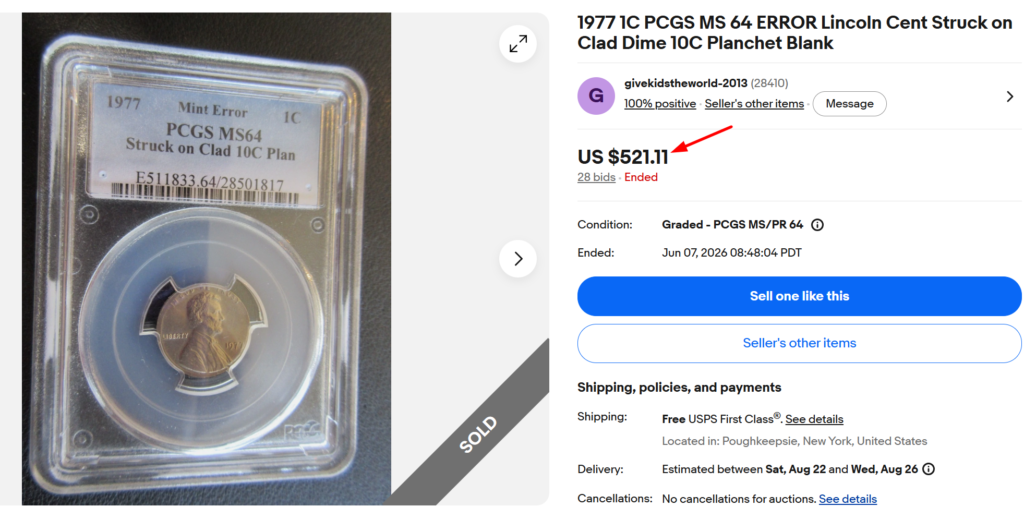
Sold for $520
This one happened when a blank meant for a Roosevelt dime accidentally got fed into the Lincoln cent press. The result is a coin with the full 1977 penny design struck on a smaller, silver-colored copper-nickel dime planchet.
MS64 or higher grade examples can easily fetch over $500 for a clean wrong-planchet error with third-party certification.
- Estimated Value: $400 to $700+
- What to Check: Silver color, smaller size, ~2.27 grams
- Quick Notes: Full Lincoln design on dime blank
5. 1977 Doubled Die Obverse (DDO)
This error happened when the die received multiple hub impressions at slightly different angles. You’ll see clear doubling in the date, “LIBERTY,” or “IN GOD WE TRUST.”
No major DDO variety has been recognized for 1977, so most examples are minor. Still, strong examples with obvious naked-eye doubling are what collectors want.
- Estimated Value: $50 to $500+
- What to Check: Doubling in date and lettering
- Quick Notes: Naked-eye doubling brings top prices
6. 1977 Off-Center Strike
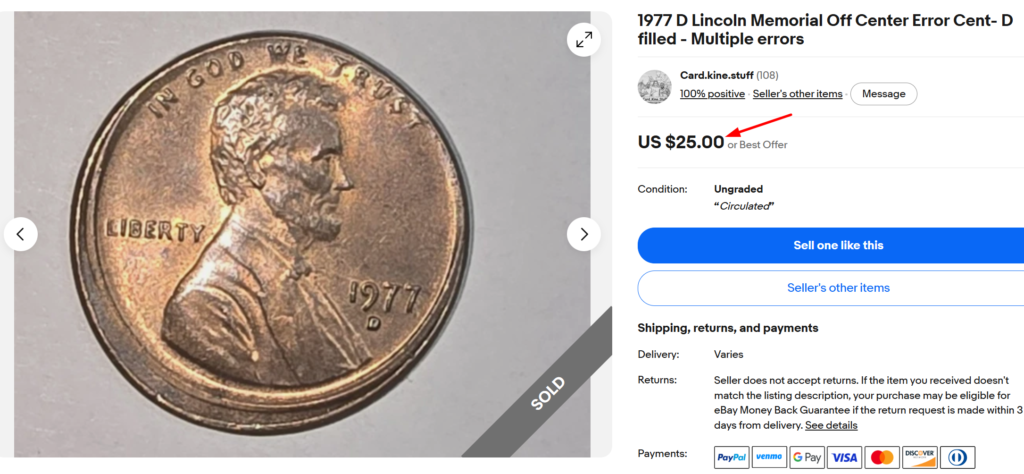
Sold for $25
These pennies got struck while the blank wasn’t lined up right, leaving part of the design missing and a blank crescent on one side. The value of these coins depends on the amount/percentage of off-center design and whether you can see the date.
The sweet spot for value is a 10-20% off-center strike where you can still read the full date. Coins that are 50% off with no date visible aren’t worth much because identification is difficult.
- Estimated Value: $20 to $150+
- What to Check: Design shifted, full date visible
7. 1977 Clipped Planchet Error
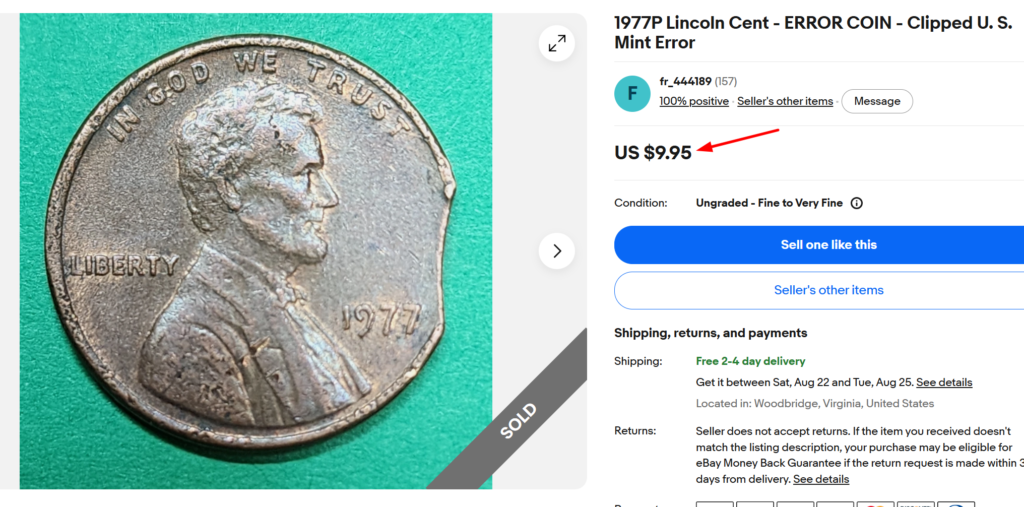
Sold for $10
Clipped planchet errors happen when the blank punching machine overlapped a previous cut, leaving a crescent missing from the edge of the finished coin. Curved clips are the most common type and bring modest premiums.
Straight clips are rarer and worth more. Clip size matters too; bigger cuts usually mean more money, but the date should be visible.
- Estimated Value: $10 to $75
- What to Check: Crescent cut on coin edge
8. 1977 Struck-Through Grease Error
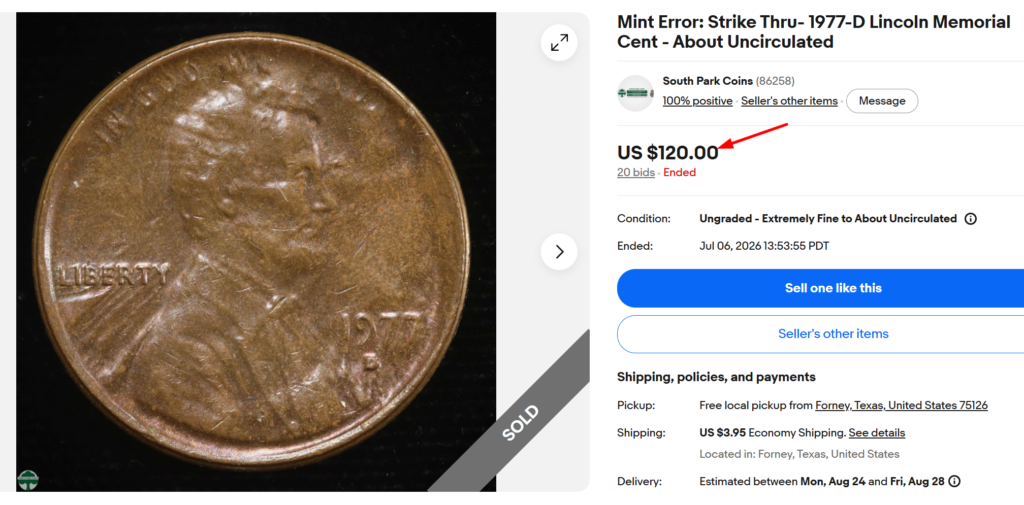
Sold for $120
Grease and debris sometimes built up in the dies during minting, blocking the design from transferring cleanly to the planchet. The result is a coin with fuzzy or missing letters, weak details in Lincoln’s hair, or a partially filled Memorial.
Small versions are common and worth a couple bucks. Dramatic ones with major missing details are more valuable.
- Estimated Value: $5 to $150
- What to Check: Weak or missing design areas
- Quick Notes: Small filled letters are common
9. 1977 Aluminum Penny (Extraordinary Rarity)
This is the unicorn. A single 1977 Lincoln cent struck on an aluminum planchet exists, weighs just 1.04 grams instead of the standard 3.11, and was authenticated by NGC as MS-60.
It sold for $50,400 at Heritage Auctions in August 2025. If your “silver” 1977 penny weighs a normal 3.1 grams, it’s plated and worth nothing extra. Only the aluminum weight matters.
- Estimated Value: $50,400 (confirmed sale)
- What to Check: Silver color, ~1.04 grams weight
- Quick Notes: Only one example known to exist
The 1977 penny is more common than people think as it was struck in billions. But some high-grade Reds and legitimate errors do carry real money. So, make sure to check closely at the details on both sides before you give away the coin.