
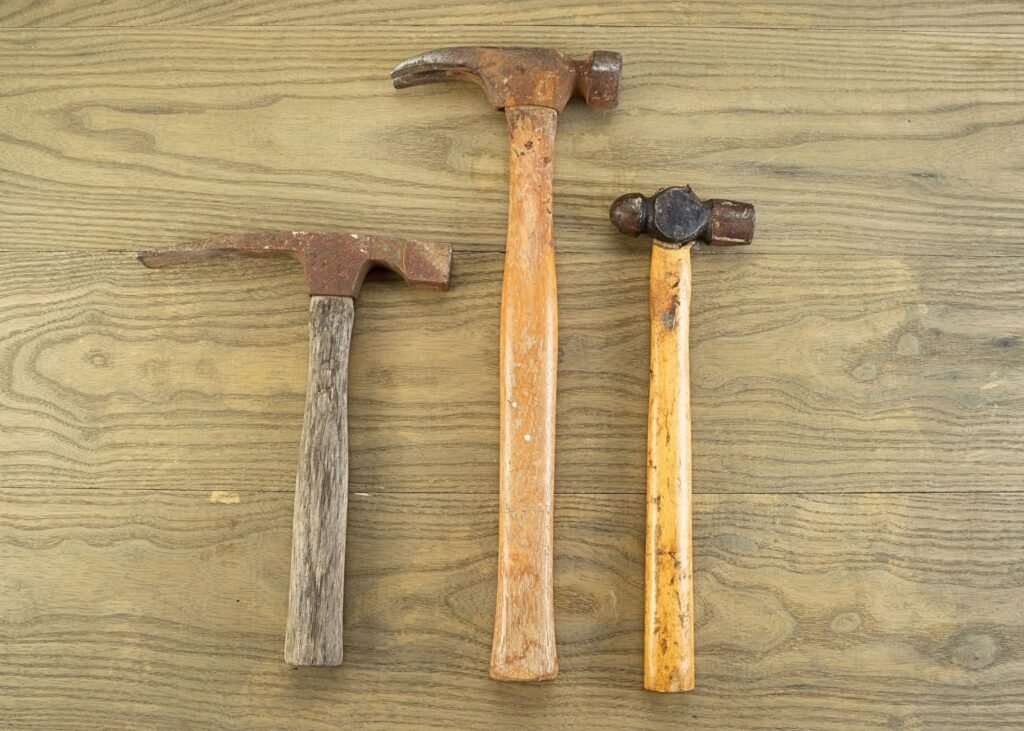
Most antique hammers you’ll find in a toolbox at a garage sale are usually worth $10 to $40. But once in a while, an antique hammer can fetch $200, or sometimes, even more. The value difference depends on three things: the maker, the type, and the marks.
If you have an old hammer or found one at a sale, use this guide to learn how to spot a genuine antique hammer, what determines its value, and which models are actually worth money today.
How to Identify an Antique Hammer (Step by Step)
So what actually counts as an antique hammer? Roughly speaking, anything over a century old, plus a wide “vintage” bracket that stretches into the 1970s for collectors.
Identifying an antique hammer can be a bit challenging for beginners because its construction varies widely. Besides, the marks aren’t always visible, so people assume it’s worthless.
But the marks are almost always there. You just have to know where to look and how to read them, and assess some other details.
1. Antique Hammer Types & Features
The first step to identifying an old hammer is to know what type you’re holding. Most collectors recognize the following nine main types.
Each type has its unique features and uses. Some were made by the millions. Others were built for a single trade and are much scarcer today.
| Hammer Type | Main Use | Key Feature to Check |
| Claw hammer | Carpentry, nail pulling | Adze eye, curved or straight claw |
| Ball peen hammer | Machinist, metalwork | Rounded peen opposite flat face |
| Cross peen hammer | Blacksmith, farrier | Wedge-shaped peen at 90° to handle |
| Sledge hammer | Striking, drilling | Heavy double-face head, long handle |
| Blacksmith rounding hammer | Forge shaping | One flat face, one domed face |
| Cobbler hammer | Shoemaking | Broad domed face, French pattern |
| Tack hammer | Upholstery | Split claw, often magnetized face |
| Jeweler’s / planishing hammer | Metalsmithing | Small polished head, delicate handle |
| Farrier hammer | Horseshoeing | Claw for pulling nails, small face |
ID Tip: If a hammer has no adze eye and looks fully hand-forged, it likely predates 1880. That alone bumps the value tier before you even find a maker’s mark.
2. Read the Maker’s Mark
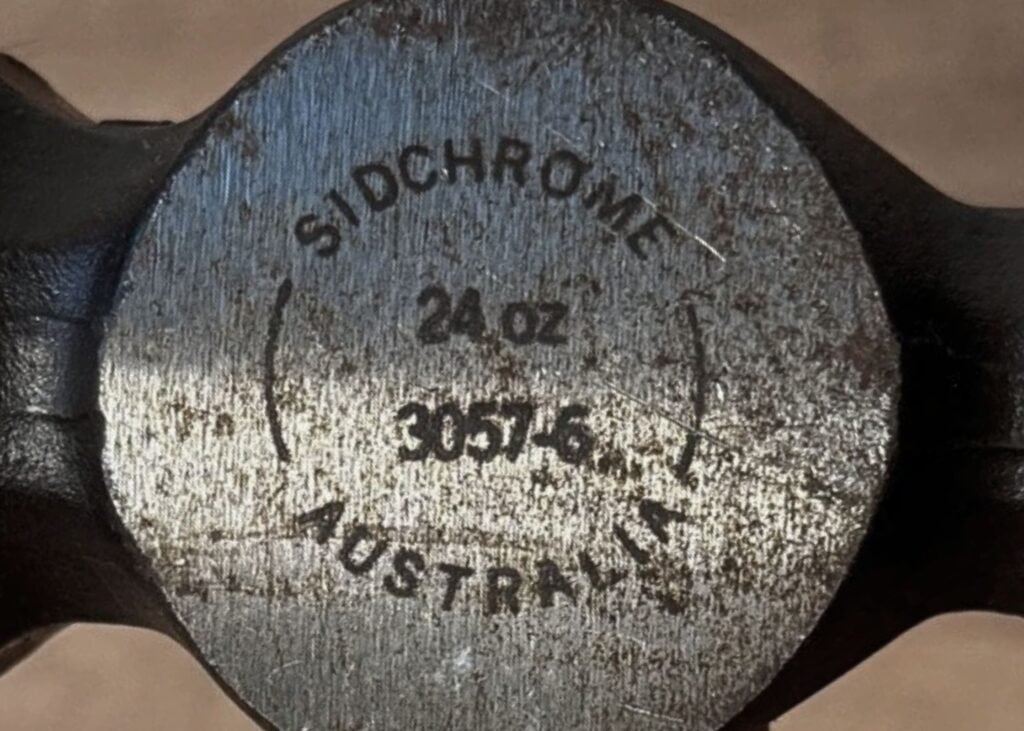
The mark is usually stamped on the cheek of the hammer head, sometimes on the poll (the flat end opposite the striking face). Old marks are shallow and often worn. So, always run your thumb over the metal in raking light before deciding it’s blank.
Common early stamps include “D. MAYDOLE / CAST STEEL”, “PLUMB” with an anchor logo, “CHENEY LITTLE FALLS, N.Y.,” and Stanley’s “Sweetheart” heart-shaped logo.
Easy Tip: Cross-check any mark against trademark databases, like Bob Kaune’s online tool trademark database, before finalizing the date.
3. Look for a Patent Date or Number
Patent dates are the single most useful clue on any American hammer. If you see something like “PAT’D NOV 25 1924” or a bare “621761” style number, research it on Google Patents. You’ll get the exact filing date and the inventor’s name.
The Cheney nail-holding hammer, for example, carries the Arthur E. Taylor 1924 patent for its ball-bearing mechanism. Patented forms almost always sell for more than plain ones.
4. Check the Handle Wood and Wedge
Original handles are made of hickory in nearly all American production from the 1850s onward. Ash and oak show up occasionally but are less common.
Also, look at the top of the eye where the handle passes through. You should see one steel wedge running one way and one or two smaller wooden wedges running across it.
Replaced handles are the biggest value killer on a good hammer. If the wood looks brighter than the head, or the wedge is a modern screw-in type, it’s likely a repair.
5. Examine the Head Shape and Eye Style
Pick the hammer up first and look at the eye.
The adze eye (a flared, extended collar) was invented by David Maydole in 1840 and became universal by 1900. Before that, most claw hammers used a strapped eye, where two forged straps ran down each side of the handle.
Strapped-eye hammers are older, rarer, and usually sell for more. Even a beat-up one can bring $75 to $150 with a crisp maker’s mark.
6. Forging Marks vs. Casting Seams
Check for the construction marks on your hammer; they can tell you how it was made. Here’s how:
- Hand-forged hammers show slight asymmetry, tiny hammer facets, and no visible seam.
- Drop-forged hammers (post-1880 or so) are perfectly symmetrical and often carry a faint parting line down the sides of the head.
- Cast hammers, which are cheaper and later, show a clear seam plus a rough interior grain when you look at the striking face.
Note: Never wire-wheel a hammer to read the mark. Use a soft brass brush, a little oil, and raking light from a flashlight. Aggressive cleaning erases the very thing that makes it valuable.
What Makes an Antique Hammer Valuable?
Common carpenter’s hammers run $10 to $25, while branded vintage examples can fetch $30 to $75. Patent-dated or rare-form pieces climb to $100 to $300, while museum-grade hammers with paperwork or documented provenance can clear $400 or more.
The value of old hammers comes down to five factors, including the maker’s name, marks, age, making, type, and condition. A hammer that hits three or four of them is worth serious money.
- Maker and mark clarity – A crisp, readable stamp can triple the price. A worn mark on the same hammer often kills any premium.
- Age and construction method – Hand-forged pre-1880 pieces bring more than drop-forged production hammers, even from famous brands.
- Rare form – Patented mechanisms like Cheney’s nail holder, unusual trade tools, and short-production runs (Winchester) all push value up.
- Condition – Original handle, tight fit, no cracks in the wood, minimal pitting on the face. Cleaning too aggressively drops value fast.
- Provenance – Railroad marks, military stamps, or named shop stamps add a premium because they tie the tool to a documented history.
Examples of Rare and Valuable Antique Hammers
Below are a few examples of the most collectible antique and vintage hammers that collectors chase today. Plus, their key features and their average values.
1. David D. Maydole Strapped Claw Hammer (Mid-1800s)
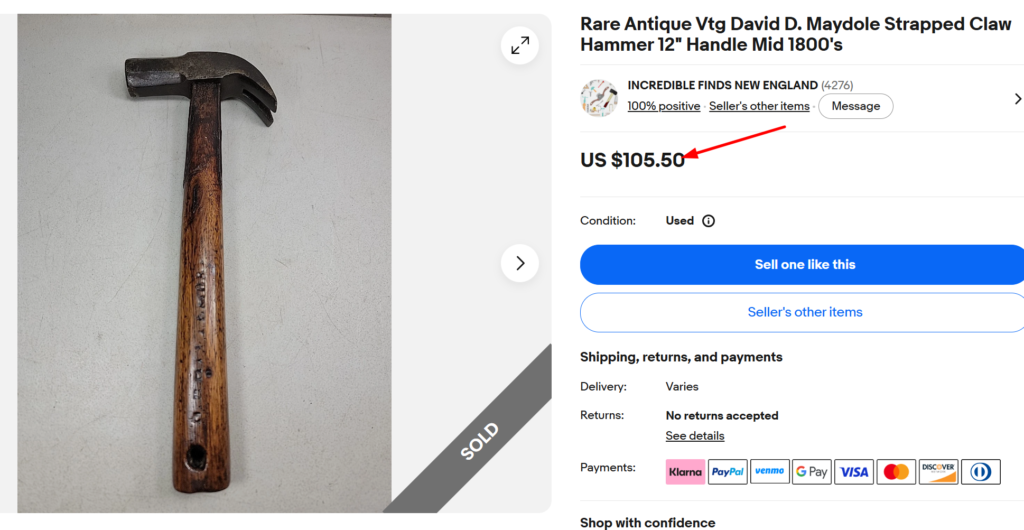
Sold for $105
The strapped-eye construction predates the adze eye Maydole later made famous. Two forged straps run down each side of the handle instead of a flared collar around it.
This is the earliest and rarest Maydole form. A mid-1800s example with a 12-inch original handle sold recently at $105.50, and cleaner ones push past $200.
- Estimated Value: $100 to $300
- Production Years: 1845 to 1870s
- What to Check: Strapped eye construction, 12-inch handle
- Quick Notes: Pre-adze-eye form is scarcest
2. Cheney No. 777 Adze-End Nail Puller Hammer
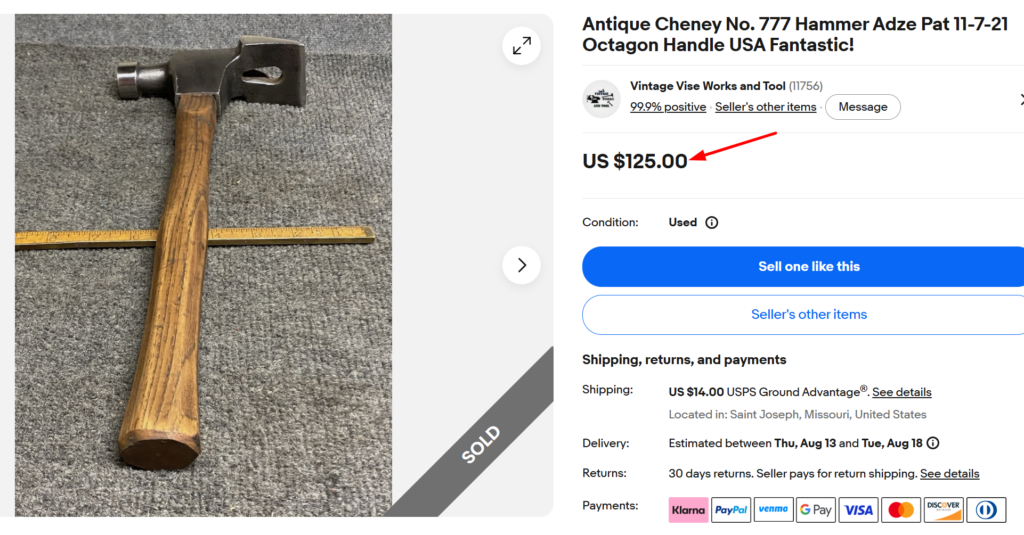
Sold for $125
The No. 777 is a specialized Cheney with an adze-shaped nail-pulling end instead of a standard claw. It carries the November 25, 1924, patent stamp along with the Cheney Little Falls mark. These are much scarcer than the standard nail-holding claw version.
Working ball bearings and a readable patent date drive top prices. Excellent-condition No. 777 examples with the 1924 patent stamp can fetch up to $150.
- Estimated Value: $75 to $175
- Production Years: 1924 to 1940
- What to Check: Patent date stamp, adze end, ball bearings
- Quick Notes: Working bearings are essential for high value.
3. French Pattern Cobbler Hammer
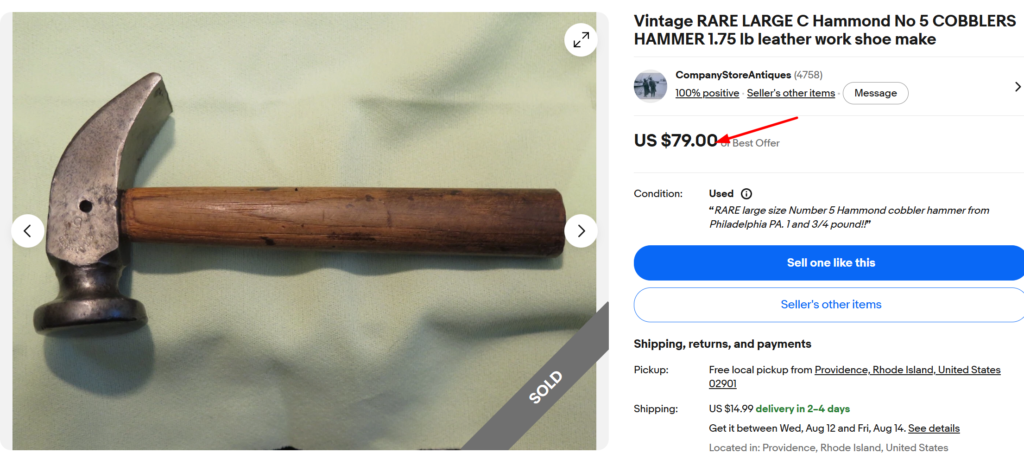
Sold for $80
The French pattern cobbler has a broad, domed face for driving tacks flush without marking the leather. Weight runs around 1 to 1.5 pounds. Marked examples from named French makers can reach $125. Unbranded pieces with original wood handles and no cracks usually sell for $35 to $60.
- Estimated Value: $35 to $125
- Production Years: 1880 to 1930
- What to Check: Domed 1.5 to 1.75-inch face, forged head
- Quick Notes: Marked French makers are the most valuable.
4. Fayette R. Plumb Anchor Brand Sledge Hammer
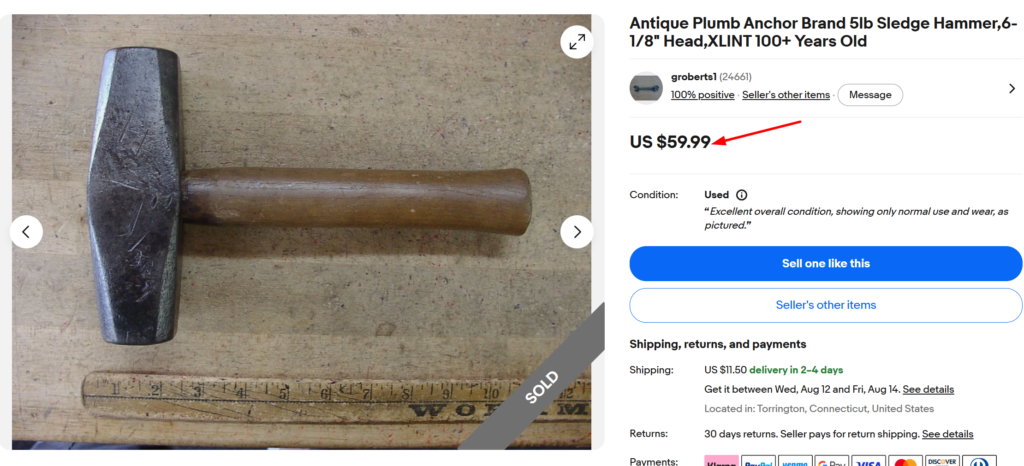
Sold for $60
Plumb’s Anchor Brand blacksmith sleds appear in their 1906 catalog. Weights run from 4 to 16 pounds. The cross peen version, used for moving stock at the anvil, brings more than the plain double-face striker. Heavy pitting can be reversed enough to boost the value of $60 to $150.
- Estimated Value: $65 to $200
- Production Years: 1890 to 1940
- What to Check: Anchor logo, weight stamp, peen shape
- Quick Notes: Cross peen versions bring more
5. True Temper Kelly Perfect No. 016 Claw Hammer
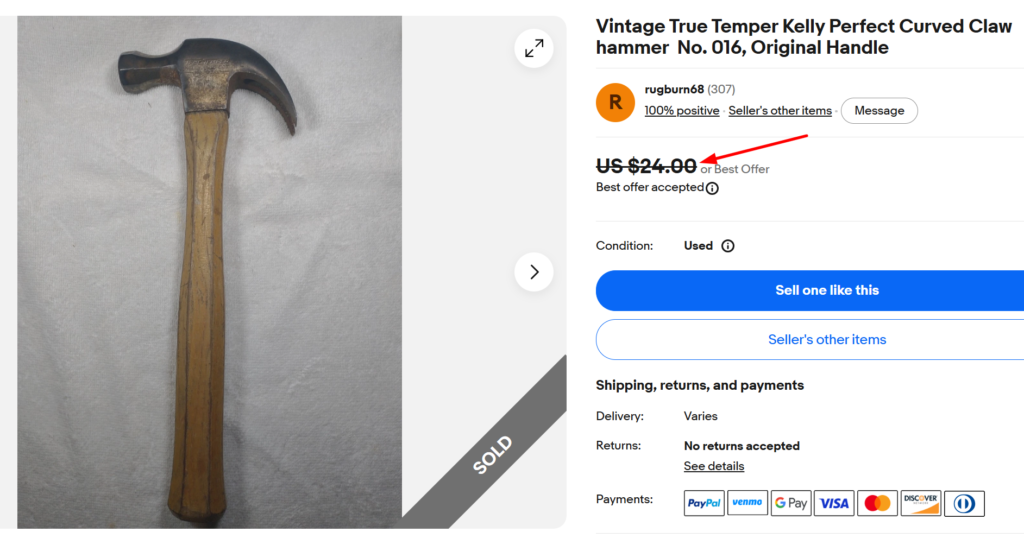
Sold for $24
The Kelly Perfect line came from the Kelly Axe & Tool Works after American Fork & Hoe bought them in 1930. The No. 016 is the standard 16-ounce curved claw.
In 1949, the axe and hammer division was renamed True Temper, so the earlier Kelly Perfect stamps carry a small premium. Original hickory handle and readable model number are worth more.
- Estimated Value: $20 to $85
- Production Years: 1930 to 1949
- What to Check: Kelly Perfect stamp, model number
- Quick Notes: Pre-1949 dates put “True Temper” premium
6. C.S. Osborne No. 33 Magnetic Split-Head Tack Hammer
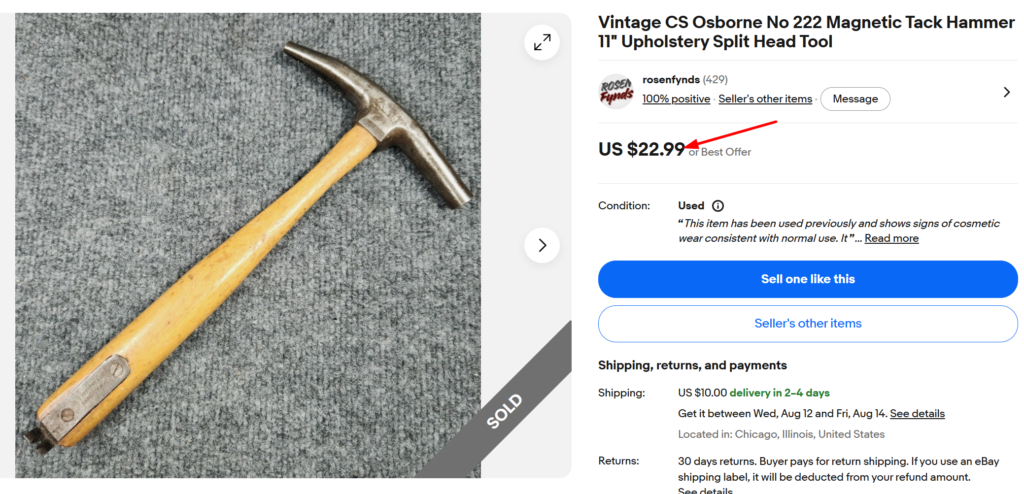
Sold for $22
C.S. Osborne of Newark has been making upholstery tools since 1826. The good ones have a split claw for pulling tacks and a magnetized face for starting them.
Look for the C.S. OSBORNE & CO., Newark, N.J., stamp with the No. 33 model number to confirm authenticity. In decent condition, these hammers can fetch up to $50.
- Estimated Value: $20 to $70
- Production Years: 1900 to 1960
- What to Check: Osborne stamp, magnetic face, rosewood handle
- Quick Notes: Working magnetism matters
Before you spend real money on any old hammer, always ask the seller for a photo of the mark in raking light. If they can’t do so, walk away. Besides, know what to check using this guide the next time you spot an old hammer at a sale.