
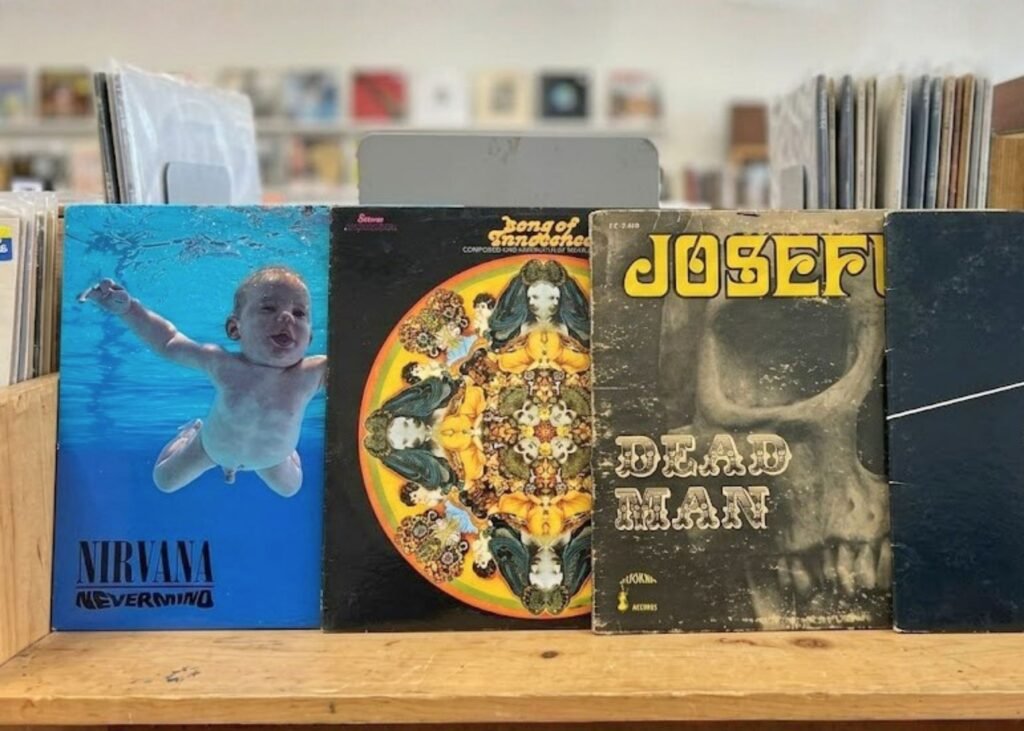
Old vinyl records are one of the most common things you’ll see in boxes at garage sales, often sold for $5-$10 each. But one of those boxes may occasionally contain something worth five thousand.
To save you from skipping a rare record, this guide will help you understand what makes a vintage vinyl record valuable, how to identify a rare one, and reveal real collectible examples.
What Counts as a “Vintage” Vinyl Record?
Vintage vinyl generally means anything pressed from 1948 (when Columbia launched the LP) through the early 1990s. That covers 45 rpm singles, 12-inch LPs, EPs, and the odd 78 rpm holdover from the tail end of shellac.
You’ll hear “antique” thrown around, too. But for records, antiques usually get reserved for pre-war 78s. Everything after that falls into the vintage or collectible bucket. And for value purposes, the sweet spot sits between 1955 and 1975.
That’s the era where first pressings, mono variants, and small-label originals do the heavy lifting. Not everything old is valuable, though. A 1972 Neil Diamond LP from a thrift store is still a five-dollar record. So the question isn’t age. It’s pressing.
How to Identify a Valuable Vintage Vinyl Record (The 7-Point Check)
Check the weight first. Surprisingly, the weight of your record will give you some information on how old it really is. Old records from the sixties were heavier due to a higher use of vinyl per record.
The next things you need to look at are:
1. Check the Label
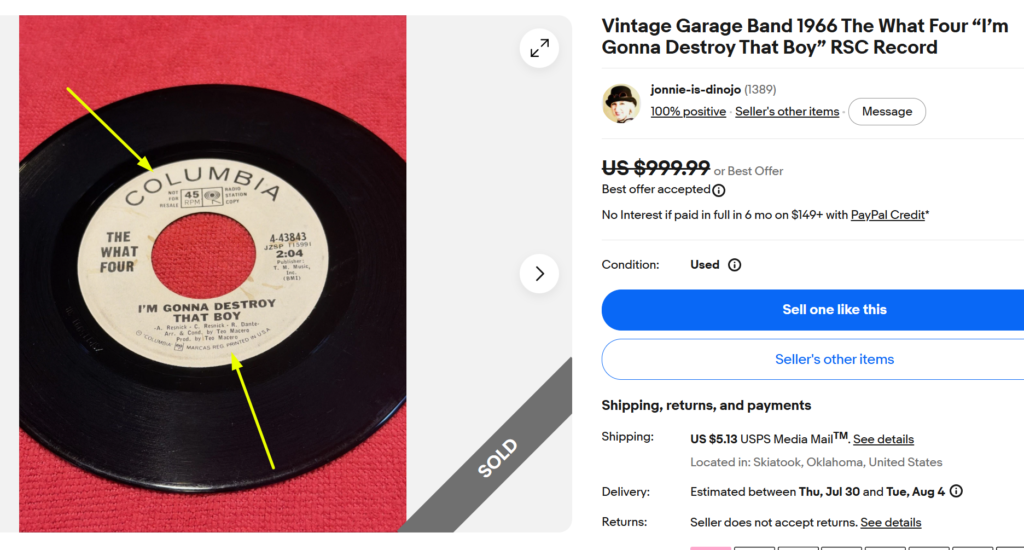
The label in the center is the fastest ID clue. Look at the color, the text, and any small logos in the perimeter. Labels changed constantly, and each variation nails down a date range.
A “deep groove” (a raised ring pressed into the label edge) usually indicates a 1950s or early 1960s pressing. And a promo copy (usually white or has “DEMONSTRATION” printed on it) can be worth two to ten times the regular version.
2. Find the Matrix / Deadwax Number
Look at the smooth area between the last groove and the label. You’ll see numbers and letters etched or stamped into the vinyl. This is called the matrix number, and it identifies the exact stamper used to press your copy.
First pressings usually end in “-1” or “1A” or similar low numbers. Later pressings run “-2,” “-3,” and up.
Some matrix codes even name the mastering engineer. For example, you may find “RVG” for Rudy Van Gelder on Blue Note jazz records, “Porky” or “Pecko Duck” on early UK Led Zeppelin pressings, and “RL” for Robert Ludwig on early Led Zeppelin II copies.
And when you see those, you’re holding something possibly valuable.
3. First Pressing vs Later Pressing
First pressings almost always outsell later ones, sometimes by 50x or more. So how do you spot one?
Check these three things together:
- the matrix number ending
- the label design
- the cover text.
All three must line up; if any one of those three matches a later reissue’s known specs, it’s not a first press.
4. Mono vs Stereo
Mono vinyl has one channel of audio for the left speaker as well as the right speaker, whereas the stereo vinyl has different audio channels for the two speakers for a better sound quality.
The easiest way to distinguish the two is the presence of “MONO” or “MONAURAL” in print on the label or cover, or the presence of “T” as catalog number at Capitol Records.
Collectors prefer mono pre-1968 records because they were relatively scarce. Old mono pressing of The Beatles albums could fetch a price from three to five times that of their stereo versions.
5. Catalog Number and Country of Origin
The catalog number appears near the top or bottom of the label and on the spine. Spotting this is important as the origin country can double or triple the value.
Usually, UK first pressings of British artists (Beatles on Parlophone, Zeppelin on Atlantic UK, Floyd on Columbia UK) are usually far more valuable than US pressings of the same album. So, checking country matters.
6. Cover Condition & Inserts
Along with the vinyl’s condition, original inserts strongly impact the value. Collectors look for things like a poster inside a first-press White Album, a lyric sheet in Bob Dylan’s Blood on the Tracks, and an obi strip on a Japanese pressing.
Missing inserts can easily drop the price by 30 to 50%. The ring wear (a circular pressure mark from the record inside) is another value killer to look out for.
7. Vinyl Condition & Grading
Collectors use the Goldmine Standard for grading the condition of old vinyl records. The grades include:
- Mint (M)
- Near Mint (NM)
- Very Good Plus (VG+)
- Very Good (VG)
- Good (G)
Hold the record up to a strong light at an angle. Hairlines, scuffs, and scratches all show up. Feel with your fingernail for anything deep that could cause skips.
The gap between NM and VG can easily create a 5x price difference between the same vinyl record.
Value Tip: Never grade a record by playing it once and calling it Mint. Even one careless play can drop a Mint copy to Near Mint. Collectors prefer a copy that “looks Mint” but has never been played; it’s called “still sealed” or “factory sealed.”
What Makes an Old Vinyl Record Rare?
The rarity of a vinyl recording generally comes down to one of the following five things.
- Withdrawn covers or recalled pressings
- Regional or country-specific first presses
- Promo, DJ, or test pressings
- Color vinyl or picture disc variants
- Limited-edition runs from small independent labels
The rarest records in the world usually combine two or three of those factors at once. A withdrawn UK first pressing on a small punk label from 1977, for example. Or a mono promo copy of a mislabeled major-label release from 1963.
Rarest & Most Valuable Vinyl Records to Collect Today
Below are the 10 most collectible vinyl records that sell for hundreds to thousands of dollars today, along with what makes each one valuable, and the exact tells to spot them.
1. The Beatles – “Yesterday and Today” (Butcher Cover)
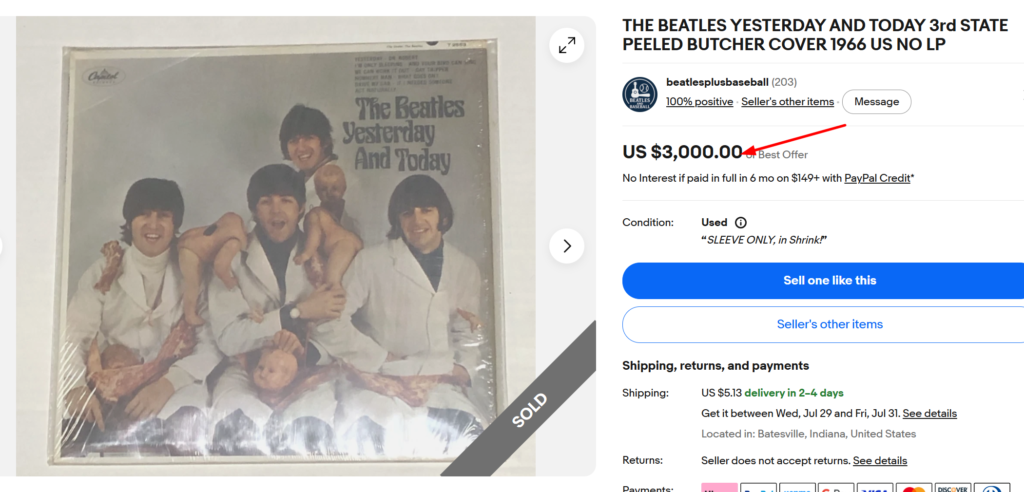
Sold for $3,000
This is one of the Beatles’ rarest records. Capitol printed about 750,000 copies with the original “butcher” photograph, showing the band in white smocks holding raw meat and dismembered baby dolls.
Retailers and DJs panicked, and Capitol pasted a bland “trunk” cover over the offending image, but a first-state copy still has the original butcher image untouched.
Stereo copies (ST 2553) are a lot rarer than mono (T 2553) copies, as fewer stereo records were made in the first place. The value is highly variable, depending on the condition: first state (untouched), second state (paste-over intact), and third state (paste-over peeled off).
- Estimated Value: $1,200 to $15,000+
- Production Years: 1966 (recalled within days)
- What to Check: Untouched butcher image, catalog T/ST 2553
- Quick Notes: Stereo is far rarer than mono
2. Elvis Presley – Sun 209 “That’s All Right” / “Blue Moon of Kentucky” (1954)
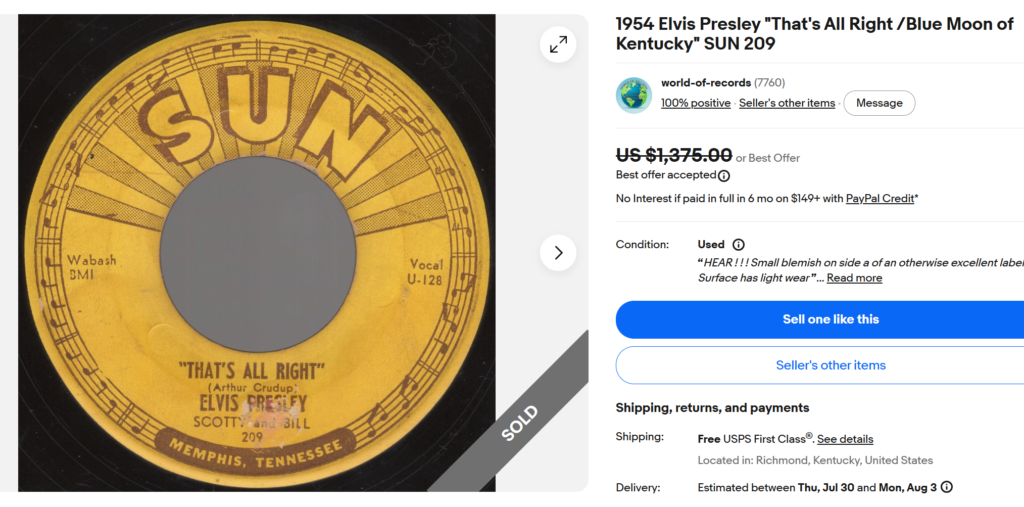
Sold for $1,375
This is Elvis’s first-ever commercial single, and one of the most historically important records. Sam Phillips was in such a rush to press it that no one caught the upside-down “209” catalog number on the B-side label.
Although the misprint was corrected almost immediately, it made the true first pressing incredibly rare.
Look for three push marks on each label and the matrix numbers “U-128” and “U-129” with a “72” stamp beside them. Sun pressings from 1954 have that famous “Sun hiss,” because Phillips cut them with a 78 rpm needle gauge.
- Estimated Value: $3,000 to $15,000+ (misprint first press)
- Production Years: July 1954
- What to Check: Upside-down 209, 3 push marks, matrix 72
- Quick Notes: Later Sun 209 pressings are still worth hundreds
3. Bob Dylan – “The Freewheelin’ Bob Dylan” (Withdrawn Version, 1963)
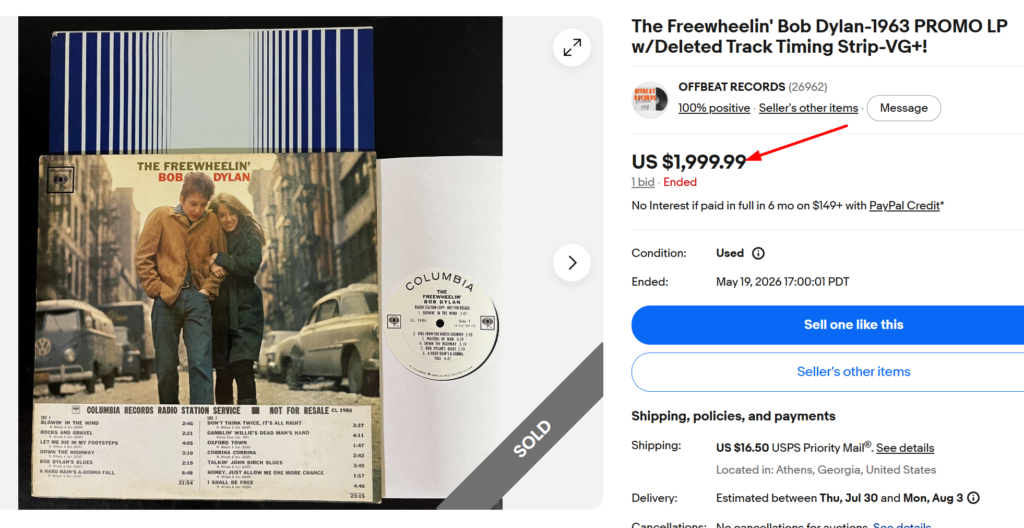
Sold for $2,000
When Bob Dylan’s Freewheelin’ was set to come out, Columbia pulled four tracks right before release, including “Talkin’ John Birch Blues.” A tiny number of copies slipped out with the original tracklist actually pressed onto the vinyl, even though the label and cover already showed the replacement songs.
To spot one, look for the matrix number that ends in “1A” in the deadwax on both sides. Side 1’s middle track is “A Hard Rain’s A-Gonna Fall” (the widest band, since it’s the longest song). On standard copies, that track sits at position 6.
Fewer than 20 mono copies are known to exist, and only two stereo copies have ever surfaced. These are rare.
- Estimated Value: $10,000 to $40,000+ (mono); stereo pushes six figures
- Production Years: 1963 (pre-release, withdrawn)
- What to Check: Matrix ends 1A, both sides, wide middle band Side 1
4. Nirvana – “Nevermind” 1st US Pressing Vinyl
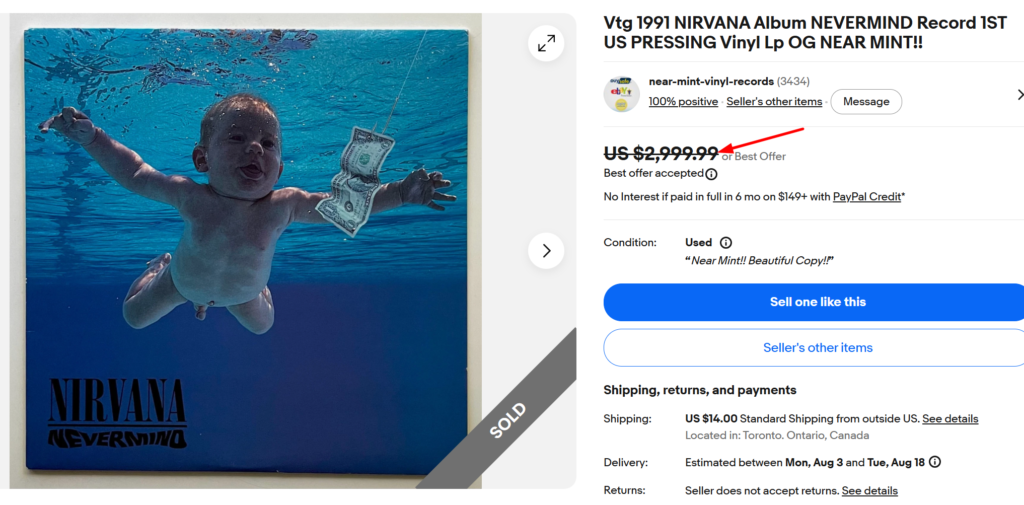
Sold for $3,000
Everyone owned Nevermind at some point. But the original 1991 US first pressing on black vinyl is the one collectors chase now, and values have climbed quietly over the last few years.
The key ID signs are specific. Catalog DGC-24425 on black labels, and MASTERDISK etched in the Side 1 runout. The inner sleeve has one side printed upside down. Watch out for CRC club copies, worth far less.
- Estimated Value: $150 to $600 (VG+ to NM); sealed pushes higher
- Production Years: September 1991 (first US run)
- What to Check: DGC-24425 label, MASTERDISK etched Side 1
- Quick Notes: CRC club version worth far less; upside-down inner confirms
5. Sex Pistols – “God Save the Queen” (1977)
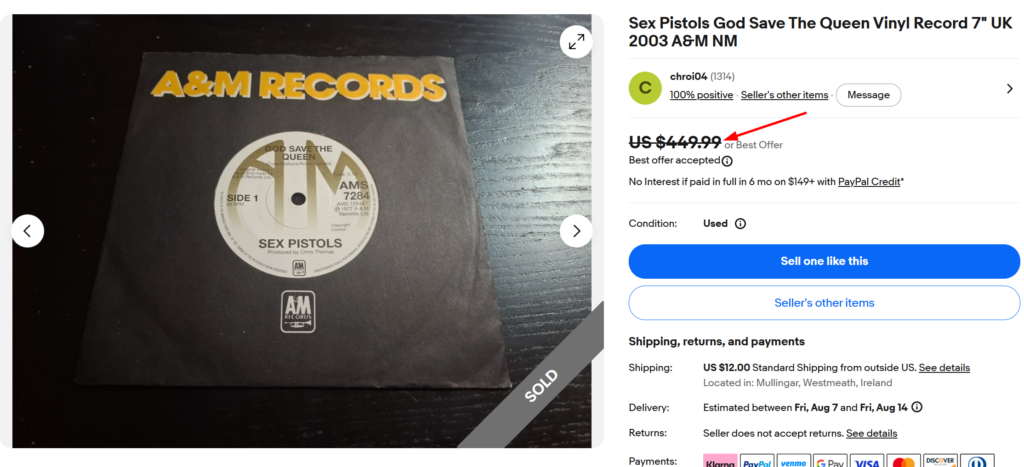
Sold for $450
A&M signed the Sex Pistols in March 1977 and dropped them six days later. They destroyed nearly all 25,000 pressed copies, but around nine authentic copies are thought to remain.
The real ones have a serrated anti-slip ring (called an anti-skate necklace) around both labels, and the catalog number “7284” is etched twice in the B-side runout. Also, matrix reads AMS-7284-A-2 and AMS-7284-B-1.
Counterfeits are very common, so never buy one without a lifetime guarantee from a known dealer or auction house.
- Estimated Value: $8,000 to $25,000+
- Production Years: March 1977 (pulled within days)
- What to Check: Serrated anti-slip ring, 7284 etched twice on B-side
6. Led Zeppelin – Led Zeppelin I (UK 1st Press, Turquoise Lettering, 1969)
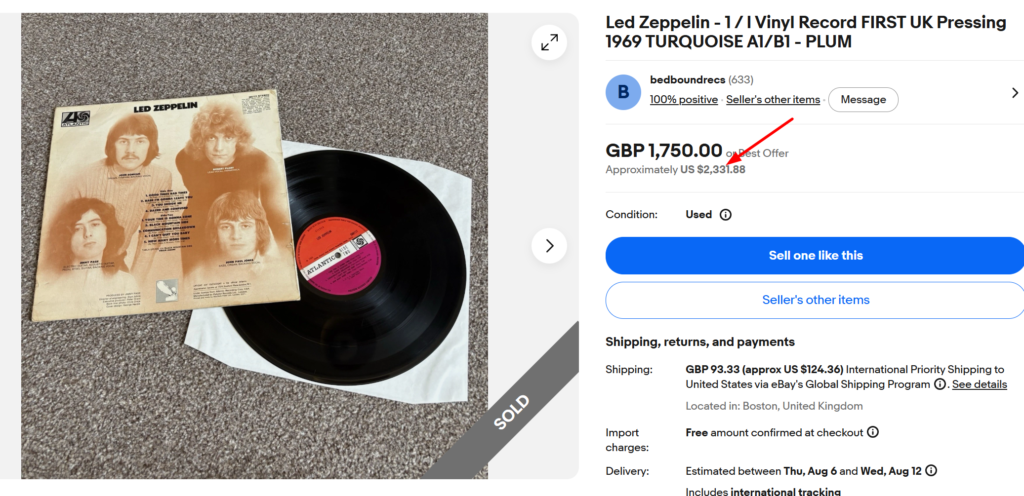
Sold for $2,330
The very first UK sleeves of this record had the band’s name printed in turquoise on the front cover. Atlantic withdrew it almost immediately and reprinted the sleeve with orange lettering. So, a real turquoise copy is the earliest and rarest version.
Some key signs of genuineness are: Catalog is 588 171 on the plum, red Atlantic label, “Superhype Music” publishing credits on most tracks, “Jewel Music” on “Communication Breakdown.”
The sleeve is fully laminated (front and back), made by E. J. Day Group of London. Uncorrected matrix numbers in the deadwax add more value.
- Estimated Value: $1,500 to $3,000+ (NM copies)
- Production Years: January 1969 (turquoise withdrawn quickly)
- What to Check: Turquoise “Led Zeppelin” text, plum/red Atlantic label
- Quick Facts: US copies are common and worth less.
7. Nirvana – Bleach (Sub Pop SP34 White Vinyl, 1989)
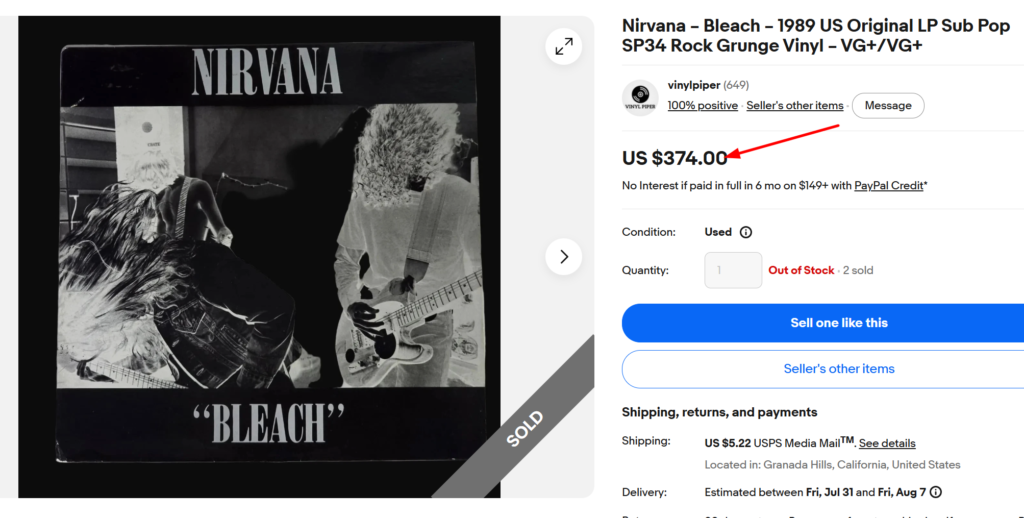
Sold for $375
Sub Pop pressed just 1,000 copies of Nirvana’s Bleach on white vinyl, followed by a 2,000-copy black vinyl run. Neither of those first two runs had a barcode on the jacket, which is the fastest way to distinguish an original from any of the many reissues. All post-1989 pressings carry a barcode.
Also, the runout has “K Disc” etched in the deadwax on both sides. And when the record is still sealed, there’s no way to tell white from black without opening it, which cuts the buyer’s confidence and hurts the price.
- Estimated Value: $1,500 to $3,000+ (US white); $2,000 to $5,000+ (UK Tupelo white)
- Production Years: June 1989 (1,000 white; 2,000 black)
- What to Check: No barcode on jacket, “K Disc” etched runout
8. The Velvet Underground & Nico (Verve V6-5008, 1967)
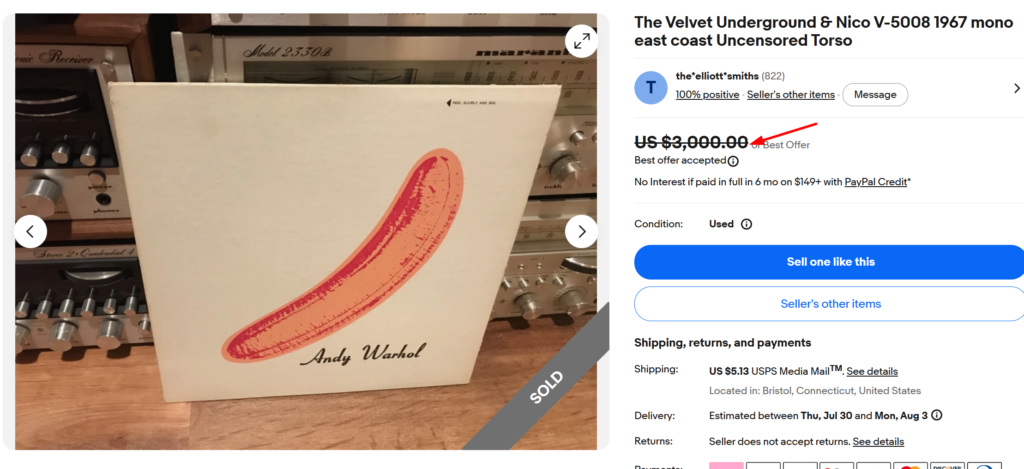
Sold for $3,000
The Andy Warhol banana cover. The original front sleeve had a peelable yellow banana sticker with the instruction “Peel slowly and see” printed alongside. Peeling revealed a pink banana underneath. Most owners peeled it. So an unpeeled sticker on an original 1967 pressing is the most collectible version.
The earliest pressings also have the “torso cover” variant: the back of the sleeve shows actor Eric Emerson upside down. He sued, and Verve airbrushed him out. So a torso-cover copy with an unpeeled banana is the top-tier find.
Look for the Verve label (V-5008 for mono, V6-5008 for stereo). Mono is significantly rarer and more valuable.
- Estimated Value: $500 to $25,000+ (varies wildly by state)
- Production Years: March 1967 (torso version withdrawn within months)
- What to Check: Unpeeled banana, Verve V-5008 or V6-5008, torso back cover
9. Miles Davis – Kind of Blue (Columbia CL 1355 Six-Eye Mono, 1959)
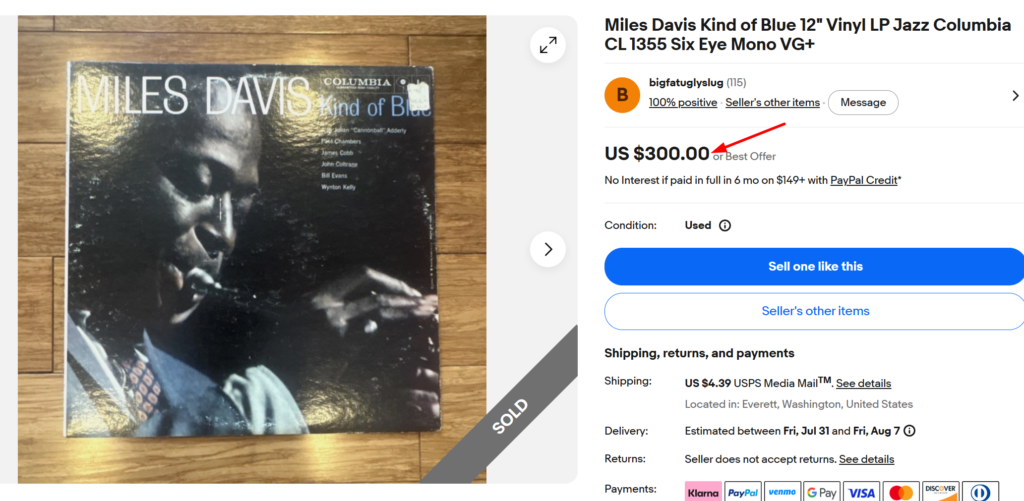
Sold for $300
Everyone owns Miles Davis’s Kind of Blue album in some form. But the original mono six-eye pressing is a true collector’s piece. The label is the classic Columbia red with six small “eye” logos arranged around the perimeter.
Look for a deep groove on both sides and no “CBS” text at the top of the labels. The sleeve also has a signature quirk: tracks B1 and B2 are reversed on both the back cover and the Side 2 label on the earliest pressings, which was never corrected until 1977.
ID note: Matrix codes for this recording vary (1A, 1AJ, 1BJ all appear on early copies), so relying on matrix alone is tricky. Combine label design, deep groove, and back-cover text to confirm.
- Estimated Value: $150 to $1,500+ (NM mono six-eye)
- Production Years: 1959 (first press); later “two-eye” and CBS pressings are much cheaper
- What to Check: Six-eye red label, deep groove, no CBS on top
10. Frank Wilson – Do I Love You (Motown Soul S 35019, 1965)
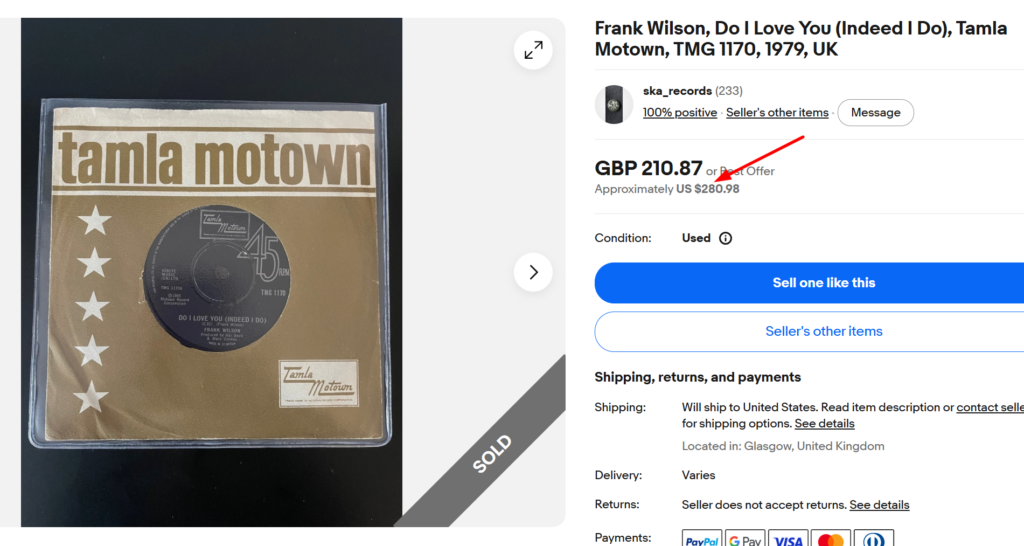
Sold for $280
While the standard Do I Love You recordings are common, a real 1965 US Soul demo is a life-changing find. Wilson recorded it for Motown’s Soul subsidiary in 1965. Berry Gordy wanted Wilson to focus on producing rather than performing, so the small demo run of 45s was ordered destroyed.
Only two or three copies are known to exist today.
Look for the Soul label with catalog number S 35019 and “DEMONSTRATION – NOT FOR SALE” on the label to identify it. Almost every “Frank Wilson” 45 you’ll find is actually a UK bootleg from the 1970s on the “Soul Fox” label, or a legitimate 1979 Tamla-Motown reissue.
- Estimated Value: $30,000 to $40,000+
- Production Years: 1965 (about 250 demos, most destroyed)
- What to Check: Motown Soul label, S 35019, “Demonstration Not For Sale”
- Quick Notes: 99% of copies are bootlegs; auction house verification only
Most Valuable Vintage Vinyl Records by Era
Some eras just produce more money records than others. Here’s a quick breakdown of where to focus your bin-digging attention.
- 1950s – Early rock and roll on Sun, Chess, and Specialty. Original Blue Note and Prestige jazz. Doo-wop 45s on small regional labels. These are old enough that survival rates are low, which drives scarcity.
- 1960s – British Invasion mono pressings (UK Parlophone Beatles, UK Decca Stones). Motown 45s on the Soul, Tamla, and V.I.P. subsidiaries. Northern Soul rarities. Original Blue Note deep-groove jazz. This era has the highest concentration of holy-grail records.
- 1970s – Progressive rock UK first pressings. Punk originals on Stiff, Chiswick, and A&M UK. Private-press folk and psych records. Early hip-hop 12-inch singles from the late ’70s.
- 1980s – Early hip-hop white labels (Sugar Hill, Enjoy). Punk and hardcore originals on Dischord, SST, and Alternative Tentacles. Withdrawn or recalled major-label pressings.
So next time you’re digging through a box full of old records, flip it over. Read the matrix. Check the address on the label. Look for missing credits or extra stickers. These signs will tell you if you’ve found a rare one.