
Do you know that a vintage Fire-king Snoopy mug recently sold for $400? This is one of the most collectible and valuable Fire-King mugs today.
The brand was started in 1942 by Anchor Hocking from its Lancaster plant as a heat-resistant alternative to Pyrex. Fire-King stopped production in 1976. Today, most vintage Fire King mugs are sold for $5, but rarities, such as the Snoopy mug, can fetch hundreds.
This guide takes you through everything you need to know about recognizing valuable Fire-King mugs, the features that make them valuable, and some rare designs and colors you should know.
How to Identify an Authentic Fire King Mug?
Most Fire King mugs carry a mark on the base, and that mark tells you the decade. However, some early pieces are unmarked, too, so shape and glass quality matter, too.
Look for the Fire-King Mark
Anchor Hocking’s marks changed several times over the years, and each style points to a rough production window.
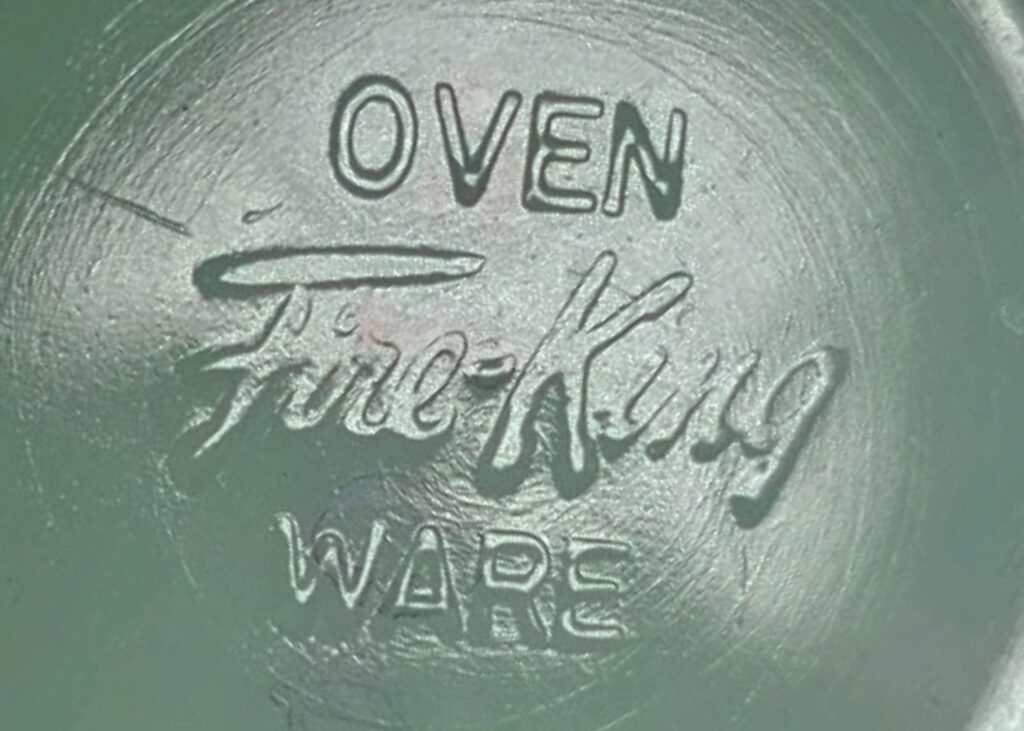
- 1942 to 1945: Earliest pieces used all block letters and the mark “OVEN FIRE-KING GLASS” or “OVEN FIRE-KING WARE.” No anchor symbol yet.
- 1946 to 1950: The script “Fire-King” logo shows up, still without the anchor.
- 1951 to 1962: Marks get more detailed. You’ll see “FIRE-KING OVEN WARE” in script, plus “MADE IN U.S.A.” and a mold number.
- 1962 to 1976: The full Anchor Hocking logo (an anchor with a capital “H” through it) sits alongside the Fire-King script.
- After 1976: The Fire-King name was dropped, so any mug marked “Fire-King” was made before this year.
- 2000 reproductions: Anchor Hocking brought back some jadeite pieces marked with “2000” clearly on the bottom. These are authentic reproductions, not fakes, but they’re not vintage either.
Identification Tip: The busier and more detailed the marking, the newer the piece. A simple “OVEN FIRE-KING WARE” mark is almost always more valuable than the 1960s stamp pieces.
Mug Shapes That Signal Fire King
The mug shape matters as much as the mark. Fire King mugs came in a handful of distinct shapes, and once you know them, you can spot a genuine Fire-King mug at a flea market.
- D-handle mug: This is a classic diner cup. Straight-sided mug with a D-shaped handle.
- C-handle mug: Curved handle, slightly smaller body. Common in restaurant ware.
- Stackable mug: Slightly tapered so mugs nest into each other. Big in the 1960s and 70s.
- Ranger mug/barrel mug: Chunky, straight-sided, thick glass.
- Extra heavy mug: Even thicker walls, made for institutional and diner use.
- Flat-bottom mug: Early D-handles from 1948 to 1950 had a totally flat base with no rim underneath. These are older and more desirable.
Fire King Mug Colors & What They Tell You
Another reliable way to determine the age of a Fire King mug is by its colors. Anchor Hocking Company used different colors in different eras, and each color has its own production period.
- Jadeite (Jade-ite): The famous milky green. Produced from 1945 to 1975, with mugs made mostly from 1948 to 1976. Restaurant ware D-handle mugs were made until 1974.
- Sapphire Blue: A pale, transparent blue used mainly for the Philbe pattern. Made from 1941 to 1956.
- Azurite: Soft, opaque light blue. Made from 1949 to 1962 in the Charm and Swirl patterns.
- Turquoise Blue: A deeper, richer teal. Made from 1956 to 1958 in the Charm and Swirl patterns. Short run, so pieces are harder to find.
- Ivory / Milk Glass White: The workhorse color. Used across many patterns and advertising mugs from the 1940s through the 1970s.
- Peach Luster: Iridescent orange-amber with a metallic sheen. Made from 1952 to 1963.
- Rose-ite (pink): A creamy pink with no pattern. Rare and short-lived.
- Forest Green and Royal Ruby: Deep colors used for specialty pieces. Uncommon for mugs.
- Fired-on colors: Blue, yellow, orange, red, and brown were painted on over the milk glass. These chips easily drop in value fast when the paint wears.
How to Spot Fake Fire King Jadeite?
Jadeite Fire-King mugs are the most reproduced pieces. Here’s how to tell a genuine mug from repros and fakes.
- Blacklight Test: Real vintage Fire King jadeite made after 1950 does NOT glow under a blacklight. Modern reproductions often do glow because they use uranium-free glass with a different chemistry. But note that some very early jadeite from before 1950 can glow, so this test isn’t foolproof on its own.
- Weight and Thickness: Vintage pieces feel heavier and thicker. Modern Mosser and Martha by Mail jadeite tends to feel lighter with sharper mold seams.
- Color Test: True Fire King jadeite has a soft, milky blue-green. Reproductions often lean too yellow or too gray.
- Backstamp Check: Any piece marked “Fire-King 2000” is an authentic 2000-era reproduction, not vintage. Pieces marked “Martha Stewart” or “Mosser” are separate brands, not Fire King at all.
- Seam Quality: Vintage mugs show soft, worn mold seams from years of use. Repros have crisp, sharp seams.
10 Valuable Fire-King Mugs Collectors Are Hunting at Thrift Stores
Below are collectible vintage Fire-King mugs ranging from mid-tier collector mugs to grail-level pieces, why they’re valuable, and how to identify them.
1. Clear Oven Ware Prototype Mug
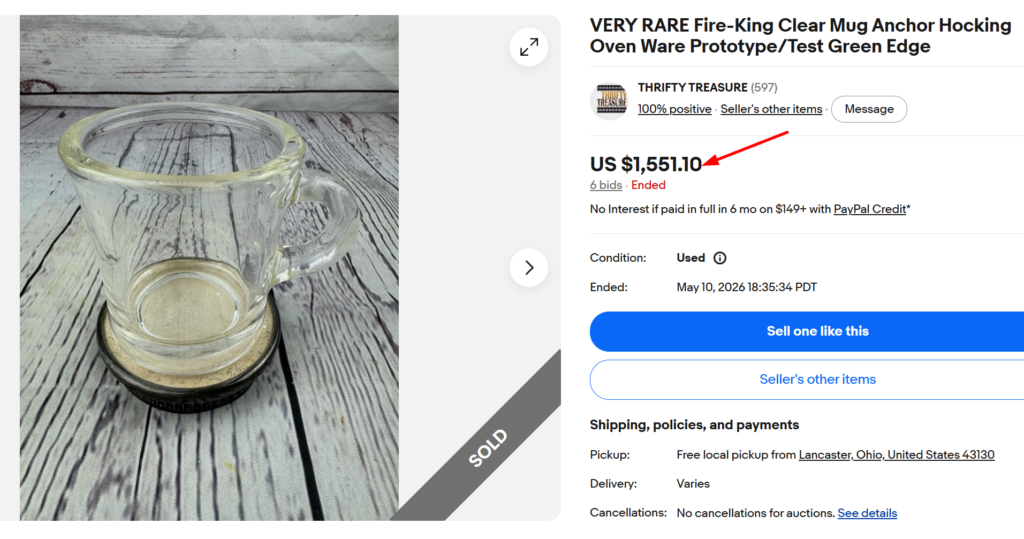
Sold for $1,550
This is the strangest Fire King mug on the list. Clear glass instead of milk glass, with a faint green edge on the rim that suggests it was a test piece from Anchor Hocking’s Lancaster, Ohio factory.
Because Fire King is almost never clear, most collectors have never seen one. You can identify it by the “Fire-King” backstamp. Such prototypes and factory test mugs are the most expensive ones; documentation and factory provenance matter more than pattern here.
- Estimated Value: $500 to $2,000+
- Production Years: Unknown (factory prototype)
- What to Check: Clear glass, green rim edge, base mark
2. Jadeite C-Handle Restaurant Ware Mugs
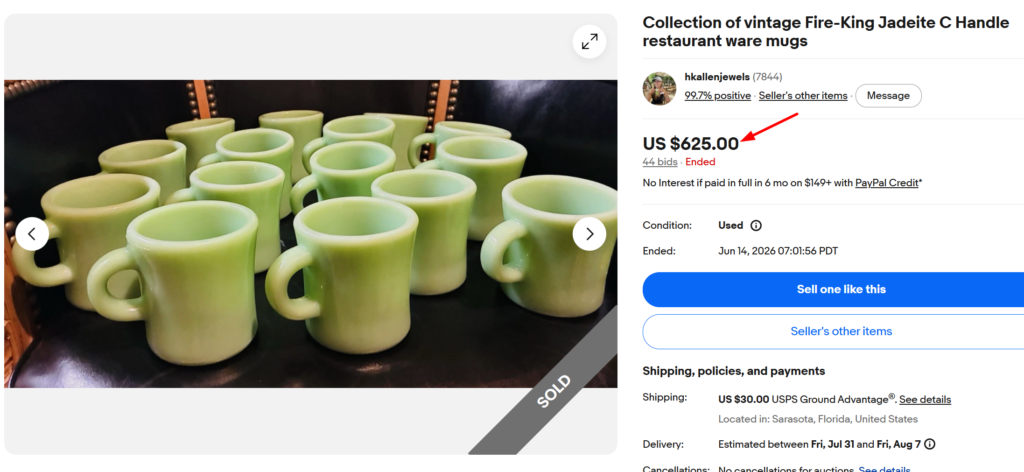
Sold for $625 (set of 15)
The C-handle jadeite mugs are slightly smaller and heavier than the D-handle, with a curved C-shaped grip. These were made from 1948 to the early 1970s as heavy-duty restaurantware. So most surviving examples show real wear from decades of service.
Single mugs run $15 to $40. But a full collection like this one, with over a dozen mugs in strong color and no chips, can easily reach $500 to $600.
- Estimated Value: $15 to $50 per mug; big lots are much higher
- Production Years: 1948 to the 1970s
- What to Check: C-handle shape, jadeite color, chips
3. Kimberly Aurora Mugs
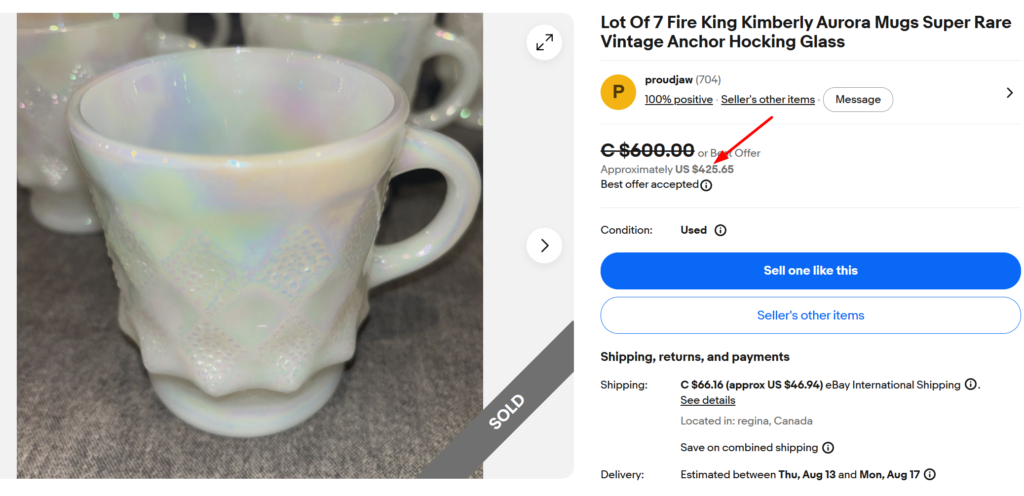
Sold for $600 (set of 7)
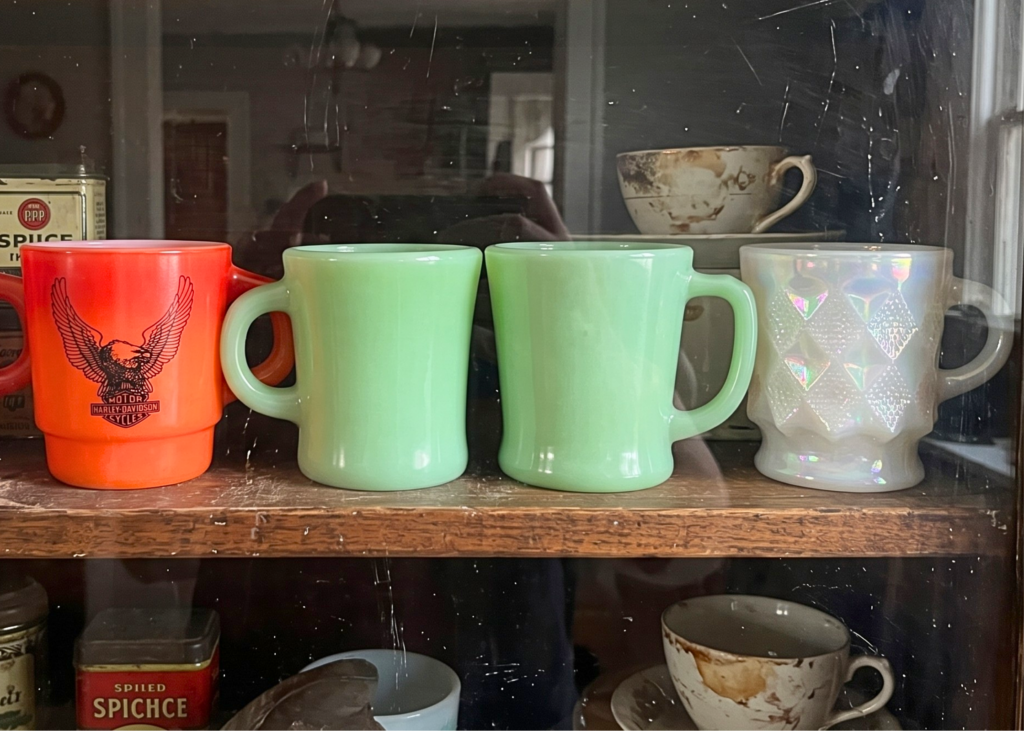
Kimberly Aurora is one of the hardest Fire King finishes to find. The base is white opal milk glass with the standard Kimberly diamond quilt pattern. But the whole surface is coated in a pearl-iridescent finish that shimmers like carnival glass.
Collectors also call it Aurora Borealis or Moonglow.
Because the finish rubs off the raised diamond peaks with use, mint examples are rare; even a single mug can sell for $40-$80.
- Estimated Value: $40 to $80 per mug; sets much higher
- Production Years: 1960s to 1970s
- What to Check: Pearl iridescent finish, diamond texture
4. “Snoopy Curse You Red Baron” Mug
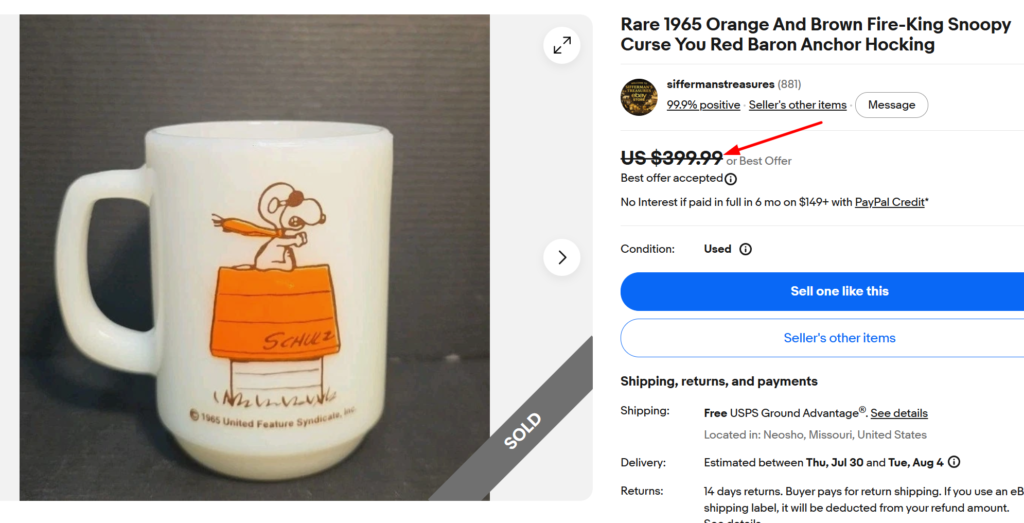
Sold for $400
Snoopy mugs are highly collectible on their own. Anchor Hocking made at least 23 different Peanuts designs, and the “Curse You Red Baron” version from 1965 is the most iconic.
You can identify it by its milk glass body, D-handle or stackable shape, and Snoopy in his flying ace outfit. Rare orange-and-brown color variants can push toward the top of the range.
- Estimated Value: $25 to $150+ (rare variants higher)
- Production Years: 1965 to 1970s
- What to Check: Red Baron scene, backstamp mold number
- Quick Notes: Orange-brown color variant is rare
5. Jadeite D-handle Mugs
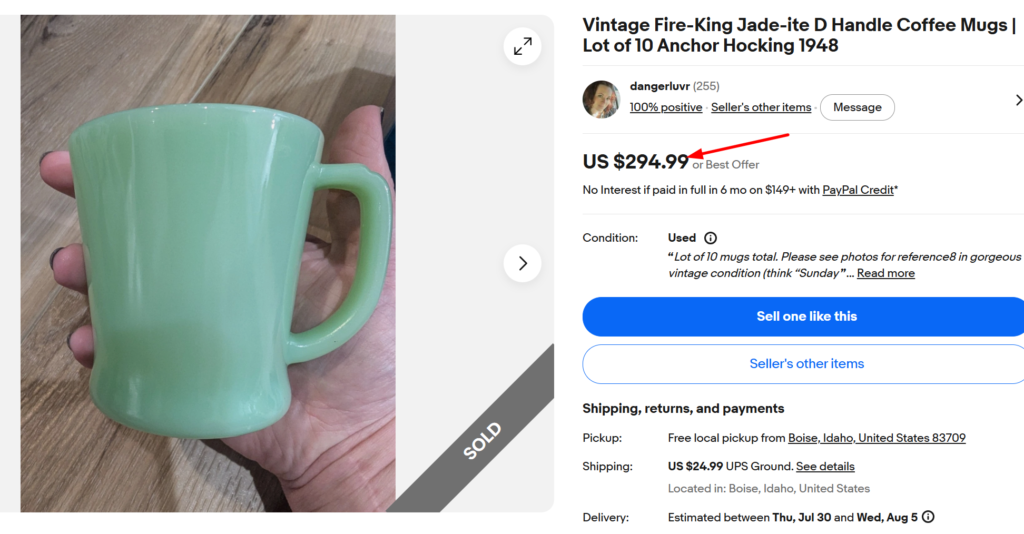
Sold for $295 (set of 10)
This is the classic diner mug, with straight walls, thick glass, D-shaped handle, and that rich milky-green jadeite finish. Fire King made these for restaurants and hospitals from 1948 to 1974, so they show up in huge numbers. But the 1948 to 1950 flat-bottom versions are quite collectible.
- Estimated Value: $25 to $150
- Production Years: 1948 to 1974
- What to Check: Flat vs rolled base, backstamp era
- Quick Notes: Flat-bottom 1948-1950 versions are worth the most.
6. Harley-Davidson Promotional Mug
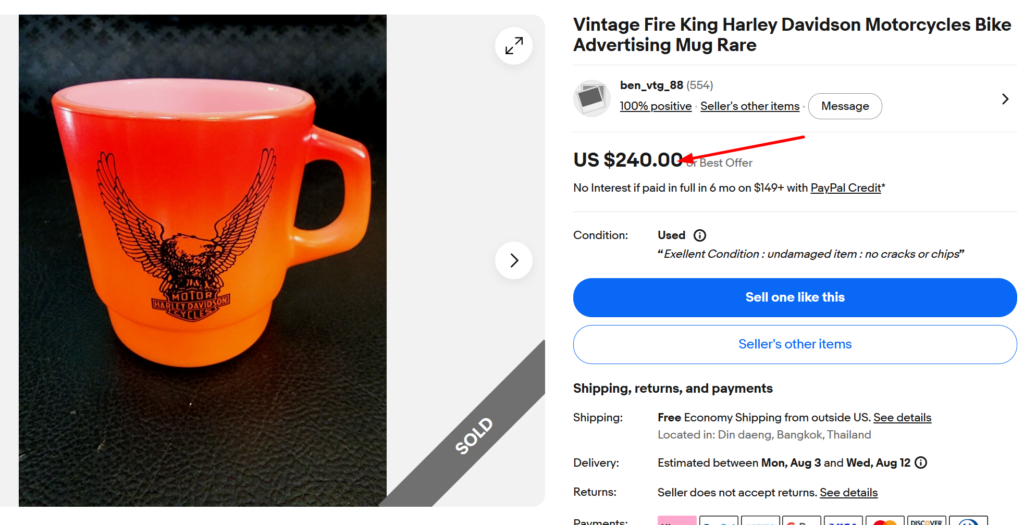
Sold for $240
This is one of the harder promotional mugs to find. You can identify it by its bright orange coating over white milk glass, D-handle stackable shape, with the classic Harley eagle and shield printed on the side.
This mug was made as an authorized advertising piece, so surviving examples with sharp, unfaded graphics are scarce. Even single mugs in excellent condition can easily sell for $150 to $250.
- Estimated Value: $80 to $250+
- Production Years: 1970s
- What to Check: Orange coating, eagle graphic sharpness
7. McDonald’s “You Deserve a Break Today” Promotional Mug
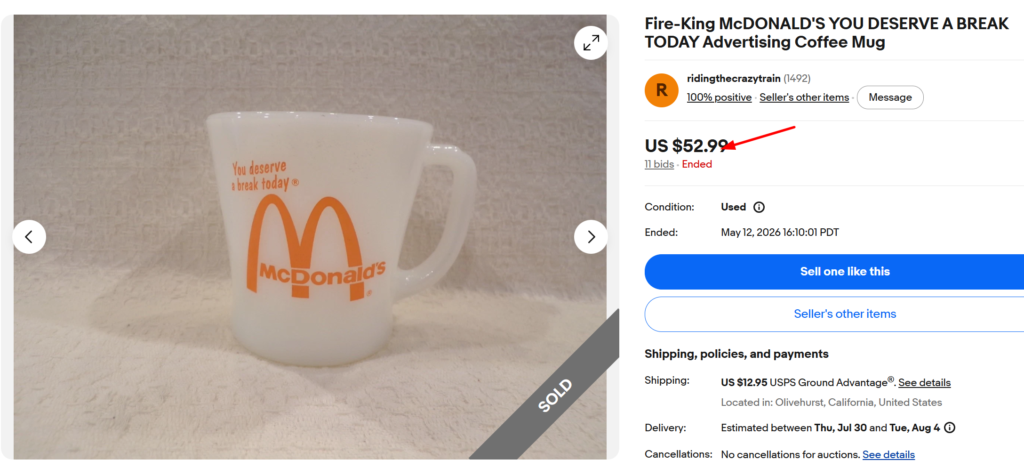
Sold for $53
This is the McDonald’s mug that collectors actually chase. White milk glass D-handle with the golden arches logo and the “You deserve a break today” slogan printed in bright orange. This was made in the 1970s as a store promotional piece.
The everyday “Good Morning” McDonald’s mug sells for pocket change, as they are much more common.
- Estimated Value: $50 to $1,000+
- Production Years: 1970s
- What to Check: Orange slogan text, arches logo
8. Cap’n Crunch “Red Eye” Mug
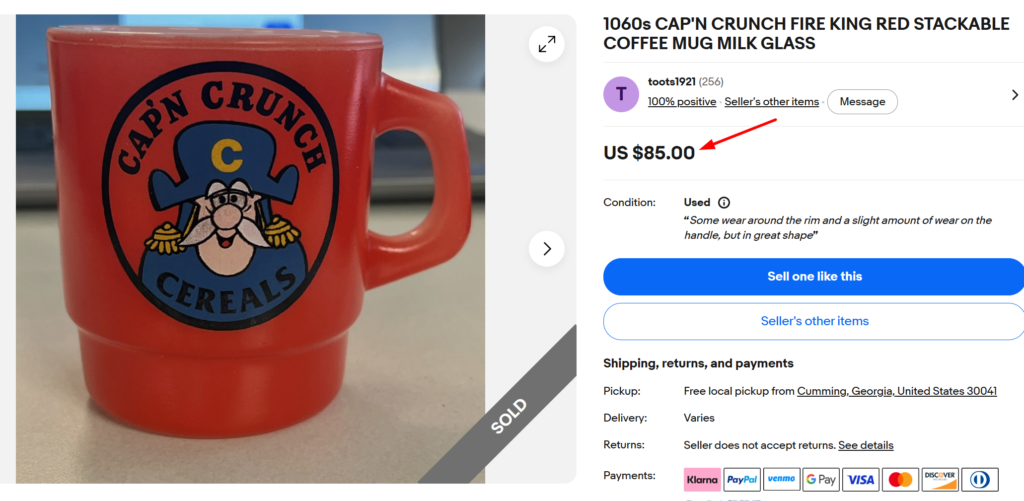
Sold for $85
Quaker Oats used these red stackable mugs to promote Cap’n Crunch cereal in the late 1960s and into the 1970s. White milk glass base, D-handle, coated in bright red, with the Cap’n’s face printed inside a blue circle. So the color really pops.
The base is marked with the anchor-in-a-square logo, dating it to the late 1960s or later. Bright, unfaded examples like this one can fetch $50 to $90. And rare “red-eye” misprint variants push much higher.
- Estimated Value: $50 to $150
- Production Years: Late 1960s to 1970s
- What to Check: Red coating, decal placement, backstamp
- Quick Notes: Red-eye misprint version is the rarest.
9. Glamalite Rubber-coated Mugs
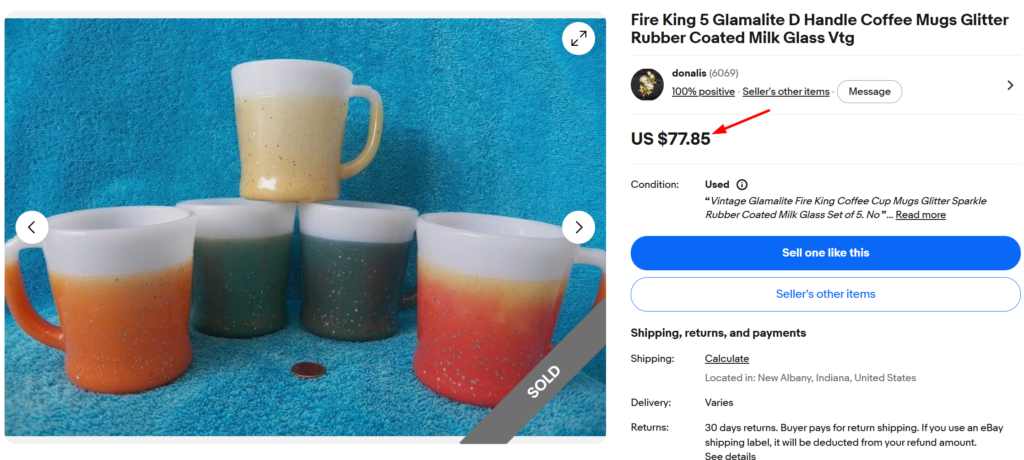
Sold for $78 (set of 5)
Glamalite is one of the weirdest Fire King lines you’ll ever see. Milk glass mugs coated in colored vinyl rubber with glitter flecks embedded in the finish. So the original label called them “thermo-insulated.”
The white rim gives them away every time. Anchor Hocking made them in the 1950s in orange, red, teal, yellow, and green. Complete sets with the original wire caddy can easily reach up to $150.
- Estimated Value: $60 to $150 per set
- Production Years: 1950s
- What to Check: White rim, rubber coating, glitter flecks
- Quick Notes: Original wire caddy doubles the value
10. Signs of the Zodiac Mugs
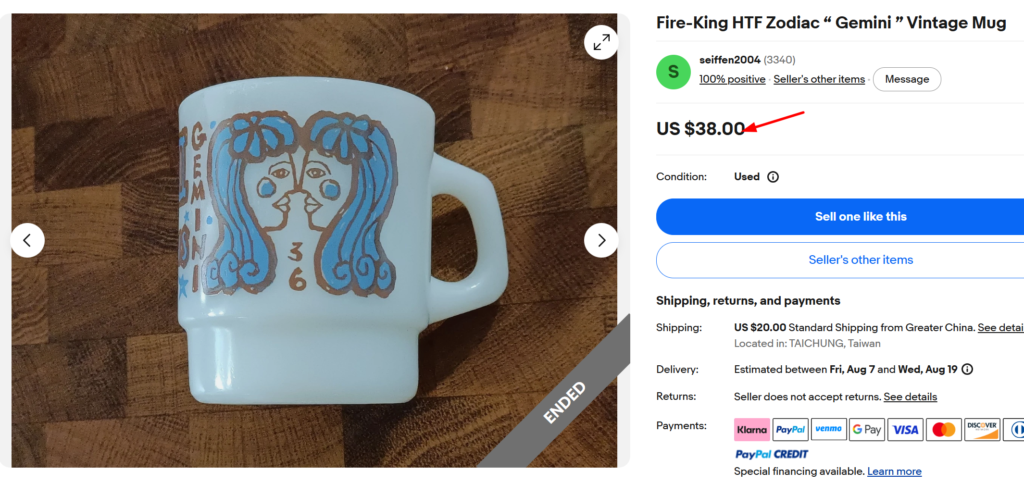
Sold for $30 (single mug)
The Zodiac series is one of the most desirable mug series to chase. The series contains white milk glass stackable mugs that show the Gemini twins in blue and brown paint, with the sign name and date range printed on the side.
So each mug is basically a mini birthday gift baked into the design. A complete set of all the Zodiac signs mugs can go up to $800 to $950 today.
- Estimated Value: $25 to $75 (single)
- Production Years: 1970s
- What to Check: Sign name, date range, paint sharpness
How to Value a Fire King Mug? 5 Key Signs
As you noticed, the value of Fire-King mugs can range from $30 to $500, depending on several factors as listed below:
- Pattern Rarity: The rarer the pattern, the more valuable the mugs. Common Jane Ray sits at the bottom. Philbe jadeite mugs sit at the top of the list.
- Color Rarity: Turquoise Blue and Rose-ite command premiums. White milk glass is common.
- Condition: Chips, cracks, cloudiness (called “sick glass”), paint wear, and utensil marks all cut value fast.
- Marking Clarity: Sharp, readable backstamps help. Faded marks or unmarked pieces need extra proof of age.
- Provenance: Original foil labels, original packaging, or documented history can double a piece’s price.
If you’ve made it this far, you already know a lot about Fire King mugs. Check the four things first: mug shapes, patterns, marks, and colors, to know whether your old mug is valuable or not.