
So you just discovered a 1937 Buffalo Nickel sitting in some old jar, coin roll, or even hiding out on grandpa’s dresser top. Most are worth $1-$2, but a few fine examples minted during this year can sell for anywhere from hundreds to almost $100,000.
What makes the difference? It all comes down to a couple of key factors. This tutorial will break down the basic history, how to identify your nickel, the real factors behind its value, and the sought-after varieties of 1937.
A Very Brief History of the 1937 Buffalo Nickel
Buffalo Nickel (aka the Indian Head Nickel) was designed by sculptor James Earle Fraser and minted from 1913 to 1938. The coin features an American native on the obverse side and the American buffalo on the reverse.
By 1937, the series had almost ended. In that year, nearly 103 million nickels were minted at the three mints combined, making the plain date coins very common today.
However, 1937 saw the creation of the most popular error coin of the whole series. 1938 was the last year, and thereafter, the Jefferson Nickel took over. This is why the late-date Buffalo Nickels, such as the 1937 Buffalo Nickel, are collectible.
How to Identify a Real 1937 Buffalo Nickel?
Before you hunt rare varieties, make sure you’re actually holding a 1937. This coin is often worn flat, so identification takes a minute.
The Minting Date
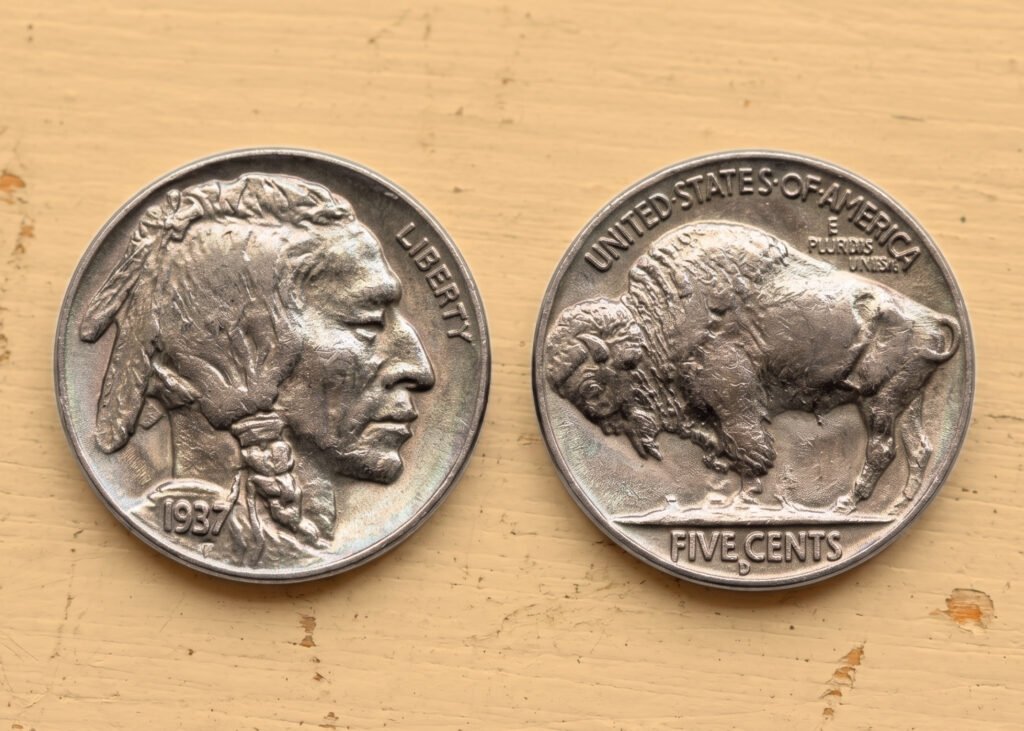
The date sits on the obverse (front) below the Native American’s neck, on the raised shoulder area. On worn examples, the “1” and “9” often blur together, but the “3” keeps some curve and the “7” shows a distinct center triangle.
If the date is completely gone, you’ve got a dateless Buffalo Nickel. Those are worth around 25 to 50 cents.
The Mint Mark
The mint mark is on the reverse (back), right below the words “FIVE CENTS.” Three mints struck the 1937 issue, and each one uses a different marker:
- No mint mark – Philadelphia. This is the most common. Around 79.48 million were struck.
- D mint mark – Denver. Roughly 17.83 million were made here.
- S mint mark – San Francisco. Only about 5.63 million left this mint, making it the scarcest regular-issue variety of the year.
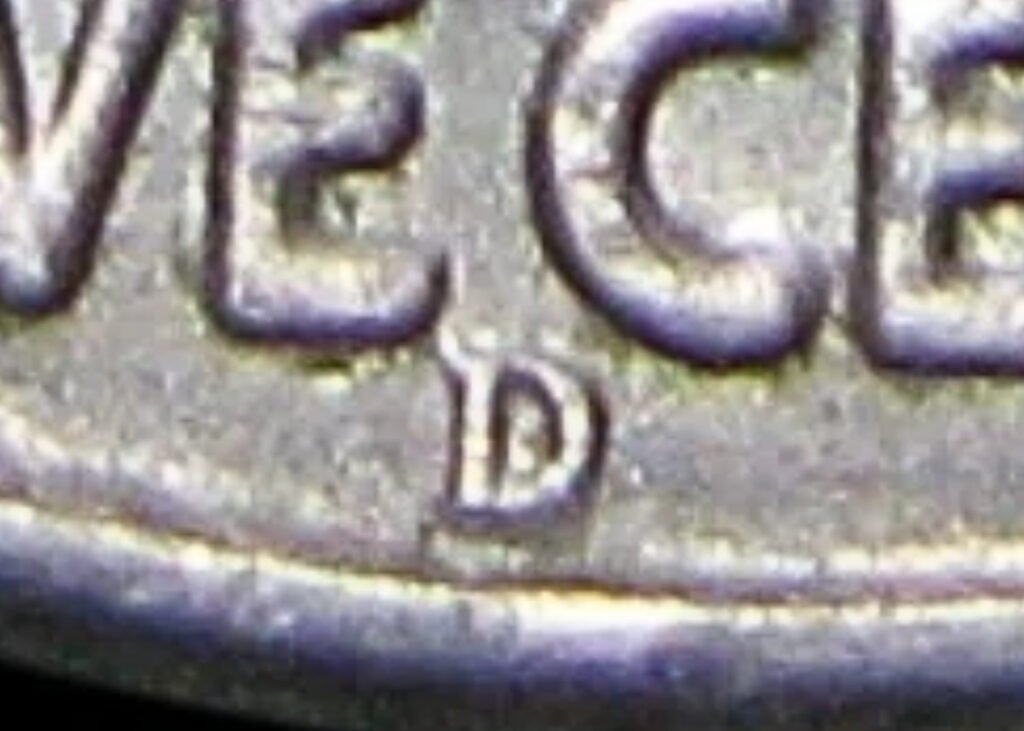
That “F” Under the Date Is Not a Mint Mark
On all Buffalo Nickels, there is an “F” under the date. The F means Fraser, who is the designer of the nickel. However, it does not make it rare. If you see an “E” or some unusual symbol, it may be a damaged die and not a mint mark at all.
Likewise, if you see an “E” or a strange letter, it’s usually die polish or damage, not a mystery mint mark.
The Material Composition
This coin is made up of 75 percent copper and 25 percent nickel. The only nickels made in the United States that have ever been composed of silver were the “silver war nickels” minted from 1942 to 1945. Hence, do not bother computing the melt value.
What Drives the Value of 1937 Buffalo Nickel?
Most 1937 Buffalo Nickels sell for $1 to $10, and honestly, that covers 95% of what you’ll find in circulation. The premium coins are the exceptions, and their value comes down to just a few things.
- Mint mark and mintage matter first. A Philadelphia 1937 in worn condition is a $1 coin, but a San Francisco example in gem uncirculated condition can bring thousands because so few survived that way.
- Condition is huge, but not in a linear way. A Fine 1937-D is worth a few dollars. That same coin in MS-65 (Gem Uncirculated) might bring $60 or $70. Push it to MS-68, and you’re looking at five-figure territory.
- Strike quality is the sleeper factor collectors know about. Look at the buffalo’s horn. A coin with a fully detailed, sharply defined horn is called a Full Horn strike, and it commands a real premium because most 1937 nickels came out of the press with soft, mushy detail.
- Errors and varieties are where the real money hides. That’s where the next section comes in.
The Most Valuable 1937 Nickels to Look for
Not every 1937 is a rare find, but these specific varieties, errors, and premium pieces are the ones worth pulling out of your change jar for a closer look. Grab a 10x loupe and start with these.
1. 1937-D “Three-Legged” Buffalo Nickel (FS-901)
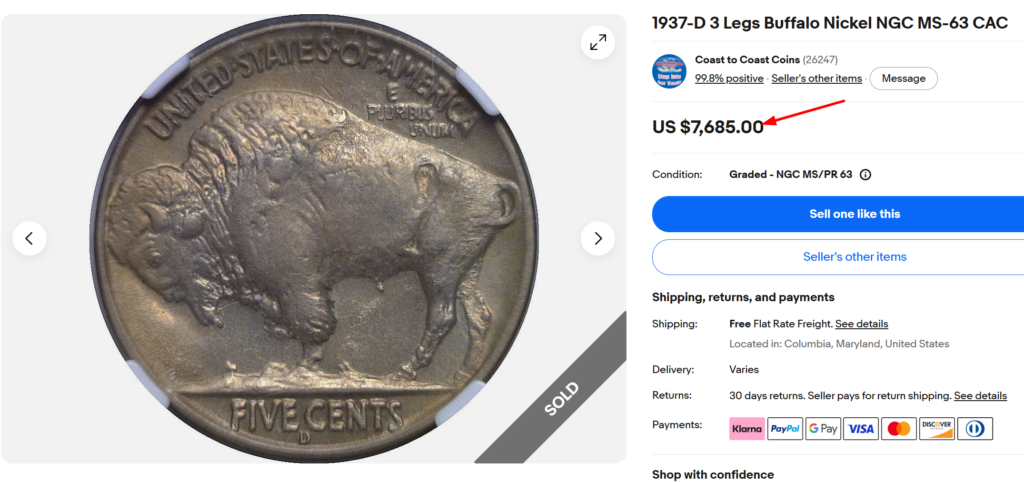
Sold for $7,685
This is the most famous error in the entire Buffalo Nickel series. A Denver Mint pressman over-polished a damaged reverse die trying to remove clash marks. He accidentally ground off most of the buffalo’s front right leg, leaving just the hoof floating below the belly.
Thousands slipped into circulation before anyone caught it. So they’re findable, but heavily faked. Genuine examples show a distinctive raised “stream” line between the buffalo’s back legs from die rust, and a moth-eaten look on the neck.
- Estimated Value: $400 to $99,875+
- Production Year: 1937 (Denver Mint only)
- What to Check: Missing front right leg, floating hoof
2. 1937 Proof Buffalo Nickel
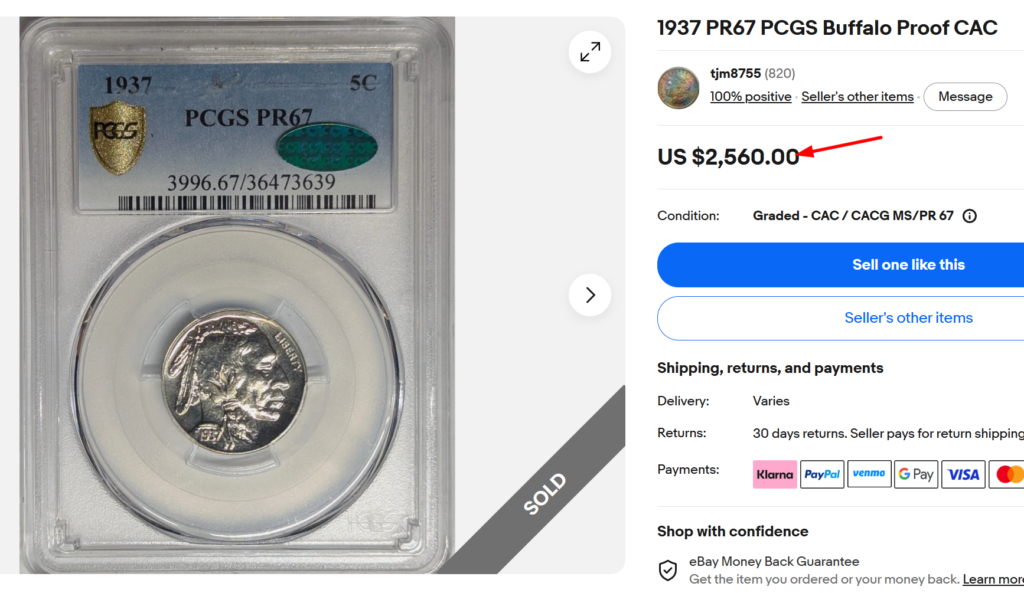
Sold for $2,560
The Philadelphia Mint struck just 5,769 proof nickels in 1937, and this was the last year proofs were ever made for the entire Buffalo series. All 1937 proofs use the fully brilliant finish, with polished mirror-like fields and sharp raised design details.
Most survivors grade PR65 or better because collectors saved them from day one. But finding one at PR67 or higher brings serious money.
- Estimated Value: $475 to $95,000+
- Production Year: 1937 (Philadelphia only)
- What to Check: Mirror fields, sharp details
- Fun Fact: Final year of Buffalo Nickel proofs
3. 1937-S in Gem Uncirculated Condition
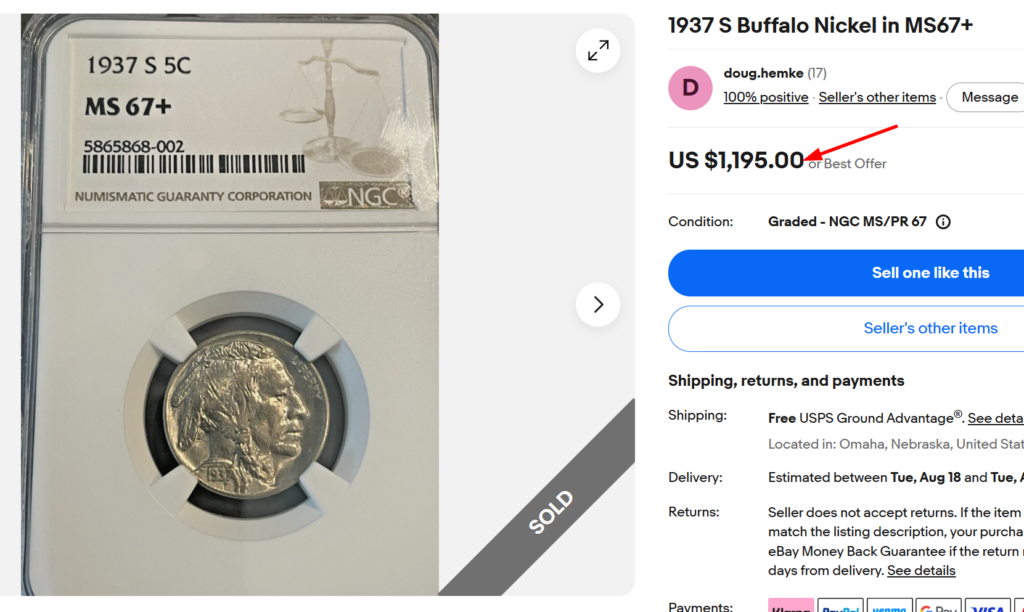
Sold for $1,195
San Francisco made the fewest 1937 nickels of any mint, but that’s not the whole story. It’s the survival rate at the top. Only three coins are certified at MS68, which is why gem examples pull auction premium prices.
Many 1937-S nickels also have weak strikes on the buffalo’s shoulder and head. A well-struck 1937-S with full detail is a genuinely rare find.
- Estimated Value: $1 (worn) to $29,900+ (MS68)
- Production Year: 1937 (San Francisco Mint)
- What to Check: “S” mint mark, sharp horn detail
4. 1937-S/S Repunched Mint Mark (RPM) Varieties
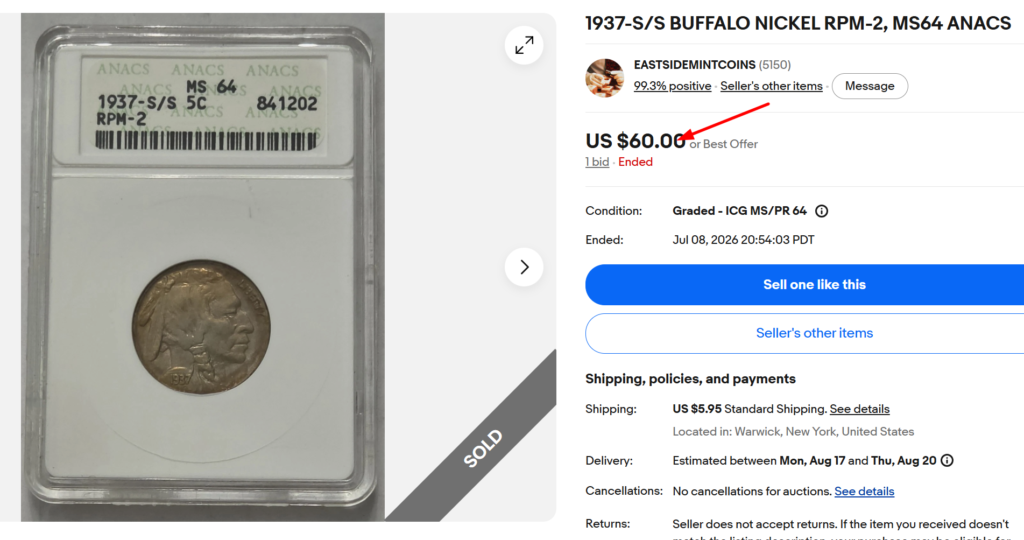
Sold for $60
In 1937, mint marks were still punched by hand. If the first blow was too light or off-position, the worker would strike again, sometimes leaving a doubled or shifted “S.”
Six different RPM varieties are cataloged for the 1937-S, with the S/S/S triple-punch being the most visually striking.
Look at the “S” under 10x magnification, and try to spot faint partial letters, shadows, or bumps around the main mint mark. Faint doubling brings very little premium, but a bold, clear RPM in Mint State can hit $150 or more.
- Estimated Value: $50 to $185+ (MS-65)
- Production Year: 1937 (San Francisco)
- What to Check: Doubled or shifted “S” mint mark
5. 1937-D/D RPM Nickel
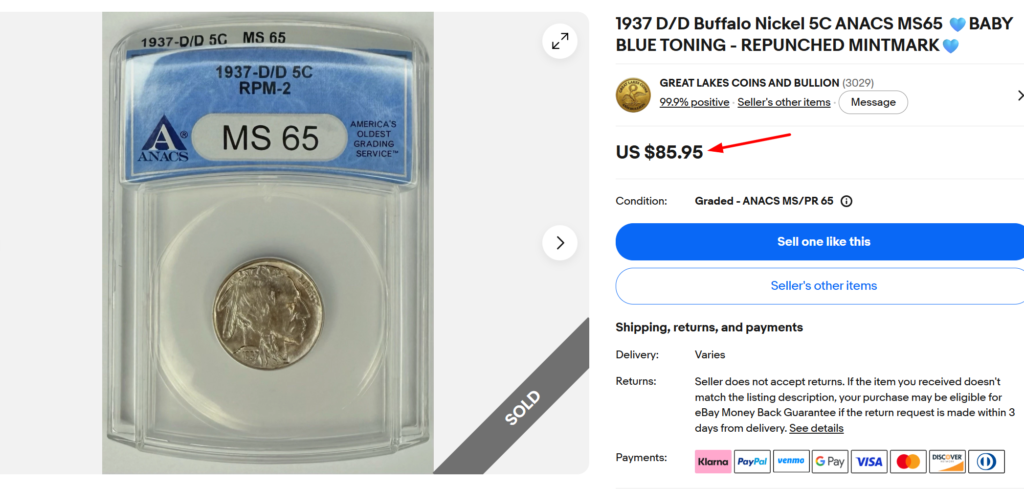
Sold for $85
The Denver mint has its own set of RPM varieties from 1937, and they’re a lot less known than the San Francisco versions. That makes them one of the best cherrypicker deals in the Buffalo Nickel series.
Spot them the same way as the S varieties. Look for a second “D” impression showing as a raised shadow, a partial letter, or extra thickness on one side. Mint State examples with clear doubling sell in the $50 to $190 range.
- Estimated Value: $50 to $190+ (MS grades)
- Production Year: 1937 (Denver)
- What to Check: Doubled or shadowed “D”
6. 1937 Full Horn Strike Premium Examples
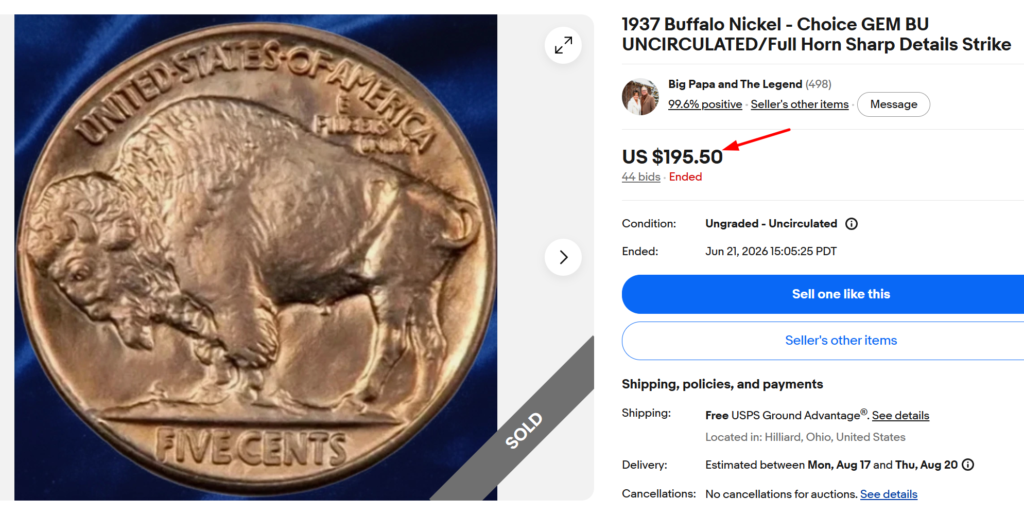
Sold for $195
It is not an error, but a very well-struck normal coin. The design of the Buffalo Nickel had a high relief that made the dies wear out quickly, hence the reason why 1937 Buffalo nickels have a fuzzy horn of the buffalo.
A Full Horn designation means the horn shows complete, sharp definition from tip to base. Any 1937 in Mint State with a genuine Full Horn strike gets a real premium over standard examples of the same grade.
- Estimated Value: 20% to 50% premium over standard MS
- Production Year: 1937 (all mints)
- What to Check: Fully detailed buffalo horn
7. 1937 Off-Center Strike Errors
Off-center strikes happen when the coin blank isn’t lined up properly under the die, so part of the design ends up missing and part of the blank stays unstamped.
On a 1937 Buffalo Nickel, a small 5% shift is barely worth extra. But a dramatic 20% to 50% off-center strike with a full readable date is a legitimate error worth chasing.
Value Tip: The date has to be visible for full value. An off-center with no date drops to hobby-money territory fast.
- Estimated Value: $100 to $4,000+
- Production Year: 1937 (any mint)
- What to Check: Shifted design, blank crescent
8. 1937 Broadstruck Errors
A broadstrike happens when the retaining collar fails during striking, so the coin spreads out wider than normal and has no reeded or defined edge. The design stays centered, but the coin ends up flatter and larger than a regular nickel.
These are less dramatic than off-center strikes, so they don’t bring the same premiums. However, an attractive 1937 broadstrike with nice detail will make for an entertaining error to collect and is among the less expensive Buffalo Nickel mint errors.
- Estimated Value: $100 to $350
- Production Year: 1937 (any mint)
- What to Check: Wider than normal, coin looks stretched with no edge detail
The 1937 Buffalo Nickel is one of those coins where 99 out of 100 are worth pocket change, but the hundredth one changes everything. Check for a D or S mint mark, and count the buffalo’s legs to know if your nickel is a rare find.