

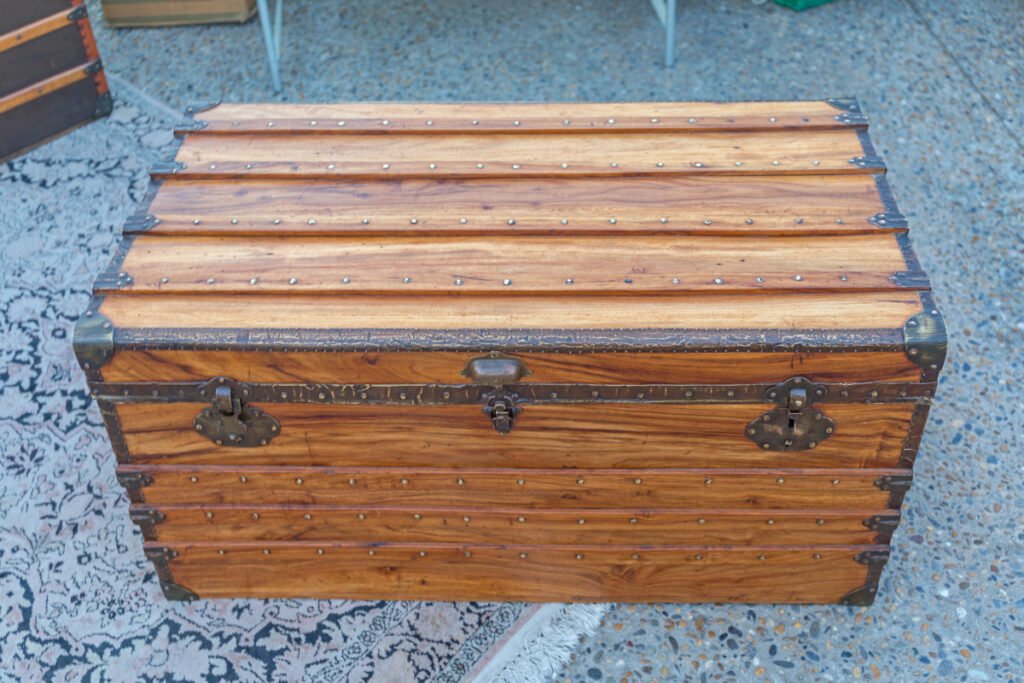
Most older trunks found in attics or basements sell for between $50-$150, and that is the bottom line. But sometimes a trunk ends up being worth more than $10,000 because it is a rare Louis Vuitton trunk made in 1910 or a beautifully painted Norwegian immigrant trunk from the 1830s.
Being able to differentiate between a $75 trunk lined with zinc and one costing $2,500, like the Saratoga, is the difference between a good or bad trade.
The guide discusses this and everything else that you need to know about identifying and valuing antique trunks.
How to Identify an Antique Trunk (7 Things to Check)
Spotting a genuinely antique trunk is a bit challenging. It’s a combination of little indicators that all work together to tell you what age, and maybe who made, the trunk. This is how to use them.
1. Examine the Shape & Top
The shape of a trunk is a reliable dating clue. A flat top and rectangular, low-profile case (generally 12″ to 16″ tall) means a steamer trunk age, which is around 1880 to 1920. These were built to stack in ship cabins and train cars.
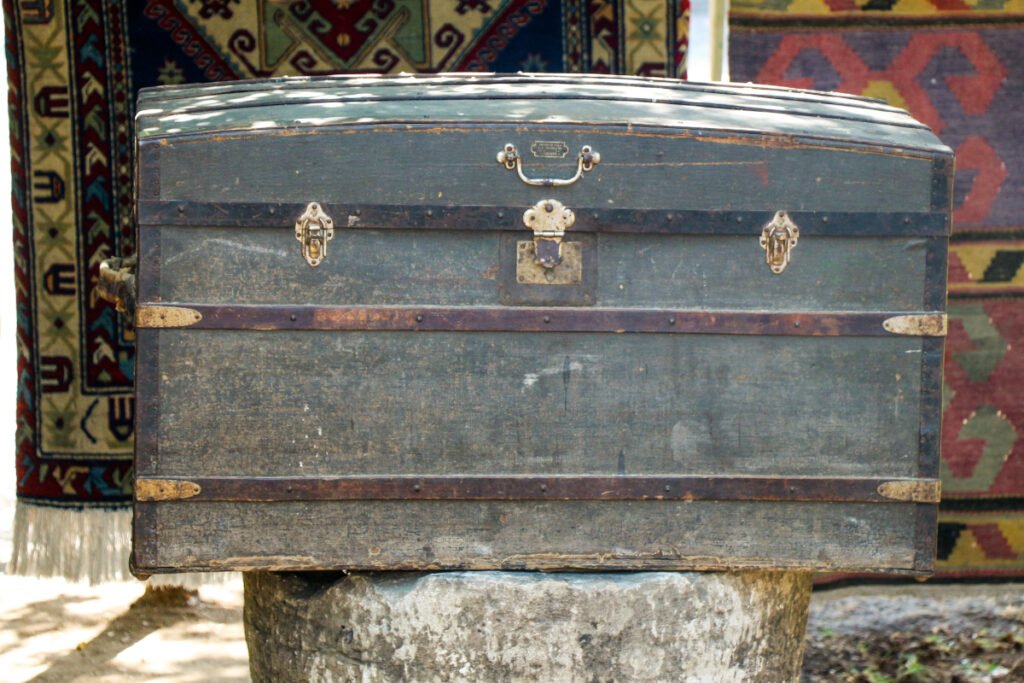
A rounded, arched top points to a dome-top, camelback, or humpback trunk. These became most popular between 1860 and 1895.
Before 1870, trunks were generally smaller and more boxlike, usually made with hide instead of canvas.
An hourglass shape on the sides, narrower in the center and wider on both ends, makes up the characteristic form of the Jenny Lind trunk, which was created between 1850 and 1870.
2. Check the Materials
- Leather was a popular material for earlier models before 1872, and it continued to be used on luxury models. Tin cases embossed became available between 1870 and 1890. The period between 1885 and 1910 saw zinc and galvanized coverings.
- Canvas-covered trunks date back to the late 1800s through the 1930s period. Crystalized Metal Covering (the frosted look metal coverings) dates back from 1880 to the early 1900s period.
- Vulcanized fiber is characterized by the hard reddish-brown and black coverings and dates back to the early 20th century.
The wood underneath matters too.
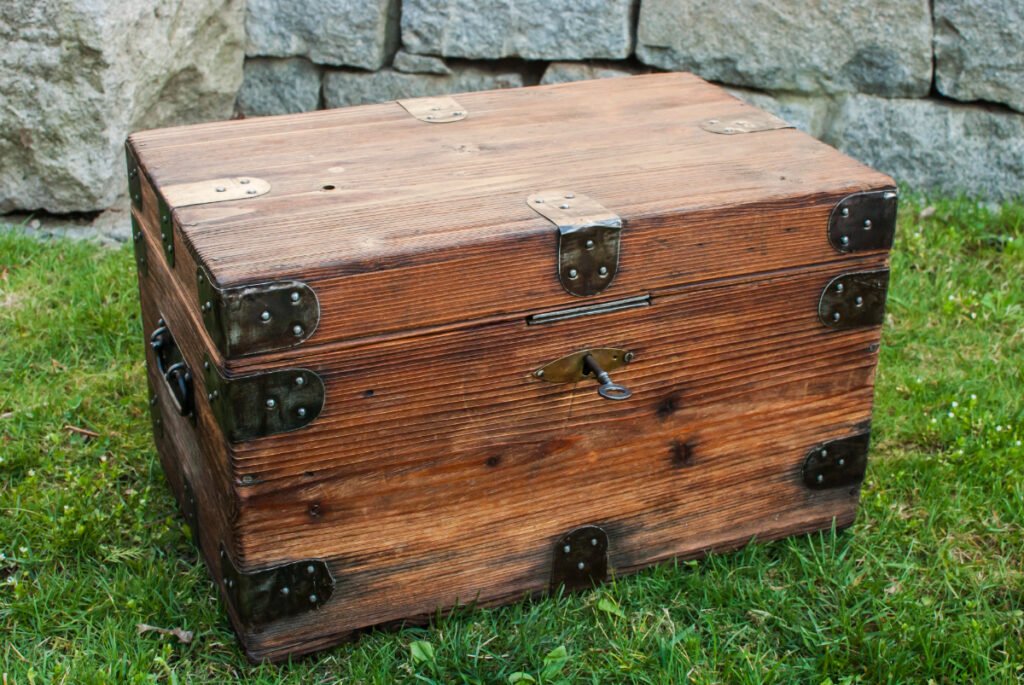
For example, pine and basswood bodies with hardwood slats (oak or ash) are typical of American trunks. The distinct odor of camphor wood indicates Chinese exports. Solid pine construction with dovetail joints hints at a Scandinavian design.
3. Maker’s Marks
A maker’s mark turns guesswork into evidence. Inspect the lid for labeling beneath, in addition to inside the box, behind the lining, if there is one. Most trunks will have some sort of label pasted on the undersurface of the lid that is very valuable indeed.
Notable American makers worth knowing are M.M. Secor, Henry Likly, Crouch & Fitzgerald, Belber, Oshkosh, Wheary, Indestructo, Neverbreak, Excelsior, Seward, and Haskell Bros. The finest American manufacturers are Hartmann (started in 1877) and Innovation.
Luxury European designers, like Louis Vuitton, Goyard, and Moynat) command the premium prices. Their logo is found on lock plates, brass nametags, leather labels, and inside labels. Serial numbers stamped into the lock often confirm authenticity for these brands.
4. Hardware
Hardware is among the cleanest dating clues in the entire trunk. Antique trunk locks, latches, corner brackets, leather straps, slat construction, and wheels each give clear hints of when the piece was made.
- Locks & Latches – Usually, lock plates have patents and maker’s names. Typical American lock manufacturers can be listed as Eagle Lock Co., Terryville, Connecticut; Yale & Towne Mfg Co., Stamford, Connecticut; Corbin and Star Lock Works. The stamp saying “Pat’d 1888” means that this particular trunk could not be made prior to 1888.
- Slat Construction – Wooden slats help strengthen the body of the cradle and protect the covering. Both cross-slat and barrel stave construction were very popular during the 1870s and 1880s. The patent dates on the slat clamps help in dating the trunk.
- Leather Straps – Used heavily before 1872, but they didn’t disappear after that. They continued on better trunks into the early 1900s. Original leather is very delicate, so most preserved straps are replacements.
- Corner Brackets & Caps – Brass corner caps are more typical on older or expensive trunks. Nickel-plated steel corner brackets were common after 1900.
- Wheels – Antique trunk wheels (castors) indicate that these are wardrobe trunks dating back to the 1900s through the 1940s. Smaller-sized steamer trunks did not have wheels since these were trunks to be carried by the porter.
5. Check the Interiors
The inside will usually be the most distinctive aspect of the antique trunk, and it has more dating clues than the exterior. Carefully open the trunk and examine everything.
Original tray, separators, and drawers are the first thing to check. The majority of steamer trunks have at least one pull-out tray. Trunks with drawers that are antiques and trunks with compartments (which include multiple trays, hat areas, glove sections, etc.) were made after 1900, especially wardrobe trunks. Older trunks tend to have a more simplistic design with only one tray.
Lining paper and lithographic designs date back to the 1870s and onwards. The floral chintz designs and marbled paper designs were popular between 1870 and 1890. Geometric and Art Deco design patterns are typical of the 1910s and 1920s period.
Built-in hangers, extendable rods, and shoe pockets are signature features of wardrobe trunks (1900s to 1940s).
Interesting Note: The antique steamer trunk with a picture inside (often a colorful chromolithograph glued to the inside of the lid) is a desirable feature. These chromolithographs were taken from French fashion catalogs in the 1860s, then printed specifically for trunks by the 1880s and 1890s.
6. Note the Origin
National origin shapes both style and value. While American trunks predominate in the used market in the U.S., immigrant trunks and Asian trunks are likely to fetch higher prices.
American trunks mostly have straightforward construction. They’re mass-produced since the 1870s and are mostly unmarked. Hartmann, Oshkosh, Belber, and Innovation are the premium American names to watch.
Norwegian and Swedish immigrant trunks are hand-painted with traditional rosemaling folk art, solid pine with hand-cut dovetails, wrought iron straps, and hinges. These are mostly dated and signed by the original owner. Most antique Norwegian trunks and antique immigrant trunks in the U.S. arrived between 1820 and 1900. Dome-top “kiste” shapes are common.
Chinese camphor chests and old Chinese trunks are made from carved camphor wood, brass corner trim, and hand-carved ornamental reliefs depicting dragons, landscapes, birds, flowers, etc. The majority of antique Chinese camphor wood chests are made in the export era of the 1850s to 1930s.
Carved Asian (Japan, Korea, China) trunks feature exotic hardwood carvings inlaid with brass, occasionally soapstone or mother-of-pearl inlay. These can be mistaken for Chinese pieces, yet are distinctive in carvings and joinery techniques.
7. Trace the Production Era (by design)
After collecting the visual evidence, place the pieces of evidence up against these era indicators:
- 17th & 18th centuries (before 1800) – Very rare in the American market. Hand forged nails, hand-hewn wood, hand-cut dovetails, hide-covered, basic iron straps and locks. Typically European-made.
- Early 1800s – Handmade dovetail joints, square-cut nails, wrought iron hardware, leather/canvas, painted with folk-art designs on European versions. Stagecoach trunks dominate.
- 1850s to 1870s – Jenny Lind hourglass trunks, early dome-tops, cut nails still common. Leather and canvas coverings.
- 1880s to 1890s – The heyday of Victorian trunk manufacturing. Tin, zinc, and crystalized metal finishings, dome tops, camel backs, intricate hardware, and chromolithograph interior linings. Use of wire nails began in the late 1880s.
- Late 1890s to 1910s – The era of flat-top steamers. Coverings of canvas and vulcanized fiber cloth, Eagle Lock, Yale, and Towne hardware.
- 1920s and 1930s – Vertical wardrobe trunks with drawers and hangers. End of the golden age of trunks as air travel took hold.
Types of Antique Trunks (8 Popular Styles)
Old trunks can be classified as any of the ten styles below. These styles belong to distinct time periods, perform distinct functions, and have different features. Below is a map to help you classify your trunk.
- Steamer Trunk (flat-top) | $150-$500 – This is the standard flat-topped trunk meant for stacking purposes in steamboats and railroads. It spans from 1885 to 1920. The covering materials vary from canvas, zinc, to vulcanized fiber.
- Dome-top / Round-top Trunk ($200–$900) – Arched top, often higher than steamers. Peak production was from 1870 to 1895. Embossed tin in its original, good condition is the most desirable variation. Also called barrel-top or monitor-top.
- Camelback / Humpback Trunk ($250–$1,200) – A more pronounced curve than a basic dome-top. The arch is taller and more steeply curved. Often confused with dome-tops, but the curve is distinctly higher.
- Wardrobe Trunk ($300–$1,500+) – Vertical style; opens like a walk-in wardrobe that includes hanging rods as well as drawers on the opposite sides. Popular during the years of 1900 to 1940. It may be heavy and bulky, but it’s what’s inside that counts.
- Saratoga Trunk ($500–$2,500+) – Very large and highly embellished trunks with domed or arched tops. Usually have multiple compartments with a mini wardrobe interior. They originated around the late 1870s
- Jenny Lind Trunk ($400–$1,200) – The signature hourglass-shaped trunk popular in the 1850s to 1870s. Brass-bound versions with original leather are worth the most.
- Sea Chest ($200–$1,000) – Crafted from solid wood (generally oak or pine); rectangle-shaped and having large rope becket handles and iron straps. Used for storing personal property by the sailors on their long voyages. Usually date from the 18th to mid-19th centuries.
- Immigrant / Stagecoach Trunk ($300–$2,500) – Stagecoach trunks are smaller, hide-covered, brass-tacked pieces from before the railroad era. Immigrant trunks include the painted Scandinavian rosemaling pieces and plainer European storage chests.
Examples of Valuable Antique Trunks Recently Sold
Below are 10 examples of valuable antique and vintage trunks that often appear at antique sales (online and offline) and are actively collected today.
1. Louis Vuitton Damier Steamer Trunk
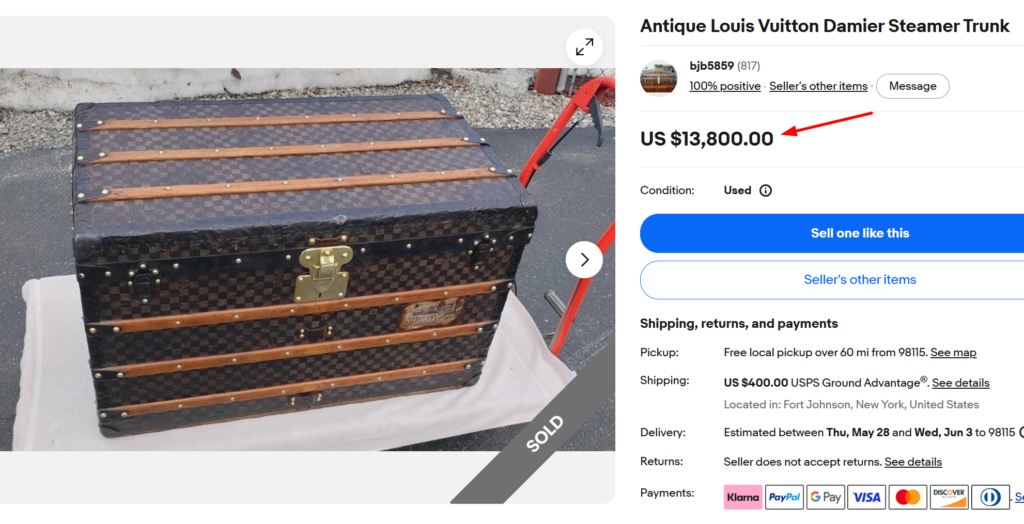
Sold for $13,800
Damier (or “checkerboard”) is the original fabric design used by Louis Vuitton; it appeared in 1888, about eight years before the brown monogram. The light-and-dark brown squares were designed to discourage counterfeiters and hide dirt from steamship travel.
Original Damier trunks from the 1888–1896 window are rarer than monogram pieces. The most valuable examples are those that still have their original canvas, slats of wood, LV brass lock, and hotel travel labels.
- Estimated Value: $5,000–$30,000+
- Production Year: 1888–1896 (original Damier run; revived 1996)
- What to Check: Light/dark brown checkerboard canvas, brass LV-stamped lock, wood slat reinforcement, serial number, hotel labels
- Quick Notes: Modern Damier pieces (post-1996) are common, antique pieces are rare and valuable.
2. Antique Goyard Cube Hat Trunk
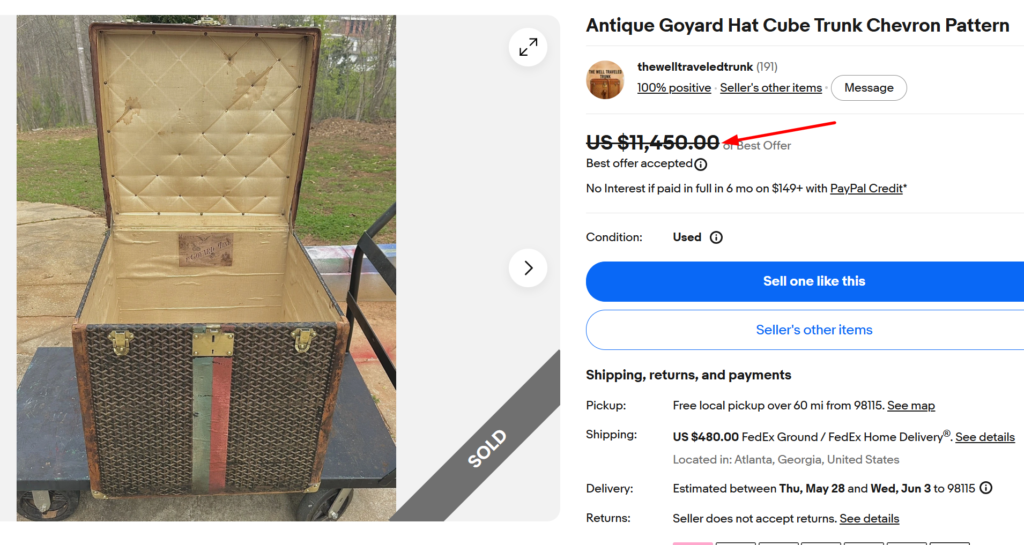
Sold for $11,450
After LV, there is the other French luxury trunk maker, Goyard, which came into existence in 1853. Besides steamers, Goyard’s cubic-shaped hat trunks with their famous Goyardine canvas featuring the chevron pattern are highly prized.
These have a cubic form, carved brass lock and clasps, two-color leather borders, and quilted cream-lined inside.
The chevron canvas made up of interlocking chevrons in the form of a letter Y was created in 1892 by Edmond Goyard and cannot be duplicated.
- Estimated Value: $8,000–$40,000+
- Production Year: Chevron canvas post-1892; most collectible 1900–1940
- What to Check: Y-pattern canvas, “E. Goyard Aîné” paper label inside lid, “Goyard” engraved brass locks, quilted cream interior
- Quick Notes: Hat/cube shapes are rarer than full steamers.
3. Louis Vuitton Monogram Steamer Trunk
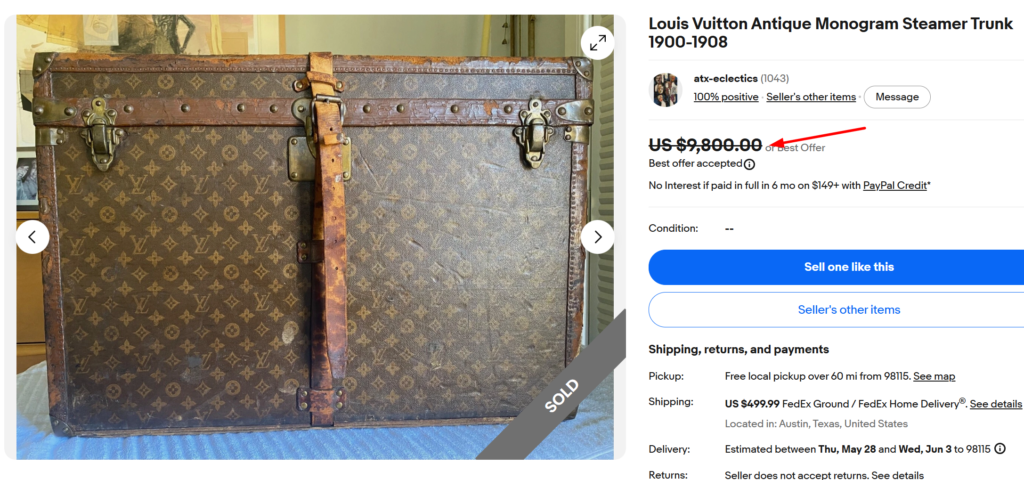
Sold for $9,800
The LV monogram is the most valuable trunk name in the world. The patented LV monogram canvas was introduced in 1896, so any piece carrying the brown LV-flower pattern dates after that.
A 1900-1908 monogram steamer with leather trim, brass corners, and original leather handles is a textbook example. Today, pre-1900 models and Hemingway library trunks fetch high prices.
- Estimated Value: $3,000–$50,000+
- Production Year: Post-1896
- What to Check: LV monogram on brass fittings, serial number on lock, “Louis Vuitton Paris” on strap loops, original quilted interior
- Quick Notes: Check the brass hardware quality & serial number for authenticity.
4. Romadka Brothers Trunk
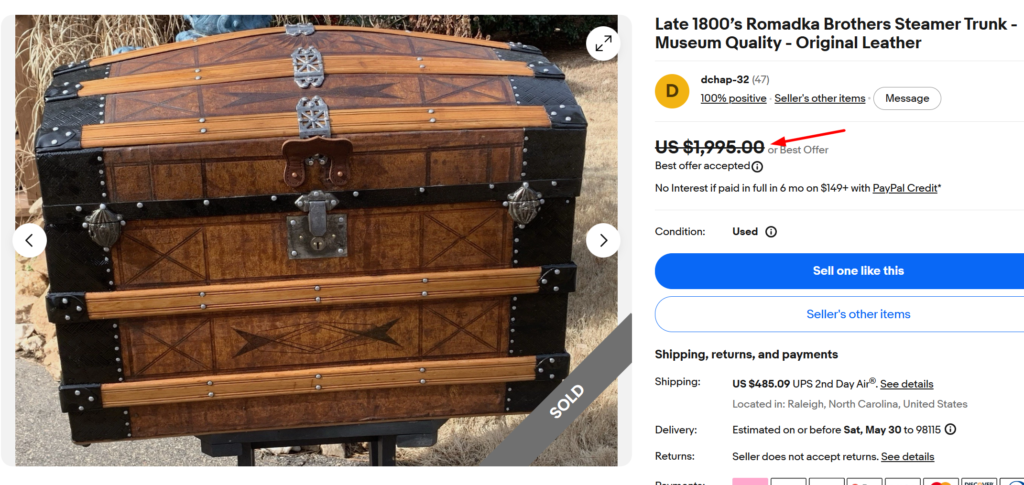
Sold for almost $2,000
Romadka Brothers was a Milwaukee, Wisconsin maker founded by Bohemian immigrants in the late 1840s. In 1877, they made 300 trunks daily, and at some stage, they were manufacturing the largest number of trunks in the whole country.
Apart from the “Romadka Bros.” paper label, you can spot these by patented hardware, like corner braces, and signature Romadka leather handle design.
Examples of such late 19th-century trunks with original leather covering, special cast corners, and Romadka patented latches can be worth $1,500 to $2,000+ today.
- Estimated Value: $800–$2,500
- Production Year: ~1848–early 1900s (most collectible: 1875–1900)
- What to Check: “Romadka Bros.” paper label inside lid, patented cast corner braces, signature Romadka leather handle design
- Quick Notes: Patented Romadka hardware was used only by this maker.
5. Camelback/humpback Steamer
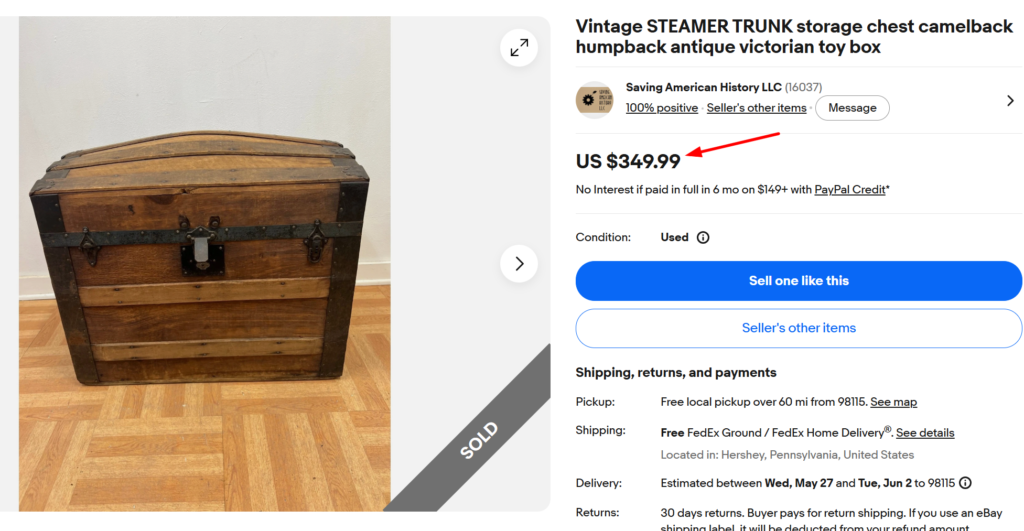
Sold for $350
Camelback steamers were popular during the Victorian period. The trunk is made of wood and strengthened by iron bands and slats, along with a dome lock and side latches, which also have working hinges.
The best ones have embossed tin linings and a complete set of chromolithographs (vivid images, mostly of Victorian era scenes or flowers) that have been pasted on the lid. These are worth more than $600.
- Estimated Value: $250–$1,500
- Production Year: 1870–1895
- What to Check: Pronounced arched top, slat construction, chromolithograph inside lid, dome lock with side latches
- Quick Notes: An intact original lithograph can double the value of an otherwise average piece
6. Jenny Lind trunk
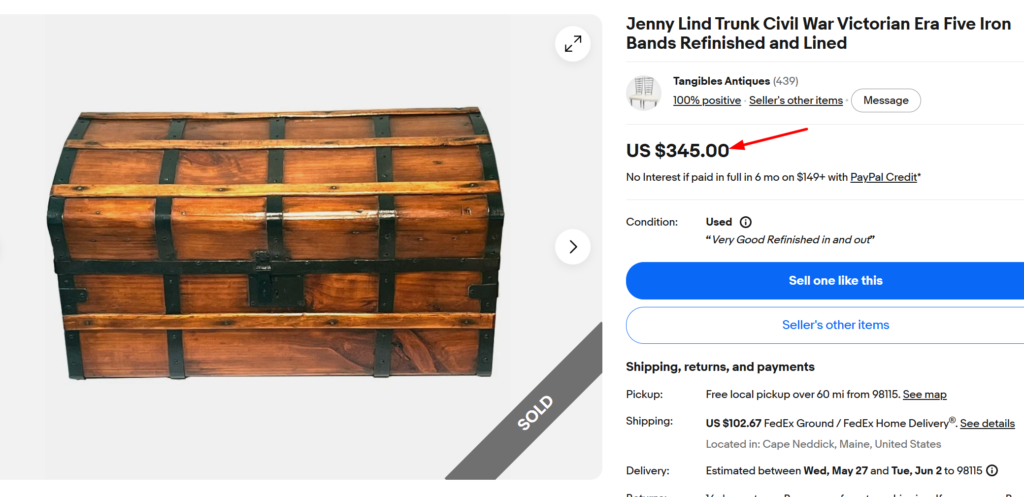
Sold for $345
The signature hourglass-shaped wood-and-iron trunk. Several American companies made them, but the paper maker’s labels are usually lost. Most surviving examples are the Civil War era (1850s–1870s) with five iron bands wrapped around a slatted wood body, brass nail caps, and a feather-keyhole lock.
Refinished examples with all five iron bands intact and a re-lined interior usually run $300 to $500. Strong original pieces can fetch over $700+.
- Estimated Value: $300–$1,200
- Production Year: 1850s–1870s
- What to Check: Hourglass profile, five iron bands, brass nail caps, feather or leaf detail over the keyhole
- Quick Notes: The shape is the primary ID clue.
7. Military / WWI–WWII Foot Locker
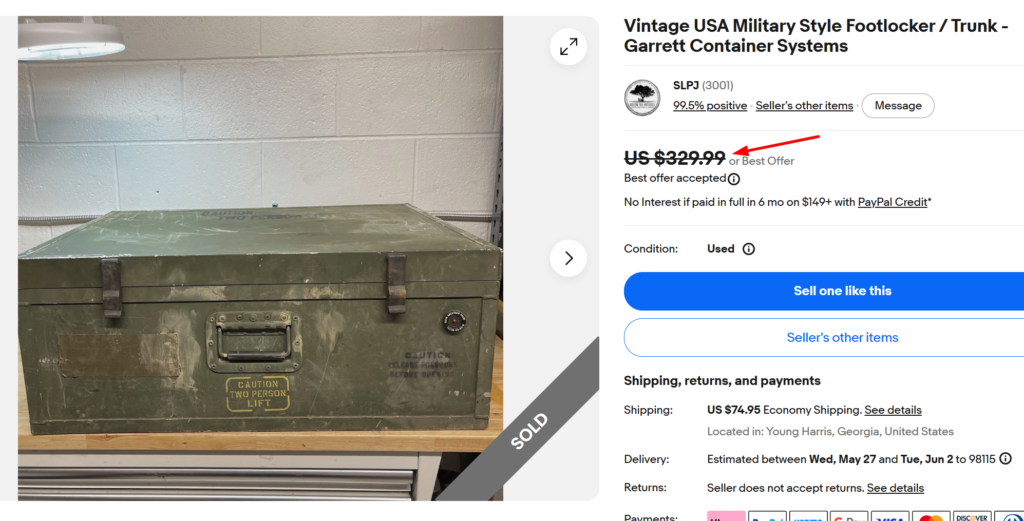
Sold for $330
These are the most common “old” trunks in U.S. estate sales. They were built from rectangular wood (pine pre-WWII, plywood after) and painted olive drab, with stenciled “Caution Two Person Lift” markings, simple metal corners, drop handles, and hasp closures.
A 1939–1945 foot locker in working condition runs $75 to $200. Named or customized pieces with documented service or specialty stamps are quite desirable.
- Estimated Value: $75–$500
- Production Year: 1914–1945 (most common: 1939–1945)
- What to Check: Solid pine vs. plywood, original inner tray, stenciled markings, maker stamp
- Quick Notes: Plywood = WWII. Solid pine = likely WWI or pre-1940.
8. Norwegian Trunk
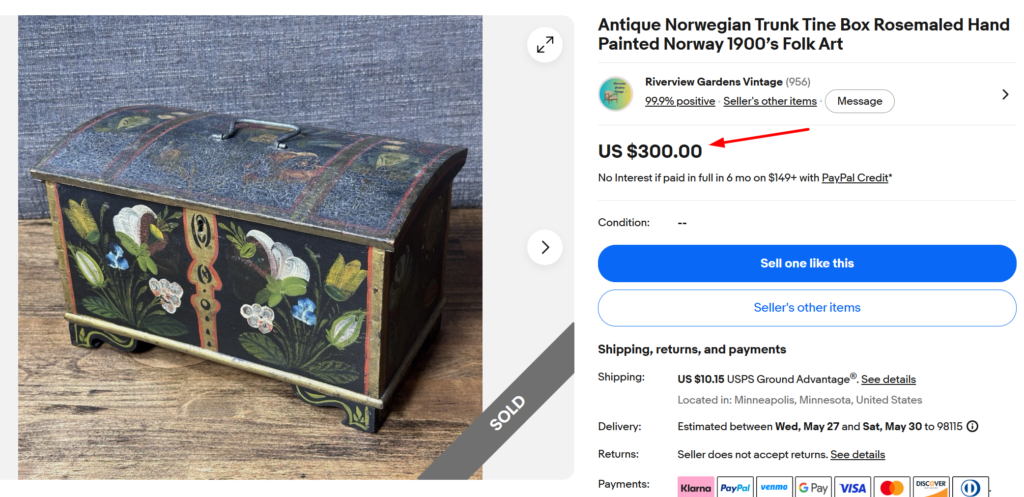
Sold for $300
The “tine” or immigrant trunk is the small-to-mid-sized piece that emigrants packed for the Atlantic crossing between 1820 and 1900. These were built with pine bodies, hand-cut joinery, and hand-forged iron straps, and they carry the recognizable dome-top “kiste” shape.
The most desirable feature for these trunks is hand-painted rosemaling: florals in red, white, blue, and yellow on a dark ground. Even a small trunk with intact rosemaling can fetch $250 to $400.
- Estimated Value: $250–$2,000
- Production Year: 1820s–1900s (most collectible: 1830s–1870s)
- What to Check: Rosemaling brushwork, hand-cut joinery, wrought iron hardware, and painted owner’s name or date.
- Quick Notes: Later 20th-century reproductions of rosemaling exist.
9. Antique Wicker Trunk
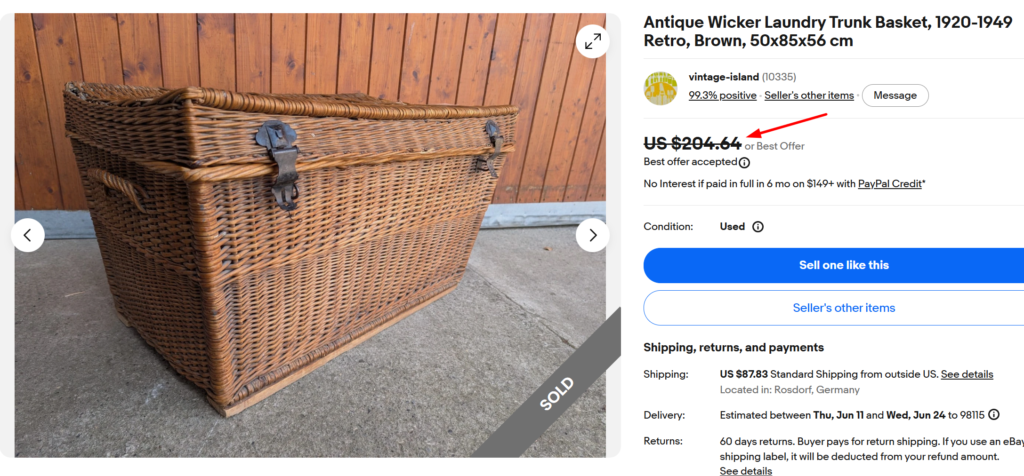
Sold for $205
Wicker trunks were lightweight alternatives to wooden ones, used for ocean liner travel and laundry transport from the 1890s through the 1940s. They were built with basket-woven rattan or willow over a wood frame, with simple iron locks.
European examples are common in the market. The standard laundry trunk from the 1920s, in good condition, is generally valued at $200-$400. Those that are older and have intricate locking systems can fetch higher, at $500-$1,000, but rarely.
- Estimated Value: $150–$1,500
- Production Year: 1880s–1940s
- What to Check: Intact weave, iron or brass fittings, original lining, working lock, and latches
- Quick Notes: Damaged wicker is hard to restore. Most surviving examples are European
10. Saratoga Trunk
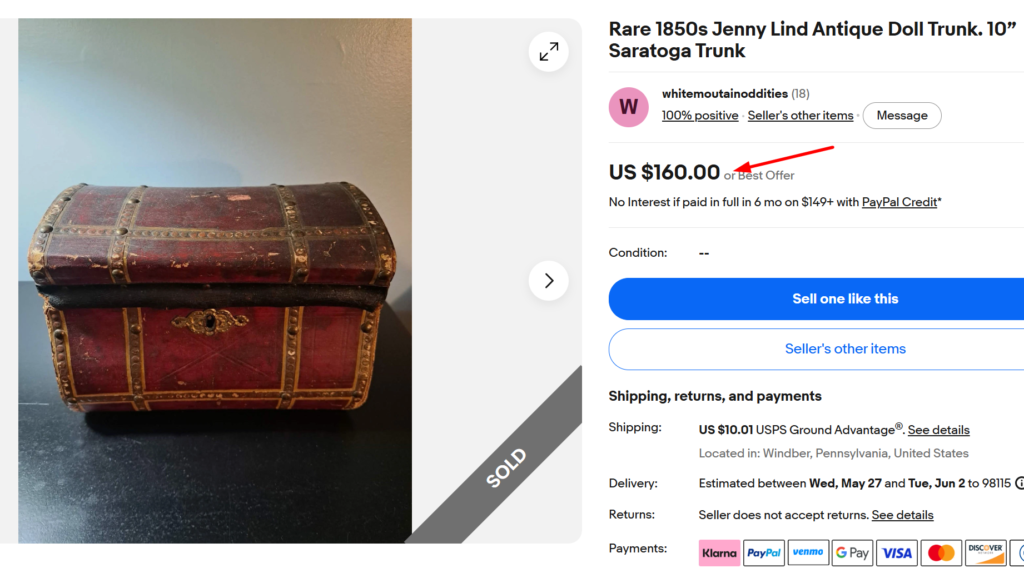
Sold for $160
Saratogas were named after the holiday resort of Saratoga Springs, where well-to-do vacationers carried them during the 1870s and 1880s. They were large cases topped with domes made with elaborate moldings, lifting trays, and plush linings.
Miniature versions (doll-sized Saratogas, often confused with small Jenny Linds) also exist and run $100 to $250. Full-size trunks made of chromium-plated metal, wood strips, and fancy interiors have sold for $2,000 or more.
- Estimated Value: $150–$2,500+ (full-size trunk, more valuable)
- Production Year: Late 1870s–1890s
- What to Check: Large size for full versions, dome or arched top, decorative hardware, fitted interior with multiple compartments
- Quick Notes: Luxurious interior fittings are a must for top value.
What Determines an Antique Trunk’s Value?
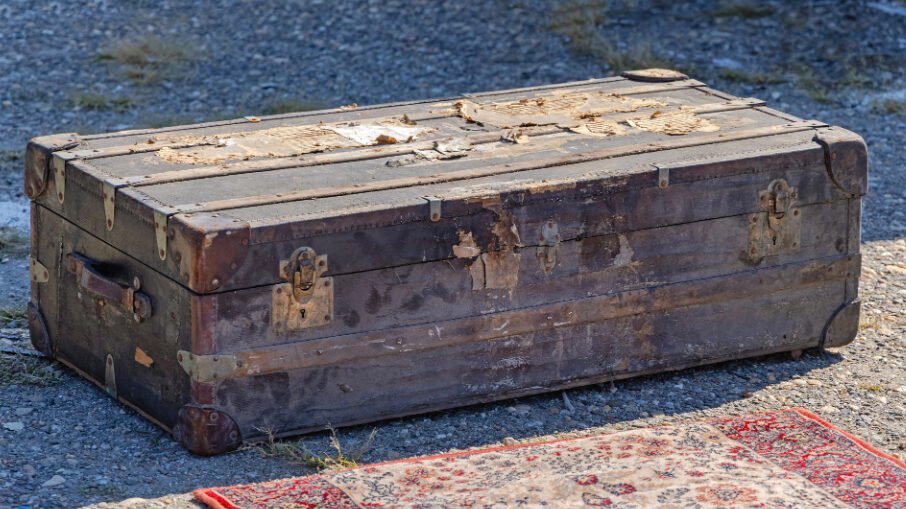
Is an old trunk valuable? They are worth between $100 and $400. However, six things determine whether your old trunk falls under the lesser-value category or the rare find category.
- Age & Period – An old trunk that is before 1880 will be rarer and hence more valuable compared to other trunks that come from the era of mass production. A Jenny Lind trunk from the pre-Civil War period will be worth more than a 1910 flat top steamer.
- Brand/Model – Designer trunks, LIKE those made by Louis Vuitton and Goyard, are worth the most today. American brands like Hartmann, Innovation, and Oshkosh are also collectible. Non-branded trunks can be difficult to value and are usually worth significantly less.
- Rarity – Rare shapes, decorations, or histories are important. An authentic signature on a Norwegian rosemaling trunk from 1845 is rarer than an ordinary flat-top trunk from 1900, even though they appear equally aged.
- Materials & Construction – Hand-carved camphor wood, exotic leather, solid brass hardware, hand-cut dovetail joinery. These all indicate superior craftsmanship and help justify higher costs.
- Originality – Original lining, fittings, leather straps, lithographic paperwork, and label information all add significant value.
- Condition – This factor works two ways. Sensible restoration can raise the value, but extensive refinishing or painted surfaces generally detract from value. The original finish wins over any new one.
So, before buying and selling an old trunk, check the shape, the materials, the hardware, the inside, and the maker’s marks. These are the exact things that will help you spot a valuable antique trunk from a cheap one.