
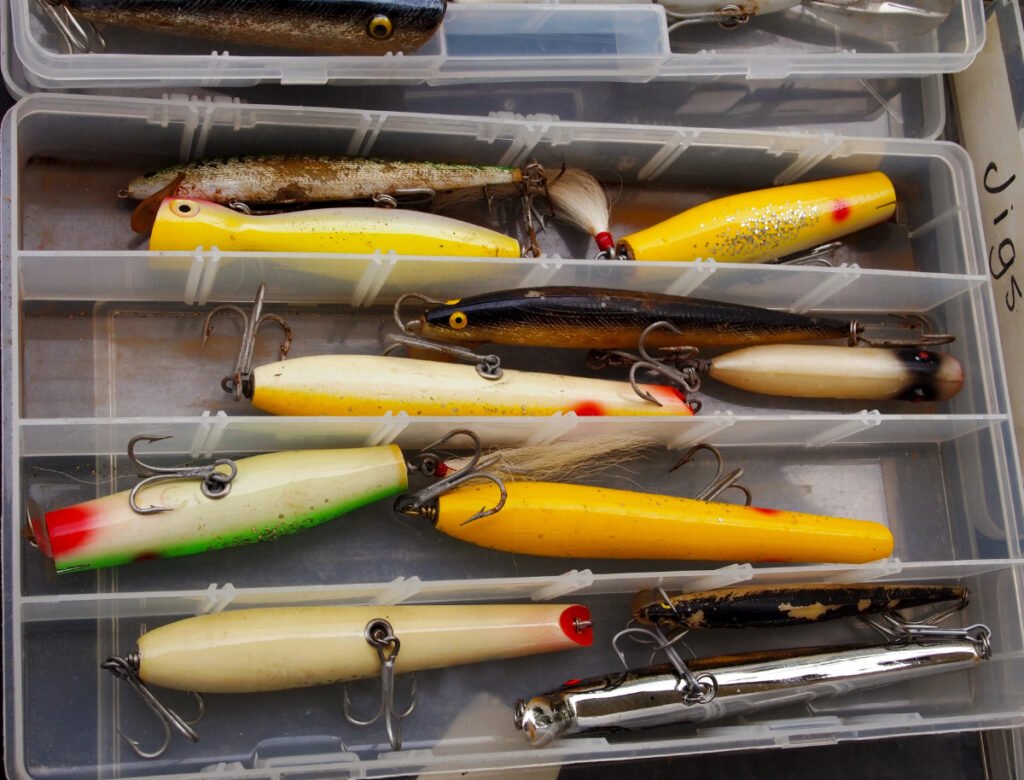
Do you own that old tackle box full of old wooden lures with chipped paint, glass eyes, and hardware that looks nothing like the modern Walmart items? If yes, this guide is for you.
Before you toss or donate any of it, pay attention to what you have. Some of those vintage fishing lures can be worth way more than you think today.
This guide walks through valuable and collectible antique fishing lures worth money, plus easy ways to identify and date your own old lures and find out if they are worth something today.
How to Identify an Old Fishing Lure (5 Clues)
Before you can figure out what a lure is worth, you need to know what you’re holding. Antique fishing lure identification comes down to five physical clues. Run through them in order. Most lures give up their age and maker within a couple of minutes.
The Body Material
Wooden lures were standard in the pre-1955 era. After that, plastic (often called Tenite or Spook in Heddon’s catalog) took over. A wooden body is heavier for its size, and if you tap it gently on a hard surface, it gives a duller sound than plastic.
Run your thumb along the body. Wood often shows the faintest hand-finishing marks, especially on lures from the 1920s and earlier. Plastic feels uniform and slick.
A wood lure with glass eyes and L-rig hardware is almost always more valuable than its later plastic version, even when the model name is the same.
The Belly Stamp and Markings
The maker marks tell you who made the lure. Flip the lure over and check the belly to spot these markings. Most major makers stamped their name into the wood or printed it on later plastic bodies.
Below are the major makers and their identifying marks you must know:
- Heddon – Belly reads “HEDDON DOWAGIAC” on early lures or “HEDDON” with a model name on later ones. The Dowagiac reference points to the Michigan factory.
- Creek Chub – Look at the metal diving lip. It’s usually stamped “C.C.B.CO. Garrett Ind.” with the patent date “9-27-20.” The earliest lures from 1916 to 1920 have no lip markings at all.
- South Bend – Belly stamp says “SOUTH BEND” with the model number printed below.
- Pflueger – The bulldog logo is stamped on the propeller blade rather than the body. The body might also have “Pflueger” printed on it.
- Heddon Spook Plastic Lures – Belly print starting in 1933 shows the lure name in black, occasionally red on rare early Yellow Shore Minnow examples.
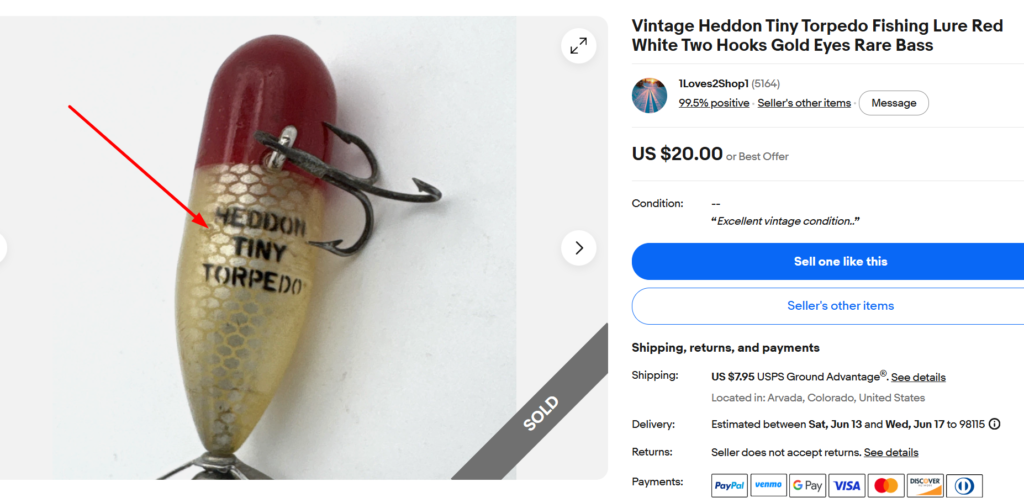
But remember that no stamp doesn’t always mean it’s not real. The earliest lures from any maker often had no markings at all. Nonetheless, a clear, correct stamp is the first thing collectors look for and the easiest one to fake on a reproduction.
The Hardware
Hardware on fishing lures changed with time, so it helps narrow down the date.
For example, the earliest lures from the 1900s through the 1910s used cup rig hardware. That means small metal cups recessed into the wood with screw eyes holding the hooks.
Through the 1920s, makers moved to L-rig, a flat L-shaped piece that pinned the hook to the body. Heddon used the L-rig heavily from the late teens into the 1930s.
These were followed by split-ring or two-piece hardware and then surface rig hardware, which characterizes lures dating from the 1940s through the 1950s. The plastic-era lures usually used the screw-on mount hangers.
The Eyes
Eyes are another reliable age indicator on a wooden lure. Glass eyes were standard from roughly the 1900s through the late 1930s on most makers.
Heddon stopped using glass by about 1939. However, Creek Chub company continued using glass eyes until the 1950s; this is what distinguishes their lures.
After the glass came tack eyes, which are small metal pins with painted heads. These were used for a short period in the late 1930s and early 1940s. Then painted eyes took over for the plastic era.
So, if you see glass eyes on a wooden body, you’re looking at something pre-1940 on most makers, which are worth the most today.
The Color Pattern
The color can be more valuable than the model itself. Each maker had standard catalog colors plus rare “special order” or experimental colors that command serious premiums.
- Heddon’s finishes as Strawberry Spot, rainbow scale, and uncatalogued colors are worth the most.
- Creek Chub’s Rainbow Fire (color code 31) and Banana (16) are tough finds.
- South Bend’s patriotic red, white, and blue Depression-era Bass-Oreno is one of the rarest.
Always check the lure against catalog references before you assume what color it is, because some of the rarest patterns look ordinary at first glance.
11 Collectible Vintage & Antique Fishing Lures from Top Makers
The following are some of the most valuable and collectible antique fishing lures from the most famous lure brands. These pieces are frequently seen at online sales today.
1. Heddon Crazy Crawler 2100 (Wooden Version)
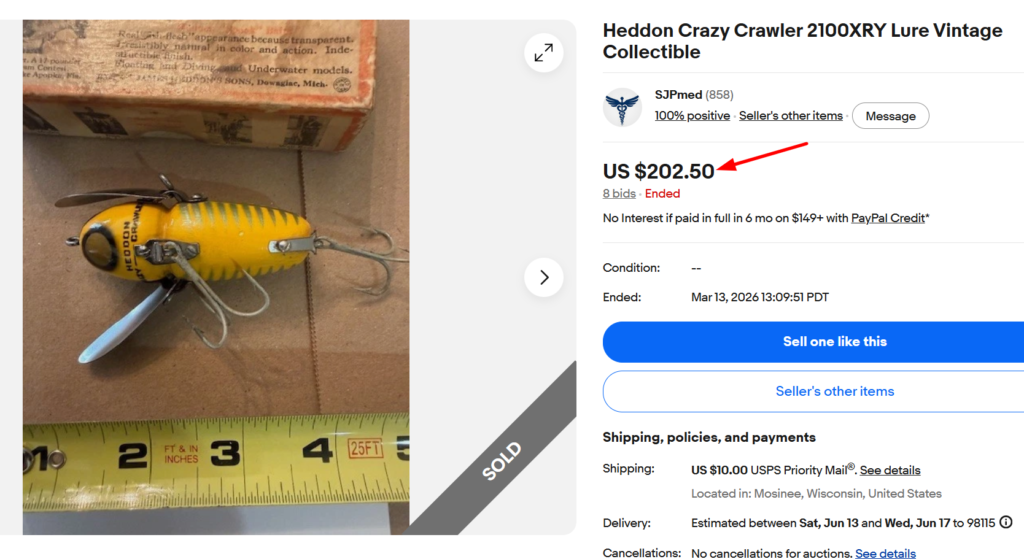
Sold for $200+ (with box)
The wooden Crazy Crawler 2100 series ran from around 1940 to 1957. The lure looks like a big beetle with two stamped aluminum wings on the sides that flap during retrieve.
Heddon made it in roughly 11 standard colors, but uncatalogued finishes like Ghost (essentially Black Shore with eerie painted eyes) are the ones that fetch the premiums. The plastic version replaced it after 1957.
- Estimated Value: $50 to $400+ for scarce colors
- Production Years: Roughly 1940 to 1957 for wooden 2100
- What to Check: Two-piece flap rig or surface hardware, aluminum wings
- Quick Notes: Ghost color and original H.R. Brush box bring premium.
2. Rainbow Fire Creek Chub Jointed Pikie 2600
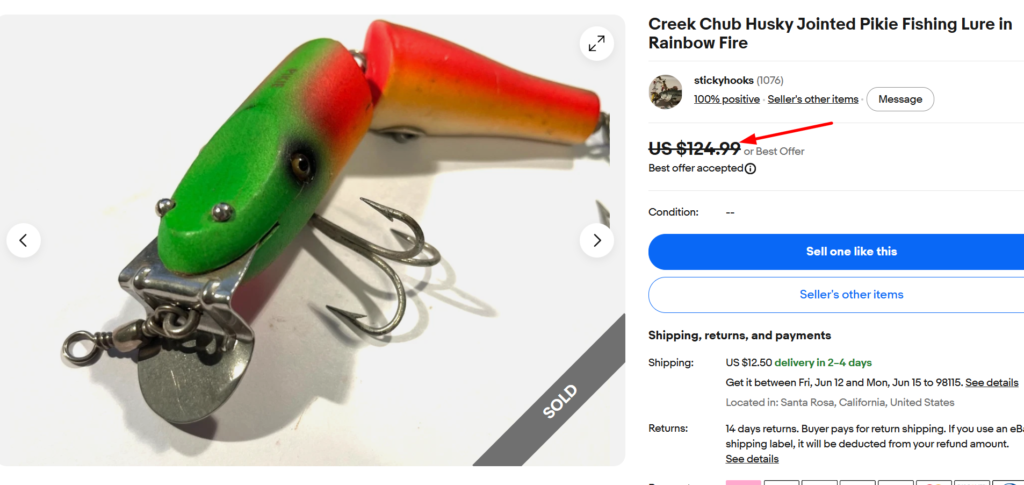
Sold for $125
The Jointed Pikie was introduced in 1926, with a hinged body that adds a wiggling action the standard Pikie doesn’t have. Catalog colors include Pike Scale (00), Perch (01), and Frog (19).
Rainbow Fire (color code 31) and Fire Plug (32) are the rarest variants, each reaching up to $130-$150 in good condition. They show bright orange or red with black streaks, a “look at me” finish meant for stained water.
- Estimated Value: $20 to $80; $100+ for rare colors with box
- Production Years: 1926 to 1978
- What to Check: Hinged two-piece body, glass eyes, stamped lip
- Quick Notes: Rainbow Fire and Fire Plug top the wood era.
3. Creek Chub Injured Minnow 1500
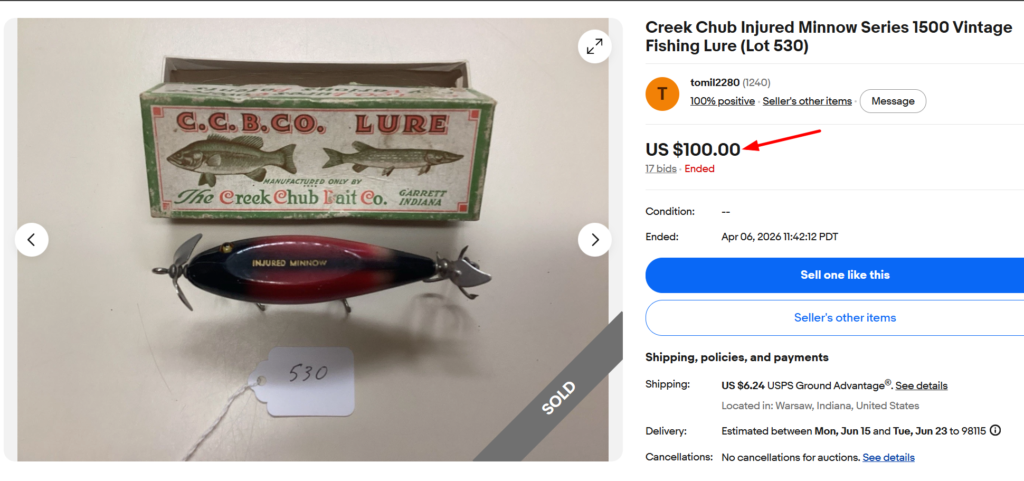
Sold for $100 (with box)
The 1500 Injured Minnow ran from 1924 to 1978. It floats on its side like a wounded baitfish, with metal props at both ends to disturb the surface. The body measures roughly 3 3/4 inches.
Some of the more difficult to find colors are Dace (1505), Banana (1516), and Purple (1511) on the wooden glass eye variety. Tack-eye versions came later, and they fetch less now.
Also, plastic Injured Minnows made near the end of their run are pretty common and sell for $15-$30.
- Estimated Value: $30 to $250+ (depending on color)
- Production Years: 1924 to 1978
- What to Check: Glass eyes, dual props, side-lying float
- Quick Notes: Wood + glass eyes + box fetch the highest value.
4. 1930s Wooden Paw Paw Hair Mouse 60
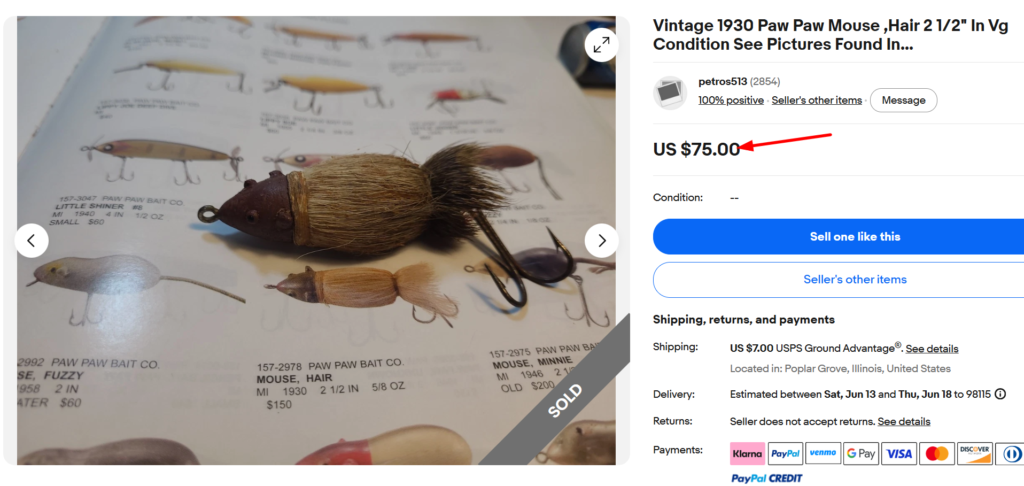
Sold for $75
Paw Paw Bait Company grew out of the older Moonlight Bait Company from Paw Paw, Michigan. The Hair Mouse 60 series from the 1930s is a small wooden lure with real deer hair banded at the head and partway down the body.
Some have front propellers, others don’t. The most notable colors include red and gray, with painted detailing on the head.
Also, Paw Paw lures used pressed eyes rather than glass on most models, which makes the hair mouse easily identifiable. Condition is everything since the deer hair tends to thin or fall out over time.
- Estimated Value: $50 to $250 with intact hair
- Production Years: Roughly 1930s
- What to Check: Real deer hair banding, pressed eyes, prop hardware
- Quick Notes: Pieces with Intact hair bring the highest premiums.
5. Wooden Heddon Lucky 13 (Glass-Eye Version)
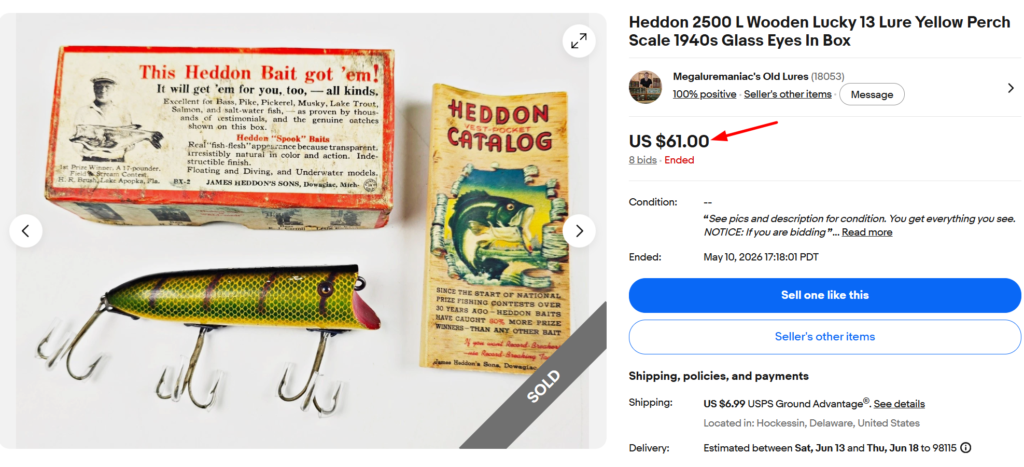
Sold for $60+ (with box)
It was produced from 1921 until decades later, and therefore the majority are common, ranging in value from $20 to $40. But the early wooden glass-eye version with L-rig hardware can sell for over $50.
Key characteristics include its mouth design, cigar-shaped body, and HEDDON LUCKY 13 belly stamp.
The rainbow color scheme and Strawberry Spot patterns from the ’20s and ’30s are the most collectible variants. Plastic eyes on your lure indicate that after 1953, its value has significantly decreased.
- Estimated Value: $40 to $300+ for early wooden examples
- Production Years: 1921 to present (wood pre-1953)
- What to Check: Glass eyes, L-rig hardware, cupped mouth, belly stamp
- Quick Notes: Rainbow and Strawberry Spot are the most collectible.
6. Creek Chub Pikie Minnow 700 (Glass-Eye Perch Scale)
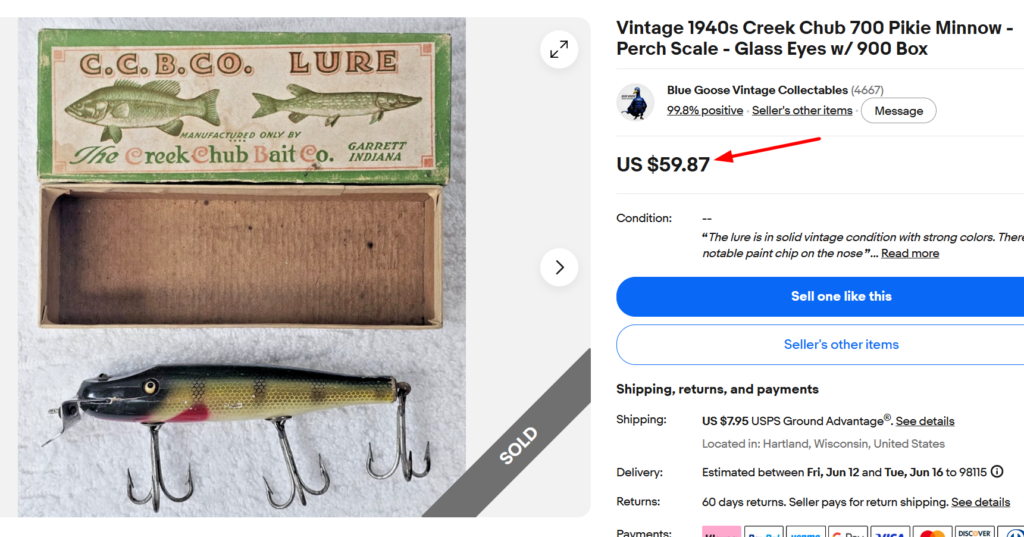
Sold for $60 (with box)
The Creek Chub Pikie Minnow 700 ran from 1920 to 1978 and was Creek Chub’s most famous lure. The collectible ones are the early wooden bodies with glass eyes and the metal diving lip stamped “C.C.B.CO. Garrett Ind. PAT 9-27-20.” The Perch Scale (color 701) shows vertical green barring over yellow flanks.
The Pre-1935 examples with NRA-stamped boxes are especially desirable, since the National Recovery Act stamp dates them to 1933-1936.
- Estimated Value: $40 to $400+ with NRA-stamped box
- Production Years: 1920 to 1978 (glass-eye era roughly 1920–1950s)
- What to Check: Glass eyes, stamped diving lip, wooden body
- Quick Notes: NRA-stamped box greatly boosts the value.
7. Yellow & Gold Pflueger Globe 3750
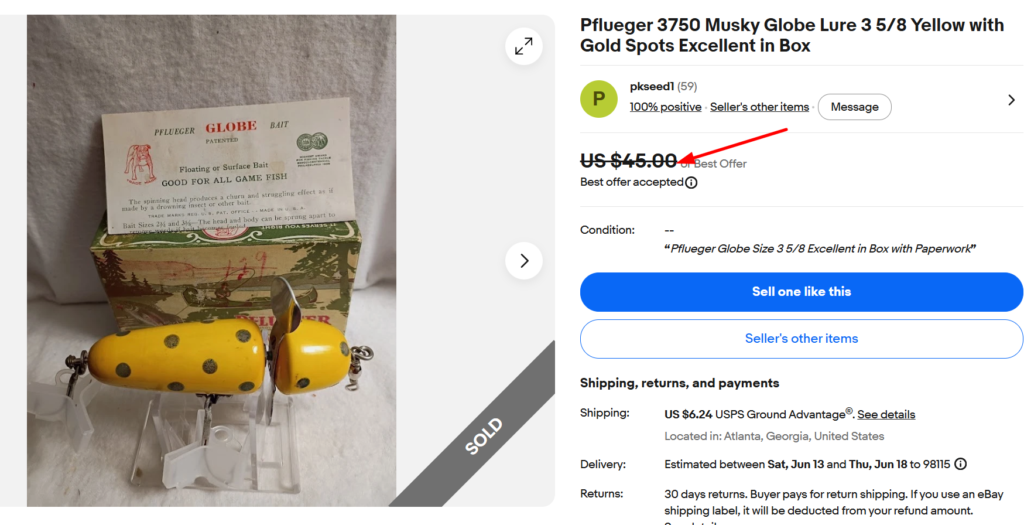
Sold for $45 (with Box)
Pflueger made the Globe from 1910 to 1966, when the company was sold to Shakespeare. The Globe features a rotating head and a propeller between the head and the body, so it makes a real commotion on retrieve. The 3750 model in Yellow Enamel with Gold Spots is one of the recognizable color codes.
The earliest Globes used see-through hardware, then moved to Neverfail hardware, then to surface rig later on. An original green-edge Pflueger canoe box drives value way up.
- Estimated Value: $75 to $300+ (the correct canoe box)
- Production Years: Roughly 1910 to 1966
- What to Check: Rotating head, prop placement, Pflueger Bulldog mark
- Quick Notes: The original canoe box is highly desirable.
8. South Bend Bass-Oreno 973 (Red, White & Blue)
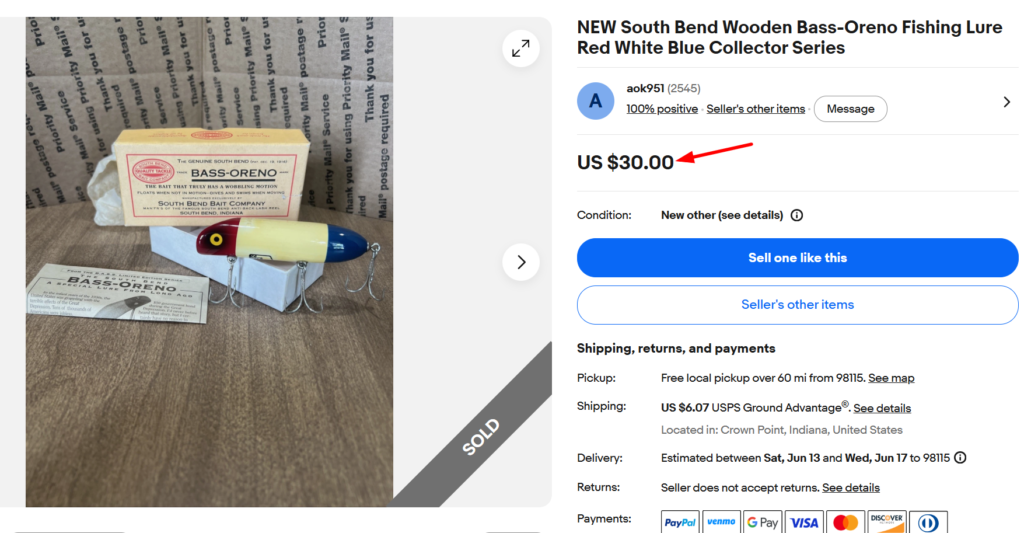
Sold for $30 (with Box & paperware)
The standard red-and-white Bass-Oreno is the most common antique lure, with most selling for $10 to $25. But the patriotic red, white, and blue version is a way rarer.
South Bend gave these limited edition lures away as a thank-you gift to people who bought U.S. Savings Bonds during the Depression, so they’re rare.
The standard Bass-Oreno is identified by its tapered tail, scooped face, and “Old Redhead” nickname. The original box and COA/paperware can add a lot of value.
- Estimated Value: $10 to $25 standard; $500 to $1,500+ for patriotic
- Production Years: 1916 to 1964 (patriotic version 1930s)
- What to Check: Tapered tail, scooped face, eye type, color
- Quick Notes: Patriotic red, white & blue is the most collectible variant.
9. Pre-Pradco Heddon Tiny Torpedo 360 (Gold Eye)
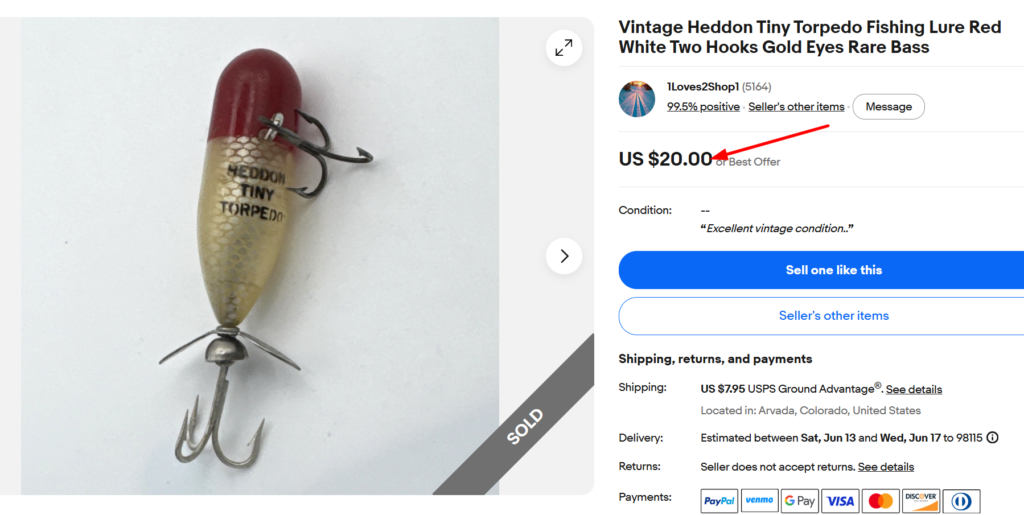
Sold for $20
The Tiny Torpedo measures around 1 7/8 inches and has a rear propeller. The 1950s and 1960s gold-eye versions made before PRADCO took over Heddon are the collectible ones.
Standard catalog colors run cheap, but uncatalogued finishes like solid Black and Karat Coachdog command real premiums. You can identify the pre-Pradco era pieces by gold eyes and large, unstamped propellers. Belly stamps should read crisply.
- Estimated Value: $20 to $120+ for rare colors
- Production Years: 1955 onward (pre-Pradco pre-1984)
- What to Check: Gold eyes, unstamped prop, belly print clarity
- Quick Notes: Uncatalogued colors like Black trigger fetch the most.
10. Bluegill Heddon Punkinseed Spook 9630
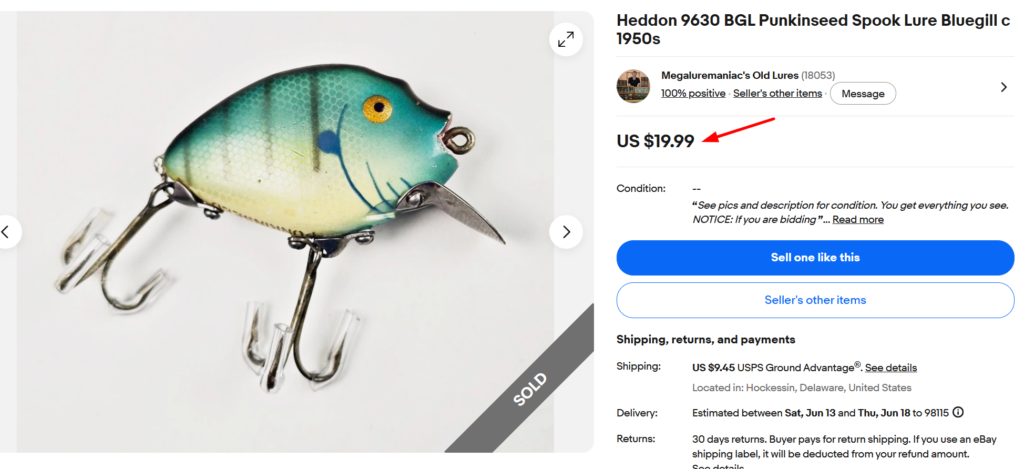
Sold for $25 (with box & COA)
The Punkinseed Spook resembles its eponymous species, which is a small-sized sunfish with a circular and disc-shaped body. Heddon came up with the plastic 9630 model in about 1950 to replace the former wooden 730 model range.
The color of the BGL model is blue-green on both sides and orange/light yellow on its belly, resembling a natural bluegill.
- Estimated Value: $50 to $250+ with original box
- Production Years: 1950 to early 1960s for the 9630 series
- What to Check: Gold or cream eyes, surface or bell rig hardware, belly stamp
- Quick Notes: Original box doubles value; 2005 reissues are clearly marked
11. Wooden Helin Flatfish F7 (Black & Orange)
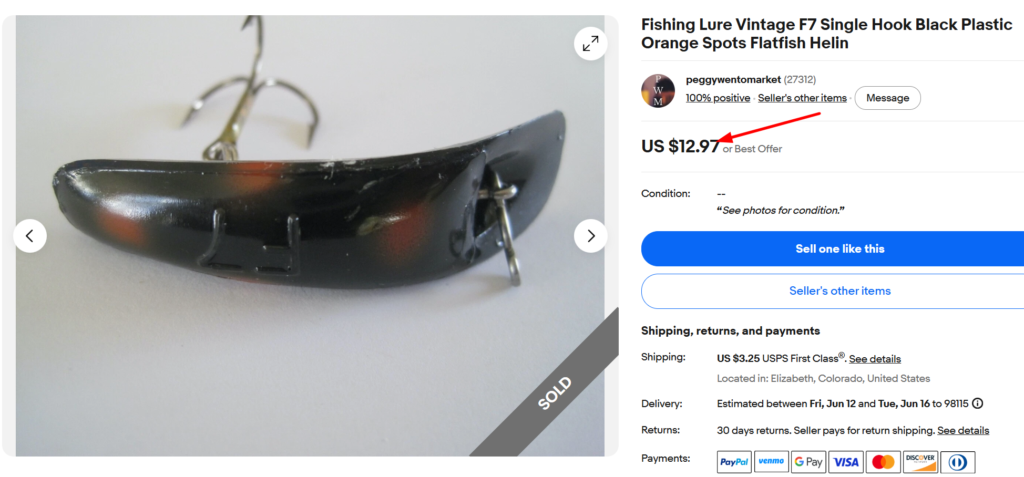
Sold for $13
Charles Helin started hand-carving Flatfish lures in his Detroit home in 1933, selling 400 the first year. By 1971, over 40 million had been sold. So most Flatfish are common.
Pieces made in wood from the late 1930s into the 1940s, until Helin began using plastic circa 1948, are the most collectible ones today.
The F7 size in Black with Orange Dots is the classic vintage finish. Look for wooden bodies, the offset detachable twin hook system Helin patented, and any original box or paperwork.
- Estimated Value: $25 to $150+ for early wood with box
- Production Years: 1933 to roughly 1948 for wood; plastic after
- What to Check: Wooden body, offset hook attachment, finish
- Quick Notes: Box and paperwork can double the lure’s value.
Why Some Old Fishing Lures Sell for Hundreds (Or More)
As you saw above, most vintage tackle boxes hold $5 to $30 lures. Common Heddon Lucky 13s and beat-up red-and-white Bass-Orenos fall in that range, and that’s fine.
But when it comes to rare colors, early wooden bodies, and original boxes, the value doubles, even triples. The four things that drive value on every antique fishing lure.
- The maker matters the most. Heddon, Creek Chub, Pflueger, South Bend, and a handful of others are the most collectible and valuable names in the market. So the brand name on the belly stamp or box is one of the most crucial things to check.
- The specific model and color variation matter next. A standard Heddon Crazy Crawler in a common red-and-white might sell for $40. The exact same lure body in a rare factory color like Ghost can fetch $300.
- Condition is the third factor. Cracks in the paint, missing hooks, broken glass eyes, and repainting all push the price down. On the other hand, original boxes and paperwork can double what a bare lure brings.
Handy Tip: Always check the value of your lure before repainting, polishing, or restoring it. Original paint is almost always more valuable, even if it’s chipped or worn. A touched-up lure is often referred to as a “repaint,” which is worth much less.
Before you give away your old tackle box, make sure to check each lure for belly markings, hardware, and material. Some old fishing lures could be worth over a hundred dollars today, if you know what signs you need to look for.