
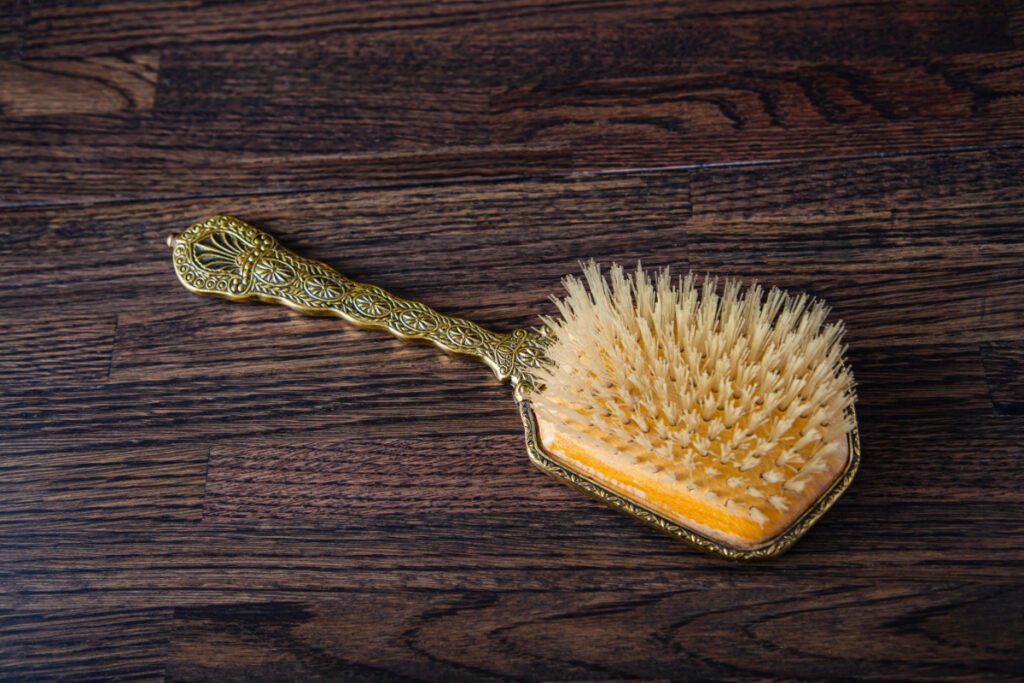
The first thing that comes to most people’s minds when they hear “antique hair brushes” is probably a handmade wooden brush. But that’s not all that it is. Early hairbrushes were also made from premium materials like silver and ivory, making them highly valuable today.
If you own an old hairbrush, this blog is for you. You’ll learn to identify a genuine antique piece, what determines its value, and some designs from top makers that collectors go crazy for!
How to Identify an Antique Hair Brush?
Identifying an old hairbrush may sound tricky, but it usually comes down to four quick checks.
- The maker
- The material & bristles
- The style and pattern
- The manufacturing period
Here’s how you can find out these details.
Step 1: Check the Handle and Back Material
Hold the brush in your hand and feel the weight. The weight itself tells you almost as much as the markings do. Here are the most common materials you will see on a vintage hair brush and tips to identify them:
- Sterling silver will feel quite heavy to hold and warm up quickly, as it’s a good conductor of heat. There should also be hallmarks on the silver, such as “STERLING”, “925”, or complete British hallmarks including the lion passant. Sterling usually rims a wooden or composition core, so a thin curl of wood is sometimes visible inside the bristle base.
- Silver plate is lighter and often stamped “EPNS” (electroplated nickel silver) or “QUADRUPLE PLATE.” If the plate is worn, you’ll see brassy patches at the high-rub points along the handle edge.
- Celluloid and French ivory are early plastics, lightweight with a creamy off-white look that mimics real ivory. Real ivory will show fine cross-hatched grain called Schreger lines, but celluloid does not.
- Bakelite and Catalin are heavier, denser plastics from the 1920s through the 1940s. Bakelite tends to come in dark browns, blacks, and deep greens. Run the piece under warm water and rub a hidden spot. A faint formaldehyde smell points to genuine Bakelite.
- Tortoise shell has a warm, mottled amber-and-brown pattern with no perfectly repeating shapes. Faux tortoise made from celluloid, on the other hand, shows machine-regular pattern repeats and a flatter finish overall.
Handy tip: To confirm sterling without a test kit, hold the handle in a closed fist for a few seconds. Genuine silver picks up body heat and gets warm faster than silverplate or brass.
Step 2: Find and Read the Hallmarks
Hallmarks confirm the material and help with dating the piece. So if you’ve narrowed the material down to silver, this is the step that pinpoints the year.
Find these marks around the edge of the back plate near the point where the bristles have been fitted, or else on the handle of the brush. These marks can be very small, so you will need a magnifying glass.
- British sterling shows four marks together. The maker’s mark, the lion passant indicating sterling, the town mark, such as the anchor for Birmingham and the leopard for London, and the date letter, which indicates the specific year of assaying.
- American sterling will usually feature only “STERLING” plus the maker’s mark. The use of “1899” on Gorham silver is the pattern date and not the manufacturing date.
Apart from these hallmarks, maker stamps are another thing you should look for to identify who made the hairbrush.
Some names that are worth recognizing are Gorham (an anchor between a lion and a Gothic G), Tiffany & Co. (often with a pattern code number), Unger Bros. (a “U” inside a “B”), Webster, R. Blackinton, William B. Kerr, and S. Kirk & Son in the US.
In England, the top makers are William Comyns, Mappin & Webb, Henry Matthews, Asprey, and Walker & Hall.
Step 3: Look at the Decoration and Style
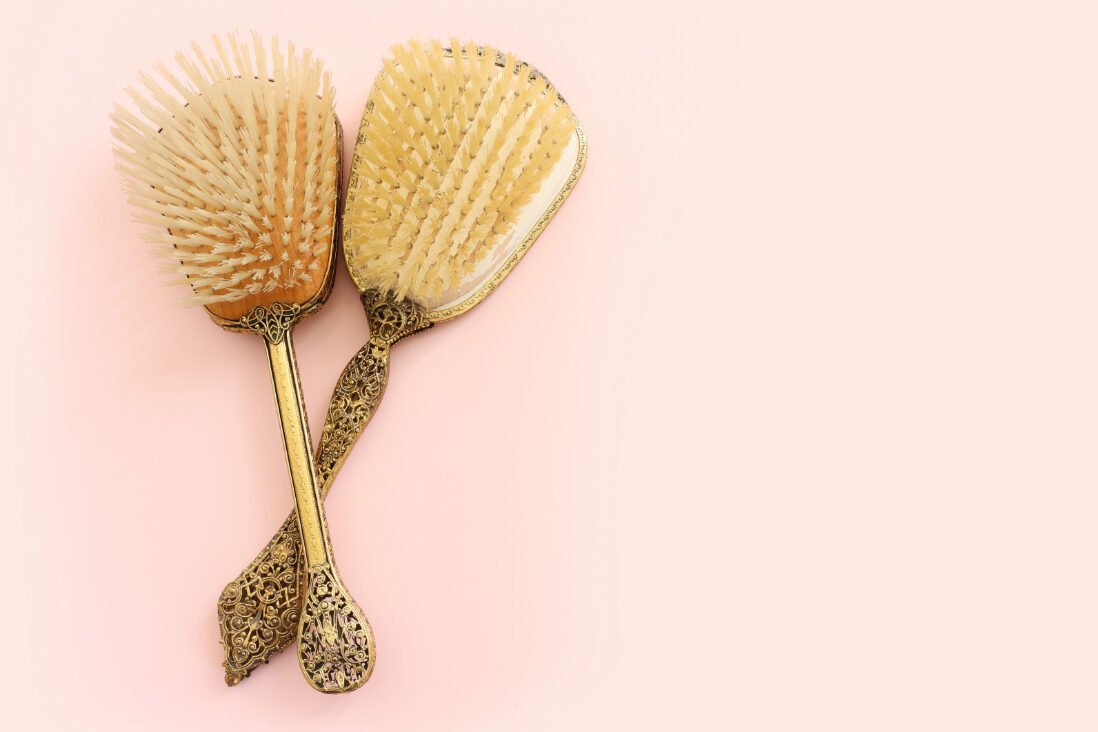
When marks are worn off or missing, style helps you date a vintage brush. Every era had a distinct look, so you can pin down the decade just by looking at the decoration.
- Victorian (1840–1900) – These feature heavy repoussé florals, cherubs, scrolls, and those ornate blank cartouches where people would add their monograms.
- Art Nouveau (1890–1910) – This era is known for whiplash curves, women with flowing hair, irises, dragonflies, all very organic and asymmetrical.
- Edwardian (1901–1915) – These pieces show lighter scrolling, ribbons, swags, and neoclassical touches. Think of it as toned-down Victorian style.
- Art Deco (1920–1940) – You can instantly identify it by sharp geometry, sunbursts, stepped lines, enamel color blocks, and stylized monogram fonts.
- Mid-century (1945–1965) – Brushes went modern. You’ll see lucite handles, chrome accents, simple shapes, pastel plastics, and ball-tip bristles.
Step 4: Examine the Bristles
While usually overlooked, the bristles can actually reveal when the brush was really manufactured. This applies even if the brush itself was recycled or refurbished later.
Natural bristles from boars were the preferred material used from the Victorian age until the mid-1950s. These would have been creamy white to yellow in color, slightly tapered, and assembled in tufts.
Horse hair is finer and darker, often used in clothes brushes and combination sets rather than hair brushes. Nylon is uniformly white or colored, with rounded plastic-looking tips. So if you see nylon, the brush is post-1938 at the earliest, and almost always post-1945.
Quick Note: A brush with its original bristles is worth significantly more than one that’s been re-bristled, even if the re-bristle was done decades ago.
What Drives the Value of an Antique Hair Brush?
Once you have identified the brush in your hand, the next step is to find out what it’s worth. Below are the five key factors that collectors assess while pricing a vintage or antique hairbrush:
- Material – Sterling silver and genuine tortoise shell sit at the top of the price list. Then ebony and quality boar bristle, with celluloid, Bakelite, and silver plate in the middle range.
- Maker – A named American maker, like Tiffany, Gorham, or Unger Bros., can add three to ten times the price over an unmarked example.
- Era and Pattern/Style – Art Nouveau figural pieces and Art Deco guilloché enamel sets both command premiums because of their distinct visual style.
- Condition – The more preserved the piece, the more valuable it is. So, look for intact original bristles, no dents in the back plate, sharp hallmarks, and a clean cartouche; all boost the value.
- Completeness – A brush with its matching comb, hand mirror, and tray can easily double or triple in value. Especially when it’s still in its original fitted box.
11 Valuable Antique and Vintage Hair Brushes & Styles
These are some real antique hair brushes by famous manufacturers that come up for sale and auction on the Internet. Get to know why they are valuable and how to spot them.
1. Tiffany & Co. Sterling Silver Repousse Hair Brush
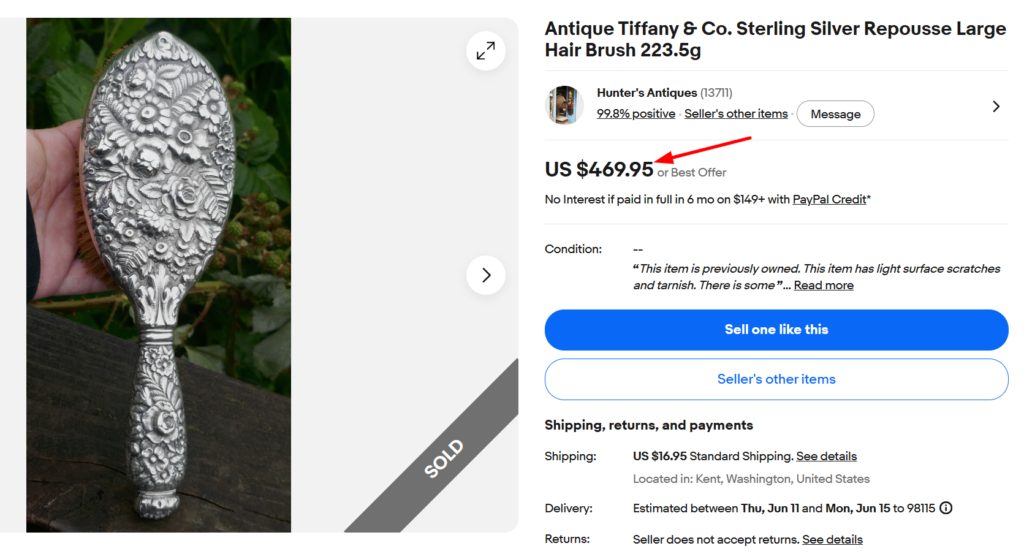
Sold for $470 (brush alone)
A Tiffany repousse brush has a unique feel from its weightier metal. The reverse of the brush features hand-chased roses, daisies, and leaves, all in three-dimensional relief so deep that they almost appear carved rather than pressed.
Although Tiffany’s pieces look and feel different, always check for the engraved “Tiffany & Co.” and “Sterling” markings to confirm you’re looking at an authentic piece.
- Estimated Value: $400–$700 (single brush)
- Production Years: ~1885–1915
- What to Check: Repousse work on the back, full Tiffany stamp, plus numbers
- Quick Notes: A matched mirror can lift the value sharply.
2. Foster & Bailey Lovers Sterling Hairbrush
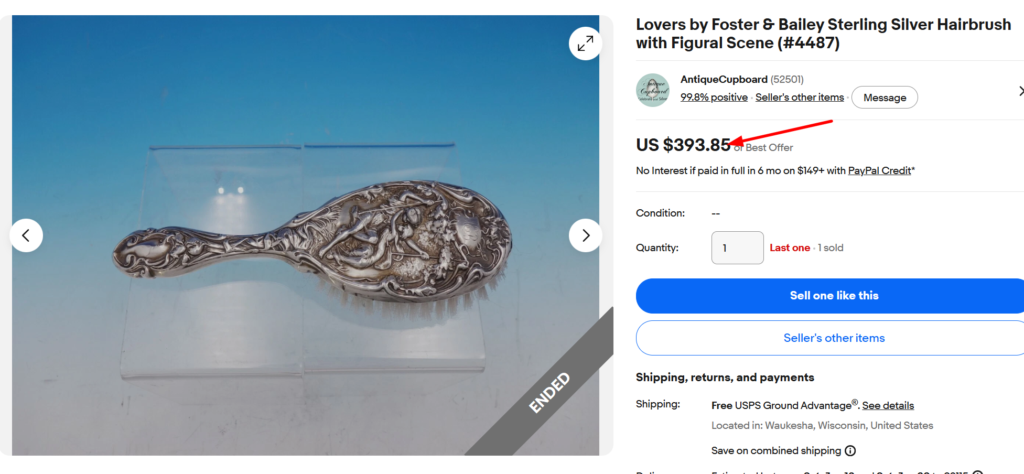
Sold for $393 (brush only)
“Lovers” is one of the most uncommon designs in antique silverware from America, which is why it sells for top dollar.
The backside of a “lovers” hairbrush depicts the romance between a courting couple set against a backdrop of a meandering garden, created using deep repoussé work in impressive detail.
Well-preserved brushes in this design can fetch $350 to $400 today. Authentic pieces may also show a “PAT’D” mark, along with the maker’s mark and hallmark.
- Estimated Value: $300–$450
- Production Years: ~1885–1898
- What to Check: Figural couple scene, Providence marks
- Quick Notes: Later Foster pieces are marked differently.
3. Unger Bros Sterling Art Nouveau Hairbrush
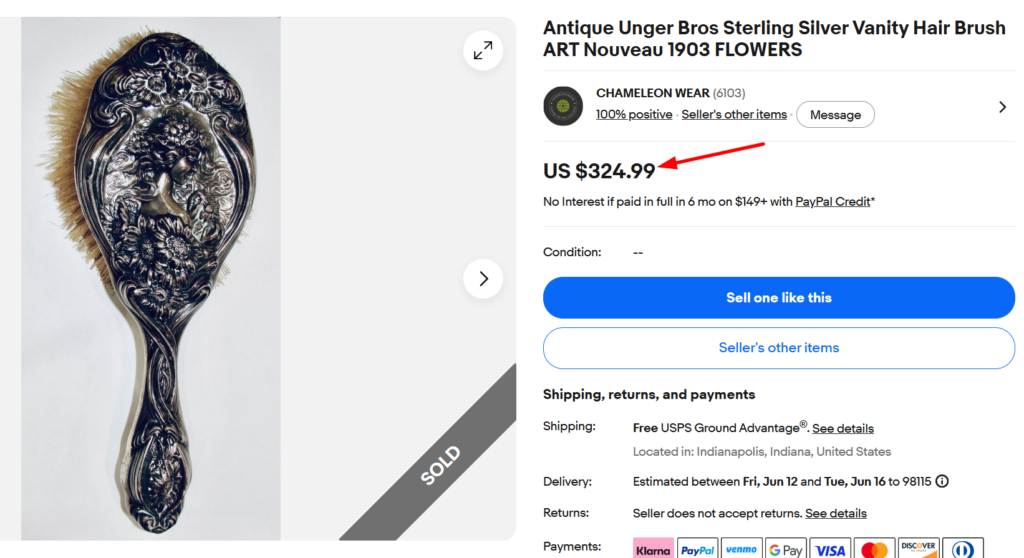
Sold for $325 (brush only)
This is probably the most dramatic design of Art Nouveau style, featuring figurative art. You’ll see the face of a young lady surrounded by sunflowers and daisies in detailed repousse work. Her long hair is used as a handle.
The pattern was patented in June 1903 and ceased being produced by Unger in 1910, making it short-lived and, hence, rare. Single hair brushes in this design can fetch up to $350 to $450 today.
Since the dies were resold, always check for the Sterling and patent marks to identify the original piece.
- Estimated Value: $250–$400
- Production Years: 1903–1910
- What to Check: “UB” cipher, 925 stamp
- Quick Notes: Dies were resold, watch for look-alikes.
4. Gorham “Buttercup” Sterling Silver Vanity Brush
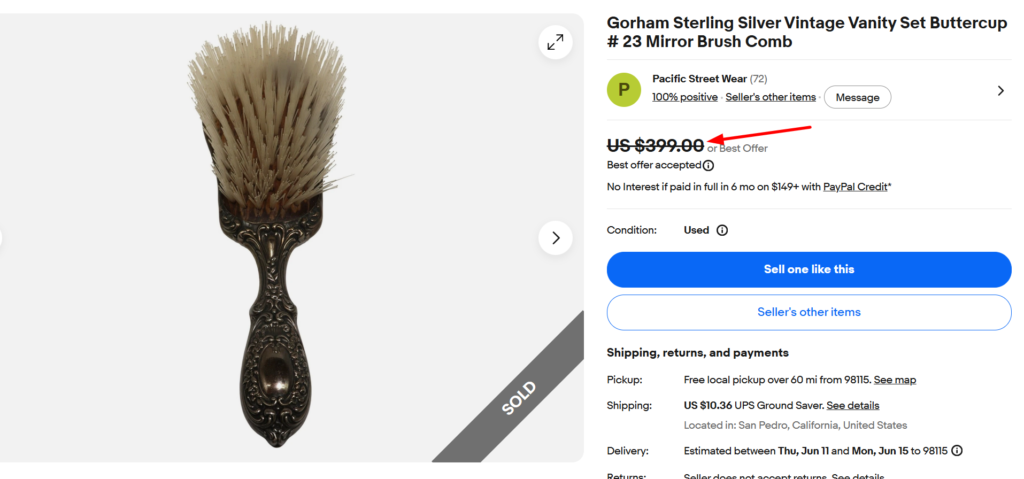
Sold for $400 (vanity set)
Buttercup was first made by Gorham in 1899 and remained in production for about fifty years. The design includes buttercups in repoussé flowing throughout the entire back of the piece, while a small cartouche is left blank for a monogram.
Older examples feature only the anchor-lion-G mark, while later ones spell “STERLING” out in full, which helps with dating.
- Estimated Value: $100–$200 (single brush); $200-$450 (vanity set)
- Production Years: 1899–~1950
- What to Check: repoussé buttercup motif, hallmark
- Quick Notes: Original bristles strongly affect price
5. Antique Alvin Sterling Silver Hairbrush Set
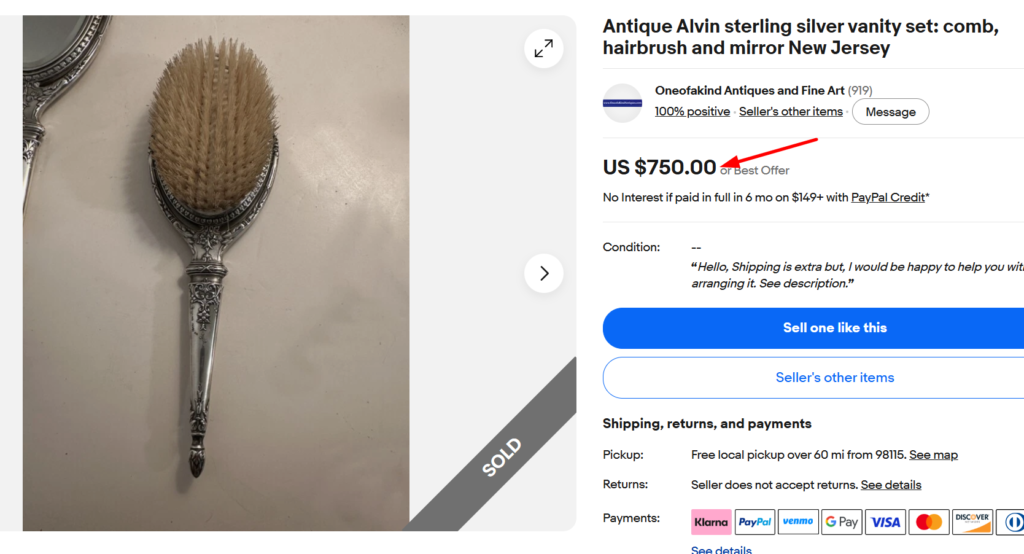
Sold for $750 (vanity set)
Alvin built a reputation for Art Nouveau designs strong enough that Gorham bought them out in 1928.
Full vanity sets, including a brush, mirror, and comb, are where Alvin really shines. The handles taper to a sculpted point, and the silver work blends floral repoussé with neat geometric borders. Complete matched sets in good condition can clear $700 to $800.
- Estimated Value: $500–$800 (complete three-piece set)
- Production Years: ~1890–1928
- What to Check: Alvin maker’s mark, matched pieces
- Quick Notes: Gorham-era Alvin pieces are still common
6. William Comyns London Sterling Brush
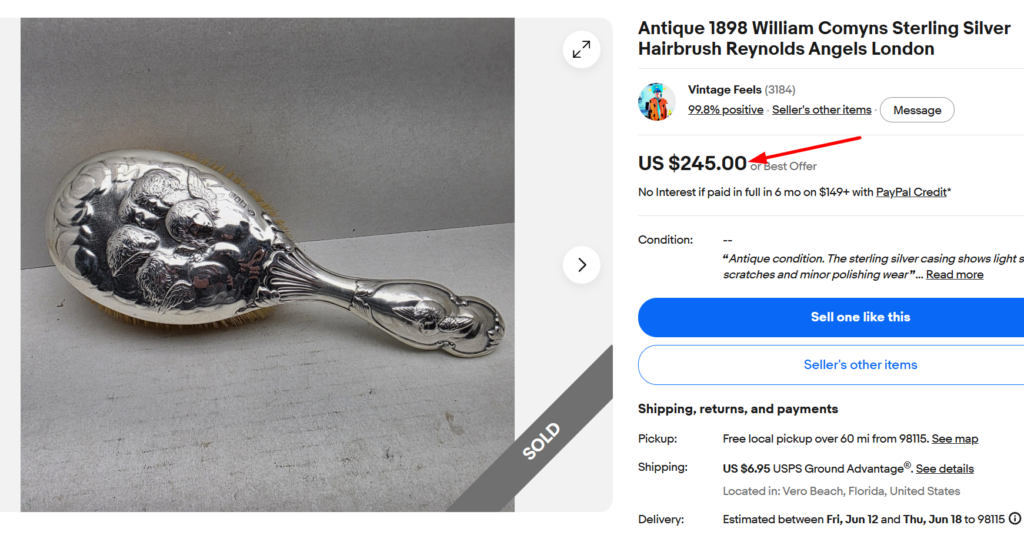
Sold for $245 (brush only)
This pattern from William Comyns takes its name from Sir Joshua Reynolds’ famous painting of cherubs, and the design lifts those exact figures straight onto the silver.
The back shows a tight cluster of winged angel faces with curly hair and chubby cheeks in deep repoussé. The detail on those little faces is what collectors look at first when judging condition.
The “W.C.” mark, along with British hallmarks, must be present for top value.
- Estimated Value: $200–$400
- Production Years: ~1885–1914
- What to Check: Cherub faces on the back, London hallmark
- Quick Notes: Polishing wears away facial detail and hurt value.
7. Whiting Art Nouveau Repousse Sterling Heraldic Brush
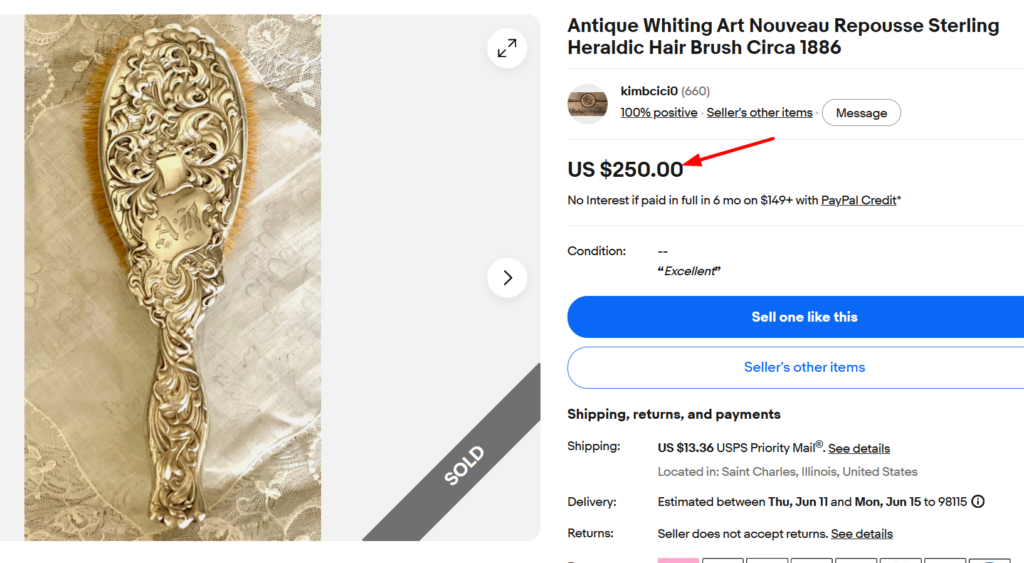
Sold for $250 (brush alone)
Whiting’s heraldic design is quite dramatic. You’ll see the heavy scrollwork in repoussé covering the entire surface in a pattern of curving C shapes and acanthus leaves surrounding a shield-shaped medallion, which often features a monogram in Gothic script.
The handle continues the scrollwork down to a pointed finial. The ornate design is one of the reasons behind its high collectibility and value; single brushes can fetch up to $300 in good condition.
The maker’s mark is a small winged griffin, usually found on the side of the handle.
- Estimated Value: $200–$350
- Production Years: ~1880–1905
- What to Check: Heraldic cartouche, winged griffin mark
- Quick Notes: Gorham bought Whiting in 1924.
8. Art Deco Guilloché Enamel Brush (Birmingham, 1930s)
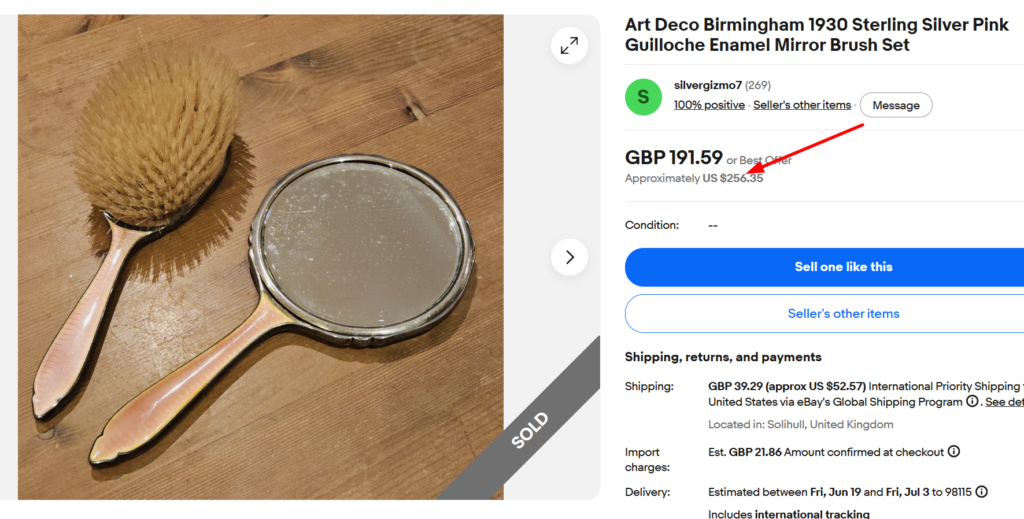
Sold for $255 (brush & mirror set)
Guilloché enamel is the key feature of the “Art Deco vanity set.” A machine-engraved silver back is fired under a translucent enamel layer. Blue, green, pink, yellow, and champagne are the common enamel colors you’ll find today.
Birmingham makers like Henry Clifford Davis, Beddoes & Co., and Adie Brothers produced these vanity pieces through the 1920s and 1930s.
Condition is crucial for enamel brushes; even minor chips or cracks kill the value.
- Estimated Value: $120–$400 (set)
- Production Years: ~1920–1939
- What to Check: enamel surface, Birmingham marks
- Quick Notes: Chips or hairline cracks in enamel can hurt the value.
9. Webster Company Sterling Art Deco Brush
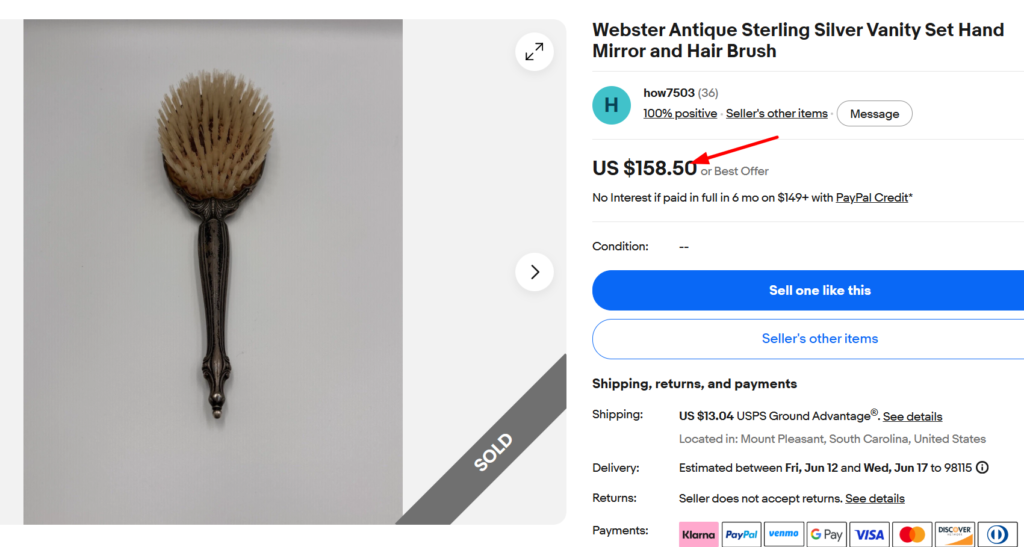
Sold for $158 (brush & mirror)
North Attleboro’s Webster was the preferred American manufacturer of thinner and lighter brushes associated with the Art Deco style from the 1920s to the 1930s. Their pieces lean clean and geometric rather than ornate.
You can identify these brushes by the engine-turned backs and monogrammed shields. Plus, these usually came in matched sets in a leather case.
- Estimated Value: $90–$220 (pair)
- Production Years: ~1915–1940
- What to Check: “WEBSTER STERLING,” engine-turned back.
- Quick Notes: Complete pairs are worth more than single brushes.
10. Mason Pearson Pneumatic Hairbrush
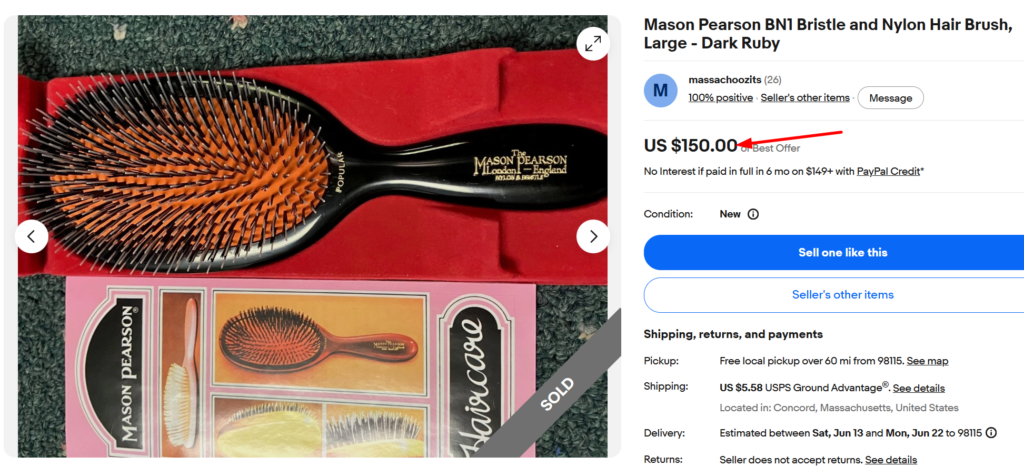
Sold for $150 (in box)
Mason Pearson patented the pneumatic rubber-cushion in 1885, and it’s still made by hand in London today. It’s known for its distinctive “pneumatic” rubber-cushion pad that inflates with air.
Dating older examples needs attention. Pre-1960s versions usually have a wooden handle rather than the polished acrylic resin of modern production. Also, the stamp on the handle evolved over time, too, which works as a dating clue, once you are familiar with the mark changes.
- Estimated Value: $50–$180
- Production Years: 1885–present (vintage examples pre-1960s)
- What to Check: Wooden handle, older stamp variant
- Quick Notes: The rubber cushion hardens with age.
11. French Ivory Celluloid Vanity Brush
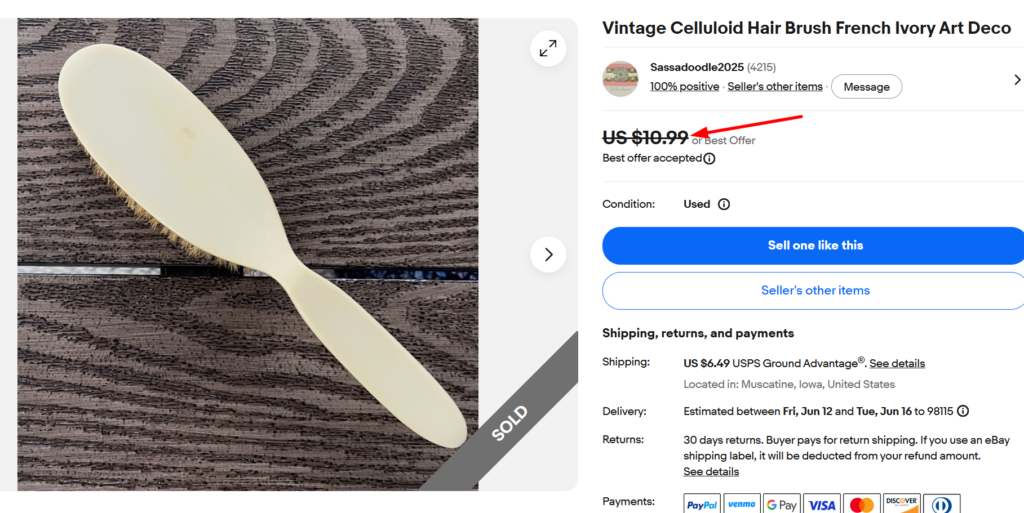
Sold for $11 (brush only)
French ivory isn’t ivory at all. It’s celluloid, colored and carved to mimic the real thing, and it was huge in the 1910s and 1920s. Sears and Montgomery Ward advertised them in their catalogs, hence the reason you see so many in attics nowadays.
The grain will help you distinguish this from real ivory. French ivory shows fine parallel lines. Real ivory shows criss-cross Schreger lines instead.
- Estimated Value: $40–$200 (set)
- Production Years: ~1900–1930
- What to Check: parallel grain, no Schreger lines
- Quick Notes: Celluloid is flammable; keep it away from heat.
So, before you discard that old, heavy hairbrush kept in your vanity’s drawer, make sure to check what it’s really made of, who made it, and when, and whether it has a matching set. These quick checks can save you from giving away a real treasure.