

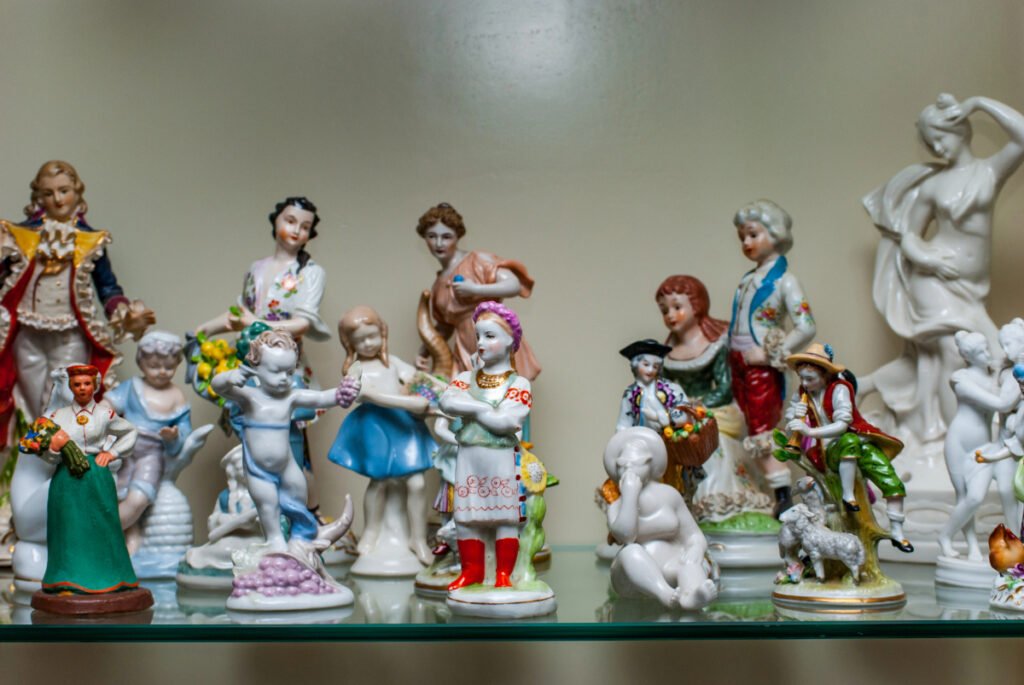
Porcelain figurines are one of the most popular vintage items among collectors. But many have no idea what they’re really worth. Some porcelain figurines are worth $20, others sell for $20,000, and the rarest early pieces can sell for far more.
In 2013, for example, an 18th-century Meissen figure of a monkey taking snuff sold at Sotheby’s in London for £818,500 (about $1.2 million).
The difference comes down to the kind of piece in question. Genuine vintage porcelain figurines from notable makers like Meissen or Royal Doulton holds value, but reproductions do not. Learning to tell them apart is the key.
This guide walks you through the identification clues, quality indicators, and value factors that separate common decorative pieces from serious collectible porcelain figurines.
How to Identify Antique and Vintage Porcelain Figurines
Porcelain figurines have been produced across Europe and Asia for centuries, but only the pieces from established manufacturers with documented histories are collectible today.
The challenge is that many of these makers have been copied extensively, and some reproductions are so good they fool casual collectors. Proper identification of real porcelain figurines starts with understanding what genuine pieces look like and what signs to look for.
Backstamp or Maker’s Mark
Backstamps are the most reliable clues to identify porcelain figurines. Flip the piece over and check the base for marks, stamps, or signatures. Most reputable makers stamped their pieces, and these marks changed over time in documented ways.
Here are some popular makers and their marks’ history:
Meissen Crossed Swords Mark
Meissen began using the crossed swords mark around 1722. The mark should be hand-painted in underglaze blue and show slight variations and brush strokes, as each was painted by hand. The swords changed over time:
- About 1763-1774 (Dot period): A dot is often painted between the hilts of the swords
- Post-1774: More refined and consistent execution, but still hand-painted
- Modern pieces: Often have year marks added (small symbols since 1948, letters since 1980)
Royal Doulton Backstamps and HN Numbers
Royal Doulton changed its backstamps multiple times, which helps with dating. It also used HN numbers starting in 1913 to catalog each figurine model. You’ll find this number on the base along with the backstamp. Our guide to identifying Royal Doulton figurines explains how to read both.
- Pre-1902: “Doulton Burslem” (with “England” added from 1891)
- 1902-1922: “Royal Doulton England” with crown and lion symbol
- From about 1930: “Made in England” added below the crown
- Late 1920s onward: “Bone China” often appears in the backstamp
Lladró Marks
Lladro didn’t use an official mark until 1960. The earliest mark was impressed into the base and showed “Lladro” with the first L underlining the word, plus “España” and “Made in Spain” below.
From 1971 onward, Lladro switched to a blue stamp featuring the bellflower symbol (often mistaken for a tulip). The specific style of this flower helps date pieces.
After 1986, they also embossed a 4-digit model number on the base. Learn more about the marks and rare models in our guide to valuable Lladro figurines.
Capodimonte Marks
Spotting Capodimonte is trickier because it’s not a single factory but a style of Italian porcelain produced by many companies.
The earliest Royal Factory pieces (1743-1759, according to the Victoria and Albert Museum) used a fleur-de-lis mark, either impressed in a circle or painted in underglaze blue.
The later royal factory in Naples (1771-1806) used a crowned N. But the problem is that this mark was never trademarked, so many Italian factories used variations of it.
For true early Capodimonte, look for these characteristics:
- Disproportionately small heads relative to body size
- Rocky or irregular bases
- White or ivory porcelain with shiny glaze (early pieces)
- Brilliantly colored examples are typically later production
Examine Material Quality and Craftsmanship
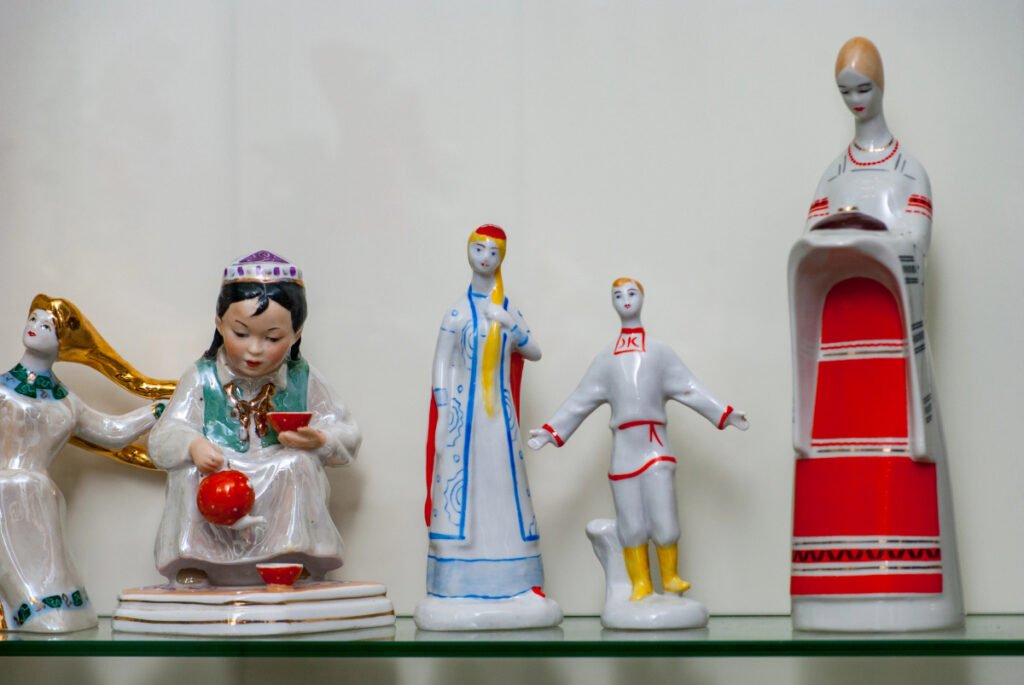
Hold the piece and pay attention to the weight. Genuine porcelain from quality makers feels substantial and noticeably heavier than most modern reproductions. The porcelain body itself should be fine-grained and smooth.
What makes it porcelain rather than ordinary ceramic? Porcelain is fired at a much higher temperature, so it is harder and whiter, and thin parts glow slightly when you hold them up to a light. Earthenware and chalkware figures are softer, thicker, and fully opaque.
You can also do the following quick checks:
- Surface test – Run your finger over the glaze. Originals often show very subtle unevenness or tiny bumps from hand-finishing. Perfectly uniform, glassy-smooth surfaces often signal newer production.
- Assembly check – Figures assembled from multiple parts should show clean joins with minimal visible seam lines. Sloppy assembly with thick glue lines or obvious gaps suggests lower-quality work.
Check Hand-Painting Details
High-end porcelain figurines feature hand-painted details, and you can spot the difference between handwork and transfer prints. Observe the following features:
- Facial features – Hand-painted eyes, lips, and eyebrows show slight variations in line thickness and small imperfections. Transfer-printed faces look identical from piece to piece with perfectly uniform features. Check multiple angles under good light.
- Clothing and decorative elements – Hand-painted designs show brush strokes under magnification. Colors may show slight bleeding or layering where the artist built up depth. Decals sit perfectly flat with no texture variation.
- Gold Decoration – Gold accents on quality pieces are real gilding applied by hand, which wears naturally over time at high points. Modern gold paint looks too bright and wears differently.
Identify Limited Editions and Artist Signatures
Limited edition pieces and those signed by notable artists are worth the most, so check the base for edition numbers, which look like “23/250,” meaning piece 23 of 250 made.
Legitimate limited editions come with matching documentation, certificates of authenticity, and often the original box showing the same number.
Artist signatures also add great value, especially on 20th-century limited editions. Early Meissen pieces by modelers Johann Gottlieb Kirchner and Johann Joachim Kändler are among the most valuable porcelain figurines ever made (the Frick Collection in New York holds Kirchner’s 1732 Great Bustard). But Meissen pieces are not usually signed by the modeler; experts attribute them by model and style.
Also, look for sculptor marks, painter numbers, and model numbers. Many quality makers used complex marking systems to track which artist worked on which piece. Meissen used painter numbers, model numbers, and date codes, while Royal Doulton artists often signed with their initials.
Assess Age Indicators and Wear
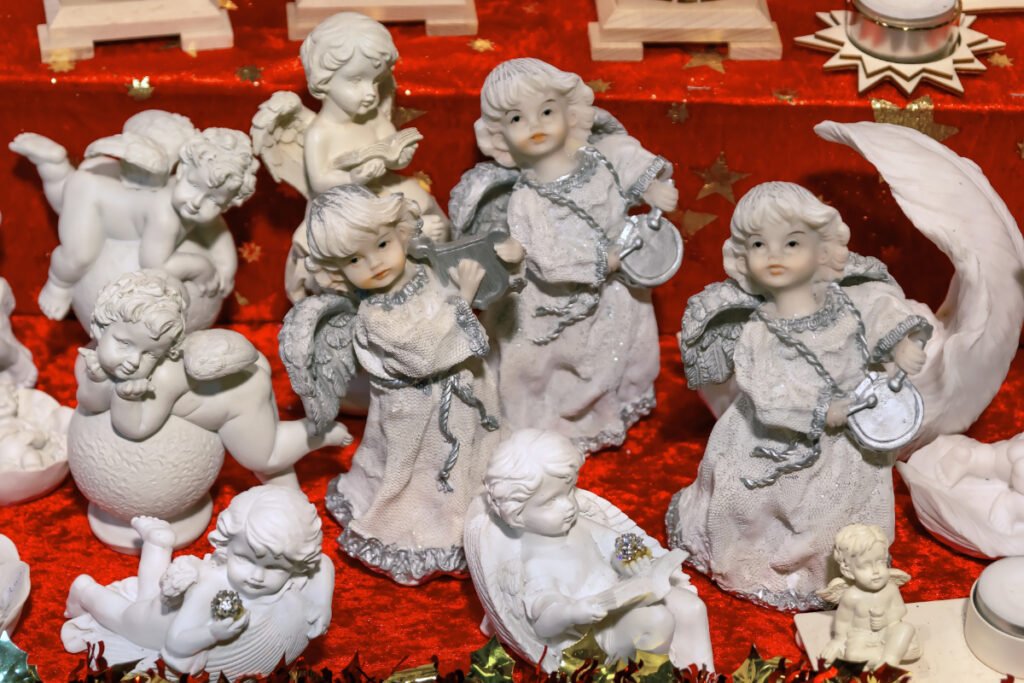
Antique and vintage porcelain figurines show age in predictable ways, such as:
- Base wear – Vintage pieces show fine scratches, slight dulling of the glaze, or tiny chips on the foot rim from decades of being moved around. A pristine base on a supposedly old figurine is a red flag.
- Crazing – Fine cracks in the glaze surface caused by age and temperature changes over time. Some crazing is normal on older pieces and doesn’t hurt value much unless it’s severe. Modern pieces rarely show crazing.
- Natural wear on decoration – Gold on edges, hands, or high points should show slight rubbing where the piece would be handled or cleaned. Paint should show very subtle fading in sun-exposed areas if displayed. Too-perfect gilt and paint suggest recent production.
Verify Authenticity Through Documentation
Lastly, original paperwork adds the most credibility and value. This includes certificates of authenticity, original purchase receipts, appraisals, and provenance documentation showing the piece’s ownership history.
Original boxes are especially valuable for collectible lines like Lladro and Hummel. The box should match the figurine’s model number and show appropriate wear for the piece’s age. A pristine box with a supposedly old figurine raises questions.
For better context, you can compare your piece to documented examples. Check sold listings on auction sites, reference books for your specific maker, and museum collections online. Look for exact pattern matches, correct proportions, and appropriate marks for the production period.
If your piece doesn’t match documented examples in key details, get a professional opinion before assuming it’s authentic.
What Determines the Value of Porcelain Figurines?
Once you’ve identified whether what you have is real, its value depends on several factors working together. A correctly identified piece might sell for $50 or $5,000, depending on these elements.
Brand and Manufacturer Reputation
Porcelain figurines from certain makers command premium prices because of their established reputation for quality and craftsmanship.
Meissen, for example, was the first European maker of hard-paste porcelain and maintains its position at the top of the market. Even common Meissen pieces can regularly fetch hundreds of dollars, while rare examples have gone over $200,000.
Royal Doulton, Lladro, Capodimonte, Royal Nymphenburg, and Sèvres all carry strong name recognition that drives value. Lesser-known makers can still be collectible, but their pieces typically fetch lower prices unless they are exceptionally rare or well-executed.
The same goes for the 1950s and 60s Japanese-made gift-shop figurines; most mid-century Lefton figurines sell for under $50.
Age and Historical Significance
While age alone doesn’t guarantee value, pieces from important production periods tend to sell for more. For Meissen, anything pre-1800 is especially collectible. Royal Doulton pieces from the early HN series (1913 through the 1930s) command higher prices than mid-century production.
Historical context matters, too. Capodimonte pieces from the original Royal Factory period (1743-1759) are far more valuable than later pieces using the Capodimonte style.
Wartime or commemorative figurines tied to specific historical events often attract more collector interest than standard production runs.
Condition and Restoration Status
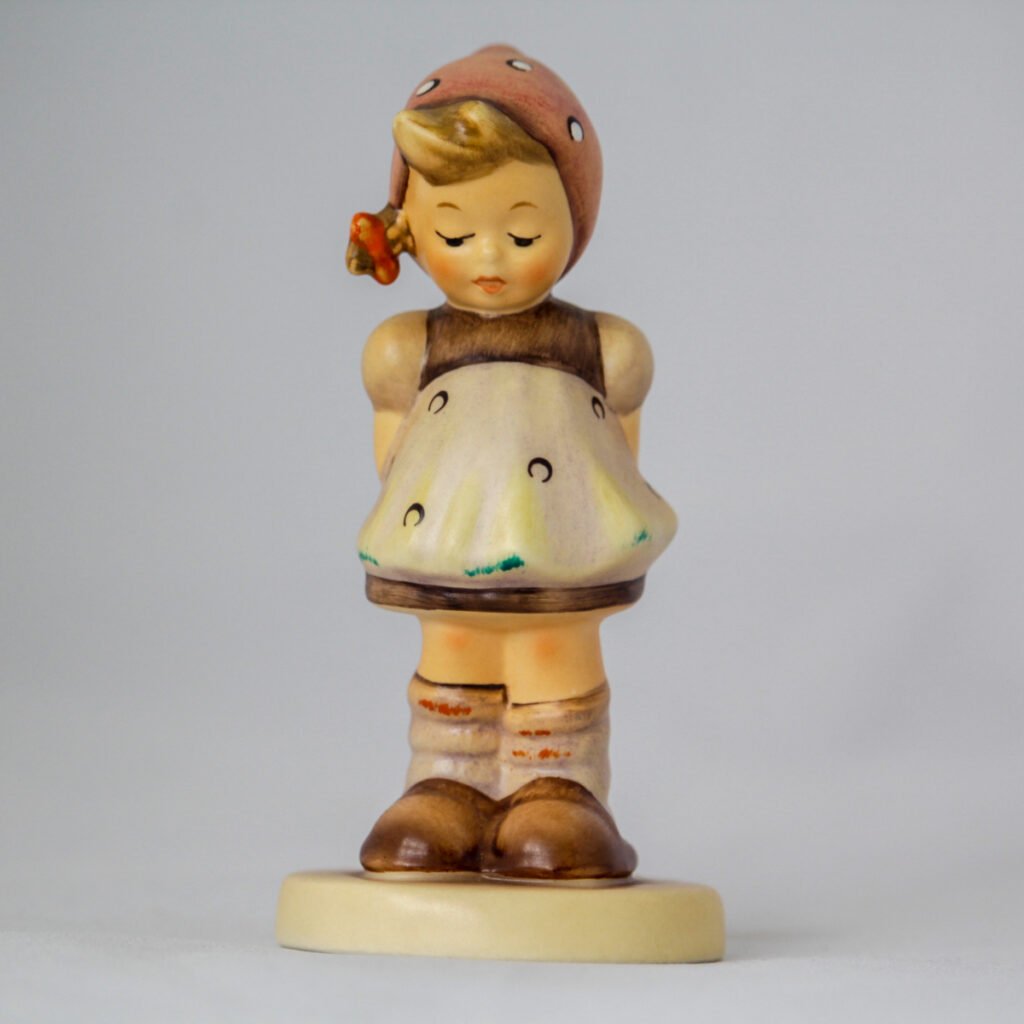
The condition is critical. Collectors pay top dollar for pristine figurines with no damage. Chips, cracks, and breaks are the main value killers. Hairline cracks are less obvious but still reduce value. Use bright light and examine every angle, especially in fragile areas such as extended arms, lace details, and flower petals.
Crazing and discoloration are common on older pieces and are generally accepted by collectors, though excessive crazing can affect value. UV exposure and staining also reduce the overall worth.
As for restoration, professional work can stabilize the damage but typically reduces value. Collectors prefer original condition, even with minor flaws, over restored pieces.
The exception is extremely rare pieces: collectors still pay high prices for them even when they are chipped, cracked, or restored, because better examples hardly ever come up.
Rarity and Limited Production Runs
Rarity drives prices up. Figurines produced in small quantities or for short periods are more valuable than mass-produced pieces.
Limited edition releases with numbered production runs create artificial scarcity. A piece marked “125/500” has a defined rarity that collectors factor into value. Retired models that are no longer in production also gain value over time as supply becomes fixed while demand continues.
One-of-a-kind pieces, prototypes, and artist’s proofs command premium prices. Plus, early production samples or pieces made for exhibitions rather than commercial sale are especially desirable.
Provenance and Original Packaging
Documented ownership history adds value, especially if the piece comes from a notable collection or has been exhibited. Auction records, including previous sales, establish market history and validate authenticity.
Original boxes that match the figurine’s model number and show appropriate age-related wear add value. Keep all documentation together, receipts, appraisals, and original literature, which help verify authenticity and justify higher prices.
9 Collectible Porcelain Figurines by Maker (With Sold Prices)
1. Meissen Monkey Band Tambourine Player
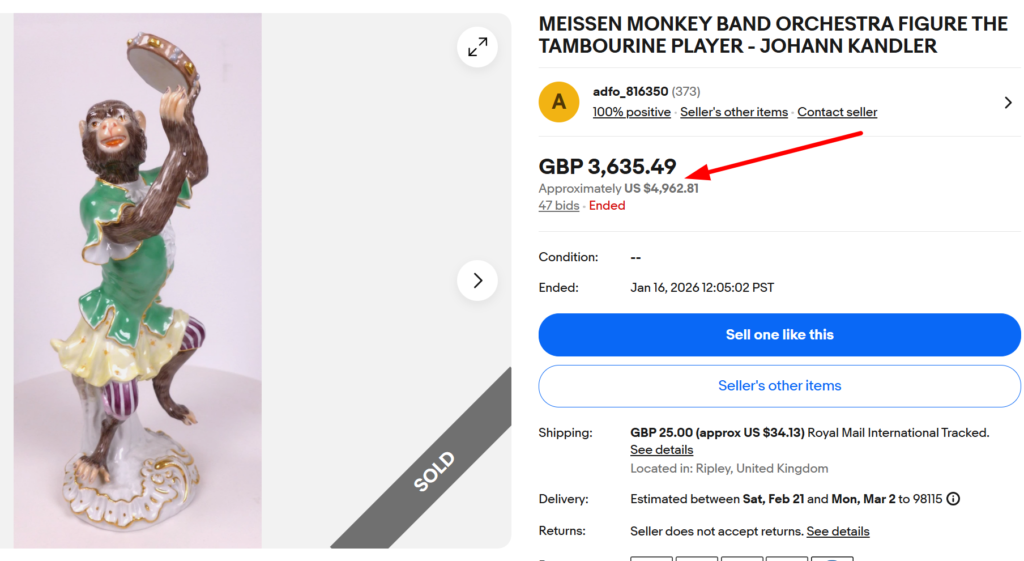
Kändler’s Meissen pieces are among the masterpieces of porcelain sculpture. This one, the tambourine player, is an individual figure from Meissen’s Monkey Orchestra by Kändler. Each monkey musician shows exceptional modeling with expressive faces, period costumes, and instruments.
Original 18th-century examples are rare, but late 1800s/early 1900s re-strikes from original molds command serious money. Even single figurines sell for thousands, like this one at about $4,960; complete sets can bring far more.
2. Royal Doulton Soldiers of the Revolution Figurine
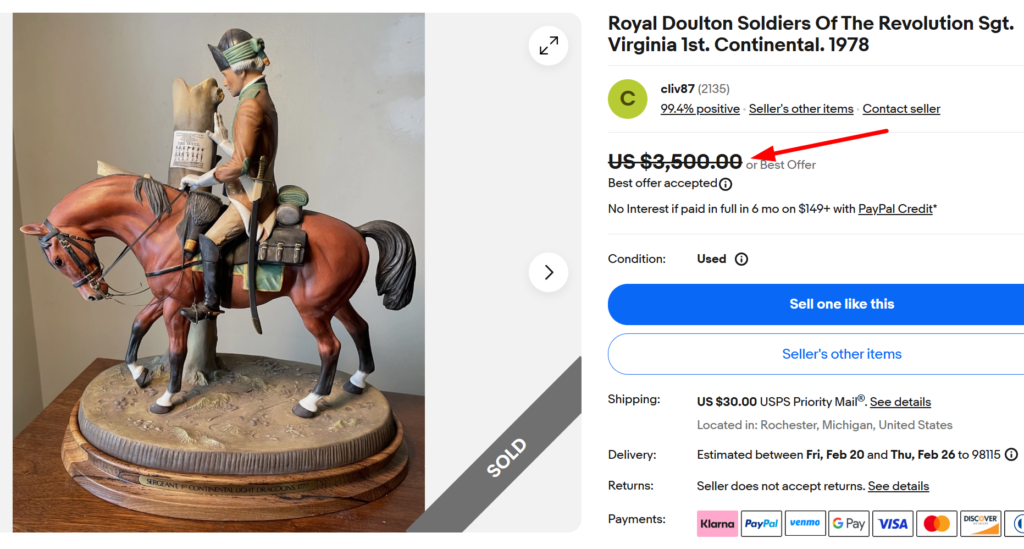
Royal Doulton’s historical military series features soldiers in accurate period uniforms. This 1978 piece shows a Continental Army sergeant on horseback from the American Revolution. These pieces are known for precise historical costuming and fine hand-painting, making them worth thousands in pristine condition.
3. Lladró Farewell of the Warrior (Limited Edition)
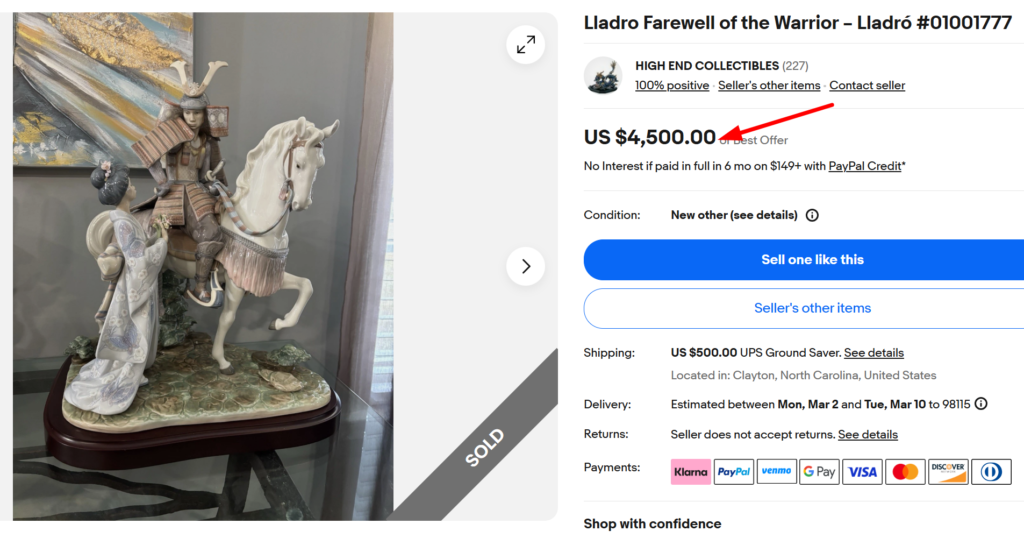
Lladró is known for porcelain with soft, pale colors, made in both glossy and matte finishes. This “Farewell of the Warrior,” showing a samurai on horseback with elaborate armor detail and a woman in a kimono beside the horse, is part of a limited edition. Large, complex pieces like this were difficult to make, which adds to their value.
4. Herend Fishnet Goldfinch on Sunflower
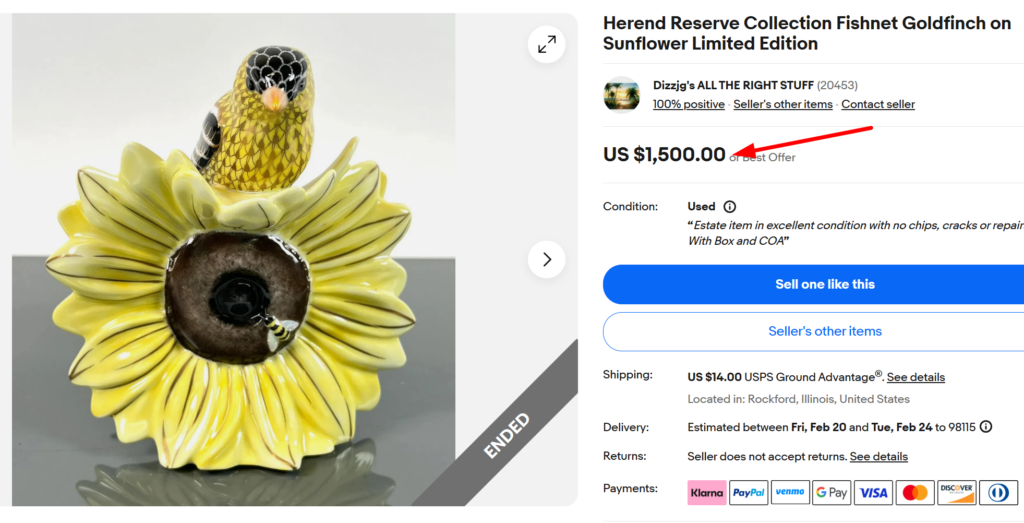
This goldfinch on a sunflower from the Reserve Collection indicates limited production from Hungarian Herend. Their fishnet pattern with 24k gold detailing is a signature technique where artisans paint tiny scales, creating texture. Herend animal figures are desirable, especially with the original box and certificates.
5. Laurenz Capodimonte Sleeping Beauty Scene
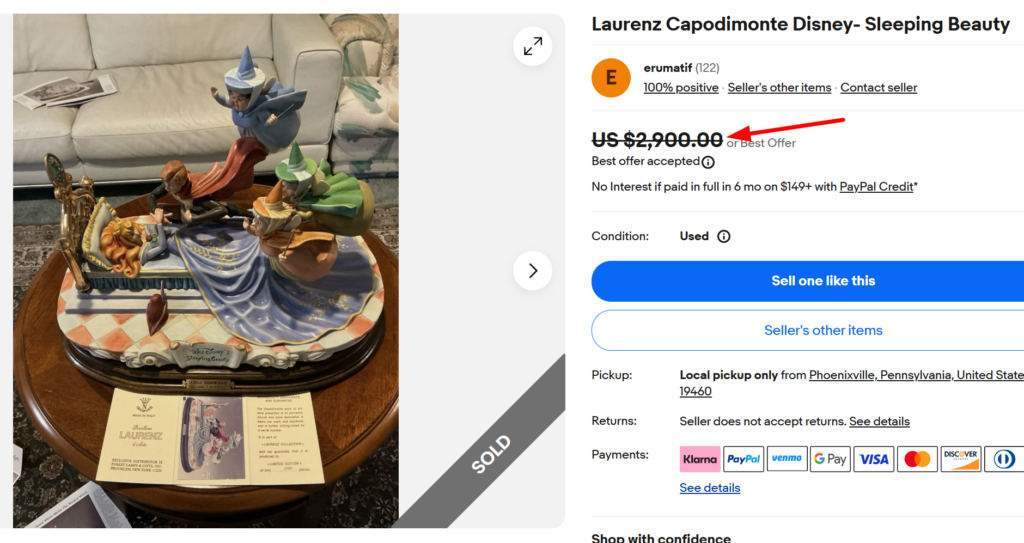
Laurenz produced elaborate Capodimonte-style pieces in Italy. This multi-figure scene shows Princess Aurora in bed with fairies and characters from Disney’s Sleeping Beauty.
This is a modern, Disney-licensed piece, so its value comes from its size, detail, and certificate rather than age. Also, large narrative scenes with multiple figures and intricate details command higher prices than simple pieces.
6. Hummel Little Fiddler (Large 1950s Size)
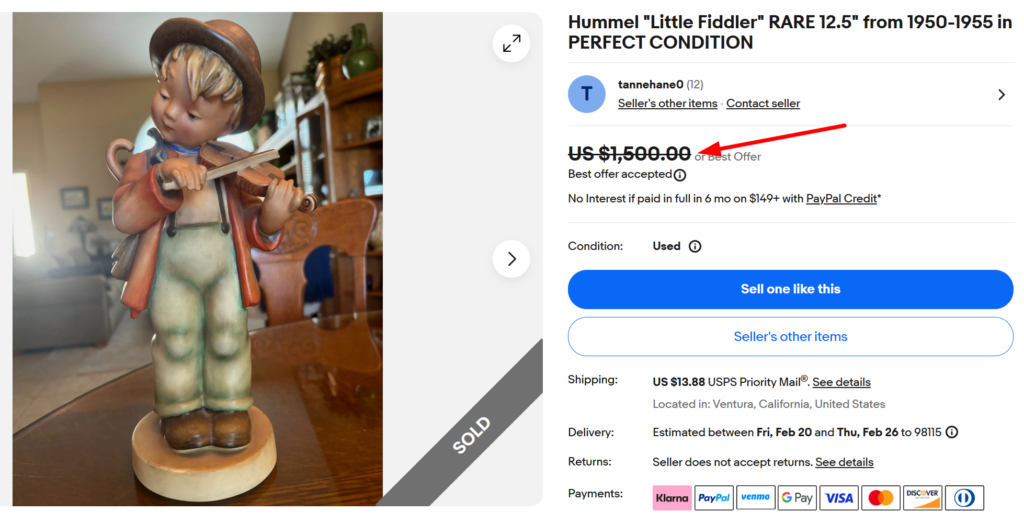
Hummel figurines based on Sister Maria Innocentia Hummel’s drawings became mid-century favorites. This 12.5-inch “Little Fiddler,” showing a boy with a violin, is one of the most recognized designs. Most Hummels sell for $10-$50, but larger sizes from the early years in perfect condition can fetch $1,000 or more.
7. Royal Worcester Queen Elizabeth I on Horseback
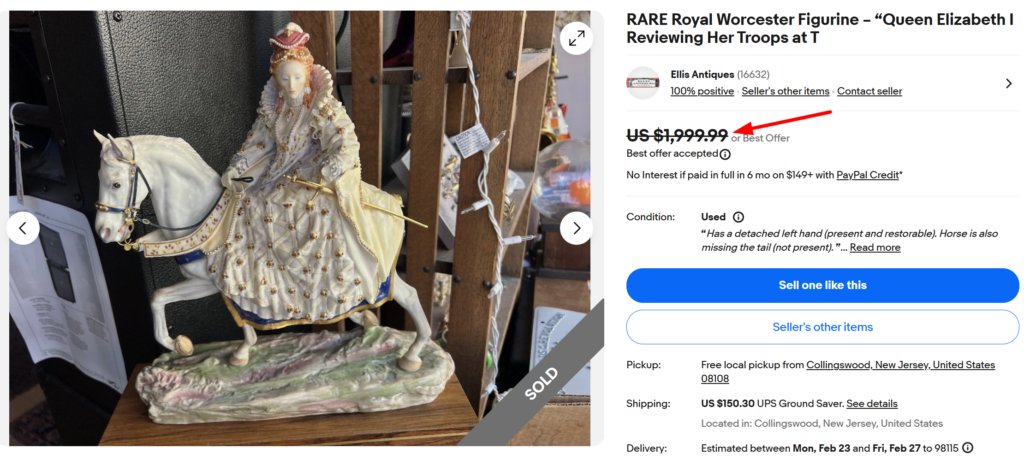
Royal Worcester produced limited-edition historical figures. This one shows Queen Elizabeth I on horseback, made of English fine bone china with detailed hand-painting, often numbered.
Limited editions with certificates hold value better than unlimited runs; check the base and certificate for its edition number.
The horse-and-rider complexity, plus the historical subject, adds to its value. But condition issues like detached parts can significantly reduce the value: this one had a detached hand, and its horse was missing its tail.
8. Dresden Porcelain Lace Figurines
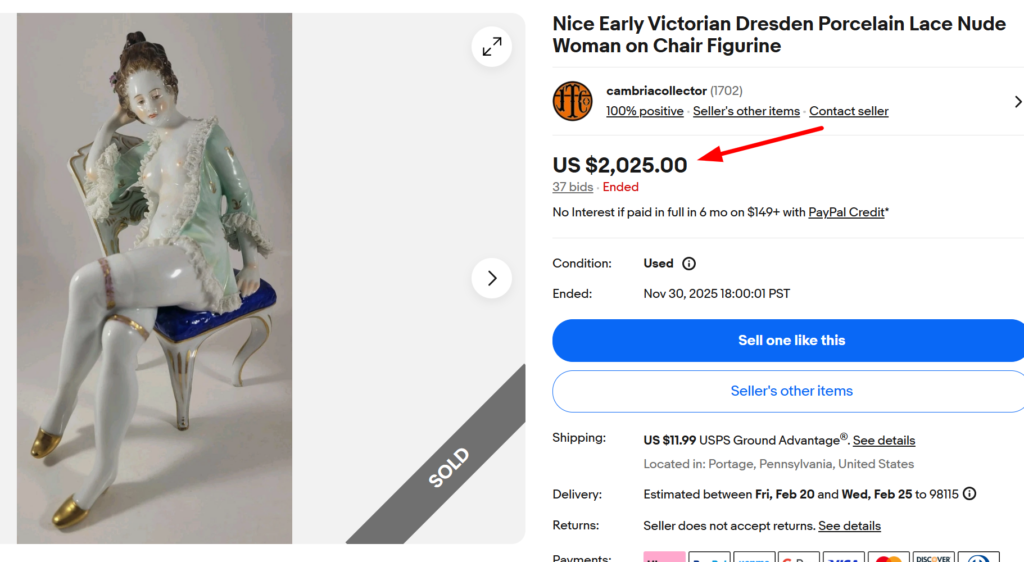
This lady seated on a blue-cushioned chair in a lace-trimmed robe is an example of a Victorian Dresden lace figurine. These are made using the slip-dipped lace technique, where real fabric soaked in porcelain slip is attached and fired. The fabric burns away, leaving fragile porcelain lace.
German studios produced these from the late 1800s through the early 1900s. Finding intact lace on pieces this old is rare.
9. Sèvres Cherub Figurines
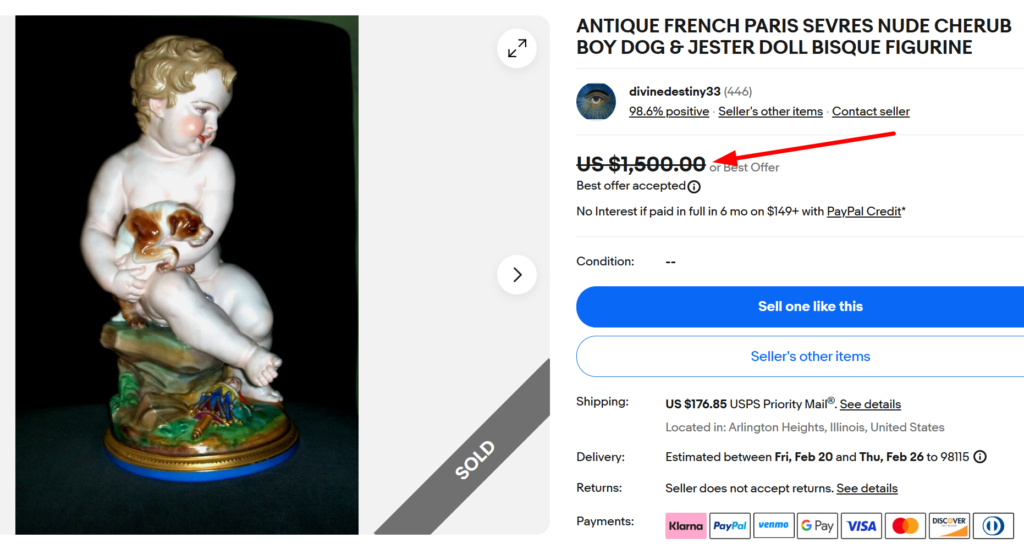
French Sèvres produced exceptional bisque (unglazed) porcelain from the 18th century onward. This nude cherub holding a small dog sits on a rocky mound above a round gilded base.
Sèvres bisque was designed to resemble white marble and became prized as an aristocratic table decoration. Pieces with original ormolu mounts are also rare.
Note that this example is painted rather than plain white, and its listing calls it “Paris Sevres”: many pieces sold under that name are Sèvres-style work from other Paris workshops, so check the mark before paying a Sèvres price.
Finding real and valuable porcelain figurines takes careful observation. Whether you are collecting or selling, focus on pieces from established makers with documented marks, and favor early production periods over recent releases. Condition matters more than almost anything else.
And the best place to sell porcelain figurines? Named mid-range pieces like the ones above sell well on eBay, while signed, 18th-century or museum-quality pieces are worth showing to an auction house that holds regular porcelain sales.
Found this guide useful?
Save it for later
Share it with someone
Keep the old finds coming
New guides and finds worth looking for, delivered to your inbox.
Keep exploring
More guides in China & Pottery
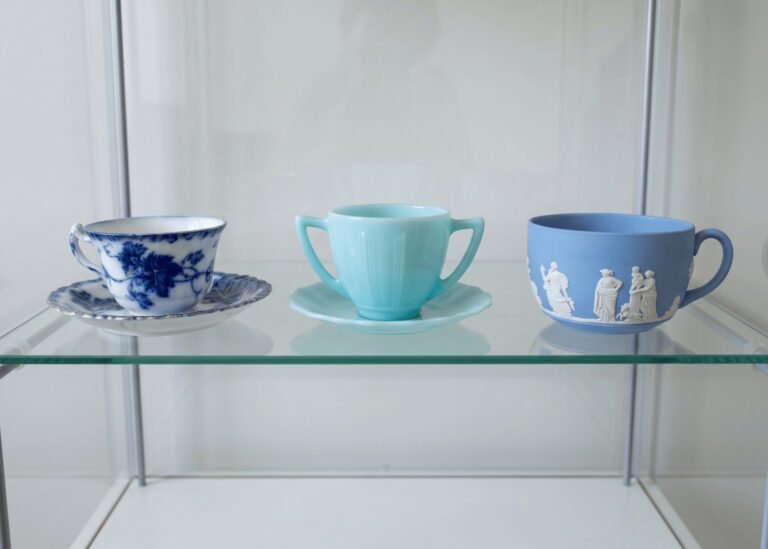 9 finds9 Types of Vintage Tea Cups That Are Highly Collectible TodayTop sale $289
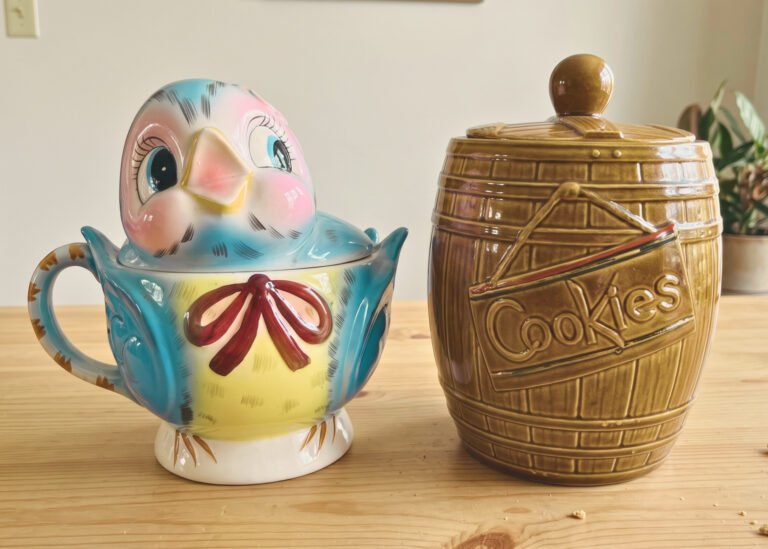 12 finds12 Rare 1950s Cookie Jars That Are Worth Collecting TodayTop sale $377
 11 finds11 Valuable Christmas Plates Collectors Are Looking For & What They’re WorthTop sale $1,300
 10 findsMost Collectible Christmas Cookie Jars & What They Are Worth NowTop sale $895